Saving Energy How can we live better by spending and wasting as low as possible?
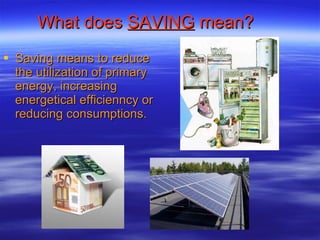
What does  SAVING  mean? Saving means to reduce the utilization of primary energy, increasing energetical efficienncy or reducing consumptions.
Five reasons to save energy: Paying cheaper bills; Participating in the national effort to reduce the consumptions of fossils fuels; Permitting to countries to became more and more independent; Improving the quality of life and of enviroment. Contributing to reduce the emissions of polluting gas.
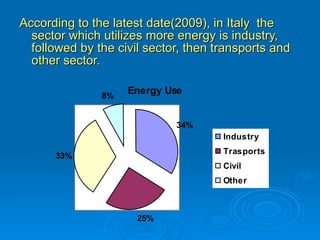
According to the latest date(2009), in Italy  the sector which utilizes more energy is industry, followed by the civil sector, then transports and other sector.
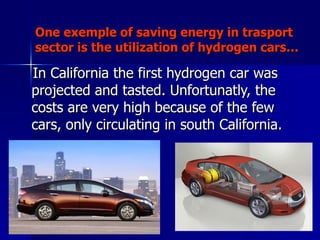
One exemple of saving energy in trasport sector is the utilization of hydrogen cars… In California the first hydrogen car was projected and tasted. Unfortunatly, the costs are very high because of the few cars, only circulating in south California.
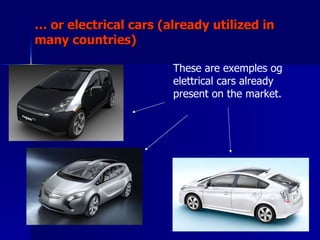
…  or electrical cars (already utilized in many countries) These are exemples og elettrical cars already present on the market.
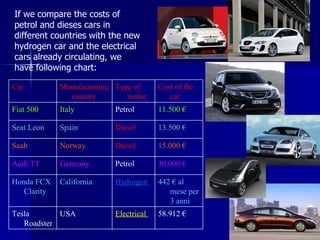
If we compare the costs of petrol and dieses cars in different countries with the new hydrogen car and the electrical cars already circulating, we have following chart: 58.912 € Electrical  USA Tesla Roadster 442 € al mese per 3 anni Hydrogen  California Honda FCX Clarity 30.000 € Petrol  Germany Audi TT 15.000 € Diesel Norway Saab 13.500 € Diesel Spain Seat Leon 11.500 €  Petrol  Italy Fiat 500 Cost of the car Type of motor Manufactoning country Car
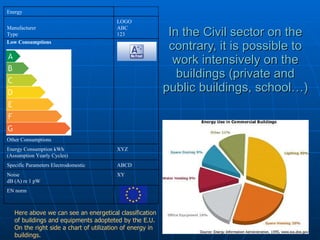
In the Civil sector on the contrary, it is possible to work intensively on the buildings (private and public buildings, school…) Here above we can see an energetical classification of buildings and equipments adopteted by the E.U. On the right side a chart of utilization of energy in buildings. Low Consumptions EN norm XY Noise dB (A) re 1 pW ABCD Specific Parameters Electrodomestic XYZ Energy Consumption kWh (Assumption Yearly Cycles) Other Consumptions LOGO ABC 123 Manufacturer  Type   Energy
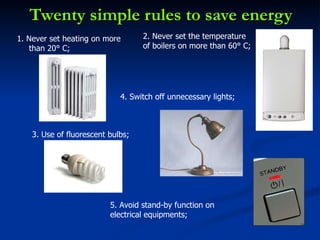
Twenty simple rules to save energy 1. Never set heating on more than 20° C; 2. Never set the temperature of boilers on more than 60° C; 3. Use of fluorescent bulbs;  4. Switch off unnecessary lights; 5. Avoid stand-by function on electrical equipments;
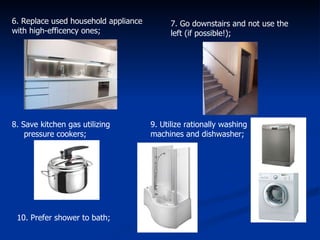
6. Replace used household appliance with high-efficency ones;  7. Go downstairs and not use the left (if possible!); 8. Save kitchen gas utilizing pressure cookers; 9. Utilize rationally washing machines and dishwasher;  10. Prefer shower to bath;
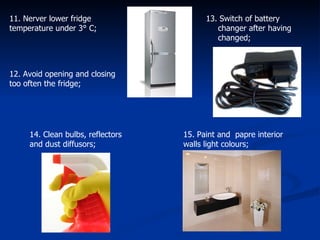
11. Nerver lower fridge temperature under 3° C;  12. Avoid opening and closing too often the fridge; 13. Switch of battery changer after having changed; 14. Clean bulbs, reflectors and dust diffusors; 15. Paint and  papre interior walls light colours;
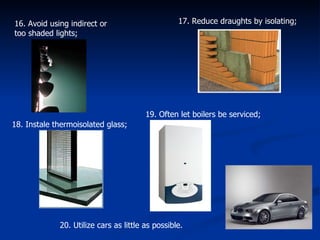
16. Avoid using indirect or too shaded lights; 17. Reduce draughts by isolating;  18. Instale thermoisolated glass;  19. Often let boilers be serviced; 20. Utilize cars as little as possible.
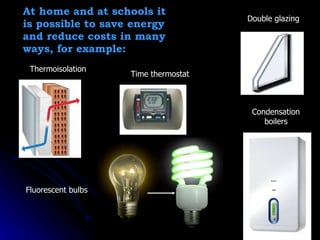
At home and at schools it is possible to save energy and reduce costs in many ways, for example: Double glazing Thermoisolation  Time thermostat  Condensation boilers Fluorescent bulbs
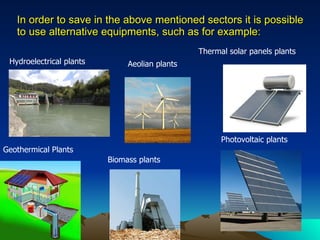
In order to save in the above mentioned sectors it is possible to use alternative equipments, such as for example: Photovoltaic plants  Thermal solar panels plants  Aeolian plants  Hydroelectrical plants  Geothermical Plants  Biomass plants
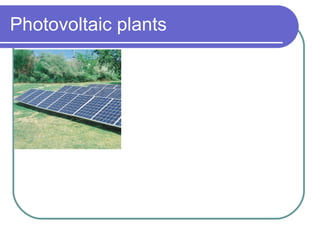
Photovoltaic plants  - They permit to transform solar power in electrical power without using fuel; - It is possible to produce electrical energy in the same place where it is consumed ; - The plants can be widened ; - Low cost servicing . - Low environmental impact ;
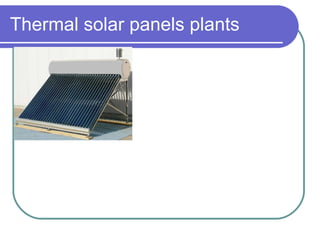
Thermal solar panels plants  - Producing hot water reducing use of fuels ; - Minimal managing and servicing costs ; - Most common application : solar manifold .
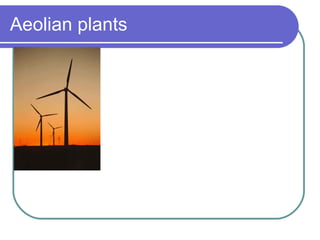
Aeolian plants  - Wind is an inexhaustible energy source ; - Wind does not produce waste ; - Wind does not pollute ; - Electrical energy is generated by transforming mechanical energy produced by the blades of the aerogenarators .
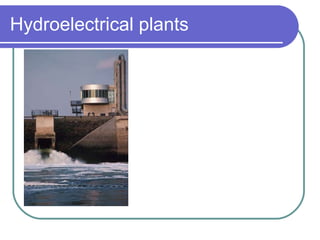
Hydroelectrical plants - The energy of water is relatively large and clean. It is produced by transforming hydraulic energy in mechanical energy by turbines which themselves move the alternators for the production of electrical energy.
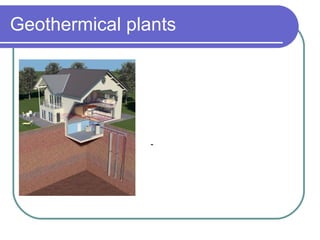
Geothermical plants - It is an inexhaustible energy source; - It’s does not pollute; - Plants do not ask for large surface of land; They are based on utilization of the subsoil which we extract the heat; - Not utilization of boiler and refrigerator ;
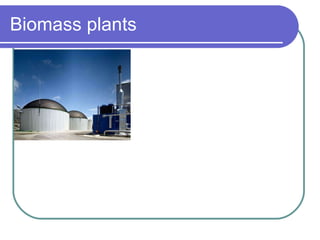
Biomass plants - Biomass are renewable energy; - They can find use as combustible; - They can be used in the production of electricity,heat and tractions.

Presentazione dany

  • 1.
    Saving Energy Howcan we live better by spending and wasting as low as possible?
  • 2.
    What does SAVING mean? Saving means to reduce the utilization of primary energy, increasing energetical efficienncy or reducing consumptions.
  • 3.
    Five reasons tosave energy: Paying cheaper bills; Participating in the national effort to reduce the consumptions of fossils fuels; Permitting to countries to became more and more independent; Improving the quality of life and of enviroment. Contributing to reduce the emissions of polluting gas.
  • 4.
    According to thelatest date(2009), in Italy the sector which utilizes more energy is industry, followed by the civil sector, then transports and other sector.
  • 5.
    One exemple ofsaving energy in trasport sector is the utilization of hydrogen cars… In California the first hydrogen car was projected and tasted. Unfortunatly, the costs are very high because of the few cars, only circulating in south California.
  • 6.
    … orelectrical cars (already utilized in many countries) These are exemples og elettrical cars already present on the market.
  • 7.
    If we comparethe costs of petrol and dieses cars in different countries with the new hydrogen car and the electrical cars already circulating, we have following chart: 58.912 € Electrical USA Tesla Roadster 442 € al mese per 3 anni Hydrogen California Honda FCX Clarity 30.000 € Petrol Germany Audi TT 15.000 € Diesel Norway Saab 13.500 € Diesel Spain Seat Leon 11.500 € Petrol Italy Fiat 500 Cost of the car Type of motor Manufactoning country Car
  • 8.
    In the Civilsector on the contrary, it is possible to work intensively on the buildings (private and public buildings, school…) Here above we can see an energetical classification of buildings and equipments adopteted by the E.U. On the right side a chart of utilization of energy in buildings. Low Consumptions EN norm XY Noise dB (A) re 1 pW ABCD Specific Parameters Electrodomestic XYZ Energy Consumption kWh (Assumption Yearly Cycles) Other Consumptions LOGO ABC 123 Manufacturer Type   Energy
  • 9.
    Twenty simple rulesto save energy 1. Never set heating on more than 20° C; 2. Never set the temperature of boilers on more than 60° C; 3. Use of fluorescent bulbs; 4. Switch off unnecessary lights; 5. Avoid stand-by function on electrical equipments;
  • 10.
    6. Replace usedhousehold appliance with high-efficency ones; 7. Go downstairs and not use the left (if possible!); 8. Save kitchen gas utilizing pressure cookers; 9. Utilize rationally washing machines and dishwasher; 10. Prefer shower to bath;
  • 11.
    11. Nerver lowerfridge temperature under 3° C; 12. Avoid opening and closing too often the fridge; 13. Switch of battery changer after having changed; 14. Clean bulbs, reflectors and dust diffusors; 15. Paint and papre interior walls light colours;
  • 12.
    16. Avoid usingindirect or too shaded lights; 17. Reduce draughts by isolating; 18. Instale thermoisolated glass; 19. Often let boilers be serviced; 20. Utilize cars as little as possible.
  • 13.
    At home andat schools it is possible to save energy and reduce costs in many ways, for example: Double glazing Thermoisolation Time thermostat Condensation boilers Fluorescent bulbs
  • 14.
    In order tosave in the above mentioned sectors it is possible to use alternative equipments, such as for example: Photovoltaic plants Thermal solar panels plants Aeolian plants Hydroelectrical plants Geothermical Plants Biomass plants
  • 15.
    Photovoltaic plants - They permit to transform solar power in electrical power without using fuel; - It is possible to produce electrical energy in the same place where it is consumed ; - The plants can be widened ; - Low cost servicing . - Low environmental impact ;
  • 16.
    Thermal solar panelsplants - Producing hot water reducing use of fuels ; - Minimal managing and servicing costs ; - Most common application : solar manifold .
  • 17.
    Aeolian plants - Wind is an inexhaustible energy source ; - Wind does not produce waste ; - Wind does not pollute ; - Electrical energy is generated by transforming mechanical energy produced by the blades of the aerogenarators .
  • 18.
    Hydroelectrical plants -The energy of water is relatively large and clean. It is produced by transforming hydraulic energy in mechanical energy by turbines which themselves move the alternators for the production of electrical energy.
  • 19.
    Geothermical plants -It is an inexhaustible energy source; - It’s does not pollute; - Plants do not ask for large surface of land; They are based on utilization of the subsoil which we extract the heat; - Not utilization of boiler and refrigerator ;
  • 20.
    Biomass plants -Biomass are renewable energy; - They can find use as combustible; - They can be used in the production of electricity,heat and tractions.