ِ‫ن‬ ٰ‫حم‬َّ‫الر‬ ِ‫ہللا‬ ِ‫سم‬ِ‫ب‬
‫يم‬ ِ‫ح‬َّ‫الر‬
ALYAN YOUSAF FA22-BME-042
MUHAMMAD ABDULAH FA22-BME-043
MUHAMMAD REHAN FA22-BME-045
python conditions
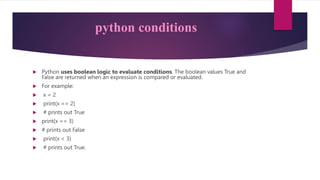
 Python uses boolean logic to evaluate conditions. The boolean values True and
False are returned when an expression is compared or evaluated.
 For example:
 x = 2
 print(x == 2)
 # prints out True
 print(x == 3)
 # prints out False
 print(x < 3)
 # prints out True.
Python Conditions
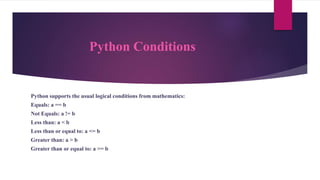
Python supports the usual logical conditions from mathematics:
Equals: a == b
Not Equals: a != b
Less than: a < b
Less than or equal to: a <= b
Greater than: a > b
Greater than or equal to: a >= b
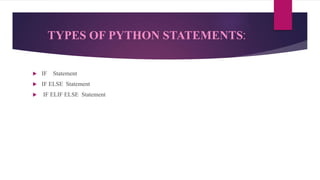
TYPES OF PYTHON STATEMENTS:
 IF Statement
 IF ELSE Statement
 IF ELIF ELSE Statement
If statement in Python
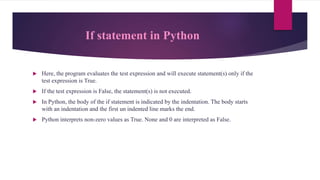
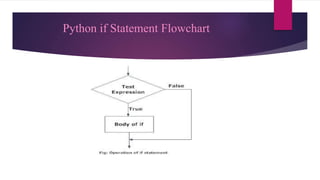
 Here, the program evaluates the test expression and will execute statement(s) only if the
test expression is True.
 If the test expression is False, the statement(s) is not executed.
 In Python, the body of the if statement is indicated by the indentation. The body starts
with an indentation and the first un indented line marks the end.
 Python interprets non-zero values as True. None and 0 are interpreted as False.
Python if Statement Flowchart
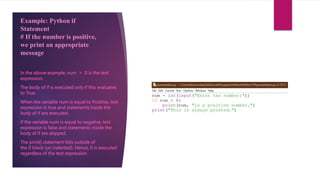
Example: Python if
Statement
# If the number is positive,
we print an appropriate
message
In the above example, num > 0 is the test
expression.
The body of if is executed only if this evaluates
to True.
When the variable num is equal to Positive, test
expression is true and statements inside the
body of if are executed.
If the variable num is equal to negative, test
expression is false and statements inside the
body of if are skipped.
The print() statement falls outside of
the if block (un indented). Hence, it is executed
regardless of the test expression
Python if,else Statement
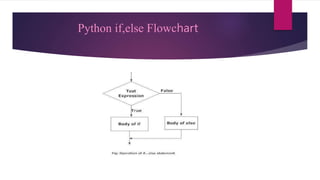
 The if else statement evaluates test expression and will execute the body of if only when
the test condition is True.
 If the condition is False, the body of else is executed. Indentation is used to separate the
blocks
Python if,else Flowchart
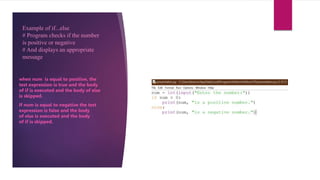
Example of if...else
# Program checks if the number
is positive or negative
# And displays an appropriate
message
when num is equal to positive, the
test expression is true and the body
of if is executed and the body of else
is skipped.
If num is equal to negative the test
expression is false and the body
of else is executed and the body
of if is skipped.
Python if , elif , else Statement
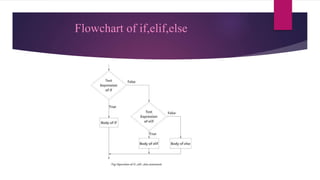
 The elif is short for else if. It allows us to check for multiple expressions.
 If the condition for if is False, it checks the condition of the next elif block and so on.
 If all the conditions are False, the body of else is executed.
 Only one block among the several if...elif...else blocks is executed according to the
condition.
 The if block can have only one else block. But it can have multiple elif blocks.
Flowchart of if,elif,else
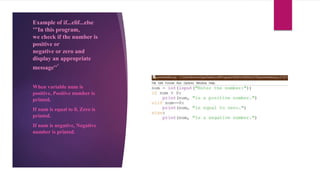
Example of if...elif...else
'''In this program,
we check if the number is
positive or
negative or zero and
display an appropriate
message'''
When variable num is
positive, Positive number is
printed.
If num is equal to 0, Zero is
printed.
If num is negative, Negative
number is printed.
Python Nested if statements
 We can have a if...elif...else statement inside another if...elif...else statement. This is
called nesting in computer programming.
 Any number of these statements can be nested inside one another. Indentation is
the only way to figure out the level of nesting. They can get confusing, so they
must be avoided unless necessary.
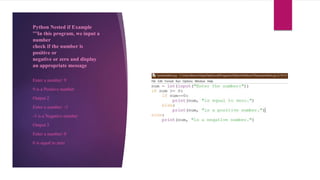
Python Nested if Example
'''In this program, we input a
number
check if the number is
positive or
negative or zero and display
an appropriate message
Enter a number: 9
9 is a Positive number
Output 2
Enter a number: -3
-3 is a Negative number
Output 3
Enter a number: 0
0 is equal to zero
‫شکریہ‬

PRESENTATION.pptx

  • 1.
    ِ‫ن‬ ٰ‫حم‬َّ‫الر‬ ِ‫ہللا‬ِ‫سم‬ِ‫ب‬ ‫يم‬ ِ‫ح‬َّ‫الر‬
  • 2.
    ALYAN YOUSAF FA22-BME-042 MUHAMMADABDULAH FA22-BME-043 MUHAMMAD REHAN FA22-BME-045
  • 3.
    python conditions  Pythonuses boolean logic to evaluate conditions. The boolean values True and False are returned when an expression is compared or evaluated.  For example:  x = 2  print(x == 2)  # prints out True  print(x == 3)  # prints out False  print(x < 3)  # prints out True.
  • 4.
    Python Conditions Python supportsthe usual logical conditions from mathematics: Equals: a == b Not Equals: a != b Less than: a < b Less than or equal to: a <= b Greater than: a > b Greater than or equal to: a >= b
  • 5.
    TYPES OF PYTHONSTATEMENTS:  IF Statement  IF ELSE Statement  IF ELIF ELSE Statement
  • 6.
    If statement inPython  Here, the program evaluates the test expression and will execute statement(s) only if the test expression is True.  If the test expression is False, the statement(s) is not executed.  In Python, the body of the if statement is indicated by the indentation. The body starts with an indentation and the first un indented line marks the end.  Python interprets non-zero values as True. None and 0 are interpreted as False.
  • 7.
  • 8.
    Example: Python if Statement #If the number is positive, we print an appropriate message In the above example, num > 0 is the test expression. The body of if is executed only if this evaluates to True. When the variable num is equal to Positive, test expression is true and statements inside the body of if are executed. If the variable num is equal to negative, test expression is false and statements inside the body of if are skipped. The print() statement falls outside of the if block (un indented). Hence, it is executed regardless of the test expression
  • 9.
    Python if,else Statement The if else statement evaluates test expression and will execute the body of if only when the test condition is True.  If the condition is False, the body of else is executed. Indentation is used to separate the blocks
  • 10.
  • 11.
    Example of if...else #Program checks if the number is positive or negative # And displays an appropriate message when num is equal to positive, the test expression is true and the body of if is executed and the body of else is skipped. If num is equal to negative the test expression is false and the body of else is executed and the body of if is skipped.
  • 12.
    Python if ,elif , else Statement  The elif is short for else if. It allows us to check for multiple expressions.  If the condition for if is False, it checks the condition of the next elif block and so on.  If all the conditions are False, the body of else is executed.  Only one block among the several if...elif...else blocks is executed according to the condition.  The if block can have only one else block. But it can have multiple elif blocks.
  • 13.
  • 14.
    Example of if...elif...else '''Inthis program, we check if the number is positive or negative or zero and display an appropriate message''' When variable num is positive, Positive number is printed. If num is equal to 0, Zero is printed. If num is negative, Negative number is printed.
  • 15.
    Python Nested ifstatements  We can have a if...elif...else statement inside another if...elif...else statement. This is called nesting in computer programming.  Any number of these statements can be nested inside one another. Indentation is the only way to figure out the level of nesting. They can get confusing, so they must be avoided unless necessary.
  • 16.
    Python Nested ifExample '''In this program, we input a number check if the number is positive or negative or zero and display an appropriate message Enter a number: 9 9 is a Positive number Output 2 Enter a number: -3 -3 is a Negative number Output 3 Enter a number: 0 0 is equal to zero
  • 17.