Pandit Deendayal Energy University
Dr Rajesh S. Gujar, Head of the Department, Civil
Engineering Dept. Pdeu, Gandhinagar.
Value Engineering
• Ph. D (Transportation Engineering, Sardar
Vallabhbhai National Institute of
Technology, Surat), 2016
• M.E. (Construction Engineering &
Management, B.V.M. Engineering College,
S. P. University, V.V. Nagar, Anand), 1999
• B.E. (Civil - Water Management,
S.G.G.S.C.E.& T, Nanded (M.S), Dr B. A.
Marathwada University, Aurangabad.
(M.S.)), 1997
• (O) 079 23275451
• rajesh.gujar@sot.pdpu.ac.in
“Don’t reduce cost; improve value," Lawrence D.
Miles (Founder of value engineering).
Dr RAJESH SHRIRAMSA
GUJAR
Syllabus
UNIT I: INTRODUCTION TO VALUE ENGINEERING
Introduction to value engineering – Concepts- Value- Types of value-Function-types of function-
Evaluation of function-Evaluation of costs-Evaluation of worth-Determination and evaluation of
economic parameters of value.
UNIT II:
Concepts of job plan – Information phase- Function phase – Creation phase – Evaluation phase –
Investigation phase – Implementation phase – Speculation phase – Analysis phase – Case studies
FAST Diagram: FAST diagram techniques – Application of FAST diagramming method to infrastructure
projects.
UNIT III: VALUE ENGINEERING DECISION MAKING TOOLS
Engineering economics: Time value of money – Rate of Return (ROR) analysis – Breakeven analysis –
Sensitivity analysis
Social Benefit Cost Analysis (SBCA)- Life Cycle Cost Analysis (LCCA) – Multi-Criteria Decision Making
(MCDM), Case studies. Cost Models: Type of cost models – Cost matrix – Development of cost models for
infrastructure projects, Case studies.
UNIT IV: METHODS OF VALUATION
Methods of Valuation: Rental method, Profit method, Case studies in rental and profit method of
evaluation; Land and Building method – Cost of construction; Estimate on area basis; Estimate on
cubic basis; Estimate by cost index; Residual or demolition value of old buildings; Case studies.
Why value engineering?
 Maximizes Value: Optimizes the balance of project function, quality, and cost to deliver necessary
performance at the lowest total life-cycle cost.
 Drives Innovation & Efficiency: Encourages multidisciplinary teams to challenge assumptions, identify
creative alternatives, and eliminate unnecessary complexity or waste.
 Ensures Significant Savings & Risk Mitigation: Systematically identifies and avoids unnecessary costs
early in a project's lifecycle, improving profitability and reducing technical risks.
 Enhances Professional Skills: Fosters critical thinking, problem-solving, and cross-functional
collaboration, making it a highly valued skill set for career advancement.
“Value Engineering is not about spending less — it’s about thinking smarter.”
What is Value engineering?
 Value Engineering (VE) is a management technique that seeks the best
functional balance between cost, reliability and performance of a
product, project, process or service.
 Value engineering is a powerful problem-solving tool that can
reduce costs while maintaining or improving performance and
quality requirements.
 Value engineering can improve decision-making that leads to
optimal expenditure of owner funds while meeting the required
function and quality level.
 The success of the VE process is due to its ability to identify
opportunities to remove unnecessary costs while assuring quality,
reliability, performance, and other critical factors that meet or
exceed customers’ expectations.
Tools And
Techniques
 FAST diagram
 Creative thinking
 Life cycle costing
 Weighted scoring techniques
 Value analysis and value engineering and value management is the concept
of a single administrative approach aimed at finding practical solutions and
reduce the useful flying quality in cost
 Value Analysis (VA):
•Definition: A study applied to completed projects or products currently in use
•Purpose: To identify opportunities for performance improvement and eliminate
unnecessary costs
•Application: Post-implementation or post-production phase
•Focus: Analyzing existing systems to find cost reduction opportunities
VALUE ENGINEERING
VALUE ENGINEERING
 Value Engineering (VE)
Definition: A systematic method designed to improve quality and reduce costs in construction projects
Also Known As: Often referred to as "Value Engineering" or "Engineering Value"
Application Timing:
During the project conceptual/idea phase
After completion of the preliminary design
Throughout the project lifecycle
Primary Goal: Optimise project value by balancing cost and performance
VALUE ENGINEERING
 Value Management (VM)
Definition: A comprehensive concept encompassing the overall management of programs and value
studies
Scope: Broader framework that includes:
How to establish value studies
How to conduct value engineering workshops
Follow-up and implementation processes
Continuous monitoring and improvement
Relationship: Value Engineering workshops and Value Analysis are integral parts of the Value
Management process
What Value Engineering is
NOT?
 VE is not a cost-cutting or trimming
project scope.
 It’s a structured problem-solving
approach aimed at improving
performance and reducing unnecessary
costs.
VALUE
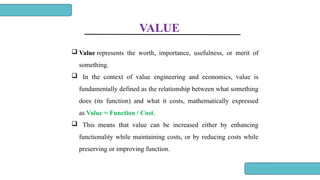
 Value represents the worth, importance, usefulness, or merit of
something.
 In the context of value engineering and economics, value is
fundamentally defined as the relationship between what something
does (its function) and what it costs, mathematically expressed
as Value = Function / Cost.
 This means that value can be increased either by enhancing
functionality while maintaining costs, or by reducing costs while
preserving or improving function.
VALUE
 Many people mistakenly equate value with price, but in reality, price is only one factor that
contributes to value.
 Value depends on several elements such as performance, quality, and timing of a product or service.
 The perception of value differs from person to person, depending on factors like location, time,
resources, and market conditions.
 Supply and demand greatly influence how value is perceived.
 For example, a piece of land next to your house may have a much higher value for you than for
someone else, because it fulfils a personal need or purpose.
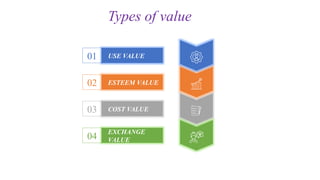
Types of value
03 COST VALUE
02 ESTEEM VALUE
04
EXCHANGE
VALUE
01 USE VALUE
USE VALUE
 Use value represents the money spent to justify the usefulness of a product.
 It is the fundamental value determined by a product's attributes, defining what
the product is able to do, how it is used, and what its purpose is.
 This is the primary type of value in value engineering, as without use value,
consumers would not initially purchase the good.
 Use value is essential for product performance and is typically measurable.
 For example, the ability of a shoe to protect feet and enable walking constitutes
its use value.
ESTEEM VALUE
 Esteem value creates qualities and appearance in a product that attract people and
create in them a desire to possess it.
 This is the price paid by the buyer or cost incurred by the manufacturer beyond the
use value.
 It makes the product attractive to buyers and meets particular satisfaction or ego
needs.
 Esteem value does not necessarily contribute toward satisfactory performance but
relates to appearance engineering and packaging.
 For instance, consumers may be willing to pay a premium for Nike shoes due to
added prestige and brand recognition, which represents positive esteem value.
COST VALUE
 Cost value refers to the actual cost of production when manufactured or the
cost of purchase when bought.
 It encompasses all expenses incurred to produce the item or service,
including labor, materials, quality control, and other production variables
during its entire life cycle.
 In value engineering analysis, if the cost value exceeds what consumers
are willing to pay, companies must reassess how to rebalance the equation.
 The cost of steel reinforcement in a structure represents its cost value.
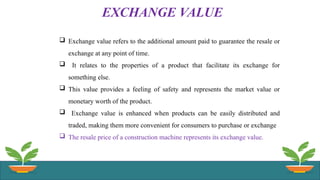
EXCHANGE VALUE
 Exchange value refers to the additional amount paid to guarantee the resale or
exchange at any point of time.
 It relates to the properties of a product that facilitate its exchange for
something else.
 This value provides a feeling of safety and represents the market value or
monetary worth of the product.
 Exchange value is enhanced when products can be easily distributed and
traded, making them more convenient for consumers to purchase or exchange
 The resale price of a construction machine represents its exchange value.
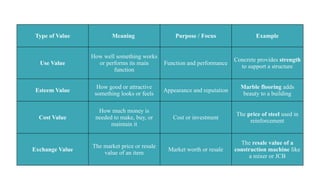
Type of Value Meaning Purpose / Focus Example
Use Value
How well something works
or performs its main
function
Function and performance
Concrete provides strength
to support a structure
Esteem Value
How good or attractive
something looks or feels
Appearance and reputation
Marble flooring adds
beauty to a building
Cost Value
How much money is
needed to make, buy, or
maintain it
Cost or investment
The price of steel used in
reinforcement
Exchange Value
The market price or resale
value of an item
Market worth or resale
The resale value of a
construction machine like
a mixer or JCB
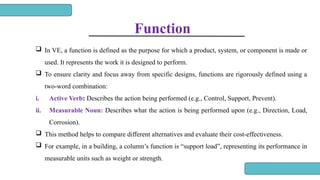
Function
 In VE, a function is defined as the purpose for which a product, system, or component is made or
used. It represents the work it is designed to perform.
 To ensure clarity and focus away from specific designs, functions are rigorously defined using a
two-word combination:
i. Active Verb: Describes the action being performed (e.g., Control, Support, Prevent).
ii. Measurable Noun: Describes what the action is being performed upon (e.g., Direction, Load,
Corrosion).
 This method helps to compare different alternatives and evaluate their cost-effectiveness.
 For example, in a building, a column’s function is “support load”, representing its performance in
measurable units such as weight or strength.
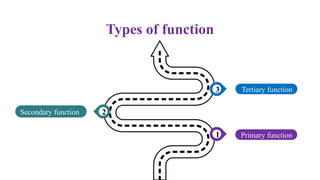
Types of function
2
Secondary function
3 Tertiary function
1 Primary function
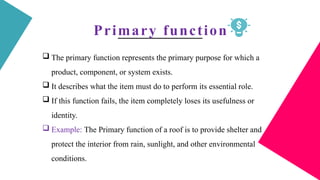
Primary function
 The primary function represents the primary purpose for which a
product, component, or system exists.
 It describes what the item must do to perform its essential role.
 If this function fails, the item completely loses its usefulness or
identity.
 Example: The Primary function of a roof is to provide shelter and
protect the interior from rain, sunlight, and other environmental
conditions.
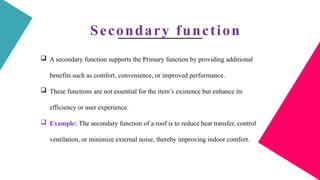
Secondary function
 A secondary function supports the Primary function by providing additional
benefits such as comfort, convenience, or improved performance.
 These functions are not essential for the item’s existence but enhance its
efficiency or user experience.
 Example: The secondary function of a roof is to reduce heat transfer, control
ventilation, or minimize external noise, thereby improving indoor comfort.
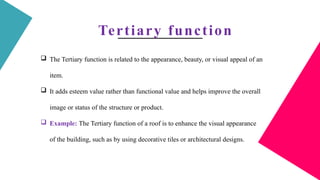
Tertiary function
 The Tertiary function is related to the appearance, beauty, or visual appeal of an
item.
 It adds esteem value rather than functional value and helps improve the overall
image or status of the structure or product.
 Example: The Tertiary function of a roof is to enhance the visual appearance
of the building, such as by using decorative tiles or architectural designs.
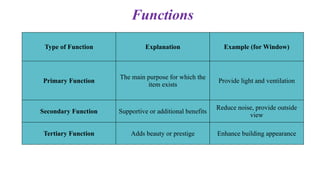
Type of Function Explanation Example (for Window)
Primary Function
The main purpose for which the
item exists
Provide light and ventilation
Secondary Function Supportive or additional benefits
Reduce noise, provide outside
view
Tertiary Function Adds beauty or prestige Enhance building appearance
Functions
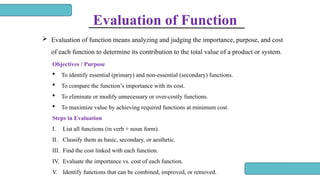
Evaluation of Function
 Evaluation of function means analyzing and judging the importance, purpose, and cost
of each function to determine its contribution to the total value of a product or system.
Objectives / Purpose
 To identify essential (primary) and non-essential (secondary) functions.
 To compare the function’s importance with its cost.
 To eliminate or modify unnecessary or over-costly functions.
 To maximize value by achieving required functions at minimum cost.
Steps in Evaluation
I. List all functions (in verb + noun form).
II. Classify them as basic, secondary, or aesthetic.
III. Find the cost linked with each function.
IV. Evaluate the importance vs. cost of each function.
V. Identify functions that can be combined, improved, or removed.
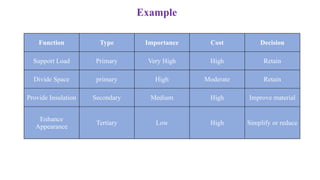
Example
Function Type Importance Cost Decision
Support Load Primary Very High High Retain
Divide Space primary High Moderate Retain
Provide Insulation Secondary Medium High Improve material
Enhance
Appearance
Tertiary Low High Simplify or reduce
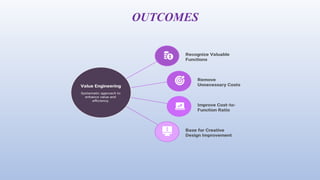
OUTCOMES
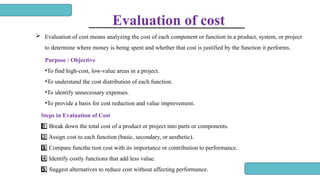
Evaluation of cost
 Evaluation of cost means analyzing the cost of each component or function in a product, system, or project
to determine where money is being spent and whether that cost is justified by the function it performs.
Purpose / Objective
•To find high-cost, low-value areas in a project.
•To understand the cost distribution of each function.
•To identify unnecessary expenses.
•To provide a basis for cost reduction and value improvement.
Steps in Evaluation of Cost
Break down the total cost of a product or project into parts or components.
1 ️
1️⃣
Assign cost to each function (basic, secondary, or aesthetic).
2️⃣
Compare functhe tion cost with its importance or contribution to performance.
3 ️
3️⃣
Identify costly functions that add less value.
4️⃣
Suggest alternatives to reduce cost without affecting performance.
5 ️
5️⃣
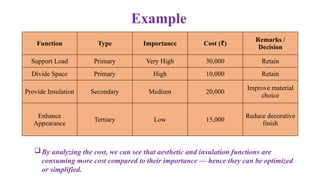
Function Type Importance Cost ( )
₹
Remarks /
Decision
Support Load Primary Very High 30,000 Retain
Divide Space Primary High 10,000 Retain
Provide Insulation Secondary Medium 20,000
Improve material
choice
Enhance
Appearance
Tertiary Low 15,000
Reduce decorative
finish
Example
By analyzing the cost, we can see that aesthetic and insulation functions are
consuming more cost compared to their importance — hence they can be optimized
or simplified.
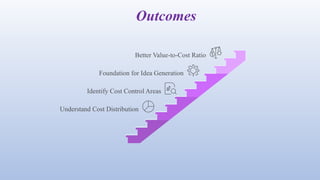
Better Value-to-Cost Ratio
Foundation for Idea Generation
Identify Cost Control Areas
Understand Cost Distribution
Outcomes
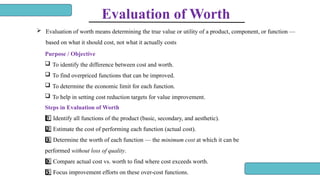
Evaluation of Worth
 Evaluation of worth means determining the true value or utility of a product, component, or function —
based on what it should cost, not what it actually costs
Purpose / Objective
 To identify the difference between cost and worth.
 To find overpriced functions that can be improved.
 To determine the economic limit for each function.
 To help in setting cost reduction targets for value improvement.
Steps in Evaluation of Worth
Identify all functions of the product (basic, secondary, and aesthetic).
1 ️
1️⃣
Estimate the cost of performing each function (actual cost).
2 ️
2️⃣
Determine the worth of each function — the
3 ️
3️⃣ minimum cost at which it can be
performed without loss of quality.
Compare actual cost vs. worth to find where cost exceeds worth.
4 ️
4️⃣
Focus improvement efforts on these over-cost functions.
5 ️
5️⃣
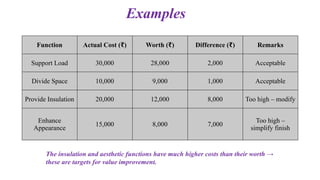
Function Actual Cost ( )
₹ Worth ( )
₹ Difference ( )
₹ Remarks
Support Load 30,000 28,000 2,000 Acceptable
Divide Space 10,000 9,000 1,000 Acceptable
Provide Insulation 20,000 12,000 8,000 Too high – modify
Enhance
Appearance
15,000 8,000 7,000
Too high –
simplify finish
Examples
The insulation and aesthetic functions have much higher costs than their worth →
these are targets for value improvement.
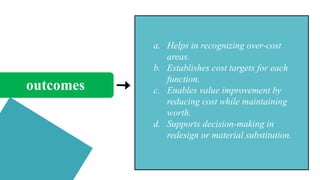
outcomes
a. Helps in recognizing over-cost
areas.
b. Establishes cost targets for each
function.
c. Enables value improvement by
reducing cost while maintaining
worth.
d. Supports decision-making in
redesign or material substitution.
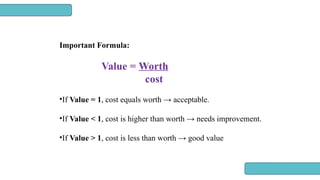
Important Formula:
Value = Worth
cost
•If Value = 1, cost equals worth → acceptable.
•If Value < 1, cost is higher than worth → needs improvement.
•If Value > 1, cost is less than worth → good value
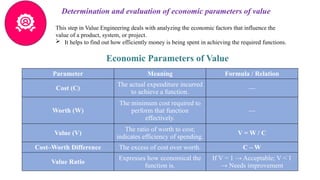
This step in Value Engineering deals with analyzing the economic factors that influence the
value of a product, system, or project.
 It helps to find out how efficiently money is being spent in achieving the required functions.
Determination and evaluation of economic parameters of value
Parameter Meaning Formula / Relation
Cost (C)
The actual expenditure incurred
to achieve a function.
—
Worth (W)
The minimum cost required to
perform that function
effectively.
—
Value (V)
The ratio of worth to cost;
indicates efficiency of spending.
V = W / C
Cost–Worth Difference The excess of cost over worth. C – W
Value Ratio
Expresses how economical the
function is.
If V = 1 → Acceptable; V < 1
→ Needs improvement
Economic Parameters of Value
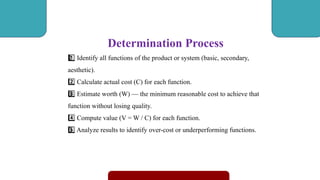
Determination Process
Identify all functions of the product or system (basic, secondary,
1 ️
1️⃣
aesthetic).
Calculate actual cost (C) for each function.
2️⃣
Estimate worth (W) — the minimum reasonable cost to achieve that
3 ️
3️⃣
function without losing quality.
Compute value (V = W / C) for each function.
4️⃣
Analyze results to identify over-cost or underperforming functions.
5 ️
5️⃣
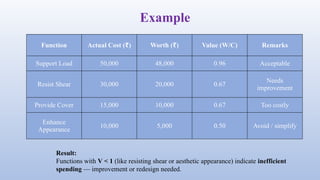
Function Actual Cost ( )
₹ Worth ( )
₹ Value (W/C) Remarks
Support Load 50,000 48,000 0.96 Acceptable
Resist Shear 30,000 20,000 0.67
Needs
improvement
Provide Cover 15,000 10,000 0.67 Too costly
Enhance
Appearance
10,000 5,000 0.50 Avoid / simplify
Result:
Functions with V < 1 (like resisting shear or aesthetic appearance) indicate inefficient
spending — improvement or redesign needed.
Example
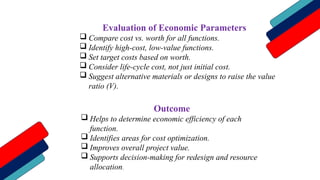
Evaluation of Economic Parameters
 Compare cost vs. worth for all functions.
 Identify high-cost, low-value functions.
 Set target costs based on worth.
 Consider life-cycle cost, not just initial cost.
 Suggest alternative materials or designs to raise the value
ratio (V).
Outcome
 Helps to determine economic efficiency of each
function.
 Identifies areas for cost optimization.
 Improves overall project value.
 Supports decision-making for redesign and resource
allocation.
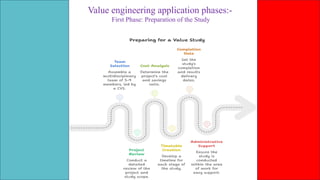
Value engineering application phases:-
First Phase: Preparation of the Study
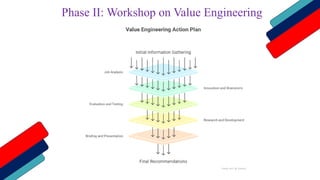
Phase II: Workshop on Value Engineering
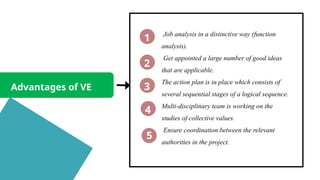
Advantages of VE
1
2
3
4
Job analysis in a distinctive way (function
analysis).
Get appointed a large number of good ideas
that are applicable.
The action plan is in place which consists of
several sequential stages of a logical sequence.
Multi-disciplinary team is working on the
studies of collective values.
Ensure coordination between the relevant
authorities in the project.
5
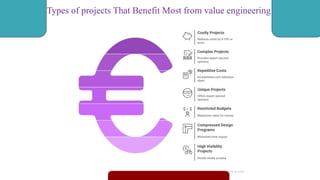
Types of projects That Benefit Most from value engineering
Reasons for Increased Unnecessary Costs and
Poor Quality
 Value studies rely on collective teamwork among specialists,
which helps bridge the gaps often found in individually
handled designs.
 When design work is done individually, engineers tend to
use higher safety factors and less efficient solutions, leading
to increased costs.
 The main reasons for unnecessary cost and reduced quality
are:
o Lack of proper information during planning and design.
o Temporary or changing site conditions.
o Erroneous assumptions or beliefs in design and
execution.
o Outdated customs and traditional practices are followed
without evaluation.
o Limited innovative ideas or lack of brainstorming.
o Rapid changes in technology are not being adopted.
o Evolving client or beneficiary requirements.
o Use of old specifications and obsolete standards.
o Time constraints that lead to hasty decisions.
o Poor coordination or communication among project
teams
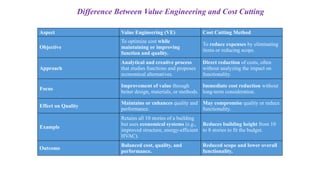
Difference Between Value Engineering and Cost Cutting
Aspect Value Engineering (VE) Cost Cutting Method
Objective
To optimize cost while
maintaining or improving
function and quality.
To reduce expenses by eliminating
items or reducing scope.
Approach
Analytical and creative process
that studies functions and proposes
economical alternatives.
Direct reduction of costs, often
without analyzing the impact on
functionality.
Focus
Improvement of value through
better design, materials, or methods.
Immediate cost reduction without
long-term consideration.
Effect on Quality
Maintains or enhances quality and
performance.
May compromise quality or reduce
functionality.
Example
Retains all 10 stories of a building
but uses economical systems (e.g.,
improved structure, energy-efficient
HVAC).
Reduces building height from 10
to 8 stories to fit the budget.
Outcome
Balanced cost, quality, and
performance.
Reduced scope and lower overall
functionality.
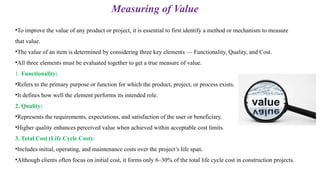
•To improve the value of any product or project, it is essential to first identify a method or mechanism to measure
that value.
•The value of an item is determined by considering three key elements — Functionality, Quality, and Cost.
•All three elements must be evaluated together to get a true measure of value.
1. Functionality:
•Refers to the primary purpose or function for which the product, project, or process exists.
•It defines how well the element performs its intended role.
2. Quality:
•Represents the requirements, expectations, and satisfaction of the user or beneficiary.
•Higher quality enhances perceived value when achieved within acceptable cost limits.
3. Total Cost (Life Cycle Cost):
•Includes initial, operating, and maintenance costs over the project’s life span.
•Although clients often focus on initial cost, it forms only 6–30% of the total life cycle cost in construction projects.
Measuring of Value
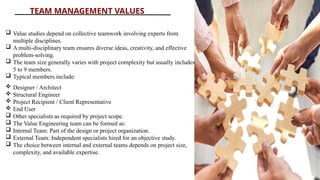
TEAM MANAGEMENT VALUES
 Value studies depend on collective teamwork involving experts from
multiple disciplines.
 A multi-disciplinary team ensures diverse ideas, creativity, and effective
problem-solving.
 The team size generally varies with project complexity but usually includes
5 to 9 members.
 Typical members include:
 Designer / Architect
 Structural Engineer
 Project Recipient / Client Representative
 End User
 Other specialists as required by project scope.
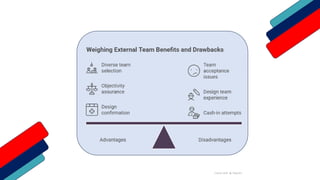
 The Value Engineering team can be formed as:
 Internal Team: Part of the design or project organization.
 External Team: Independent specialists hired for an objective study.
 The choice between internal and external teams depends on project size,
complexity, and available expertise.
Value engineering and cost analysis with case study

Value engineering and cost analysis with case study

  • 1.
    Pandit Deendayal EnergyUniversity Dr Rajesh S. Gujar, Head of the Department, Civil Engineering Dept. Pdeu, Gandhinagar. Value Engineering
  • 2.
    • Ph. D(Transportation Engineering, Sardar Vallabhbhai National Institute of Technology, Surat), 2016 • M.E. (Construction Engineering & Management, B.V.M. Engineering College, S. P. University, V.V. Nagar, Anand), 1999 • B.E. (Civil - Water Management, S.G.G.S.C.E.& T, Nanded (M.S), Dr B. A. Marathwada University, Aurangabad. (M.S.)), 1997 • (O) 079 23275451 • rajesh.gujar@sot.pdpu.ac.in “Don’t reduce cost; improve value," Lawrence D. Miles (Founder of value engineering). Dr RAJESH SHRIRAMSA GUJAR
  • 3.
    Syllabus UNIT I: INTRODUCTIONTO VALUE ENGINEERING Introduction to value engineering – Concepts- Value- Types of value-Function-types of function- Evaluation of function-Evaluation of costs-Evaluation of worth-Determination and evaluation of economic parameters of value. UNIT II: Concepts of job plan – Information phase- Function phase – Creation phase – Evaluation phase – Investigation phase – Implementation phase – Speculation phase – Analysis phase – Case studies FAST Diagram: FAST diagram techniques – Application of FAST diagramming method to infrastructure projects. UNIT III: VALUE ENGINEERING DECISION MAKING TOOLS Engineering economics: Time value of money – Rate of Return (ROR) analysis – Breakeven analysis – Sensitivity analysis Social Benefit Cost Analysis (SBCA)- Life Cycle Cost Analysis (LCCA) – Multi-Criteria Decision Making (MCDM), Case studies. Cost Models: Type of cost models – Cost matrix – Development of cost models for infrastructure projects, Case studies. UNIT IV: METHODS OF VALUATION Methods of Valuation: Rental method, Profit method, Case studies in rental and profit method of evaluation; Land and Building method – Cost of construction; Estimate on area basis; Estimate on cubic basis; Estimate by cost index; Residual or demolition value of old buildings; Case studies.
  • 4.
    Why value engineering? Maximizes Value: Optimizes the balance of project function, quality, and cost to deliver necessary performance at the lowest total life-cycle cost.  Drives Innovation & Efficiency: Encourages multidisciplinary teams to challenge assumptions, identify creative alternatives, and eliminate unnecessary complexity or waste.  Ensures Significant Savings & Risk Mitigation: Systematically identifies and avoids unnecessary costs early in a project's lifecycle, improving profitability and reducing technical risks.  Enhances Professional Skills: Fosters critical thinking, problem-solving, and cross-functional collaboration, making it a highly valued skill set for career advancement. “Value Engineering is not about spending less — it’s about thinking smarter.”
  • 5.
    What is Valueengineering?  Value Engineering (VE) is a management technique that seeks the best functional balance between cost, reliability and performance of a product, project, process or service.  Value engineering is a powerful problem-solving tool that can reduce costs while maintaining or improving performance and quality requirements.  Value engineering can improve decision-making that leads to optimal expenditure of owner funds while meeting the required function and quality level.  The success of the VE process is due to its ability to identify opportunities to remove unnecessary costs while assuring quality, reliability, performance, and other critical factors that meet or exceed customers’ expectations.
  • 6.
    Tools And Techniques  FASTdiagram  Creative thinking  Life cycle costing  Weighted scoring techniques
  • 7.
     Value analysisand value engineering and value management is the concept of a single administrative approach aimed at finding practical solutions and reduce the useful flying quality in cost  Value Analysis (VA): •Definition: A study applied to completed projects or products currently in use •Purpose: To identify opportunities for performance improvement and eliminate unnecessary costs •Application: Post-implementation or post-production phase •Focus: Analyzing existing systems to find cost reduction opportunities VALUE ENGINEERING
  • 8.
    VALUE ENGINEERING  ValueEngineering (VE) Definition: A systematic method designed to improve quality and reduce costs in construction projects Also Known As: Often referred to as "Value Engineering" or "Engineering Value" Application Timing: During the project conceptual/idea phase After completion of the preliminary design Throughout the project lifecycle Primary Goal: Optimise project value by balancing cost and performance
  • 9.
    VALUE ENGINEERING  ValueManagement (VM) Definition: A comprehensive concept encompassing the overall management of programs and value studies Scope: Broader framework that includes: How to establish value studies How to conduct value engineering workshops Follow-up and implementation processes Continuous monitoring and improvement Relationship: Value Engineering workshops and Value Analysis are integral parts of the Value Management process
  • 10.
    What Value Engineeringis NOT?  VE is not a cost-cutting or trimming project scope.  It’s a structured problem-solving approach aimed at improving performance and reducing unnecessary costs.
  • 11.
    VALUE  Value representsthe worth, importance, usefulness, or merit of something.  In the context of value engineering and economics, value is fundamentally defined as the relationship between what something does (its function) and what it costs, mathematically expressed as Value = Function / Cost.  This means that value can be increased either by enhancing functionality while maintaining costs, or by reducing costs while preserving or improving function.
  • 12.
    VALUE  Many peoplemistakenly equate value with price, but in reality, price is only one factor that contributes to value.  Value depends on several elements such as performance, quality, and timing of a product or service.  The perception of value differs from person to person, depending on factors like location, time, resources, and market conditions.  Supply and demand greatly influence how value is perceived.  For example, a piece of land next to your house may have a much higher value for you than for someone else, because it fulfils a personal need or purpose.
  • 13.
    Types of value 03COST VALUE 02 ESTEEM VALUE 04 EXCHANGE VALUE 01 USE VALUE
  • 14.
    USE VALUE  Usevalue represents the money spent to justify the usefulness of a product.  It is the fundamental value determined by a product's attributes, defining what the product is able to do, how it is used, and what its purpose is.  This is the primary type of value in value engineering, as without use value, consumers would not initially purchase the good.  Use value is essential for product performance and is typically measurable.  For example, the ability of a shoe to protect feet and enable walking constitutes its use value.
  • 15.
    ESTEEM VALUE  Esteemvalue creates qualities and appearance in a product that attract people and create in them a desire to possess it.  This is the price paid by the buyer or cost incurred by the manufacturer beyond the use value.  It makes the product attractive to buyers and meets particular satisfaction or ego needs.  Esteem value does not necessarily contribute toward satisfactory performance but relates to appearance engineering and packaging.  For instance, consumers may be willing to pay a premium for Nike shoes due to added prestige and brand recognition, which represents positive esteem value.
  • 16.
    COST VALUE  Costvalue refers to the actual cost of production when manufactured or the cost of purchase when bought.  It encompasses all expenses incurred to produce the item or service, including labor, materials, quality control, and other production variables during its entire life cycle.  In value engineering analysis, if the cost value exceeds what consumers are willing to pay, companies must reassess how to rebalance the equation.  The cost of steel reinforcement in a structure represents its cost value.
  • 17.
    EXCHANGE VALUE  Exchangevalue refers to the additional amount paid to guarantee the resale or exchange at any point of time.  It relates to the properties of a product that facilitate its exchange for something else.  This value provides a feeling of safety and represents the market value or monetary worth of the product.  Exchange value is enhanced when products can be easily distributed and traded, making them more convenient for consumers to purchase or exchange  The resale price of a construction machine represents its exchange value.
  • 18.
    Type of ValueMeaning Purpose / Focus Example Use Value How well something works or performs its main function Function and performance Concrete provides strength to support a structure Esteem Value How good or attractive something looks or feels Appearance and reputation Marble flooring adds beauty to a building Cost Value How much money is needed to make, buy, or maintain it Cost or investment The price of steel used in reinforcement Exchange Value The market price or resale value of an item Market worth or resale The resale value of a construction machine like a mixer or JCB
  • 19.
    Function  In VE,a function is defined as the purpose for which a product, system, or component is made or used. It represents the work it is designed to perform.  To ensure clarity and focus away from specific designs, functions are rigorously defined using a two-word combination: i. Active Verb: Describes the action being performed (e.g., Control, Support, Prevent). ii. Measurable Noun: Describes what the action is being performed upon (e.g., Direction, Load, Corrosion).  This method helps to compare different alternatives and evaluate their cost-effectiveness.  For example, in a building, a column’s function is “support load”, representing its performance in measurable units such as weight or strength.
  • 20.
    Types of function 2 Secondaryfunction 3 Tertiary function 1 Primary function
  • 21.
    Primary function  Theprimary function represents the primary purpose for which a product, component, or system exists.  It describes what the item must do to perform its essential role.  If this function fails, the item completely loses its usefulness or identity.  Example: The Primary function of a roof is to provide shelter and protect the interior from rain, sunlight, and other environmental conditions.
  • 22.
    Secondary function  Asecondary function supports the Primary function by providing additional benefits such as comfort, convenience, or improved performance.  These functions are not essential for the item’s existence but enhance its efficiency or user experience.  Example: The secondary function of a roof is to reduce heat transfer, control ventilation, or minimize external noise, thereby improving indoor comfort.
  • 23.
    Tertiary function  TheTertiary function is related to the appearance, beauty, or visual appeal of an item.  It adds esteem value rather than functional value and helps improve the overall image or status of the structure or product.  Example: The Tertiary function of a roof is to enhance the visual appearance of the building, such as by using decorative tiles or architectural designs.
  • 24.
    Type of FunctionExplanation Example (for Window) Primary Function The main purpose for which the item exists Provide light and ventilation Secondary Function Supportive or additional benefits Reduce noise, provide outside view Tertiary Function Adds beauty or prestige Enhance building appearance Functions
  • 25.
    Evaluation of Function Evaluation of function means analyzing and judging the importance, purpose, and cost of each function to determine its contribution to the total value of a product or system. Objectives / Purpose  To identify essential (primary) and non-essential (secondary) functions.  To compare the function’s importance with its cost.  To eliminate or modify unnecessary or over-costly functions.  To maximize value by achieving required functions at minimum cost. Steps in Evaluation I. List all functions (in verb + noun form). II. Classify them as basic, secondary, or aesthetic. III. Find the cost linked with each function. IV. Evaluate the importance vs. cost of each function. V. Identify functions that can be combined, improved, or removed.
  • 26.
    Example Function Type ImportanceCost Decision Support Load Primary Very High High Retain Divide Space primary High Moderate Retain Provide Insulation Secondary Medium High Improve material Enhance Appearance Tertiary Low High Simplify or reduce
  • 27.
  • 28.
    Evaluation of cost Evaluation of cost means analyzing the cost of each component or function in a product, system, or project to determine where money is being spent and whether that cost is justified by the function it performs. Purpose / Objective •To find high-cost, low-value areas in a project. •To understand the cost distribution of each function. •To identify unnecessary expenses. •To provide a basis for cost reduction and value improvement. Steps in Evaluation of Cost Break down the total cost of a product or project into parts or components. 1 ️ 1️⃣ Assign cost to each function (basic, secondary, or aesthetic). 2️⃣ Compare functhe tion cost with its importance or contribution to performance. 3 ️ 3️⃣ Identify costly functions that add less value. 4️⃣ Suggest alternatives to reduce cost without affecting performance. 5 ️ 5️⃣
  • 29.
    Function Type ImportanceCost ( ) ₹ Remarks / Decision Support Load Primary Very High 30,000 Retain Divide Space Primary High 10,000 Retain Provide Insulation Secondary Medium 20,000 Improve material choice Enhance Appearance Tertiary Low 15,000 Reduce decorative finish Example By analyzing the cost, we can see that aesthetic and insulation functions are consuming more cost compared to their importance — hence they can be optimized or simplified.
  • 30.
    Better Value-to-Cost Ratio Foundationfor Idea Generation Identify Cost Control Areas Understand Cost Distribution Outcomes
  • 31.
    Evaluation of Worth Evaluation of worth means determining the true value or utility of a product, component, or function — based on what it should cost, not what it actually costs Purpose / Objective  To identify the difference between cost and worth.  To find overpriced functions that can be improved.  To determine the economic limit for each function.  To help in setting cost reduction targets for value improvement. Steps in Evaluation of Worth Identify all functions of the product (basic, secondary, and aesthetic). 1 ️ 1️⃣ Estimate the cost of performing each function (actual cost). 2 ️ 2️⃣ Determine the worth of each function — the 3 ️ 3️⃣ minimum cost at which it can be performed without loss of quality. Compare actual cost vs. worth to find where cost exceeds worth. 4 ️ 4️⃣ Focus improvement efforts on these over-cost functions. 5 ️ 5️⃣
  • 32.
    Function Actual Cost( ) ₹ Worth ( ) ₹ Difference ( ) ₹ Remarks Support Load 30,000 28,000 2,000 Acceptable Divide Space 10,000 9,000 1,000 Acceptable Provide Insulation 20,000 12,000 8,000 Too high – modify Enhance Appearance 15,000 8,000 7,000 Too high – simplify finish Examples The insulation and aesthetic functions have much higher costs than their worth → these are targets for value improvement.
  • 33.
    outcomes a. Helps inrecognizing over-cost areas. b. Establishes cost targets for each function. c. Enables value improvement by reducing cost while maintaining worth. d. Supports decision-making in redesign or material substitution.
  • 34.
    Important Formula: Value =Worth cost •If Value = 1, cost equals worth → acceptable. •If Value < 1, cost is higher than worth → needs improvement. •If Value > 1, cost is less than worth → good value
  • 35.
    This step inValue Engineering deals with analyzing the economic factors that influence the value of a product, system, or project.  It helps to find out how efficiently money is being spent in achieving the required functions. Determination and evaluation of economic parameters of value Parameter Meaning Formula / Relation Cost (C) The actual expenditure incurred to achieve a function. — Worth (W) The minimum cost required to perform that function effectively. — Value (V) The ratio of worth to cost; indicates efficiency of spending. V = W / C Cost–Worth Difference The excess of cost over worth. C – W Value Ratio Expresses how economical the function is. If V = 1 → Acceptable; V < 1 → Needs improvement Economic Parameters of Value
  • 36.
    Determination Process Identify allfunctions of the product or system (basic, secondary, 1 ️ 1️⃣ aesthetic). Calculate actual cost (C) for each function. 2️⃣ Estimate worth (W) — the minimum reasonable cost to achieve that 3 ️ 3️⃣ function without losing quality. Compute value (V = W / C) for each function. 4️⃣ Analyze results to identify over-cost or underperforming functions. 5 ️ 5️⃣
  • 37.
    Function Actual Cost( ) ₹ Worth ( ) ₹ Value (W/C) Remarks Support Load 50,000 48,000 0.96 Acceptable Resist Shear 30,000 20,000 0.67 Needs improvement Provide Cover 15,000 10,000 0.67 Too costly Enhance Appearance 10,000 5,000 0.50 Avoid / simplify Result: Functions with V < 1 (like resisting shear or aesthetic appearance) indicate inefficient spending — improvement or redesign needed. Example
  • 38.
    Evaluation of EconomicParameters  Compare cost vs. worth for all functions.  Identify high-cost, low-value functions.  Set target costs based on worth.  Consider life-cycle cost, not just initial cost.  Suggest alternative materials or designs to raise the value ratio (V). Outcome  Helps to determine economic efficiency of each function.  Identifies areas for cost optimization.  Improves overall project value.  Supports decision-making for redesign and resource allocation.
  • 39.
    Value engineering applicationphases:- First Phase: Preparation of the Study
  • 40.
    Phase II: Workshopon Value Engineering
  • 41.
    Advantages of VE 1 2 3 4 Jobanalysis in a distinctive way (function analysis). Get appointed a large number of good ideas that are applicable. The action plan is in place which consists of several sequential stages of a logical sequence. Multi-disciplinary team is working on the studies of collective values. Ensure coordination between the relevant authorities in the project. 5
  • 42.
    Types of projectsThat Benefit Most from value engineering
  • 43.
    Reasons for IncreasedUnnecessary Costs and Poor Quality  Value studies rely on collective teamwork among specialists, which helps bridge the gaps often found in individually handled designs.  When design work is done individually, engineers tend to use higher safety factors and less efficient solutions, leading to increased costs.  The main reasons for unnecessary cost and reduced quality are: o Lack of proper information during planning and design. o Temporary or changing site conditions. o Erroneous assumptions or beliefs in design and execution. o Outdated customs and traditional practices are followed without evaluation. o Limited innovative ideas or lack of brainstorming. o Rapid changes in technology are not being adopted. o Evolving client or beneficiary requirements. o Use of old specifications and obsolete standards. o Time constraints that lead to hasty decisions. o Poor coordination or communication among project teams
  • 44.
    Difference Between ValueEngineering and Cost Cutting Aspect Value Engineering (VE) Cost Cutting Method Objective To optimize cost while maintaining or improving function and quality. To reduce expenses by eliminating items or reducing scope. Approach Analytical and creative process that studies functions and proposes economical alternatives. Direct reduction of costs, often without analyzing the impact on functionality. Focus Improvement of value through better design, materials, or methods. Immediate cost reduction without long-term consideration. Effect on Quality Maintains or enhances quality and performance. May compromise quality or reduce functionality. Example Retains all 10 stories of a building but uses economical systems (e.g., improved structure, energy-efficient HVAC). Reduces building height from 10 to 8 stories to fit the budget. Outcome Balanced cost, quality, and performance. Reduced scope and lower overall functionality.
  • 45.
    •To improve thevalue of any product or project, it is essential to first identify a method or mechanism to measure that value. •The value of an item is determined by considering three key elements — Functionality, Quality, and Cost. •All three elements must be evaluated together to get a true measure of value. 1. Functionality: •Refers to the primary purpose or function for which the product, project, or process exists. •It defines how well the element performs its intended role. 2. Quality: •Represents the requirements, expectations, and satisfaction of the user or beneficiary. •Higher quality enhances perceived value when achieved within acceptable cost limits. 3. Total Cost (Life Cycle Cost): •Includes initial, operating, and maintenance costs over the project’s life span. •Although clients often focus on initial cost, it forms only 6–30% of the total life cycle cost in construction projects. Measuring of Value
  • 46.
    TEAM MANAGEMENT VALUES Value studies depend on collective teamwork involving experts from multiple disciplines.  A multi-disciplinary team ensures diverse ideas, creativity, and effective problem-solving.  The team size generally varies with project complexity but usually includes 5 to 9 members.  Typical members include:  Designer / Architect  Structural Engineer  Project Recipient / Client Representative  End User  Other specialists as required by project scope.  The Value Engineering team can be formed as:  Internal Team: Part of the design or project organization.  External Team: Independent specialists hired for an objective study.  The choice between internal and external teams depends on project size, complexity, and available expertise.