CONDITIONAL STATEMENTS
and
CONTROL STATEMENTS
1
Prepared by –
AMAY JAISWAL
CS (4A) , 2100290120027
Python Programming
Kiet Group Of Institutions
CONDITIONAL STATEMENTS (Decision Making)
The basic decision statements in computer is
selection structure.
The decision is described to computer as a
conditional statement that can be answered
True or False.
Python language provide the following
conditional (Decision making) statements.
if statement
if...else statement
if...elif...else staement
Nested if..else statement
2
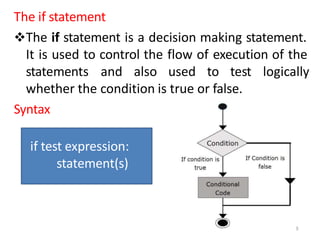
The if statement
The if statement is a decision making statement.
It is used to control the flow of execution of the
logically
statements and also used to test
whether the condition is true or false.
Syntax
if test expression:
statement(s)
3
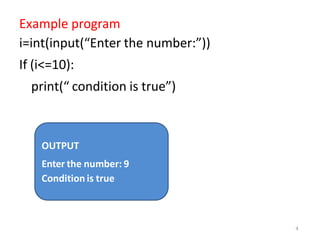
Example program
i=int(input(“Enter the number:”))
If (i<=10):
print(“ condition is true”)
OUTPUT
Enter the number: 9
Condition is true
4
If … else statement
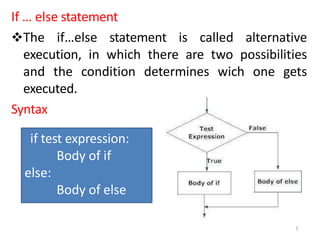
The if…else statement is called alternative
execution, in which there are two possibilities
and the condition determines wich one gets
executed.
Syntax
if test expression:
Body of if
else:
Body of else
5
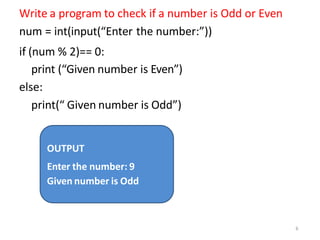
Write a program to check if a number is Odd or Even
num = int(input(“Enter the number:”))
if (num % 2)== 0:
print (“Given number is Even”)
else:
print(“ Given number is Odd”)
OUTPUT
Enter the number: 9
Given number is Odd
6
elif Statements
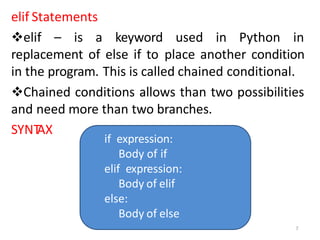
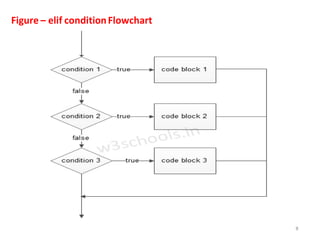
elif – is a keyword used in Python in
replacement of else if to place another condition
in the program. This is called chained conditional.
Chained conditions allows than two possibilities
and need more than two branches.
SYNT
AX
if expression:
Body of if
elif expression:
Body of elif
else:
Body of else
7
Figure – elif conditionFlowchart
8
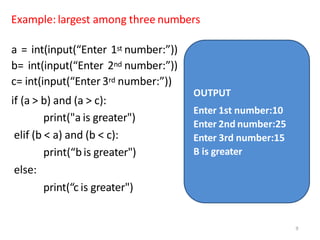
Example: largest among three numbers
a = int(input(“Enter 1st number:”))
b= int(input(“Enter 2nd number:”))
c= int(input(“Enter 3rd number:”))
if (a > b) and (a > c):
print("a is greater")
elif (b < a) and (b < c):
print(“bis greater")
else:
print(“c is greater")
OUTPUT
Enter 1st number:10
Enter 2nd number:25
Enter 3rd number:15
B is greater
9
10
Nested if … else Statements
We can write an entire if… else statement in
another if… else statement called nesting, and the
statement is called nested if.
 In a nested if construct, you can have an if … elif
… else construct inside an if … elif.. Else construct.
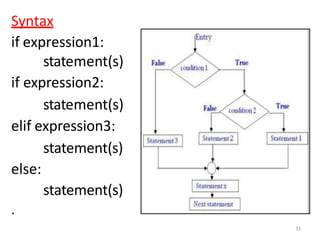
Syntax
if expression1:
statement(s)
if expression2:
statement(s)
elif expression3:
statement(s)
else:
statement(s)
.
11
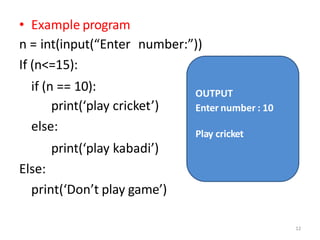
• Example program
n = int(input(“Enter number:”))
If (n<=15):
if (n == 10):
print(‘play cricket’)
else:
print(‘play kabadi’)
Else:
print(‘Don’t play game’)
OUTPUT
Enter number : 10
12
Play cricket
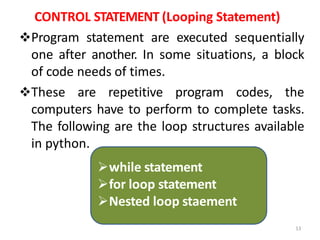
CONTROL STATEMENT (Looping Statement)
Program statement are executed sequentially
one after another. In some situations, a block
of code needs of times.
These are repetitive program codes, the
computers have to perform to complete tasks.
The following are the loop structures available
in python.
while statement
for loop statement
Nested loop staement
13
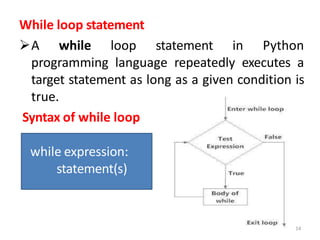
While loop statement
A while loop statement in Python
programming language repeatedly executes a
target statement as long as a given condition is
true.
Syntax of while loop
while expression:
statement(s)
14
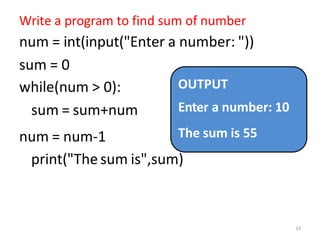
Write a program to find sum of number
num = int(input("Enter a number: "))
sum = 0
while(num > 0):
sum = sum+num
num = num-1
print("The sum is",sum)
OUTPUT
Enter a number: 10
The sum is 55
15
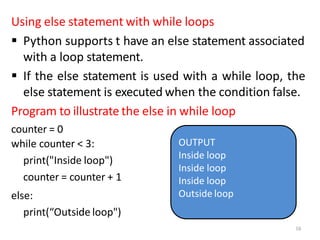
Using else statement with while loops
 Python supports t have an else statement associated
with a loop statement.
 If the else statement is used with a while loop, the
else statement is executed when the condition false.
Program to illustrate the else in while loop
counter = 0
while counter < 3:
print("Inside loop")
counter = counter + 1
else:
print(“Outside loop")
OUTPUT
Inside loop
Inside loop
Inside loop
Outside loop
16
17
For loop statement
The for loop is another repetitive control
structure, and is used to execute a set of
instructions repeatedly, until the condition
becomes false.
The for loop in Python is used to iterate over a
sequence (list, tuple, string) or other iterable
objects. Iterating over a sequence is called
traversal.
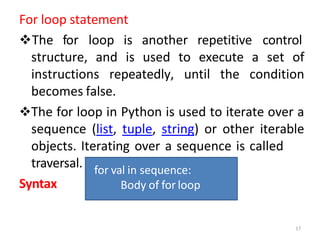
Syntax
for val in sequence:
Body of for loop
For loop flow chart
Addition of number using for loop
numbers = [6, 5, 3, 8, 4, 2, 5, 4]
sum1 = 0
for val in numbers:
sum1 = sum1+val
print("The sum is", sum1)
OUTPUT
The sum is 37
18
for Loop and for Loop with else
EX-01:
genre = ['pop', 'rock', 'jazz']
for i in range(len(genre)):
print("I like", genre[i])
EX-02:
genre = ['pop', 'rock', 'jazz']
for i in range(len(genre)):
print("I like", genre[i])
else:
print("No items left.")
OUTPUT
I like pop
I like rock
I like jazz
OUTPUT
I like pop
I like rock
I like jazz
No items left.

loops.pdf

  • 1.
    CONDITIONAL STATEMENTS and CONTROL STATEMENTS 1 Preparedby – AMAY JAISWAL CS (4A) , 2100290120027 Python Programming Kiet Group Of Institutions
  • 2.
    CONDITIONAL STATEMENTS (DecisionMaking) The basic decision statements in computer is selection structure. The decision is described to computer as a conditional statement that can be answered True or False. Python language provide the following conditional (Decision making) statements. if statement if...else statement if...elif...else staement Nested if..else statement 2
  • 3.
    The if statement Theif statement is a decision making statement. It is used to control the flow of execution of the logically statements and also used to test whether the condition is true or false. Syntax if test expression: statement(s) 3
  • 4.
    Example program i=int(input(“Enter thenumber:”)) If (i<=10): print(“ condition is true”) OUTPUT Enter the number: 9 Condition is true 4
  • 5.
    If … elsestatement The if…else statement is called alternative execution, in which there are two possibilities and the condition determines wich one gets executed. Syntax if test expression: Body of if else: Body of else 5
  • 6.
    Write a programto check if a number is Odd or Even num = int(input(“Enter the number:”)) if (num % 2)== 0: print (“Given number is Even”) else: print(“ Given number is Odd”) OUTPUT Enter the number: 9 Given number is Odd 6
  • 7.
    elif Statements elif –is a keyword used in Python in replacement of else if to place another condition in the program. This is called chained conditional. Chained conditions allows than two possibilities and need more than two branches. SYNT AX if expression: Body of if elif expression: Body of elif else: Body of else 7
  • 8.
    Figure – elifconditionFlowchart 8
  • 9.
    Example: largest amongthree numbers a = int(input(“Enter 1st number:”)) b= int(input(“Enter 2nd number:”)) c= int(input(“Enter 3rd number:”)) if (a > b) and (a > c): print("a is greater") elif (b < a) and (b < c): print(“bis greater") else: print(“c is greater") OUTPUT Enter 1st number:10 Enter 2nd number:25 Enter 3rd number:15 B is greater 9
  • 10.
    10 Nested if …else Statements We can write an entire if… else statement in another if… else statement called nesting, and the statement is called nested if.  In a nested if construct, you can have an if … elif … else construct inside an if … elif.. Else construct.
  • 11.
    Syntax if expression1: statement(s) if expression2: statement(s) elifexpression3: statement(s) else: statement(s) . 11
  • 12.
    • Example program n= int(input(“Enter number:”)) If (n<=15): if (n == 10): print(‘play cricket’) else: print(‘play kabadi’) Else: print(‘Don’t play game’) OUTPUT Enter number : 10 12 Play cricket
  • 13.
    CONTROL STATEMENT (LoopingStatement) Program statement are executed sequentially one after another. In some situations, a block of code needs of times. These are repetitive program codes, the computers have to perform to complete tasks. The following are the loop structures available in python. while statement for loop statement Nested loop staement 13
  • 14.
    While loop statement Awhile loop statement in Python programming language repeatedly executes a target statement as long as a given condition is true. Syntax of while loop while expression: statement(s) 14
  • 15.
    Write a programto find sum of number num = int(input("Enter a number: ")) sum = 0 while(num > 0): sum = sum+num num = num-1 print("The sum is",sum) OUTPUT Enter a number: 10 The sum is 55 15
  • 16.
    Using else statementwith while loops  Python supports t have an else statement associated with a loop statement.  If the else statement is used with a while loop, the else statement is executed when the condition false. Program to illustrate the else in while loop counter = 0 while counter < 3: print("Inside loop") counter = counter + 1 else: print(“Outside loop") OUTPUT Inside loop Inside loop Inside loop Outside loop 16
  • 17.
    17 For loop statement Thefor loop is another repetitive control structure, and is used to execute a set of instructions repeatedly, until the condition becomes false. The for loop in Python is used to iterate over a sequence (list, tuple, string) or other iterable objects. Iterating over a sequence is called traversal. Syntax for val in sequence: Body of for loop
  • 18.
    For loop flowchart Addition of number using for loop numbers = [6, 5, 3, 8, 4, 2, 5, 4] sum1 = 0 for val in numbers: sum1 = sum1+val print("The sum is", sum1) OUTPUT The sum is 37 18
  • 19.
    for Loop andfor Loop with else EX-01: genre = ['pop', 'rock', 'jazz'] for i in range(len(genre)): print("I like", genre[i]) EX-02: genre = ['pop', 'rock', 'jazz'] for i in range(len(genre)): print("I like", genre[i]) else: print("No items left.") OUTPUT I like pop I like rock I like jazz OUTPUT I like pop I like rock I like jazz No items left.