“Conversion of Sign Language to Text & Speech”
(Minor Project)
A Project Report Submitted
In Partial Fulfilment of the Requirements for the Degree of
MASTER OF COMPUTER APPLICATION
by
Deepti Verman
B2292R10400015
Under the Supervision of
Mr. Santosh Soni
Assistant Professor
Session: 2022-24
Department of Computer Science & Engineering
AKS University, Satna
(Madhya Pradesh)
CONTENT
• Introduction
• Objective & Problem Statement
• System Requirement Specification
• System Architecture
• Overview of Approach
• Pre-Processing Data (Testing)
• Model Building & Layers
• Data Flow Diagram
• Result & Analysis
• Advantages & Disadvantages
• Future Enhancement
• Conclusion
INTRODUCTION
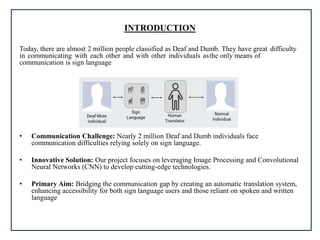
Today, there are almost 2 million people classified as Deaf and Dumb. They have great difficulty
in communicating with each other and with other individuals asthe only means of
communication is sign language
• Communication Challenge: Nearly 2 million Deaf and Dumb individuals face
communication difficulties relying solely on sign language.
• Innovative Solution: Our project focuses on leveraging Image Processing and Convolutional
Neural Networks (CNN) to develop cutting-edge technologies.
• Primary Aim: Bridging the communication gap by creating an automatic translation system,
enhancing accessibility for both sign language users and those reliant on spoken and written
language
OBJECTIVE & PROBLEM STATEMENT
Objective:
• Develop innovative technologies for seamless communication between sign language users and
those relying on spoken and written language.
• Utilize Image Processing and Convolutional Neural Networks (CNN) for accurate interpretation and
conversion of sign language gestures.
• Enhance accessibility and inclusivity by creating systems that convert sign language into both
written text and audible speech.
Problem Statement:
• Limited accessibility and communication inequality for Deaf and Dumb individuals.
• Existing technological gaps hinder the development of advanced solutions for interpreting sign
language gestures.
• Challenges contribute to inclusivity struggles, limiting effective communication for individuals with
diverse communication needs.
• The project aims to overcome these challenges by implementing advanced technologies to bridge
the communication gap.
SYSTEM REQUIREMENT
1. Purpose:
1. Provide a detailed description of the Sign Language to Text translator system for
both developers and users.
2. Scope:
1. Primarily intended for developing an Interpreter for sign language.
2. Applications extend to business communication and unique sign language
development for security purposes.
3. Users include deaf and mute individuals, businesses, and security personnel.
3. Functional Requirements:
1. Translate sign language into text, accommodating both single characters and
complete words.
2. Image pre-processing to modify captured images for training the model in signal
classification.
4. Non-Functional Requirements:
1. Designed to facilitate communication for disabled individuals.
2. Emphasis on efficiency for accurate and fast sign translation, overcoming
limitations of previous slow and inefficient devices.
3. Software designed for easy modification and efficient maintenance.
SYSTEM ARCHITECTURE
Objective: Classify gestures and label them using a trained CNN model. Train the system on labeled
images for accurate interpretation and conversion of sign language gestures.
Training Process: Utilize labeled images of gestures for Convolutional Neural Network (CNN)
model training. Multiple copies of each gesture image are created for efficient
feature extraction. New gestures are signaled in front of the connected camera,
recording and matching them with trained models for real-time translation.
User Interface: Allows users to add new gestures and train the model. Directs users to a "hand
recognition" window for performing gestures. Provides options for translating sign
language to text, both character by character and concatenated to form complete
words
Gesture Categories: A total of 44 gestures are trained, including 26 English alphabets, 10 numeric
digits, and 8 commonly used symbols. Each gesture has 1200 images captured,
flipped, resized to 50x50 pixels, and converted to grayscale for training.
OVERVIEW OF APPROACH
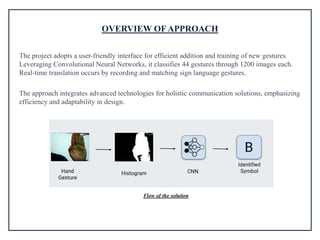
The project adopts a user-friendly interface for efficient addition and training of new gestures.
Leveraging Convolutional Neural Networks, it classifies 44 gestures through 1200 images each.
Real-time translation occurs by recording and matching sign language gestures.
The approach integrates advanced technologies for holistic communication solutions, emphasizing
efficiency and adaptability in design.
Flow of the solution
PRE-PROCESSING DATA (TESTING)
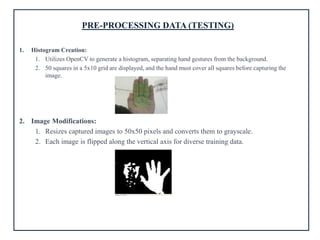
1. Histogram Creation:
1. Utilizes OpenCV to generate a histogram, separating hand gestures from the background.
2. 50 squares in a 5x10 grid are displayed, and the hand must cover all squares before capturing the
image.
2. Image Modifications:
1. Resizes captured images to 50x50 pixels and converts them to grayscale.
2. Each image is flipped along the vertical axis for diverse training data.
PRE-PROCESSING DATA (TESTING) (Contd…)
3. Convolution:
1. Applies convolution with feature detectors to create feature maps for efficient
feature detection.
2. The main aim is to identify and highlight relevant features in the gesture images.
4. ReLu Layer:
1. Passes the convoluted image through the Rectifier function to increase non-linearity.
2. Enhances the features extracted from the image, preparing them for further
processing.
5. Max Pooling:
1. Selects the maximum value in small grids, reducing data size and preserving
essential features.
2. Resolves issues related to variations in feature size and orientation.
6. Flattening:
1. Flattens the pooled image features to transform them into columns.
2. Prepares the data for input into the Artificial Neural Network
MODEL BUILDING & LAYER
• Convolutional Neural Network (CNN): The primary model architecture for image
classification and feature extraction. Utilizes convolutional layers for
detecting and learning relevant features from the pre-processed
gesture images.
• Activation Function - ReLu Layer: Applied after convolution to introduce non-linearity in
the image. Enhances the network's ability to capture complex
patterns and relationships in the gesture features.
• Max Pooling Layer: Reduces data size by selecting the maximum value within small grids in
the feature maps. Aims to retain essential features while discarding redundant
information.
• Flattening Layer: Transforms the output of the max pooling layer into a flat array. Prepares the data
for input into the Artificial Neural Network.
• Artificial Neural Network (ANN): Incorporates fully connected layers for complex pattern
recognition and classification. Receives the flattened features from the
CNN to make predictions and classify sign language gestures.
• Output Layer: Produces the final output, representing the classification or label of the sign
language gesture. The number of nodes corresponds to the total number of defined
gesture categories.
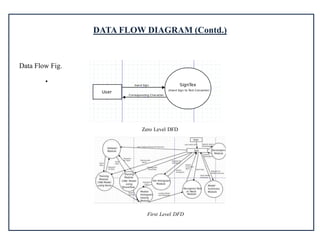
DATA FLOW DIAGRAM
Input: Gesture Input: Real-time sign language gestures captured by the camera.
Pre-processed Images: Resized, flipped, and grayscale images ready for analysis.
Process: Image Processing Module: Enhances images through operations like histogram creation,
convolution, and flattening.
CNN Model Training: Processes pre-processed images to train a Convolutional Neural
Network for gesture classification.
Output: Trained Model: Result of CNN model training, capable of accurately classifying sign language
gestures.
Real-Time Translation: New gestures recorded by the camera are processed by the trained model,
providing real-time translation.
User Interaction: User Interface: Allows users to add gestures, initiate training, and choose translation
options.
Output Window: Displays translated text for user understanding
DATA FLOW DIAGRAM (Contd.)
Data Flow Fig.
.
Zero Level DFD
First Level DFD
RESULT & ANALYSIS
• Results:
1. Precision Translations:
1. Sign language accurately translated into English alphabet characters.
2. Successful outputs demonstrate precise concatenation for word formation.
2. Effectiveness of Convolutional and Dense Layers:
1. Convolutional and dense layers capture spatial features and complex
relationships effectively.
2. Model proficiency validated through coherent and accurate output.
3. Continuous Monitoring Importance:
1. Ongoing evaluation through confusion matrix and metrics essential for model
robustness.
2. Fine-tuning and optimization based on analysis contribute to refinement.
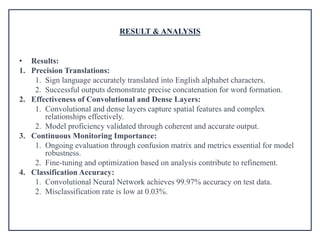
4. Classification Accuracy:
1. Convolutional Neural Network achieves 99.97% accuracy on test data.
2. Misclassification rate is low at 0.03%.
Contd…
• Analysis:
1. Precision and Accuracy:
1. Precise translation suggests high precision, crucial for accurate predictions.
2. High accuracy implied by successful translations, showcasing model effectiveness.
2. Recall:
1. Precise translated outputs indicate high recall, capturing true positive cases effectively.
2. Model adept at recognizing and translating relevant sign language gestures.
3. False Positives and False Negatives:
1. Absence of reported false positives or false negatives suggests correct translations and
minimal misclassification.
2. Rigorous evaluation required for critical insights.
4. Continuous Monitoring and Refinement:
1. Translator accuracy increases with more epochs and images for each gesture.
2. Ongoing monitoring through confusion matrix aids in identifying and addressing evolving
challenges.
ADVANTAGES & DISADVATAGES
• Advantages:
1. Precision Translation:
Achieves precise translation for accurate communication.
2. Effective Layer Utilization:
Convolutional and dense layers capture spatial features effectively.
3. Continuous Monitoring:
Ongoing evaluation and refinement through a confusion matrix.
• Disadvantages:
1. Overfitting Risk:
Risk increases with more epochs during training.
2. Misclassification Challenges:
Continuous monitoring needed to address potential misclassifications.
3. Dependency on Image Quality:
Model performance may be affected by input image quality.
FUTURE ENHANCEMENT
1. Gesture Vocabulary Expansion:
1. Increase the vocabulary of recognized sign language gestures for broader
communication.
2. Real-time Interaction:
1. Implement real-time translation to enhance immediacy in communication.
3. Multilingual Support:
1. Integrate support for multiple languages to cater to diverse user needs.
4. User-Defined Gestures:
1. Allow users to define and train the system for personalized gestures, enhancing
customization.
CONCLUSION
In conclusion, the "Conversion of Sign Language into Text and Speech" model stands as a
promising solution to bridge communication gaps for the deaf and mute community. Its precision
in translating gestures, effective use of advanced layers, and continuous monitoring for refinement
showcase its potential.
Future enhancements, including gesture vocabulary expansion and real-time interaction,
underscore the commitment to improving accessibility.
As technology advances, this model serves as a significant step towards a more inclusive and
seamless communication experience for individuals using sign language.
THANK YOU

Presentation_Conversion of Sign language to text.pptx

  • 1.
    “Conversion of SignLanguage to Text & Speech” (Minor Project) A Project Report Submitted In Partial Fulfilment of the Requirements for the Degree of MASTER OF COMPUTER APPLICATION by Deepti Verman B2292R10400015 Under the Supervision of Mr. Santosh Soni Assistant Professor Session: 2022-24 Department of Computer Science & Engineering AKS University, Satna (Madhya Pradesh)
  • 2.
    CONTENT • Introduction • Objective& Problem Statement • System Requirement Specification • System Architecture • Overview of Approach • Pre-Processing Data (Testing) • Model Building & Layers • Data Flow Diagram • Result & Analysis • Advantages & Disadvantages • Future Enhancement • Conclusion
  • 3.
    INTRODUCTION Today, there arealmost 2 million people classified as Deaf and Dumb. They have great difficulty in communicating with each other and with other individuals asthe only means of communication is sign language • Communication Challenge: Nearly 2 million Deaf and Dumb individuals face communication difficulties relying solely on sign language. • Innovative Solution: Our project focuses on leveraging Image Processing and Convolutional Neural Networks (CNN) to develop cutting-edge technologies. • Primary Aim: Bridging the communication gap by creating an automatic translation system, enhancing accessibility for both sign language users and those reliant on spoken and written language
  • 4.
    OBJECTIVE & PROBLEMSTATEMENT Objective: • Develop innovative technologies for seamless communication between sign language users and those relying on spoken and written language. • Utilize Image Processing and Convolutional Neural Networks (CNN) for accurate interpretation and conversion of sign language gestures. • Enhance accessibility and inclusivity by creating systems that convert sign language into both written text and audible speech. Problem Statement: • Limited accessibility and communication inequality for Deaf and Dumb individuals. • Existing technological gaps hinder the development of advanced solutions for interpreting sign language gestures. • Challenges contribute to inclusivity struggles, limiting effective communication for individuals with diverse communication needs. • The project aims to overcome these challenges by implementing advanced technologies to bridge the communication gap.
  • 5.
    SYSTEM REQUIREMENT 1. Purpose: 1.Provide a detailed description of the Sign Language to Text translator system for both developers and users. 2. Scope: 1. Primarily intended for developing an Interpreter for sign language. 2. Applications extend to business communication and unique sign language development for security purposes. 3. Users include deaf and mute individuals, businesses, and security personnel. 3. Functional Requirements: 1. Translate sign language into text, accommodating both single characters and complete words. 2. Image pre-processing to modify captured images for training the model in signal classification. 4. Non-Functional Requirements: 1. Designed to facilitate communication for disabled individuals. 2. Emphasis on efficiency for accurate and fast sign translation, overcoming limitations of previous slow and inefficient devices. 3. Software designed for easy modification and efficient maintenance.
  • 6.
    SYSTEM ARCHITECTURE Objective: Classifygestures and label them using a trained CNN model. Train the system on labeled images for accurate interpretation and conversion of sign language gestures. Training Process: Utilize labeled images of gestures for Convolutional Neural Network (CNN) model training. Multiple copies of each gesture image are created for efficient feature extraction. New gestures are signaled in front of the connected camera, recording and matching them with trained models for real-time translation. User Interface: Allows users to add new gestures and train the model. Directs users to a "hand recognition" window for performing gestures. Provides options for translating sign language to text, both character by character and concatenated to form complete words Gesture Categories: A total of 44 gestures are trained, including 26 English alphabets, 10 numeric digits, and 8 commonly used symbols. Each gesture has 1200 images captured, flipped, resized to 50x50 pixels, and converted to grayscale for training.
  • 7.
    OVERVIEW OF APPROACH Theproject adopts a user-friendly interface for efficient addition and training of new gestures. Leveraging Convolutional Neural Networks, it classifies 44 gestures through 1200 images each. Real-time translation occurs by recording and matching sign language gestures. The approach integrates advanced technologies for holistic communication solutions, emphasizing efficiency and adaptability in design. Flow of the solution
  • 8.
    PRE-PROCESSING DATA (TESTING) 1.Histogram Creation: 1. Utilizes OpenCV to generate a histogram, separating hand gestures from the background. 2. 50 squares in a 5x10 grid are displayed, and the hand must cover all squares before capturing the image. 2. Image Modifications: 1. Resizes captured images to 50x50 pixels and converts them to grayscale. 2. Each image is flipped along the vertical axis for diverse training data.
  • 9.
    PRE-PROCESSING DATA (TESTING)(Contd…) 3. Convolution: 1. Applies convolution with feature detectors to create feature maps for efficient feature detection. 2. The main aim is to identify and highlight relevant features in the gesture images. 4. ReLu Layer: 1. Passes the convoluted image through the Rectifier function to increase non-linearity. 2. Enhances the features extracted from the image, preparing them for further processing. 5. Max Pooling: 1. Selects the maximum value in small grids, reducing data size and preserving essential features. 2. Resolves issues related to variations in feature size and orientation. 6. Flattening: 1. Flattens the pooled image features to transform them into columns. 2. Prepares the data for input into the Artificial Neural Network
  • 10.
    MODEL BUILDING &LAYER • Convolutional Neural Network (CNN): The primary model architecture for image classification and feature extraction. Utilizes convolutional layers for detecting and learning relevant features from the pre-processed gesture images. • Activation Function - ReLu Layer: Applied after convolution to introduce non-linearity in the image. Enhances the network's ability to capture complex patterns and relationships in the gesture features. • Max Pooling Layer: Reduces data size by selecting the maximum value within small grids in the feature maps. Aims to retain essential features while discarding redundant information. • Flattening Layer: Transforms the output of the max pooling layer into a flat array. Prepares the data for input into the Artificial Neural Network. • Artificial Neural Network (ANN): Incorporates fully connected layers for complex pattern recognition and classification. Receives the flattened features from the CNN to make predictions and classify sign language gestures. • Output Layer: Produces the final output, representing the classification or label of the sign language gesture. The number of nodes corresponds to the total number of defined gesture categories.
  • 11.
    DATA FLOW DIAGRAM Input:Gesture Input: Real-time sign language gestures captured by the camera. Pre-processed Images: Resized, flipped, and grayscale images ready for analysis. Process: Image Processing Module: Enhances images through operations like histogram creation, convolution, and flattening. CNN Model Training: Processes pre-processed images to train a Convolutional Neural Network for gesture classification. Output: Trained Model: Result of CNN model training, capable of accurately classifying sign language gestures. Real-Time Translation: New gestures recorded by the camera are processed by the trained model, providing real-time translation. User Interaction: User Interface: Allows users to add gestures, initiate training, and choose translation options. Output Window: Displays translated text for user understanding
  • 12.
    DATA FLOW DIAGRAM(Contd.) Data Flow Fig. . Zero Level DFD First Level DFD
  • 13.
    RESULT & ANALYSIS •Results: 1. Precision Translations: 1. Sign language accurately translated into English alphabet characters. 2. Successful outputs demonstrate precise concatenation for word formation. 2. Effectiveness of Convolutional and Dense Layers: 1. Convolutional and dense layers capture spatial features and complex relationships effectively. 2. Model proficiency validated through coherent and accurate output. 3. Continuous Monitoring Importance: 1. Ongoing evaluation through confusion matrix and metrics essential for model robustness. 2. Fine-tuning and optimization based on analysis contribute to refinement. 4. Classification Accuracy: 1. Convolutional Neural Network achieves 99.97% accuracy on test data. 2. Misclassification rate is low at 0.03%.
  • 14.
    Contd… • Analysis: 1. Precisionand Accuracy: 1. Precise translation suggests high precision, crucial for accurate predictions. 2. High accuracy implied by successful translations, showcasing model effectiveness. 2. Recall: 1. Precise translated outputs indicate high recall, capturing true positive cases effectively. 2. Model adept at recognizing and translating relevant sign language gestures. 3. False Positives and False Negatives: 1. Absence of reported false positives or false negatives suggests correct translations and minimal misclassification. 2. Rigorous evaluation required for critical insights. 4. Continuous Monitoring and Refinement: 1. Translator accuracy increases with more epochs and images for each gesture. 2. Ongoing monitoring through confusion matrix aids in identifying and addressing evolving challenges.
  • 15.
    ADVANTAGES & DISADVATAGES •Advantages: 1. Precision Translation: Achieves precise translation for accurate communication. 2. Effective Layer Utilization: Convolutional and dense layers capture spatial features effectively. 3. Continuous Monitoring: Ongoing evaluation and refinement through a confusion matrix. • Disadvantages: 1. Overfitting Risk: Risk increases with more epochs during training. 2. Misclassification Challenges: Continuous monitoring needed to address potential misclassifications. 3. Dependency on Image Quality: Model performance may be affected by input image quality.
  • 16.
    FUTURE ENHANCEMENT 1. GestureVocabulary Expansion: 1. Increase the vocabulary of recognized sign language gestures for broader communication. 2. Real-time Interaction: 1. Implement real-time translation to enhance immediacy in communication. 3. Multilingual Support: 1. Integrate support for multiple languages to cater to diverse user needs. 4. User-Defined Gestures: 1. Allow users to define and train the system for personalized gestures, enhancing customization.
  • 17.
    CONCLUSION In conclusion, the"Conversion of Sign Language into Text and Speech" model stands as a promising solution to bridge communication gaps for the deaf and mute community. Its precision in translating gestures, effective use of advanced layers, and continuous monitoring for refinement showcase its potential. Future enhancements, including gesture vocabulary expansion and real-time interaction, underscore the commitment to improving accessibility. As technology advances, this model serves as a significant step towards a more inclusive and seamless communication experience for individuals using sign language.
  • 18.