INTRODUCTION
• HIV is a lentivirus causing AIDS.
• RNA virus with reverse transcription.
• Two types: HIV-1 and HIV-2.
• HIV-1 causes global pandemic.
• HIV-2 progresses slowly and less transmissible.
• HIV-2 is resistant to some drugs.
EPIDEMIOLOGY
HIV spreads in different ways:
• Men who have sex with men
• Sharing of sharp objects
• Heterosexual intercourse Factors that contribute to spread:
• Poverty
• Domestic violence
• Poor education, medical care
TRANSMISSION
• HIV transmission modes:
• Blood, semen, vaginal fluids carry HIV.
• Unprotected sex, blood transfusion spread HIV.
• Skin grafts, organ transplants, semen can spread.
• Sharing needles, mother-to-baby transmission, HIV.
• Needle stick injuries, splashing transmit HIV.
LIFE CYCLE
• Virus life cycle steps:
• Binding, fusion, entry.
• Reverse transcription prone to errors.
• Integration: makes HIV incurable.
• Transcription and translation occur next.
• Assembly, budding, and maturation follow.
PHARMACOTHERAPY OF ANTIRETROVIRAL AGENTS
• HIV antiretroviral agents act by interfering with important functions in
the viral life-cycle.
• These agents include;
• Nucleoside reverse transcriptase inhibitors
• Non - nucleoside reverse transcriptase inhibitors
• Protease inhibitors
• CCR5 receptor antagonists
• Integrase strand transfer inhibitors (insti)
NUCLEOSIDE AND NUCLEOTIDE
REVERSE TRANSCRIPTASE INHIBITORS
(NRTIS)
• Nucleoside inhibitors stop HIV spread
• Drugs block viral replication, lack 3-hydroxyl
• Must be triphosphorylated for activity
• Inhibit HIV-1 and HIV-2 and other retroviruses
• Toxicity from mitochondrial DNA synthesis inhibition
• Eliminated via renal excretion, dosed daily Slow resistance compared
to other drugs.
EXAMPLES OF NNRTIS
 Zidovudine
 Didanosin
 Zalcitabine
 Lamivudine
 Abacavir
 Tenofovir
 Emtricitabine
NON-NUCLEOSIDE REVERSE
TRANSCRIPTASE INHIBITORS (NNRTIS)
• NNRTIs inhibit viral DNA formation
• Chemicals bind to reverse transcriptase enzyme
• Compounds induce enzyme conformational change
• No intracellular phosphorylation required for activity
• Effective against HIV-1, not HIV-2
• No activity against host cell DNA
CONT
• NNRTIs metabolized by liver.
• Efavirenz & nevirapine have 24-72 hr half-lives.
• Single-amino acid change can cause drug resistance.
• NNRTIs can induce resistance and relapse.
• Combination with other drugs is effective.
• Rashes and fat accumulation are common side effects.
CONT
• HIV protease inhibitors cleared by liver metabolism,
• Elimination half-lives vary from 1.8 to 10 hours,
• High interindividual variability in pharmacokinetics,
• Less penetration into semen than other drugs,
• Intermediate resistance development speed compared to other
drugs,
• Effective for long-term HIV suppression with some toxicities.
• Examples of protease Inhibitors
• SAQUINAVIR
• ATAZANAVIR
• LOPINAVIR‡
• FOSAMPRENAVIR
• AMPRENAVIR
• NELFINAVIR
• RITONAVIR
• INDINAVIR
ENTRY INHIBITORS
Enfuvirtide blocks HIV entry process
Targets gp41 subunit, given subcutaneously
Injection site reactions are common
Used in combination therapies with CD4
Prevents viral membrane fusion with host
Entry inhibitors for HIV prevention.
CCR5 RECEPTOR ANTAGONISTS
Antiviral drug blocks HIV entry
Targets CCR5 receptor on host cells
Used for resistant R5 HIV
Many drug interactions and side effects
Maraviroc is one example
Prevents conformational change in viral envelope
INTEGRASE STRAND TRANSFER INHIBITORS
(INSTI)
• INSTI stops HIV DNA integration process
• Integrase enzyme blocked by INSTI
• Viral enzyme binding prevents strand transfer
• Replication of HIV is inhibited
• Host cell DNA is protected by INSTI
• Pro-viral DNA integration is interferes
• Raltegravir, Elvitegravir, Dolutegravir - INSTI drugs.
FIXED DOSE COMBINATIONS
•
FDCs simplify drug logistics management.
• Reduced pill burden improves adherence.
• Appropriate combinations avoid toxicities, interactions.
• Consider patient factors and virus characteristics.
• Selection based on disease symptoms and illnesses.
• Frequently complex regimens require ease
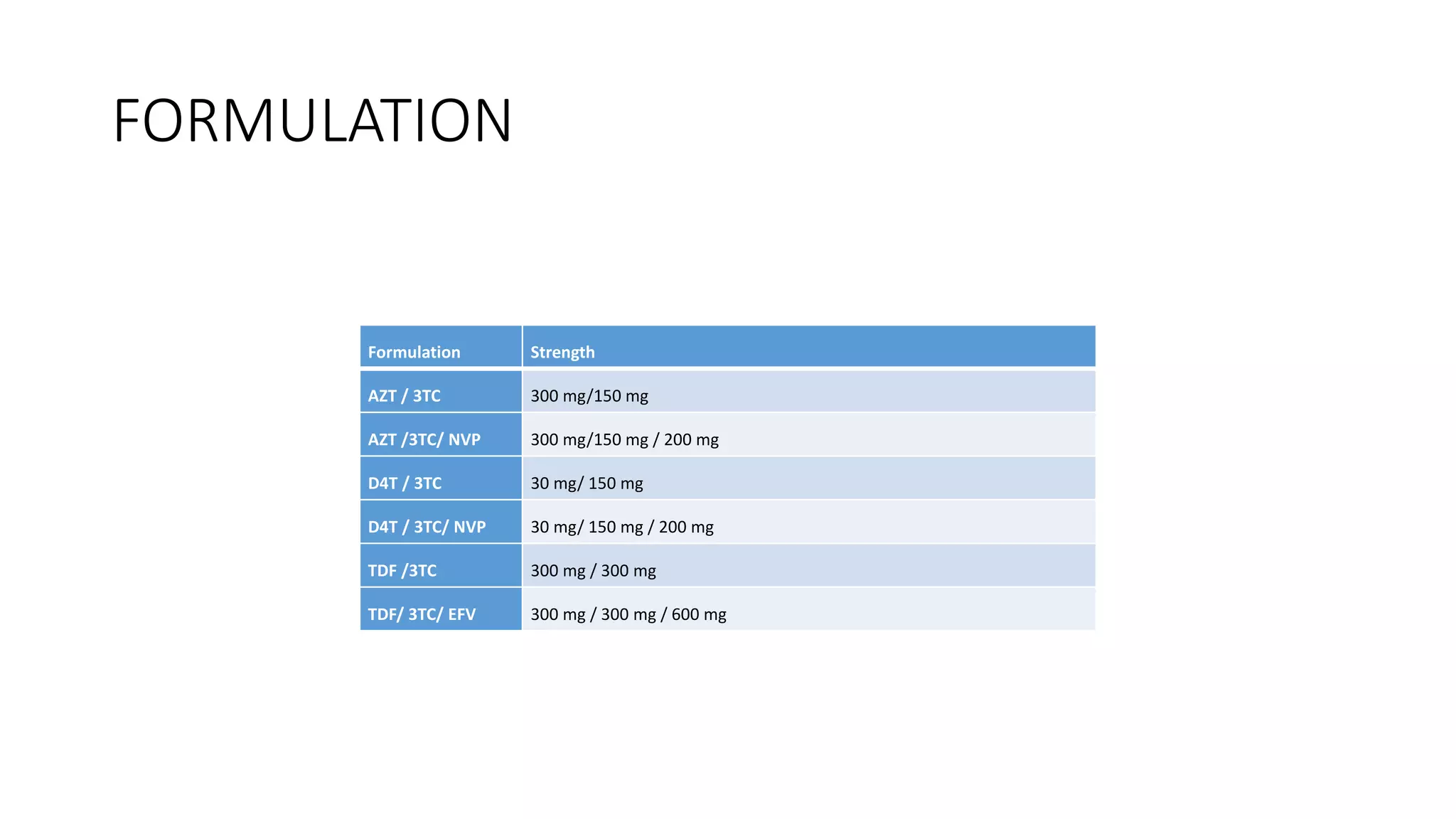
FORMULATION
Formulation Strength
AZT / 3TC 300 mg/150 mg
AZT /3TC/ NVP 300 mg/150 mg / 200 mg
D4T / 3TC 30 mg/ 150 mg
D4T / 3TC/ NVP 30 mg/ 150 mg / 200 mg
TDF /3TC 300 mg / 300 mg
TDF/ 3TC/ EFV 300 mg / 300 mg / 600 mg
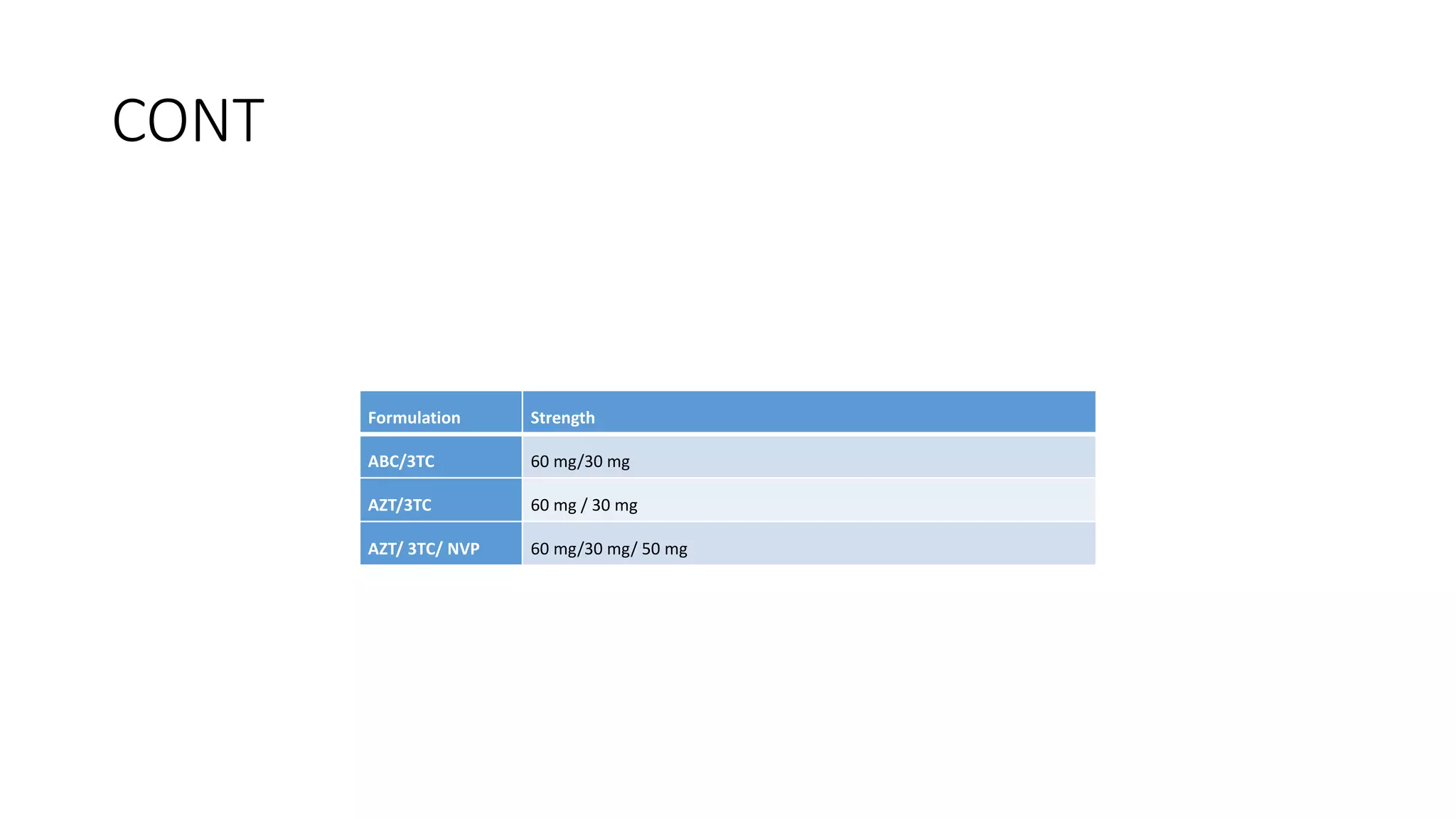
CONT
Formulation Strength
ABC/3TC 60 mg/30 mg
AZT/3TC 60 mg / 30 mg
AZT/ 3TC/ NVP 60 mg/30 mg/ 50 mg
Goals of therapy
 To maximally and durably suppress viral load replication,
 To restore and preserve immunologic function,
 To reduce HIV-related morbidity and mortality,
 To improve quality of life
SUMMARY
• HIV is a retrovirus causing AIDS
• Spread through blood, sex, breast milk
• Distinct patterns men who have sex with men
• Sharp object sharing and heterosexual intercourse
• Virus found in various body fluids
• Therapeutic drug targets in its life cycle
CONT
• HIV treatment: PIs block protease
• NRTIs reverse transcriptase inhibitors
• NNRTIs reverse transcriptase inhibitors too
• Entry inhibitors prevent virus entry
• CCR5 antagonists block viral binding
• INSTIs block viral integration process.

Presentation1.pptx

  • 2.
    INTRODUCTION • HIV isa lentivirus causing AIDS. • RNA virus with reverse transcription. • Two types: HIV-1 and HIV-2. • HIV-1 causes global pandemic. • HIV-2 progresses slowly and less transmissible. • HIV-2 is resistant to some drugs.
  • 3.
    EPIDEMIOLOGY HIV spreads indifferent ways: • Men who have sex with men • Sharing of sharp objects • Heterosexual intercourse Factors that contribute to spread: • Poverty • Domestic violence • Poor education, medical care
  • 4.
    TRANSMISSION • HIV transmissionmodes: • Blood, semen, vaginal fluids carry HIV. • Unprotected sex, blood transfusion spread HIV. • Skin grafts, organ transplants, semen can spread. • Sharing needles, mother-to-baby transmission, HIV. • Needle stick injuries, splashing transmit HIV.
  • 5.
    LIFE CYCLE • Viruslife cycle steps: • Binding, fusion, entry. • Reverse transcription prone to errors. • Integration: makes HIV incurable. • Transcription and translation occur next. • Assembly, budding, and maturation follow.
  • 6.
    PHARMACOTHERAPY OF ANTIRETROVIRALAGENTS • HIV antiretroviral agents act by interfering with important functions in the viral life-cycle. • These agents include; • Nucleoside reverse transcriptase inhibitors • Non - nucleoside reverse transcriptase inhibitors • Protease inhibitors • CCR5 receptor antagonists • Integrase strand transfer inhibitors (insti)
  • 7.
    NUCLEOSIDE AND NUCLEOTIDE REVERSETRANSCRIPTASE INHIBITORS (NRTIS) • Nucleoside inhibitors stop HIV spread • Drugs block viral replication, lack 3-hydroxyl • Must be triphosphorylated for activity • Inhibit HIV-1 and HIV-2 and other retroviruses • Toxicity from mitochondrial DNA synthesis inhibition • Eliminated via renal excretion, dosed daily Slow resistance compared to other drugs.
  • 8.
    EXAMPLES OF NNRTIS Zidovudine  Didanosin  Zalcitabine  Lamivudine  Abacavir  Tenofovir  Emtricitabine
  • 9.
    NON-NUCLEOSIDE REVERSE TRANSCRIPTASE INHIBITORS(NNRTIS) • NNRTIs inhibit viral DNA formation • Chemicals bind to reverse transcriptase enzyme • Compounds induce enzyme conformational change • No intracellular phosphorylation required for activity • Effective against HIV-1, not HIV-2 • No activity against host cell DNA
  • 10.
    CONT • NNRTIs metabolizedby liver. • Efavirenz & nevirapine have 24-72 hr half-lives. • Single-amino acid change can cause drug resistance. • NNRTIs can induce resistance and relapse. • Combination with other drugs is effective. • Rashes and fat accumulation are common side effects.
  • 11.
    CONT • HIV proteaseinhibitors cleared by liver metabolism, • Elimination half-lives vary from 1.8 to 10 hours, • High interindividual variability in pharmacokinetics, • Less penetration into semen than other drugs, • Intermediate resistance development speed compared to other drugs, • Effective for long-term HIV suppression with some toxicities.
  • 12.
    • Examples ofprotease Inhibitors • SAQUINAVIR • ATAZANAVIR • LOPINAVIR‡ • FOSAMPRENAVIR • AMPRENAVIR • NELFINAVIR • RITONAVIR • INDINAVIR
  • 13.
    ENTRY INHIBITORS Enfuvirtide blocksHIV entry process Targets gp41 subunit, given subcutaneously Injection site reactions are common Used in combination therapies with CD4 Prevents viral membrane fusion with host Entry inhibitors for HIV prevention.
  • 14.
    CCR5 RECEPTOR ANTAGONISTS Antiviraldrug blocks HIV entry Targets CCR5 receptor on host cells Used for resistant R5 HIV Many drug interactions and side effects Maraviroc is one example Prevents conformational change in viral envelope
  • 15.
    INTEGRASE STRAND TRANSFERINHIBITORS (INSTI) • INSTI stops HIV DNA integration process • Integrase enzyme blocked by INSTI • Viral enzyme binding prevents strand transfer • Replication of HIV is inhibited • Host cell DNA is protected by INSTI • Pro-viral DNA integration is interferes • Raltegravir, Elvitegravir, Dolutegravir - INSTI drugs.
  • 16.
    FIXED DOSE COMBINATIONS • FDCssimplify drug logistics management. • Reduced pill burden improves adherence. • Appropriate combinations avoid toxicities, interactions. • Consider patient factors and virus characteristics. • Selection based on disease symptoms and illnesses. • Frequently complex regimens require ease
  • 17.
    FORMULATION Formulation Strength AZT /3TC 300 mg/150 mg AZT /3TC/ NVP 300 mg/150 mg / 200 mg D4T / 3TC 30 mg/ 150 mg D4T / 3TC/ NVP 30 mg/ 150 mg / 200 mg TDF /3TC 300 mg / 300 mg TDF/ 3TC/ EFV 300 mg / 300 mg / 600 mg
  • 18.
    CONT Formulation Strength ABC/3TC 60mg/30 mg AZT/3TC 60 mg / 30 mg AZT/ 3TC/ NVP 60 mg/30 mg/ 50 mg
  • 19.
    Goals of therapy To maximally and durably suppress viral load replication,  To restore and preserve immunologic function,  To reduce HIV-related morbidity and mortality,  To improve quality of life
  • 20.
    SUMMARY • HIV isa retrovirus causing AIDS • Spread through blood, sex, breast milk • Distinct patterns men who have sex with men • Sharp object sharing and heterosexual intercourse • Virus found in various body fluids • Therapeutic drug targets in its life cycle
  • 21.
    CONT • HIV treatment:PIs block protease • NRTIs reverse transcriptase inhibitors • NNRTIs reverse transcriptase inhibitors too • Entry inhibitors prevent virus entry • CCR5 antagonists block viral binding • INSTIs block viral integration process.