 Little by little, Internet and mobile technology seems to
be subtly destroying the meaningfulness of interactions
we have with others.
 Disconnecting us from the world around us, and
leading to an imminent sense of isolation in today’s
society.
 Instead of spending time in person with friends, we
just call, text or instant message them.
 Technological detachment doesn’t just apply to our
friends; it applies to the world around us.
 There’s something intangibly real and valuable about
talking with someone face-to-face. It’s significant for
friends, partners, potential employers, and other
recurring people that make up your everyday world.
 That person becomes an important existing human
connection, not just someone whose disembodied text
voice pops up on your cell phone, ipad or computer
screen.
 The more advanced society becomes
technologically, the more people begin to depend on
computers and other forms of technology for everyday
existence.
 This means that when a machine breaks or a computer
crashes, humans become almost disabled until the
problem is resolved.
 This kind of dependency on technology puts people at
a distinct disadvantage, because they become less self
reliant.
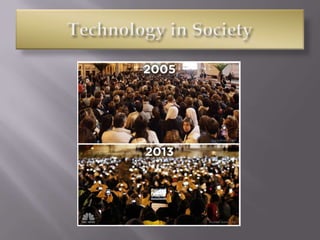
 The top photo was taken in 2005 – two years before the
debut of the first iphone – when visitors faithfully
gathered to witness Pope John Paul II’s body being
carried into the Basilica for public viewing.
 The bottom photo is from 2013 – when Pope Francis
made his inaugural public appearance.
 At first glance, these two seem almost ordinary but
when putting them together, any of us can feel the
impression of how technology is changing the world.
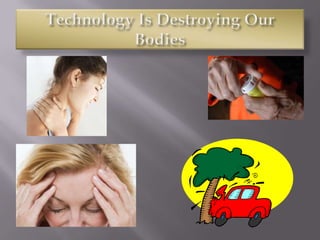
 Mobile technology has become an integral part of our
lives, but what most people don’t realize is the
potential harm your mobile device could cause.
 Computer Vision Syndrome or CVS, is caused by
looking at screens, including smart phone screens.
 Dry eyes – we normally blink 16-20 times a minute, but
while looking at a cell phone we blink just 6-8 times.
 Headaches – poor neck position and eye strain increase
the chances of headaches.
 Blurry vision – strained ocular muscles can no longer
focus at varying distances, while this is temporary at
first, it can become permanent.
 Eventual nearsightness – focusing on a screen for long
periods of time stains the eye muscles, which are
designed to focus naturally about 20 feet away.
 37% of mobile users are likely to develop tinnitus
(ringing in the ear).
 Users who average 10 minutes or more per day
increase their chances of tinnitus development to 71%.
 There are virtually no cures for the effects of tinnitus.
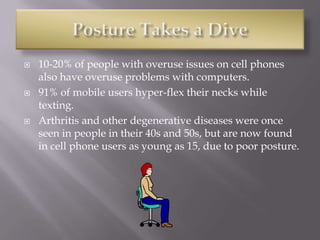
 10-20% of people with overuse issues on cell phones
also have overuse problems with computers.
 91% of mobile users hyper-flex their necks while
texting.
 Arthritis and other degenerative diseases were once
seen in people in their 40s and 50s, but are now found
in cell phone users as young as 15, due to poor posture.
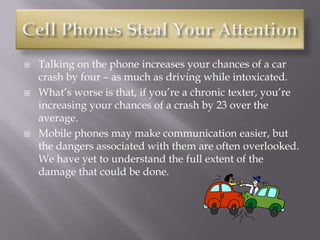
 Talking on the phone increases your chances of a car
crash by four – as much as driving while intoxicated.
 What’s worse is that, if you’re a chronic texter, you’re
increasing your chances of a crash by 23 over the
average.
 Mobile phones may make communication easier, but
the dangers associated with them are often overlooked.
We have yet to understand the full extent of the
damage that could be done.
 It seems we have more extended connections than ever
in this digital world, which can be great for
networking, if it’s used right.
 The sad fact of the matter is that most of us don’t use it
right. It’s too hard to keep up with 1000 friends, let
alone 200.
 We need to start prizing the meaning of quality in our
connections, not sheer quantity.
 Cyber bullying affects adolescents and teens on a daily
basis. Cyber bullying involves using technology, like
cell phones and the Internet to bully or harass another
person.
 In a survey done by Ditch The Label, an anti-bullying
charity from the United Kingdom stated that more
than two-thirds of people aged 13-22 have been bullied
online.
 Facebook, Ask.fm and Twitter were found to be most
likely sources for cyber bullying.
 A recent report from the NSPCC, (National Society for
the Prevention of Cruelty to Children) said 20% of
children between 11 and 16 reported bad experiences
online last year, including bullying, unwanted sexual
messages and cyber stalking.
 Past evolutionary psychology research by British
anthropologist and psychologist Robin Dunbar has
revealed that people are actually limited to a certain
number of stable, supportive connections with others
in their social network: roughly 150.
 Recent follow-up research by Cornell University's
Bruno Goncalves used twitter data to show that despite
the current ability to connect with vast amounts of
people via the internet, a person can still only truly
maintain a friendship with a maximum of 100 to 200
real friends in their social network.
 Bbc.com. (2013). BBC – Newsbeat – ā€œGrowing Trendā€
of Cyber Bullying on Social Networks. [online]
 Blog.nus.edu.sg. (2014). How Information Technology
is Destroying Human Interaction. [online]
 Small Business – Chron.com. (2014). Advantages and
Disadvantages of Technology Advances. [online]
 Tabouli, J. (2014). Are Mobile Devices Destroying Your
Body? Daily infographic. [online]
 Thebottomline.as.ucsb.edu. (2014). Technology is
Destroying the Quality of Human Interaction. The
Bottom Line (UCSB). [online]
Contemporary Social Issues Multimedia
Presentation
Mitch Weiland
200260083

Contemporary Social Issues - Technology Presentation

  • 2.
     Little bylittle, Internet and mobile technology seems to be subtly destroying the meaningfulness of interactions we have with others.  Disconnecting us from the world around us, and leading to an imminent sense of isolation in today’s society.  Instead of spending time in person with friends, we just call, text or instant message them.
  • 3.
     Technological detachmentdoesn’t just apply to our friends; it applies to the world around us.  There’s something intangibly real and valuable about talking with someone face-to-face. It’s significant for friends, partners, potential employers, and other recurring people that make up your everyday world.  That person becomes an important existing human connection, not just someone whose disembodied text voice pops up on your cell phone, ipad or computer screen.
  • 4.
     The moreadvanced society becomes technologically, the more people begin to depend on computers and other forms of technology for everyday existence.  This means that when a machine breaks or a computer crashes, humans become almost disabled until the problem is resolved.  This kind of dependency on technology puts people at a distinct disadvantage, because they become less self reliant.
  • 6.
     The topphoto was taken in 2005 – two years before the debut of the first iphone – when visitors faithfully gathered to witness Pope John Paul II’s body being carried into the Basilica for public viewing.  The bottom photo is from 2013 – when Pope Francis made his inaugural public appearance.  At first glance, these two seem almost ordinary but when putting them together, any of us can feel the impression of how technology is changing the world.
  • 8.
     Mobile technologyhas become an integral part of our lives, but what most people don’t realize is the potential harm your mobile device could cause.  Computer Vision Syndrome or CVS, is caused by looking at screens, including smart phone screens.
  • 9.
     Dry eyes– we normally blink 16-20 times a minute, but while looking at a cell phone we blink just 6-8 times.  Headaches – poor neck position and eye strain increase the chances of headaches.  Blurry vision – strained ocular muscles can no longer focus at varying distances, while this is temporary at first, it can become permanent.  Eventual nearsightness – focusing on a screen for long periods of time stains the eye muscles, which are designed to focus naturally about 20 feet away.
  • 10.
     37% ofmobile users are likely to develop tinnitus (ringing in the ear).  Users who average 10 minutes or more per day increase their chances of tinnitus development to 71%.  There are virtually no cures for the effects of tinnitus.
  • 11.
     10-20% ofpeople with overuse issues on cell phones also have overuse problems with computers.  91% of mobile users hyper-flex their necks while texting.  Arthritis and other degenerative diseases were once seen in people in their 40s and 50s, but are now found in cell phone users as young as 15, due to poor posture.
  • 12.
     Talking onthe phone increases your chances of a car crash by four – as much as driving while intoxicated.  What’s worse is that, if you’re a chronic texter, you’re increasing your chances of a crash by 23 over the average.  Mobile phones may make communication easier, but the dangers associated with them are often overlooked. We have yet to understand the full extent of the damage that could be done.
  • 13.
     It seemswe have more extended connections than ever in this digital world, which can be great for networking, if it’s used right.  The sad fact of the matter is that most of us don’t use it right. It’s too hard to keep up with 1000 friends, let alone 200.  We need to start prizing the meaning of quality in our connections, not sheer quantity.
  • 15.
     Cyber bullyingaffects adolescents and teens on a daily basis. Cyber bullying involves using technology, like cell phones and the Internet to bully or harass another person.  In a survey done by Ditch The Label, an anti-bullying charity from the United Kingdom stated that more than two-thirds of people aged 13-22 have been bullied online.  Facebook, Ask.fm and Twitter were found to be most likely sources for cyber bullying.
  • 16.
     A recentreport from the NSPCC, (National Society for the Prevention of Cruelty to Children) said 20% of children between 11 and 16 reported bad experiences online last year, including bullying, unwanted sexual messages and cyber stalking.
  • 17.
     Past evolutionarypsychology research by British anthropologist and psychologist Robin Dunbar has revealed that people are actually limited to a certain number of stable, supportive connections with others in their social network: roughly 150.
  • 18.
     Recent follow-upresearch by Cornell University's Bruno Goncalves used twitter data to show that despite the current ability to connect with vast amounts of people via the internet, a person can still only truly maintain a friendship with a maximum of 100 to 200 real friends in their social network.
  • 19.
     Bbc.com. (2013).BBC – Newsbeat – ā€œGrowing Trendā€ of Cyber Bullying on Social Networks. [online]  Blog.nus.edu.sg. (2014). How Information Technology is Destroying Human Interaction. [online]  Small Business – Chron.com. (2014). Advantages and Disadvantages of Technology Advances. [online]  Tabouli, J. (2014). Are Mobile Devices Destroying Your Body? Daily infographic. [online]  Thebottomline.as.ucsb.edu. (2014). Technology is Destroying the Quality of Human Interaction. The Bottom Line (UCSB). [online]
  • 20.
    Contemporary Social IssuesMultimedia Presentation Mitch Weiland 200260083