At a party of 240 people, 3/7 of the females were women, but only 1/3 of the males were men.  There were twice as many boys as women.  How many women, girls, men and boys were there? This is the problem statement.
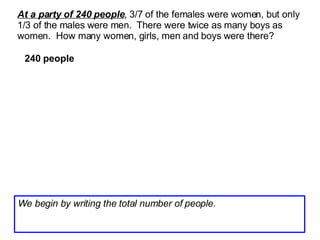
At a party of 240 people , 3/7 of the females were women, but only 1/3 of the males were men.  There were twice as many boys as women.  How many women, girls, men and boys were there? 240 people We begin by writing the total number of people.
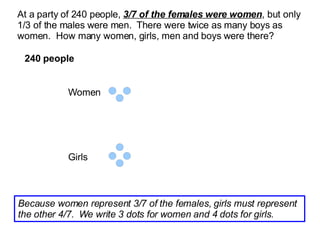
At a party of 240 people,  3/7 of the females were women , but only 1/3 of the males were men.  There were twice as many boys as women.  How many women, girls, men and boys were there? 240 people Women Girls Because women represent 3/7 of the females, girls must represent the other 4/7.  We write 3 dots for women and 4 dots for girls.
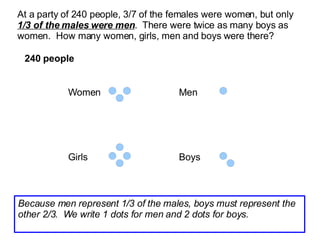
At a party of 240 people, 3/7 of the females were women, but only  1/3 of the males were men .  There were twice as many boys as women.  How many women, girls, men and boys were there? 240 people Women Girls Men Boys Because men represent 1/3 of the males, boys must represent the other 2/3.  We write 1 dots for men and 2 dots for boys.
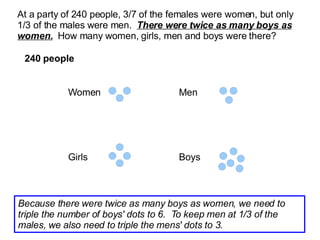
At a party of 240 people, 3/7 of the females were women, but only 1/3 of the males were men.  There were twice as many boys as women.   How many women, girls, men and boys were there? 240 people Women Girls Men Boys Because there were twice as many boys as women, we need to triple the number of boys' dots to 6.  To keep men at 1/3 of the males, we also need to triple the mens' dots to 3.
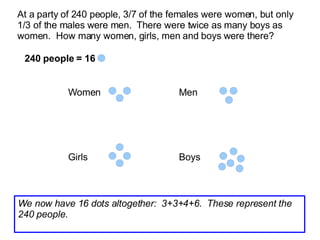
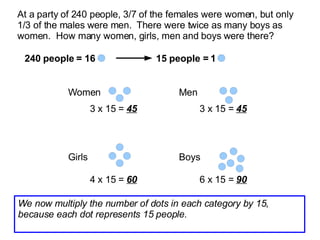
At a party of 240 people, 3/7 of the females were women, but only 1/3 of the males were men.  There were twice as many boys as women.  How many women, girls, men and boys were there? 240 people = 16  Women Girls Men Boys We now have 16 dots altogether:  3+3+4+6.  These represent the 240 people.
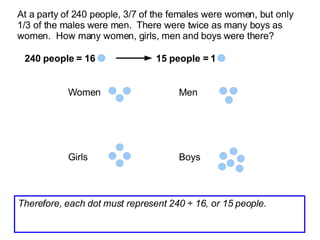
At a party of 240 people, 3/7 of the females were women, but only 1/3 of the males were men.  There were twice as many boys as women.  How many women, girls, men and boys were there? 240 people = 16  Women Girls Men Boys 15 people = 1  Therefore, each dot must represent 240 ÷ 16, or 15 people.
At a party of 240 people, 3/7 of the females were women, but only 1/3 of the males were men.  There were twice as many boys as women.  How many women, girls, men and boys were there? 240 people = 16  Women Girls Men Boys 15 people = 1  3 x 15 =  45   3 x 15 =  45   4 x 15 =  60   6 x 15 =  90   We now multiply the number of dots in each category by 15, because each dot represents 15 people.
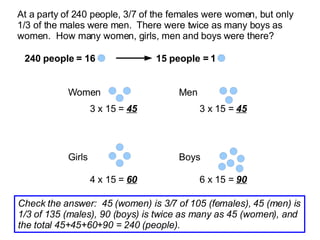
At a party of 240 people, 3/7 of the females were women, but only 1/3 of the males were men.  There were twice as many boys as women.  How many women, girls, men and boys were there? 240 people = 16  Women Girls Men Boys 15 people = 1  3 x 15 =  45   3 x 15 =  45   4 x 15 =  60   6 x 15 =  90   Check the answer:  45 (women) is 3/7 of 105 (females), 45 (men) is 1/3 of 135 (males), 90 (boys) is twice as many as 45 (women), and the total 45+45+60+90 = 240 (people).

Presentation

  • 1.
    At a partyof 240 people, 3/7 of the females were women, but only 1/3 of the males were men. There were twice as many boys as women. How many women, girls, men and boys were there? This is the problem statement.
  • 2.
    At a partyof 240 people , 3/7 of the females were women, but only 1/3 of the males were men. There were twice as many boys as women. How many women, girls, men and boys were there? 240 people We begin by writing the total number of people.
  • 3.
    At a partyof 240 people, 3/7 of the females were women , but only 1/3 of the males were men. There were twice as many boys as women. How many women, girls, men and boys were there? 240 people Women Girls Because women represent 3/7 of the females, girls must represent the other 4/7. We write 3 dots for women and 4 dots for girls.
  • 4.
    At a partyof 240 people, 3/7 of the females were women, but only 1/3 of the males were men . There were twice as many boys as women. How many women, girls, men and boys were there? 240 people Women Girls Men Boys Because men represent 1/3 of the males, boys must represent the other 2/3. We write 1 dots for men and 2 dots for boys.
  • 5.
    At a partyof 240 people, 3/7 of the females were women, but only 1/3 of the males were men. There were twice as many boys as women. How many women, girls, men and boys were there? 240 people Women Girls Men Boys Because there were twice as many boys as women, we need to triple the number of boys' dots to 6. To keep men at 1/3 of the males, we also need to triple the mens' dots to 3.
  • 6.
    At a partyof 240 people, 3/7 of the females were women, but only 1/3 of the males were men. There were twice as many boys as women. How many women, girls, men and boys were there? 240 people = 16 Women Girls Men Boys We now have 16 dots altogether: 3+3+4+6. These represent the 240 people.
  • 7.
    At a partyof 240 people, 3/7 of the females were women, but only 1/3 of the males were men. There were twice as many boys as women. How many women, girls, men and boys were there? 240 people = 16 Women Girls Men Boys 15 people = 1 Therefore, each dot must represent 240 ÷ 16, or 15 people.
  • 8.
    At a partyof 240 people, 3/7 of the females were women, but only 1/3 of the males were men. There were twice as many boys as women. How many women, girls, men and boys were there? 240 people = 16 Women Girls Men Boys 15 people = 1 3 x 15 = 45 3 x 15 = 45 4 x 15 = 60 6 x 15 = 90 We now multiply the number of dots in each category by 15, because each dot represents 15 people.
  • 9.
    At a partyof 240 people, 3/7 of the females were women, but only 1/3 of the males were men. There were twice as many boys as women. How many women, girls, men and boys were there? 240 people = 16 Women Girls Men Boys 15 people = 1 3 x 15 = 45 3 x 15 = 45 4 x 15 = 60 6 x 15 = 90 Check the answer: 45 (women) is 3/7 of 105 (females), 45 (men) is 1/3 of 135 (males), 90 (boys) is twice as many as 45 (women), and the total 45+45+60+90 = 240 (people).