Outline
• Definition ofOccupational Health
→Scope of O.H. (what it entails)
→Objectives of O.H. (why the need for O.H.)
• Brief History and Evolution of Occupational Health
• Components of Occupational Health
• Responsibility of the Nurse in Occupational Health
• The role of General Nurses in Occupational Health
• Conclusion
• References
4.
4
Definition of OccupationalHealth
• International Labour Organization /World Health Organization,
1950
• Occupational Health is the promotion and maintenance of the highest
degree of physical, mental and social well-being of workers in all
occupations by preventing departures from health, controlling risks and the
adaptation of work to people, and people to their jobs.
• ILO/WHO, 1996
• “The promotion and maintenance of the highest degree of physical,
mental and social well-being of workers in all occupations – total health of
all at work”
5.
Definition and Scopeof Occupational Health
• International Commission
on O.H. (ICOH, 2005)
• A service for the
protection of people’s
health at work, for
promotion of health,
wellbeing and work-
ability as well as for
prevention of ill-health
and accidents
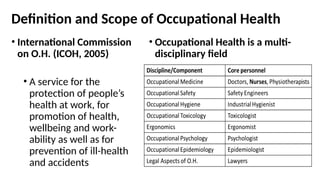
• Occupational Health is a multi-
disciplinary field
6.
Objectives of OccupationalHealth (Why O.H.?)
• Promote and maintain the highest degree of physical, mental & social well-being of
workers of all occupations
• Prevent workers from departures due to health caused by their working conditions
• Protect workers in their working environment from hazards and risks usually causing
adverse health effects
• Place & maintain a worker in an occupational environment adapted to his/her
physiological ability
7.
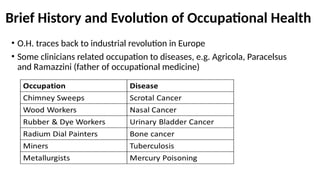
Brief History andEvolution of Occupational Health
• O.H. traces back to industrial revolution in Europe
• Some clinicians related occupation to diseases, e.g. Agricola, Paracelsus
and Ramazzini (father of occupational medicine)
8.
Brief History andEvolution of Occupational Health
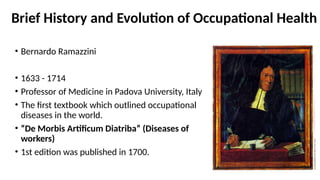
• Bernardo Ramazzini
• 1633 - 1714
• Professor of Medicine in Padova University, Italy
• The first textbook which outlined occupational
diseases in the world.
• “De Morbis Artificum Diatriba” (Diseases of
workers)
• 1st edition was published in 1700.
9.
Brief History andEvolution of Occupational Health
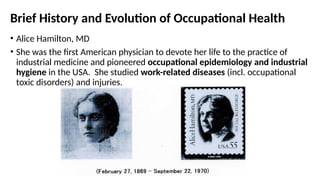
• Alice Hamilton, MD
• She was the first American physician to devote her life to the practice of
industrial medicine and pioneered occupational epidemiology and industrial
hygiene in the USA. She studied work-related diseases (incl. occupational
toxic disorders) and injuries.
10.
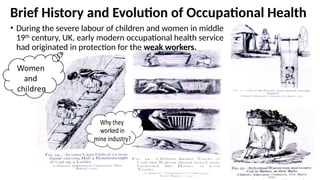
Brief History andEvolution of Occupational Health
• During the severe labour of children and women in middle
19th
century, UK, early modern occupational health service
had originated in protection for the weak workers.
11.
Brief History andEvolution of Occupational Health
• All these healthcare workers were involved in diagnosis and
treatment of diseases among “weak workers” in the industrial
environment and called the practice Industrial Medicine
• Later the practice looked at the working environment of healthy
individuals thus was called Industrial Health.
• Currently Occupational Health has grown the gates of the factory
to embrace societal concerns such as pollution of air, water and
land, personal pollution by cigarette smoking and transport of
industrial toxicants into homes, work space and office safety etc. –
Occupational and Environmental Health.
12.
Components of OccupationalHealth
• Occupational Health Medicine
Itis the clinical component of occupational health.
It is a discipline concerned with the effects of work and work
environment on the health and the influence of pre-existing health
problems on the capacity to work
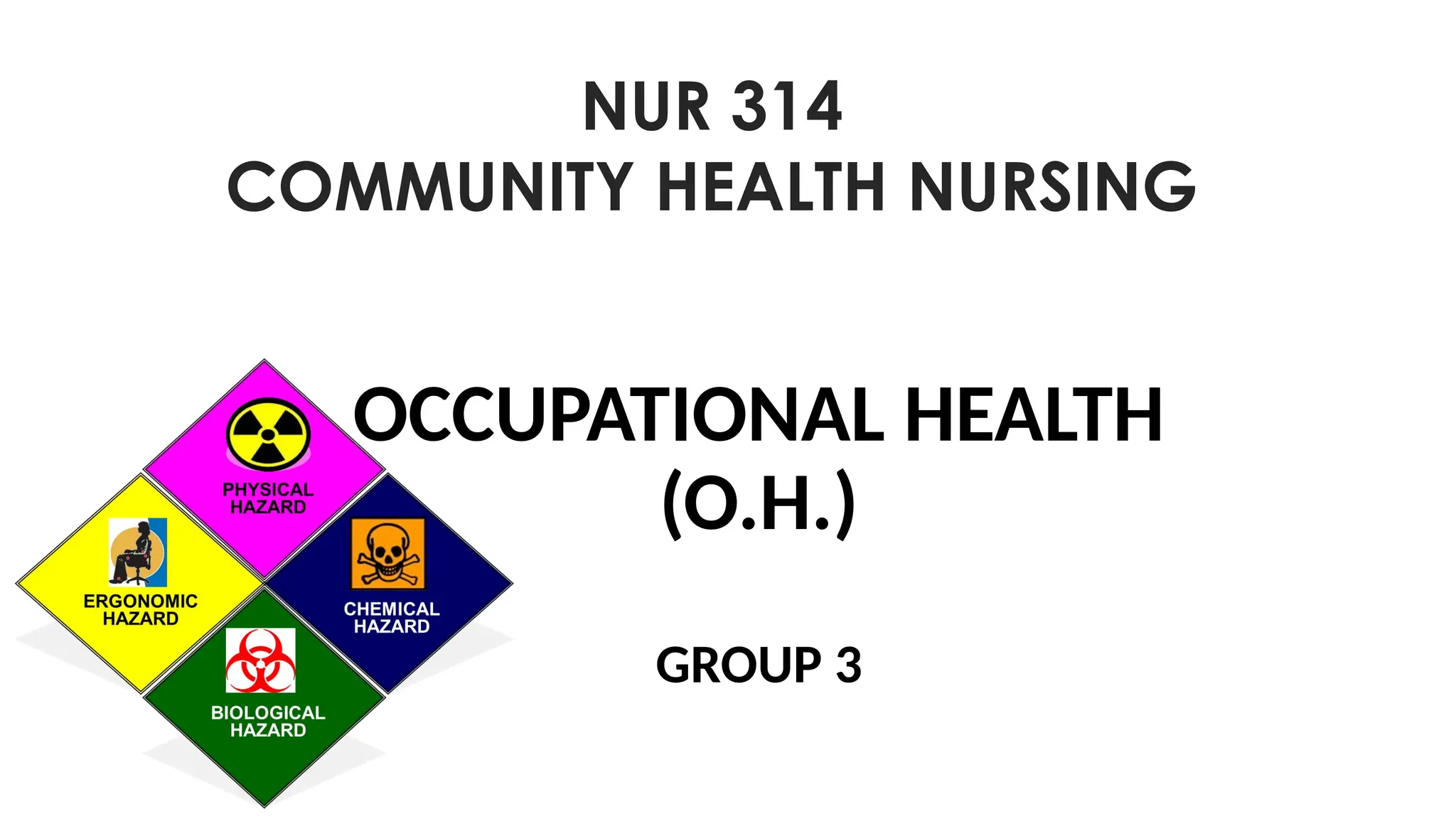
• Occupational Health Hygiene is applied science concerned with anticipation,
recognition, evaluation and control chemical, physical and biological disease-
causing agents arising from work activity.
13.
Components of OccupationalHealth
• Occupational Health Ergonomics is the study of how to improve the fit
between the physical demands of the work place and employees who
perform the work.
• Occupational Health Safety is described as a series of processes and activities
designed to prevent accidents by effectively controlling of people, equipment,
material, energy and risk factors.
• Occupational Health Toxicology is the scientific study of characteristics and
effects of chemicals/poisons related to working conditions and the workplace
• Occupational Health Epidemiology: It is the study of distribution of diseases
and determinants of heath related states among workers
• Occupational Health Law: provides the legal framework in which the rights
and responsibilities for health and safety of both the employer and employee
are observed in the workplace
14.
Responsibility of theNurse in Occupational Health
He or She is entrusted with essentially preventive functions and is
responsible for advising the employer, workers and their
representative on:
• maintenance of safe and healthy work environment which will
facilitate optimal physical and mental health in relation to work
• the adaptation of work to the capabilities of workers in the light of
their state of physical and mental wellbeing
15.
Responsibility of theNurse in Occupational Health
• Identification of hazards and Assessment of risks
• Surveillance of risk factors in the work environment
• Advice on planning and organization work, workplace design,
machinery etc.
• Advice on Occupational Safety, Hygiene, Ergonomics and
Protective equipment
16.
Responsibility of theNurse in Occupational Health
• Surveillance of worker in relation to work (health assessments)
• Contribute to vocational rehabilitation
• Training in O.H. hygiene and ergonomics
• First aid and emergency treatment
• Analysis of occupational accident and diseases
17.
The role ofGeneral Nurses in Occupational Health
• Provision of primary care services
• First aid and emergency treatment









![CTEV [ clubfoot] DR ARUN LAL ,DR MOHAMED ASHRAF travancore medical college k...](https://cdn.slidesharecdn.com/ss_thumbnails/ctevclubfootdrarunlaldrmohamedashraftravancoremedicalcollegekollamkeralaindia-260208063247-18fc466c-thumbnail.jpg?width=640&height=640&fit=bounds)


