Case study 1
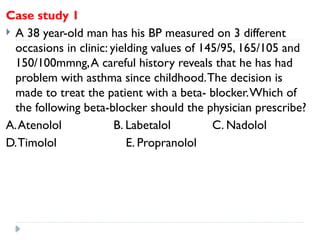
 A 38 year-old man has his BP measured on 3 different
occasions in clinic: yielding values of 145/95, 165/105 and
150/100mmng,A careful history reveals that he has had
problem with asthma since childhood.The decision is
made to treat the patient with a beta- blocker.Which of
the following beta-blocker should the physician prescribe?
A.Atenolol B. Labetalol C. Nadolol
D.Timolol E. Propranolol
Case study 2
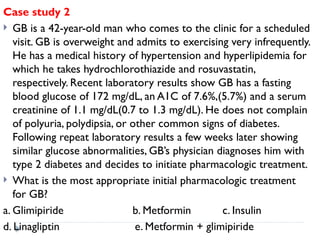
 GB is a 42-year-old man who comes to the clinic for a scheduled
visit. GB is overweight and admits to exercising very infrequently.
He has a medical history of hypertension and hyperlipidemia for
which he takes hydrochlorothiazide and rosuvastatin,
respectively. Recent laboratory results show GB has a fasting
blood glucose of 172 mg/dL, an A1C of 7.6%,(5.7%) and a serum
creatinine of 1.1 mg/dL(0.7 to 1.3 mg/dL). He does not complain
of polyuria, polydipsia, or other common signs of diabetes.
Following repeat laboratory results a few weeks later showing
similar glucose abnormalities, GB’s physician diagnoses him with
type 2 diabetes and decides to initiate pharmacologic treatment.
 What is the most appropriate initial pharmacologic treatment
for GB?
a. Glimipiride b. Metformin c. Insulin
d. Linagliptin e. Metformin + glimipiride
Case study 3
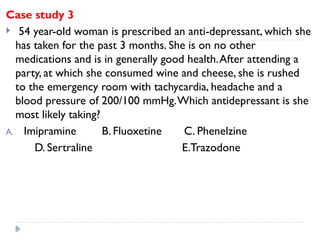
 54 year-old woman is prescribed an anti-depressant, which she
has taken for the past 3 months. She is on no other
medications and is in generally good health.After attending a
party, at which she consumed wine and cheese, she is rushed
to the emergency room with tachycardia, headache and a
blood pressure of 200/100 mmHg.Which antidepressant is she
most likely taking?
A. Imipramine B. Fluoxetine C. Phenelzine
D. Sertraline E.Trazodone
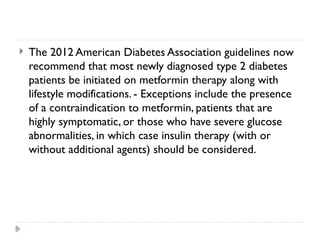
 The 2012 American Diabetes Association guidelines now
recommend that most newly diagnosed type 2 diabetes
patients be initiated on metformin therapy along with
lifestyle modifications. - Exceptions include the presence
of a contraindication to metformin, patients that are
highly symptomatic, or those who have severe glucose
abnormalities, in which case insulin therapy (with or
without additional agents) should be considered.
Case study: 4
 A 47-year-old male with type 2 diabetes returns for follow-up.
You find his blood pressure to be 138/72 in the left arm and
142/74 in the right arm. One month ago, his blood pressures
were 136/68 in the left arm and 140/72 in the right, and on the
visit before that the readings were 138/70 in the left arm and
142/68 in the right arm. He has attempted to modify his diet
and exercise. Urinalysis shows microalbuminuria.You
recommend
A. Start lisinopril 5 mg po every day
B. Start amlodipine 5 mg po every day
C. Start hydrochlorothiazide 12.5 mg every day
D. Continue lifestyle modification and recheck blood pressure in
two months
E. Do nothing now and recheck blood pressure in two months
Case study:5
Q:A 60-year-old man with hypertension and continued tobacco
use visits your office for a physical. Initial labs reveal a total
cholesterol of 340(Less than 200 mg/dL), LDL of 210(Less than
100 mg/dL), and HDL of 35 (60 mg/dL or above).What would
you recommend to lower his cholesterol?
A. Start diet therapy
B. Start diet therapy and an exercise program
C. Start diet therapy, an exercise program, and a statin
D. Repeat the labs to confirm the cholesterol measurement
and then start diet therapy
E. Repeat the labs to confirm the cholesterol measurement and
then start medication
 Answer:A.The diagnosis of stage 1 hypertension is
established in this patient.The presence of diabetes places
him at high risk of complications from hypertension and
warrants the initiation of drug therapy.Although
hydrochlorothiazide is a very reasonable option in most
patients with hypertension, the use of an angiotensin
converting enzyme inhibitor is more appropriate in this
patient because it has been shown to decrease the
incidence of diabetic nephropathy in patients with
microalbuminuria.
 Answer: C.This man is at extremely high risk of CHD,
given his numerous risk factors: male, age over 45 years,
hypertension, and active smoking. Compounding these
factors is the markedly elevated LDL level.The most
aggressive therapy, including diet, exercise, and medication
(such as a statin), should be pursued without delay.There
is no reason to repeat the measurement.

Presentation on case (Diploma in Pharmacy)

  • 1.
    Case study 1 A 38 year-old man has his BP measured on 3 different occasions in clinic: yielding values of 145/95, 165/105 and 150/100mmng,A careful history reveals that he has had problem with asthma since childhood.The decision is made to treat the patient with a beta- blocker.Which of the following beta-blocker should the physician prescribe? A.Atenolol B. Labetalol C. Nadolol D.Timolol E. Propranolol
  • 2.
    Case study 2 GB is a 42-year-old man who comes to the clinic for a scheduled visit. GB is overweight and admits to exercising very infrequently. He has a medical history of hypertension and hyperlipidemia for which he takes hydrochlorothiazide and rosuvastatin, respectively. Recent laboratory results show GB has a fasting blood glucose of 172 mg/dL, an A1C of 7.6%,(5.7%) and a serum creatinine of 1.1 mg/dL(0.7 to 1.3 mg/dL). He does not complain of polyuria, polydipsia, or other common signs of diabetes. Following repeat laboratory results a few weeks later showing similar glucose abnormalities, GB’s physician diagnoses him with type 2 diabetes and decides to initiate pharmacologic treatment.  What is the most appropriate initial pharmacologic treatment for GB? a. Glimipiride b. Metformin c. Insulin d. Linagliptin e. Metformin + glimipiride
  • 3.
    Case study 3 54 year-old woman is prescribed an anti-depressant, which she has taken for the past 3 months. She is on no other medications and is in generally good health.After attending a party, at which she consumed wine and cheese, she is rushed to the emergency room with tachycardia, headache and a blood pressure of 200/100 mmHg.Which antidepressant is she most likely taking? A. Imipramine B. Fluoxetine C. Phenelzine D. Sertraline E.Trazodone
  • 4.
     The 2012American Diabetes Association guidelines now recommend that most newly diagnosed type 2 diabetes patients be initiated on metformin therapy along with lifestyle modifications. - Exceptions include the presence of a contraindication to metformin, patients that are highly symptomatic, or those who have severe glucose abnormalities, in which case insulin therapy (with or without additional agents) should be considered.
  • 5.
    Case study: 4 A 47-year-old male with type 2 diabetes returns for follow-up. You find his blood pressure to be 138/72 in the left arm and 142/74 in the right arm. One month ago, his blood pressures were 136/68 in the left arm and 140/72 in the right, and on the visit before that the readings were 138/70 in the left arm and 142/68 in the right arm. He has attempted to modify his diet and exercise. Urinalysis shows microalbuminuria.You recommend A. Start lisinopril 5 mg po every day B. Start amlodipine 5 mg po every day C. Start hydrochlorothiazide 12.5 mg every day D. Continue lifestyle modification and recheck blood pressure in two months E. Do nothing now and recheck blood pressure in two months
  • 6.
    Case study:5 Q:A 60-year-oldman with hypertension and continued tobacco use visits your office for a physical. Initial labs reveal a total cholesterol of 340(Less than 200 mg/dL), LDL of 210(Less than 100 mg/dL), and HDL of 35 (60 mg/dL or above).What would you recommend to lower his cholesterol? A. Start diet therapy B. Start diet therapy and an exercise program C. Start diet therapy, an exercise program, and a statin D. Repeat the labs to confirm the cholesterol measurement and then start diet therapy E. Repeat the labs to confirm the cholesterol measurement and then start medication
  • 7.
     Answer:A.The diagnosisof stage 1 hypertension is established in this patient.The presence of diabetes places him at high risk of complications from hypertension and warrants the initiation of drug therapy.Although hydrochlorothiazide is a very reasonable option in most patients with hypertension, the use of an angiotensin converting enzyme inhibitor is more appropriate in this patient because it has been shown to decrease the incidence of diabetic nephropathy in patients with microalbuminuria.
  • 8.
     Answer: C.Thisman is at extremely high risk of CHD, given his numerous risk factors: male, age over 45 years, hypertension, and active smoking. Compounding these factors is the markedly elevated LDL level.The most aggressive therapy, including diet, exercise, and medication (such as a statin), should be pursued without delay.There is no reason to repeat the measurement.