COMPANY STUDIES & EARNING  FORECASTS Amit Gilra
INTRODUCTION 1 The normal methods of assessing stocks intrinsic worth are to  measure earning capacity, earnings in relation to net worth equity,  return on investment or return on asset. Prima facie,  earnings are a function of revenue & expenditure. EBDIT =   Earnings Before Depreciation Interest and Taxes. Depreciation being retained for use by the Company, Cash  earnings include depreciation also & thus EBIT viz, Earnings before Interest & Taxation is a better measure.
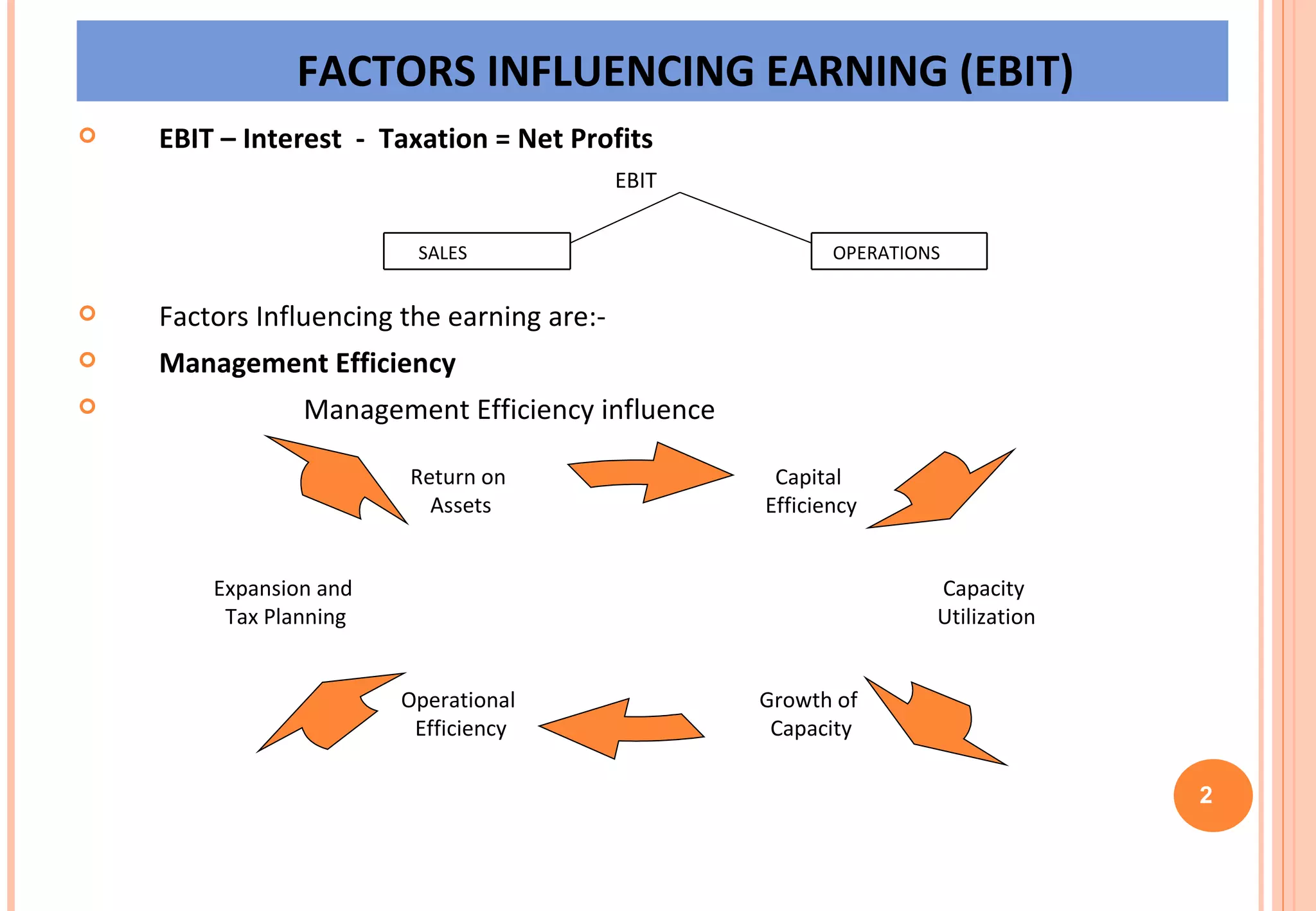
FACTORS INFLUENCING EARNING (EBIT) EBIT – Interest  -  Taxation = Net Profits EBIT Factors Influencing the earning are:- Management Efficiency  Management Efficiency influence 2 SALES OPERATIONS Capital  Efficiency Capacity  Utilization Growth of  Capacity Operational  Efficiency Expansion and  Tax Planning Return on  Assets
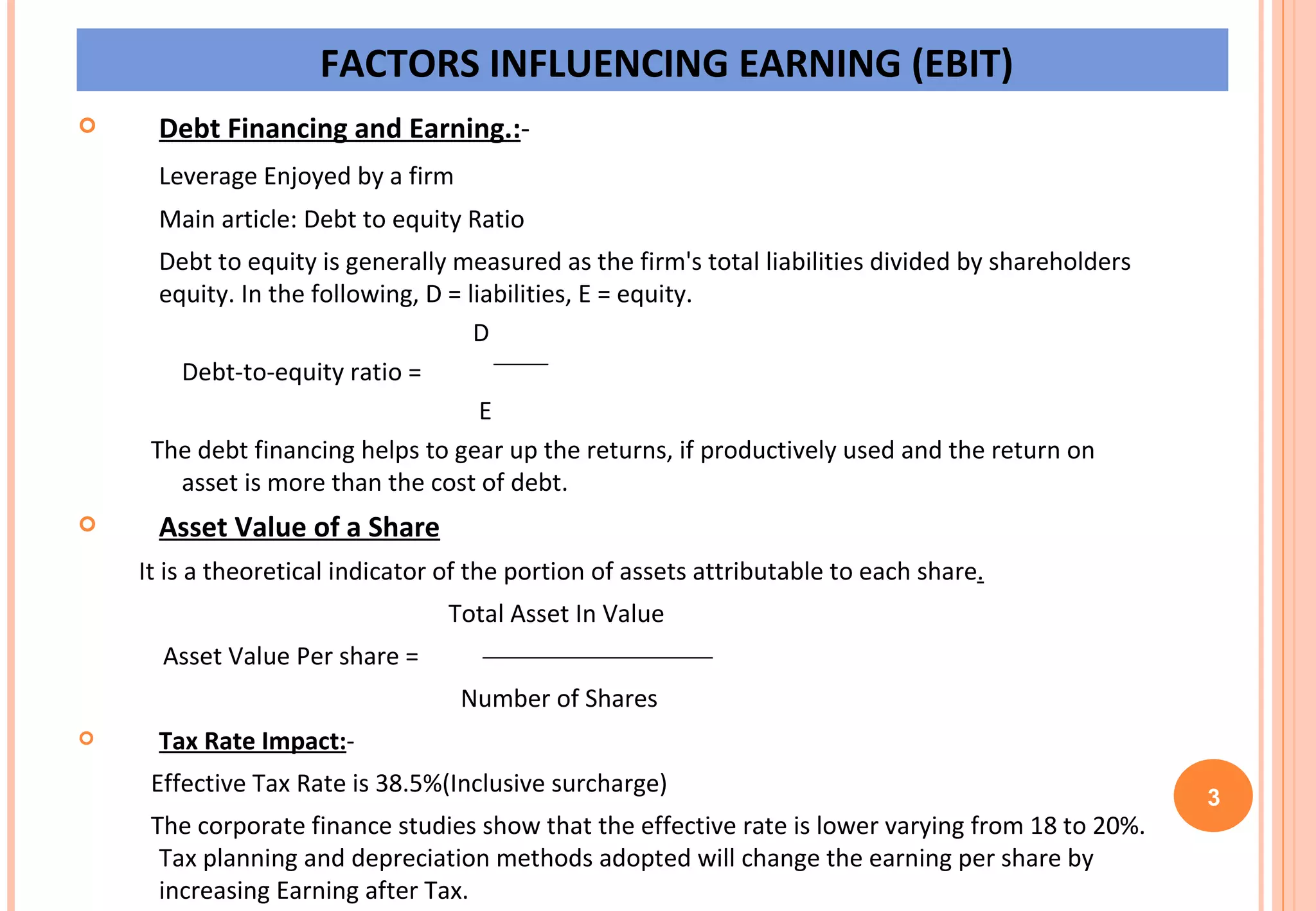
FACTORS INFLUENCING EARNING (EBIT) Debt Financing and Earning.: - Leverage Enjoyed by a firm Main article: Debt to equity Ratio Debt to equity is generally measured as the firm's total liabilities divided by shareholders equity. In the following, D = liabilities, E = equity.     D Debt-to-equity ratio =      E The debt financing helps to gear up the returns, if productively used and the return on  asset is more than the cost of debt. Asset Value of a Share It is a theoretical indicator of the portion of assets attributable to each share .   Total Asset In Value Asset Value Per share =      Number of Shares Tax Rate Impact: - Effective Tax Rate is 38.5%(Inclusive surcharge) The corporate finance studies show that the effective rate is lower varying from 18 to 20%. Tax planning and depreciation methods adopted will change the earning per share by increasing Earning after Tax. 3
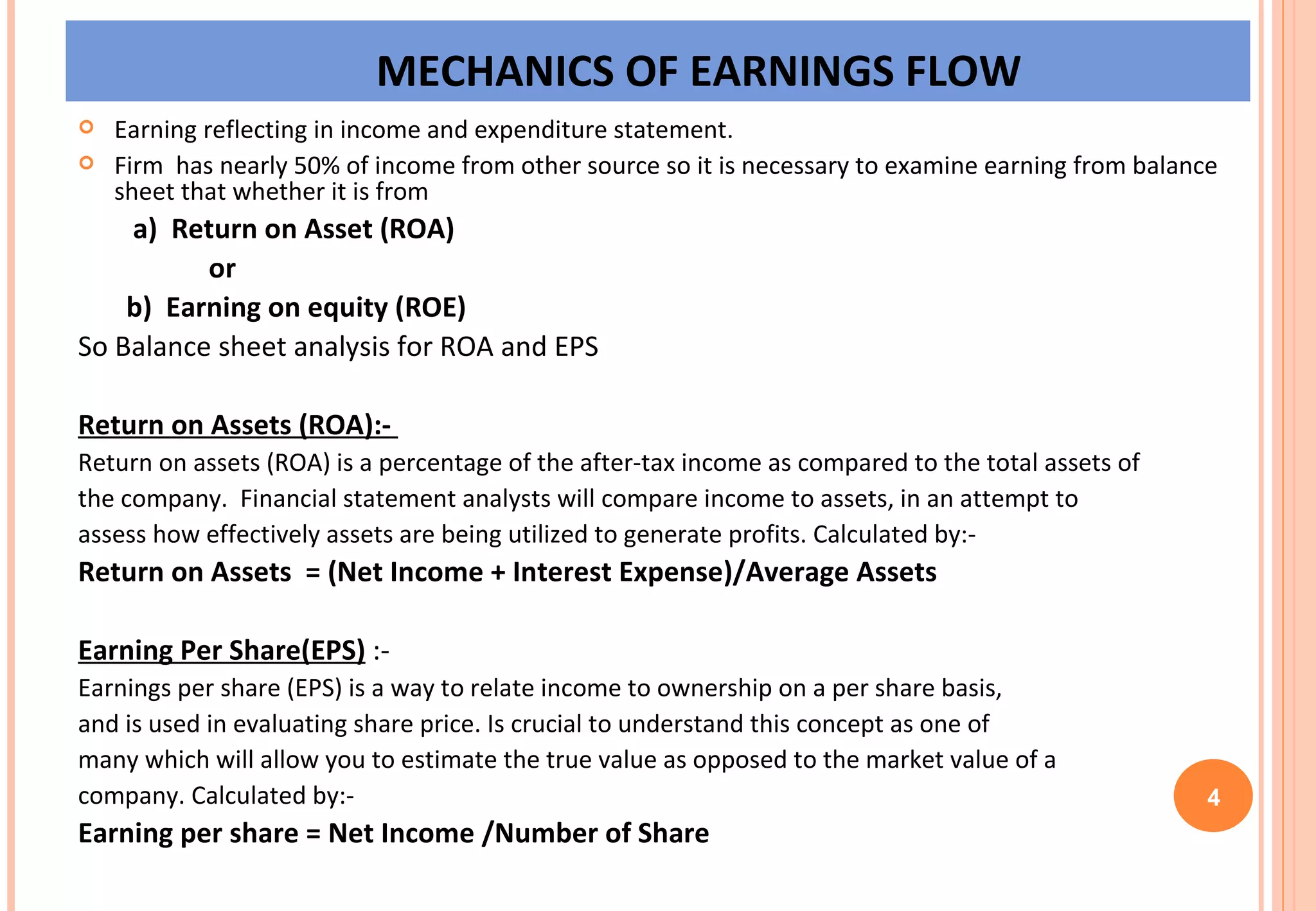
MECHANICS OF EARNINGS FLOW Earning reflecting in income and expenditure statement. Firm  has nearly 50% of income from other source so it is necessary to examine earning from balance sheet that whether it is from a)  Return on Asset (ROA) or b)  Earning on equity (ROE) So Balance sheet analysis for ROA and EPS Return on Assets (ROA):-   Return on assets (ROA) is a percentage of the after-tax income as compared to the total assets of the company.  Financial statement analysts will compare income to assets, in an attempt to  assess how effectively assets are being utilized to generate profits. Calculated by:- Return on Assets  = (Net Income + Interest Expense)/Average Assets Earning Per Share(EPS)  :-  Earnings per share (EPS) is a way to relate income to ownership on a per share basis,  and is used in evaluating share price. Is crucial to understand this concept as one of  many which will allow you to estimate the true value as opposed to the market value of a  company. Calculated by:- Earning per share = Net Income /Number of Share   4
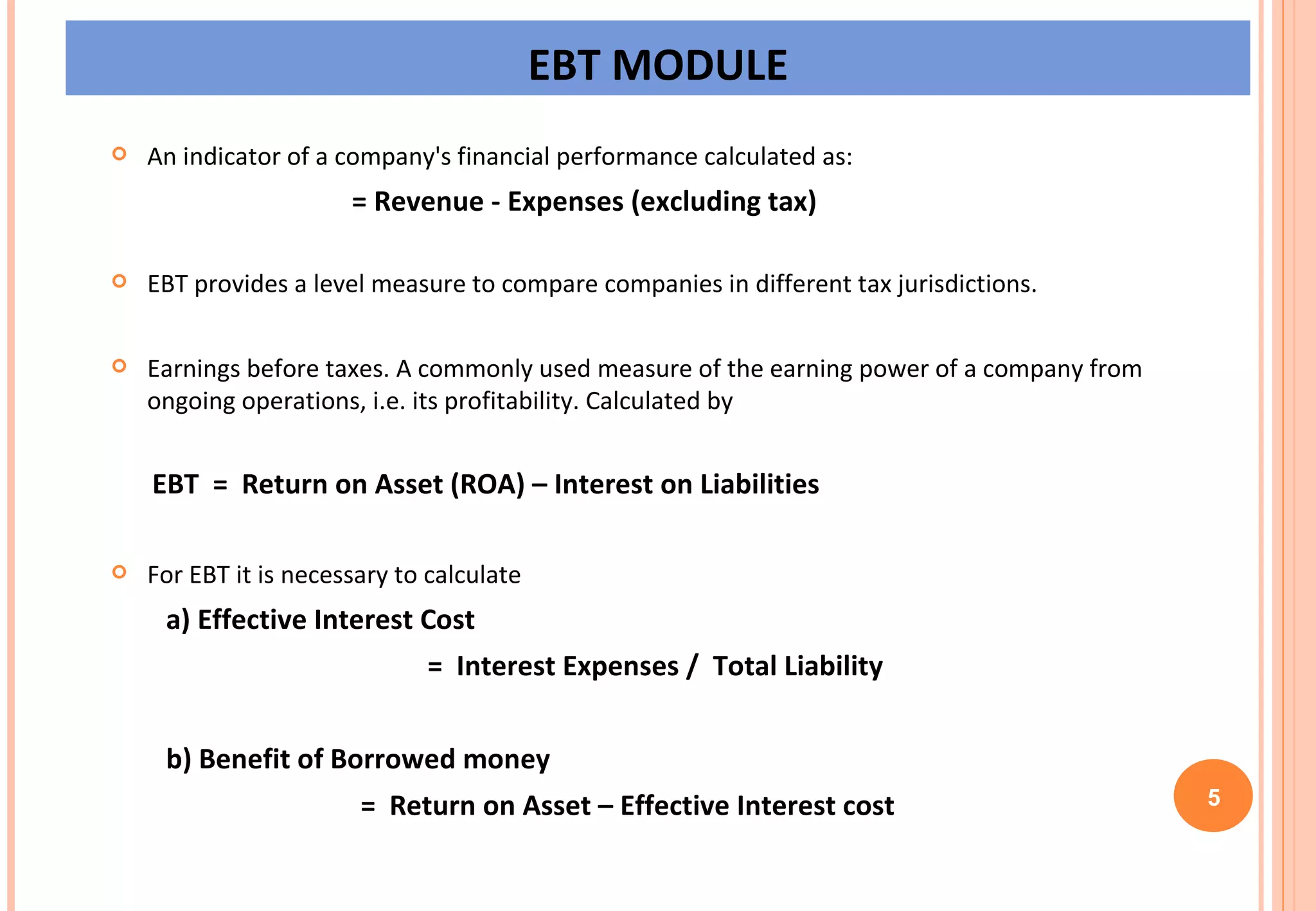
EBT MODULE An indicator of a company's financial performance calculated as:                                       = Revenue - Expenses (excluding tax)   EBT provides a level measure to compare companies in different tax jurisdictions.  Earnings before taxes. A commonly used measure of the earning power of a company from ongoing operations, i.e. its profitability. Calculated by EBT  =  Return on Asset (ROA) – Interest on Liabilities  For EBT it is necessary to calculate  a) Effective Interest Cost =  Interest Expenses /  Total Liability b) Benefit of Borrowed money   =  Return on Asset – Effective Interest cost 5
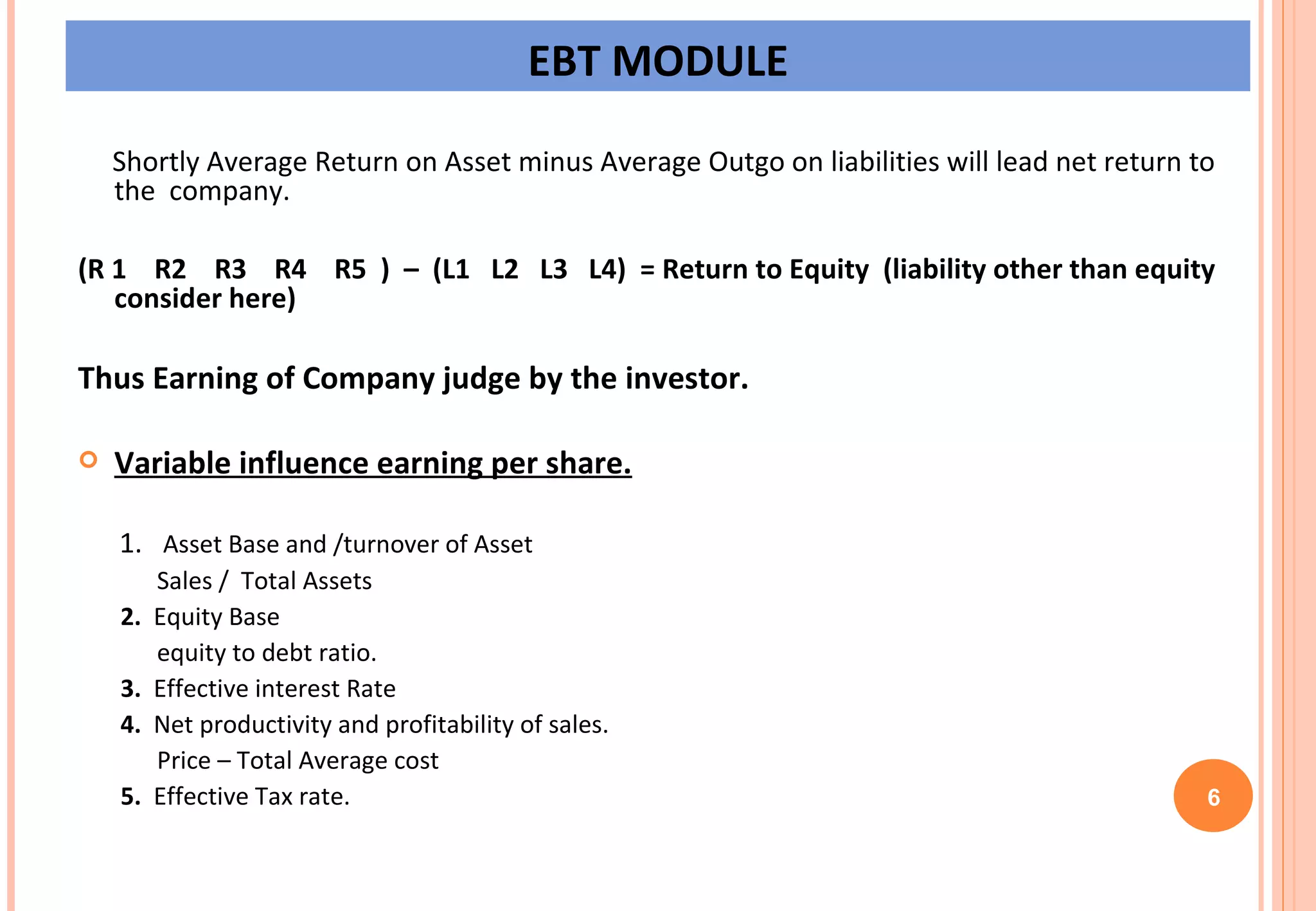
EBT MODULE Shortly Average Return on Asset minus Average Outgo on liabilities will lead net return to the  company. (R 1  R2  R3  R4  R5  )  –  (L1  L2  L3  L4)  = Return to Equity  (liability other than equity consider here) Thus Earning of Company judge by the investor. Variable influence earning per share. 1.  Asset Base and /turnover of Asset Sales /  Total Assets 2.   Equity Base  equity to debt ratio. 3.   Effective interest Rate 4.   Net productivity and profitability of sales. Price – Total Average cost 5.   Effective Tax rate. 6
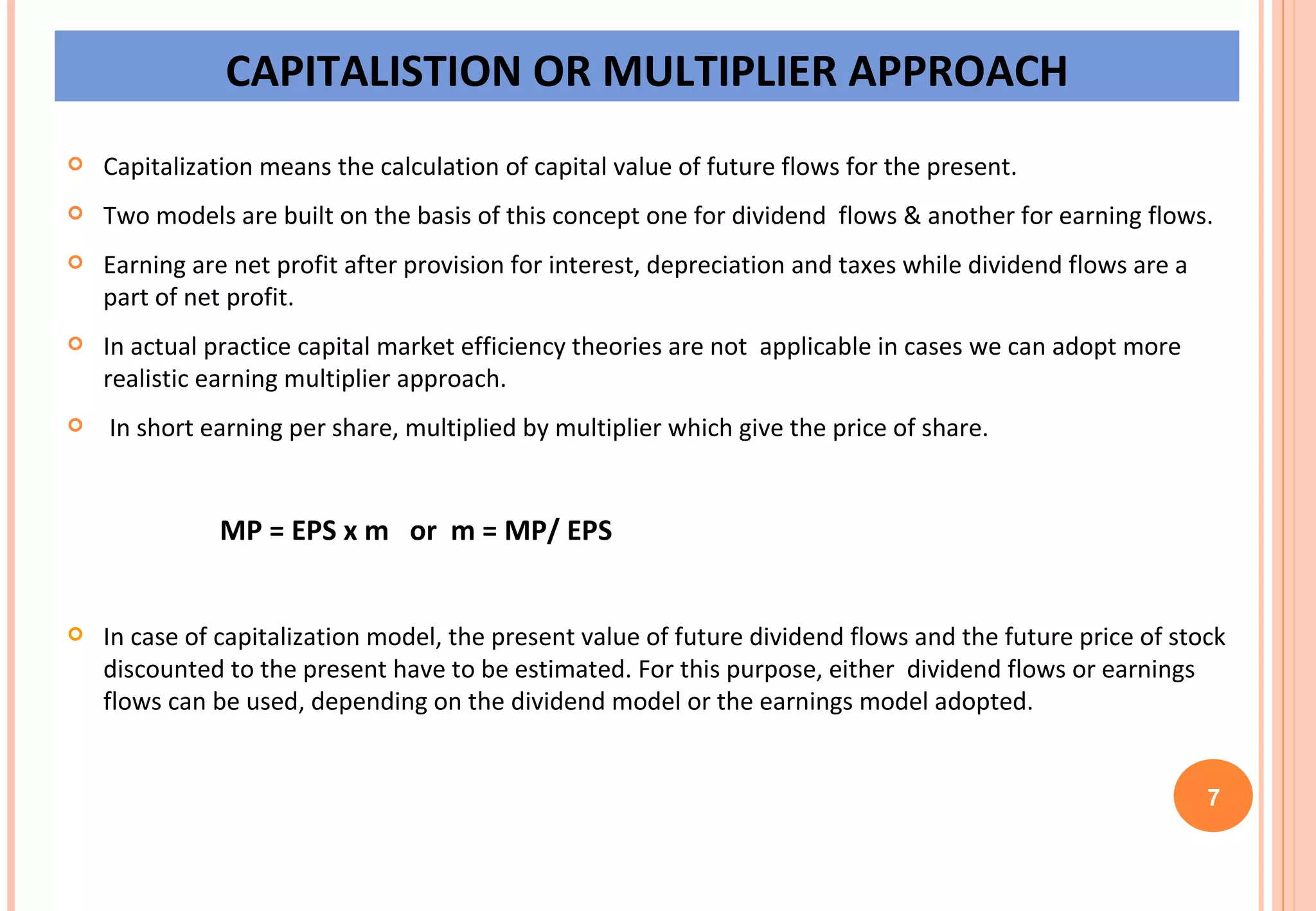
CAPITALISTION OR MULTIPLIER APPROACH Capitalization means the calculation of capital value of future flows for the present. Two models are built on the basis of this concept one for dividend  flows & another for earning flows. Earning are net profit after provision for interest, depreciation and taxes while dividend flows are a part of net profit. In actual practice capital market efficiency theories are not  applicable in cases we can adopt more realistic earning multiplier approach. In short earning per share, multiplied by multiplier which give the price of share. MP = EPS x m  or  m = MP/ EPS In case of capitalization model, the present value of future dividend flows and the future price of stock discounted to the present have to be estimated. For this purpose, either  dividend flows or earnings flows can be used, depending on the dividend model or the earnings model adopted. 7
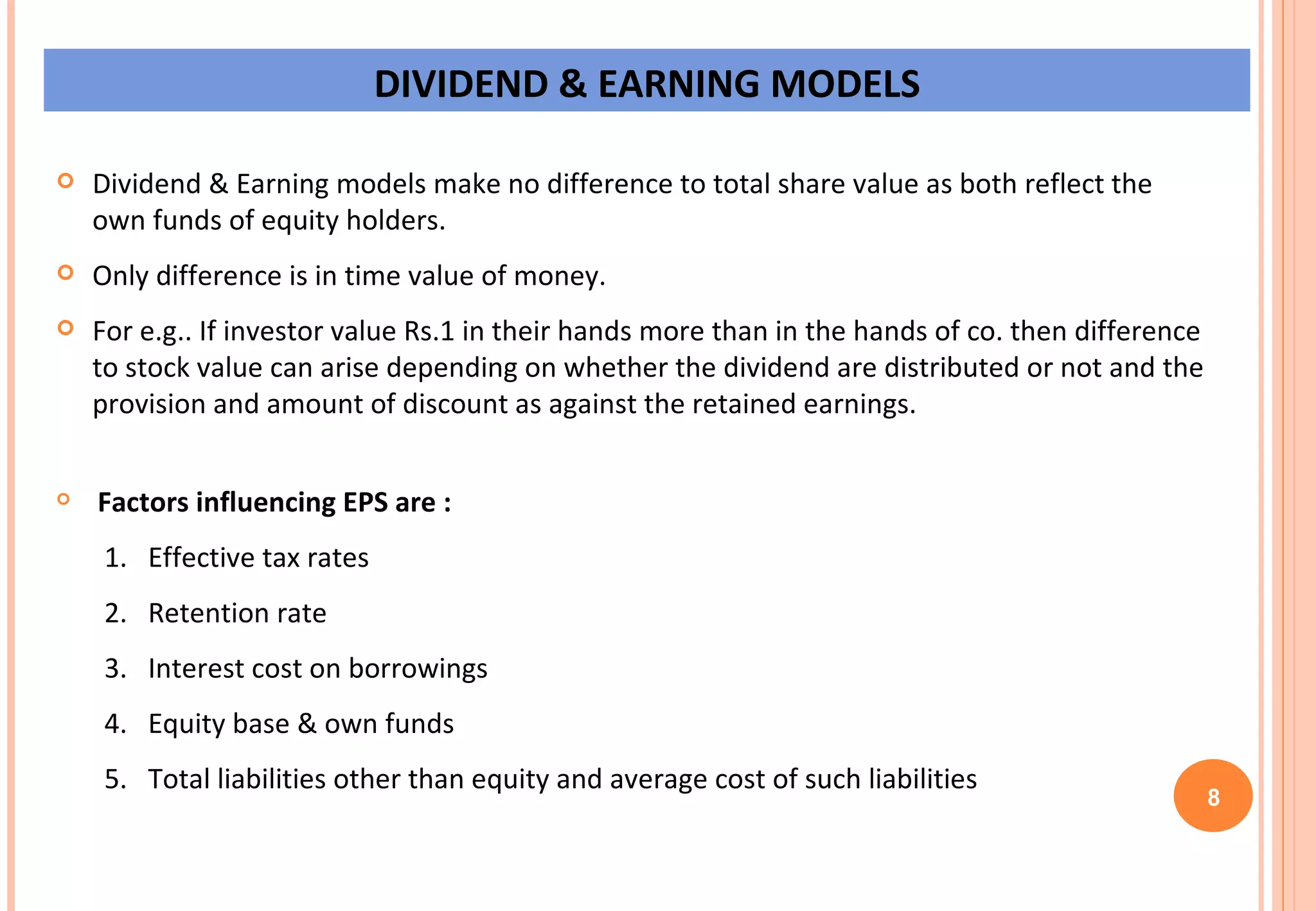
DIVIDEND & EARNING MODELS Dividend & Earning models make no difference to total share value as both reflect the own funds of equity holders. Only difference is in time value of money. For e.g.. If investor value Rs.1 in their hands more than in the hands of co. then difference to stock value can arise depending on whether the dividend are distributed or not and the provision and amount of discount as against the retained earnings. Factors influencing EPS are :   1.  Effective tax rates  2.  Retention rate  3.  Interest cost on borrowings 4.  Equity base & own funds 5.  Total liabilities other than equity and average cost of such liabilities  8
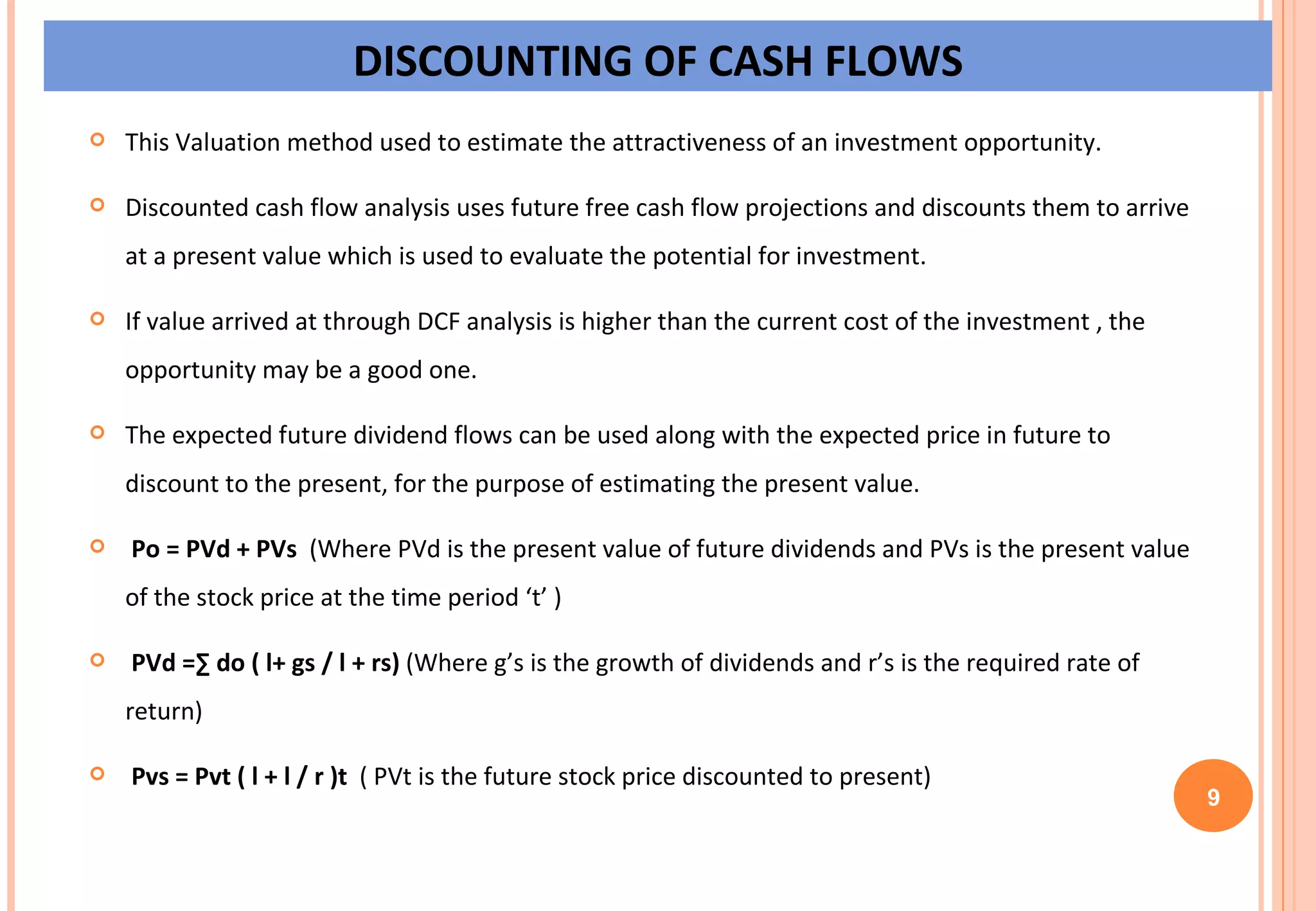
DISCOUNTING OF CASH FLOWS This Valuation method used to estimate the attractiveness of an investment opportunity. Discounted cash flow analysis uses future free cash flow projections and discounts them to arrive at a present value which is used to evaluate the potential for investment. If value arrived at through DCF analysis is higher than the current cost of the investment , the opportunity may be a good one.  The expected future dividend flows can be used along with the expected price in future to discount to the present, for the purpose of estimating the present value. Po = PVd + PVs   (Where PVd is the present value of future dividends and PVs is the present value of the stock price at the time period ‘t’ ) PVd =∑ do ( l+ gs / l + rs)  (Where g’s is the growth of dividends and r’s is the required rate of  return) Pvs = Pvt ( l + l / r )t  ( PVt is the future stock price discounted to present)  9
FORMULA PLANS When the theories do not take us far to success in the stock price prediction and in making gain in operations, then practical tricks of the trade can be done.  When the prices are falling purchase has to be done and when the prices are rising selling has to be done. The above automatic formula rules should lay down :  When to purchase  In what quantity  Selection of scrips  The implementation or execution of the plan at least cost  [Cost of deals and  incidentals] 10
EBT = [ R + ( R – I ) L/E ] E Where R is Average Return on Investments or Assets  and I is Interest Cost on Liabilities other  than Equity . EAT = EBT – CORPORATE TAX EPS = EAT / NO. OF SHARES MP = EPS  X  P/E Where P/E is Price Earning Ratio of past can be taken HPY [Holding Period Yield] = (FV – PV + D)/PV Where PV is present value, FV is future value and D is dividend paid per share. 11 FORECASTING EARNINGS
Fixed cost and Variable cost :  Some firm has high fixed cost e.g.:- consumer durable and capital goods. Some firms have high variable cost e.g. :- food processing, handloom, electronic goods etc. Break even Point : At this point income of the business exactly equals to its expenditure, if production is enhanced beyond this level profit shall accure to the business, if it decreased from this level, loss shall be suffered by the business. Break Even Point Analysis : It depends on the implication of fixed cost and variable cost . The rate of growth accelerates very rapidly in respect of sales and profits, etc in the cased of projects with high fixed costs after the BEP period than those with low fixed cost 12 ROLE OF FIXED COSTS & BREAK EVEN POINT
Investment Analysis : Investment analyst give weight age to the type of firms, their product range, low or high  fixed costs and the level of sales and capacity utilization at which the BEP occurs. Forecasts of Individual Items of Revenue & Expenses: From detail analysis of total revenue and total expenditure we get forecast  of earnings  i.e. EBDIT, from this any interest, depreciation, and tax is deducted for the estimation of  EAT.  These net earnings are divided by the no. of equity shares  to arrive at the EPS and  deduce the expected market price (MP) by applying the historical P/E multiple of the  company or the industry average. Earnings depend on the income and expenditure of the  unit. The overall management efficiency is, infact , reflected in the earnings of the firm.  ROLE OF FIXED COSTS & BREAK EVEN POINT 13
Normal methods of assessing stocks intrinsic worth. EBIT is influenced by management efficiency as reflected in operations & marketing. The right mixture of various methods of financing lowers the costs through lower interest burden. Earnings per share are influenced by turnover to assets, equity to debt ratio, cost of funds, net profitability & tax rate. Investors that depend on the principle of contrariness buy shares when majority of them are selling and vice versa. Companies with large capital investment have high break even point & a long period to turn profits & dividends. Forecast of individual items of revenue & expenses provides most scientific method for estimating earnings & market price. 14 SUMMARY
15 Thank You

Presentation Of Security Analy

  • 1.
    COMPANY STUDIES &EARNING FORECASTS Amit Gilra
  • 2.
    INTRODUCTION 1 Thenormal methods of assessing stocks intrinsic worth are to measure earning capacity, earnings in relation to net worth equity, return on investment or return on asset. Prima facie, earnings are a function of revenue & expenditure. EBDIT = Earnings Before Depreciation Interest and Taxes. Depreciation being retained for use by the Company, Cash earnings include depreciation also & thus EBIT viz, Earnings before Interest & Taxation is a better measure.
  • 3.
    FACTORS INFLUENCING EARNING(EBIT) EBIT – Interest - Taxation = Net Profits EBIT Factors Influencing the earning are:- Management Efficiency Management Efficiency influence 2 SALES OPERATIONS Capital Efficiency Capacity Utilization Growth of Capacity Operational Efficiency Expansion and Tax Planning Return on Assets
  • 4.
    FACTORS INFLUENCING EARNING(EBIT) Debt Financing and Earning.: - Leverage Enjoyed by a firm Main article: Debt to equity Ratio Debt to equity is generally measured as the firm's total liabilities divided by shareholders equity. In the following, D = liabilities, E = equity. D Debt-to-equity ratio = E The debt financing helps to gear up the returns, if productively used and the return on asset is more than the cost of debt. Asset Value of a Share It is a theoretical indicator of the portion of assets attributable to each share . Total Asset In Value Asset Value Per share = Number of Shares Tax Rate Impact: - Effective Tax Rate is 38.5%(Inclusive surcharge) The corporate finance studies show that the effective rate is lower varying from 18 to 20%. Tax planning and depreciation methods adopted will change the earning per share by increasing Earning after Tax. 3
  • 5.
    MECHANICS OF EARNINGSFLOW Earning reflecting in income and expenditure statement. Firm has nearly 50% of income from other source so it is necessary to examine earning from balance sheet that whether it is from a) Return on Asset (ROA) or b) Earning on equity (ROE) So Balance sheet analysis for ROA and EPS Return on Assets (ROA):- Return on assets (ROA) is a percentage of the after-tax income as compared to the total assets of the company. Financial statement analysts will compare income to assets, in an attempt to assess how effectively assets are being utilized to generate profits. Calculated by:- Return on Assets = (Net Income + Interest Expense)/Average Assets Earning Per Share(EPS) :- Earnings per share (EPS) is a way to relate income to ownership on a per share basis, and is used in evaluating share price. Is crucial to understand this concept as one of many which will allow you to estimate the true value as opposed to the market value of a company. Calculated by:- Earning per share = Net Income /Number of Share 4
  • 6.
    EBT MODULE Anindicator of a company's financial performance calculated as:                                      = Revenue - Expenses (excluding tax) EBT provides a level measure to compare companies in different tax jurisdictions. Earnings before taxes. A commonly used measure of the earning power of a company from ongoing operations, i.e. its profitability. Calculated by EBT = Return on Asset (ROA) – Interest on Liabilities For EBT it is necessary to calculate a) Effective Interest Cost = Interest Expenses / Total Liability b) Benefit of Borrowed money = Return on Asset – Effective Interest cost 5
  • 7.
    EBT MODULE ShortlyAverage Return on Asset minus Average Outgo on liabilities will lead net return to the company. (R 1 R2 R3 R4 R5 ) – (L1 L2 L3 L4) = Return to Equity (liability other than equity consider here) Thus Earning of Company judge by the investor. Variable influence earning per share. 1. Asset Base and /turnover of Asset Sales / Total Assets 2. Equity Base equity to debt ratio. 3. Effective interest Rate 4. Net productivity and profitability of sales. Price – Total Average cost 5. Effective Tax rate. 6
  • 8.
    CAPITALISTION OR MULTIPLIERAPPROACH Capitalization means the calculation of capital value of future flows for the present. Two models are built on the basis of this concept one for dividend flows & another for earning flows. Earning are net profit after provision for interest, depreciation and taxes while dividend flows are a part of net profit. In actual practice capital market efficiency theories are not applicable in cases we can adopt more realistic earning multiplier approach. In short earning per share, multiplied by multiplier which give the price of share. MP = EPS x m or m = MP/ EPS In case of capitalization model, the present value of future dividend flows and the future price of stock discounted to the present have to be estimated. For this purpose, either dividend flows or earnings flows can be used, depending on the dividend model or the earnings model adopted. 7
  • 9.
    DIVIDEND & EARNINGMODELS Dividend & Earning models make no difference to total share value as both reflect the own funds of equity holders. Only difference is in time value of money. For e.g.. If investor value Rs.1 in their hands more than in the hands of co. then difference to stock value can arise depending on whether the dividend are distributed or not and the provision and amount of discount as against the retained earnings. Factors influencing EPS are : 1. Effective tax rates 2. Retention rate 3. Interest cost on borrowings 4. Equity base & own funds 5. Total liabilities other than equity and average cost of such liabilities 8
  • 10.
    DISCOUNTING OF CASHFLOWS This Valuation method used to estimate the attractiveness of an investment opportunity. Discounted cash flow analysis uses future free cash flow projections and discounts them to arrive at a present value which is used to evaluate the potential for investment. If value arrived at through DCF analysis is higher than the current cost of the investment , the opportunity may be a good one. The expected future dividend flows can be used along with the expected price in future to discount to the present, for the purpose of estimating the present value. Po = PVd + PVs (Where PVd is the present value of future dividends and PVs is the present value of the stock price at the time period ‘t’ ) PVd =∑ do ( l+ gs / l + rs) (Where g’s is the growth of dividends and r’s is the required rate of return) Pvs = Pvt ( l + l / r )t ( PVt is the future stock price discounted to present) 9
  • 11.
    FORMULA PLANS Whenthe theories do not take us far to success in the stock price prediction and in making gain in operations, then practical tricks of the trade can be done. When the prices are falling purchase has to be done and when the prices are rising selling has to be done. The above automatic formula rules should lay down : When to purchase In what quantity Selection of scrips The implementation or execution of the plan at least cost [Cost of deals and incidentals] 10
  • 12.
    EBT = [R + ( R – I ) L/E ] E Where R is Average Return on Investments or Assets and I is Interest Cost on Liabilities other than Equity . EAT = EBT – CORPORATE TAX EPS = EAT / NO. OF SHARES MP = EPS X P/E Where P/E is Price Earning Ratio of past can be taken HPY [Holding Period Yield] = (FV – PV + D)/PV Where PV is present value, FV is future value and D is dividend paid per share. 11 FORECASTING EARNINGS
  • 13.
    Fixed cost andVariable cost : Some firm has high fixed cost e.g.:- consumer durable and capital goods. Some firms have high variable cost e.g. :- food processing, handloom, electronic goods etc. Break even Point : At this point income of the business exactly equals to its expenditure, if production is enhanced beyond this level profit shall accure to the business, if it decreased from this level, loss shall be suffered by the business. Break Even Point Analysis : It depends on the implication of fixed cost and variable cost . The rate of growth accelerates very rapidly in respect of sales and profits, etc in the cased of projects with high fixed costs after the BEP period than those with low fixed cost 12 ROLE OF FIXED COSTS & BREAK EVEN POINT
  • 14.
    Investment Analysis :Investment analyst give weight age to the type of firms, their product range, low or high fixed costs and the level of sales and capacity utilization at which the BEP occurs. Forecasts of Individual Items of Revenue & Expenses: From detail analysis of total revenue and total expenditure we get forecast of earnings i.e. EBDIT, from this any interest, depreciation, and tax is deducted for the estimation of EAT. These net earnings are divided by the no. of equity shares to arrive at the EPS and deduce the expected market price (MP) by applying the historical P/E multiple of the company or the industry average. Earnings depend on the income and expenditure of the unit. The overall management efficiency is, infact , reflected in the earnings of the firm. ROLE OF FIXED COSTS & BREAK EVEN POINT 13
  • 15.
    Normal methods ofassessing stocks intrinsic worth. EBIT is influenced by management efficiency as reflected in operations & marketing. The right mixture of various methods of financing lowers the costs through lower interest burden. Earnings per share are influenced by turnover to assets, equity to debt ratio, cost of funds, net profitability & tax rate. Investors that depend on the principle of contrariness buy shares when majority of them are selling and vice versa. Companies with large capital investment have high break even point & a long period to turn profits & dividends. Forecast of individual items of revenue & expenses provides most scientific method for estimating earnings & market price. 14 SUMMARY
  • 16.