1
CHAPTER 5
REPORT AND BALANCE SHEET
2
Problems in Reporting
 Time of revenue recognition
 Pension Fund Earnings Assumptions
 Amortization of intangible assets
 Including all losses and debt
 Off-Balance-Sheet Financing - ENRON
3
Ratios Can Be Misleading
 Differing accounting practices
 Might be significant dispersion in the
ratio for the industry
 Many firms operate in more than one
industry - Industry classification
 Financial ratios provide a historical
record of performance
4
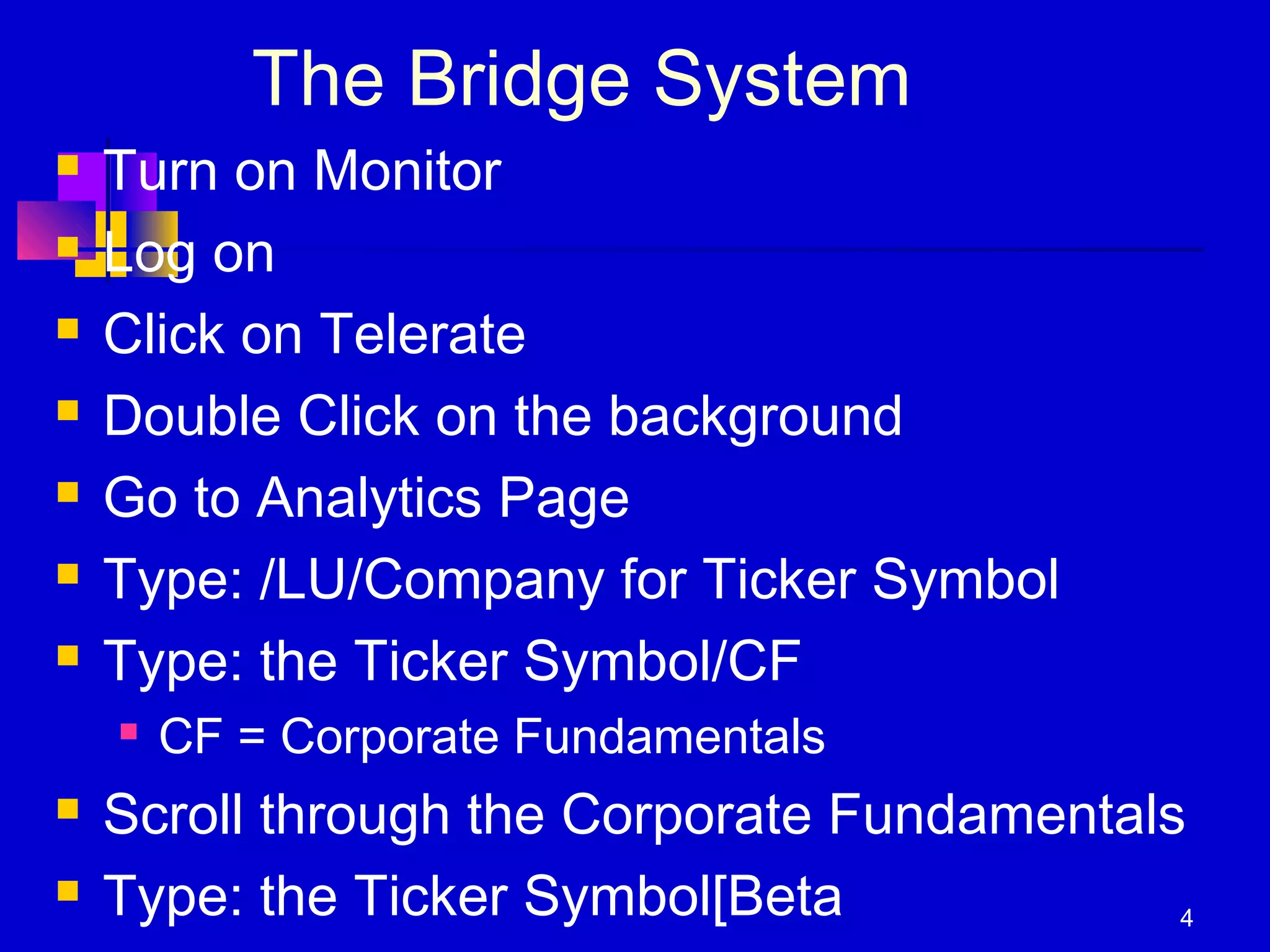
The Bridge System
 Turn on Monitor
 Log on
 Click on Telerate
 Double Click on the background
 Go to Analytics Page
 Type: /LU/Company for Ticker Symbol
 Type: the Ticker Symbol/CF
 CF = Corporate Fundamentals
 Scroll through the Corporate Fundamentals
 Type: the Ticker Symbol[Beta
5
To Obtain the Latest
Corporate News
 Tab to another page in Telerate
 Double click on the background
 Go to News Watch
 Right Click then Search by Ticker Symbol
 Type in the Ticker Symbol
 Then double click on any headline story to
bring up the entire story.
 You can print out the story or possibly save it
to a disk.
6
Analysis Based on the
Market Value of the
Firm
 Market value added ( MVA ) = Total
Market value – Total Capital
MVA is the market value of debt, preferred
stock, and common equity less the Capital
raised by investors or Retained Earnings.
The capital market’s assessment of the
accumulated NPV of all of the firm’s past
and present projected investment projects.
7
Economic Value Added (EVA)
 Economic value added ( EVA ) = [ Return
on total capital (r) – Cost of Capital (k )] x
Capital
 EVA = EBIT(1 – Corporate tax rate) –
(Operating Capital)(k)
 r = net operating profits after taxes divided by
beginning of year capital (Return on Capital)
 k = Weighted After-Tax Cost of Capital
8
EVA - Continued
The yearly contribution of a firm’s operations
to the creation of MVA.
 EVA measures the extent to which the firm
has increased shareholder value in a given
year.
 EVA represents the residual value that
remains after the cost of all capital, including
equity capital has been deducted.
9
Increase Economic Value
Added (EVA)
 Increase operating efficiency
 Commit new resources that promise a
high return
 Redirect resources to more productive
uses
 Make prudent use of tax benefits of
debt financing
10
Problems Caused by
Inflation
 Inventory profit as a result of timing of
price increases
 Inventory valuation methods
( LIFO ) ( FIFO )
 Rising interest rates causes a decline in
the value of long term debt
 Differences in the reporting of earnings
 Understatement of fixed assets
 Recognition of sales
11
The Cash Flow
Concept
 Accounting income Vs Cash flow
 Cash flow is the relevant source of value for the
firm
 ATCF = EAT + Noncash charges
 ATCF = EAT + Depreciation + Deferred taxes
 Free Cash Flow (FCF) = EBIT(1 – T) – Net
Investment in operating capital
 FCF = (EBIT(1 – T) + Depreciation) – Gross
investment in operating capital
12
Statement of Cash
Flows
 Presents the net cash provided by
operating, investing, or financing
activities
 Direct method presents the net cash
provided by operating, investing, or
financing activities
 Indirect method presents the adjustments
to net income to show net cash provided
Used for public financial reports
 The final results are identical
13
Complex International
Aspects of Financial
Statement Analysis
 Influenced by fluctuating exchange
rates
 SFAS No. 52 deals with foreign
currency translation
14
Accuracy of Financial
Statements
 External auditor
 Generally accepted accounting
principles
 People pose for a picture like a
corporation poses for a financial
statement
 Sarbanes-Oxley Act of 2002
15
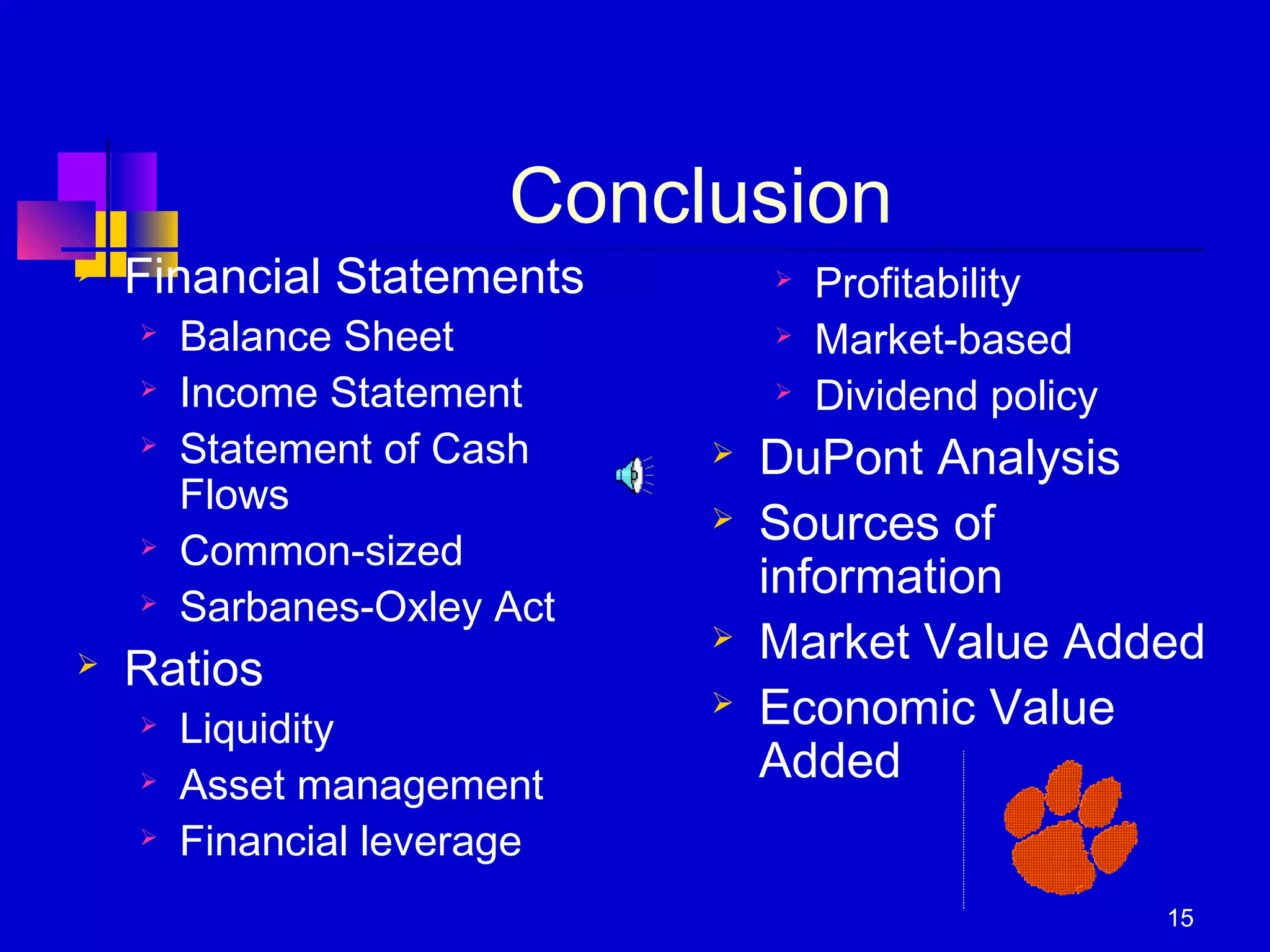
Conclusion
 Financial Statements
 Balance Sheet
 Income Statement
 Statement of Cash
Flows
 Common-sized
 Sarbanes-Oxley Act
 Ratios
 Liquidity
 Asset management
 Financial leverage
 Profitability
 Market-based
 Dividend policy
 DuPont Analysis
 Sources of
information
 Market Value Added
 Economic Value
Added

Fm chapter 5

  • 1.
  • 2.
    2 Problems in Reporting Time of revenue recognition  Pension Fund Earnings Assumptions  Amortization of intangible assets  Including all losses and debt  Off-Balance-Sheet Financing - ENRON
  • 3.
    3 Ratios Can BeMisleading  Differing accounting practices  Might be significant dispersion in the ratio for the industry  Many firms operate in more than one industry - Industry classification  Financial ratios provide a historical record of performance
  • 4.
    4 The Bridge System Turn on Monitor  Log on  Click on Telerate  Double Click on the background  Go to Analytics Page  Type: /LU/Company for Ticker Symbol  Type: the Ticker Symbol/CF  CF = Corporate Fundamentals  Scroll through the Corporate Fundamentals  Type: the Ticker Symbol[Beta
  • 5.
    5 To Obtain theLatest Corporate News  Tab to another page in Telerate  Double click on the background  Go to News Watch  Right Click then Search by Ticker Symbol  Type in the Ticker Symbol  Then double click on any headline story to bring up the entire story.  You can print out the story or possibly save it to a disk.
  • 6.
    6 Analysis Based onthe Market Value of the Firm  Market value added ( MVA ) = Total Market value – Total Capital MVA is the market value of debt, preferred stock, and common equity less the Capital raised by investors or Retained Earnings. The capital market’s assessment of the accumulated NPV of all of the firm’s past and present projected investment projects.
  • 7.
    7 Economic Value Added(EVA)  Economic value added ( EVA ) = [ Return on total capital (r) – Cost of Capital (k )] x Capital  EVA = EBIT(1 – Corporate tax rate) – (Operating Capital)(k)  r = net operating profits after taxes divided by beginning of year capital (Return on Capital)  k = Weighted After-Tax Cost of Capital
  • 8.
    8 EVA - Continued Theyearly contribution of a firm’s operations to the creation of MVA.  EVA measures the extent to which the firm has increased shareholder value in a given year.  EVA represents the residual value that remains after the cost of all capital, including equity capital has been deducted.
  • 9.
    9 Increase Economic Value Added(EVA)  Increase operating efficiency  Commit new resources that promise a high return  Redirect resources to more productive uses  Make prudent use of tax benefits of debt financing
  • 10.
    10 Problems Caused by Inflation Inventory profit as a result of timing of price increases  Inventory valuation methods ( LIFO ) ( FIFO )  Rising interest rates causes a decline in the value of long term debt  Differences in the reporting of earnings  Understatement of fixed assets  Recognition of sales
  • 11.
    11 The Cash Flow Concept Accounting income Vs Cash flow  Cash flow is the relevant source of value for the firm  ATCF = EAT + Noncash charges  ATCF = EAT + Depreciation + Deferred taxes  Free Cash Flow (FCF) = EBIT(1 – T) – Net Investment in operating capital  FCF = (EBIT(1 – T) + Depreciation) – Gross investment in operating capital
  • 12.
    12 Statement of Cash Flows Presents the net cash provided by operating, investing, or financing activities  Direct method presents the net cash provided by operating, investing, or financing activities  Indirect method presents the adjustments to net income to show net cash provided Used for public financial reports  The final results are identical
  • 13.
    13 Complex International Aspects ofFinancial Statement Analysis  Influenced by fluctuating exchange rates  SFAS No. 52 deals with foreign currency translation
  • 14.
    14 Accuracy of Financial Statements External auditor  Generally accepted accounting principles  People pose for a picture like a corporation poses for a financial statement  Sarbanes-Oxley Act of 2002
  • 15.
    15 Conclusion  Financial Statements Balance Sheet  Income Statement  Statement of Cash Flows  Common-sized  Sarbanes-Oxley Act  Ratios  Liquidity  Asset management  Financial leverage  Profitability  Market-based  Dividend policy  DuPont Analysis  Sources of information  Market Value Added  Economic Value Added