VALUATION OF SHARES
MODULE 1
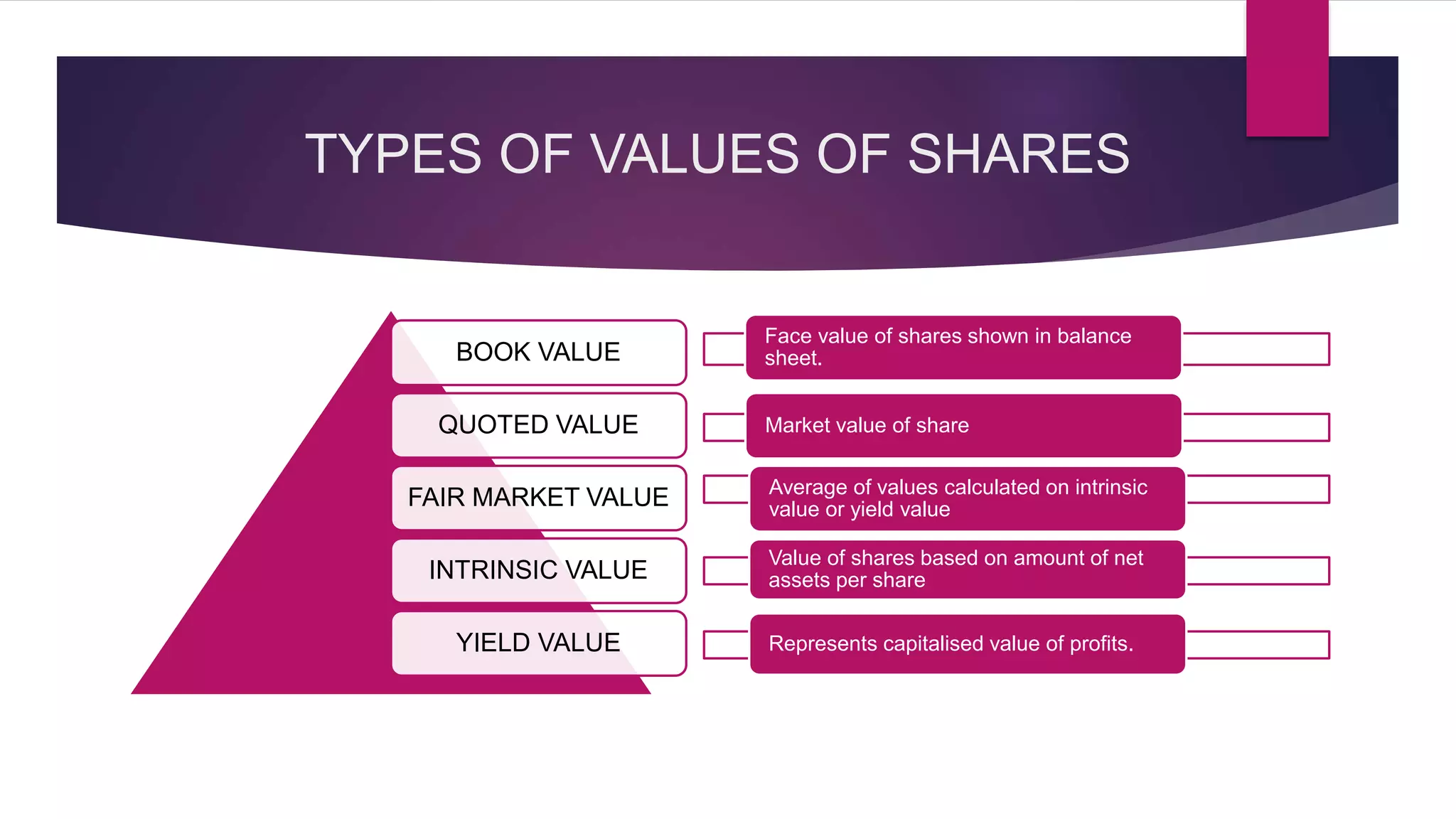
TYPES OF VALUES OF SHARES
BOOK VALUE
QUOTED VALUE
FAIR MARKET VALUE
INTRINSIC VALUE
YIELD VALUE
Face value of shares shown in balance
sheet.
Market value of share
Average of values calculated on intrinsic
value or yield value
Value of shares based on amount of net
assets per share
Represents capitalised value of profits.
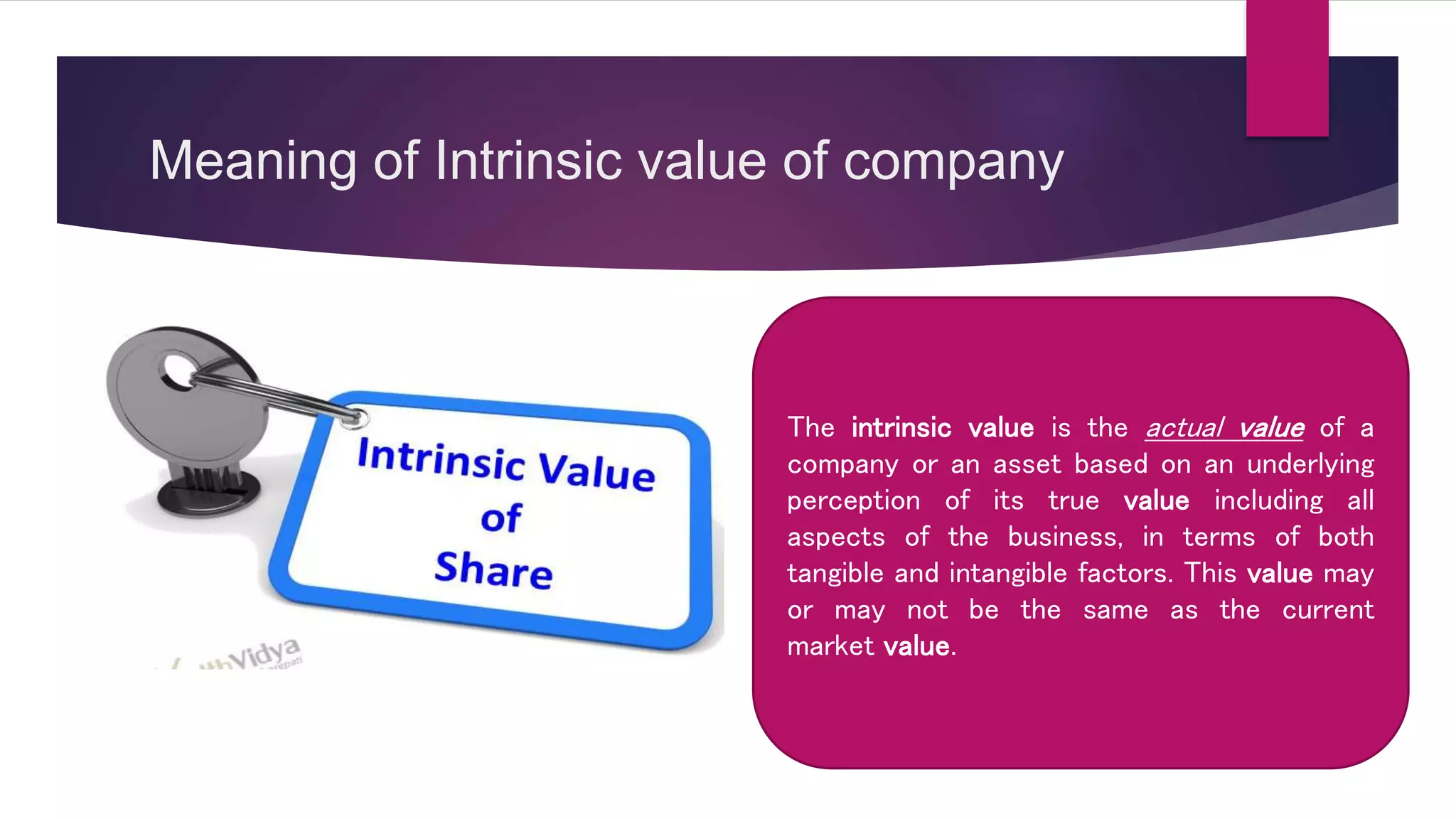
Meaning of Intrinsic value of company
The intrinsic value is the actual value of a
company or an asset based on an underlying
perception of its true value including all
aspects of the business, in terms of both
tangible and intangible factors. This value may
or may not be the same as the current
market value.
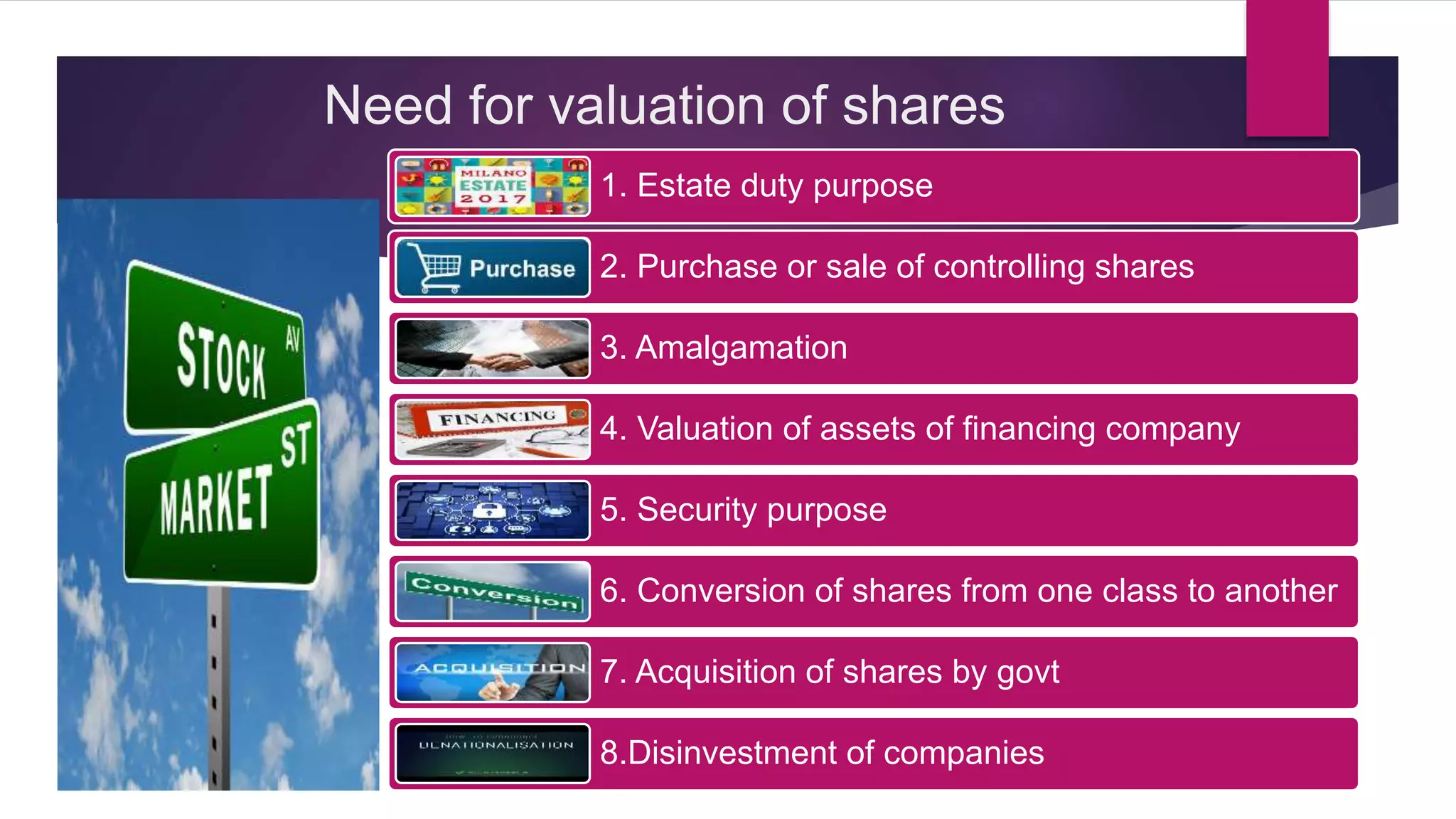
Need for valuation of shares
1. Estate duty purpose
2. Purchase or sale of controlling shares
3. Amalgamation
4. Valuation of assets of financing company
5. Security purpose
6. Conversion of shares from one class to another
7. Acquisition of shares by govt
8.Disinvestment of companies
MEANING OF VALUATION OF SHARES
Valuation of shares means the ascertainment of the
value of shares which is independent of the price of
shares quoted in the share market.
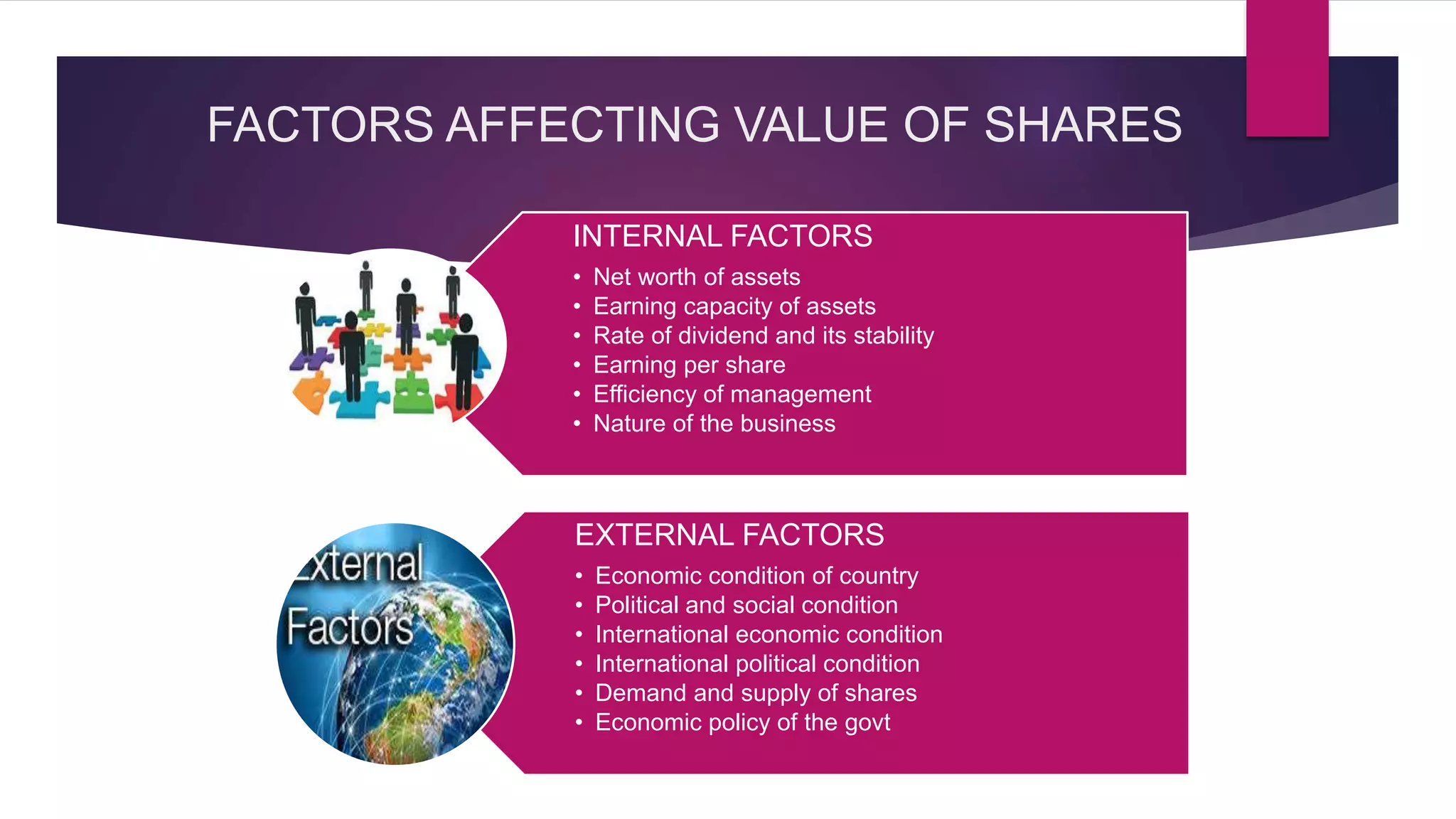
FACTORS AFFECTING VALUE OF SHARES
INTERNAL FACTORS
• Net worth of assets
• Earning capacity of assets
• Rate of dividend and its stability
• Earning per share
• Efficiency of management
• Nature of the business
EXTERNAL FACTORS
• Economic condition of country
• Political and social condition
• International economic condition
• International political condition
• Demand and supply of shares
• Economic policy of the govt
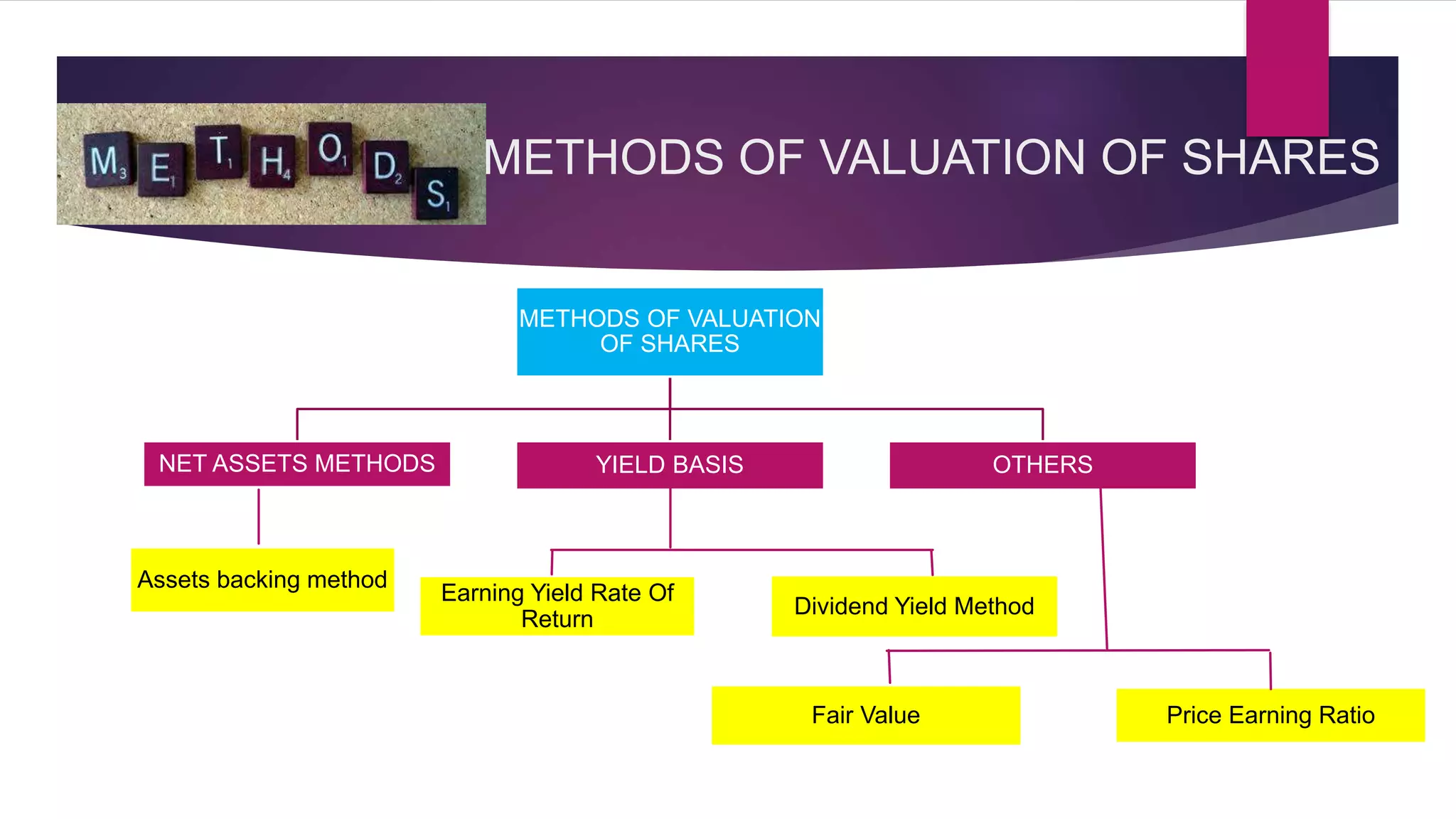
METHODS OF VALUATION OF SHARES
METHODS OF VALUATION
OF SHARES
NET ASSETS METHODS YIELD BASIS OTHERS
Assets backing method
Earning Yield Rate Of
Return
Dividend Yield Method
Fair Value Price Earning Ratio
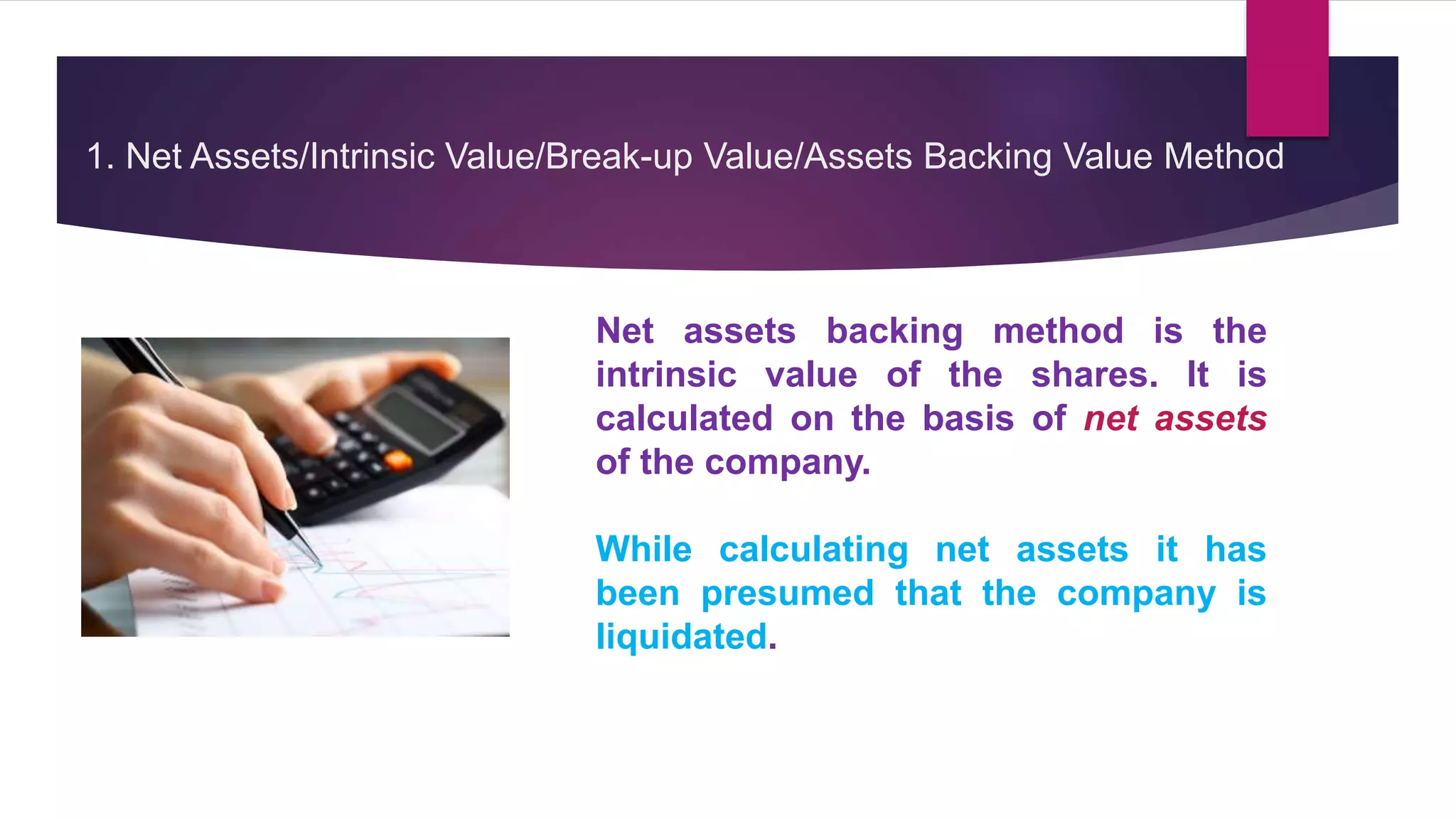
1. Net Assets/Intrinsic Value/Break-up Value/Assets Backing Value Method
Net assets backing method is the
intrinsic value of the shares. It is
calculated on the basis of net assets
of the company.
While calculating net assets it has
been presumed that the company is
liquidated.
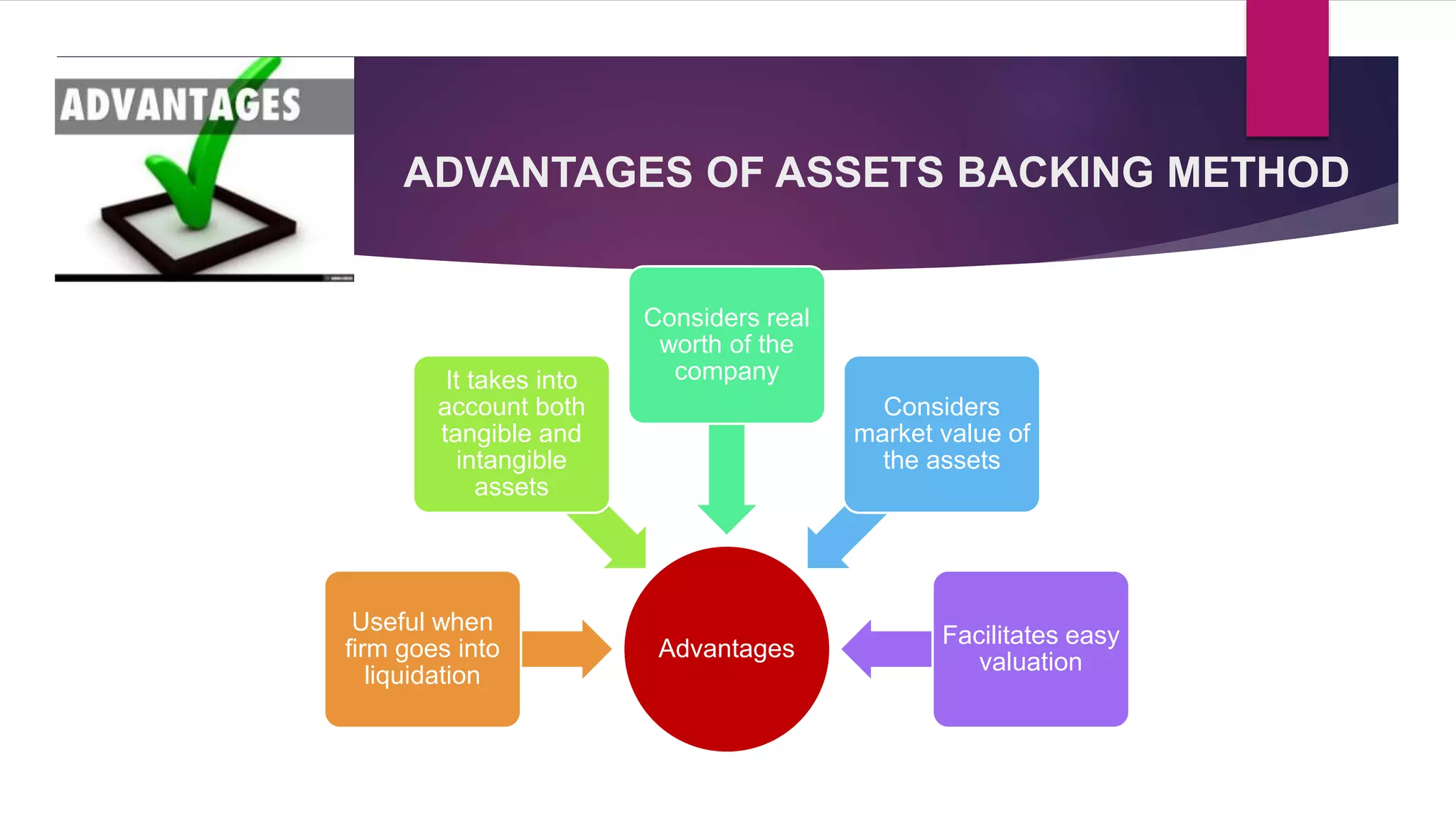
ADVANTAGES OF ASSETS BACKING METHOD
Advantages
Useful when
firm goes into
liquidation
It takes into
account both
tangible and
intangible
assets
Considers real
worth of the
company
Considers
market value of
the assets
Facilitates easy
valuation
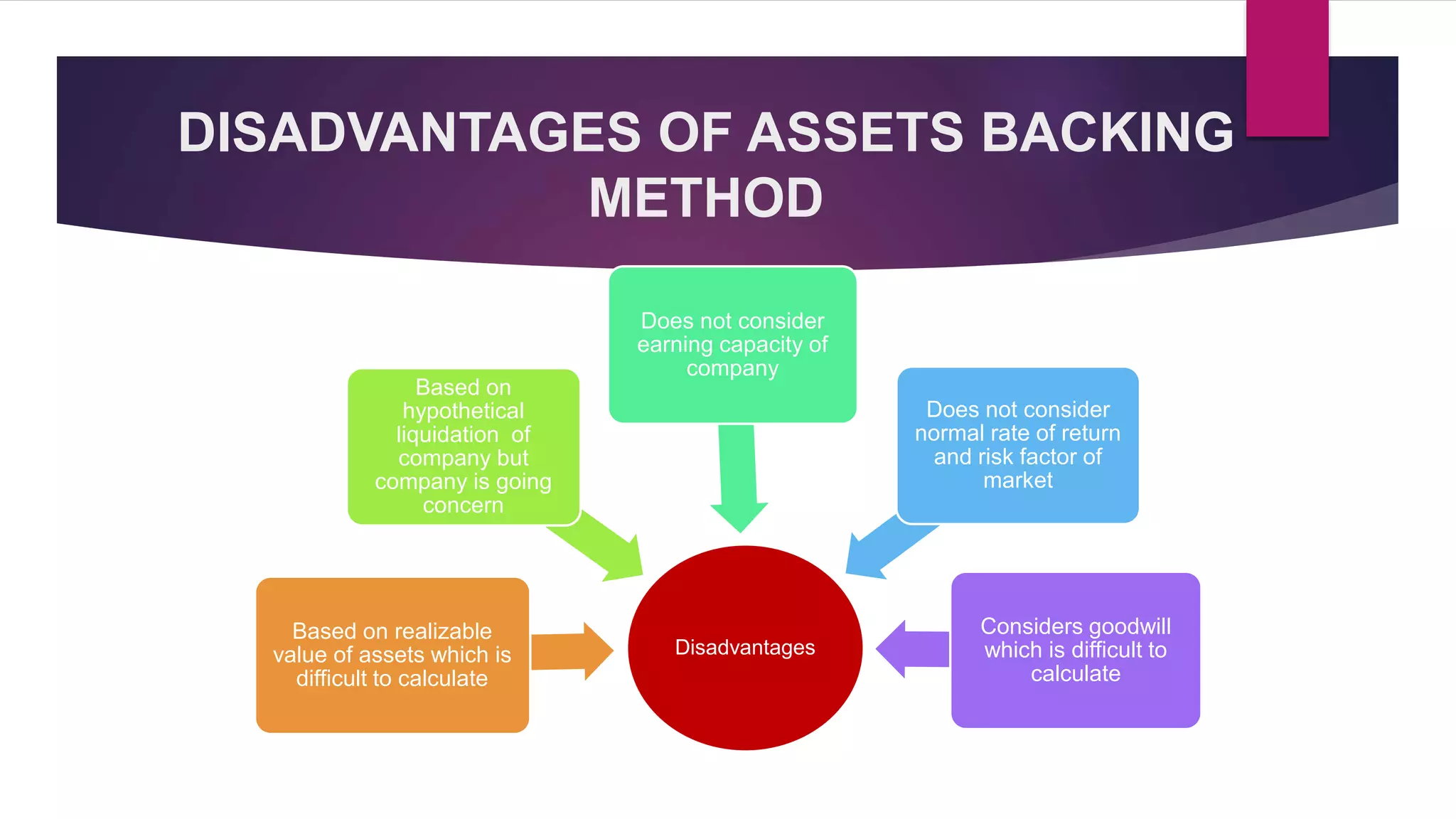
DISADVANTAGES OF ASSETS BACKING
METHOD
Disadvantages
Based on realizable
value of assets which is
difficult to calculate
Based on
hypothetical
liquidation of
company but
company is going
concern
Does not consider
earning capacity of
company
Does not consider
normal rate of return
and risk factor of
market
Considers goodwill
which is difficult to
calculate
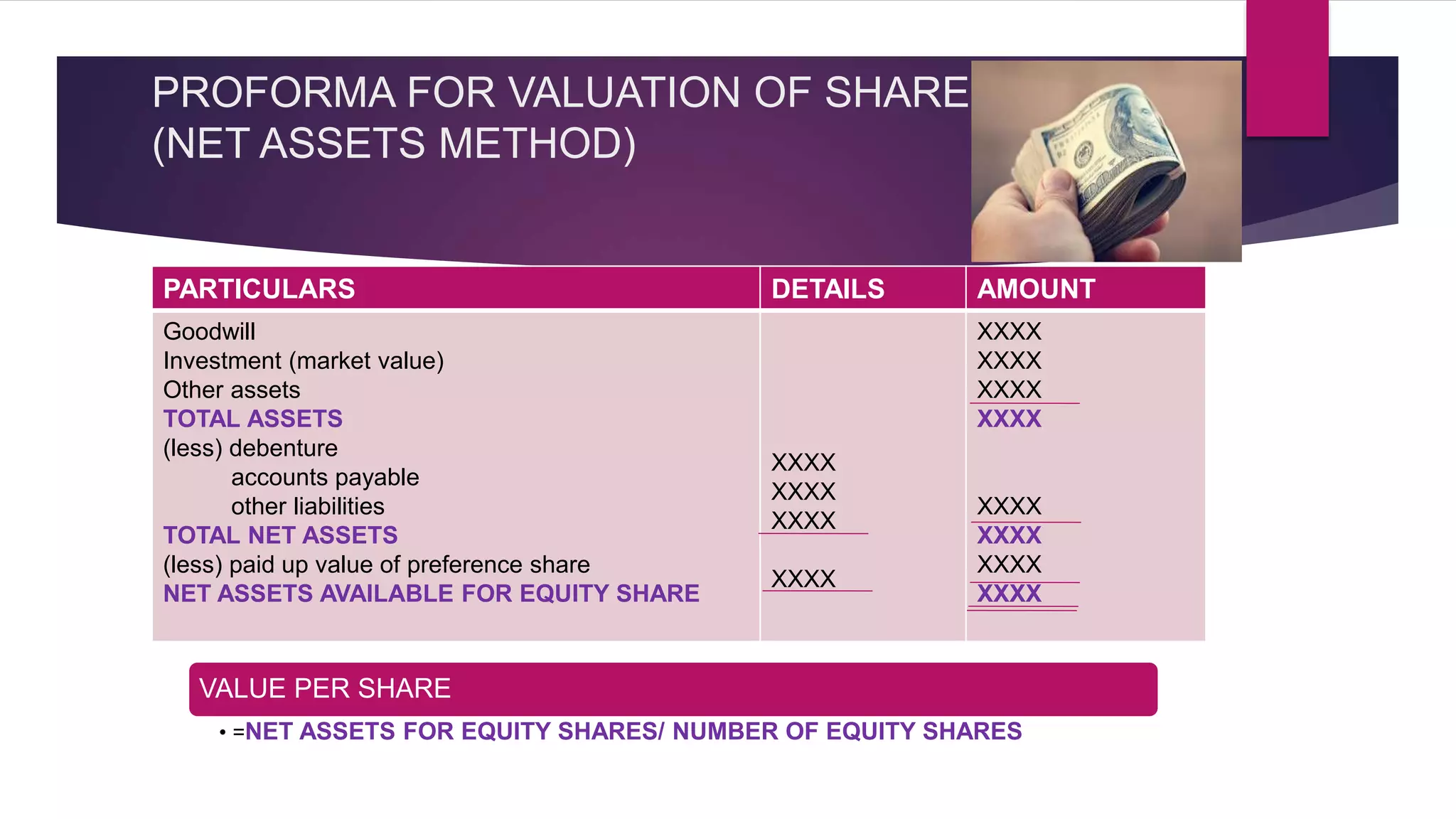
PROFORMA FOR VALUATION OF SHARES
(NET ASSETS METHOD)
PARTICULARS DETAILS AMOUNT
Goodwill
Investment (market value)
Other assets
TOTAL ASSETS
(less) debenture
accounts payable
other liabilities
TOTAL NET ASSETS
(less) paid up value of preference share
NET ASSETS AVAILABLE FOR EQUITY SHARE
XXXX
XXXX
XXXX
XXXX
XXXX
XXXX
XXXX
XXXX
XXXX
XXXX
XXXX
XXXX
VALUE PER SHARE
• =NET ASSETS FOR EQUITY SHARES/ NUMBER OF EQUITY SHARES
EX-DIVIDEND & CUM-DIVIDEND- INTRODUCTION
 EX-DIVIDEND = WITHOUT DIVIDEND
 CUM-DIVIDEND = WITH DIVIDEND
ANNOUNCEMENT
DATE
EX-DIV
DATE
RECOR
D
DATE
PAYMENT
DATE
ANNOUNCEMENT DATE - The date when company announces that it is
going to provide dividend
RECORD DATE - The date when company shows the list of investors who
have bought the shares of company.
EX-DIVIDEND DATE – On the Ex-dividend date, the shareholder will not get
any dividend for its share.
PAYMENT DATE – The date on which dividend is paid to shareholders.
SETTLEMENT
PERIOD
T+2
CUM - DIVIDEND EX-DIVIDEND
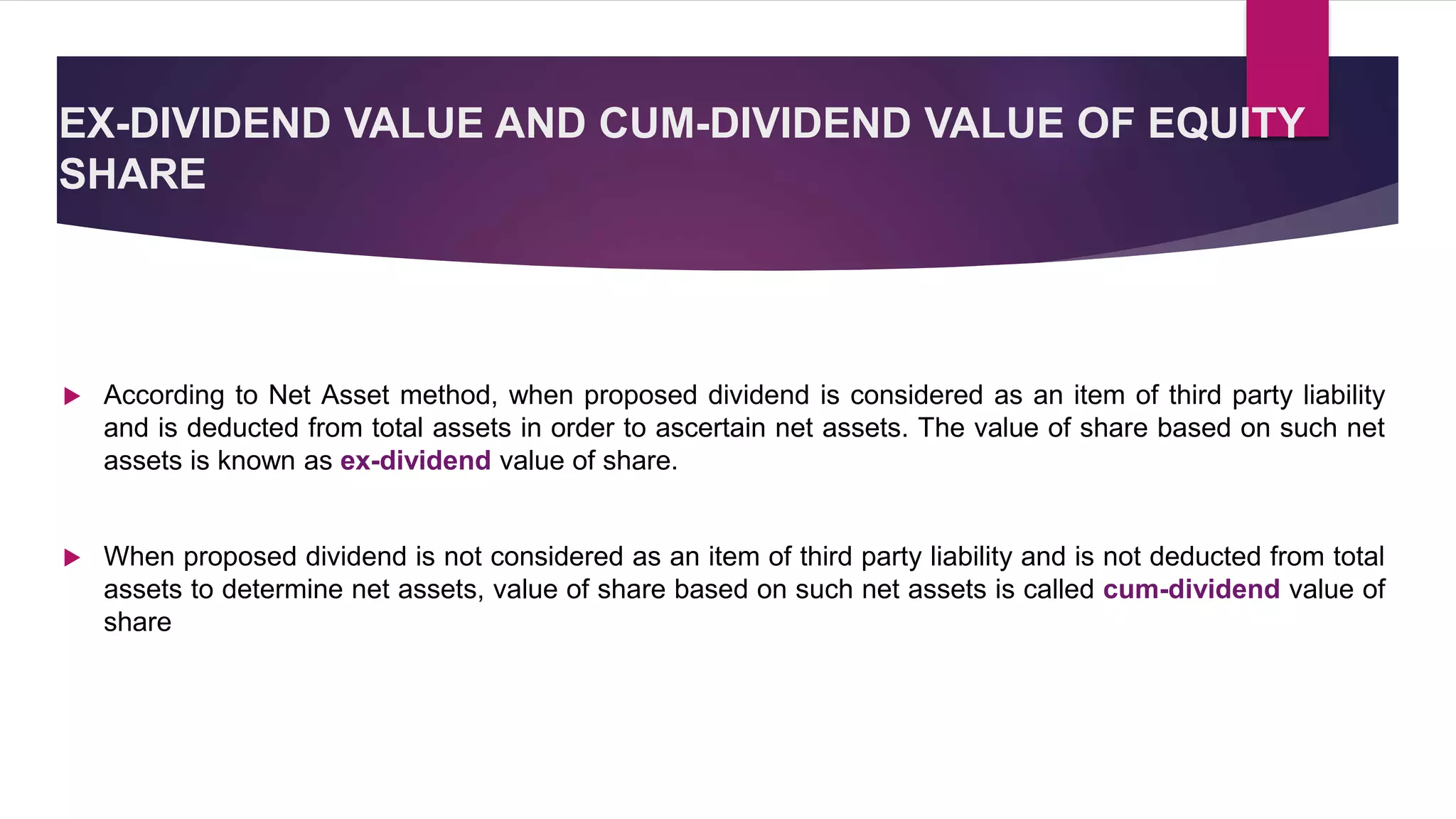
EX-DIVIDEND VALUE AND CUM-DIVIDEND VALUE OF EQUITY
SHARE
 According to Net Asset method, when proposed dividend is considered as an item of third party liability
and is deducted from total assets in order to ascertain net assets. The value of share based on such net
assets is known as ex-dividend value of share.
 When proposed dividend is not considered as an item of third party liability and is not deducted from total
assets to determine net assets, value of share based on such net assets is called cum-dividend value of
share
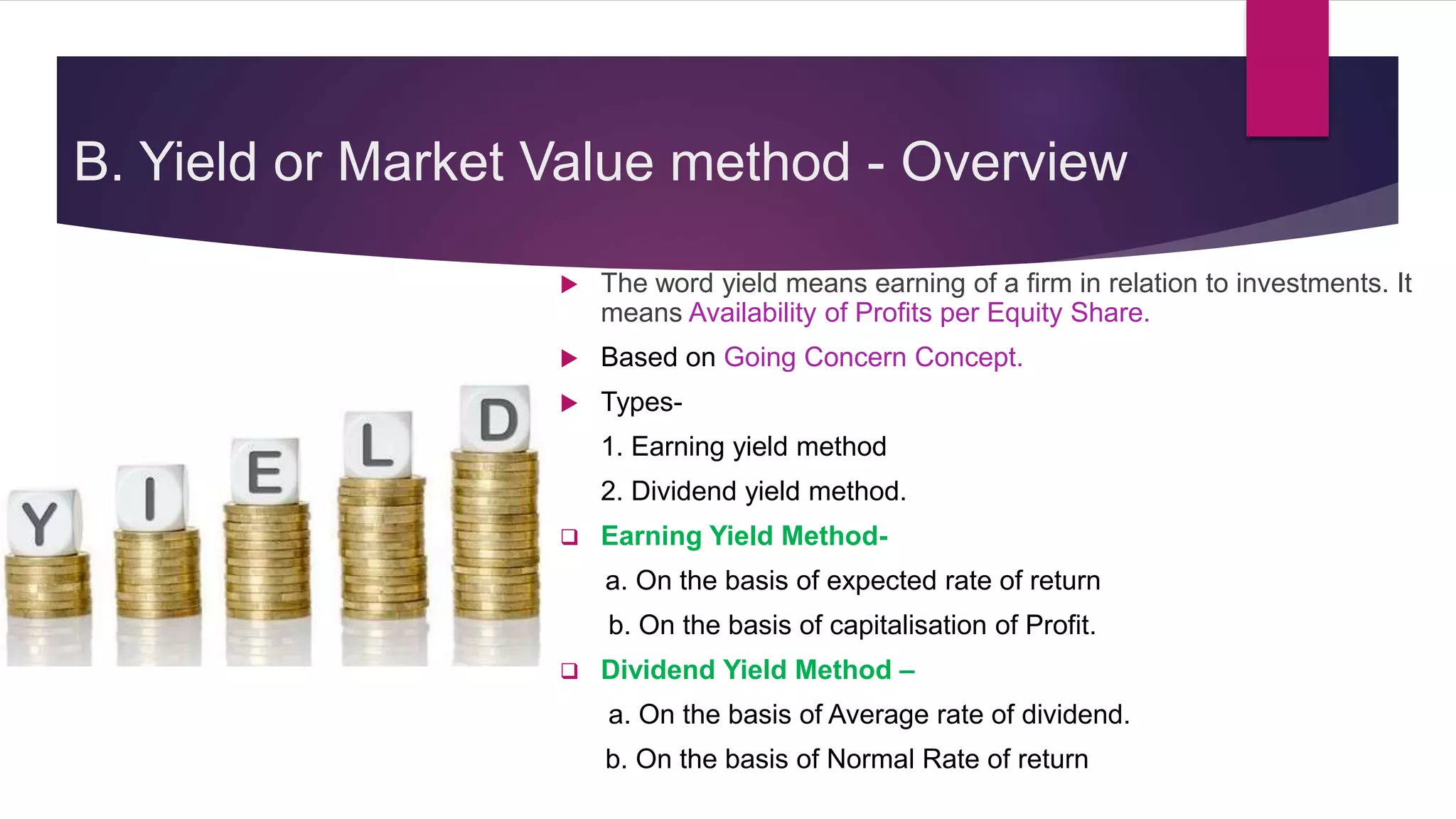
B. Yield or Market Value method - Overview
 The word yield means earning of a firm in relation to investments. It
means Availability of Profits per Equity Share.
 Based on Going Concern Concept.
 Types-
1. Earning yield method
2. Dividend yield method.
 Earning Yield Method-
a. On the basis of expected rate of return
b. On the basis of capitalisation of Profit.
 Dividend Yield Method –
a. On the basis of Average rate of dividend.
b. On the basis of Normal Rate of return
ATTENTION – IMPORTANT POINTS
 1. where information is given regarding Earning/Profits of the company
along with normal rate of return, Earning Yield Method should be
applied.
 2. where information is given regarding Rate of Dividend of the
company along with normal rate of return, Dividend Yield Method
should be applied.
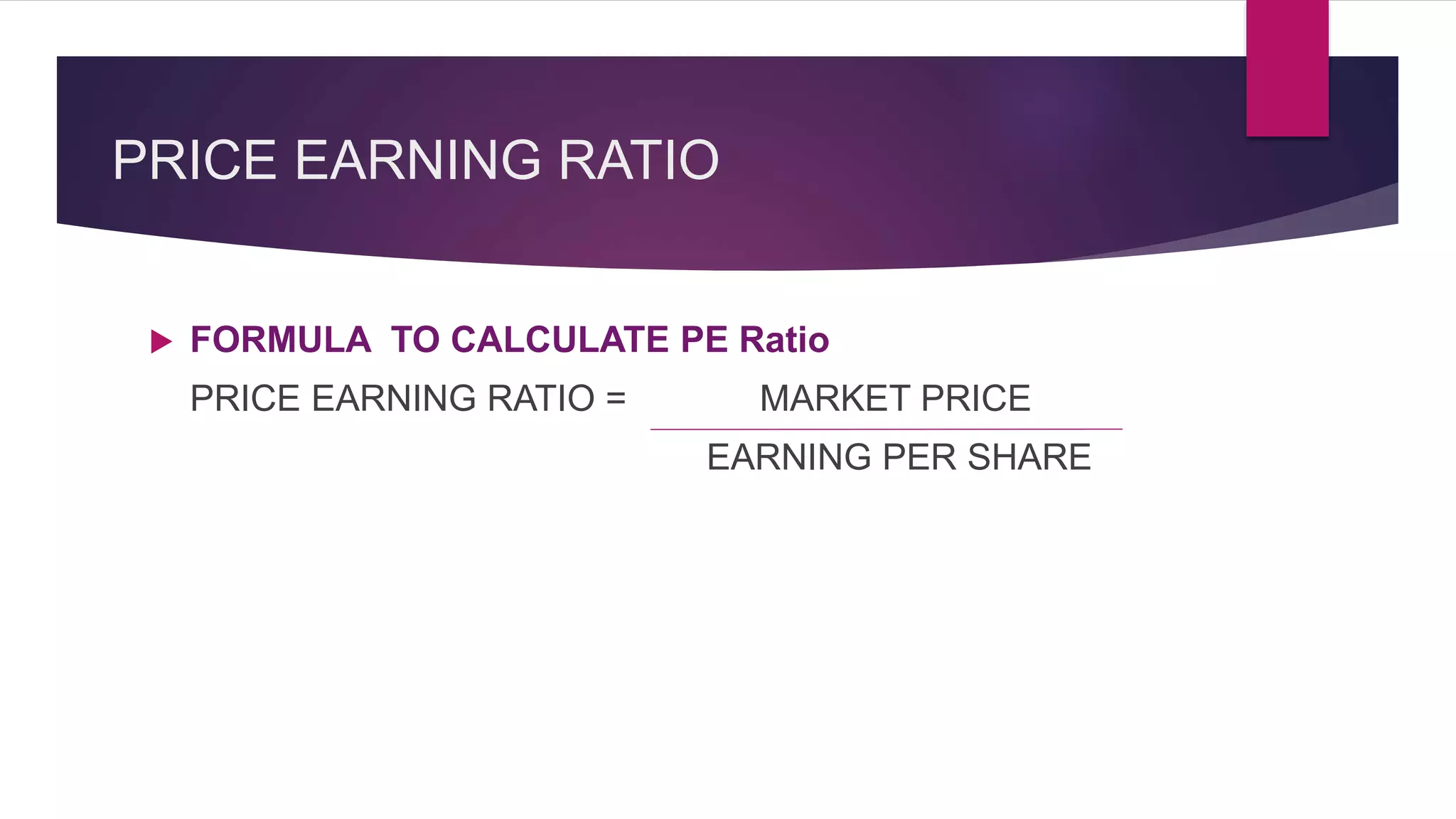
PRICE EARNING RATIO
 FORMULA TO CALCULATE PE Ratio
PRICE EARNING RATIO = MARKET PRICE
EARNING PER SHARE
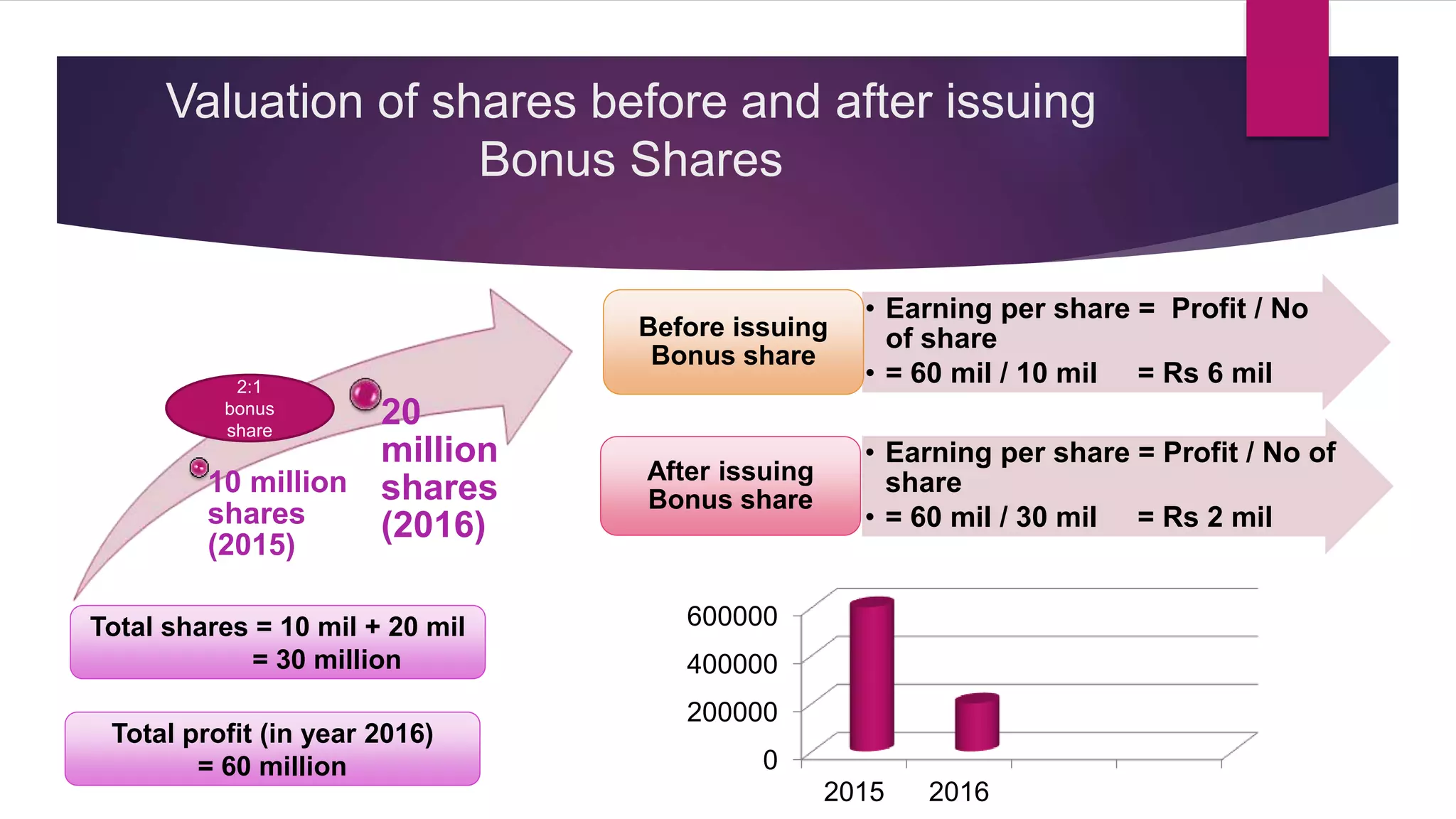
Valuation of shares before and after issuing
Bonus Shares
10 million
shares
(2015)
20
million
shares
(2016)
2:1
bonus
share
Total shares = 10 mil + 20 mil
= 30 million
• Earning per share = Profit / No
of share
• = 60 mil / 10 mil = Rs 6 mil
Before issuing
Bonus share
• Earning per share = Profit / No of
share
• = 60 mil / 30 mil = Rs 2 mil
After issuing
Bonus share
Total profit (in year 2016)
= 60 million 0
200000
400000
600000
2015 2016
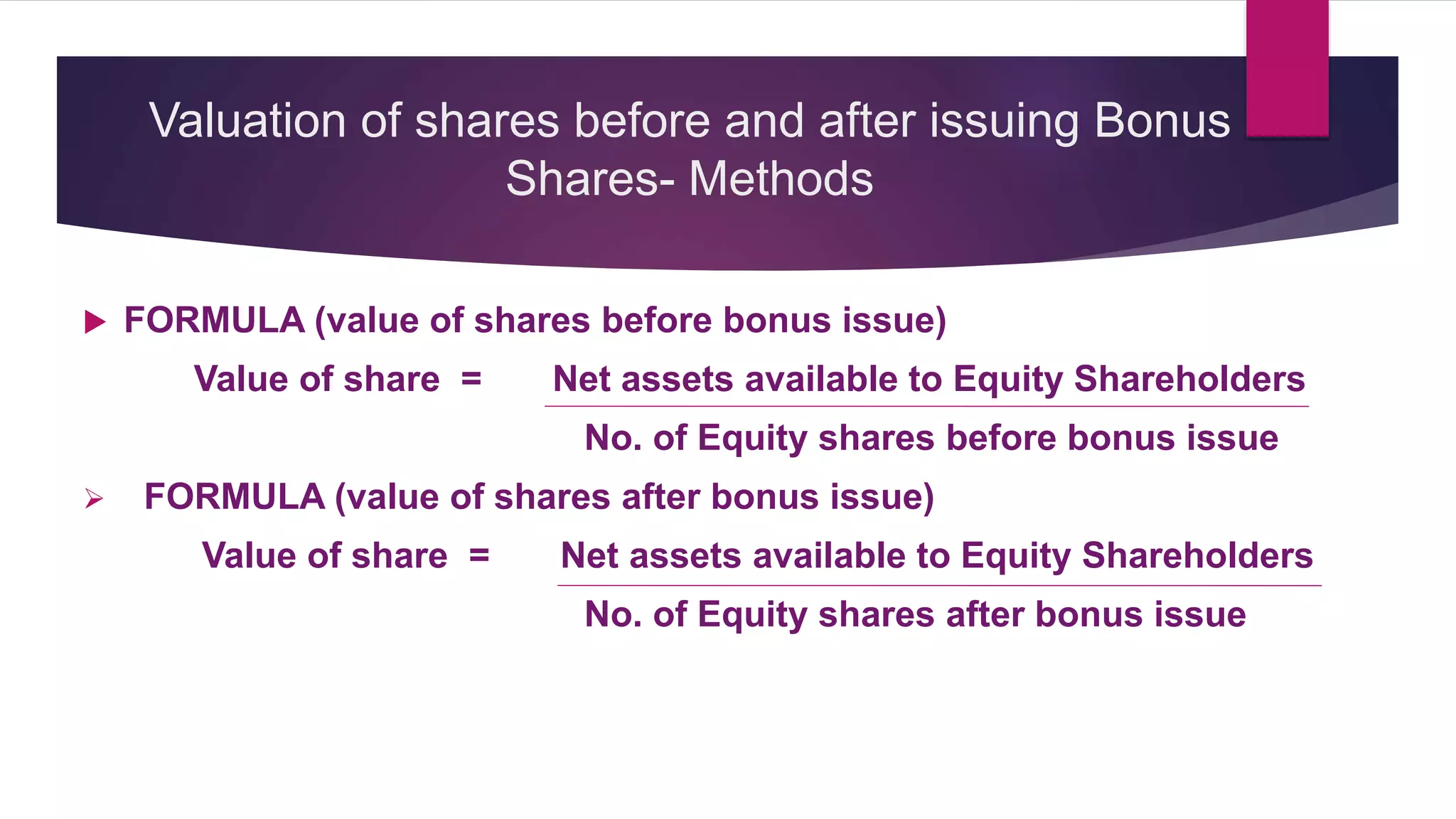
 FORMULA (value of shares before bonus issue)
Value of share = Net assets available to Equity Shareholders
No. of Equity shares before bonus issue
 FORMULA (value of shares after bonus issue)
Value of share = Net assets available to Equity Shareholders
No. of Equity shares after bonus issue
Valuation of shares before and after issuing Bonus
Shares- Methods

Module 1 valuation of shares copy

  • 1.
  • 2.
    TYPES OF VALUESOF SHARES BOOK VALUE QUOTED VALUE FAIR MARKET VALUE INTRINSIC VALUE YIELD VALUE Face value of shares shown in balance sheet. Market value of share Average of values calculated on intrinsic value or yield value Value of shares based on amount of net assets per share Represents capitalised value of profits.
  • 3.
    Meaning of Intrinsicvalue of company The intrinsic value is the actual value of a company or an asset based on an underlying perception of its true value including all aspects of the business, in terms of both tangible and intangible factors. This value may or may not be the same as the current market value.
  • 4.
    Need for valuationof shares 1. Estate duty purpose 2. Purchase or sale of controlling shares 3. Amalgamation 4. Valuation of assets of financing company 5. Security purpose 6. Conversion of shares from one class to another 7. Acquisition of shares by govt 8.Disinvestment of companies
  • 5.
    MEANING OF VALUATIONOF SHARES Valuation of shares means the ascertainment of the value of shares which is independent of the price of shares quoted in the share market.
  • 6.
    FACTORS AFFECTING VALUEOF SHARES INTERNAL FACTORS • Net worth of assets • Earning capacity of assets • Rate of dividend and its stability • Earning per share • Efficiency of management • Nature of the business EXTERNAL FACTORS • Economic condition of country • Political and social condition • International economic condition • International political condition • Demand and supply of shares • Economic policy of the govt
  • 7.
    METHODS OF VALUATIONOF SHARES METHODS OF VALUATION OF SHARES NET ASSETS METHODS YIELD BASIS OTHERS Assets backing method Earning Yield Rate Of Return Dividend Yield Method Fair Value Price Earning Ratio
  • 8.
    1. Net Assets/IntrinsicValue/Break-up Value/Assets Backing Value Method Net assets backing method is the intrinsic value of the shares. It is calculated on the basis of net assets of the company. While calculating net assets it has been presumed that the company is liquidated.
  • 9.
    ADVANTAGES OF ASSETSBACKING METHOD Advantages Useful when firm goes into liquidation It takes into account both tangible and intangible assets Considers real worth of the company Considers market value of the assets Facilitates easy valuation
  • 10.
    DISADVANTAGES OF ASSETSBACKING METHOD Disadvantages Based on realizable value of assets which is difficult to calculate Based on hypothetical liquidation of company but company is going concern Does not consider earning capacity of company Does not consider normal rate of return and risk factor of market Considers goodwill which is difficult to calculate
  • 11.
    PROFORMA FOR VALUATIONOF SHARES (NET ASSETS METHOD) PARTICULARS DETAILS AMOUNT Goodwill Investment (market value) Other assets TOTAL ASSETS (less) debenture accounts payable other liabilities TOTAL NET ASSETS (less) paid up value of preference share NET ASSETS AVAILABLE FOR EQUITY SHARE XXXX XXXX XXXX XXXX XXXX XXXX XXXX XXXX XXXX XXXX XXXX XXXX VALUE PER SHARE • =NET ASSETS FOR EQUITY SHARES/ NUMBER OF EQUITY SHARES
  • 12.
    EX-DIVIDEND & CUM-DIVIDEND-INTRODUCTION  EX-DIVIDEND = WITHOUT DIVIDEND  CUM-DIVIDEND = WITH DIVIDEND ANNOUNCEMENT DATE EX-DIV DATE RECOR D DATE PAYMENT DATE ANNOUNCEMENT DATE - The date when company announces that it is going to provide dividend RECORD DATE - The date when company shows the list of investors who have bought the shares of company. EX-DIVIDEND DATE – On the Ex-dividend date, the shareholder will not get any dividend for its share. PAYMENT DATE – The date on which dividend is paid to shareholders. SETTLEMENT PERIOD T+2 CUM - DIVIDEND EX-DIVIDEND
  • 13.
    EX-DIVIDEND VALUE ANDCUM-DIVIDEND VALUE OF EQUITY SHARE  According to Net Asset method, when proposed dividend is considered as an item of third party liability and is deducted from total assets in order to ascertain net assets. The value of share based on such net assets is known as ex-dividend value of share.  When proposed dividend is not considered as an item of third party liability and is not deducted from total assets to determine net assets, value of share based on such net assets is called cum-dividend value of share
  • 14.
    B. Yield orMarket Value method - Overview  The word yield means earning of a firm in relation to investments. It means Availability of Profits per Equity Share.  Based on Going Concern Concept.  Types- 1. Earning yield method 2. Dividend yield method.  Earning Yield Method- a. On the basis of expected rate of return b. On the basis of capitalisation of Profit.  Dividend Yield Method – a. On the basis of Average rate of dividend. b. On the basis of Normal Rate of return
  • 15.
    ATTENTION – IMPORTANTPOINTS  1. where information is given regarding Earning/Profits of the company along with normal rate of return, Earning Yield Method should be applied.  2. where information is given regarding Rate of Dividend of the company along with normal rate of return, Dividend Yield Method should be applied.
  • 16.
    PRICE EARNING RATIO FORMULA TO CALCULATE PE Ratio PRICE EARNING RATIO = MARKET PRICE EARNING PER SHARE
  • 17.
    Valuation of sharesbefore and after issuing Bonus Shares 10 million shares (2015) 20 million shares (2016) 2:1 bonus share Total shares = 10 mil + 20 mil = 30 million • Earning per share = Profit / No of share • = 60 mil / 10 mil = Rs 6 mil Before issuing Bonus share • Earning per share = Profit / No of share • = 60 mil / 30 mil = Rs 2 mil After issuing Bonus share Total profit (in year 2016) = 60 million 0 200000 400000 600000 2015 2016
  • 18.
     FORMULA (valueof shares before bonus issue) Value of share = Net assets available to Equity Shareholders No. of Equity shares before bonus issue  FORMULA (value of shares after bonus issue) Value of share = Net assets available to Equity Shareholders No. of Equity shares after bonus issue Valuation of shares before and after issuing Bonus Shares- Methods