TITLE: "UNDERSTANDING DIGITAL CLOCKS"
SUBTITLE: EXPLORING THE MECHANICS AND SIGNIFICANCE
PRESENTED BY: [NISCHAL BHUJEL]
PRESENTED TO : ER AMIT KUMAR SHA
DATE: [2080/11/30]
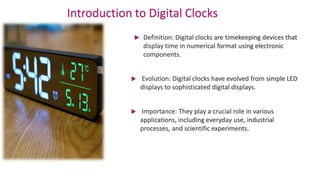
Introduction to Digital Clocks
 Definition: Digital clocks are timekeeping devices that
display time in numerical format using electronic
components.
 Evolution: Digital clocks have evolved from simple LED
displays to sophisticated digital displays.
 Importance: They play a crucial role in various
applications, including everyday use, industrial
processes, and scientific experiments.
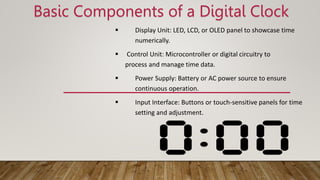
Basic Components of a Digital Clock
 Display Unit: LED, LCD, or OLED panel to showcase time
numerically.
 Control Unit: Microcontroller or digital circuitry to
process and manage time data.
 Power Supply: Battery or AC power source to ensure
continuous operation.
 Input Interface: Buttons or touch-sensitive panels for time
setting and adjustment.
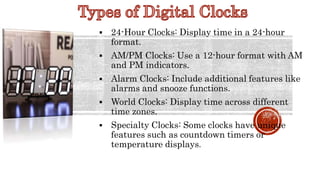
 24-Hour Clocks: Display time in a 24-hour
format.
 AM/PM Clocks: Use a 12-hour format with AM
and PM indicators.
 Alarm Clocks: Include additional features like
alarms and snooze functions.
 World Clocks: Display time across different
time zones.
 Specialty Clocks: Some clocks have unique
features such as countdown timers or
temperature displays.
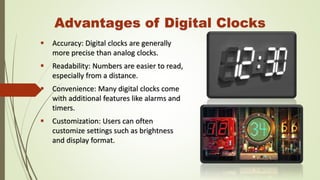
Advantages of Digital Clocks
 Accuracy: Digital clocks are generally
more precise than analog clocks.
 Readability: Numbers are easier to read,
especially from a distance.
 Convenience: Many digital clocks come
with additional features like alarms and
timers.
 Customization: Users can often
customize settings such as brightness
and display format.
Applications of Digital Clocks
 Home Use: Digital clocks are commonly used in
households for keeping track of time.
 Offices: Essential for scheduling meetings and
appointments.
 Transportation: Used in vehicles, airports, and train
stations for departure and arrival times.
 Education: Digital clocks are found in classrooms and
lecture halls for time management.
 Healthcare: Hospitals and clinics use digital clocks for
patient care and scheduling.
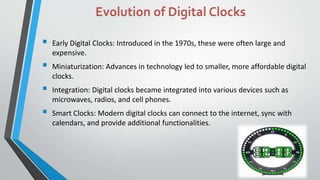
 Early Digital Clocks: Introduced in the 1970s, these were often large and
expensive.
 Miniaturization: Advances in technology led to smaller, more affordable digital
clocks.
 Integration: Digital clocks became integrated into various devices such as
microwaves, radios, and cell phones.
 Smart Clocks: Modern digital clocks can connect to the internet, sync with
calendars, and provide additional functionalities.
 Internet of Things (IoT): Digital clocks may become part of interconnected smart
home systems.
 Wearable Tech: Digital clocks integrated into wearable devices like smartwatches
and fitness trackers.
 Artificial Intelligence: AI-powered clocks could offer personalized time
management suggestions.
 Sustainability: Future digital clocks may incorporate eco-friendly materials and
energy-saving features.
 SUMMARY: THE PROPOSAL OUTLINES THE DEVELOPMENT OF A DIGITAL CLOCK
APPLICATION IN JAVA, EMPHASIZING ITS FEATURES, TECHNOLOGIES, DESIGN,
DEVELOPMENT PROCESS, CHALLENGES, AND BENEFITS.
 NEXT STEPS: PROCEEDING WITH THE DEVELOPMENT PHASE TO BRING THE
DIGITAL CLOCK APPLICATION TO FRUITION, CONTRIBUTING TO BOTH PERSONAL
SKILL ENHANCEMENT AND POTENTIAL UTILITY FOR USERS.
“THE END”
THANKS EVERY FOR GIVING ME YOUR
IMPORTANT TIME

Presentation of digital clock with description

  • 2.
    TITLE: "UNDERSTANDING DIGITALCLOCKS" SUBTITLE: EXPLORING THE MECHANICS AND SIGNIFICANCE PRESENTED BY: [NISCHAL BHUJEL] PRESENTED TO : ER AMIT KUMAR SHA DATE: [2080/11/30]
  • 4.
    Introduction to DigitalClocks  Definition: Digital clocks are timekeeping devices that display time in numerical format using electronic components.  Evolution: Digital clocks have evolved from simple LED displays to sophisticated digital displays.  Importance: They play a crucial role in various applications, including everyday use, industrial processes, and scientific experiments.
  • 5.
    Basic Components ofa Digital Clock  Display Unit: LED, LCD, or OLED panel to showcase time numerically.  Control Unit: Microcontroller or digital circuitry to process and manage time data.  Power Supply: Battery or AC power source to ensure continuous operation.  Input Interface: Buttons or touch-sensitive panels for time setting and adjustment.
  • 6.
     24-Hour Clocks:Display time in a 24-hour format.  AM/PM Clocks: Use a 12-hour format with AM and PM indicators.  Alarm Clocks: Include additional features like alarms and snooze functions.  World Clocks: Display time across different time zones.  Specialty Clocks: Some clocks have unique features such as countdown timers or temperature displays.
  • 7.
    Advantages of DigitalClocks  Accuracy: Digital clocks are generally more precise than analog clocks.  Readability: Numbers are easier to read, especially from a distance.  Convenience: Many digital clocks come with additional features like alarms and timers.  Customization: Users can often customize settings such as brightness and display format.
  • 8.
    Applications of DigitalClocks  Home Use: Digital clocks are commonly used in households for keeping track of time.  Offices: Essential for scheduling meetings and appointments.  Transportation: Used in vehicles, airports, and train stations for departure and arrival times.  Education: Digital clocks are found in classrooms and lecture halls for time management.  Healthcare: Hospitals and clinics use digital clocks for patient care and scheduling.
  • 9.
     Early DigitalClocks: Introduced in the 1970s, these were often large and expensive.  Miniaturization: Advances in technology led to smaller, more affordable digital clocks.  Integration: Digital clocks became integrated into various devices such as microwaves, radios, and cell phones.  Smart Clocks: Modern digital clocks can connect to the internet, sync with calendars, and provide additional functionalities.
  • 10.
     Internet ofThings (IoT): Digital clocks may become part of interconnected smart home systems.  Wearable Tech: Digital clocks integrated into wearable devices like smartwatches and fitness trackers.  Artificial Intelligence: AI-powered clocks could offer personalized time management suggestions.  Sustainability: Future digital clocks may incorporate eco-friendly materials and energy-saving features.
  • 11.
     SUMMARY: THEPROPOSAL OUTLINES THE DEVELOPMENT OF A DIGITAL CLOCK APPLICATION IN JAVA, EMPHASIZING ITS FEATURES, TECHNOLOGIES, DESIGN, DEVELOPMENT PROCESS, CHALLENGES, AND BENEFITS.  NEXT STEPS: PROCEEDING WITH THE DEVELOPMENT PHASE TO BRING THE DIGITAL CLOCK APPLICATION TO FRUITION, CONTRIBUTING TO BOTH PERSONAL SKILL ENHANCEMENT AND POTENTIAL UTILITY FOR USERS.
  • 12.
    “THE END” THANKS EVERYFOR GIVING ME YOUR IMPORTANT TIME

Editor's Notes

  • #3 This template is provided by http://www.free-power-point-templates.com/