JBS S.A.


                      “In God we trust, nature we respect”

December, 2009

JBS S.A..
JBS S.A
Our Values
The Foundation Of Our Culture
           Planning

         Determination

           Discipline

          Availability

          Openness

           Simplicity

                                1
The Global Beef Industry


                           8
                           8
Global Market


                        Largest beef producers                              Largest beef consumers


                     Others                                             Others
                                                   United States                                         United States
                      31%                                                31%
                                                       21%                                                   22%


                                                     Brazil                                                EU-27
                                                     15%                                                    15%
             India
              4%                                                   Mexico
                                                                    4%
               Argentina
                                                                       Argentina
                  5%                       EU-27                                               Brazil
                               China                                      5%     China
                                            14%                                                13%
                               10%                                               10%


                        Largest beef exporters                              Largest beef importers


                      Others
                       25%                         Brazil                                               United States
                                                   23%                Others                                19%
                                                                       38%
                                                                                                           Russia
                                                                                                            16%
          New Zealand
                                                    Australia
              7%
                                                      19%
               Canada
                 7% India                                          South Korea
                                                                                                Japan
                                   United States                       4%              EU-27
                      8%                                                      Mexico             10%
                                       11%                                              8%
                                                                               5%


Source: USDA 2009
                                                                                                                         3
World Population Growth and Beef Consumption
                                (1960 – 2050)


                                                                                                                                                        140
                       10000              Population growth, a beef
                                            consumption driver.
                                                                                                                                                        120

                       8000


                                                                                                                                                              Consumption (million tons)
                                                                                                                                                        100
Population (million)


                       6000                                                                                                                             80


                                                                                                                                                        60
                       4000


                                                                                                                                                        40


                       2000
                                                                                                                                                        20


                          0                                                                                                                             0
                               1960 1965 1970 1975 1980 1985 1990 1995 2000 2005 2010* 2015* 2020* 2025* 2030* 2035* 2040* 2045* 2050*
                                               Population - Developed countries                Population - Developing countries   Beef Consumption**

                               Source: UN (United Nations) and USDA
                               *UN Estimates
                               **Beef consumption trend considering CAGR of 2.0% (from 1960 to 2008)                                                          4
Per capita food consumption (Kg / Year)


180
                                                                    1969/ 71
160                                                                 1979/ 81
                                                                    1989/ 91
140
                                                                    1999/ 01
120                                                                 2030
                                                                    2050
100

 80

 60

 40

 20

  0

          Cereals   Roots and   Beans, Peas    Sugar   Oils Crops      Meat    Milk and its
                     Tubers      and Lentils             and its                products
                                                        products
      Source: FAO


                                                                                              5
US Beef and Veal Exports (Million Pounds)


3,000


                       2,467                          2,520
          2,412                              2,449
2,500
                                  2,269


2,000                                                                                                  1,888


                                                                                             1,433
1,500                                                                                                               1,349
                                                                                   1,146                     1442
                                                                                                                       1349

1,000
                                                                          697

                                                                461
 500


   0
          1999         2000       2001       2002     2003      2004     2005      2006      2007          2008     2009

        Mexico    Canada       South Korea   Japan   Vietnam   China   Hong Kong   N etherlands   Others     Until September

    Source: USDA ERS


                                                                                                                               6
US Pork Exports (Million Pounds)


5,000
                                                                                                              4,667

4,500

4,000

3,500                                                                                             3,142         3,619
                                                                                    2,995                               3,003
3,000                                                                  2,667
                                                                                                                          3,003

2,500
                                                              2,181

2,000                                               1,717
                                  1,560    1,612
1,500     1,278        1,287

1,000

 500

   0
          1999         2000       2001     2002     2003      2004      2005        2006          2007        2008      2009

        Japan     China       Hong Kong   Mexico   Russia   Canada    South Korea     Australia      Others     Until September

    Source: USDA ERS


                                                                                                                                  7
US Poultry Exports (Million Pounds)


8,000
                                                                                                           7,109
7,000
                                                                                                6,070
6,000                          5,738
                                                                        5,333       5,367
                       5,138                                                                                         5,208
          4,980                           4,942    5,013      4,997
5,000                                                                                                        5,324      5,208


4,000


3,000


2,000


1,000


   0
          1999         2000    2001       2002     2003       2004      2005        2006        2007       2008      2009

        Russia    China (Mainland)     Iraq   Mexico      Canada      Cuba      Other Chicken     Others     Until September

    Source: USDA ERS


                                                                                                                               8
Brazilian beef exports (USD billion)


Source Secex


                                                  9
Our Strategy


               8
               8
Our Strategy

         2005/2006                                                           2009/2010                            2011/2012
                                         2007/2008
          Adequate                                                          Global Sales &                        Value Added
                                      Global Production
          Financial                                                          Distribution                          Products &
                                          Platform
          Structure                                                            Platform                             Branding

                                                                       South America                         Fresh Products
                                          South
    Debt for                              America                      North America
                                                                                                             Cooked Products

    Working                                                                                                  Minced Products
                                          North                            Australia                         Cured Products
    Capital                               America                      European Union                        Ready to Eat
                                                                                                               Products
      Equity                            Australia
                                                                                Asia                         Case Ready
                                                                                                               Products
        to                                                                   Russia
                                                                                                             Global Brands
     Finance                           European                               Africa
                                                                                                              Marketing
                                         Union
     Growth                                                             Middle East                          Investments
                                 -   Access to raw material        -    Integrate the sales and          -   High technology
-   High liquidity level.                                               distribution platform to             investments to produce
                                     supply globally.
-   Debt equalized to cash                                              serve efficiently, local and         value added products.
                                 -   Leader in countries with
    generation.                                                         external markets, small          -   Increase value added
                                     surplus production.
-   Strong cash position.                                               retailers, food processors,          products portfolio.
                                 -   Scale.
-   Access to international                                             restaurants, and other           -   Customized products to
                                 -   Leader in exports globally.
    capital markets to finance                                          customers globally.                  each market.
                                 -   Access to all meat
    growth.                                                        -    Sales force distributed over     -   Convenience to consumers
                                     markets.                           the globe.
-   Development of long term                                                                                 day to day.
                                 -   Exchange of best              -    Efficiency on selling the best
    financing plan.                                                                                      -   Brand and Quality
                                     practices.                         product, to the best market,
-   Use of export platform to                                                                                recognition and leadership.
                                 -   Efficiency cost gains.             with the best price.             -   Marketing investments to
    grow.
                                 -   Cost reduction                -    Cost reduction on sales and          be present in consumer
-   Hands-on working capital
                                     opportunities.                     transport.                           minds.
    management.
                                 -   Margin improvements.          -    Margin improvements.             -   Margin improvements.          11
Our Strategy


                                                                  50%

                          Branding


                           Value
                           Added
                          Products                                12%


                          Sales &
                        Distribution                               8%
                         Platform


                  Production Platform                              4%


                                                               Consolidated
                                Cost Reduction,                  Average
      Financial   Experienced    Productivity,       Risk
                                                                 EBITDA
      Structure   Management        Process       Management     Margin
                                  Optimization

                         Foundation                                           12
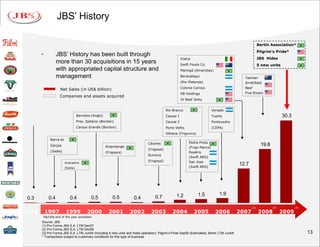
JBS’ History

                                                                                                                                                        Bertin Association*
                                                                                                                                                        Pilgrim’s Pride*
       •            JBS’ History has been built through
                                                                                                      Inalca                                            JBS Hides
                    more than 30 acquisitions in 15 years                                             Swift Foods Co.                                   5 new units
                    with appropriated capital structure and                                           Maringá (Amambay)
                    management                                                                        Berazategui                            Tasman
                                                                                                      (Rio Platense)                         Smithfield
                                                                                                      Colonia Caroya                         Beef
                      Net Sales (in US$ billion)
                                                                                                      SB Holdings                            Five Rivers
                     Companies and assets acquired
                                                                                                      JV Beef Jerky


                                                                                           Rio Branco                      Venado
                                    Barretos (Anglo)                                       Cacoal 1                        Tuerto                                     30.3
                                    Pres. Epitácio (Bordon)                                Cacoal 2                        Pontevedra
                                    Campo Grande (Bordon)                                  Porto Velho                     (CEPA)
                                                                                           Vilhena (Frigovira)
               Barra do
                                                                              Cáceres                      Pedra Preta
               Garças                                  Araputanga                                          (Frigo Marca)
                                                                                                                                                         19.8
                                                                              (Frigosol)
               (Sadia)                                 (Frigoara)                                          Rosário
                                                                              Iturama
                                                                                                           (Swift ARG)
                                                                              (Frigosol)                   San Jose
                          Andradina
                                                                                                           (Swift ARG)
                                                                                                                                           12.7
                          (Sadia)


                                                                                                 1.2             1.5           1.9
 0.3          0.4            0.4             0.5           0.5       0.4           0.7
                                                                                                                                                  (1)           (2)          (3)
1996       1997           1999            2000          2001        2002        2003           2004            2005          2006          2007         2008          2009
           R$/US$ end of the year quotation
       Source: JBS
       (1) Pro Forma JBS S.A. LTM Dec07
       (2) Pro Forma JBS S.A. LTM Dec08
       (3) Pro Forma JBS S.A. LTM Jun09 (including 5 new units and hides operation); Pilgrim’s Pride Sep09 (Estimated); Bertin LTM Jun09                                           13
       * Transactions subject to customary conditions for this type of business
Global Production and Distribution Platform


                                               JBS’ main units and markets


         x           =


 Legend

  Slaughterhouse (Beef)
  Slaughterhouse and Industry
  Distribution Center
  Vegetable Canning Plant
  Beef Canning Plant
  Beef Jerky Plant (Beef Snack’s)
  Slaughterhouse (Pork)
  Slaughterhouse (Lamb)
x Beef and Pork Processing Plant
= Wet Blue Processing Plant
  Headquarters Office
  Feed Lot
  Package Industry
  Inland Container Terminal
  Commercial Office
                                                                                  14
Brief Description


                                                    Global Production Platform
                                                      Production Units              Employees                 Daily Slaugther Capacity

                          JBS Brasil                                     25                      16,993                        26,950 B


                          JBS Argentina                                   6                       5,059                         6,700 B

                                                                                                                               28,600 B
                          JBS USA                                        16                      24,295                        48,500 P
                                                                                                                                4,500 S
                                                                                                                                8,690 B
                          JBS Australia                                  10                       6,995
                                                                                                                               15,000 S


                          Inalca JBS                                      8                       2,019                         3,000 B

                                                                                                                              7 3 ,9 4 0 B
                          Tota l JBS                                     65                     5 5 ,3 6 1
                                                                                                                              4 8 ,5 0 0 P
                                                                                                                              1 9 ,5 0 0 S
                                                Additional Distribution Platform


United Kingdom                    Russia   Angola                Congo             Algeria         Dem. Rep. of the Congo        Poland

(B) Beef; (P) Pork; (S) Smalls;


                                                                                                                                     15
JBS Consolidated Net Revenue Distribution


                        Revenue Distribution by Market 3Q09


                                        Italy
                         Australia       5%      Argentina
                           14%                      2%


                                                       Brazil
                   Pork USA
                                                       17%
                     12%


                                     Beef USA
                                       50%


Source: JBS

                                                                16
Sustainability


                       Actions                            Sustainability Policies
                       Reduction of Greenhouse                   JBS is aware of its responsibilities as the largest beef Company in the world and all the impacts its operations
Emissions, Effluents


                       Gases emission (GHG)                       generates in every region. The Company has a appropriate sustainability program in each of its units including:
   and W aste


                                                                           Environmental Policy                                               Natural Resources Usage

                                                                           Procedures Adopted                                                 Social-environmental Actions
                       50% Effluent reutilization
                       50% Solid waste recycling                           Informative Policy                                                 Waste Treatment

                       Energetic Matrix development                        Community Relationship and Environmental Investments
     Energy


                       Use of certified wood
                       25% Consume reduction
                                                                  JBS is the first and only beef Company to register a CDM project at the
                       35% Consume reduction                       UNFCCC (United Nations Framework Convention on Climate Change).
     W ater


                       (2m3 per head)                              The project is in validation phase at the designated national authority.

                       Flora conservation
     Biodiversity


                       Animal origination control         Sustainability Principles                                       Priorities
                                                          • Ecological feasability                                        • Sustainable use of materials
                       Focus on environmentally
     Materials


                       friendly materials                 • Ecological correctness                                        • Partnership with organizations equally
                                                                                                                             concerned
                                                          • Social concern
 Laws                  Legislative compliance                                                                             • Health and Quality of Life
                                                          • Cultural acceptance
                       Environmental awareness                                                                            • Climate
                       Physical activities
                                                                                                                          • Waste
     Society


                       Health Care
                                                             The environmental and social responsibility have always been part of JBS´s development and business growth.
                       Formal education                       The Company’s extensive experience proves the importance of the reduction of environmental impacts and the
                                                              improvement of its relations with the community, throughout constant investments that focus these issues.
                                                                                                                                                                               17
Corporate Governance


    JBS has embraced a Corporate Governance model with a view to implant the best practices in the Company. The view is that the model
        demonstrates transparency and confidence to the public, guaranteeing the best products and services for customers, solidity for
                  suppliers, satisfactory return for shareholders and the certainty of a better future for all JBS collaborators.


Novo Mercado

   JBS is part of the of BM&FBOVESPA´s Novo Mercado, is in accordance with all requirements of this market and with the obligations imposed by the
    current Brazilian legislation.

Management and Board of Directors

   Board of Directors - JBS’ Board of Directors is formed by 7 members – a president, a vice-president, 2 effective councils without specific
    denomination and 3 independent effective councils.

   Audit Board - The Audit Board shall consist of at least 3 and at most five 5 sitting members and alternates in the same number, shareholders or not,
    liable to be elected or dismissed at any time of the General Meeting.

   Board of Executive Officers - The members of the Company’s board of executive officers are elected by the board of directors, for three-year terms,
    and are eligible for reelection.

Board of Directors’ Committees

   The Board of Directors has approved the establishment of the following Committees: Audit, Financial, Personnel Management and Corporate
    Strategy, that incorporates the Sustainability matters.

Publishing and Use of Information

   JBS is completely in accordance with the CVM 358 instruction that revised and consolidated the requirements regarding the disclosure and use of
    information related to material facts and acts of publicly held companies, including the disclosure of information in the trading and acquisition of
    securities issued by publicly held companies.

Conduct and Ethic Manual

   JBS Executive Officers have developed a Conduct and Ethic Manual according to the corporate governance best practices concept. The conduct
    code embraces the relationship between the members of the board, shareholders, employees, suppliers and all the other stakeholders.

                                                                                                                                                           18
JBS American Depositary Receipt (JBSAY)


The Bank of New York Mellon, has been selected by JBS S.A. as the depositary bank for its
American depositary receipt (ADR) program. Each JBS ADR represents two common shares
and they are traded on the over-the-counter market under the symbol “JBSAY“.

On May 2009, JBS became the first Brazilian Company to have its ADRs traded under the
OTCQX, a kind of “Novo Mercado” of the North American over-the-counter market. Since then,
the JBS’ ADRs (JBSAY) appreciated in value by 172.1%.
                            ADRs’ traded volume (JBSAY)
           140,000                                                                                                  11.51    $12.00

                                                                                                           10.51
           120,000
                                                                                                                             $10.00

                                                                                                           99,075
           100,000                                                                                 7.95
                                                                                         7.92
                                                                                                                             $8.00
                                                                               7.26

            80,000
                                                           6.00     6.08
                                                                                                                             $6.00
                                                                                                                    60,827
            60,000                               4.60
                      4.23     4.13     3.96
                                                                   41,970                                                    $4.00
            40,000

                                                                                         23,730
                                                                                                                             $2.00
            20,000                                                            14,600
                     11,000                               10,000
                                                                                                  4,500
                              1,300     500     1,500
                0                                                                                                            $0.00
                     Dec-08   Jan-09   Feb-09   Mar-09    Apr-09   May-09    Jun-09      Jul-09   Aug-09   Sep-09   Oct-09
                                                        Volume      Closing Price (U$)                                                19
JBS American Depositary Receipt (JBSAY)


                                          20
3rd Quarter 2009 Results


                           8
                           8
JBS Consolidated Results


                 Net Revenue (R$ million)       EBITDA and EBITDA Margin (R$ million)


         24.0%          -3.8%   -0.1%   -9.5%

                                                    -44.0%   -20.4%   81.6%   -24.0%


Source: JBS
    EBITDA Margin (%)
                                                                                        22
Currency effects in the net revenue


                        Net Revenue (Million)
                                                                      • Excluding the exchange rate effect in
               R$                               US$                   the period, net revenue increased
                                                   Exchange rate
                                                                      0.6% over 2Q09.
                                             average of the period:
                                                   2Q09 – 2.0748
                                                   3Q09 – 1.8677


   9,255.0
                    8,379.9             4.460.7        4.486.8


              -9.5%                               0.6%


    2Q09                3Q09             2Q09          3Q09

Source: JBS
Source: Banco Central


                                                                                                                23
Performance by Business Units

    JBS USA (Beef)
        Including Australia                 JBS USA (Pork)           INALCA JBS                       JBS MERCOSUL
             Net Sales                          Net Sales               Net Sales                             Net Sales
          (US$ billion)                       (US$ million)              (€ million)                          (R$ billion)


                             2.9      2.8                             162                           1.8                     1.7
             2.8                                                             144     144    146             1.6                      1.7
  2.7               2.7                                       143                                                  1.4


 3Q08     4Q08      1Q09     2Q09    3Q09                     3Q08    4Q08   1Q09    2Q09   3Q09   3Q08     4Q08    1Q09    2Q09     3Q09


    EBITDA (US$ mi)                         EBITDA (US$ mi)          EBITDA (€ mi)                        EBITDA (R$ mi)
     EBITDA margin                           EBITDA margin           EBITDA margin                        EBITDA margin


5.2%
                                                                                            6.6%
                            3.6%    3.8%                      5.3%    5.1%           4.6%            5.6%   4.3%              4.9%
         2.2%      2.2%                                                                                              3.7%
                                                                              3.9%                                                   2.9%


                                                                                            9.7
                                                                      8.3
                           104.6 108.4                        7.6
                                                                                     6.6
                                                                             5.6
104.1 60.4         59.7                                                                            199,1
                                                                                                            69.4            82.6
                                                                                                                   58,2              47.3


3Q08     4Q08      1Q09    2Q09     3Q09                      3Q08    4Q08   1Q09    2Q09   3Q09   3Q08     4Q08   1Q09     2Q09     3Q09


Source JBS
                                                                                                                                      24
    EBITDA Margin (%)
Debt


•        The net debt / EBITDA ratio increased from 2.6x in 2Q09 to 3.3x in 3Q09, reflecting
         the EBITDA decline when compared with 3Q08.
•        The company projects a reduction in leverage levels by the end of the year.
•        The gross and net debt reduced 5.6% and 2.2%, respectively, over 2Q09.


             Net Debt / EBITDA Pro Forma per Quarter                             Gross debt Profile (R$ million)

                                                                               5,971.8                6,226.4
                                                                                                                     5,877.1

                                                                       3.3 *

                                                 2.5            2.6
          2.3
                             2.0


        3Q08              4Q08              1Q09             2Q09     3Q09      1T09                   2T09           3T09

                                                                                         Short term      Long term
    Source: JBS
           Net Debt/ EBITDA                      EBITDA pro-forma
    * LTM including Smithfield Beef pro-forma.


                                                                                                                               25
Working Capital


JBS continues to reduce its working capital needs, which decreased from 37 days in 2Q09 to 33
days in 3Q09.

                     2º Quarter 2009
            Client’s order                    Product                                 Client’s payment
                to JBS                        Delivery                                      to JBS
                         Production & Stock
                                                           CLIENT = 37 days
                               21 dias


                       SUPPLYER = 21 days                        37 days


                                              Supplyer
                                                           WORKING CAPITAL &
                                              payment
                                                               INTERESTS


                     3º Quarter 2009
            Client’s order                    Product                         Client’s payment
                to JBS                        Delivery                              to JBS
                         Production & Stock
                                                         CLIENT = 33 days
                               21 dias


                        SUPPLYER = 21 days                   33 days


                                              Supplyer
                                                           WORKING CAPITAL &
                                              payment
                                                               INTERESTS
                                                                                                         26
JBS Consolidated Exports Distribution


                    Revenue Distribution by Market 3Q09                                                         Revenue Distribution by Market 2Q09


                             Exports                                                                                           Exports
                              24%                                                                                               26%


                                                                                                                                                             Domestic
                                                     Domestic Market                                                                                          Market
                                                         76%
                                                                                                                                                               74%


                          Exports Distribution 3Q09                                                                      Exports Distribution 2Q09

                                            JBS Exports 3Q09
                                            US$ 1,127.4 Million                                                                               JBS Exports2Q 09
                                                                                                                                             US$ 1,169.1 Million


                                   Others                         Japan                                Taiwan                            O thers                          Japan
      Indonesia                     18%                                                        China
                                                                                                         2%                               14%                              18%
                                                                   19%
          3%                                                                                    4%
    China                                                                          E.U.   Hong Kong                                                                                     E.U.
     4%                                                                            12%       5%                                                                                         15%
                                                                          Russia                                 South Korea
South Korea                                                 USA                            Canada                    6%         Russia
                                                                                                                                                            Africa and            USA
                                                 Mexico                    9%                                                                      Mexico   Middle East           9%
    4%                                                      8%                              5%                                   7%                 7%          8%
                                                  7%
    Hong Kong
       5%
             Africa and
            Middle East   Canada
                 6%         6%


      Source: JBS
                                                                                                                                                                                               27
Investor Relations
     www.jbs.com.br/ir
         ir@jbs.com.br
      +55 11 3144 4055


Thank you!
Disclaimer


The forward-looking statements presented herein are subject to risks and uncertainties. These statements are
based on the beliefs and assumptions of our management, and on information currently available to us.

Forward-looking statements are not guarantees of performance. They involve risks, uncertainties and assumptions
because they relate to future events and therefore depend on circumstances that may or may not occur. Our future
operating results, financial condition, strategies, market share and values may differ materially from those expressed
in or suggested by these forward-looking statements. Many of the factors that will determine these results and
values are beyond our ability to control or predict.

Forward-looking statements also include information concerning our possible or assumed future operating results,
as well as statements preceded by, followed by, or including the words ''believes,'' ''may,'' ''will,'' ''continues,''
''expects,'„ ''anticipates,'' ''intends,'' ''plans,'' ''estimates'' or similar expressions.


                                                                                                                         29

Presentation Jbs S.A. December 2009

  • 1.
    JBS S.A. “In God we trust, nature we respect” December, 2009 JBS S.A.. JBS S.A
  • 2.
    Our Values The FoundationOf Our Culture Planning Determination Discipline Availability Openness Simplicity 1
  • 3.
    The Global BeefIndustry 8 8
  • 4.
    Global Market Largest beef producers Largest beef consumers Others Others United States United States 31% 31% 21% 22% Brazil EU-27 15% 15% India 4% Mexico 4% Argentina Argentina 5% EU-27 Brazil China 5% China 14% 13% 10% 10% Largest beef exporters Largest beef importers Others 25% Brazil United States 23% Others 19% 38% Russia 16% New Zealand Australia 7% 19% Canada 7% India South Korea Japan United States 4% EU-27 8% Mexico 10% 11% 8% 5% Source: USDA 2009 3
  • 5.
    World Population Growthand Beef Consumption (1960 – 2050) 140 10000 Population growth, a beef consumption driver. 120 8000 Consumption (million tons) 100 Population (million) 6000 80 60 4000 40 2000 20 0 0 1960 1965 1970 1975 1980 1985 1990 1995 2000 2005 2010* 2015* 2020* 2025* 2030* 2035* 2040* 2045* 2050* Population - Developed countries Population - Developing countries Beef Consumption** Source: UN (United Nations) and USDA *UN Estimates **Beef consumption trend considering CAGR of 2.0% (from 1960 to 2008) 4
  • 6.
    Per capita foodconsumption (Kg / Year) 180 1969/ 71 160 1979/ 81 1989/ 91 140 1999/ 01 120 2030 2050 100 80 60 40 20 0 Cereals Roots and Beans, Peas Sugar Oils Crops Meat Milk and its Tubers and Lentils and its products products Source: FAO 5
  • 7.
    US Beef andVeal Exports (Million Pounds) 3,000 2,467 2,520 2,412 2,449 2,500 2,269 2,000 1,888 1,433 1,500 1,349 1,146 1442 1349 1,000 697 461 500 0 1999 2000 2001 2002 2003 2004 2005 2006 2007 2008 2009 Mexico Canada South Korea Japan Vietnam China Hong Kong N etherlands Others Until September Source: USDA ERS 6
  • 8.
    US Pork Exports(Million Pounds) 5,000 4,667 4,500 4,000 3,500 3,142 3,619 2,995 3,003 3,000 2,667 3,003 2,500 2,181 2,000 1,717 1,560 1,612 1,500 1,278 1,287 1,000 500 0 1999 2000 2001 2002 2003 2004 2005 2006 2007 2008 2009 Japan China Hong Kong Mexico Russia Canada South Korea Australia Others Until September Source: USDA ERS 7
  • 9.
    US Poultry Exports(Million Pounds) 8,000 7,109 7,000 6,070 6,000 5,738 5,333 5,367 5,138 5,208 4,980 4,942 5,013 4,997 5,000 5,324 5,208 4,000 3,000 2,000 1,000 0 1999 2000 2001 2002 2003 2004 2005 2006 2007 2008 2009 Russia China (Mainland) Iraq Mexico Canada Cuba Other Chicken Others Until September Source: USDA ERS 8
  • 10.
    Brazilian beef exports(USD billion) Source Secex 9
  • 11.
  • 12.
    Our Strategy 2005/2006 2009/2010 2011/2012 2007/2008 Adequate Global Sales & Value Added Global Production Financial Distribution Products & Platform Structure Platform Branding South America Fresh Products South Debt for America North America Cooked Products Working Minced Products North Australia Cured Products Capital America European Union Ready to Eat Products Equity Australia Asia Case Ready Products to Russia Global Brands Finance European Africa Marketing Union Growth Middle East Investments - Access to raw material - Integrate the sales and - High technology - High liquidity level. distribution platform to investments to produce supply globally. - Debt equalized to cash serve efficiently, local and value added products. - Leader in countries with generation. external markets, small - Increase value added surplus production. - Strong cash position. retailers, food processors, products portfolio. - Scale. - Access to international restaurants, and other - Customized products to - Leader in exports globally. capital markets to finance customers globally. each market. - Access to all meat growth. - Sales force distributed over - Convenience to consumers markets. the globe. - Development of long term day to day. - Exchange of best - Efficiency on selling the best financing plan. - Brand and Quality practices. product, to the best market, - Use of export platform to recognition and leadership. - Efficiency cost gains. with the best price. - Marketing investments to grow. - Cost reduction - Cost reduction on sales and be present in consumer - Hands-on working capital opportunities. transport. minds. management. - Margin improvements. - Margin improvements. - Margin improvements. 11
  • 13.
    Our Strategy 50% Branding Value Added Products 12% Sales & Distribution 8% Platform Production Platform 4% Consolidated Cost Reduction, Average Financial Experienced Productivity, Risk EBITDA Structure Management Process Management Margin Optimization Foundation 12
  • 14.
    JBS’ History Bertin Association* Pilgrim’s Pride* • JBS’ History has been built through Inalca JBS Hides more than 30 acquisitions in 15 years Swift Foods Co. 5 new units with appropriated capital structure and Maringá (Amambay) management Berazategui Tasman (Rio Platense) Smithfield Colonia Caroya Beef Net Sales (in US$ billion) SB Holdings Five Rivers Companies and assets acquired JV Beef Jerky Rio Branco Venado Barretos (Anglo) Cacoal 1 Tuerto 30.3 Pres. Epitácio (Bordon) Cacoal 2 Pontevedra Campo Grande (Bordon) Porto Velho (CEPA) Vilhena (Frigovira) Barra do Cáceres Pedra Preta Garças Araputanga (Frigo Marca) 19.8 (Frigosol) (Sadia) (Frigoara) Rosário Iturama (Swift ARG) (Frigosol) San Jose Andradina (Swift ARG) 12.7 (Sadia) 1.2 1.5 1.9 0.3 0.4 0.4 0.5 0.5 0.4 0.7 (1) (2) (3) 1996 1997 1999 2000 2001 2002 2003 2004 2005 2006 2007 2008 2009 R$/US$ end of the year quotation Source: JBS (1) Pro Forma JBS S.A. LTM Dec07 (2) Pro Forma JBS S.A. LTM Dec08 (3) Pro Forma JBS S.A. LTM Jun09 (including 5 new units and hides operation); Pilgrim’s Pride Sep09 (Estimated); Bertin LTM Jun09 13 * Transactions subject to customary conditions for this type of business
  • 15.
    Global Production andDistribution Platform JBS’ main units and markets x = Legend Slaughterhouse (Beef) Slaughterhouse and Industry Distribution Center Vegetable Canning Plant Beef Canning Plant Beef Jerky Plant (Beef Snack’s) Slaughterhouse (Pork) Slaughterhouse (Lamb) x Beef and Pork Processing Plant = Wet Blue Processing Plant Headquarters Office Feed Lot Package Industry Inland Container Terminal Commercial Office 14
  • 16.
    Brief Description Global Production Platform Production Units Employees Daily Slaugther Capacity JBS Brasil 25 16,993 26,950 B JBS Argentina 6 5,059 6,700 B 28,600 B JBS USA 16 24,295 48,500 P 4,500 S 8,690 B JBS Australia 10 6,995 15,000 S Inalca JBS 8 2,019 3,000 B 7 3 ,9 4 0 B Tota l JBS 65 5 5 ,3 6 1 4 8 ,5 0 0 P 1 9 ,5 0 0 S Additional Distribution Platform United Kingdom Russia Angola Congo Algeria Dem. Rep. of the Congo Poland (B) Beef; (P) Pork; (S) Smalls; 15
  • 17.
    JBS Consolidated NetRevenue Distribution Revenue Distribution by Market 3Q09 Italy Australia 5% Argentina 14% 2% Brazil Pork USA 17% 12% Beef USA 50% Source: JBS 16
  • 18.
    Sustainability Actions Sustainability Policies Reduction of Greenhouse  JBS is aware of its responsibilities as the largest beef Company in the world and all the impacts its operations Emissions, Effluents Gases emission (GHG) generates in every region. The Company has a appropriate sustainability program in each of its units including: and W aste  Environmental Policy  Natural Resources Usage  Procedures Adopted  Social-environmental Actions 50% Effluent reutilization 50% Solid waste recycling  Informative Policy  Waste Treatment Energetic Matrix development  Community Relationship and Environmental Investments Energy Use of certified wood 25% Consume reduction  JBS is the first and only beef Company to register a CDM project at the 35% Consume reduction UNFCCC (United Nations Framework Convention on Climate Change). W ater (2m3 per head) The project is in validation phase at the designated national authority. Flora conservation Biodiversity Animal origination control Sustainability Principles Priorities • Ecological feasability • Sustainable use of materials Focus on environmentally Materials friendly materials • Ecological correctness • Partnership with organizations equally concerned • Social concern Laws Legislative compliance • Health and Quality of Life • Cultural acceptance Environmental awareness • Climate Physical activities • Waste Society Health Care  The environmental and social responsibility have always been part of JBS´s development and business growth. Formal education The Company’s extensive experience proves the importance of the reduction of environmental impacts and the improvement of its relations with the community, throughout constant investments that focus these issues. 17
  • 19.
    Corporate Governance JBS has embraced a Corporate Governance model with a view to implant the best practices in the Company. The view is that the model demonstrates transparency and confidence to the public, guaranteeing the best products and services for customers, solidity for suppliers, satisfactory return for shareholders and the certainty of a better future for all JBS collaborators. Novo Mercado  JBS is part of the of BM&FBOVESPA´s Novo Mercado, is in accordance with all requirements of this market and with the obligations imposed by the current Brazilian legislation. Management and Board of Directors  Board of Directors - JBS’ Board of Directors is formed by 7 members – a president, a vice-president, 2 effective councils without specific denomination and 3 independent effective councils.  Audit Board - The Audit Board shall consist of at least 3 and at most five 5 sitting members and alternates in the same number, shareholders or not, liable to be elected or dismissed at any time of the General Meeting.  Board of Executive Officers - The members of the Company’s board of executive officers are elected by the board of directors, for three-year terms, and are eligible for reelection. Board of Directors’ Committees  The Board of Directors has approved the establishment of the following Committees: Audit, Financial, Personnel Management and Corporate Strategy, that incorporates the Sustainability matters. Publishing and Use of Information  JBS is completely in accordance with the CVM 358 instruction that revised and consolidated the requirements regarding the disclosure and use of information related to material facts and acts of publicly held companies, including the disclosure of information in the trading and acquisition of securities issued by publicly held companies. Conduct and Ethic Manual  JBS Executive Officers have developed a Conduct and Ethic Manual according to the corporate governance best practices concept. The conduct code embraces the relationship between the members of the board, shareholders, employees, suppliers and all the other stakeholders. 18
  • 20.
    JBS American DepositaryReceipt (JBSAY) The Bank of New York Mellon, has been selected by JBS S.A. as the depositary bank for its American depositary receipt (ADR) program. Each JBS ADR represents two common shares and they are traded on the over-the-counter market under the symbol “JBSAY“. On May 2009, JBS became the first Brazilian Company to have its ADRs traded under the OTCQX, a kind of “Novo Mercado” of the North American over-the-counter market. Since then, the JBS’ ADRs (JBSAY) appreciated in value by 172.1%. ADRs’ traded volume (JBSAY) 140,000 11.51 $12.00 10.51 120,000 $10.00 99,075 100,000 7.95 7.92 $8.00 7.26 80,000 6.00 6.08 $6.00 60,827 60,000 4.60 4.23 4.13 3.96 41,970 $4.00 40,000 23,730 $2.00 20,000 14,600 11,000 10,000 4,500 1,300 500 1,500 0 $0.00 Dec-08 Jan-09 Feb-09 Mar-09 Apr-09 May-09 Jun-09 Jul-09 Aug-09 Sep-09 Oct-09 Volume Closing Price (U$) 19
  • 21.
    JBS American DepositaryReceipt (JBSAY) 20
  • 22.
    3rd Quarter 2009Results 8 8
  • 23.
    JBS Consolidated Results Net Revenue (R$ million) EBITDA and EBITDA Margin (R$ million) 24.0% -3.8% -0.1% -9.5% -44.0% -20.4% 81.6% -24.0% Source: JBS EBITDA Margin (%) 22
  • 24.
    Currency effects inthe net revenue Net Revenue (Million) • Excluding the exchange rate effect in R$ US$ the period, net revenue increased Exchange rate 0.6% over 2Q09. average of the period: 2Q09 – 2.0748 3Q09 – 1.8677 9,255.0 8,379.9 4.460.7 4.486.8 -9.5% 0.6% 2Q09 3Q09 2Q09 3Q09 Source: JBS Source: Banco Central 23
  • 25.
    Performance by BusinessUnits JBS USA (Beef) Including Australia JBS USA (Pork) INALCA JBS JBS MERCOSUL Net Sales Net Sales Net Sales Net Sales (US$ billion) (US$ million) (€ million) (R$ billion) 2.9 2.8 162 1.8 1.7 2.8 144 144 146 1.6 1.7 2.7 2.7 143 1.4 3Q08 4Q08 1Q09 2Q09 3Q09 3Q08 4Q08 1Q09 2Q09 3Q09 3Q08 4Q08 1Q09 2Q09 3Q09 EBITDA (US$ mi) EBITDA (US$ mi) EBITDA (€ mi) EBITDA (R$ mi) EBITDA margin EBITDA margin EBITDA margin EBITDA margin 5.2% 6.6% 3.6% 3.8% 5.3% 5.1% 4.6% 5.6% 4.3% 4.9% 2.2% 2.2% 3.7% 3.9% 2.9% 9.7 8.3 104.6 108.4 7.6 6.6 5.6 104.1 60.4 59.7 199,1 69.4 82.6 58,2 47.3 3Q08 4Q08 1Q09 2Q09 3Q09 3Q08 4Q08 1Q09 2Q09 3Q09 3Q08 4Q08 1Q09 2Q09 3Q09 Source JBS 24 EBITDA Margin (%)
  • 26.
    Debt • The net debt / EBITDA ratio increased from 2.6x in 2Q09 to 3.3x in 3Q09, reflecting the EBITDA decline when compared with 3Q08. • The company projects a reduction in leverage levels by the end of the year. • The gross and net debt reduced 5.6% and 2.2%, respectively, over 2Q09. Net Debt / EBITDA Pro Forma per Quarter Gross debt Profile (R$ million) 5,971.8 6,226.4 5,877.1 3.3 * 2.5 2.6 2.3 2.0 3Q08 4Q08 1Q09 2Q09 3Q09 1T09 2T09 3T09 Short term Long term Source: JBS Net Debt/ EBITDA EBITDA pro-forma * LTM including Smithfield Beef pro-forma. 25
  • 27.
    Working Capital JBS continuesto reduce its working capital needs, which decreased from 37 days in 2Q09 to 33 days in 3Q09. 2º Quarter 2009 Client’s order Product Client’s payment to JBS Delivery to JBS Production & Stock CLIENT = 37 days 21 dias SUPPLYER = 21 days 37 days Supplyer WORKING CAPITAL & payment INTERESTS 3º Quarter 2009 Client’s order Product Client’s payment to JBS Delivery to JBS Production & Stock CLIENT = 33 days 21 dias SUPPLYER = 21 days 33 days Supplyer WORKING CAPITAL & payment INTERESTS 26
  • 28.
    JBS Consolidated ExportsDistribution Revenue Distribution by Market 3Q09 Revenue Distribution by Market 2Q09 Exports Exports 24% 26% Domestic Domestic Market Market 76% 74% Exports Distribution 3Q09 Exports Distribution 2Q09 JBS Exports 3Q09 US$ 1,127.4 Million JBS Exports2Q 09 US$ 1,169.1 Million Others Japan Taiwan O thers Japan Indonesia 18% China 2% 14% 18% 19% 3% 4% China E.U. Hong Kong E.U. 4% 12% 5% 15% Russia South Korea South Korea USA Canada 6% Russia Africa and USA Mexico 9% Mexico Middle East 9% 4% 8% 5% 7% 7% 8% 7% Hong Kong 5% Africa and Middle East Canada 6% 6% Source: JBS 27
  • 29.
    Investor Relations www.jbs.com.br/ir ir@jbs.com.br +55 11 3144 4055 Thank you!
  • 30.
    Disclaimer The forward-looking statementspresented herein are subject to risks and uncertainties. These statements are based on the beliefs and assumptions of our management, and on information currently available to us. Forward-looking statements are not guarantees of performance. They involve risks, uncertainties and assumptions because they relate to future events and therefore depend on circumstances that may or may not occur. Our future operating results, financial condition, strategies, market share and values may differ materially from those expressed in or suggested by these forward-looking statements. Many of the factors that will determine these results and values are beyond our ability to control or predict. Forward-looking statements also include information concerning our possible or assumed future operating results, as well as statements preceded by, followed by, or including the words ''believes,'' ''may,'' ''will,'' ''continues,'' ''expects,'„ ''anticipates,'' ''intends,'' ''plans,'' ''estimates'' or similar expressions. 29