DIGITAL TRANSFORMATION
GROUP-9
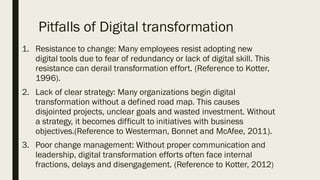
Pitfalls of Digital transformation
1. Resistance to change: Many employees resist adopting new
digital tools due to fear of redundancy or lack of digital skill. This
resistance can derail transformation effort. (Reference to Kotter,
1996).
2. Lack of clear strategy: Many organizations begin digital
transformation without a defined road map. This causes
disjointed projects, unclear goals and wasted investment. Without
a strategy, it becomes difficult to initiatives with business
objectives.(Reference to Westerman, Bonnet and McAfee, 2011).
3. Poor change management: Without proper communication and
leadership, digital transformation efforts often face internal
fractions, delays and disengagement. (Reference to Kotter, 2012)
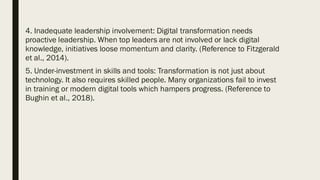
4. Inadequate leadership involvement: Digital transformation needs
proactive leadership. When top leaders are not involved or lack digital
knowledge, initiatives loose momentum and clarity. (Reference to Fitzgerald
et al., 2014).
5. Under-investment in skills and tools: Transformation is not just about
technology. It also requires skilled people. Many organizations fail to invest
in training or modern digital tools which hampers progress. (Reference to
Bughin et al., 2018).
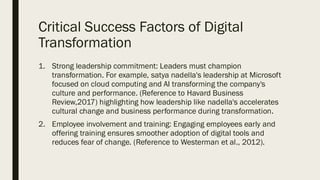
Critical Success Factors of Digital
Transformation
1. Strong leadership commitment: Leaders must champion
transformation. For example, satya nadella's leadership at Microsoft
focused on cloud computing and AI transforming the company's
culture and performance. (Reference to Havard Business
Review,2017) highlighting how leadership like nadella's accelerates
cultural change and business performance during transformation.
2. Employee involvement and training: Engaging employees early and
offering training ensures smoother adoption of digital tools and
reduces fear of change. (Reference to Westerman et al., 2012).
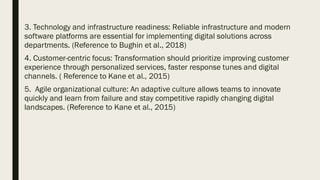
3. Technology and infrastructure readiness: Reliable infrastructure and modern
software platforms are essential for implementing digital solutions across
departments. (Reference to Bughin et al., 2018)
4. Customer-centric focus: Transformation should prioritize improving customer
experience through personalized services, faster response tunes and digital
channels. ( Reference to Kane et al., 2015)
5. Agile organizational culture: An adaptive culture allows teams to innovate
quickly and learn from failure and stay competitive rapidly changing digital
landscapes. (Reference to Kane et al., 2015)
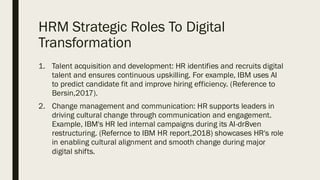
HRM Strategic Roles To Digital
Transformation
1. Talent acquisition and development: HR identifies and recruits digital
talent and ensures continuous upskilling. For example, IBM uses AI
to predict candidate fit and improve hiring efficiency. (Reference to
Bersin,2017).
2. Change management and communication: HR supports leaders in
driving cultural change through communication and engagement.
Example, IBM's HR led internal campaigns during its AI-dr8ven
restructuring. (Refernce to IBM HR report,2018) showcases HR's role
in enabling cultural alignment and smooth change during major
digital shifts.
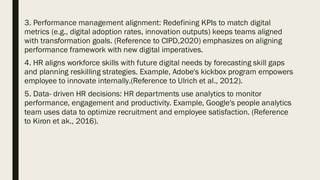
3. Performance management alignment: Redefining KPIs to match digital
metrics (e.g., digital adoption rates, innovation outputs) keeps teams aligned
with transformation goals. (Reference to CIPD,2020) emphasizes on aligning
performance framework with new digital imperatives.
4. HR aligns workforce skills with future digital needs by forecasting skill gaps
and planning reskilling strategies. Example, Adobe's kickbox program empowers
employee to innovate internally.(Reference to Ulrich et al., 2012).
5. Data- driven HR decisions: HR departments use analytics to monitor
performance, engagement and productivity. Example, Google's people analytics
team uses data to optimize recruitment and employee satisfaction. (Reference
to Kiron et ak., 2016).

Presentation for digital transformation.pdf

  • 1.
  • 2.
    Pitfalls of Digitaltransformation 1. Resistance to change: Many employees resist adopting new digital tools due to fear of redundancy or lack of digital skill. This resistance can derail transformation effort. (Reference to Kotter, 1996). 2. Lack of clear strategy: Many organizations begin digital transformation without a defined road map. This causes disjointed projects, unclear goals and wasted investment. Without a strategy, it becomes difficult to initiatives with business objectives.(Reference to Westerman, Bonnet and McAfee, 2011). 3. Poor change management: Without proper communication and leadership, digital transformation efforts often face internal fractions, delays and disengagement. (Reference to Kotter, 2012)
  • 3.
    4. Inadequate leadershipinvolvement: Digital transformation needs proactive leadership. When top leaders are not involved or lack digital knowledge, initiatives loose momentum and clarity. (Reference to Fitzgerald et al., 2014). 5. Under-investment in skills and tools: Transformation is not just about technology. It also requires skilled people. Many organizations fail to invest in training or modern digital tools which hampers progress. (Reference to Bughin et al., 2018).
  • 4.
    Critical Success Factorsof Digital Transformation 1. Strong leadership commitment: Leaders must champion transformation. For example, satya nadella's leadership at Microsoft focused on cloud computing and AI transforming the company's culture and performance. (Reference to Havard Business Review,2017) highlighting how leadership like nadella's accelerates cultural change and business performance during transformation. 2. Employee involvement and training: Engaging employees early and offering training ensures smoother adoption of digital tools and reduces fear of change. (Reference to Westerman et al., 2012).
  • 5.
    3. Technology andinfrastructure readiness: Reliable infrastructure and modern software platforms are essential for implementing digital solutions across departments. (Reference to Bughin et al., 2018) 4. Customer-centric focus: Transformation should prioritize improving customer experience through personalized services, faster response tunes and digital channels. ( Reference to Kane et al., 2015) 5. Agile organizational culture: An adaptive culture allows teams to innovate quickly and learn from failure and stay competitive rapidly changing digital landscapes. (Reference to Kane et al., 2015)
  • 6.
    HRM Strategic RolesTo Digital Transformation 1. Talent acquisition and development: HR identifies and recruits digital talent and ensures continuous upskilling. For example, IBM uses AI to predict candidate fit and improve hiring efficiency. (Reference to Bersin,2017). 2. Change management and communication: HR supports leaders in driving cultural change through communication and engagement. Example, IBM's HR led internal campaigns during its AI-dr8ven restructuring. (Refernce to IBM HR report,2018) showcases HR's role in enabling cultural alignment and smooth change during major digital shifts.
  • 7.
    3. Performance managementalignment: Redefining KPIs to match digital metrics (e.g., digital adoption rates, innovation outputs) keeps teams aligned with transformation goals. (Reference to CIPD,2020) emphasizes on aligning performance framework with new digital imperatives. 4. HR aligns workforce skills with future digital needs by forecasting skill gaps and planning reskilling strategies. Example, Adobe's kickbox program empowers employee to innovate internally.(Reference to Ulrich et al., 2012). 5. Data- driven HR decisions: HR departments use analytics to monitor performance, engagement and productivity. Example, Google's people analytics team uses data to optimize recruitment and employee satisfaction. (Reference to Kiron et ak., 2016).