NKY Y!r business mate	
Nunkyworldnky
HR
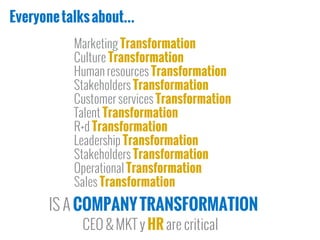
Everyonetalksabout...
Marketing Transformation
Culture Transformation
Human resources Transformation
Stakeholders Transformation
Customer services Transformation
Talent Transformation
R+d Transformation
Leadership Transformation
Stakeholders Transformation
Operational Transformation
Sales Transformation
IS A COMPANYTRANSFORMATION
CEO & MKT y HR are critical
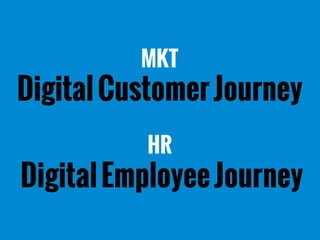
MKT
DigitalCustomerJourney
HR
DigitalEmployeeJourney
HRdepartmentisnot
changingfastenough
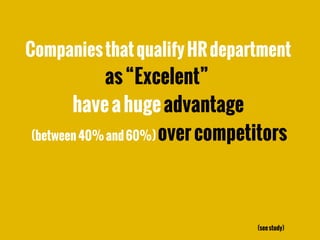
CompaniesthatqualifyHRdepartment
as“Excelent”
haveahugeadvantage
(between40%and60%)overcompetitors
(seestudy)
6
Thekeyofthe
transformationprocess
isHR
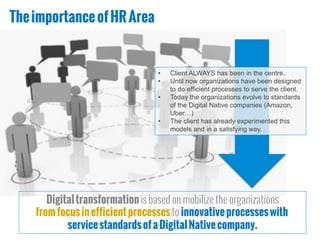
TheimportanceofHRArea
Digitaltransformationis based on mobilize the organizations
fromfocusinefficientprocessesto innovativeprocesseswith
servicestandardsofaDigitalNativecompany.
•  Client ALWAYS has been in the centre.
•  Until now organizations have been designed
to do efficient processes to serve the client.
•  Today the organizations evolve to standards
of the Digital Native companies (Amazon,
Uber…)
•  The client has already experimented this
models and in a satisfying way.
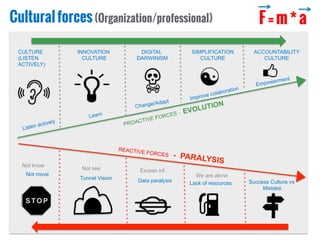
Listen actively
Learn
Change/Adapt Improve colaboration
Empowerment
CULTURE
(LISTEN
ACTIVELY)
INNOVATION
CULTURE
DIGITAL
DARWINISM
SIMPLIFICATION
CULTURE
ACCOUNTABILITY
CULTURE
Lack of resources Success Culture vs
Mistake
Not move
Tunnel Vision Data paralysis
Culturalforces(Organization/professional) F=m*a
PROACTIVE FORCES - EVOLUTION
Not know
Not see Excess inf.
We are alone
REACTIVE FORCES - PARALYSIS
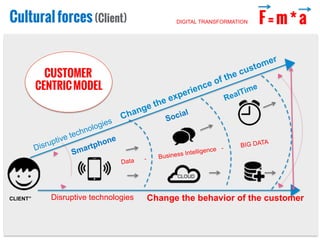
Culturalforces(Client)
Smartphone
Social
Disruptive technologies Change the behavior of the customer
Data - Business Intelligence - BIG DATA
CLOUD
CUSTOMER
CENTRICMODEL
CLIENT”
F=m*aDIGITAL TRANSFORMATION
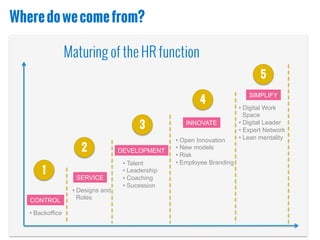
Wheredowecomefrom?
CONTROL
SERVICE
DEVELOPMENT
INNOVATE
SIMPLIFY
• Backoffice
• Designs and
Roles
• Talent
• Leadership
• Coaching
• Sucession
• Open Innovation
• New models
• Risk
• Employee Branding
• Digital Work
Space
• Digital Leader
• Expert Network
• Lean mentality
Maturing of the HR function
1
2
3
4
5
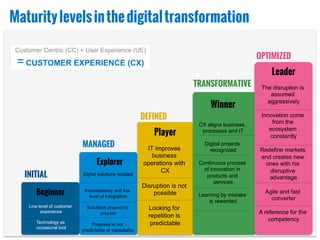
Maturitylevelsinthedigitaltransformation
Beginner
Explorer
Player
Winner
Leader
INITIAL
MANAGED
DEFINED
TRANSFORMATIVE
OPTIMIZED
Low level of customer
experience
Technology as
occasional tool
Digital solutions isolated
Inconsistency and low
level of integration
Solutions proyect to
proyect
Progress is not
predictable or repeatable
IT improves
business
operations with
CX
Disruption is not
possible
Looking for
repetition is
predictable
CX aligns business,
processes and IT
Digital projects
recognized
Continuous process
of innovation in
products and
services
Learning by mistake
is rewarded
The disruption is
assumed
aggressively
Innovation come
from the
ecosystem
constantly
Redefine markets
and creates new
ones with his
disruptive
advantage
Agile and fast
converter
A reference for the
competency
Customer Centric (CC) + User Experience (UE)
=CUSTOMER EXPERIENCE (CX)
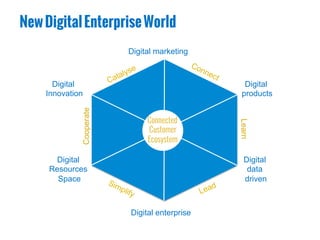
NewDigitalEnterpriseWorld
Digital marketing
Digital
products
Digital
data
driven
Digital enterprise
Digital
Resources
Space
Digital
Innovation
Learn
Cooperate
Connected
Customer
Ecosystem
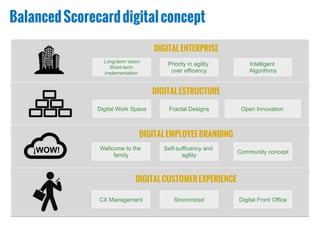
DIGITALENTERPRISE
DIGITALESTRUCTURE
DIGITALEMPLOYEEBRANDING
DIGITALCUSTOMEREXPERIENCE
Long-term vision
Short-term
implementation
Intelligent
Algorithms
Priority in agility
over efficency
Digital Work Space Open InnovationFractal Designs
Wellcome to the
family
Community concept
Self-sufficency and
agility
CX Management Digital Front OfficeSincronized
¡WOW!
BalancedScorecarddigitalconcept
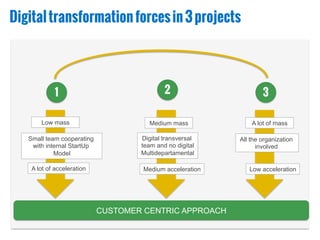
Digitaltransformationforcesin3projects
Low mass
1 2 3
Small team cooperating
with internal StartUp
Model
A lot of acceleration
Digital transversal
team and no digital
Multidepartamental
CUSTOMER CENTRIC APPROACH
Medium mass
Medium acceleration
A lot of mass
All the organization
involved
Low acceleration
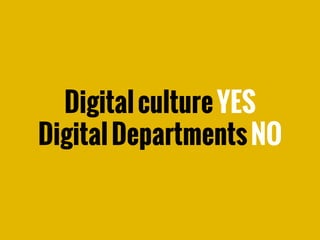
DigitalcultureYES
DigitalDepartmentsNO
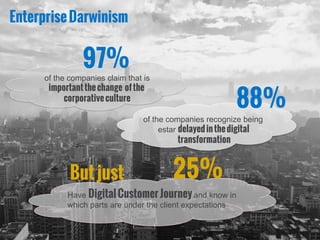
EnterpriseDarwinism
of the companies claim that is
importantthechange ofthe
corporativeculture
of the companies recognize being
estar delayedinthedigital
transformation
Have DigitalCustomerJourneyand know in
which parts are under the client expectations
97%
88%
25%Butjust
Nowwearenotcompeting
againstCoca-Colabut
StartUps
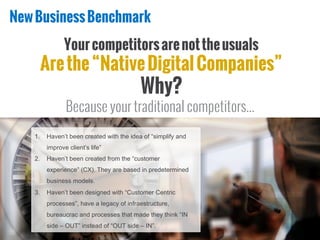
NewBusinessBenchmark
Yourcompetitorsarenottheusuals
Arethe“NativeDigitalCompanies”
Why?
Because your traditional competitors...
1.  Haven’t been created with the idea of “simplify and
improve client’s life”
2.  Haven’t been created from the “customer
experience” (CX). They are based in predetermined
business models.
3.  Haven’t been designed with “Customer Centric
processes”, have a legacy of infraestructure,
bureaucrac and processes that made they think “IN
side – OUT” instead of “OUT side – IN”.
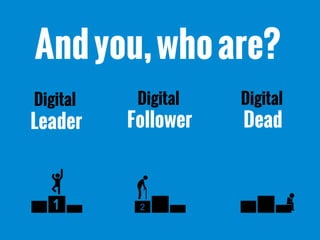
Digital
Leader
Digital
Follower
Digital
Dead
Andyou,whoare?
2
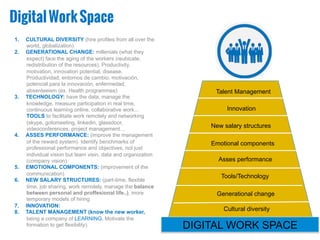
DigitalWorkSpace
1.  CULTURAL DIVERSITY (hire profiles from all over the
world, globalization)
2.  GENERATIONAL CHANGE: millenials (what they
expect) face the aging of the workers (reubicate,
redistribution of the resources). Productivity,
motivation, innovation potential, disease,
Productividad, entornos de cambio, motivación,
potencial para la innovación, enfermedad,
absenteeism (ex. Health programmes)
3.  TECHNOLOGY: have the data, manage the
knowledge, measure participation in real time,
continuous learning online, collaborative work...
TOOLS to facilitate work remotely and networking
(skype, gotomeeting, linkedin, glassdoor,
videoconferences, project management…
4.  ASSES PERFORMANCE: (improve the management
of the reward system). Identify benchmarks of
professional performance and objectives, not just
individual vision but team visin, data and organization
(company vision).
5.  EMOTIONAL COMPONENTS: (improvement of the
communication)
6.  NEW SALARY STRUCTURES: (part-time, flexible
time, job sharing, work remotely, manage the balance
between personal and proffesional life..), more
temporary models of hiring
7.  INNOVATION:
8.  TALENT MANAGEMENT (know the new worker,
being a company of LEARNING. Motivate the
formation to get flexibility). DIGITAL WORK SPACE
Cultural diversity
Generational change
Emotional components
Innovation
Talent Management
Tools/Technology
New salary structures
Asses performance
21
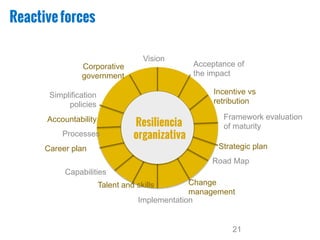
Reactiveforces
Vision
Acceptance of
the impact
Incentive vs
retribution
Framework evaluation
of maturity
Strategic plan
Road Map
Change
management
Implementation
Talent and skills
Capabilities
Career plan
Processes
Accountability
Simplification
policies
Corporative
government
Resiliencia
organizativa
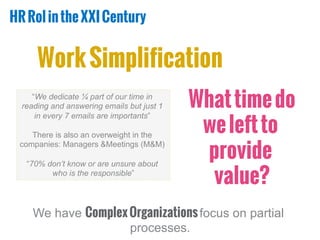
HRRolintheXXICentury
WorkSimplification
“We dedicate ¼ part of our time in
reading and answering emails but just 1
in every 7 emails are importants”
There is also an overweight in the
companies: Managers &Meetings (M&M)
“70% don’t know or are unsure about
who is the responsible”
We have ComplexOrganizationsfocus on partial
processes.
Whattimedo
weleftto
provide
value?
¿Arewealready
thinkingabouthow...
24
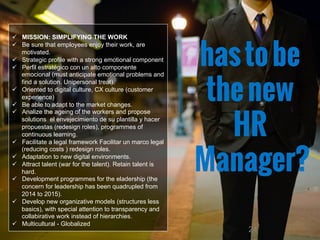
ü  MISSION: SIMPLIFYING THE WORK
ü  Be sure that employees enjoy their work, are
motivated.
ü  Strategic profile with a strong emotional component
ü  Perfil estratégico con un alto componente
emocional (must anticipate emotional problems and
find a solution. Unipersonal treat).
ü  Oriented to digital culture, CX culture (customer
experience)
ü  Be able to adapt to the market changes.
ü  Analize the ageing of the workers and propose
solutions el envejecimiento de su plantilla y hacer
propuestas (redesign roles), programmes of
continuous learning.
ü  Facilitate a legal framework Facilitar un marco legal
(reducing costs ) redesign roles.
ü  Adaptation to new digital environments.
ü  Attract talent (war for the talent). Retain talent is
hard.
ü  Development programmes for the eladership (the
concern for leadership has been quadrupled from
2014 to 2015).
ü  Develop new organizative models (structures less
basics), with special attention to transparency and
collabirative work instead of hierarchies.
ü  Multicultural - Globalized
hastobe
thenew
HR
Manager?
isthe
newworker?
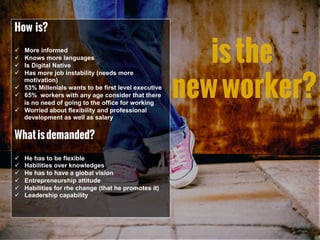
How is?
ü  More informed
ü  Knows more languages
ü  Is Digital Native
ü  Has more job instability (needs more
motivation)
ü  53% Millenials wants to be first level executive
ü  65% workers with any age consider that there
is no need of going to the office for working
ü  Worried about flexibility and professional
development as well as salary
Whatisdemanded?
ü  He has to be flexible
ü  Habilities over knowledges
ü  He has to have a global vision
ü  Entrepreneurship attitude
ü  Habilities for rhe change (that he promotes it)
ü  Leadership capability
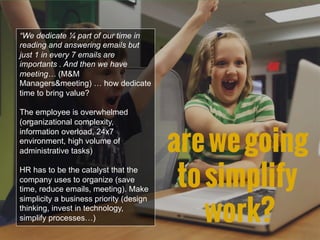
“We dedicate ¼ part of our time in
reading and answering emails but
just 1 in every 7 emails are
importants . And then we have
meeting… (M&M
Managers&meeting) … how dedicate
time to bring value?
The employee is overwhelmed
(organizational complexity,
information overload, 24x7
environment, high volume of
administrative tasks)
HR has to be the catalyst that the
company uses to organize (save
time, reduce emails, meeting). Make
simplicity a business priority (design
thinking, invest in technology,
simplify processes…)
arewegoing
tosimplify
work?
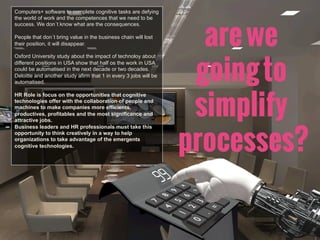
Computers+ software to complete cognitive tasks are defying
the world of work and the competences that we need to be
success. We don´t know what are the consequences.
People that don´t bring value in the business chain will lost
their position, it will disappear.
Oxford University study about the impact of technoloy about
different positions in USA show that half os the work in USA
could be automatised in the next decade or two decades.
Deloitte and another study afirm that 1 in every 3 jobs will be
automatised.
HR Role is focus on the opportunities that cognitive
technologies offer with the collaboration of people and
machines to make companies more efficients,
productives, profitables and the most significance and
attractive jobs.
Business leaders and HR professionals must take this
opportunity to think creatively in a way to help
organizations to take advantage of the emergents
cognitive technologies.
arewe
goingto
simplify
processes?
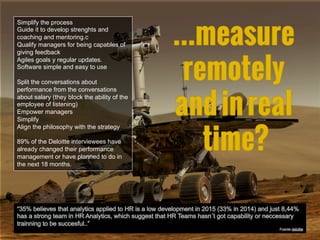
Simplify the process
Guide it to develop strenghts and
coaching and mentoring.c
Qualify managers for being capables of
giving feedback
Agiles goals y regular updates.
Software simple and easy to use
Split the conversations about
performance from the conversations
about salary (they block the ability of the
employee of listening)
Empower managers
Simplify
Align the philosophy with the strategy
89% of the Deloitte interviewees have
already changed their performance
management or have planned to do in
the next 18 months.
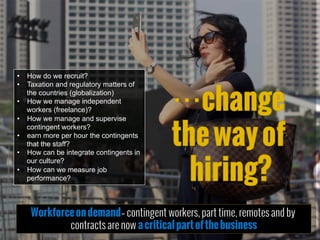
•  How do we recruit?
•  Taxation and regulatory matters of
the countries (globalization)
•  How we manage independent
workers (freelance)?
•  How we manage and supervise
contingent workers?
•  earn more per hour the contingents
that the staff?
•  How can be integrate contingents in
our culture?
•  How can we measure job
performance?
Workforceondemand– contingent workers, part time, remotes and by
contracts are now acriticalpartofthebusiness
NKYY!r business mate	
hola@nunkyworld.com

Human Resources in the 21th century

  • 1.
    NKY Y!r businessmate Nunkyworldnky HR
  • 2.
    Everyonetalksabout... Marketing Transformation Culture Transformation Humanresources Transformation Stakeholders Transformation Customer services Transformation Talent Transformation R+d Transformation Leadership Transformation Stakeholders Transformation Operational Transformation Sales Transformation IS A COMPANYTRANSFORMATION CEO & MKT y HR are critical
  • 3.
  • 4.
  • 5.
  • 6.
  • 7.
    TheimportanceofHRArea Digitaltransformationis based onmobilize the organizations fromfocusinefficientprocessesto innovativeprocesseswith servicestandardsofaDigitalNativecompany. •  Client ALWAYS has been in the centre. •  Until now organizations have been designed to do efficient processes to serve the client. •  Today the organizations evolve to standards of the Digital Native companies (Amazon, Uber…) •  The client has already experimented this models and in a satisfying way.
  • 8.
    Listen actively Learn Change/Adapt Improvecolaboration Empowerment CULTURE (LISTEN ACTIVELY) INNOVATION CULTURE DIGITAL DARWINISM SIMPLIFICATION CULTURE ACCOUNTABILITY CULTURE Lack of resources Success Culture vs Mistake Not move Tunnel Vision Data paralysis Culturalforces(Organization/professional) F=m*a PROACTIVE FORCES - EVOLUTION Not know Not see Excess inf. We are alone REACTIVE FORCES - PARALYSIS
  • 9.
    Culturalforces(Client) Smartphone Social Disruptive technologies Changethe behavior of the customer Data - Business Intelligence - BIG DATA CLOUD CUSTOMER CENTRICMODEL CLIENT” F=m*aDIGITAL TRANSFORMATION
  • 10.
    Wheredowecomefrom? CONTROL SERVICE DEVELOPMENT INNOVATE SIMPLIFY • Backoffice • Designs and Roles • Talent • Leadership • Coaching • Sucession • Open Innovation • Newmodels • Risk • Employee Branding • Digital Work Space • Digital Leader • Expert Network • Lean mentality Maturing of the HR function 1 2 3 4 5
  • 11.
    Maturitylevelsinthedigitaltransformation Beginner Explorer Player Winner Leader INITIAL MANAGED DEFINED TRANSFORMATIVE OPTIMIZED Low level ofcustomer experience Technology as occasional tool Digital solutions isolated Inconsistency and low level of integration Solutions proyect to proyect Progress is not predictable or repeatable IT improves business operations with CX Disruption is not possible Looking for repetition is predictable CX aligns business, processes and IT Digital projects recognized Continuous process of innovation in products and services Learning by mistake is rewarded The disruption is assumed aggressively Innovation come from the ecosystem constantly Redefine markets and creates new ones with his disruptive advantage Agile and fast converter A reference for the competency Customer Centric (CC) + User Experience (UE) =CUSTOMER EXPERIENCE (CX)
  • 12.
  • 13.
    DIGITALENTERPRISE DIGITALESTRUCTURE DIGITALEMPLOYEEBRANDING DIGITALCUSTOMEREXPERIENCE Long-term vision Short-term implementation Intelligent Algorithms Priority inagility over efficency Digital Work Space Open InnovationFractal Designs Wellcome to the family Community concept Self-sufficency and agility CX Management Digital Front OfficeSincronized ¡WOW! BalancedScorecarddigitalconcept
  • 14.
    Digitaltransformationforcesin3projects Low mass 1 23 Small team cooperating with internal StartUp Model A lot of acceleration Digital transversal team and no digital Multidepartamental CUSTOMER CENTRIC APPROACH Medium mass Medium acceleration A lot of mass All the organization involved Low acceleration
  • 15.
  • 16.
    EnterpriseDarwinism of the companiesclaim that is importantthechange ofthe corporativeculture of the companies recognize being estar delayedinthedigital transformation Have DigitalCustomerJourneyand know in which parts are under the client expectations 97% 88% 25%Butjust
  • 17.
  • 18.
    NewBusinessBenchmark Yourcompetitorsarenottheusuals Arethe“NativeDigitalCompanies” Why? Because your traditionalcompetitors... 1.  Haven’t been created with the idea of “simplify and improve client’s life” 2.  Haven’t been created from the “customer experience” (CX). They are based in predetermined business models. 3.  Haven’t been designed with “Customer Centric processes”, have a legacy of infraestructure, bureaucrac and processes that made they think “IN side – OUT” instead of “OUT side – IN”.
  • 19.
  • 20.
    DigitalWorkSpace 1.  CULTURAL DIVERSITY(hire profiles from all over the world, globalization) 2.  GENERATIONAL CHANGE: millenials (what they expect) face the aging of the workers (reubicate, redistribution of the resources). Productivity, motivation, innovation potential, disease, Productividad, entornos de cambio, motivación, potencial para la innovación, enfermedad, absenteeism (ex. Health programmes) 3.  TECHNOLOGY: have the data, manage the knowledge, measure participation in real time, continuous learning online, collaborative work... TOOLS to facilitate work remotely and networking (skype, gotomeeting, linkedin, glassdoor, videoconferences, project management… 4.  ASSES PERFORMANCE: (improve the management of the reward system). Identify benchmarks of professional performance and objectives, not just individual vision but team visin, data and organization (company vision). 5.  EMOTIONAL COMPONENTS: (improvement of the communication) 6.  NEW SALARY STRUCTURES: (part-time, flexible time, job sharing, work remotely, manage the balance between personal and proffesional life..), more temporary models of hiring 7.  INNOVATION: 8.  TALENT MANAGEMENT (know the new worker, being a company of LEARNING. Motivate the formation to get flexibility). DIGITAL WORK SPACE Cultural diversity Generational change Emotional components Innovation Talent Management Tools/Technology New salary structures Asses performance
  • 21.
    21 Reactiveforces Vision Acceptance of the impact Incentivevs retribution Framework evaluation of maturity Strategic plan Road Map Change management Implementation Talent and skills Capabilities Career plan Processes Accountability Simplification policies Corporative government Resiliencia organizativa
  • 22.
    HRRolintheXXICentury WorkSimplification “We dedicate ¼part of our time in reading and answering emails but just 1 in every 7 emails are importants” There is also an overweight in the companies: Managers &Meetings (M&M) “70% don’t know or are unsure about who is the responsible” We have ComplexOrganizationsfocus on partial processes. Whattimedo weleftto provide value?
  • 23.
  • 24.
    24 ü  MISSION: SIMPLIFYINGTHE WORK ü  Be sure that employees enjoy their work, are motivated. ü  Strategic profile with a strong emotional component ü  Perfil estratégico con un alto componente emocional (must anticipate emotional problems and find a solution. Unipersonal treat). ü  Oriented to digital culture, CX culture (customer experience) ü  Be able to adapt to the market changes. ü  Analize the ageing of the workers and propose solutions el envejecimiento de su plantilla y hacer propuestas (redesign roles), programmes of continuous learning. ü  Facilitate a legal framework Facilitar un marco legal (reducing costs ) redesign roles. ü  Adaptation to new digital environments. ü  Attract talent (war for the talent). Retain talent is hard. ü  Development programmes for the eladership (the concern for leadership has been quadrupled from 2014 to 2015). ü  Develop new organizative models (structures less basics), with special attention to transparency and collabirative work instead of hierarchies. ü  Multicultural - Globalized hastobe thenew HR Manager?
  • 25.
    isthe newworker? How is? ü  Moreinformed ü  Knows more languages ü  Is Digital Native ü  Has more job instability (needs more motivation) ü  53% Millenials wants to be first level executive ü  65% workers with any age consider that there is no need of going to the office for working ü  Worried about flexibility and professional development as well as salary Whatisdemanded? ü  He has to be flexible ü  Habilities over knowledges ü  He has to have a global vision ü  Entrepreneurship attitude ü  Habilities for rhe change (that he promotes it) ü  Leadership capability
  • 26.
    “We dedicate ¼part of our time in reading and answering emails but just 1 in every 7 emails are importants . And then we have meeting… (M&M Managers&meeting) … how dedicate time to bring value? The employee is overwhelmed (organizational complexity, information overload, 24x7 environment, high volume of administrative tasks) HR has to be the catalyst that the company uses to organize (save time, reduce emails, meeting). Make simplicity a business priority (design thinking, invest in technology, simplify processes…) arewegoing tosimplify work?
  • 27.
    Computers+ software tocomplete cognitive tasks are defying the world of work and the competences that we need to be success. We don´t know what are the consequences. People that don´t bring value in the business chain will lost their position, it will disappear. Oxford University study about the impact of technoloy about different positions in USA show that half os the work in USA could be automatised in the next decade or two decades. Deloitte and another study afirm that 1 in every 3 jobs will be automatised. HR Role is focus on the opportunities that cognitive technologies offer with the collaboration of people and machines to make companies more efficients, productives, profitables and the most significance and attractive jobs. Business leaders and HR professionals must take this opportunity to think creatively in a way to help organizations to take advantage of the emergents cognitive technologies. arewe goingto simplify processes?
  • 28.
    Simplify the process Guideit to develop strenghts and coaching and mentoring.c Qualify managers for being capables of giving feedback Agiles goals y regular updates. Software simple and easy to use Split the conversations about performance from the conversations about salary (they block the ability of the employee of listening) Empower managers Simplify Align the philosophy with the strategy 89% of the Deloitte interviewees have already changed their performance management or have planned to do in the next 18 months.
  • 29.
    •  How dowe recruit? •  Taxation and regulatory matters of the countries (globalization) •  How we manage independent workers (freelance)? •  How we manage and supervise contingent workers? •  earn more per hour the contingents that the staff? •  How can be integrate contingents in our culture? •  How can we measure job performance? Workforceondemand– contingent workers, part time, remotes and by contracts are now acriticalpartofthebusiness
  • 30.