Computer science – DN201
Student name: Jingyi Cui
Student number:2523574
Subject : Computer Science
What is it?
◦ Topics include advanced software
engineering, mobile application
development, networks and Internet
systems. Students learn programming
languages such as Java and Ruby; software
development tools and methodologies such
as Git and Scrum; web technologies such
as JavaScript; and Big Data programming
techniques. Students will use both
Windows and Linux/Unix operating
systems.
Course
Pathway
Course
Pathway
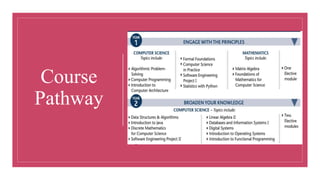
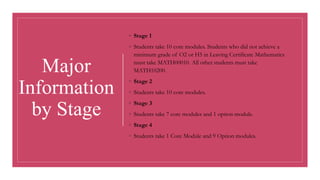
◦ Stage 1
◦ Students take 10 core modules. Students who did not achieve a
minimum grade of O2 or H5 in Leaving Certificate Mathematics
must take MATH00010. All other students must take
MATH10200.
◦ Stage 2
◦ Students take 10 core modules.
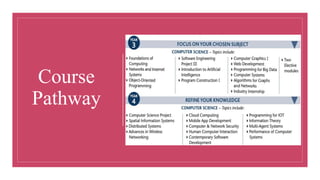
◦ Stage 3
◦ Students take 7 core modules and 1 option module.
◦ Stage 4
◦ Students take 1 Core Module and 9 Option modules.
Major
Information
by Stage
◦ Do you ever wonder how Google,
Skype, Internet banking or computer
games work? Would you like to develop
the next generation of cutting-edge
computing technologies? If you’re a
logical thinker who likes problem
solving and you enjoy subjects like
mathematics, a degree in Computer
Science could be for you.
Why is this
course for
me?
◦ A UCD Computer Science degree equips you with the
necessary skills to work as a computer programmer,
software engineer or architect, database designer, web
developer, network engineer, systems administrator or
manager, and IT consultant. Some graduates also go on to
start their own companies. With a BSc in Computer
Science, you’re also eligible to pursue graduate study in
computer science and in related areas, such as business,
mathematics and engineering. Graduates also pursue
research in computer science through PhD programmes in
UCD or other institutions.
Career &
Graduate
Study
Opportunities

Presentation for Degree

  • 1.
    Computer science –DN201 Student name: Jingyi Cui Student number:2523574 Subject : Computer Science
  • 2.
    What is it? ◦Topics include advanced software engineering, mobile application development, networks and Internet systems. Students learn programming languages such as Java and Ruby; software development tools and methodologies such as Git and Scrum; web technologies such as JavaScript; and Big Data programming techniques. Students will use both Windows and Linux/Unix operating systems.
  • 3.
  • 4.
  • 5.
    ◦ Stage 1 ◦Students take 10 core modules. Students who did not achieve a minimum grade of O2 or H5 in Leaving Certificate Mathematics must take MATH00010. All other students must take MATH10200. ◦ Stage 2 ◦ Students take 10 core modules. ◦ Stage 3 ◦ Students take 7 core modules and 1 option module. ◦ Stage 4 ◦ Students take 1 Core Module and 9 Option modules. Major Information by Stage
  • 6.
    ◦ Do youever wonder how Google, Skype, Internet banking or computer games work? Would you like to develop the next generation of cutting-edge computing technologies? If you’re a logical thinker who likes problem solving and you enjoy subjects like mathematics, a degree in Computer Science could be for you. Why is this course for me?
  • 7.
    ◦ A UCDComputer Science degree equips you with the necessary skills to work as a computer programmer, software engineer or architect, database designer, web developer, network engineer, systems administrator or manager, and IT consultant. Some graduates also go on to start their own companies. With a BSc in Computer Science, you’re also eligible to pursue graduate study in computer science and in related areas, such as business, mathematics and engineering. Graduates also pursue research in computer science through PhD programmes in UCD or other institutions. Career & Graduate Study Opportunities