

Birmingham City University
Faculty of Technology, Engineering and the
Environment
Undergraduate Programme
Programme Specification
BSc (Hons) Computer Science
Date of Course
Approval/Review
Version Number Version Date
5 March 2013 4.00 10 January 2013
BSc (Hons) Computer Science i
CONTENTS
Definitive Documents and Version Control...............................................................................1 
Programme Specification .........................................................................................................2 
Programme philosophy and aims.............................................................................................3 
Learning Outcomes..................................................................................................................4 
Learning teaching, and assessment methods..........................................................................6 
Programme structure................................................................................................................7 
Support for Learning.................................................................................................................8 
Criteria for admission ...............................................................................................................9 
Methods for evaluation and enhancement of quality and standards......................................10 
BSc (Hons) Computer Science 1
Definitive Documents and Version Control
The process leading to the introduction of new courses, major changes to courses, and
minor changes to courses and modules follows the appropriate formal procedure as
described in the Faculty’s Academic Procedures and Quality Manual.
On the front sheet of this document, the date of course approval/review refers to the most
recent full approval/review event. The version date will be that of the most recent event at
which formal consideration was given to course changes.
Further details about the course and document development may be obtained from minutes
of the approval or minor changes board.
BSc (Hons) Computer Science 2
Programme Specification
BSc (Hons) Computer Science
Date of Publication to Students: TBC
NOTE: This specification provides a concise summary of the main features of the
course and the learning outcomes that a typical student might reasonably be
expected to achieve and demonstrate if s/he takes advantage of the learning
opportunities that are provided. More detail on the specific learning outcomes,
indicative content and the teaching, learning and assessment methods of each
module can be found (1) at https://mytid.bcu.ac.uk, (2) in the Module Specifications
and (3) in the Student Handbook.
The accuracy of the information contained in this document is reviewed by the
University and may be checked within independent review processes undertaken by
the Quality Assurance Agency.
Awarding Institution / Body: Birmingham City University
Teaching Institution: Birmingham City University
Interim Awards and Final
Award:
Cert HE / Dip HE / BSc / BSc (Hons)
Programme Title: Computer Science
Main fields of Study: Computing, Databases, Mathematics, Software
Engineering, Mobile Technology, Web-based
systems
Modes of Study: FT/PT/SW
Language of Study: English
UCAS Code: G401
JACS Code: G400
Professional Status of the programme (if applicable):
The programme will be submitted for accreditation by the British Computer Society.
Relevant subject benchmark statements and other external reference points
used to inform programme outcomes:
QAA benchmark statements for computing
British Computer Society guidance.
BSc (Hons) Computer Science 3
Programme philosophy and aims
The programme intends to develop competence in using tools and techniques for
producing computer systems solutions from a sound mathematical and scientific
base while appreciating the professional responsibilities and quality issues needed
by industry.
The aims of the programme are to provide:
• a sound understanding of the theory and principles underlying the
construction of modern computing systems;
• a stimulating and supportive learning environment that will enable students to
develop the skills and knowledge necessary for constructing high quality
software for a range of applications;
• the development of transferable skills of analysis, communication and
organisation;
• an awareness of the moral, ethical and legal responsibilities of an IT
professional;
• independent learning skills and encourage an appreciation of the importance
to an IT professional of continuing professional development and life long
learning.
The more general aims are:
• to enable each student to benefit as much as he or she is able from the
programme of study by enabling the student to acquire and develop:
a. the broad intellectual and practical skills required for study at honours
degree level;
b. specific intellectual and practical skills relevant to the student’s
programme of study;
c. confidence, competence and good judgement in dealing with
personal, interpersonal and professional issues;
• to facilitate graduate employability.
BSc (Hons) Computer Science 4
Intended learning outcomes and the means by which they are achieved and
demonstrated:
Learning Outcomes
1. Knowledge and Understanding
KU1. Demonstrate knowledge and understanding of essential facts,
concepts, theories and principles of computer technology; including:
high-level programming languages; program design; system
development; software design methodologies; database design and
management; web technologies and open systems;
KU2. Have an appreciation of advanced computer applications;
KU3. Identify the human and social factors impacting on software
construction and operation;
KU4. Understand the communication issues in large, complex software
projects
KU5. Appreciate the social, environmental, ethical, economic and
commercial considerations that impact on the processes of computer
systems.
2. Intellectual Skills
IS1. Apply the modelling and design of computer-based systems for the
purposes of comprehension, communication, prediction and the
understanding of trade-offs.
IS2. Specify the requirements and practical constraints of computer-based
systems (including computer systems, information systems, and
distributed systems) in their context.
IS3. Recognise and analyse criteria and specifications appropriate to
specific problems, and plan strategies for their solution.
IS4. Analyse the extent to which a computer-based system meets the
criteria defined for its current use and future development.
IS5. Reflection and reasoning skills: develop rational and reasoned
arguments that address a given information handling problem or
opportunity. This should include assessment of the impact of new
technologies.
IS6. Evaluate systems in terms of general quality attributes and possible
trade-offs presented within the given problem the ability to recognise
any risks or safety aspects that may be involved in the operation of
computing equipment within a given context
BSc (Hons) Computer Science 5
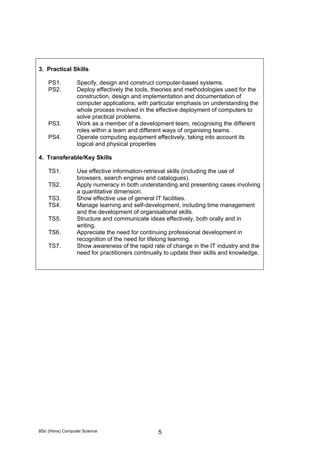
3. Practical Skills
PS1. Specify, design and construct computer-based systems.
PS2. Deploy effectively the tools, theories and methodologies used for the
construction, design and implementation and documentation of
computer applications, with particular emphasis on understanding the
whole process involved in the effective deployment of computers to
solve practical problems.
PS3. Work as a member of a development team, recognising the different
roles within a team and different ways of organising teams.
PS4. Operate computing equipment effectively, taking into account its
logical and physical properties
4. Transferable/Key Skills
TS1. Use effective information-retrieval skills (including the use of
browsers, search engines and catalogues).
TS2. Apply numeracy in both understanding and presenting cases involving
a quantitative dimension.
TS3. Show effective use of general IT facilities.
TS4. Manage learning and self-development, including time management
and the development of organisational skills.
TS5. Structure and communicate ideas effectively, both orally and in
writing.
TS6. Appreciate the need for continuing professional development in
recognition of the need for lifelong learning.
TS7. Show awareness of the rapid rate of change in the IT industry and the
need for practitioners continually to update their skills and knowledge.
BSc (Hons) Computer Science 6
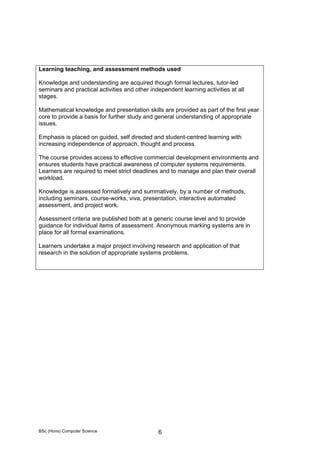
Learning teaching, and assessment methods used
Knowledge and understanding are acquired though formal lectures, tutor-led
seminars and practical activities and other independent learning activities at all
stages.
Mathematical knowledge and presentation skills are provided as part of the first year
core to provide a basis for further study and general understanding of appropriate
issues.
Emphasis is placed on guided, self directed and student-centred learning with
increasing independence of approach, thought and process.
The course provides access to effective commercial development environments and
ensures students have practical awareness of computer systems requirements.
Learners are required to meet strict deadlines and to manage and plan their overall
workload.
Knowledge is assessed formatively and summatively, by a number of methods,
including seminars, course-works, viva, presentation, interactive automated
assessment, and project work.
Assessment criteria are published both at a generic course level and to provide
guidance for individual items of assessment. Anonymous marking systems are in
place for all formal examinations.
Learners undertake a major project involving research and application of that
research in the solution of appropriate systems problems.
BSc (Hons) Computer Science 7
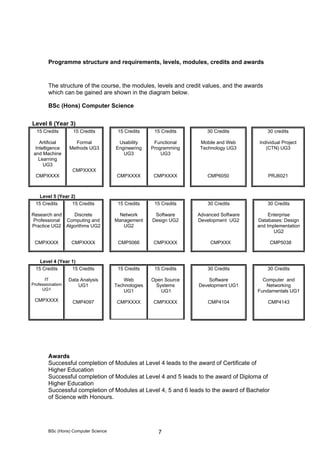
Programme structure and requirements, levels, modules, credits and awards
The structure of the course, the modules, levels and credit values, and the awards
which can be gained are shown in the diagram below.
BSc (Hons) Computer Science
Level 6 (Year 3)
15 Credits
Artificial
Intelligence
and Machine
Learning
UG3
CMPXXXX
15 Credits
Formal
Methods UG3
CMPXXXX
15 Credits
Usability
Engineering
UG3
CMPXXXX
15 Credits
Functional
Programming
UG3
CMPXXXX
30 Credits
Mobile and Web
Technology UG3
CMP6050
30 credits
Individual Project
(CTN) UG3
PRJ6021
Level 5 (Year 2)
15 Credits
Research and
Professional
Practice UG2
CMPXXXX
15 Credits
Discrete
Computing and
Algorithms UG2
CMPXXXX
15 Credits
Network
Management
UG2
CMP5066
15 Credits
Software
Design UG2
CMPXXXX
30 Credits
Advanced Software
Development UG2
CMPXXX
30 Credits
Enterprise
Databases: Design
and Implementation
UG2
CMP5038
Level 4 (Year 1)
15 Credits
IT
Professionalism
UG1
CMPXXXX
15 Credits
Data Analysis
UG1
CMP4097
15 Credits
Web
Technologies
UG1
CMPXXXX
15 Credits
Open Source
Systems
UG1
CMPXXXX
30 Credits
Software
Development UG1
CMP4104
30 Credits
Computer and
Networking
Fundamentals UG1
CMP4143
Awards
Successful completion of Modules at Level 4 leads to the award of Certificate of
Higher Education
Successful completion of Modules at Level 4 and 5 leads to the award of Diploma of
Higher Education
Successful completion of Modules at Level 4, 5 and 6 leads to the award of Bachelor
of Science with Honours.
BSc (Hons) Computer Science 8
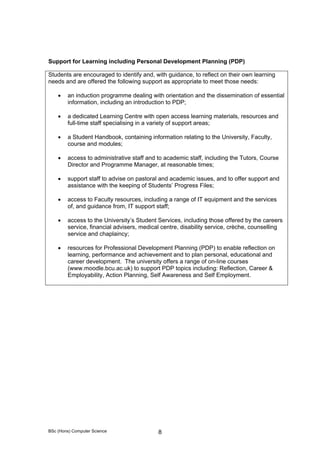
Support for Learning including Personal Development Planning (PDP)
Students are encouraged to identify and, with guidance, to reflect on their own learning
needs and are offered the following support as appropriate to meet those needs:
• an induction programme dealing with orientation and the dissemination of essential
information, including an introduction to PDP;
• a dedicated Learning Centre with open access learning materials, resources and
full-time staff specialising in a variety of support areas;
• a Student Handbook, containing information relating to the University, Faculty,
course and modules;
• access to administrative staff and to academic staff, including the Tutors, Course
Director and Programme Manager, at reasonable times;
• support staff to advise on pastoral and academic issues, and to offer support and
assistance with the keeping of Students’ Progress Files;
• access to Faculty resources, including a range of IT equipment and the services
of, and guidance from, IT support staff;
• access to the University’s Student Services, including those offered by the careers
service, financial advisers, medical centre, disability service, crèche, counselling
service and chaplaincy;
• resources for Professional Development Planning (PDP) to enable reflection on
learning, performance and achievement and to plan personal, educational and
career development. The university offers a range of on-line courses
(www.moodle.bcu.ac.uk) to support PDP topics including: Reflection, Career &
Employability, Action Planning, Self Awareness and Self Employment.
BSc (Hons) Computer Science 9
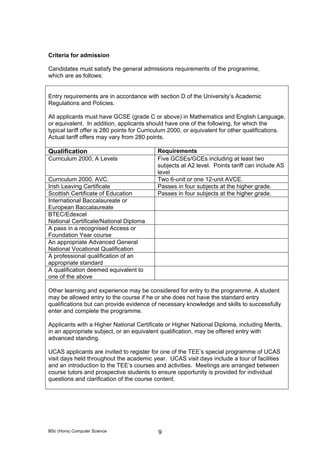
Criteria for admission
Candidates must satisfy the general admissions requirements of the programme,
which are as follows:
Entry requirements are in accordance with section D of the University’s Academic
Regulations and Policies.
All applicants must have GCSE (grade C or above) in Mathematics and English Language,
or equivalent. In addition, applicants should have one of the following, for which the
typical tariff offer is 280 points for Curriculum 2000, or equivalent for other qualifications.
Actual tariff offers may vary from 280 points.
Qualification Requirements
Curriculum 2000, A Levels Five GCSEs/GCEs including at least two
subjects at A2 level. Points tariff can include AS
level
Curriculum 2000, AVC. Two 6-unit or one 12-unit AVCE.
Irish Leaving Certificate Passes in four subjects at the higher grade.
Scottish Certificate of Education Passes in four subjects at the higher grade.
International Baccalaureate or
European Baccalaureate
BTEC/Edexcel
National Certificate/National Diploma
A pass in a recognised Access or
Foundation Year course
An appropriate Advanced General
National Vocational Qualification
A professional qualification of an
appropriate standard
A qualification deemed equivalent to
one of the above
Other learning and experience may be considered for entry to the programme. A student
may be allowed entry to the course if he or she does not have the standard entry
qualifications but can provide evidence of necessary knowledge and skills to successfully
enter and complete the programme.
Applicants with a Higher National Certificate or Higher National Diploma, including Merits,
in an appropriate subject, or an equivalent qualification, may be offered entry with
advanced standing.
UCAS applicants are invited to register for one of the TEE’s special programme of UCAS
visit days held throughout the academic year. UCAS visit days include a tour of facilities
and an introduction to the TEE’s courses and activities. Meetings are arranged between
course tutors and prospective students to ensure opportunity is provided for individual
questions and clarification of the course content.
BSc (Hons) Computer Science 10
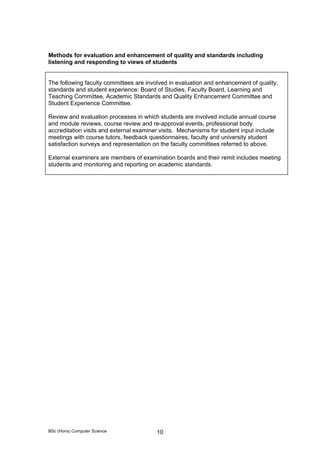
Methods for evaluation and enhancement of quality and standards including
listening and responding to views of students
The following faculty committees are involved in evaluation and enhancement of quality,
standards and student experience: Board of Studies, Faculty Board, Learning and
Teaching Committee, Academic Standards and Quality Enhancement Committee and
Student Experience Committee.
Review and evaluation processes in which students are involved include annual course
and module reviews, course review and re-approval events, professional body
accreditation visits and external examiner visits. Mechanisms for student input include
meetings with course tutors, feedback questionnaires, faculty and university student
satisfaction surveys and representation on the faculty committees referred to above.
External examiners are members of examination boards and their remit includes meeting
students and monitoring and reporting on academic standards.

bsc computer science - programme spec _2

  • 1.
    Birmingham City University Facultyof Technology, Engineering and the Environment Undergraduate Programme Programme Specification BSc (Hons) Computer Science Date of Course Approval/Review Version Number Version Date 5 March 2013 4.00 10 January 2013
  • 2.
    BSc (Hons) ComputerScience i CONTENTS Definitive Documents and Version Control...............................................................................1  Programme Specification .........................................................................................................2  Programme philosophy and aims.............................................................................................3  Learning Outcomes..................................................................................................................4  Learning teaching, and assessment methods..........................................................................6  Programme structure................................................................................................................7  Support for Learning.................................................................................................................8  Criteria for admission ...............................................................................................................9  Methods for evaluation and enhancement of quality and standards......................................10 
  • 3.
    BSc (Hons) ComputerScience 1 Definitive Documents and Version Control The process leading to the introduction of new courses, major changes to courses, and minor changes to courses and modules follows the appropriate formal procedure as described in the Faculty’s Academic Procedures and Quality Manual. On the front sheet of this document, the date of course approval/review refers to the most recent full approval/review event. The version date will be that of the most recent event at which formal consideration was given to course changes. Further details about the course and document development may be obtained from minutes of the approval or minor changes board.
  • 4.
    BSc (Hons) ComputerScience 2 Programme Specification BSc (Hons) Computer Science Date of Publication to Students: TBC NOTE: This specification provides a concise summary of the main features of the course and the learning outcomes that a typical student might reasonably be expected to achieve and demonstrate if s/he takes advantage of the learning opportunities that are provided. More detail on the specific learning outcomes, indicative content and the teaching, learning and assessment methods of each module can be found (1) at https://mytid.bcu.ac.uk, (2) in the Module Specifications and (3) in the Student Handbook. The accuracy of the information contained in this document is reviewed by the University and may be checked within independent review processes undertaken by the Quality Assurance Agency. Awarding Institution / Body: Birmingham City University Teaching Institution: Birmingham City University Interim Awards and Final Award: Cert HE / Dip HE / BSc / BSc (Hons) Programme Title: Computer Science Main fields of Study: Computing, Databases, Mathematics, Software Engineering, Mobile Technology, Web-based systems Modes of Study: FT/PT/SW Language of Study: English UCAS Code: G401 JACS Code: G400 Professional Status of the programme (if applicable): The programme will be submitted for accreditation by the British Computer Society. Relevant subject benchmark statements and other external reference points used to inform programme outcomes: QAA benchmark statements for computing British Computer Society guidance.
  • 5.
    BSc (Hons) ComputerScience 3 Programme philosophy and aims The programme intends to develop competence in using tools and techniques for producing computer systems solutions from a sound mathematical and scientific base while appreciating the professional responsibilities and quality issues needed by industry. The aims of the programme are to provide: • a sound understanding of the theory and principles underlying the construction of modern computing systems; • a stimulating and supportive learning environment that will enable students to develop the skills and knowledge necessary for constructing high quality software for a range of applications; • the development of transferable skills of analysis, communication and organisation; • an awareness of the moral, ethical and legal responsibilities of an IT professional; • independent learning skills and encourage an appreciation of the importance to an IT professional of continuing professional development and life long learning. The more general aims are: • to enable each student to benefit as much as he or she is able from the programme of study by enabling the student to acquire and develop: a. the broad intellectual and practical skills required for study at honours degree level; b. specific intellectual and practical skills relevant to the student’s programme of study; c. confidence, competence and good judgement in dealing with personal, interpersonal and professional issues; • to facilitate graduate employability.
  • 6.
    BSc (Hons) ComputerScience 4 Intended learning outcomes and the means by which they are achieved and demonstrated: Learning Outcomes 1. Knowledge and Understanding KU1. Demonstrate knowledge and understanding of essential facts, concepts, theories and principles of computer technology; including: high-level programming languages; program design; system development; software design methodologies; database design and management; web technologies and open systems; KU2. Have an appreciation of advanced computer applications; KU3. Identify the human and social factors impacting on software construction and operation; KU4. Understand the communication issues in large, complex software projects KU5. Appreciate the social, environmental, ethical, economic and commercial considerations that impact on the processes of computer systems. 2. Intellectual Skills IS1. Apply the modelling and design of computer-based systems for the purposes of comprehension, communication, prediction and the understanding of trade-offs. IS2. Specify the requirements and practical constraints of computer-based systems (including computer systems, information systems, and distributed systems) in their context. IS3. Recognise and analyse criteria and specifications appropriate to specific problems, and plan strategies for their solution. IS4. Analyse the extent to which a computer-based system meets the criteria defined for its current use and future development. IS5. Reflection and reasoning skills: develop rational and reasoned arguments that address a given information handling problem or opportunity. This should include assessment of the impact of new technologies. IS6. Evaluate systems in terms of general quality attributes and possible trade-offs presented within the given problem the ability to recognise any risks or safety aspects that may be involved in the operation of computing equipment within a given context
  • 7.
    BSc (Hons) ComputerScience 5 3. Practical Skills PS1. Specify, design and construct computer-based systems. PS2. Deploy effectively the tools, theories and methodologies used for the construction, design and implementation and documentation of computer applications, with particular emphasis on understanding the whole process involved in the effective deployment of computers to solve practical problems. PS3. Work as a member of a development team, recognising the different roles within a team and different ways of organising teams. PS4. Operate computing equipment effectively, taking into account its logical and physical properties 4. Transferable/Key Skills TS1. Use effective information-retrieval skills (including the use of browsers, search engines and catalogues). TS2. Apply numeracy in both understanding and presenting cases involving a quantitative dimension. TS3. Show effective use of general IT facilities. TS4. Manage learning and self-development, including time management and the development of organisational skills. TS5. Structure and communicate ideas effectively, both orally and in writing. TS6. Appreciate the need for continuing professional development in recognition of the need for lifelong learning. TS7. Show awareness of the rapid rate of change in the IT industry and the need for practitioners continually to update their skills and knowledge.
  • 8.
    BSc (Hons) ComputerScience 6 Learning teaching, and assessment methods used Knowledge and understanding are acquired though formal lectures, tutor-led seminars and practical activities and other independent learning activities at all stages. Mathematical knowledge and presentation skills are provided as part of the first year core to provide a basis for further study and general understanding of appropriate issues. Emphasis is placed on guided, self directed and student-centred learning with increasing independence of approach, thought and process. The course provides access to effective commercial development environments and ensures students have practical awareness of computer systems requirements. Learners are required to meet strict deadlines and to manage and plan their overall workload. Knowledge is assessed formatively and summatively, by a number of methods, including seminars, course-works, viva, presentation, interactive automated assessment, and project work. Assessment criteria are published both at a generic course level and to provide guidance for individual items of assessment. Anonymous marking systems are in place for all formal examinations. Learners undertake a major project involving research and application of that research in the solution of appropriate systems problems.
  • 9.
    BSc (Hons) ComputerScience 7 Programme structure and requirements, levels, modules, credits and awards The structure of the course, the modules, levels and credit values, and the awards which can be gained are shown in the diagram below. BSc (Hons) Computer Science Level 6 (Year 3) 15 Credits Artificial Intelligence and Machine Learning UG3 CMPXXXX 15 Credits Formal Methods UG3 CMPXXXX 15 Credits Usability Engineering UG3 CMPXXXX 15 Credits Functional Programming UG3 CMPXXXX 30 Credits Mobile and Web Technology UG3 CMP6050 30 credits Individual Project (CTN) UG3 PRJ6021 Level 5 (Year 2) 15 Credits Research and Professional Practice UG2 CMPXXXX 15 Credits Discrete Computing and Algorithms UG2 CMPXXXX 15 Credits Network Management UG2 CMP5066 15 Credits Software Design UG2 CMPXXXX 30 Credits Advanced Software Development UG2 CMPXXX 30 Credits Enterprise Databases: Design and Implementation UG2 CMP5038 Level 4 (Year 1) 15 Credits IT Professionalism UG1 CMPXXXX 15 Credits Data Analysis UG1 CMP4097 15 Credits Web Technologies UG1 CMPXXXX 15 Credits Open Source Systems UG1 CMPXXXX 30 Credits Software Development UG1 CMP4104 30 Credits Computer and Networking Fundamentals UG1 CMP4143 Awards Successful completion of Modules at Level 4 leads to the award of Certificate of Higher Education Successful completion of Modules at Level 4 and 5 leads to the award of Diploma of Higher Education Successful completion of Modules at Level 4, 5 and 6 leads to the award of Bachelor of Science with Honours.
  • 10.
    BSc (Hons) ComputerScience 8 Support for Learning including Personal Development Planning (PDP) Students are encouraged to identify and, with guidance, to reflect on their own learning needs and are offered the following support as appropriate to meet those needs: • an induction programme dealing with orientation and the dissemination of essential information, including an introduction to PDP; • a dedicated Learning Centre with open access learning materials, resources and full-time staff specialising in a variety of support areas; • a Student Handbook, containing information relating to the University, Faculty, course and modules; • access to administrative staff and to academic staff, including the Tutors, Course Director and Programme Manager, at reasonable times; • support staff to advise on pastoral and academic issues, and to offer support and assistance with the keeping of Students’ Progress Files; • access to Faculty resources, including a range of IT equipment and the services of, and guidance from, IT support staff; • access to the University’s Student Services, including those offered by the careers service, financial advisers, medical centre, disability service, crèche, counselling service and chaplaincy; • resources for Professional Development Planning (PDP) to enable reflection on learning, performance and achievement and to plan personal, educational and career development. The university offers a range of on-line courses (www.moodle.bcu.ac.uk) to support PDP topics including: Reflection, Career & Employability, Action Planning, Self Awareness and Self Employment.
  • 11.
    BSc (Hons) ComputerScience 9 Criteria for admission Candidates must satisfy the general admissions requirements of the programme, which are as follows: Entry requirements are in accordance with section D of the University’s Academic Regulations and Policies. All applicants must have GCSE (grade C or above) in Mathematics and English Language, or equivalent. In addition, applicants should have one of the following, for which the typical tariff offer is 280 points for Curriculum 2000, or equivalent for other qualifications. Actual tariff offers may vary from 280 points. Qualification Requirements Curriculum 2000, A Levels Five GCSEs/GCEs including at least two subjects at A2 level. Points tariff can include AS level Curriculum 2000, AVC. Two 6-unit or one 12-unit AVCE. Irish Leaving Certificate Passes in four subjects at the higher grade. Scottish Certificate of Education Passes in four subjects at the higher grade. International Baccalaureate or European Baccalaureate BTEC/Edexcel National Certificate/National Diploma A pass in a recognised Access or Foundation Year course An appropriate Advanced General National Vocational Qualification A professional qualification of an appropriate standard A qualification deemed equivalent to one of the above Other learning and experience may be considered for entry to the programme. A student may be allowed entry to the course if he or she does not have the standard entry qualifications but can provide evidence of necessary knowledge and skills to successfully enter and complete the programme. Applicants with a Higher National Certificate or Higher National Diploma, including Merits, in an appropriate subject, or an equivalent qualification, may be offered entry with advanced standing. UCAS applicants are invited to register for one of the TEE’s special programme of UCAS visit days held throughout the academic year. UCAS visit days include a tour of facilities and an introduction to the TEE’s courses and activities. Meetings are arranged between course tutors and prospective students to ensure opportunity is provided for individual questions and clarification of the course content.
  • 12.
    BSc (Hons) ComputerScience 10 Methods for evaluation and enhancement of quality and standards including listening and responding to views of students The following faculty committees are involved in evaluation and enhancement of quality, standards and student experience: Board of Studies, Faculty Board, Learning and Teaching Committee, Academic Standards and Quality Enhancement Committee and Student Experience Committee. Review and evaluation processes in which students are involved include annual course and module reviews, course review and re-approval events, professional body accreditation visits and external examiner visits. Mechanisms for student input include meetings with course tutors, feedback questionnaires, faculty and university student satisfaction surveys and representation on the faculty committees referred to above. External examiners are members of examination boards and their remit includes meeting students and monitoring and reporting on academic standards.