www.zerocarbon.email
Email and digital sobriety
It is not always easy to identify the work that need to be set up in order to move
towards digital sobriety, and therefore the reduction of the carbon footprint of our
activities. As far as email marketing and CRM are concerned, here are some of
the ideas regularly mentioned:
• Data minimization
• Reduction of the volume of mailings (treatment of inactive people, better
targeting, ...)
• Reduction of the weight of the messages
• Responsible purchasing policy (low carbon data centers, carbon offsets, etc.)
• ...
These are all subjects on which companies are autonomous.
And the emails (all the same) sent?
The issue of email storage in recipients’ mailboxes is important:
• Because after a few days marketing emails become obsolete
• Because the recipients do not take the time to delete them (lack of
tools, education on digital sobriety, lack of time, lack of...)
What if we reverse the logic and relieve the recipient of this responsibility?
(without hiding the problem) What if we made the sending companies
responsible?
The size of the problem?
Billions of emails are sent every day. (about 300 billion according to
Radicati)
• A large part of these emails are spam, and therefore deleted directly
or quarantined in the spam box
• A very small part is made up of personal or transactional emails
• Everything else, the commercial emails (the graymail), stagnate
forever in the recipients’ inboxes... even though they have become
totally obsolete.
The recipients, are very, very, very few to take the time to clean
them.
The size of the problem?
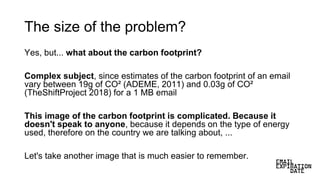
Yes, but... what about the carbon footprint?
Complex subject, since estimates of the carbon footprint of an email
vary between 19g of CO² (ADEME, 2011) and 0.03g of CO²
(TheShiftProject 2018) for a 1 MB email
This image of the carbon footprint is complicated. Because it
doesn't speak to anyone, because it depends on the type of energy
used, therefore on the country we are talking about, ...
Let's take another image that is much easier to remember.
The size of the problem?
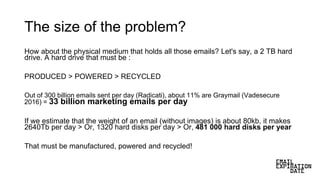
How about the physical medium that holds all those emails? Let's say, a 2 TB hard
drive. A hard drive that must be :
PRODUCED > POWERED > RECYCLED
Out of 300 billion emails sent per day (Radicati), about 11% are Graymail (Vadesecure
2016) = 33 billion marketing emails per day
If we estimate that the weight of an email (without images) is about 80kb, it makes
2640Tb per day > Or, 1320 hard disks per day > Or, 481 000 hard disks per year
That must be manufactured, powered and recycled!
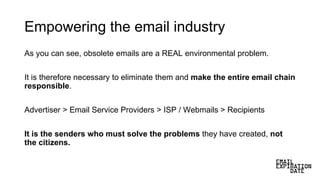
Empowering the email industry
As you can see, obsolete emails are a REAL environmental problem.
It is therefore necessary to eliminate them and make the entire email chain
responsible.
Advertiser > Email Service Providers > ISP / Webmails > Recipients
It is the senders who must solve the problems they have created, not
the citizens.
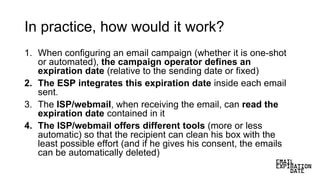
In practice, how would it work?
1. When configuring an email campaign (whether it is one-shot
or automated), the campaign operator defines an
expiration date (relative to the sending date or fixed)
2. The ESP integrates this expiration date inside each email
sent.
3. The ISP/webmail, when receiving the email, can read the
expiration date contained in it
4. The ISP/webmail offers different tools (more or less
automatic) so that the recipient can clean his box with the
least possible effort (and if he gives his consent, the emails
can be automatically deleted)
In what order do we move forward?
The concept, even at the technical level, is not complicated. But the adoption must be massive in
order to have an impact.
The actors who will have the most work in the implementation will clearly be the ISPs and Webmails.
Here are the milestones we are currently planning (but will likely evolve):
1. Project structuring: organization / content creation
2. Gathering support: to prove that there is a real interest in the project
3. Start of legal and communication working groups
4. Creation of a technical working group
5. 1st test implementations
6. Adoption
It will probably take one or two years before the first implementations arrive.
How to support the project?
Declare your support publicly!
It means:
• You agree to use and implement the expiration date mechanism
as soon as it is technically validated.
• You get involved in the project by helping us to generate more and
more support.
• You may participate in one of the working groups set up.
• You agree that your company's logo and name may be associated
with the project (list of supporters)
How to support the project?
Participate in the different working groups (in progress):
• Legal :
• Creation of a charter that can be signed by all supporters
• Legal personality of the project (creation of a legal structure or
backing of an existing structure)
• Validation of the concept of expiration date in local legislations
(secrecy of correspondence, ...)
• ...
How to support the project?
Participate in the different working groups (in progress):
• Communication
• Sharing of contents (FAQ, presentations, articles, ...)
• Organization of the collection of support
• Animation of the community of supporters
• Internal lobbying in your respective companies
• ...
How to support the project?
Participate in the different working groups (in progress):
• Technical
• Creating a draft technical proposal
• Collection of comments
• Drafting of technical recommendations for implementation by
ISPs/Webmails
• Drafting of technical recommendations for implementation by ESPs
• ...
They already support us!
And many more!
What's next?
• Connect to our discussion area:
https://chat.lepatron.email/invite/nj7wLQ
• Validate the form to receive updates on the progress of the
project: https://www.zerocarbon.email/
• Encourage your company to publicly support the project:
https://www.zerocarbon.email/support/
• Offer your help: https://www.zerocarbon.email/contact/

Presentation Email Expiration Date Initiative

  • 1.
  • 2.
    Email and digitalsobriety It is not always easy to identify the work that need to be set up in order to move towards digital sobriety, and therefore the reduction of the carbon footprint of our activities. As far as email marketing and CRM are concerned, here are some of the ideas regularly mentioned: • Data minimization • Reduction of the volume of mailings (treatment of inactive people, better targeting, ...) • Reduction of the weight of the messages • Responsible purchasing policy (low carbon data centers, carbon offsets, etc.) • ... These are all subjects on which companies are autonomous.
  • 3.
    And the emails(all the same) sent? The issue of email storage in recipients’ mailboxes is important: • Because after a few days marketing emails become obsolete • Because the recipients do not take the time to delete them (lack of tools, education on digital sobriety, lack of time, lack of...) What if we reverse the logic and relieve the recipient of this responsibility? (without hiding the problem) What if we made the sending companies responsible?
  • 4.
    The size ofthe problem? Billions of emails are sent every day. (about 300 billion according to Radicati) • A large part of these emails are spam, and therefore deleted directly or quarantined in the spam box • A very small part is made up of personal or transactional emails • Everything else, the commercial emails (the graymail), stagnate forever in the recipients’ inboxes... even though they have become totally obsolete. The recipients, are very, very, very few to take the time to clean them.
  • 5.
    The size ofthe problem? Yes, but... what about the carbon footprint? Complex subject, since estimates of the carbon footprint of an email vary between 19g of CO² (ADEME, 2011) and 0.03g of CO² (TheShiftProject 2018) for a 1 MB email This image of the carbon footprint is complicated. Because it doesn't speak to anyone, because it depends on the type of energy used, therefore on the country we are talking about, ... Let's take another image that is much easier to remember.
  • 6.
    The size ofthe problem? How about the physical medium that holds all those emails? Let's say, a 2 TB hard drive. A hard drive that must be : PRODUCED > POWERED > RECYCLED Out of 300 billion emails sent per day (Radicati), about 11% are Graymail (Vadesecure 2016) = 33 billion marketing emails per day If we estimate that the weight of an email (without images) is about 80kb, it makes 2640Tb per day > Or, 1320 hard disks per day > Or, 481 000 hard disks per year That must be manufactured, powered and recycled!
  • 7.
    Empowering the emailindustry As you can see, obsolete emails are a REAL environmental problem. It is therefore necessary to eliminate them and make the entire email chain responsible. Advertiser > Email Service Providers > ISP / Webmails > Recipients It is the senders who must solve the problems they have created, not the citizens.
  • 8.
    In practice, howwould it work? 1. When configuring an email campaign (whether it is one-shot or automated), the campaign operator defines an expiration date (relative to the sending date or fixed) 2. The ESP integrates this expiration date inside each email sent. 3. The ISP/webmail, when receiving the email, can read the expiration date contained in it 4. The ISP/webmail offers different tools (more or less automatic) so that the recipient can clean his box with the least possible effort (and if he gives his consent, the emails can be automatically deleted)
  • 9.
    In what orderdo we move forward? The concept, even at the technical level, is not complicated. But the adoption must be massive in order to have an impact. The actors who will have the most work in the implementation will clearly be the ISPs and Webmails. Here are the milestones we are currently planning (but will likely evolve): 1. Project structuring: organization / content creation 2. Gathering support: to prove that there is a real interest in the project 3. Start of legal and communication working groups 4. Creation of a technical working group 5. 1st test implementations 6. Adoption It will probably take one or two years before the first implementations arrive.
  • 10.
    How to supportthe project? Declare your support publicly! It means: • You agree to use and implement the expiration date mechanism as soon as it is technically validated. • You get involved in the project by helping us to generate more and more support. • You may participate in one of the working groups set up. • You agree that your company's logo and name may be associated with the project (list of supporters)
  • 11.
    How to supportthe project? Participate in the different working groups (in progress): • Legal : • Creation of a charter that can be signed by all supporters • Legal personality of the project (creation of a legal structure or backing of an existing structure) • Validation of the concept of expiration date in local legislations (secrecy of correspondence, ...) • ...
  • 12.
    How to supportthe project? Participate in the different working groups (in progress): • Communication • Sharing of contents (FAQ, presentations, articles, ...) • Organization of the collection of support • Animation of the community of supporters • Internal lobbying in your respective companies • ...
  • 13.
    How to supportthe project? Participate in the different working groups (in progress): • Technical • Creating a draft technical proposal • Collection of comments • Drafting of technical recommendations for implementation by ISPs/Webmails • Drafting of technical recommendations for implementation by ESPs • ...
  • 14.
    They already supportus! And many more!
  • 15.
    What's next? • Connectto our discussion area: https://chat.lepatron.email/invite/nj7wLQ • Validate the form to receive updates on the progress of the project: https://www.zerocarbon.email/ • Encourage your company to publicly support the project: https://www.zerocarbon.email/support/ • Offer your help: https://www.zerocarbon.email/contact/