explain how Brahe’sinnovations and
extensive collection of data in
observational astronomy paved the
way for Kepler’s discovery of his laws
of planetary motion
(S11/12PS-IVb-44)
5.
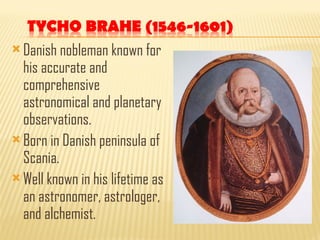
Danish noblemanknown for
his accurate and
comprehensive
astronomical and planetary
observations.
Born in Danish peninsula of
Scania.
Well known in his lifetime as
an astronomer, astrologer,
and alchemist.
7.
Became famous inhis time because of
his improvement of celestial
knowledge.
Persuaded King Frederick II of
Denmark to give him funds and the
Hven as the site for the finest
observatory of its time.
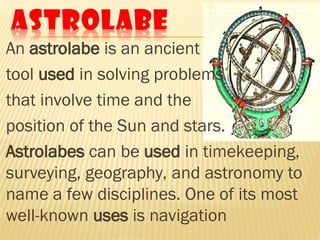
An astrolabe isan ancient
tool used in solving problems
that involve time and the
position of the Sun and stars.
Astrolabes can be used in timekeeping,
surveying, geography, and astronomy to
name a few disciplines. One of its most
well-known uses is navigation
15.
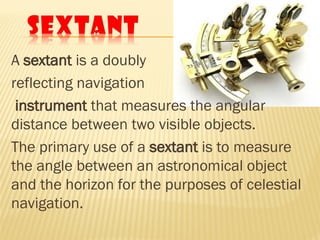
A sextant isa doubly
reflecting navigation
instrument that measures the angular
distance between two visible objects.
The primary use of a sextant is to measure
the angle between an astronomical object
and the horizon for the purposes of celestial
navigation.
16.
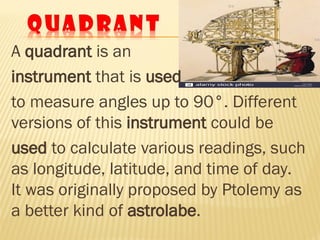
A quadrant isan
instrument that is used
to measure angles up to 90°. Different
versions of this instrument could be
used to calculate various readings, such
as longitude, latitude, and time of day.
It was originally proposed by Ptolemy as
a better kind of astrolabe.
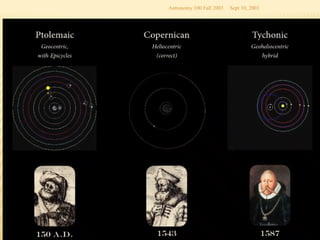
Brahe modified thegeocentric
model.
He proposed an arrangement
that saved Earth at the center,
but the other planets orbited
around the sun, which also
revolved around Earth.
It was inPrague when
Brahe met Johannes Kepler
who became his student.
Kepler inherited Brahe’s
volume of data and utilized it
to simplify the description of
planetary motion.
21.
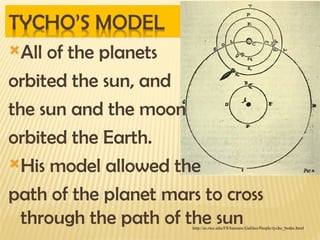
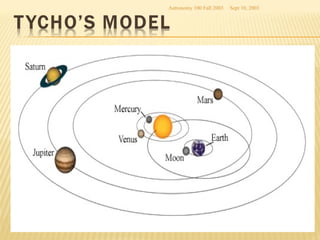
All of theplanets
orbited the sun, and
the sun and the moon
orbited the Earth.
His model allowed the
path of the planet mars to cross
through the path of the sun
http://es.rice.edu/ES/humsoc/Galileo/People/tycho_brahe.html
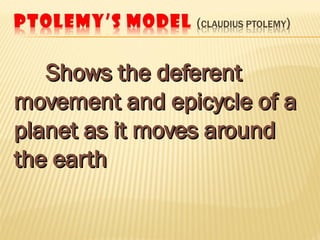
Shows the deferent
Showsthe deferent
movement and epicycle of a
movement and epicycle of a
planet as it moves around
planet as it moves around
the earth
the earth
25.
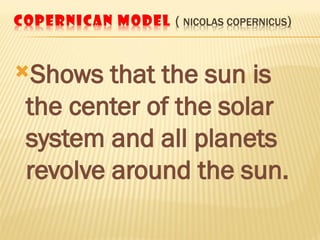
Shows that thesun is
the center of the solar
system and all planets
revolve around the sun.
26.
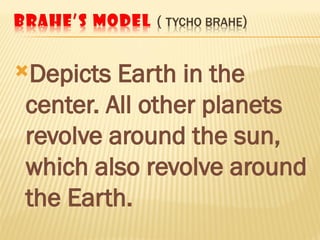
Depicts Earth inthe
center. All other planets
revolve around the sun,
which also revolve around
the Earth.
27.
Tycho died aftertwo years and Kepler
inherited his data and his title:
imperial mathematician to the
emperor Rudolf II.
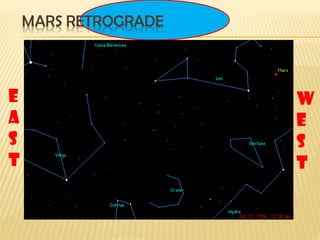
Kepler dutifully attempted to reconcile
the mars data using models of
Ptolemy,Copernicus, and Tycho.
None were successful at representing
Tycho’s accurate data for mars.
30.
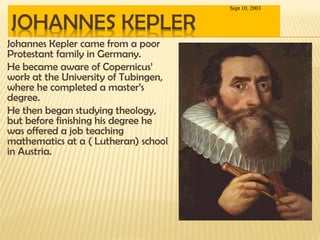
Johannes Kepler camefrom a poor
Protestant family in Germany.
He became aware of Copernicus’
work at the University of Tubingen,
where he completed a master’s
degree.
He then began studying theology,
but before finishing his degree he
was offered a job teaching
mathematics at a ( Lutheran) school
in Austria.
Sept 10, 2003
31.
Tycho died aftertwo years and kepler
inherited his data and his title: imperial
mathematician to the emperor Rudolf II.
Kepler dutifully attempted to reconcile
the mars data using models of
Ptolemy,Copernicus, and Tycho.
None were successful at representing
Tycho’s accurate data for mars.
32.
After six yearsof work he gave up
attempting to use circles for the
planetary orbits.
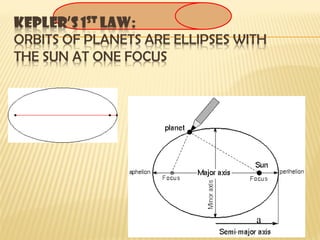
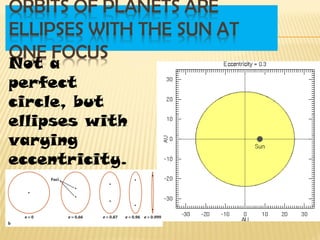
Kepler realized Mars moves in an ellipse
around the sun.
In his Astronomia Nova (1609) he
presented his first two laws of planetary
motion.
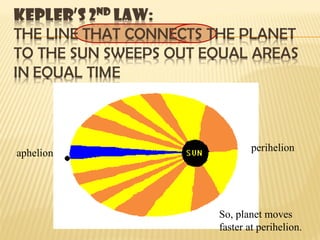
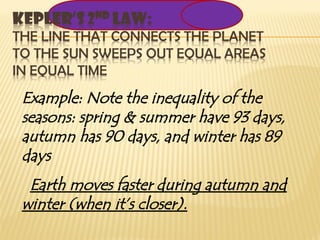
Example: Note theinequality of the
seasons: spring & summer have 93 days,
autumn has 90 days, and winter has 89
days
Earth moves faster during autumn and
winter (when it’s closer).
38.
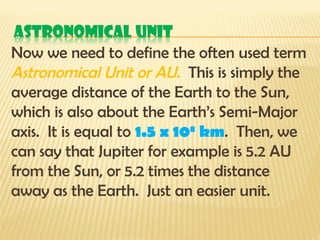
Now we needto define the often used term
Astronomical Unit or AU. This is simply the
average distance of the Earth to the Sun,
which is also about the Earth’s Semi-Major
axis. It is equal to 1.5 x 10⁸
km. Then, we
can say that Jupiter for example is 5.2 AU
from the Sun, or 5.2 times the distance
away as the Earth. Just an easier unit.
39.
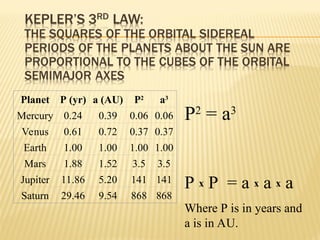
Planet P (yr)a (AU) P2
a3
Mercury 0.24 0.39 0.06 0.06
Venus 0.61 0.72 0.37 0.37
Earth 1.00 1.00 1.00 1.00
Mars 1.88 1.52 3.5 3.5
Jupiter 11.86 5.20 141 141
Saturn 29.46 9.54 868 868
P2
= a3
P x P = a x a x a
Where P is in years and
a is in AU.
40.
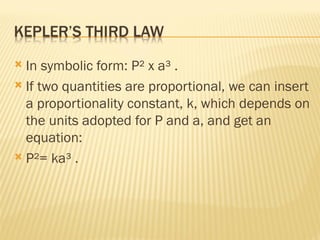
In symbolicform: P² x a³ .
If two quantities are proportional, we can insert
a proportionality constant, k, which depends on
the units adopted for P and a, and get an
equation:
P²= ka³ .
41.
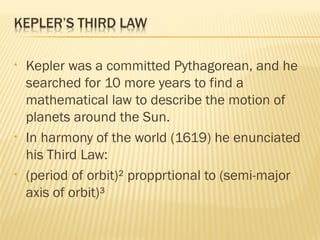
• Kepler wasa committed Pythagorean, and he
searched for 10 more years to find a
mathematical law to describe the motion of
planets around the Sun.
• In harmony of the world (1619) he enunciated
his Third Law:
• (period of orbit)² propprtional to (semi-major
axis of orbit)³
42.
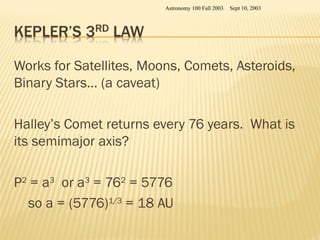
Works for Satellites,Moons, Comets, Asteroids,
Binary Stars… (a caveat)
Halley’s Comet returns every 76 years. What is
its semimajor axis?
P2
= a3
or a3
= 762
= 5776
so a = (5776)1/3
= 18 AU
Sept 10, 2003
Astronomy 100 Fall 2003
43.
The farther awayfrom the Sun, the longer it takes
for the planet to orbit AND the slower it’s average
orbit speed.
44.
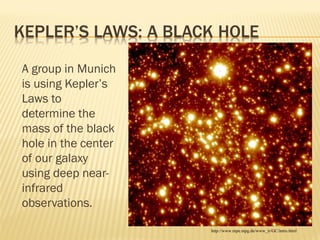
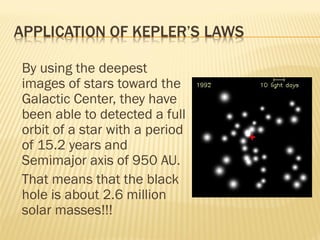
A group inMunich
is using Kepler’s
Laws to
determine the
mass of the black
hole in the center
of our galaxy
using deep near-
infrared
observations.
http://www.mpe.mpg.de/www_ir/GC/intro.html
45.
By using thedeepest
images of stars toward the
Galactic Center, they have
been able to detected a full
orbit of a star with a period
of 15.2 years and
Semimajor axis of 950 AU.
That means that the black
hole is about 2.6 million
solar masses!!!
47.
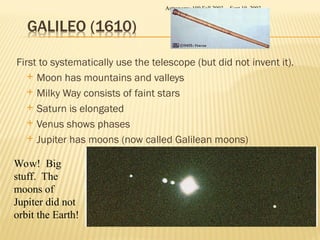
First to systematicallyuse the telescope (but did not invent it).
Moon has mountains and valleys
Milky Way consists of faint stars
Saturn is elongated
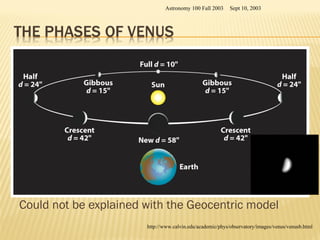
Venus shows phases
Jupiter has moons (now called Galilean moons)
Sept 10, 2003
Astronomy 100 Fall 2003
Wow! Big
stuff. The
moons of
Jupiter did not
orbit the Earth!
48.
Sept 10, 2003
Astronomy100 Fall 2003
http://photojournal.jpl.nasa.gov/catalog/PIA01299
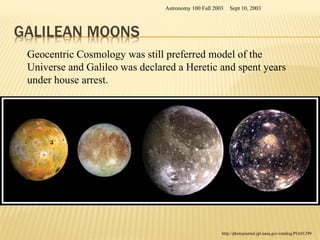
Geocentric Cosmology was still preferred model of the
Universe and Galileo was declared a Heretic and spent years
under house arrest.
49.
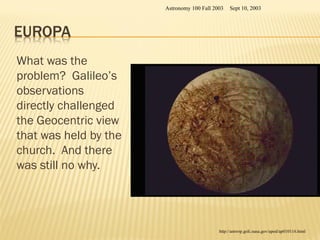
What was the
problem?Galileo’s
observations
directly challenged
the Geocentric view
that was held by the
church. And there
was still no why.
Sept 10, 2003
Astronomy 100 Fall 2003
http://antwrp.gsfc.nasa.gov/apod/ap010116.html
50.
Could not beexplained with the Geocentric model
Sept 10, 2003
Astronomy 100 Fall 2003
http://www.calvin.edu/academic/phys/observatory/images/venus/venusb.html
51.
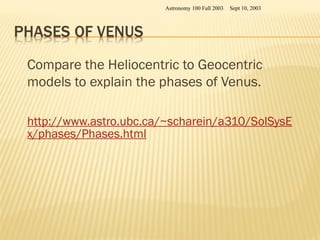
Compare the Heliocentricto Geocentric
models to explain the phases of Venus.
http://www.astro.ubc.ca/~scharein/a310/SolSysE
x/phases/Phases.html
Sept 10, 2003
Astronomy 100 Fall 2003
52.
Disproved Ptolemaicsystem
Rome bullied him into recanting (cleared
in 1992)
Now we understand the motions and the
fact that the solar system MUST be
Heliocentric, but now we need a reason
why?
Sept 10, 2003
Astronomy 100 Fall 2003
53.
Kepler discovered thesepatterns in nature by
using the data that Tycho collected, BUT the
world had to wait until someone could
understand the Natural Law that predicts
Kepler’s Laws.
The real problem: On Earth we’re use to things
that move but always come quickly to a rest. Why
didn’t the planets stop?
Sept 10, 2003
Astronomy 100 Fall 2003
54.
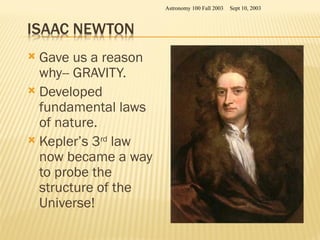
Gave usa reason
why-- GRAVITY.
Developed
fundamental laws
of nature.
Kepler’s 3rd
law
now became a way
to probe the
structure of the
Universe!
Sept 10, 2003
Astronomy 100 Fall 2003