Streaming Data Analytics For Unknown
(Attacker) Vehicle Identification In Passive
Sensing Scenario
May 13, 2023
Streaming Data Analytics For Unknown (Attacker) Vehicle Identification In Passive Sensing Scenario
B
y
V
a
r
u
n
G
a
r
g
,
P
Description: What Needs to be Solved?
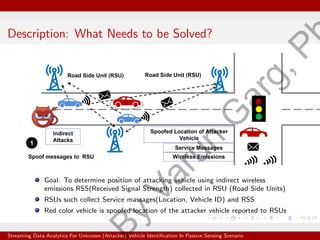
Goal: To determine position of attacking vehicle using indirect wireless
emissions RSS(Received Signal Strength) collected in RSU (Road Side Units)
RSUs such collect Service massages(Location, Vehicle ID) and RSS
Red color vehicle is spoofed location of the attacker vehicle reported to RSUs
Streaming Data Analytics For Unknown (Attacker) Vehicle Identification In Passive Sensing Scenario
B
y
V
a
r
u
n
G
a
r
g
,
P
General Description: How are we Solving?
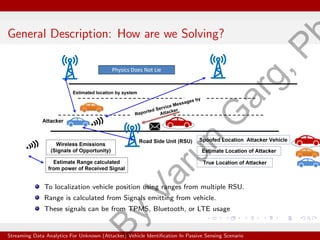
To localization vehicle position using ranges from multiple RSU.
Range is calculated from Signals emitting from vehicle.
These signals can be from TPMS, Bluetooth, or LTE usage
Streaming Data Analytics For Unknown (Attacker) Vehicle Identification In Passive Sensing Scenario
B
y
V
a
r
u
n
G
a
r
g
,
P
Motivation
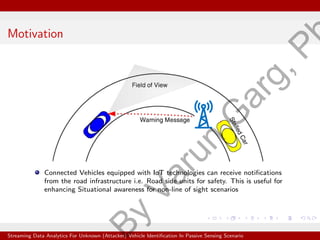
Connected Vehicles equipped with IoT technologies can receive notifications
from the road infrastructure i.e. Road side units for safety. This is useful for
enhancing Situational awareness for non-line of sight scenarios
Streaming Data Analytics For Unknown (Attacker) Vehicle Identification In Passive Sensing Scenario
B
y
V
a
r
u
n
G
a
r
g
,
P
Flowchart of Approach
Streaming Data Analytics For Unknown (Attacker) Vehicle Identification In Passive Sensing Scenario
B
y
V
a
r
u
n
G
a
r
g
,
P
Data Processing Approach?
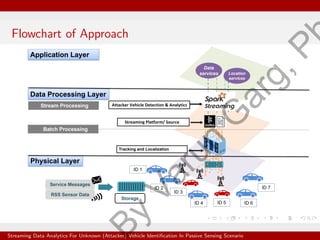
At the system level, localization of the attacker vehicle is conducted using its
wireless emissions
Using the localization method, localized position estimates are obtained from
different time instances. Features such as velocity of the vehicle is extracted
from these position estimates.
These features are processed using a Streaming Analytics Pipeline where
Machine learning model classifies a vehicle as attacker or normal
Streaming Data Analytics For Unknown (Attacker) Vehicle Identification In Passive Sensing Scenario
B
y
V
a
r
u
n
G
a
r
g
,
P
Streaming Analytics
Streaming Data Analytics For Unknown (Attacker) Vehicle Identification In Passive Sensing Scenario
B
y
V
a
r
u
n
G
a
r
g
,
P
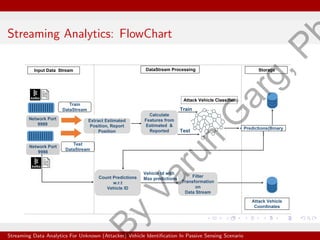
Streaming Analytics: FlowChart
Streaming Data Analytics For Unknown (Attacker) Vehicle Identification In Passive Sensing Scenario
B
y
V
a
r
u
n
G
a
r
g
,
P
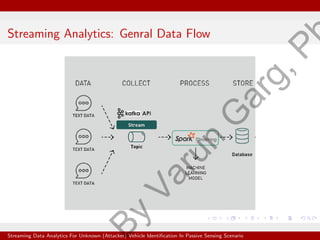
Streaming Analytics: Genral Data Flow
Streaming Data Analytics For Unknown (Attacker) Vehicle Identification In Passive Sensing Scenario
B
y
V
a
r
u
n
G
a
r
g
,
P
Apache Kafka
Apache Kafka is a distributed event store which connect to
external systems for data import/export
Figure: Kafka Publisher Subscriber
Streaming Data Analytics For Unknown (Attacker) Vehicle Identification In Passive Sensing Scenario
B
y
V
a
r
u
n
G
a
r
g
,
P
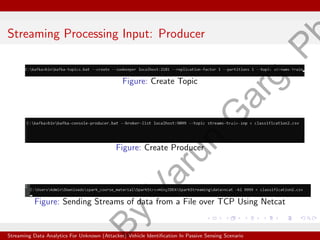
Streaming Processing Input: Producer
Figure: Create Topic
Figure: Create Producer
Figure: Sending Streams of data from a File over TCP Using Netcat
Streaming Data Analytics For Unknown (Attacker) Vehicle Identification In Passive Sensing Scenario
B
y
V
a
r
u
n
G
a
r
g
,
P
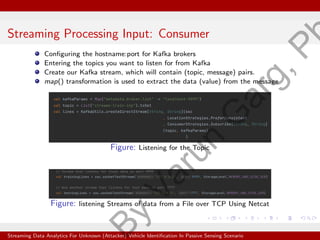
Streaming Processing Input: Consumer
Configuring the hostname:port for Kafka brokers
Entering the topics you want to listen for from Kafka
Create our Kafka stream, which will contain (topic, message) pairs.
map() transformation is used to extract the data (value) from the message
Figure: Listening for the Topic
Figure: listening Streams of data from a File over TCP Using Netcat
Streaming Data Analytics For Unknown (Attacker) Vehicle Identification In Passive Sensing Scenario
B
y
V
a
r
u
n
G
a
r
g
,
P
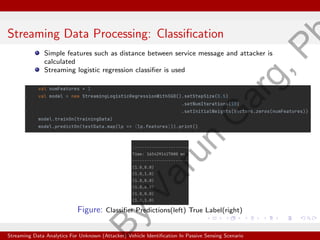
Streaming Data Processing: Classification
Simple features such as distance between service message and attacker is
calculated
Streaming logistic regression classifier is used
Figure: Classifier Predictions(left) True Label(right)
Streaming Data Analytics For Unknown (Attacker) Vehicle Identification In Passive Sensing Scenario
B
y
V
a
r
u
n
G
a
r
g
,
P
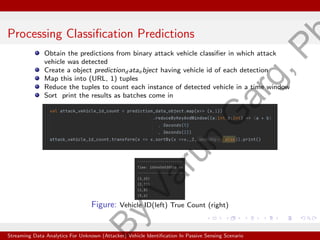
Processing Classification Predictions
Obtain the predictions from binary attack vehicle classifier in which attack
vehicle was detected
Create a object predictiond ataobject having vehicle id of each detection
Map this into (URL, 1) tuples
Reduce the tuples to count each instance of detected vehicle in a time window
Sort print the results as batches come in
Figure: Vehicle ID(left) True Count (right)
Streaming Data Analytics For Unknown (Attacker) Vehicle Identification In Passive Sensing Scenario
B
y
V
a
r
u
n
G
a
r
g
,
P
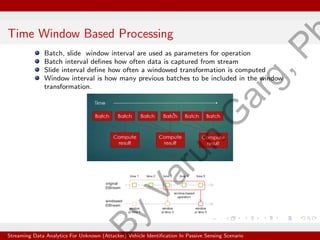
Time Window Based Processing
Batch, slide window interval are used as parameters for operation
Batch interval defines how often data is captured from stream
Slide interval define how often a windowed transformation is computed
Window interval is how many previous batches to be included in the window
transformation.
Streaming Data Analytics For Unknown (Attacker) Vehicle Identification In Passive Sensing Scenario
B
y
V
a
r
u
n
G
a
r
g
,
P
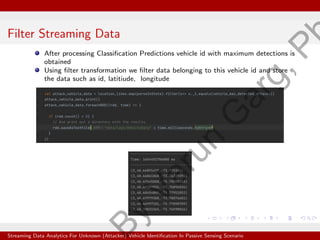
Filter Streaming Data
After processing Classification Predictions vehicle id with maximum detections is
obtained
Using filter transformation we filter data belonging to this vehicle id and store
the data such as id, latitiude, longitude
Streaming Data Analytics For Unknown (Attacker) Vehicle Identification In Passive Sensing Scenario
B
y
V
a
r
u
n
G
a
r
g
,
P
Summary
A range-based localization method using ranges from multiple
RSUs (road side units) was used estimates the position of
target vehicle
Localization was performed using a OLS (i.e., ordinary least
square)
Kalman filter was applied to the OLS estimates
Validation of the method was performed on simple simulated
scenario
Streaming Data Analytics For Unknown (Attacker) Vehicle Identification In Passive Sensing Scenario
B
y
V
a
r
u
n
G
a
r
g
,
P
Thank you!
Streaming Data Analytics For Unknown (Attacker) Vehicle Identification In Passive Sensing Scenario
B
y
V
a
r
u
n
G
a
r
g
,
P

presentation big data analytics on Apache spark

  • 1.
    Streaming Data AnalyticsFor Unknown (Attacker) Vehicle Identification In Passive Sensing Scenario May 13, 2023 Streaming Data Analytics For Unknown (Attacker) Vehicle Identification In Passive Sensing Scenario B y V a r u n G a r g , P
  • 2.
    Description: What Needsto be Solved? Goal: To determine position of attacking vehicle using indirect wireless emissions RSS(Received Signal Strength) collected in RSU (Road Side Units) RSUs such collect Service massages(Location, Vehicle ID) and RSS Red color vehicle is spoofed location of the attacker vehicle reported to RSUs Streaming Data Analytics For Unknown (Attacker) Vehicle Identification In Passive Sensing Scenario B y V a r u n G a r g , P
  • 3.
    General Description: Howare we Solving? To localization vehicle position using ranges from multiple RSU. Range is calculated from Signals emitting from vehicle. These signals can be from TPMS, Bluetooth, or LTE usage Streaming Data Analytics For Unknown (Attacker) Vehicle Identification In Passive Sensing Scenario B y V a r u n G a r g , P
  • 4.
    Motivation Connected Vehicles equippedwith IoT technologies can receive notifications from the road infrastructure i.e. Road side units for safety. This is useful for enhancing Situational awareness for non-line of sight scenarios Streaming Data Analytics For Unknown (Attacker) Vehicle Identification In Passive Sensing Scenario B y V a r u n G a r g , P
  • 5.
    Flowchart of Approach StreamingData Analytics For Unknown (Attacker) Vehicle Identification In Passive Sensing Scenario B y V a r u n G a r g , P
  • 6.
    Data Processing Approach? Atthe system level, localization of the attacker vehicle is conducted using its wireless emissions Using the localization method, localized position estimates are obtained from different time instances. Features such as velocity of the vehicle is extracted from these position estimates. These features are processed using a Streaming Analytics Pipeline where Machine learning model classifies a vehicle as attacker or normal Streaming Data Analytics For Unknown (Attacker) Vehicle Identification In Passive Sensing Scenario B y V a r u n G a r g , P
  • 7.
    Streaming Analytics Streaming DataAnalytics For Unknown (Attacker) Vehicle Identification In Passive Sensing Scenario B y V a r u n G a r g , P
  • 8.
    Streaming Analytics: FlowChart StreamingData Analytics For Unknown (Attacker) Vehicle Identification In Passive Sensing Scenario B y V a r u n G a r g , P
  • 9.
    Streaming Analytics: GenralData Flow Streaming Data Analytics For Unknown (Attacker) Vehicle Identification In Passive Sensing Scenario B y V a r u n G a r g , P
  • 10.
    Apache Kafka Apache Kafkais a distributed event store which connect to external systems for data import/export Figure: Kafka Publisher Subscriber Streaming Data Analytics For Unknown (Attacker) Vehicle Identification In Passive Sensing Scenario B y V a r u n G a r g , P
  • 11.
    Streaming Processing Input:Producer Figure: Create Topic Figure: Create Producer Figure: Sending Streams of data from a File over TCP Using Netcat Streaming Data Analytics For Unknown (Attacker) Vehicle Identification In Passive Sensing Scenario B y V a r u n G a r g , P
  • 12.
    Streaming Processing Input:Consumer Configuring the hostname:port for Kafka brokers Entering the topics you want to listen for from Kafka Create our Kafka stream, which will contain (topic, message) pairs. map() transformation is used to extract the data (value) from the message Figure: Listening for the Topic Figure: listening Streams of data from a File over TCP Using Netcat Streaming Data Analytics For Unknown (Attacker) Vehicle Identification In Passive Sensing Scenario B y V a r u n G a r g , P
  • 13.
    Streaming Data Processing:Classification Simple features such as distance between service message and attacker is calculated Streaming logistic regression classifier is used Figure: Classifier Predictions(left) True Label(right) Streaming Data Analytics For Unknown (Attacker) Vehicle Identification In Passive Sensing Scenario B y V a r u n G a r g , P
  • 14.
    Processing Classification Predictions Obtainthe predictions from binary attack vehicle classifier in which attack vehicle was detected Create a object predictiond ataobject having vehicle id of each detection Map this into (URL, 1) tuples Reduce the tuples to count each instance of detected vehicle in a time window Sort print the results as batches come in Figure: Vehicle ID(left) True Count (right) Streaming Data Analytics For Unknown (Attacker) Vehicle Identification In Passive Sensing Scenario B y V a r u n G a r g , P
  • 15.
    Time Window BasedProcessing Batch, slide window interval are used as parameters for operation Batch interval defines how often data is captured from stream Slide interval define how often a windowed transformation is computed Window interval is how many previous batches to be included in the window transformation. Streaming Data Analytics For Unknown (Attacker) Vehicle Identification In Passive Sensing Scenario B y V a r u n G a r g , P
  • 16.
    Filter Streaming Data Afterprocessing Classification Predictions vehicle id with maximum detections is obtained Using filter transformation we filter data belonging to this vehicle id and store the data such as id, latitiude, longitude Streaming Data Analytics For Unknown (Attacker) Vehicle Identification In Passive Sensing Scenario B y V a r u n G a r g , P
  • 17.
    Summary A range-based localizationmethod using ranges from multiple RSUs (road side units) was used estimates the position of target vehicle Localization was performed using a OLS (i.e., ordinary least square) Kalman filter was applied to the OLS estimates Validation of the method was performed on simple simulated scenario Streaming Data Analytics For Unknown (Attacker) Vehicle Identification In Passive Sensing Scenario B y V a r u n G a r g , P
  • 18.
    Thank you! Streaming DataAnalytics For Unknown (Attacker) Vehicle Identification In Passive Sensing Scenario B y V a r u n G a r g , P