OpenEditionBooks platform
for Humanities and Social Sciences
by Daša Radovič
1- OpenEdition’s platforms
2- OpeneditionBooks platform
3- Proposal for German University Presses
2000 books
1000 research blogs
400 journals
30 000 event
announcements
OpenEdition home page
BUILDING A PLACE OF ATTENTION
FOR A WORLDWIDE AUDIENCE
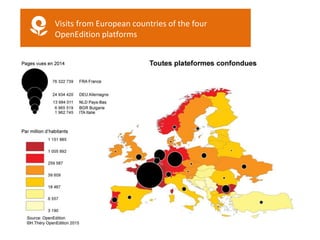
Visits from European countries of the four
OpenEdition platforms
Founded in 1999
400 online journals, 100 000 articles
95 % available in full open access
30 countries of publication represented
Quality criteria and by peers’ selection
Four examples of
journals published in
different countries
Online announcement service in the HSS
Founded in 2000
30 000 event announcements in open access
Calenda home page
• Research blog platform open to all disciplines in HSS
• An innovative and original laboratory for the new forms
of writing
• 1000 blogs run by a community of 1200 bloggers from
different countries
• New functions are regularly implemented to respond to
the needs of academic blogging
• The platform receives more than 1 million visits per
month.
Hypotheses home page
An international and multilingual catalogue
OpenEdition home page
An international and
multilingual catalogue
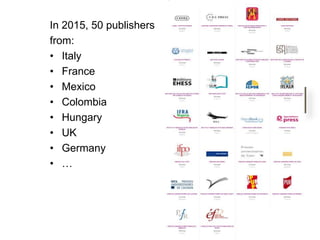
In 2015, 50 publishers
from:
• Italy
• France
• Mexico
• Colombia
• Hungary
• UK
• Germany
• …
Italy
France
Mexico
Peru
Hungary
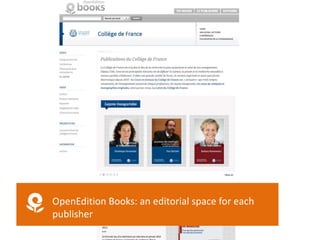
OpenEdition Books: an editorial space for each
publisher
OpenEdition Books: an editorial space for each
publisher
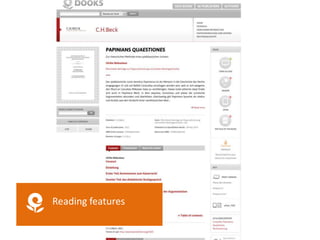
Reading features
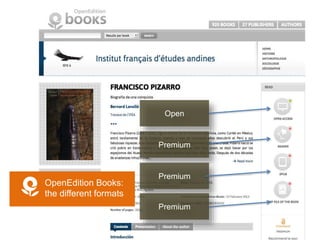
Pdf - ePub - Mobi online reader
Formats
HTML content consultable online
ePubs for tablets and smartphones (MOBI via Amazon)
PDFs of chapters or books available for download
Dissemination features
Open
Premium
Premium
Premium
OpenEdition Books:
the different formats
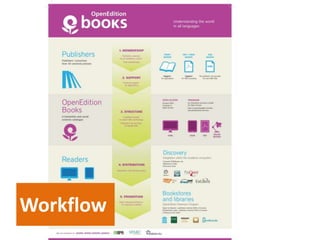
Workflow
INPUT
Publisher Back Office
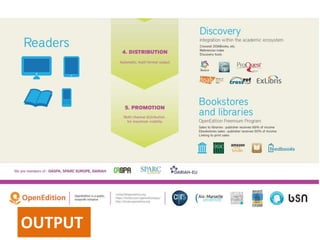
OUTPUT
• Access to digital publishing software designed
for scholarly publications
• Distribution management via an online
interface
• Sophisticated content structuring using XML-
TEI
• Detailed usage statistics
SERVICES : support for digital publishing
• discussion forum to assess and improve the
platform’s services.
• the consortium is open to all publishers who
join OpenEdition Books
A publishers’ consortium
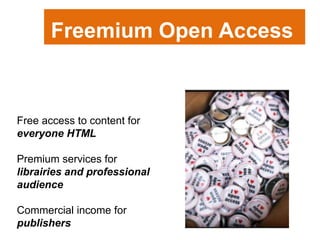
Free access to content for
everyone HTML
Premium services for
librairies and professional
audience
Commercial income for
publishers
Freemium Open Access
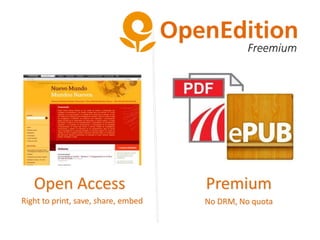
PremiumOpen Access
No DRM, No quotaRight to print, save, share, embed
An Open Access
inclusive dynamic for
every publisher
(fair)
exclusive
gratis
freemium OA Libre OA
Our proposal:
• Free access to content for everybody
• Premium services to generate income for editors
Our partners: libraries an institutions all over the
world
Starting with…
A proposal for University Presses in Germany
• OpenEdition proposes support for digital publishing
• Economic models respecting the publishers commercial
needs and strategies :
a) FREEMIUM OPEN ACCESS (97%)
free, digitization and encoding on OE expenses
b) FULL OPEN ACCESS
%free = offer for University presses, % on payement
OR
c)Trainings
A proposal for University Presses in Germany ?
Trainings
• Training to digital software designed for
sholarly publication
• Content management
• Publisher space management
• Dissemination of books
http://openedition.org
http://leo.hypotheses.org
@openeditionsays
dasa.radovic@openedition.org
Thank you for your attention

OpenEdition Books platform for humanities and social sciences

Editor's Notes

  • #7 OpenEdition annual number of visits in millions: an increasing visibility
  • #8  Worldwide visits of the four OpenEdition platforms Public provient du monde entier La carte présente le nombre des plages lus par million d’habitants L’europr et l’amerique du nord sont des principaux visiteurs Efforts to internationalize the contents the last years
  • #11 Augmentation of the submission requests coming from outside France 2014 – 26% Languages used are enlarged to portuguese and italian
  • #12 Voir : http://calenda.org/about
  • #14 Voir : http://issuu.com/openedition/docs/biface_hypotheses_en_web A variety of uses Hypotheses hosts different types of personal and collaborative blogs : research blogs, fieldwork blogs, seminar blogs, news and development blogs, etc. free training in several languages on how to use Wordpress to write academic blogs. online editorial support tools (Maison des Carnets, Bloghaus, Casa de los blogs).
  • #16 Voir : https://docs.google.com/a/openedition.org/document/d/1JbN6vh-d_UUL3B4A9VDEziIqN3sL1yri6MXxpwmC2HI/edit OpenEdition Books is now home to almost 2,000 titles from 50 publishers in the humanities and social sciences. A total of 16,000 books will be published online by 2020. The platform aims to build an international library while encouraging publishers to develop Open Access in the long term. It is open to publications in all languages and from all fields of research in the humanities and social sciences. Titles available from each publisher are displayed on the individual publisher’s page. Our referencing procedures ensure that titles enjoy maximum visibility on the web. PDFs and ePubs can be purchased by libraries and are on sale from digital bookstores.
  • #17 OpenEdition Books is now home to almost 2,000 titles from 50 publishers in the humanities and social sciences. A total of 16,000 books will be published online by 2020. The platform aims to build an international library while encouraging publishers to develop Open Access in the long term. It is open to publications in all languages and from all fields of research in the humanities and social sciences. Titles available from each publisher are displayed on the individual publisher’s page. Our referencing procedures ensure that titles enjoy maximum visibility on the web. PDFs and ePubs can be purchased by libraries and are on sale from digital bookstores.
  • #32 Call for submissions for the digitisation, encoding and electronic publication of books in the humanities and social sciences OpenEdition, the electronic resource portal, is launching a call for submissions from university presses, private publishers and learned societies publishing high quality books in the humanities and social sciences who wish to distribute a part of their catalogue in Open Access. OpenEdition offers to digitise, then publish and distribute online in Open Access all or part of publishers’ book catalogue on its dedicated platform, OpenEdition Books. The program is run by the Centre for Open Electronic Publishing (Cléo), a non-profit making institution, financed by the French State. It aims to build an international library for the digital humanities, while encouraging publishers to adopt Open Access in the long term. Joining OpenEdition Books means:  Joining the OpenEdition ecosystem, one of the leading European open electronic publishing platforms, which includes the renowned platforms: Revues.org, Calenda and Hypotheses. Together all sites attract almost 3 million visits per month from around the world.  Integration in a platform that will steadily grow to 15,000 books. Our program promotes all cultural domains, through all historical periods in most scientific languages. The ambition of OpenEdition Books is summed up thus: “Understanding the world in every language.”  Taking part in an innovative program that is developing a steadfast economic model for Open Access. The program is known as OpenEdition Freemium, and consists of selling services and products derived on the basis of Open Access work. Open Access books distributed in HTML format, legible in a web browser, can be downloaded in detachable formats (PDF, ePub, Mobi) exclusively for the users of subscriber libraries. Other users can purchase these formats on a unit-by-unit basis at one of over one hundred electronic online libraries (iBookstore, Amazon, etc.).