AN INTRODUCTION TO
Mechanical Waves
Faculty: Information and Computer Technologies
Department: Data AnalyticsData Science
Student: Mahammad Ahmadov
A mechanical wave is a type of wave that transmits energy
through a medium, such as solids, liquids, or gases, by
causing the particles within the medium to oscillate around
a central point.
Technologies like ultrasound use mechanical waves
to create images of the inside of the human body,
being widely used in medicine
What mechanical waves are and why
they mater?
Mechanical Waves in contrast
to Electromagnetic waves
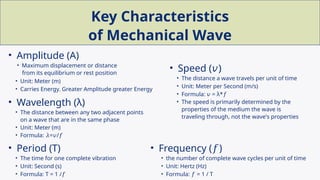
Key Characteristics
of Mechanical Wave
• Amplitude (A)
• Maximum displacement or distance
from its equilibrium or rest position
• Unit: Meter (m)
• Carries Energy. Greater Amplitude greater Energy
• Wavelength (λ)
• The distance between any two adjacent points
on a wave that are in the same phase
• Unit: Meter (m)
• Formula: = /
𝜆 𝑣 𝑓
• Period (T)
• The time for one complete vibration
• Unit: Second (s)
• Formula: T = 1 /𝑓
• Frequency ( )
𝑓
• the number of complete wave cycles per unit of time
• Unit: Hertz (Hz)
• Formula: = 1 / T
𝑓
• Speed ( )
𝑣
• The distance a wave travels per unit of time
• Unit: Meter per Second (m/s)
• Formula: = λ*
𝑣 𝑓
• The speed is primarily determined by the
properties of the medium the wave is
traveling through, not the wave's properties
Transverse Wave
TYPES OF WAVES:
vibrations of particles are
perpendicular to the
direction of travel
direction
of travel
vibration amplitude
wavelength
crest
troug
h
vibrations of particles are
parallel to the direction of
travel
Longitudinal Wave
TYPES OF WAVES:
vibration
rarefaction
compression
direction of travel
• Light waves ripple on a
water surface
• Hand moving up and down
• Sound waves
• Hand moves back and
forth
Transverse Longitudinal
Examples of Waves
Earthquake
Examples of Mechanical
Waves
Water
Sound
Medium Speed of Sound (m/s)
Steel 5000
Water 1480
Air 343
SOUND
Sound has characteristics such as loudness and pitch
• Loudness depends on amplitude. The greater the amplitude, the louder the sound
• Pitch depends on frequency. The sound with higher frequency is more shrill
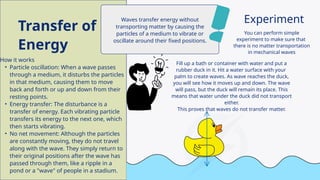
Transfer of
Energy
How it works
• Particle oscillation: When a wave passes
through a medium, it disturbs the particles
in that medium, causing them to move
back and forth or up and down from their
resting points.
• Energy transfer: The disturbance is a
transfer of energy. Each vibrating particle
transfers its energy to the next one, which
then starts vibrating.
• No net movement: Although the particles
are constantly moving, they do not travel
along with the wave. They simply return to
their original positions after the wave has
passed through them, like a ripple in a
pond or a "wave" of people in a stadium.
Waves transfer energy without
transporting matter by causing the
particles of a medium to vibrate or
oscillate around their fixed positions.
Experiment
You can perform simple
experiment to make sure that
there is no matter transportation
in mechanical waves
Fill up a bath or container with water and put a
rubber duck in it. Hit a water surface with your
palm to create waves. As wave reaches the duck,
you will see how it moves up and down. The wave
will pass, but the duck will remain its place. This
means that water under the duck did not transport
either.
This proves that waves do not transfer matter.
Superposition Interference
The superposition principle for mechanical
waves states that when two or more waves
overlap, the total displacement at any point is
the algebraic sum of the individual
displacements of each wave at that point
Interference is a phenomenon where
mechanical waves combine in a medium,
resulting in either a larger wave (constructive
interference) or a smaller wave (destructive
interference) through the principle of
superposition
Resonance
Resonance is a phenomenon
where a mechanical system
vibrates with maximum
amplitude when the frequency
of an external force matches its
natural frequency of vibration
This effect can be
demonstrated by
pushing a child on
a swing in time with
the swing's motion,
causing it to go
higher with each
push
However, it can also cause destructive swaying in
structures like bridges and buildings
The Broughton
Suspension Bridge in
England collapsed in 1831
due to a military march.
Soldiers marching in step
on the bridge created a
rhythmic force that
matched the bridge's
natural frequency, causing
it to vibrate violently and
collapse
Real-World Application of
Mechanical Waves
Medicine SONAR
(Sound Navigation and Ranging)
Entertainmen
t
• Mechanical waves need a medium and carry
energy, not matter.
• Their properties (frequency, wavelength, speed)
define how they move and interact.
• Concepts like interference and resonance
explain many real-world behaviors.
• Mechanical waves are essential in medicine,
engineering, communication, and Earth
science.
• They remain a central topic in physics with
many practical uses.
Key Takeaways
Mechanical waves are not just
theoretical concepts—they are the
foundation of how our world moves,
communicates, and responds to
forces
Reference
https://www.alloprof.qc.ca/en/students/vl/physics/wave-characteristics-p1109
https://www.ebsco.com/research-starters/physics/mechanical-wave
https://teachy.ai/en/summaries/high-school/12th-grade/physics-en
https://www.istockphoto.com/stock-photos
https://laserscientist.com/interference
https://oceanservice.noaa.gov/facts/sonar.html

presentation about mechanical waves for physics

  • 1.
    AN INTRODUCTION TO MechanicalWaves Faculty: Information and Computer Technologies Department: Data AnalyticsData Science Student: Mahammad Ahmadov
  • 2.
    A mechanical waveis a type of wave that transmits energy through a medium, such as solids, liquids, or gases, by causing the particles within the medium to oscillate around a central point. Technologies like ultrasound use mechanical waves to create images of the inside of the human body, being widely used in medicine What mechanical waves are and why they mater?
  • 3.
    Mechanical Waves incontrast to Electromagnetic waves
  • 4.
    Key Characteristics of MechanicalWave • Amplitude (A) • Maximum displacement or distance from its equilibrium or rest position • Unit: Meter (m) • Carries Energy. Greater Amplitude greater Energy • Wavelength (λ) • The distance between any two adjacent points on a wave that are in the same phase • Unit: Meter (m) • Formula: = / 𝜆 𝑣 𝑓 • Period (T) • The time for one complete vibration • Unit: Second (s) • Formula: T = 1 /𝑓 • Frequency ( ) 𝑓 • the number of complete wave cycles per unit of time • Unit: Hertz (Hz) • Formula: = 1 / T 𝑓 • Speed ( ) 𝑣 • The distance a wave travels per unit of time • Unit: Meter per Second (m/s) • Formula: = λ* 𝑣 𝑓 • The speed is primarily determined by the properties of the medium the wave is traveling through, not the wave's properties
  • 5.
    Transverse Wave TYPES OFWAVES: vibrations of particles are perpendicular to the direction of travel direction of travel vibration amplitude wavelength crest troug h
  • 6.
    vibrations of particlesare parallel to the direction of travel Longitudinal Wave TYPES OF WAVES: vibration rarefaction compression direction of travel
  • 7.
    • Light wavesripple on a water surface • Hand moving up and down • Sound waves • Hand moves back and forth Transverse Longitudinal Examples of Waves
  • 8.
  • 9.
    Medium Speed ofSound (m/s) Steel 5000 Water 1480 Air 343 SOUND Sound has characteristics such as loudness and pitch • Loudness depends on amplitude. The greater the amplitude, the louder the sound • Pitch depends on frequency. The sound with higher frequency is more shrill
  • 10.
    Transfer of Energy How itworks • Particle oscillation: When a wave passes through a medium, it disturbs the particles in that medium, causing them to move back and forth or up and down from their resting points. • Energy transfer: The disturbance is a transfer of energy. Each vibrating particle transfers its energy to the next one, which then starts vibrating. • No net movement: Although the particles are constantly moving, they do not travel along with the wave. They simply return to their original positions after the wave has passed through them, like a ripple in a pond or a "wave" of people in a stadium. Waves transfer energy without transporting matter by causing the particles of a medium to vibrate or oscillate around their fixed positions. Experiment You can perform simple experiment to make sure that there is no matter transportation in mechanical waves Fill up a bath or container with water and put a rubber duck in it. Hit a water surface with your palm to create waves. As wave reaches the duck, you will see how it moves up and down. The wave will pass, but the duck will remain its place. This means that water under the duck did not transport either. This proves that waves do not transfer matter.
  • 11.
    Superposition Interference The superpositionprinciple for mechanical waves states that when two or more waves overlap, the total displacement at any point is the algebraic sum of the individual displacements of each wave at that point Interference is a phenomenon where mechanical waves combine in a medium, resulting in either a larger wave (constructive interference) or a smaller wave (destructive interference) through the principle of superposition
  • 12.
    Resonance Resonance is aphenomenon where a mechanical system vibrates with maximum amplitude when the frequency of an external force matches its natural frequency of vibration This effect can be demonstrated by pushing a child on a swing in time with the swing's motion, causing it to go higher with each push However, it can also cause destructive swaying in structures like bridges and buildings The Broughton Suspension Bridge in England collapsed in 1831 due to a military march. Soldiers marching in step on the bridge created a rhythmic force that matched the bridge's natural frequency, causing it to vibrate violently and collapse
  • 13.
    Real-World Application of MechanicalWaves Medicine SONAR (Sound Navigation and Ranging) Entertainmen t
  • 14.
    • Mechanical wavesneed a medium and carry energy, not matter. • Their properties (frequency, wavelength, speed) define how they move and interact. • Concepts like interference and resonance explain many real-world behaviors. • Mechanical waves are essential in medicine, engineering, communication, and Earth science. • They remain a central topic in physics with many practical uses. Key Takeaways Mechanical waves are not just theoretical concepts—they are the foundation of how our world moves, communicates, and responds to forces
  • 15.