







Presented By: MADIHA
RASHID
SPINACH (Spinacia oleracea)
 Family – Chenopodiaceae
NUTRITIONAL IMPORTANCE
 Source of Mg, Mn, Fe, Ca, K, Cu, P, Zn, Se
 Vitamins, protein, antioxidants, fatty acids,
carotenoids, flavonoids & apocyanin
 Whole plant – for remedy of urinary
calculi
 Leaves – bowel, lung inflammation,
febrile affliction & cooling
 Leaf extract – powerful water soluble
natural antioxidants
 Past – agronomic, morphological and
physiological traits – used to characterize
varieties
 Influence of environmental factors or presence
of multiple alleles
 Field testing & evaluation – difficult & time
taking
 Now – biochemical markers to assess the
 SDS-PAGE more simple, valid,
practically reliable and extensively
used
 Seed storage proteins – synthesized
in developing seeds
 Important for seed germination &
seedling growth
 high stability
 independence of ecological
conditions
 used to determine taxonomic and
 considerable progress in genetic improvement
of Spinacia oleracea L.
 but its genetic variability at molecular level has
not been investigated
OBJECTIVE
 assessment of genetic diversity of 25 Spinach
accessions using SDS-PAGE technology &
molecular markers
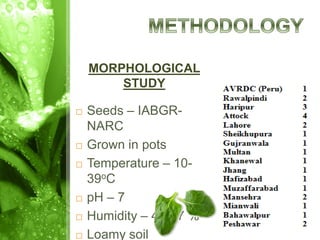
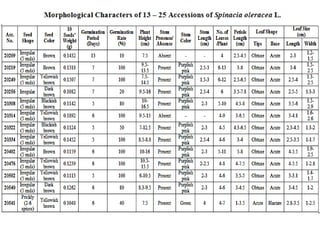
MORPHOLOGICAL
STUDY
 Seeds – IABGR-
NARC
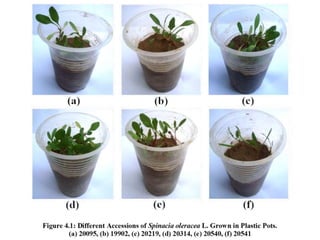
 Grown in pots
 Temperature – 10-
39οC
 pH – 7
 Humidity – 42-67 %
 Loamy soil
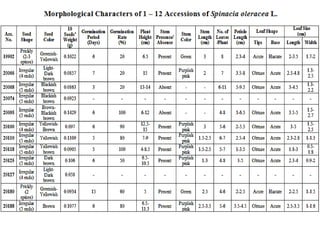
 Seed Shape
 Seed Color
 Seed Weight (10
seeds)
 Germination Rate
 Plant Height
 Stem
(Presence/Absence)
 Stem Length
 Number of
Leaves/Plant
 Petiole Length
 Leaf Tips
 Leaf Base
 Leaf Length
 Leaf Width
 Urea Buffer - 0.5 M tris HCl pH 8.0, 5
M urea, 0.2 % SDS & 1 % 2-
mercaptoethanol in dist. water +
PMSF (protease inhibitor) +
Bromophenol blue
 Ground seeds + extraction buffer
 Boiling – 5 min
 Centrifuge – 15000 rpm
 Supernatant collected
 12 % Resolving Gel – 30 % acrylamide, 1.5 M
tris pH 8.8, 10 % SDS, 10 % APS & TEMED in
distilled water
 Resolving gel in gel plates
 n-butanol poured on it
 Stacking gel – 30 % acrylamide, 1 M tris pH
6.8, 10 % SDS, 10 % APS & TEMED in
distilled water
 Reducing buffer was prepared by
adding tris, glycine & SDS in distilled
water
 Protein extracts & marker in wells
 Reducing buffer & power supply
 Staining solution – methanol, glacial
acetic acid, distilled water &
Commassie Brilliant Blue
(50:10:40:0.3)
 De-staining solution – methanol,
glacial acetic acid & distilled water
RESULTS
MORPHOLOGICAL STUDY
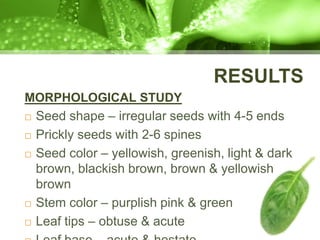
 Seed shape – irregular seeds with 4-5 ends
 Prickly seeds with 2-6 spines
 Seed color – yellowish, greenish, light & dark
brown, blackish brown, brown & yellowish
brown
 Stem color – purplish pink & green
 Leaf tips – obtuse & acute
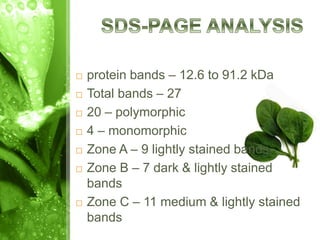
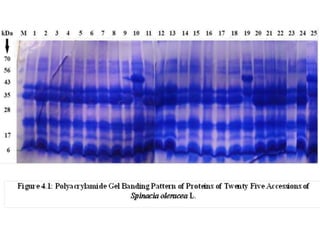
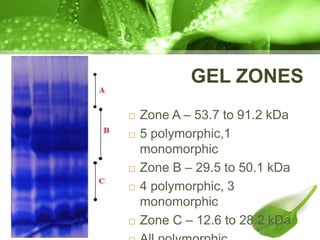
 protein bands – 12.6 to 91.2 kDa
 Total bands – 27
 20 – polymorphic
 4 – monomorphic
 Zone A – 9 lightly stained bands
 Zone B – 7 dark & lightly stained
bands
 Zone C – 11 medium & lightly stained
bands
GEL ZONES
 Zone A – 53.7 to 91.2 kDa
 5 polymorphic,1
monomorphic
 Zone B – 29.5 to 50.1 kDa
 4 polymorphic, 3
monomorphic
 Zone C – 12.6 to 28.2 kDa
RESULTS
 number of band variation in
accessions -10–18
 79.4, 66.1 & 63.1 kDa – in all
accessions
 53.7, 35.5, 33.1 & 29.5 kDa – in
20541
 From Peshawar
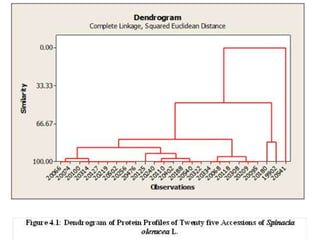
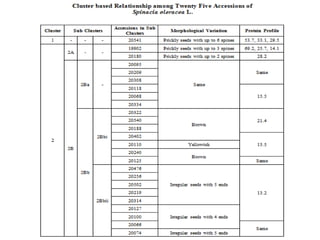
 20541, 19902 & 20180 had significant
genetic differences
 91.2, 85.1, 69.2, 53.7, 50.1, 36.3,
RESULTS
 20541 (Peshawar) had 53.7, 33.1 &
29.5 kDa
 19902 (AVRDC) had 69.2, 25.7 &
14.1
 20180 (Lahore) had 28.2 kDa
DISCUSSION
 Use of morphological and seed
storage protein characters – better
way to explore genetic diversity of
plant genotypes
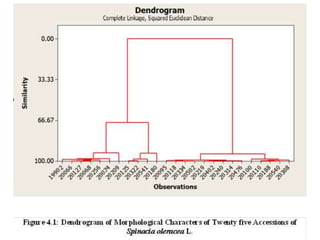
 Variation in morphological characters
is based on genetic variation
 Seed storage proteins – not affected
by environmental fluctuations
 used to characterize the taxonomic
and evolutionary features of different
crops
Protein Profiles vs
Geography
 polymorphism in seed proteins is linked with
the geographical regions
 No linkage was found in case of spinach
 e.g., 20180 & 20188 from Lahore
 20540 & 20541 from Peshawar
 Accessions from local origin had less
variation
 SDS-PAGE – a better technique for genetic
CONCLUSION
 Significant differences exist in
spinach accessions
 Also some minor differences exist
 Genetic differences are directly linked
with morphological differences
 No linkage with geographical
locations was found in case of
spinach accessions
SUGGESTION
 Minor differences found can be studied by
advanced molecular techniques including
2D electrophoresis & DNA markers
 These variations might have certain
concealed capabilities which can be
preserved for future plant breeding
programs
PRESENTATION

PRESENTATION

  • 1.
  • 3.
    SPINACH (Spinacia oleracea) Family – Chenopodiaceae NUTRITIONAL IMPORTANCE  Source of Mg, Mn, Fe, Ca, K, Cu, P, Zn, Se  Vitamins, protein, antioxidants, fatty acids, carotenoids, flavonoids & apocyanin
  • 4.
     Whole plant– for remedy of urinary calculi  Leaves – bowel, lung inflammation, febrile affliction & cooling  Leaf extract – powerful water soluble natural antioxidants
  • 5.
     Past –agronomic, morphological and physiological traits – used to characterize varieties  Influence of environmental factors or presence of multiple alleles  Field testing & evaluation – difficult & time taking  Now – biochemical markers to assess the
  • 6.
     SDS-PAGE moresimple, valid, practically reliable and extensively used  Seed storage proteins – synthesized in developing seeds  Important for seed germination & seedling growth  high stability  independence of ecological conditions  used to determine taxonomic and
  • 7.
     considerable progressin genetic improvement of Spinacia oleracea L.  but its genetic variability at molecular level has not been investigated OBJECTIVE  assessment of genetic diversity of 25 Spinach accessions using SDS-PAGE technology & molecular markers
  • 8.
    MORPHOLOGICAL STUDY  Seeds –IABGR- NARC  Grown in pots  Temperature – 10- 39οC  pH – 7  Humidity – 42-67 %  Loamy soil
  • 9.
     Seed Shape Seed Color  Seed Weight (10 seeds)  Germination Rate  Plant Height  Stem (Presence/Absence)  Stem Length  Number of Leaves/Plant  Petiole Length  Leaf Tips  Leaf Base  Leaf Length  Leaf Width
  • 10.
     Urea Buffer- 0.5 M tris HCl pH 8.0, 5 M urea, 0.2 % SDS & 1 % 2- mercaptoethanol in dist. water + PMSF (protease inhibitor) + Bromophenol blue  Ground seeds + extraction buffer  Boiling – 5 min  Centrifuge – 15000 rpm  Supernatant collected
  • 11.
     12 %Resolving Gel – 30 % acrylamide, 1.5 M tris pH 8.8, 10 % SDS, 10 % APS & TEMED in distilled water  Resolving gel in gel plates  n-butanol poured on it  Stacking gel – 30 % acrylamide, 1 M tris pH 6.8, 10 % SDS, 10 % APS & TEMED in distilled water
  • 12.
     Reducing bufferwas prepared by adding tris, glycine & SDS in distilled water  Protein extracts & marker in wells  Reducing buffer & power supply  Staining solution – methanol, glacial acetic acid, distilled water & Commassie Brilliant Blue (50:10:40:0.3)  De-staining solution – methanol, glacial acetic acid & distilled water
  • 14.
    RESULTS MORPHOLOGICAL STUDY  Seedshape – irregular seeds with 4-5 ends  Prickly seeds with 2-6 spines  Seed color – yellowish, greenish, light & dark brown, blackish brown, brown & yellowish brown  Stem color – purplish pink & green  Leaf tips – obtuse & acute
  • 18.
     protein bands– 12.6 to 91.2 kDa  Total bands – 27  20 – polymorphic  4 – monomorphic  Zone A – 9 lightly stained bands  Zone B – 7 dark & lightly stained bands  Zone C – 11 medium & lightly stained bands
  • 20.
    GEL ZONES  ZoneA – 53.7 to 91.2 kDa  5 polymorphic,1 monomorphic  Zone B – 29.5 to 50.1 kDa  4 polymorphic, 3 monomorphic  Zone C – 12.6 to 28.2 kDa
  • 21.
    RESULTS  number ofband variation in accessions -10–18  79.4, 66.1 & 63.1 kDa – in all accessions  53.7, 35.5, 33.1 & 29.5 kDa – in 20541  From Peshawar  20541, 19902 & 20180 had significant genetic differences  91.2, 85.1, 69.2, 53.7, 50.1, 36.3,
  • 22.
    RESULTS  20541 (Peshawar)had 53.7, 33.1 & 29.5 kDa  19902 (AVRDC) had 69.2, 25.7 & 14.1  20180 (Lahore) had 28.2 kDa
  • 24.
    DISCUSSION  Use ofmorphological and seed storage protein characters – better way to explore genetic diversity of plant genotypes  Variation in morphological characters is based on genetic variation  Seed storage proteins – not affected by environmental fluctuations  used to characterize the taxonomic and evolutionary features of different crops
  • 25.
    Protein Profiles vs Geography polymorphism in seed proteins is linked with the geographical regions  No linkage was found in case of spinach  e.g., 20180 & 20188 from Lahore  20540 & 20541 from Peshawar  Accessions from local origin had less variation  SDS-PAGE – a better technique for genetic
  • 27.
    CONCLUSION  Significant differencesexist in spinach accessions  Also some minor differences exist  Genetic differences are directly linked with morphological differences  No linkage with geographical locations was found in case of spinach accessions
  • 28.
    SUGGESTION  Minor differencesfound can be studied by advanced molecular techniques including 2D electrophoresis & DNA markers  These variations might have certain concealed capabilities which can be preserved for future plant breeding programs

Editor's Notes

  • #5 Urinary calculi – Kidney stone, bowel – intestine part, febrile – related to epilepsy
  • #9 Agri-biotechnology and Genetic Resources (IABGR), National Agriculture Research Center (NARC), Islamabad AVRDC world vegetable center – asian vegetable research development center
  • #11 PMSF - phenylmethylsulfonyl fluoride
  • #12 TEMED - Tetramethylethylenediamine
  • #13 Maker with 11 bands.