Beyond Optimal City Size 
An Evaluation of Alternative Urban Growth Patterns 
Gobardhan Banskota 
Nepal Engineering College 
Centre for Postgraduate Studies(nec-CPS) 
MSc in Transportation Engineering and 
Management 
1 Planning Studio 12/11/14
Presentation Outline 
 Introduction: 
 Definition: 
 Abstract: 
 Evaluation System: 
 Conclusion: 
2 Planning Studio 12/11/14
Introduction 
 Research by Roberta Capello and Roberto Camagni 
 Paper first received, January 1999; final form, 
August 1999 
 Size of optimal city: one single size or infinite sizes 
 The model is applied to 58 Italian cities. 
3 Planning Studio 12/11/14
Abstract 
 The aim of the paper is to present a critical view of 
theoretical works on city size. 
 Begins with the consideration that, during the 1960s and 
1970s, the question of optimal city size tended to be 
expressed in a misleading way. 
 The real issue is not ‘optimal city size’ but ‘efficient size’ 
4 Planning Studio 12/11/14
Abstract contd… 
 depends on the functional characteristics of the city and on 
the spatial organisation within the urban 
 will vary from city to city, from society to society 
 to identify the main theories which replace the limits of the 
neoclassical approach 
*neoclassical=focusing on the determination of prices, outputs, and income distributions in markets through 
supply and demand 
5 Planning Studio 12/11/14
Major issues 
 The debate on ‘optimal’ city size: one single size or infinite 
sizes? 
> Since the 1960s, urban economists and geographers focused on the 
problem of the optimal city size 
> The optimal condition for the entire population of the system, urban 
and not urban, is reached when urban marginal costs equal marginal 
benefits (to size increase). 
* 
6 Planning Studio 12/11/14
The determinants of urban size 
1. Traditional approaches 
2. Unconventional approaches 
7 Planning Studio 12/11/14
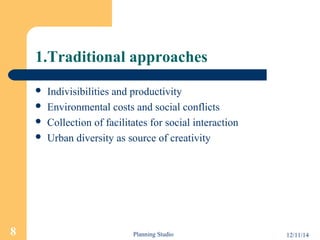
1.Traditional approaches 
 Indivisibilities and productivity 
 Environmental costs and social conflicts 
 Collection of facilitates for social interaction 
 Urban diversity as source of creativity 
8 Planning Studio 12/11/14
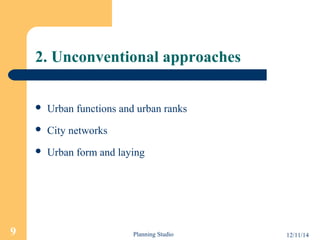
2. Unconventional approaches 
 Urban functions and urban ranks 
 City networks 
 Urban form and laying 
9 Planning Studio 12/11/14
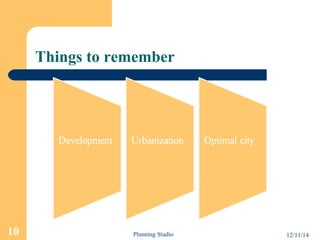
Things to remember 
10 Planning Studio 12/11/14
Purpose/function 
11 Planning Studio 12/11/14
12 Planning Studio 12/11/14
13 Planning Studio 12/11/14
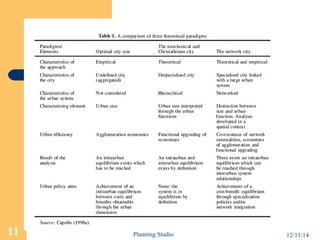
Evaluation 
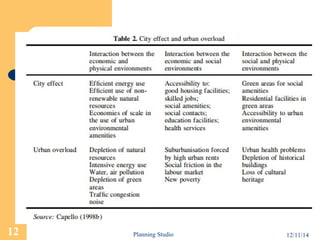
 Rational formula is widely used to evaluate The 
Measurement of the City Effect and the Urban Overload 
 The results have regard to the size elasticity of the city effect 
and the urban overload, calculated in three circumstances: 
I. for different levels of urban size; 
II. for different types of function; 
III. for different levels of network integration. 
14 Planning Studio 12/11/14
15 Planning Studio 12/11/14

Presentation on An Evaluation of Alternative Urban Growth Patterns

  • 1.
    Beyond Optimal CitySize An Evaluation of Alternative Urban Growth Patterns Gobardhan Banskota Nepal Engineering College Centre for Postgraduate Studies(nec-CPS) MSc in Transportation Engineering and Management 1 Planning Studio 12/11/14
  • 2.
    Presentation Outline Introduction:  Definition:  Abstract:  Evaluation System:  Conclusion: 2 Planning Studio 12/11/14
  • 3.
    Introduction  Researchby Roberta Capello and Roberto Camagni  Paper first received, January 1999; final form, August 1999  Size of optimal city: one single size or infinite sizes  The model is applied to 58 Italian cities. 3 Planning Studio 12/11/14
  • 4.
    Abstract  Theaim of the paper is to present a critical view of theoretical works on city size.  Begins with the consideration that, during the 1960s and 1970s, the question of optimal city size tended to be expressed in a misleading way.  The real issue is not ‘optimal city size’ but ‘efficient size’ 4 Planning Studio 12/11/14
  • 5.
    Abstract contd… depends on the functional characteristics of the city and on the spatial organisation within the urban  will vary from city to city, from society to society  to identify the main theories which replace the limits of the neoclassical approach *neoclassical=focusing on the determination of prices, outputs, and income distributions in markets through supply and demand 5 Planning Studio 12/11/14
  • 6.
    Major issues The debate on ‘optimal’ city size: one single size or infinite sizes? > Since the 1960s, urban economists and geographers focused on the problem of the optimal city size > The optimal condition for the entire population of the system, urban and not urban, is reached when urban marginal costs equal marginal benefits (to size increase). * 6 Planning Studio 12/11/14
  • 7.
    The determinants ofurban size 1. Traditional approaches 2. Unconventional approaches 7 Planning Studio 12/11/14
  • 8.
    1.Traditional approaches Indivisibilities and productivity  Environmental costs and social conflicts  Collection of facilitates for social interaction  Urban diversity as source of creativity 8 Planning Studio 12/11/14
  • 9.
    2. Unconventional approaches  Urban functions and urban ranks  City networks  Urban form and laying 9 Planning Studio 12/11/14
  • 10.
    Things to remember 10 Planning Studio 12/11/14
  • 11.
  • 12.
  • 13.
  • 14.
    Evaluation  Rationalformula is widely used to evaluate The Measurement of the City Effect and the Urban Overload  The results have regard to the size elasticity of the city effect and the urban overload, calculated in three circumstances: I. for different levels of urban size; II. for different types of function; III. for different levels of network integration. 14 Planning Studio 12/11/14
  • 15.