Gender Difference in
Brand Commitment,
Impulse Buying,
and Hedonic Consumption
Instructor: Dr. Pi-Ying Hsu
Presenter: Hsuan, Lin
Date: April 21, 2014
Citation
Sigal, T., & Ram, H.(2012). Gender differences in brand
commitment, impulse buying, and hedonic consumption.
Product & Brand Management21/(3), 176-182.
2
Contents
 Introduction
 Literature Review
 Methodology
 Results & Discussions
 Suggestions
3
Introduction
Introduction
Background
Literature Review
Gap
Purpose of Study
Value
4
Introduction
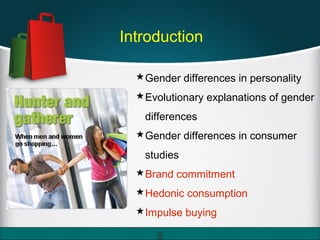
Gender differences in personality
Evolutionary explanations of gender
differences
Gender differences in consumer
studies
Brand commitment
Hedonic consumption
Impulse buying
5
Background
Gender is one of the most common segmentation criteria
used by marketers. This makes sense, given that the male-
female divide is “easy to identify, easy to access, and large
enough to be profitable”
(Putrevu, 2001, p. 1)
6
Literature Review
 Brand Commitment
Brand commitment is highly associated with brand
loyalty (Kim et al., 2008); some argue that it is a
necessary and sufficient condition for brand loyalty
(e.g. Knox and Walker, 2001).
7
Literature Review
 Hedonic Consumption
Hedonic consumption also has indirect effects on well-
being, by improving consumers’ satisfaction within
relevant life domains
(Zhong and Mitchell, 2010)
8
Literature Review
 Impulse Buying
Consumers report that they feel better after an
impulsive purchase (Rook, 1987), even experiencing a
sense of being rewarded
(Hausman, 2000)
9
Gap
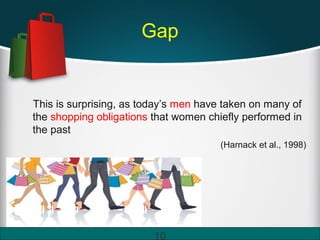
This is surprising, as today’s men have taken on many of
the shopping obligations that women chiefly performed in
the past
(Harnack et al., 1998)
10
Purpose of Study
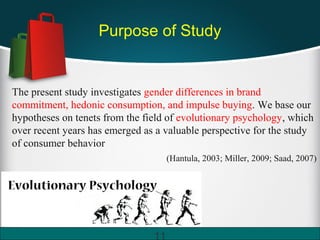
The present study investigates gender differences in brand
commitment, hedonic consumption, and impulse buying. We base our
hypotheses on tenets from the field of evolutionary psychology, which
over recent years has emerged as a valuable perspective for the study
of consumer behavior
(Hantula, 2003; Miller, 2009; Saad, 2007)
11
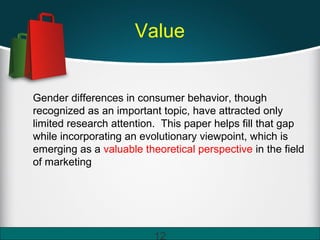
Value
Gender differences in consumer behavior, though
recognized as an important topic, have attracted only
limited research attention. This paper helps fill that gap
while incorporating an evolutionary viewpoint, which is
emerging as a valuable theoretical perspective in the field
of marketing
12
Literature Review
►Research Framework
►Gender difference in personality
►Evolutionary explanation of gender difference
►Gender difference in consumer studies
►Hypotheses
13
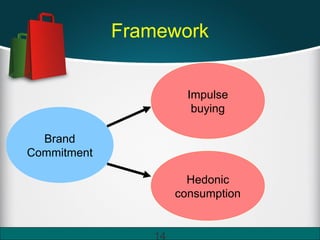
Brand
Commitment
Hedonic
consumption
Impulse
buying
Framework
14
Gender difference in personality
In a large study of 26 cultures with 23,000
participants, women scored higher on neuroticism,
agreeableness and warmth, while men scored higher
on assertiveness
(Costa et al., 2001)
15
Evolutionary explanation of gender difference
16
In such societies, the women gather fruits, tubers, and
other edible resources in groups, on a daily basis. Men,
on the other hand, hunt in groups approximately once a
week, returning to the tribe with meat that is usually
divided equally between all tribe families
(Marlowe, 2007)
Gender difference in consumer studies
17
Women put more time and effort into shopping for
Christmas presents than men (Fischer and Arnold, 1990),
and enjoy shopping in general more than men do (Rook
and Hoch, 1985).
Brand Commitment
A tendency toward risk taking, on the other hand, would
have benefited ancestral men as they engaged in the
competition for resources and mates
(Wilson and Daly, 1985)
Hypotheses1:
Women will report higher levels of brand commitment in
comparison to men.
18
Hedonic Consumption
In fact, women report enjoying shopping more than men
and are more likely to view it as a recreational pastime
(Kruger and Byker, 2009)
Hypotheses 2:
Women will report higher levels of hedonic consumption in
comparison to men
19
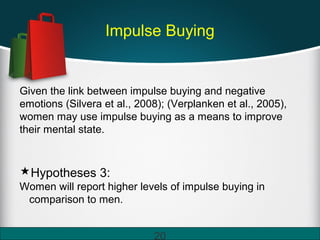
Impulse Buying
Given the link between impulse buying and negative
emotions (Silvera et al., 2008); (Verplanken et al., 2005),
women may use impulse buying as a means to improve
their mental state.
Hypotheses 3:
Women will report higher levels of impulse buying in
comparison to men.
20
Methodology
►Participants & Place
►Questions
21
Methodology
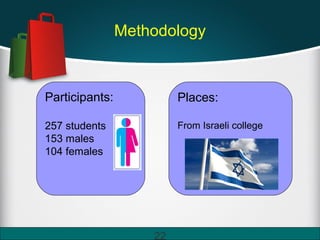
Participants:
257 students
153 males
104 females
Places:
From Israeli college
22
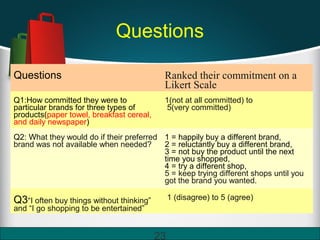
Questions
Questions Ranked their commitment on a
Likert Scale
Q1:How committed they were to
particular brands for three types of
products(paper towel, breakfast cereal,
and daily newspaper)
1(not at all committed) to
5(very committed)
Q2: What they would do if their preferred
brand was not available when needed?
1 = happily buy a different brand,
2 = reluctantly buy a different brand,
3 = not buy the product until the next
time you shopped,
4 = try a different shop,
5 = keep trying different shops until you
got the brand you wanted.
Q3“I often buy things without thinking”
and “I go shopping to be entertained”
1 (disagree) to 5 (agree)
23
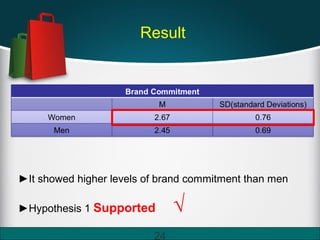
►It showed higher levels of brand commitment than men
Result
►Hypothesis 1 Supported √
24
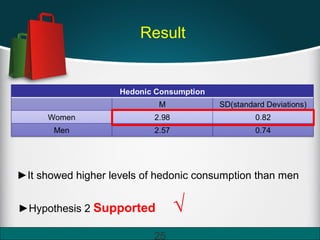
►It showed higher levels of hedonic consumption than men
Result
►Hypothesis 2 Supported √
25
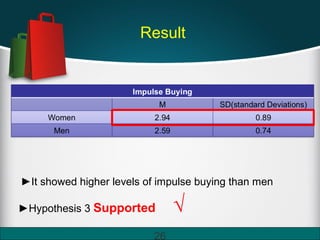
►It showed higher levels of impulse buying than men
Result
►Hypothesis 3 Supported √
26
Discussion
• The study results showed that in comparison to men,
women had higher levels of brand commitment, hedonic
consumption, and impulse buying.
27
Limitations of Study
 Israel is a fairly westernized nation with a thriving
consumer culture. Less relevant to other settings, such
as less consumer-oriented cultures, or other groups of
participants, such as older shoppers.
 Women are more likely to engage in impulse buying.
28
26
Suggestions
►Could investigate different culture participants and also
different ages.
►The number of participants should be equal.
Thank you

Presentation

  • 1.
    Gender Difference in BrandCommitment, Impulse Buying, and Hedonic Consumption Instructor: Dr. Pi-Ying Hsu Presenter: Hsuan, Lin Date: April 21, 2014
  • 2.
    Citation Sigal, T., &Ram, H.(2012). Gender differences in brand commitment, impulse buying, and hedonic consumption. Product & Brand Management21/(3), 176-182. 2
  • 3.
    Contents  Introduction  LiteratureReview  Methodology  Results & Discussions  Suggestions 3
  • 4.
  • 5.
    Introduction Gender differences inpersonality Evolutionary explanations of gender differences Gender differences in consumer studies Brand commitment Hedonic consumption Impulse buying 5
  • 6.
    Background Gender is oneof the most common segmentation criteria used by marketers. This makes sense, given that the male- female divide is “easy to identify, easy to access, and large enough to be profitable” (Putrevu, 2001, p. 1) 6
  • 7.
    Literature Review  BrandCommitment Brand commitment is highly associated with brand loyalty (Kim et al., 2008); some argue that it is a necessary and sufficient condition for brand loyalty (e.g. Knox and Walker, 2001). 7
  • 8.
    Literature Review  HedonicConsumption Hedonic consumption also has indirect effects on well- being, by improving consumers’ satisfaction within relevant life domains (Zhong and Mitchell, 2010) 8
  • 9.
    Literature Review  ImpulseBuying Consumers report that they feel better after an impulsive purchase (Rook, 1987), even experiencing a sense of being rewarded (Hausman, 2000) 9
  • 10.
    Gap This is surprising,as today’s men have taken on many of the shopping obligations that women chiefly performed in the past (Harnack et al., 1998) 10
  • 11.
    Purpose of Study Thepresent study investigates gender differences in brand commitment, hedonic consumption, and impulse buying. We base our hypotheses on tenets from the field of evolutionary psychology, which over recent years has emerged as a valuable perspective for the study of consumer behavior (Hantula, 2003; Miller, 2009; Saad, 2007) 11
  • 12.
    Value Gender differences inconsumer behavior, though recognized as an important topic, have attracted only limited research attention. This paper helps fill that gap while incorporating an evolutionary viewpoint, which is emerging as a valuable theoretical perspective in the field of marketing 12
  • 13.
    Literature Review ►Research Framework ►Genderdifference in personality ►Evolutionary explanation of gender difference ►Gender difference in consumer studies ►Hypotheses 13
  • 14.
  • 15.
    Gender difference inpersonality In a large study of 26 cultures with 23,000 participants, women scored higher on neuroticism, agreeableness and warmth, while men scored higher on assertiveness (Costa et al., 2001) 15
  • 16.
    Evolutionary explanation ofgender difference 16 In such societies, the women gather fruits, tubers, and other edible resources in groups, on a daily basis. Men, on the other hand, hunt in groups approximately once a week, returning to the tribe with meat that is usually divided equally between all tribe families (Marlowe, 2007)
  • 17.
    Gender difference inconsumer studies 17 Women put more time and effort into shopping for Christmas presents than men (Fischer and Arnold, 1990), and enjoy shopping in general more than men do (Rook and Hoch, 1985).
  • 18.
    Brand Commitment A tendencytoward risk taking, on the other hand, would have benefited ancestral men as they engaged in the competition for resources and mates (Wilson and Daly, 1985) Hypotheses1: Women will report higher levels of brand commitment in comparison to men. 18
  • 19.
    Hedonic Consumption In fact,women report enjoying shopping more than men and are more likely to view it as a recreational pastime (Kruger and Byker, 2009) Hypotheses 2: Women will report higher levels of hedonic consumption in comparison to men 19
  • 20.
    Impulse Buying Given thelink between impulse buying and negative emotions (Silvera et al., 2008); (Verplanken et al., 2005), women may use impulse buying as a means to improve their mental state. Hypotheses 3: Women will report higher levels of impulse buying in comparison to men. 20
  • 21.
  • 22.
    Methodology Participants: 257 students 153 males 104females Places: From Israeli college 22
  • 23.
    Questions Questions Ranked theircommitment on a Likert Scale Q1:How committed they were to particular brands for three types of products(paper towel, breakfast cereal, and daily newspaper) 1(not at all committed) to 5(very committed) Q2: What they would do if their preferred brand was not available when needed? 1 = happily buy a different brand, 2 = reluctantly buy a different brand, 3 = not buy the product until the next time you shopped, 4 = try a different shop, 5 = keep trying different shops until you got the brand you wanted. Q3“I often buy things without thinking” and “I go shopping to be entertained” 1 (disagree) to 5 (agree) 23
  • 24.
    ►It showed higherlevels of brand commitment than men Result ►Hypothesis 1 Supported √ 24
  • 25.
    ►It showed higherlevels of hedonic consumption than men Result ►Hypothesis 2 Supported √ 25
  • 26.
    ►It showed higherlevels of impulse buying than men Result ►Hypothesis 3 Supported √ 26
  • 27.
    Discussion • The studyresults showed that in comparison to men, women had higher levels of brand commitment, hedonic consumption, and impulse buying. 27
  • 28.
    Limitations of Study Israel is a fairly westernized nation with a thriving consumer culture. Less relevant to other settings, such as less consumer-oriented cultures, or other groups of participants, such as older shoppers.  Women are more likely to engage in impulse buying. 28
  • 29.
    26 Suggestions ►Could investigate differentculture participants and also different ages. ►The number of participants should be equal.
  • 30.