Performance prediction:  preliminary research for manned missions to Mars Stefan kennedie  [kennedie[at]gmail.com]
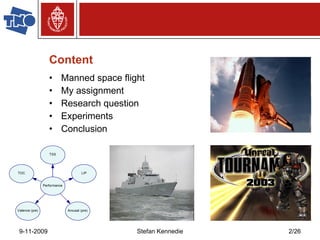
Content Manned space flight My assignment Research question Experiments Conclusion
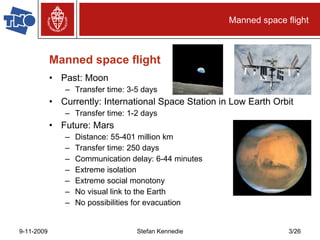
Manned space flight Past: Moon Transfer time: 3-5 days Currently: International Space Station in Low Earth Orbit Transfer time: 1-2 days Future: Mars Distance: 55-401 million km  Transfer time: 250 days Communication delay: 6-44 minutes Extreme isolation Extreme social monotony No visual link to the Earth No possibilities for evacuation Manned space flight
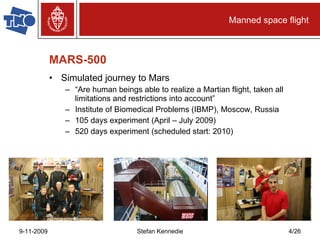
MARS-500 Simulated journey to Mars “ Are human beings able to realize a Martian flight, taken all limitations and restrictions into account” Institute of Biomedical Problems (IBMP), Moscow, Russia 105 days experiment (April – July 2009) 520 days experiment (scheduled start: 2010) Manned space flight
MECA consortium Mission Execution Crew Assistant Martian crew has to rely on an artificial life system during their voyage to Mars in order to survive “ supports humans and machines to act in a distributed, autonomous but cooperative way” Predicting performance Manned space flight
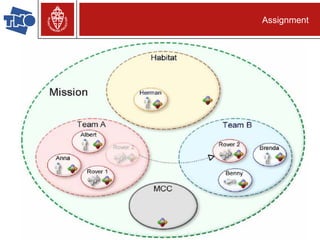
Assignment
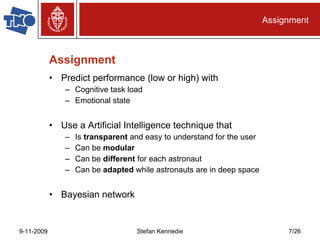
Assignment Predict performance (low or high) with Cognitive task load Emotional state Use a Artificial Intelligence technique that Is  transparent  and easy to understand for the user Can be  modular Can be  different  for each astronaut Can be  adapted  while astronauts are in deep space Bayesian network Assignment
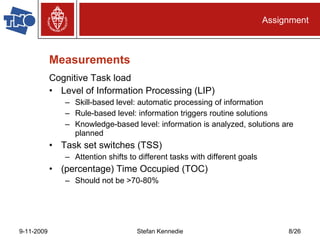
Measurements Cognitive Task load Level of Information Processing (LIP) Skill-based level: automatic processing of information Rule-based level: information triggers routine solutions Knowledge-based level: information is analyzed, solutions are planned Task set switches (TSS) Attention shifts to different tasks with different goals (percentage) Time Occupied (TOC) Should not be >70-80% Assignment
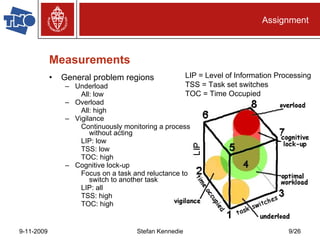
Measurements General problem regions Underload All: low Overload All: high Vigilance Continuously monitoring a process without acting LIP: low  TSS: low TOC: high Cognitive lock-up Focus on a task and reluctance to switch to another task LIP: all TSS: high TOC: high Assignment LIP = Level of Information Processing TSS = Task set switches TOC = Time Occupied
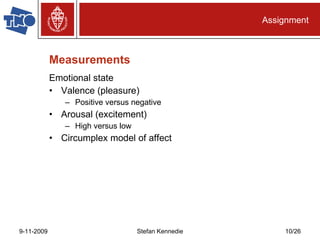
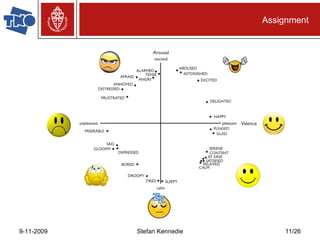
Measurements Emotional state Valence (pleasure) Positive versus negative Arousal (excitement) High versus low Circumplex model of affect Assignment
Assignment
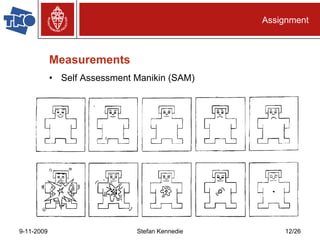
Measurements Self Assessment Manikin (SAM) Assignment
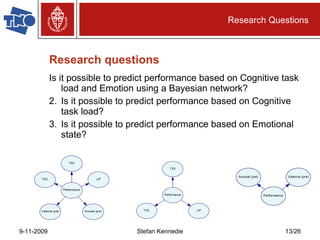
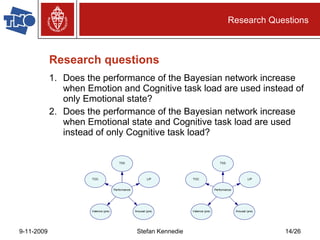
Research questions Is it possible to predict performance based on Cognitive task load and Emotion using a Bayesian network? Is it possible to predict performance based on Cognitive task load? Is it possible to predict performance based on Emotional state? Research Questions
Research questions Does the performance of the Bayesian network increase when Emotion and Cognitive task load are used instead of only Emotional state? Does the performance of the Bayesian network increase when Emotional state and Cognitive task load are used instead of only Cognitive task load? Research Questions
Experiments Generating datasets with: Performance and Cognitive task load Marc Grootjen’s naval operators experiment (Lab & Ship) Research sub question 1 Performance and Emotion Paul Merkx’ First person shooter emotion experiment Research sub question 2 Performance, Cognitive task load and emotion MECA’s Collaborative trainer experiment Main research question, sub question 3 and 4 Experiments
Cognitive Task Load Lab experiment 12 students had to deal with alarms during platform supervision, damage control and navigation tasks 1407 cases with data for LIP, TSS, TOC and Performance 60 sec with an overlap of 50 sec All 8 of 8 networks performed significantly better than chance level (50%) Performance of best performing network: 84.8% Experiments
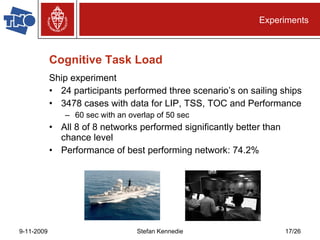
Cognitive Task Load Ship experiment 24 participants performed three scenario’s on sailing ships 3478 cases with data for LIP, TSS, TOC and Performance 60 sec with an overlap of 50 sec All 8 of 8 networks performed significantly better than chance level Performance of best performing network: 74.2% Experiments
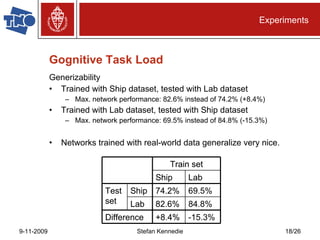
Gognitive Task Load Generizability Trained with Ship dataset, tested with Lab dataset Max. network performance: 82.6% instead of 74.2% (+8.4%) Trained with Lab dataset, tested with Ship dataset Max. network performance: 69.5% instead of 84.8% (-15.3%) Networks trained with real-world data generalize very nice. Experiments +8.4% Difference 82.6% Lab 74.2% Ship Test set Lab Ship Train set -15.3% +8.4% Difference 84.8% 82.6% Lab 69.5% 74.2% Ship Test set Lab Ship Train set
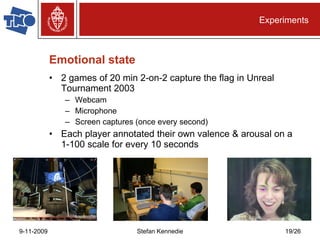
Emotional state 2 games of 20 min 2-on-2 capture the flag in Unreal Tournament 2003 Webcam Microphone Screen captures (once every second) Each player annotated their own valence & arousal on a  1-100 scale for every 10 seconds Experiments
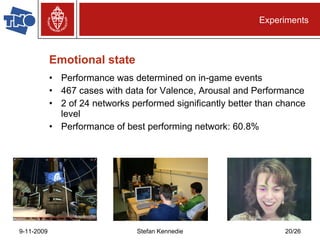
Emotional state Performance was determined on in-game events 467 cases with data for Valence, Arousal and Performance 2 of 24 networks performed significantly better than chance level Performance of best performing network: 60.8% Experiments
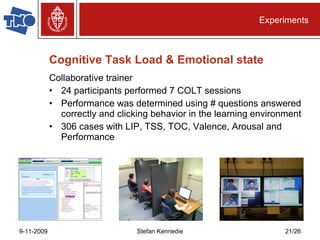
Cognitive Task Load & Emotional state Collaborative trainer 24 participants performed 7 COLT sessions Performance was determined using # questions answered correctly and clicking behavior in the learning environment 306 cases with LIP, TSS, TOC, Valence, Arousal and Performance Experiments
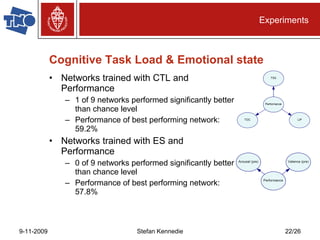
Cognitive Task Load & Emotional state Networks trained with CTL and Performance 1 of 9 networks performed significantly better than chance level Performance of best performing network: 59.2% Networks trained with ES and Performance 0 of 9 networks performed significantly better than chance level Performance of best performing network: 57.8% Experiments
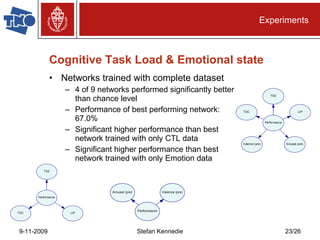
Cognitive Task Load & Emotional state Networks trained with complete dataset 4 of 9 networks performed significantly better than chance level Performance of best performing network: 67.0% Significant higher performance than best network trained with only CTL data Significant higher performance than best network trained with only Emotion data Experiments
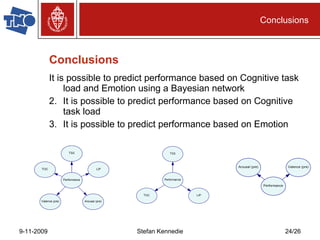
Conclusions It is possible to predict performance based on Cognitive task load and Emotion using a Bayesian network It is possible to predict performance based on Cognitive task load It is possible to predict performance based on Emotion Conclusions
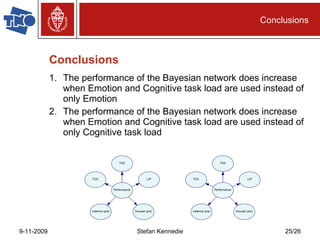
Conclusions The performance of the Bayesian network does increase when Emotion and Cognitive task load are used instead of only Emotion The performance of the Bayesian network does increase when Emotion and Cognitive task load are used instead of only Cognitive task load Conclusions
Bayesian networks can be used to predict performance using Cognitive task load and Emotional state, however, more research is needed for applying them in the space domain.

Master Thesis

  • 1.
    Performance prediction: preliminary research for manned missions to Mars Stefan kennedie [kennedie[at]gmail.com]
  • 2.
    Content Manned spaceflight My assignment Research question Experiments Conclusion
  • 3.
    Manned space flightPast: Moon Transfer time: 3-5 days Currently: International Space Station in Low Earth Orbit Transfer time: 1-2 days Future: Mars Distance: 55-401 million km Transfer time: 250 days Communication delay: 6-44 minutes Extreme isolation Extreme social monotony No visual link to the Earth No possibilities for evacuation Manned space flight
  • 4.
    MARS-500 Simulated journeyto Mars “ Are human beings able to realize a Martian flight, taken all limitations and restrictions into account” Institute of Biomedical Problems (IBMP), Moscow, Russia 105 days experiment (April – July 2009) 520 days experiment (scheduled start: 2010) Manned space flight
  • 5.
    MECA consortium MissionExecution Crew Assistant Martian crew has to rely on an artificial life system during their voyage to Mars in order to survive “ supports humans and machines to act in a distributed, autonomous but cooperative way” Predicting performance Manned space flight
  • 6.
  • 7.
    Assignment Predict performance(low or high) with Cognitive task load Emotional state Use a Artificial Intelligence technique that Is transparent and easy to understand for the user Can be modular Can be different for each astronaut Can be adapted while astronauts are in deep space Bayesian network Assignment
  • 8.
    Measurements Cognitive Taskload Level of Information Processing (LIP) Skill-based level: automatic processing of information Rule-based level: information triggers routine solutions Knowledge-based level: information is analyzed, solutions are planned Task set switches (TSS) Attention shifts to different tasks with different goals (percentage) Time Occupied (TOC) Should not be >70-80% Assignment
  • 9.
    Measurements General problemregions Underload All: low Overload All: high Vigilance Continuously monitoring a process without acting LIP: low TSS: low TOC: high Cognitive lock-up Focus on a task and reluctance to switch to another task LIP: all TSS: high TOC: high Assignment LIP = Level of Information Processing TSS = Task set switches TOC = Time Occupied
  • 10.
    Measurements Emotional stateValence (pleasure) Positive versus negative Arousal (excitement) High versus low Circumplex model of affect Assignment
  • 11.
  • 12.
    Measurements Self AssessmentManikin (SAM) Assignment
  • 13.
    Research questions Isit possible to predict performance based on Cognitive task load and Emotion using a Bayesian network? Is it possible to predict performance based on Cognitive task load? Is it possible to predict performance based on Emotional state? Research Questions
  • 14.
    Research questions Doesthe performance of the Bayesian network increase when Emotion and Cognitive task load are used instead of only Emotional state? Does the performance of the Bayesian network increase when Emotional state and Cognitive task load are used instead of only Cognitive task load? Research Questions
  • 15.
    Experiments Generating datasetswith: Performance and Cognitive task load Marc Grootjen’s naval operators experiment (Lab & Ship) Research sub question 1 Performance and Emotion Paul Merkx’ First person shooter emotion experiment Research sub question 2 Performance, Cognitive task load and emotion MECA’s Collaborative trainer experiment Main research question, sub question 3 and 4 Experiments
  • 16.
    Cognitive Task LoadLab experiment 12 students had to deal with alarms during platform supervision, damage control and navigation tasks 1407 cases with data for LIP, TSS, TOC and Performance 60 sec with an overlap of 50 sec All 8 of 8 networks performed significantly better than chance level (50%) Performance of best performing network: 84.8% Experiments
  • 17.
    Cognitive Task LoadShip experiment 24 participants performed three scenario’s on sailing ships 3478 cases with data for LIP, TSS, TOC and Performance 60 sec with an overlap of 50 sec All 8 of 8 networks performed significantly better than chance level Performance of best performing network: 74.2% Experiments
  • 18.
    Gognitive Task LoadGenerizability Trained with Ship dataset, tested with Lab dataset Max. network performance: 82.6% instead of 74.2% (+8.4%) Trained with Lab dataset, tested with Ship dataset Max. network performance: 69.5% instead of 84.8% (-15.3%) Networks trained with real-world data generalize very nice. Experiments +8.4% Difference 82.6% Lab 74.2% Ship Test set Lab Ship Train set -15.3% +8.4% Difference 84.8% 82.6% Lab 69.5% 74.2% Ship Test set Lab Ship Train set
  • 19.
    Emotional state 2games of 20 min 2-on-2 capture the flag in Unreal Tournament 2003 Webcam Microphone Screen captures (once every second) Each player annotated their own valence & arousal on a 1-100 scale for every 10 seconds Experiments
  • 20.
    Emotional state Performancewas determined on in-game events 467 cases with data for Valence, Arousal and Performance 2 of 24 networks performed significantly better than chance level Performance of best performing network: 60.8% Experiments
  • 21.
    Cognitive Task Load& Emotional state Collaborative trainer 24 participants performed 7 COLT sessions Performance was determined using # questions answered correctly and clicking behavior in the learning environment 306 cases with LIP, TSS, TOC, Valence, Arousal and Performance Experiments
  • 22.
    Cognitive Task Load& Emotional state Networks trained with CTL and Performance 1 of 9 networks performed significantly better than chance level Performance of best performing network: 59.2% Networks trained with ES and Performance 0 of 9 networks performed significantly better than chance level Performance of best performing network: 57.8% Experiments
  • 23.
    Cognitive Task Load& Emotional state Networks trained with complete dataset 4 of 9 networks performed significantly better than chance level Performance of best performing network: 67.0% Significant higher performance than best network trained with only CTL data Significant higher performance than best network trained with only Emotion data Experiments
  • 24.
    Conclusions It ispossible to predict performance based on Cognitive task load and Emotion using a Bayesian network It is possible to predict performance based on Cognitive task load It is possible to predict performance based on Emotion Conclusions
  • 25.
    Conclusions The performanceof the Bayesian network does increase when Emotion and Cognitive task load are used instead of only Emotion The performance of the Bayesian network does increase when Emotion and Cognitive task load are used instead of only Cognitive task load Conclusions
  • 26.
    Bayesian networks canbe used to predict performance using Cognitive task load and Emotional state, however, more research is needed for applying them in the space domain.