



The European Conference on Educational Research 
The Past, the Future and Present of 
Educational Research in Europe 
The Training We Receive Is Not Useful To 
Work”. Study About The Identity Of The 
Novice Teacher 
Authors: 
- Rivas, J.Ignacio (i_rivas@uma.es) 
- Leite, Analía (aleite@uma.es) 
- Cortés, Pablo (pcortes@uma.es) 
- Pérez, Miguel (mperez@ujaen.es) 
- Quijano, Rocío (rquijano@ujaen.es)
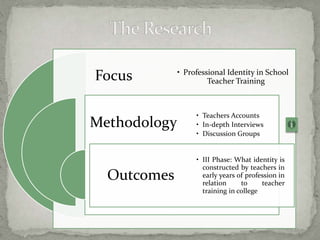
Focus 
Methodology 
Outcomes 
• Professional Identity in School 
Teacher Training 
• Teachers Accounts 
• In-depth Interviews 
• Discussion Groups 
• III Phase: What identity is 
constructed by teachers in 
early years of profession in 
relation to teacher 
training in college
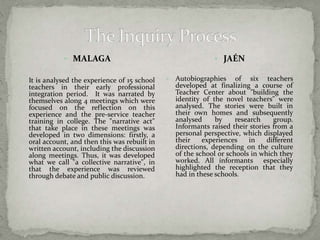
 MALAGA 
 It is analysed the experience of 15 school 
teachers in their early professional 
integration period. It was narrated by 
themselves along 4 meetings which were 
focused on the reflection on this 
experience and the pre-service teacher 
training in college. The "narrative act" 
that take place in these meetings was 
developed in two dimensions: firstly, a 
oral account, and then this was rebuilt in 
written account, including the discussion 
along meetings. Thus, it was developed 
what we call "a collective narrative", in 
that the experience was reviewed 
through debate and public discussion. 
 JAÉN 
 Autobiographies of six teachers 
developed at finalizing a course of 
Teacher Center about "building the 
identity of the novel teachers" were 
analysed. The stories were built in 
their own homes and subsequently 
analysed by research group. 
Informants raised their stories from a 
personal perspective, which displayed 
their experiences in different 
directions, depending on the culture 
of the school or schools in which they 
worked. All informants especially 
highlighted the reception that they 
had in these schools.
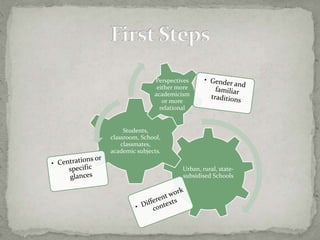
Perspectives 
either more 
academicism 
or more 
relational 
Urban, rural, state-subsidised 
Schools 
Students, 
classroom, School, 
classmates, 
academic subjects.
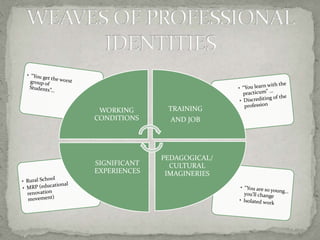
WORKING 
CONDITIONS 
TRAINING 
AND JOB 
PEDAGOGICAL/ 
CULTURAL 
IMAGINERIES 
SIGNIFICANT 
EXPERIENCES
GEOGRAPHICAL 
ASPECTS RELATIONSHIPS 
MANAGEMENT
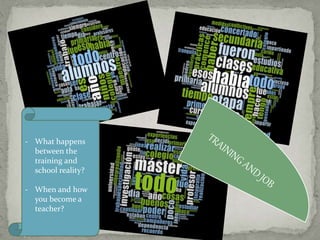
- What happens 
between the 
training and 
school reality? 
- When and how 
you become a 
teacher?
"... The teacher 
becomes in the 
classroom, not by a 
mark of public 
examination and it is 
the time that makes 
you a better teacher."
 “Socialization in the early years can be understood as a strategy for 
institutional ‘domestication´ in order to configure a specified 
professional model” (Rivas et al. 2005). 
 The curricula of initial teacher training seem more interested in giving 
either entirely decontextualized theoretical frameworks or technical 
criteria on what should or should not be done 
 Teacher identity begins to be forged even before starting teacher 
training studies, due to own experience as students, and the influence 
of socio-cultural imaginary about the school and teaching, among 
other factors. 
 The years of university training make explicit many of the views about 
the school and it is positioned as one of the mainstays of teacher 
identity.
 ÁVALOS, B. (2009). La inserción Profesional de los Docentes. En Profesorado. Revista de Currículum y formación del 
Profesorado. Vol. 13, nº 1, 43 – 59 
 BERLINER, D.C. (2000). In Porsuit of the Expert Pedagoge. Educational Researcher. 15 (7), pp. 5-13. 
 CONLE, C. (2000). Anatomy of a Narrative Curriculum. Educational Researcher, 32(3): 3-15 
 CUBAN, L. (1992).Managing Dilemmas While. Building Professional Communities Educational Researcher. 21(1): 4-11. 
 FIACHRA LONGA, F.et al. (2012). Novice teachers as ‘invisible’ learners. Teachers and Teaching: theory and practice. 
Volume 18, Issue 6, 619-636. 
 KNOWLES, J.G. (2004), “Modelos para la comprensión de las biografías del profesorado en formación y en sus primeros 
años de docencia. Ilustraciones a partir de estudios de caso”, en: I. F. Goodson, ed., Historias de vida del profesorado, 
Barcelona, Octaedro, pp. 149-205. 
 LEITE, A. (2007). Profesorado, formación e innovación: Los grupos de trabajo como vía para la construcción de un 
profesorado reflexivo y crítico. Sevilla: Publicaciones Cooperación Educativa 
 LIEBERMAN, A. (1992). The Meaning of Scholarly Activity and the Building of Community. Educational Researcher. 
21(6): 5-12. 
 RIVAS, J.I. ET AL.(2005). La cultura profesional del profesorado de enseñanza ecundaria: Un estudio biográfico. Archivos 
Analíticos de Políticas Educativas 13(47), Retrieved [13 de dicembre de 2005] from http://epaa.asu.edu/epaa/v13n49/ 
 RIVAS, J.I. Y LEITE, A.E. (2013). “Aprender la profesión desde el pupitre”. Cuadernos de pedagogía, 436: 34-37 
 RIVAS, J. I., LEITE, A., CORTÉS, P. MÁRQUEZ, M. J. Y PADUA, D. (2010). La configuración de identidades en la experiencia 
escolar. Escenarios, sujetos y regulaciones. Revista de educación, nº 353, 187-209. 
 STELIOS N. GEORGIOUA, S. N., (2008). Beliefs of experienced and novice teachers about achievement. Educational 
Psychology: An International Journal of Experimental Educational Psychology. Volume 28, Issue 2, 119 – 131 
 WENGER, E. (2001). Comunidades de práctica. Aprendizaje, significado e identidad. Barcelona: Paidós
The European Conference on Educational Research 
The Past, the Future and Present of 
Educational Research in Europe 
The Training We Receive Is Not Useful To 
Work”. Study About The Identity Of The 
Novice Teacher 
Authors: 
- Rivas, J.Ignacio (i_rivas@uma.es) 
- Leite, Analía (aleite@uma.es) 
- Cortés, Pablo (pcortes@uma.es) 
- Pérez, Miguel (mperez@ujaen.es) 
- Quijano, Rocío (rquijano@ujaen.es)
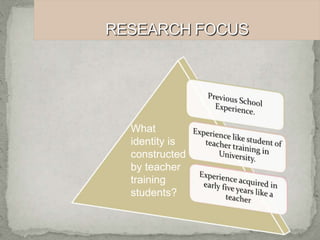
What 
identity is 
constructed 
by teacher 
training 
students?
The training we recieve is not useful to work

The training we recieve is not useful to work

  • 1.
    The European Conferenceon Educational Research The Past, the Future and Present of Educational Research in Europe The Training We Receive Is Not Useful To Work”. Study About The Identity Of The Novice Teacher Authors: - Rivas, J.Ignacio (i_rivas@uma.es) - Leite, Analía (aleite@uma.es) - Cortés, Pablo (pcortes@uma.es) - Pérez, Miguel (mperez@ujaen.es) - Quijano, Rocío (rquijano@ujaen.es)
  • 2.
    Focus Methodology Outcomes • Professional Identity in School Teacher Training • Teachers Accounts • In-depth Interviews • Discussion Groups • III Phase: What identity is constructed by teachers in early years of profession in relation to teacher training in college
  • 3.
     MALAGA It is analysed the experience of 15 school teachers in their early professional integration period. It was narrated by themselves along 4 meetings which were focused on the reflection on this experience and the pre-service teacher training in college. The "narrative act" that take place in these meetings was developed in two dimensions: firstly, a oral account, and then this was rebuilt in written account, including the discussion along meetings. Thus, it was developed what we call "a collective narrative", in that the experience was reviewed through debate and public discussion.  JAÉN  Autobiographies of six teachers developed at finalizing a course of Teacher Center about "building the identity of the novel teachers" were analysed. The stories were built in their own homes and subsequently analysed by research group. Informants raised their stories from a personal perspective, which displayed their experiences in different directions, depending on the culture of the school or schools in which they worked. All informants especially highlighted the reception that they had in these schools.
  • 4.
    Perspectives either more academicism or more relational Urban, rural, state-subsidised Schools Students, classroom, School, classmates, academic subjects.
  • 5.
    WORKING CONDITIONS TRAINING AND JOB PEDAGOGICAL/ CULTURAL IMAGINERIES SIGNIFICANT EXPERIENCES
  • 6.
  • 7.
    - What happens between the training and school reality? - When and how you become a teacher?
  • 9.
    "... The teacher becomes in the classroom, not by a mark of public examination and it is the time that makes you a better teacher."
  • 11.
     “Socialization inthe early years can be understood as a strategy for institutional ‘domestication´ in order to configure a specified professional model” (Rivas et al. 2005).  The curricula of initial teacher training seem more interested in giving either entirely decontextualized theoretical frameworks or technical criteria on what should or should not be done  Teacher identity begins to be forged even before starting teacher training studies, due to own experience as students, and the influence of socio-cultural imaginary about the school and teaching, among other factors.  The years of university training make explicit many of the views about the school and it is positioned as one of the mainstays of teacher identity.
  • 12.
     ÁVALOS, B.(2009). La inserción Profesional de los Docentes. En Profesorado. Revista de Currículum y formación del Profesorado. Vol. 13, nº 1, 43 – 59  BERLINER, D.C. (2000). In Porsuit of the Expert Pedagoge. Educational Researcher. 15 (7), pp. 5-13.  CONLE, C. (2000). Anatomy of a Narrative Curriculum. Educational Researcher, 32(3): 3-15  CUBAN, L. (1992).Managing Dilemmas While. Building Professional Communities Educational Researcher. 21(1): 4-11.  FIACHRA LONGA, F.et al. (2012). Novice teachers as ‘invisible’ learners. Teachers and Teaching: theory and practice. Volume 18, Issue 6, 619-636.  KNOWLES, J.G. (2004), “Modelos para la comprensión de las biografías del profesorado en formación y en sus primeros años de docencia. Ilustraciones a partir de estudios de caso”, en: I. F. Goodson, ed., Historias de vida del profesorado, Barcelona, Octaedro, pp. 149-205.  LEITE, A. (2007). Profesorado, formación e innovación: Los grupos de trabajo como vía para la construcción de un profesorado reflexivo y crítico. Sevilla: Publicaciones Cooperación Educativa  LIEBERMAN, A. (1992). The Meaning of Scholarly Activity and the Building of Community. Educational Researcher. 21(6): 5-12.  RIVAS, J.I. ET AL.(2005). La cultura profesional del profesorado de enseñanza ecundaria: Un estudio biográfico. Archivos Analíticos de Políticas Educativas 13(47), Retrieved [13 de dicembre de 2005] from http://epaa.asu.edu/epaa/v13n49/  RIVAS, J.I. Y LEITE, A.E. (2013). “Aprender la profesión desde el pupitre”. Cuadernos de pedagogía, 436: 34-37  RIVAS, J. I., LEITE, A., CORTÉS, P. MÁRQUEZ, M. J. Y PADUA, D. (2010). La configuración de identidades en la experiencia escolar. Escenarios, sujetos y regulaciones. Revista de educación, nº 353, 187-209.  STELIOS N. GEORGIOUA, S. N., (2008). Beliefs of experienced and novice teachers about achievement. Educational Psychology: An International Journal of Experimental Educational Psychology. Volume 28, Issue 2, 119 – 131  WENGER, E. (2001). Comunidades de práctica. Aprendizaje, significado e identidad. Barcelona: Paidós
  • 13.
    The European Conferenceon Educational Research The Past, the Future and Present of Educational Research in Europe The Training We Receive Is Not Useful To Work”. Study About The Identity Of The Novice Teacher Authors: - Rivas, J.Ignacio (i_rivas@uma.es) - Leite, Analía (aleite@uma.es) - Cortés, Pablo (pcortes@uma.es) - Pérez, Miguel (mperez@ujaen.es) - Quijano, Rocío (rquijano@ujaen.es)
  • 14.
    What identity is constructed by teacher training students?