


Michael Sargent Santiago, January 22nd, 2010
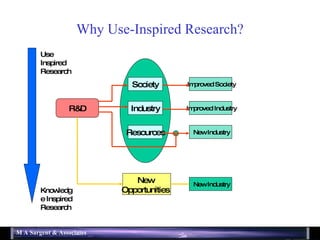
Why Use-Inspired Research? R&D Society Industry Resources Improved Society Improved Industry New Industry New Opportunities New Industry Use Inspired Research Knowledge Inspired Research
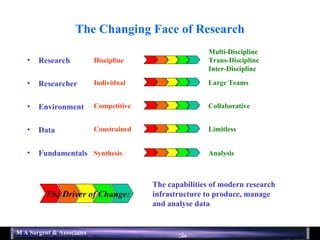
The Changing Face of Research Research Researcher Environment Data Fundamentals The Driver of Change: The capabilities of modern research infrastructure to produce, manage and analyse data Discipline Multi-Discipline Trans-Discipline Inter-Discipline Individual Large Teams Competitive Collaborative Constrained Limitless Synthesis Analysis
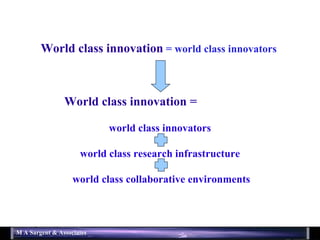
World class innovation =  world class innovators  . world class research infrastructure .  world class collaborative environments World class innovation  = world class innovators
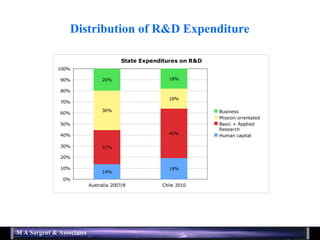
Distribution of R&D Expenditure
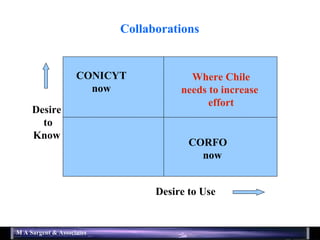
Collaborations Desire to Use Desire to Know CONICYT now CORFO now Where Chile needs to increase  effort
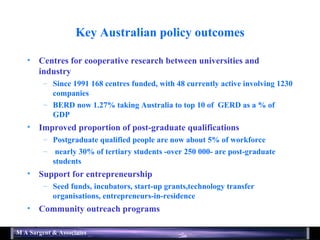
Key Australian policy outcomes Centres for cooperative research between universities and industry Since 1991 168 centres funded, with 48 currently active involving 1230 companies BERD now 1.27% taking Australia to top 10 of  GERD as a % of GDP  Improved proportion of post-graduate qualifications Postgraduate qualified people are now about 5% of workforce nearly 30% of tertiary students -over 250 000- are post-graduate students Support for entrepreneurship Seed funds, incubators, start-up grants,technology transfer organisations, entrepreneurs-in-residence Community outreach programs
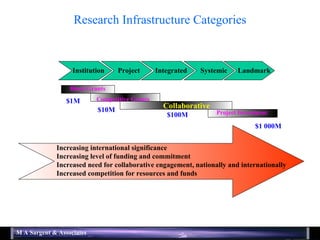
Research Infrastructure Categories $1M $10M $100M $1 000M Institution Project Integrated Systemic Landmark Block Grants Competitive Grants Collaborative Project Investment Increasing international significance Increasing level of funding and commitment Increased need for collaborative engagement, nationally and internationally Increased competition for resources and funds
Collaborative Infrastructure  Principles Investments should enhance R&D contributions to national priority goals Focus on areas where the country is, or potentially is, world-class and can provide international leadership Development on a collaborative, national basis to serve the research and innovation system broadly Access is a critical issue.  There should be as few barriers as possible to accessing major infrastructures  Consideration of whole-of-life costs and operational funding where appropriate
Some Important Gaps  ICT Infrastructure no group had an overview of the needs and strategies for systemic intervention Bioinformatics organic development in silos of effort and information Data accessibility traditional empires of control
Collaborative Research Infrastructure Impacts provides access by universities  and  industry to leading edge research infrastructure improves the quality of research facilitates interaction and innovative interaction across the research and innovation system enables new ways of conducting research provides opportunities for new types of research attracts and retains high quality researchers
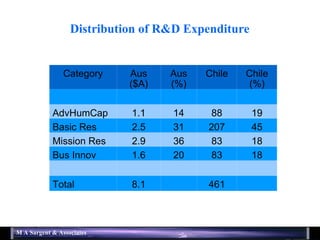
Distribution of R&D Expenditure Category Aus ($A) Aus (%) Chile Chile (%) AdvHumCap 1.1 14 88 19 Basic Res 2.5 31 207 45 Mission Res 2.9 36 83 18 Bus Innov 1.6 20 83 18 Total 8.1 461
Some Observations Collaboration  at researcher, institutional and government levels is essential Governance and access  regimes are key determinants of success Strategic intent  underpins rational prioritisation of investments Strategic review  provides a living framework for ongoing investment Cultural change  in the research sector is a key issue  (Full time)  Operations resources  are the key resource for sustainable investments and open access -  and yet are the scarcest and most under-respected resource in the system -until you have to find them The link between research descriptions and infrastructure descriptions is rarely a one-to-one match, so  trans-disciplinary discussions  on strategies are important Systemic needs  (eg modelling platforms, data management and fusion) are rarely effectively articulated as a part of the investment proposals The larger the investment the more socio-economic groups you are competing with
National Research Priorities Australia’s National Research Priorities are:  An environmentally sustainable Australia  Promoting and maintaining good health  Frontier technologies and transforming Australian industries  Safeguarding Australia National Research Priorities are designed to focus the Australian Government’s research effort into those areas that can deliver significant economic, social and environmental benefits to Australia .
A Reality Check GDP of US$800M (PPP) (about 5% of USA’s) GDP/capita on par with the 4 dominant Western economies Australia ranks globally 19th in size of economy only about 5% of the size of the economies we like to compare ourselves with Australia ranks barely in the top 20 of nations in innovative activity In the OECD, Australia is: in the second highest quartile in researchers per 1000 employment in the middle quartile for venture capital investment as % GDP in the bottom quartile of trade intensity 97% of R&D output occurs outside Australia Smarter, focussed, cohesive Australia has a strong robust economy, an innovative socio-economic structure, and a market-oriented economy. It has : However:
Barriers Collaborative action required funding regime predominantly competitive or short-term project collaboration Access to facilities hidden costs borne by ‘owner’ and not met by research funding programs Sustainability and strategic evolution of activity no ongoing process to review currency and relevance
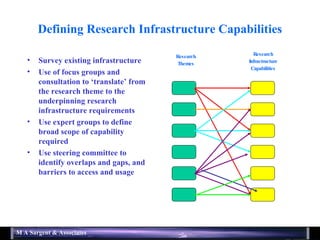
Defining Research Infrastructure Capabilities Survey existing infrastructure Use of focus groups and consultation to ‘translate’ from the research theme to the underpinning research infrastructure requirements Use expert groups to define broad scope of capability required Use steering committee to identify overlaps and gaps, and barriers to access and usage Research Themes Research Infrastructure Capabilities
Access and Pricing Principles   nfrastructure should be  accessible by all classes of researchers  including  -  meritorious researchers (these include research students and early career researchers); commercial users; and international users.    The  terms of access should be transparent  to users and potential users.  Pricing for  meritorious researchers should not exceed the  marginal cost  of providing access    Co-investors will have a preferential price position  compared with others
Governance Principles Governance arrangements for each capability should be relevant to the proposed strategic investment plan, and ensure: adequate oversight of the investment oversight of the operations of the facility management of the access and pricing regimes coordination between partners annual review of the strategic position, relevance and value of the facilities The governing body must provide: an investment and operating plan for the five year funding period an  access and pricing plan an  annual report  of activities an  annual business plan  for the following year Governance arrangements may vary between capabilities,  ranging from companies through unincorporated joint ventures
Some Questions Do we know what we have? Do we know what we need? Is what we have being used effectively? If not, what are the reasons for this? If we need to make further investments, what investments? If we need to make further investments, how should we do this? The answer to all these were: we don't know

Presentación Michael Sargent

  • 1.
    Michael Sargent Santiago,January 22nd, 2010
  • 2.
    Why Use-Inspired Research?R&D Society Industry Resources Improved Society Improved Industry New Industry New Opportunities New Industry Use Inspired Research Knowledge Inspired Research
  • 3.
    The Changing Faceof Research Research Researcher Environment Data Fundamentals The Driver of Change: The capabilities of modern research infrastructure to produce, manage and analyse data Discipline Multi-Discipline Trans-Discipline Inter-Discipline Individual Large Teams Competitive Collaborative Constrained Limitless Synthesis Analysis
  • 4.
    World class innovation= world class innovators . world class research infrastructure . world class collaborative environments World class innovation = world class innovators
  • 5.
  • 6.
    Collaborations Desire toUse Desire to Know CONICYT now CORFO now Where Chile needs to increase effort
  • 7.
    Key Australian policyoutcomes Centres for cooperative research between universities and industry Since 1991 168 centres funded, with 48 currently active involving 1230 companies BERD now 1.27% taking Australia to top 10 of GERD as a % of GDP Improved proportion of post-graduate qualifications Postgraduate qualified people are now about 5% of workforce nearly 30% of tertiary students -over 250 000- are post-graduate students Support for entrepreneurship Seed funds, incubators, start-up grants,technology transfer organisations, entrepreneurs-in-residence Community outreach programs
  • 8.
    Research Infrastructure Categories$1M $10M $100M $1 000M Institution Project Integrated Systemic Landmark Block Grants Competitive Grants Collaborative Project Investment Increasing international significance Increasing level of funding and commitment Increased need for collaborative engagement, nationally and internationally Increased competition for resources and funds
  • 9.
    Collaborative Infrastructure Principles Investments should enhance R&D contributions to national priority goals Focus on areas where the country is, or potentially is, world-class and can provide international leadership Development on a collaborative, national basis to serve the research and innovation system broadly Access is a critical issue. There should be as few barriers as possible to accessing major infrastructures Consideration of whole-of-life costs and operational funding where appropriate
  • 10.
    Some Important Gaps ICT Infrastructure no group had an overview of the needs and strategies for systemic intervention Bioinformatics organic development in silos of effort and information Data accessibility traditional empires of control
  • 11.
    Collaborative Research InfrastructureImpacts provides access by universities and industry to leading edge research infrastructure improves the quality of research facilitates interaction and innovative interaction across the research and innovation system enables new ways of conducting research provides opportunities for new types of research attracts and retains high quality researchers
  • 12.
    Distribution of R&DExpenditure Category Aus ($A) Aus (%) Chile Chile (%) AdvHumCap 1.1 14 88 19 Basic Res 2.5 31 207 45 Mission Res 2.9 36 83 18 Bus Innov 1.6 20 83 18 Total 8.1 461
  • 13.
    Some Observations Collaboration at researcher, institutional and government levels is essential Governance and access regimes are key determinants of success Strategic intent underpins rational prioritisation of investments Strategic review provides a living framework for ongoing investment Cultural change in the research sector is a key issue (Full time) Operations resources are the key resource for sustainable investments and open access - and yet are the scarcest and most under-respected resource in the system -until you have to find them The link between research descriptions and infrastructure descriptions is rarely a one-to-one match, so trans-disciplinary discussions on strategies are important Systemic needs (eg modelling platforms, data management and fusion) are rarely effectively articulated as a part of the investment proposals The larger the investment the more socio-economic groups you are competing with
  • 14.
    National Research PrioritiesAustralia’s National Research Priorities are: An environmentally sustainable Australia Promoting and maintaining good health Frontier technologies and transforming Australian industries Safeguarding Australia National Research Priorities are designed to focus the Australian Government’s research effort into those areas that can deliver significant economic, social and environmental benefits to Australia .
  • 15.
    A Reality CheckGDP of US$800M (PPP) (about 5% of USA’s) GDP/capita on par with the 4 dominant Western economies Australia ranks globally 19th in size of economy only about 5% of the size of the economies we like to compare ourselves with Australia ranks barely in the top 20 of nations in innovative activity In the OECD, Australia is: in the second highest quartile in researchers per 1000 employment in the middle quartile for venture capital investment as % GDP in the bottom quartile of trade intensity 97% of R&D output occurs outside Australia Smarter, focussed, cohesive Australia has a strong robust economy, an innovative socio-economic structure, and a market-oriented economy. It has : However:
  • 16.
    Barriers Collaborative actionrequired funding regime predominantly competitive or short-term project collaboration Access to facilities hidden costs borne by ‘owner’ and not met by research funding programs Sustainability and strategic evolution of activity no ongoing process to review currency and relevance
  • 17.
    Defining Research InfrastructureCapabilities Survey existing infrastructure Use of focus groups and consultation to ‘translate’ from the research theme to the underpinning research infrastructure requirements Use expert groups to define broad scope of capability required Use steering committee to identify overlaps and gaps, and barriers to access and usage Research Themes Research Infrastructure Capabilities
  • 18.
    Access and PricingPrinciples   nfrastructure should be accessible by all classes of researchers including - meritorious researchers (these include research students and early career researchers); commercial users; and international users.  The terms of access should be transparent to users and potential users.  Pricing for  meritorious researchers should not exceed the marginal cost of providing access  Co-investors will have a preferential price position compared with others
  • 19.
    Governance Principles Governancearrangements for each capability should be relevant to the proposed strategic investment plan, and ensure: adequate oversight of the investment oversight of the operations of the facility management of the access and pricing regimes coordination between partners annual review of the strategic position, relevance and value of the facilities The governing body must provide: an investment and operating plan for the five year funding period an access and pricing plan an annual report of activities an annual business plan for the following year Governance arrangements may vary between capabilities, ranging from companies through unincorporated joint ventures
  • 20.
    Some Questions Dowe know what we have? Do we know what we need? Is what we have being used effectively? If not, what are the reasons for this? If we need to make further investments, what investments? If we need to make further investments, how should we do this? The answer to all these were: we don't know