PRESENT PERFECT, PRESENT
PERFECT CONTINUOUS
PRESENT PERFECT
The present perfect is formed from the present tense of the verb have and the past
participle of a verb.
We use the present perfect:
•for something that started in the past and continues in the present:
They've been married for nearly fifty years.
She has lived in Liverpool all her life.
•when we are talking about our experience up to the present:
I've seen that film before.
I've played the guitar ever since I was a teenager.
He has written three books and he is working on another one.
PRESENT PERFECT
0
PRESENT PERFECT
• We often use the adverb ever to talk about experience up to the present:
My last birthday was the worst day I have ever had.
• We use never for the negative form :
Have you ever met George?
Yes, but I've never met his wife.
PRESENT PERFECT
•for something that happened in the past but is important in the present:
I can't get in the house. I've lost my keys.
Teresa isn't at home. I think she has gone shopping.
PRESENT PERFECT
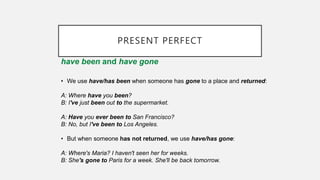
have been and have gone
• We use have/has been when someone has gone to a place and returned:
A: Where have you been?
B: I've just been out to the supermarket.
A: Have you ever been to San Francisco?
B: No, but I've been to Los Angeles.
• But when someone has not returned, we use have/has gone:
A: Where's Maria? I haven't seen her for weeks.
B: She's gone to Paris for a week. She'll be back tomorrow.
PRESENT PERFECT WITH TIME
ADVERBIALS
• We often use the present perfect with adverbials which refer to the recent past:
recently / just / only just
Scientists have recently discovered a new breed of monkey.
We have just got back from our holidays.
• or adverbials which include the present:
so far / until now / up to now / ever (in questions) / yet (in questions and
negatives)
Have you ever seen a ghost?
Where have you been up to now?
A: Have you finished your homework yet?
B: No, so far I've only done my history.
PRESENT PERFECT WITH TIME
ADVERBIALS
• After a clause with the present perfect we often use a clause with since to show
when something started in the past:
I've been watching that program every week since it started.
PRESENT PERFECT WITH TIME
ADVERBIALS
• We do not use the present perfect with adverbials which refer to a finished past time:
yesterday last week / month / year / in 2017 / when I was younger / etc.
I have seen that film yesterday.
We have just bought a new car last week.
When we were children we have been to California.
• but we can use the present perfect with adverbials which refer to a time which is not yet
finished:
today / this week / month / year / now that I am 18 / etc.
Have you seen Helen today?
We have bought a new car this week.
PRESENT PERFECT
Present perfect for future
• We normally use the present simple to talk about the future in clauses with before,
after, until, etc.:
I'll keep looking until I find my book.
We'll begin when everyone arrives.
• but we can also use the present perfect:
I'll keep looking until I have found my book.
We'll begin when everyone has arrived.
PRESENT PERFECT CONTINOUS
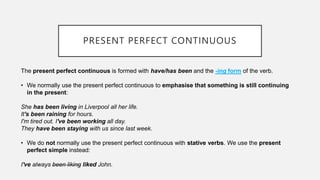
PRESENT PERFECT CONTINUOUS
The present perfect continuous is formed with have/has been and the -ing form of the verb.
• We normally use the present perfect continuous to emphasise that something is still continuing
in the present:
She has been living in Liverpool all her life.
It's been raining for hours.
I'm tired out. I've been working all day.
They have been staying with us since last week.
• We do not normally use the present perfect continuous with stative verbs. We use the present
perfect simple instead:
I've always been liking liked John.
PRESENT PERFECT CONTINUOUS

Present perfect, present perfect continuous.pptx

  • 1.
  • 2.
    PRESENT PERFECT The presentperfect is formed from the present tense of the verb have and the past participle of a verb. We use the present perfect: •for something that started in the past and continues in the present: They've been married for nearly fifty years. She has lived in Liverpool all her life. •when we are talking about our experience up to the present: I've seen that film before. I've played the guitar ever since I was a teenager. He has written three books and he is working on another one.
  • 3.
  • 4.
    PRESENT PERFECT • Weoften use the adverb ever to talk about experience up to the present: My last birthday was the worst day I have ever had. • We use never for the negative form : Have you ever met George? Yes, but I've never met his wife.
  • 5.
    PRESENT PERFECT •for somethingthat happened in the past but is important in the present: I can't get in the house. I've lost my keys. Teresa isn't at home. I think she has gone shopping.
  • 6.
    PRESENT PERFECT have beenand have gone • We use have/has been when someone has gone to a place and returned: A: Where have you been? B: I've just been out to the supermarket. A: Have you ever been to San Francisco? B: No, but I've been to Los Angeles. • But when someone has not returned, we use have/has gone: A: Where's Maria? I haven't seen her for weeks. B: She's gone to Paris for a week. She'll be back tomorrow.
  • 7.
    PRESENT PERFECT WITHTIME ADVERBIALS • We often use the present perfect with adverbials which refer to the recent past: recently / just / only just Scientists have recently discovered a new breed of monkey. We have just got back from our holidays. • or adverbials which include the present: so far / until now / up to now / ever (in questions) / yet (in questions and negatives) Have you ever seen a ghost? Where have you been up to now? A: Have you finished your homework yet? B: No, so far I've only done my history.
  • 8.
    PRESENT PERFECT WITHTIME ADVERBIALS • After a clause with the present perfect we often use a clause with since to show when something started in the past: I've been watching that program every week since it started.
  • 9.
    PRESENT PERFECT WITHTIME ADVERBIALS • We do not use the present perfect with adverbials which refer to a finished past time: yesterday last week / month / year / in 2017 / when I was younger / etc. I have seen that film yesterday. We have just bought a new car last week. When we were children we have been to California. • but we can use the present perfect with adverbials which refer to a time which is not yet finished: today / this week / month / year / now that I am 18 / etc. Have you seen Helen today? We have bought a new car this week.
  • 10.
    PRESENT PERFECT Present perfectfor future • We normally use the present simple to talk about the future in clauses with before, after, until, etc.: I'll keep looking until I find my book. We'll begin when everyone arrives. • but we can also use the present perfect: I'll keep looking until I have found my book. We'll begin when everyone has arrived.
  • 11.
  • 12.
    PRESENT PERFECT CONTINUOUS Thepresent perfect continuous is formed with have/has been and the -ing form of the verb. • We normally use the present perfect continuous to emphasise that something is still continuing in the present: She has been living in Liverpool all her life. It's been raining for hours. I'm tired out. I've been working all day. They have been staying with us since last week. • We do not normally use the present perfect continuous with stative verbs. We use the present perfect simple instead: I've always been liking liked John.
  • 13.