PREPOSITIONS OF TIME:
AT, IN, ON
We use:
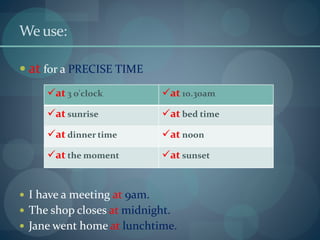
 at for a PRECISE TIME
 I have a meeting at 9am.
 The shop closes at midnight.
 Jane went home at lunchtime.
at 3 o'clock at 10.30am
at sunrise at bed time
at dinner time at noon
at the moment at sunset
Weuse:
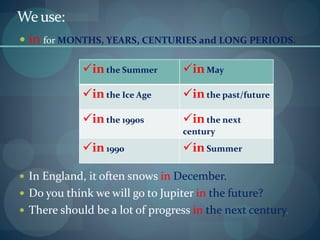
 in for MONTHS, YEARS, CENTURIES and LONG PERIODS.
 In England, it often snows in December.
 Do you think we will go to Jupiter in the future?
 There should be a lot of progress in the next century.
in the Summer inMay
in the Ice Age inthe past/future
in the 1990s inthe next
century
in 1990 inSummer
We use:
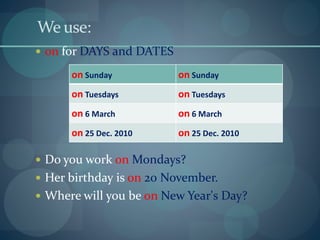
 on for DAYS and DATES
 Do you work on Mondays?
 Her birthday is on 20 November.
 Where will you be on New Year's Day?
on Sunday on Sunday
on Tuesdays on Tuesdays
on 6 March on 6 March
on 25 Dec. 2010 on 25 Dec. 2010
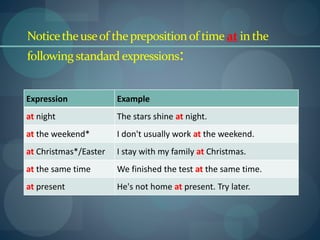
Noticetheuseof theprepositionof time at inthe
following standard expressions:
Expression Example
at night The stars shine at night.
at the weekend* I don't usually work at the weekend.
at Christmas*/Easter I stay with my family at Christmas.
at the same time We finished the test at the same time.
at present He's not home at present. Try later.
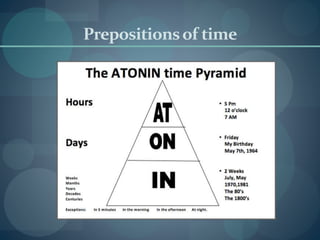
Prepositionsof time
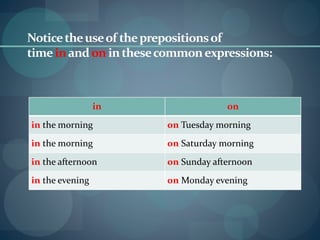
Noticetheuseof theprepositionsof
timeinandon inthesecommonexpressions:
in on
in the morning on Tuesday morning
in the morning on Saturday morning
in the afternoon on Sunday afternoon
in the evening on Monday evening
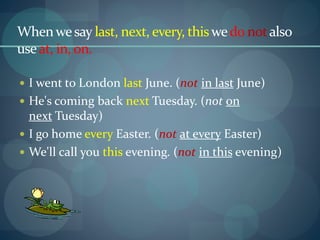
Whenwesay last, next, every, thiswedo notalso
useat, in, on.
 I went to London last June. (not in last June)
 He's coming back next Tuesday. (not on
next Tuesday)
 I go home every Easter. (not at every Easter)
 We'll call you this evening. (not in this evening)
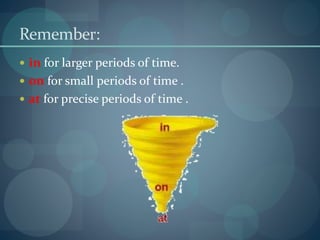
Remember:
 in for larger periods of time.
 on for small periods of time .
 at for precise periods of time .
preposition ----------of-------time.pptx

preposition ----------of-------time.pptx

  • 1.
  • 2.
    We use:  atfor a PRECISE TIME  I have a meeting at 9am.  The shop closes at midnight.  Jane went home at lunchtime. at 3 o'clock at 10.30am at sunrise at bed time at dinner time at noon at the moment at sunset
  • 3.
    Weuse:  in forMONTHS, YEARS, CENTURIES and LONG PERIODS.  In England, it often snows in December.  Do you think we will go to Jupiter in the future?  There should be a lot of progress in the next century. in the Summer inMay in the Ice Age inthe past/future in the 1990s inthe next century in 1990 inSummer
  • 4.
    We use:  onfor DAYS and DATES  Do you work on Mondays?  Her birthday is on 20 November.  Where will you be on New Year's Day? on Sunday on Sunday on Tuesdays on Tuesdays on 6 March on 6 March on 25 Dec. 2010 on 25 Dec. 2010
  • 5.
    Noticetheuseof theprepositionof timeat inthe following standard expressions: Expression Example at night The stars shine at night. at the weekend* I don't usually work at the weekend. at Christmas*/Easter I stay with my family at Christmas. at the same time We finished the test at the same time. at present He's not home at present. Try later.
  • 6.
  • 7.
    Noticetheuseof theprepositionsof timeinandon inthesecommonexpressions: inon in the morning on Tuesday morning in the morning on Saturday morning in the afternoon on Sunday afternoon in the evening on Monday evening
  • 8.
    Whenwesay last, next,every, thiswedo notalso useat, in, on.  I went to London last June. (not in last June)  He's coming back next Tuesday. (not on next Tuesday)  I go home every Easter. (not at every Easter)  We'll call you this evening. (not in this evening)
  • 9.
    Remember:  in forlarger periods of time.  on for small periods of time .  at for precise periods of time .