Preparing
Vegetable Dishes
“The foods you choose make
difference”
– You are what you eat
Basic Principles
of Cooking
Vegetables to
meet Quality
Standards
Cook vegetables so they have an appealing appearance
Cook vegetables for good flavor typical of the vegetable
Serve vegetables at the right temperature
Green
Vegetables
Do not overcook to maintain their bright green color
which comes from chlorophyll.
Never add lemon juice to avoid from changing color and
softening.
Correct cooking
of Green
Vegetables
Orange & Yellow
Vegetables
Follow the recipe or directions for exact cooking time to
get the right texture.
Undercooking may make the vegetables too crisp while
overcooking makes some mushy.
Correct cooking of
Orange & Yellow
Vegetables
Do not add baking soda to avoid mushy texture
Vegetable
Selection and
Storage
1. FRESH
Desirable Qualities
• Crisp
• Bright Color
• Firm
• Absence of Decay
Storage
• Store in fridge
• Eat in 2-3 days
Vegetable
Selection and
Storage
2. CANNED
Advantages
• Precooked
• Convenient
Disadvantages
• Higher in sodium
• Possibly mushy texture
Storage
• Store at room
temperature
• Use by expiration
date, if given
Vegetable
Selection and
Storage
3. FROZEN
Benefits
• Partially prepared
• No need to thaw before cooking.
• No sodium added
• Retain the appearance and flavor fresh-picked
vegies.
• Usually cost less than fresh
• Available “out of season”
Storage
• Keep frozen
• Do not refreeze if
thawed
Vegetable
Selection and
Storage
4. DRIED
Most common dried veggies
are legumes (dry beans)
Benefit: Long Shelf life
Disadvantage: Must soak dry
beans before cooking
Storage
• Store in a cool dry
place
Selecting and Preparing
Fresh Vegetables
1.Purchasing, storage, and preparation are factors that
affect vegetable cookery
2.Once purchased, vegetables need to be properly
stored so they remain their best until you are ready to
use them.
3.Without exception, all vegetables should be wiped, or
washed, before you prepare them.
4.Peeling and trimming vegetable skins like carrots and
potatoes is a common practice.
Characteristics Of Quality Vegetables
• Always buy fresh, crisp, newly harvested vegetables.
• Avoid buying vegetables that have been sliced and
pre-packed in plastic bags.
• Root vegetables such as carrots, gabi, labanos, or
radish and fruit vegetables such as eggplant,
tomatoes, and squash must be firm, well-shaped, and
without bruises or blemishes.
• Choose young and tender sitaw, ampalaya, okra, and
eggplant because they have better taste.
•
Thawing Frozen Vegetables
• Food must be kept at safe temperature
during defrosting.
• as soon as food begins to defrost and
become warmer than 40°F, any bacteria
that may have been present before
freezing can begin to multiply.
Methods of Thawing Vegetables
1.Cook from Frozen
2.Microwave
3.Thaw under water
Methods of Cooking Vegetables
1. BLANCHING 2. BOILING
Methods of Cooking Vegetables
3. BRAISING 4. POACHING
Methods of Cooking Vegetables
5. SIMMERING 6. STEAMING
Methods of Cooking Vegetables
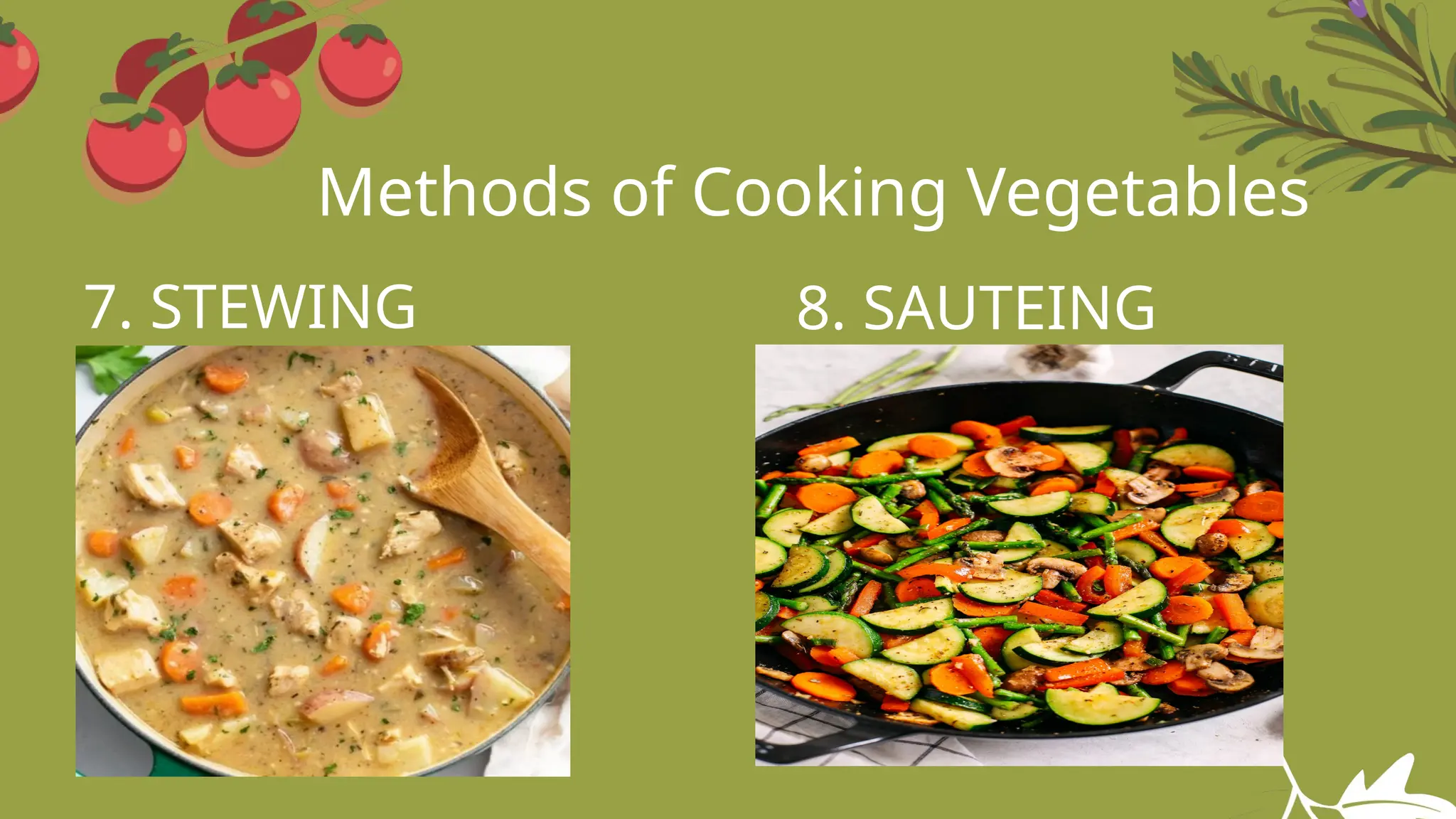
7. STEWING 8. SAUTEING
Methods of Cooking Vegetables
9. BROILING 10. GRILLING
Methods of Cooking Vegetables
11. ROASTING 12. STIR-FRYING

Preparing Vegetables DISHES TLE 10 .pptx

  • 1.
  • 2.
    “The foods youchoose make difference” – You are what you eat
  • 3.
    Basic Principles of Cooking Vegetablesto meet Quality Standards
  • 4.
    Cook vegetables sothey have an appealing appearance Cook vegetables for good flavor typical of the vegetable Serve vegetables at the right temperature
  • 5.
  • 6.
    Do not overcookto maintain their bright green color which comes from chlorophyll. Never add lemon juice to avoid from changing color and softening. Correct cooking of Green Vegetables
  • 7.
  • 8.
    Follow the recipeor directions for exact cooking time to get the right texture. Undercooking may make the vegetables too crisp while overcooking makes some mushy. Correct cooking of Orange & Yellow Vegetables Do not add baking soda to avoid mushy texture
  • 9.
    Vegetable Selection and Storage 1. FRESH DesirableQualities • Crisp • Bright Color • Firm • Absence of Decay Storage • Store in fridge • Eat in 2-3 days
  • 10.
    Vegetable Selection and Storage 2. CANNED Advantages •Precooked • Convenient Disadvantages • Higher in sodium • Possibly mushy texture Storage • Store at room temperature • Use by expiration date, if given
  • 11.
    Vegetable Selection and Storage 3. FROZEN Benefits •Partially prepared • No need to thaw before cooking. • No sodium added • Retain the appearance and flavor fresh-picked vegies. • Usually cost less than fresh • Available “out of season” Storage • Keep frozen • Do not refreeze if thawed
  • 12.
    Vegetable Selection and Storage 4. DRIED Mostcommon dried veggies are legumes (dry beans) Benefit: Long Shelf life Disadvantage: Must soak dry beans before cooking Storage • Store in a cool dry place
  • 13.
    Selecting and Preparing FreshVegetables 1.Purchasing, storage, and preparation are factors that affect vegetable cookery 2.Once purchased, vegetables need to be properly stored so they remain their best until you are ready to use them. 3.Without exception, all vegetables should be wiped, or washed, before you prepare them. 4.Peeling and trimming vegetable skins like carrots and potatoes is a common practice.
  • 14.
    Characteristics Of QualityVegetables • Always buy fresh, crisp, newly harvested vegetables. • Avoid buying vegetables that have been sliced and pre-packed in plastic bags. • Root vegetables such as carrots, gabi, labanos, or radish and fruit vegetables such as eggplant, tomatoes, and squash must be firm, well-shaped, and without bruises or blemishes. • Choose young and tender sitaw, ampalaya, okra, and eggplant because they have better taste. •
  • 15.
    Thawing Frozen Vegetables •Food must be kept at safe temperature during defrosting. • as soon as food begins to defrost and become warmer than 40°F, any bacteria that may have been present before freezing can begin to multiply.
  • 16.
    Methods of ThawingVegetables 1.Cook from Frozen 2.Microwave 3.Thaw under water
  • 17.
    Methods of CookingVegetables 1. BLANCHING 2. BOILING
  • 18.
    Methods of CookingVegetables 3. BRAISING 4. POACHING
  • 19.
    Methods of CookingVegetables 5. SIMMERING 6. STEAMING
  • 20.
    Methods of CookingVegetables 7. STEWING 8. SAUTEING
  • 21.
    Methods of CookingVegetables 9. BROILING 10. GRILLING
  • 22.
    Methods of CookingVegetables 11. ROASTING 12. STIR-FRYING