PREPARING FOR SERVICES
LIBERALISATION
NEGOTIATIONS
Mr. Teemu Alexander Puutio
As. Economic Affairs Officer
Trade, Investment and Innovation Division, UNESCAP
TRAINING COURSE ON
“TRADE IN SERVICES NEGOTIATIONS”
31 March – 1 April 2016
United Nations Conference Centre, Bangkok, Thailand
SESSION 3
CONSULTING THE STAKEHOLDERS
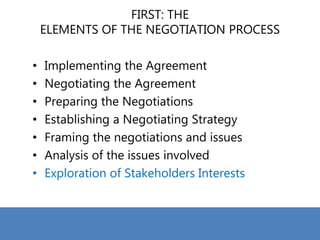
FIRST: THE
ELEMENTS OF THE NEGOTIATION PROCESS
• Implementing the Agreement
• Negotiating the Agreement
• Preparing the Negotiations
• Establishing a Negotiating Strategy
• Framing the negotiations and issues
• Analysis of the issues involved
• Exploration of Stakeholders Interests
STAKEHOLDERS
• In any negotiation identification of and
consultations with stakeholders is very
important
• For negotiations in Services EIAs:
identification is equally important
• Who are the ‘Stakeholders”?
• Define as per your experiences
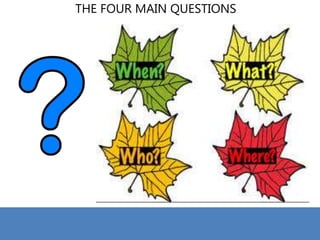
THE FOUR MAIN QUESTIONS
Identification of the stakeholders
Within government:
• Parliament
• Executive agencies
– Cabinet
– Ministries/Departments
– Agencies – regulators
• Provincial or local government
• Municipality and other agencies
• The other government
• The other governments
Outside Governments:
• Private sector
– Companies
– Persons
– Associations
– Chambers
• Civil Society Organisations
• Think tanks / research organisations
Identification of the stakeholders
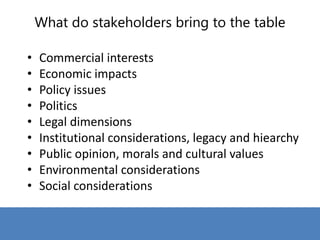
• Commercial interests
• Economic impacts
• Policy issues
• Politics
• Legal dimensions
• Institutional considerations, legacy and hiearchy
• Public opinion, morals and cultural values
• Environmental considerations
• Social considerations
What do stakeholders bring to the table
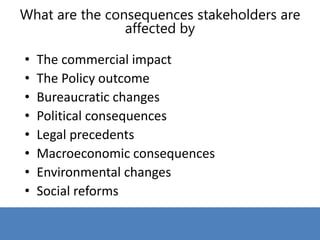
• The commercial impact
• The Policy outcome
• Bureaucratic changes
• Political consequences
• Legal precedents
• Macroeconomic consequences
• Environmental changes
• Social reforms
What are the consequences stakeholders are
affected by
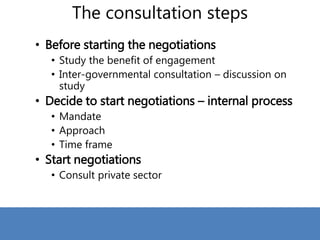
The consultation steps
• Before starting the negotiations
• Study the benefit of engagement
• Inter-governmental consultation – discussion on
study
• Decide to start negotiations – internal process
• Mandate
• Approach
• Time frame
• Start negotiations
• Consult private sector
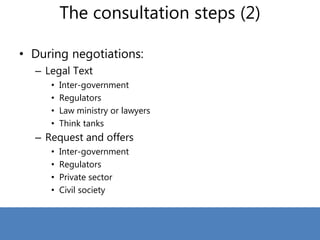
• During negotiations:
– Legal Text
• Inter-government
• Regulators
• Law ministry or lawyers
• Think tanks
– Request and offers
• Inter-government
• Regulators
• Private sector
• Civil society
The consultation steps (2)
A CONSIDERATION:
INDUSTRY’S PREPAREDNESS
• Who sets the agenda for negotiations?
• To help successfully in policy making
process
• Feedback during negotiations
• After implementation:
– Trade defense measures
– Circumvention
– Any other issues
12
RECAP:
STAKEHOLDER BUY-IN ENSURES A SUCCESSFUL
NEGOTIATION STRATEGY
• Frame the issue for negotiations
• Identify of win/win solutions
• Identify potential supporters among domestic and
foreign stakeholders
• Outline message to potential supporters
• Identify opposing stakeholders & the means for
reducing or deflecting opposition
• Establish the utility, legitimacy and fairness of
proposed outcome
REGULATORY AUDITS
REGULATORY AUDIT
• Already done during WTO accession
• During Trade Policy Review Mechanism
• However, changes do happen!
• Useful in EIA negotiations:
– Prepare for better understanding of trade
partner’s policies and regulations
– Enhances quality of dialogue between
negotiators, sectoral regulators and private
sector stakeholders.
REGULATORY AUDIT: USEFULNESS
• Better understanding among the negotiators
and regulators of the implications of
commitments being offered
• Benchmarking the national regulatory regime
in terms of its effectiveness and compliance
with international best practices
• Anticipating and preparing for requests that
are likely to ensue from negotiating partners
once the negotiations have started
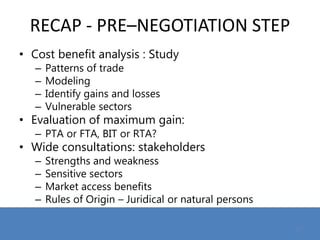
RECAP - PRE–NEGOTIATION STEP
• Cost benefit analysis : Study
– Patterns of trade
– Modeling
– Identify gains and losses
– Vulnerable sectors
• Evaluation of maximum gain:
– PTA or FTA, BIT or RTA?
• Wide consultations: stakeholders
– Strengths and weakness
– Sensitive sectors
– Market access benefits
– Rules of Origin – Juridical or natural persons
17
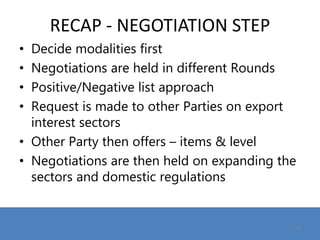
• Decide modalities first
• Negotiations are held in different Rounds
• Positive/Negative list approach
• Request is made to other Parties on export
interest sectors
• Other Party then offers – items & level
• Negotiations are then held on expanding the
sectors and domestic regulations
18
RECAP - NEGOTIATION STEP
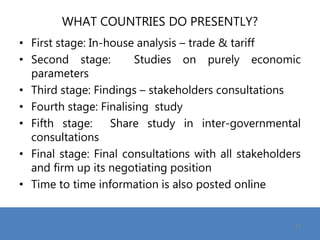
WHAT COUNTRIES DO PRESENTLY?
• First stage: In-house analysis – trade & tariff
• Second stage: Studies on purely economic
parameters
• Third stage: Findings – stakeholders consultations
• Fourth stage: Finalising study
• Fifth stage: Share study in inter-governmental
consultations
• Final stage: Final consultations with all stakeholders
and firm up its negotiating position
• Time to time information is also posted online
19
20
21
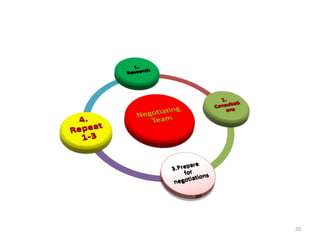
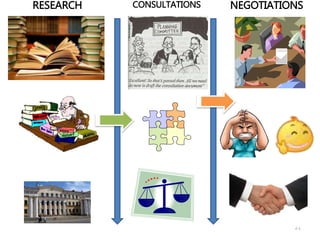
RESEARCH CONSULTATIONS NEGOTIATIONS
CONCLUSIONS
• The importance of proper research and
stakeholders consultations in the design of
trade agreements – very important and
essential
• There can be several problems associated
with:
• Conflicting interests
• Domestic policies
• Inefficiencies
• Large industry vrs. SME
22
THANK YOU

Preparing for negotiations - stakeholders and regulatory audit

  • 1.
    PREPARING FOR SERVICES LIBERALISATION NEGOTIATIONS Mr.Teemu Alexander Puutio As. Economic Affairs Officer Trade, Investment and Innovation Division, UNESCAP TRAINING COURSE ON “TRADE IN SERVICES NEGOTIATIONS” 31 March – 1 April 2016 United Nations Conference Centre, Bangkok, Thailand SESSION 3
  • 2.
  • 3.
    FIRST: THE ELEMENTS OFTHE NEGOTIATION PROCESS • Implementing the Agreement • Negotiating the Agreement • Preparing the Negotiations • Establishing a Negotiating Strategy • Framing the negotiations and issues • Analysis of the issues involved • Exploration of Stakeholders Interests
  • 4.
    STAKEHOLDERS • In anynegotiation identification of and consultations with stakeholders is very important • For negotiations in Services EIAs: identification is equally important • Who are the ‘Stakeholders”? • Define as per your experiences
  • 5.
    THE FOUR MAINQUESTIONS
  • 6.
    Identification of thestakeholders Within government: • Parliament • Executive agencies – Cabinet – Ministries/Departments – Agencies – regulators • Provincial or local government • Municipality and other agencies • The other government • The other governments
  • 7.
    Outside Governments: • Privatesector – Companies – Persons – Associations – Chambers • Civil Society Organisations • Think tanks / research organisations Identification of the stakeholders
  • 8.
    • Commercial interests •Economic impacts • Policy issues • Politics • Legal dimensions • Institutional considerations, legacy and hiearchy • Public opinion, morals and cultural values • Environmental considerations • Social considerations What do stakeholders bring to the table
  • 9.
    • The commercialimpact • The Policy outcome • Bureaucratic changes • Political consequences • Legal precedents • Macroeconomic consequences • Environmental changes • Social reforms What are the consequences stakeholders are affected by
  • 10.
    The consultation steps •Before starting the negotiations • Study the benefit of engagement • Inter-governmental consultation – discussion on study • Decide to start negotiations – internal process • Mandate • Approach • Time frame • Start negotiations • Consult private sector
  • 11.
    • During negotiations: –Legal Text • Inter-government • Regulators • Law ministry or lawyers • Think tanks – Request and offers • Inter-government • Regulators • Private sector • Civil society The consultation steps (2)
  • 12.
    A CONSIDERATION: INDUSTRY’S PREPAREDNESS •Who sets the agenda for negotiations? • To help successfully in policy making process • Feedback during negotiations • After implementation: – Trade defense measures – Circumvention – Any other issues 12
  • 13.
    RECAP: STAKEHOLDER BUY-IN ENSURESA SUCCESSFUL NEGOTIATION STRATEGY • Frame the issue for negotiations • Identify of win/win solutions • Identify potential supporters among domestic and foreign stakeholders • Outline message to potential supporters • Identify opposing stakeholders & the means for reducing or deflecting opposition • Establish the utility, legitimacy and fairness of proposed outcome
  • 14.
  • 15.
    REGULATORY AUDIT • Alreadydone during WTO accession • During Trade Policy Review Mechanism • However, changes do happen! • Useful in EIA negotiations: – Prepare for better understanding of trade partner’s policies and regulations – Enhances quality of dialogue between negotiators, sectoral regulators and private sector stakeholders.
  • 16.
    REGULATORY AUDIT: USEFULNESS •Better understanding among the negotiators and regulators of the implications of commitments being offered • Benchmarking the national regulatory regime in terms of its effectiveness and compliance with international best practices • Anticipating and preparing for requests that are likely to ensue from negotiating partners once the negotiations have started
  • 17.
    RECAP - PRE–NEGOTIATIONSTEP • Cost benefit analysis : Study – Patterns of trade – Modeling – Identify gains and losses – Vulnerable sectors • Evaluation of maximum gain: – PTA or FTA, BIT or RTA? • Wide consultations: stakeholders – Strengths and weakness – Sensitive sectors – Market access benefits – Rules of Origin – Juridical or natural persons 17
  • 18.
    • Decide modalitiesfirst • Negotiations are held in different Rounds • Positive/Negative list approach • Request is made to other Parties on export interest sectors • Other Party then offers – items & level • Negotiations are then held on expanding the sectors and domestic regulations 18 RECAP - NEGOTIATION STEP
  • 19.
    WHAT COUNTRIES DOPRESENTLY? • First stage: In-house analysis – trade & tariff • Second stage: Studies on purely economic parameters • Third stage: Findings – stakeholders consultations • Fourth stage: Finalising study • Fifth stage: Share study in inter-governmental consultations • Final stage: Final consultations with all stakeholders and firm up its negotiating position • Time to time information is also posted online 19
  • 20.
  • 21.
  • 22.
    CONCLUSIONS • The importanceof proper research and stakeholders consultations in the design of trade agreements – very important and essential • There can be several problems associated with: • Conflicting interests • Domestic policies • Inefficiencies • Large industry vrs. SME 22
  • 23.