BOARD OF DIRECTORS
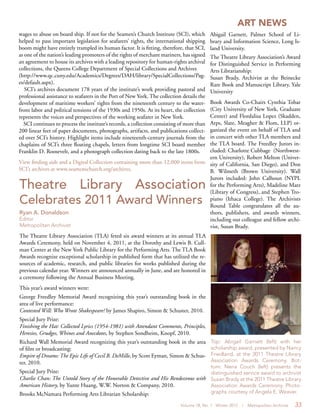
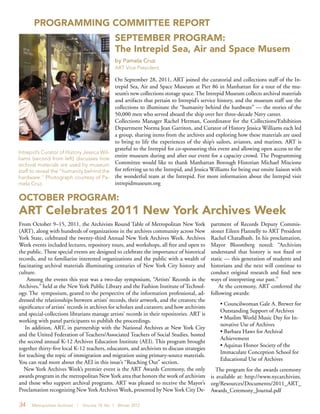
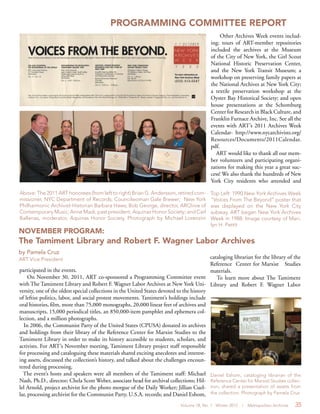
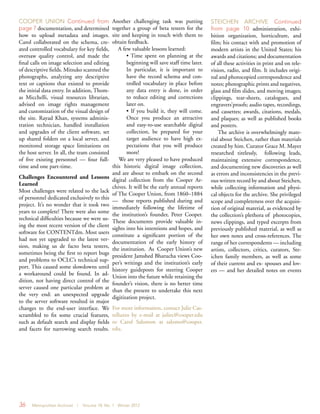
Rachel Chatalbash
President
Pamela Cruz
Vice President
Mitchell Brodsky
Treasurer
Catherine Carson Ricciardi
Secretary
Elizabeth Pope
Coordinator,
Education Committee
Ryan Anthony Donaldson
Coordinator, Communications &
Outreach Committee
Heather Ball
Coordinator, Membership &
Nominating Committee
Editor-in-Chief
Ryan Anthony Donaldson
Managing Editors
Mary Ann Quinn
Madeline Rogers
Features Editor
Celia Hartmann
Interview Editor
Ellen Mehling
Book Review Editor
Lindsey Wyckoff
ART News Editor
Will Andersen
Student Section Editor
Jesi Bender
Layout Design
Shirin Khaki
New Members
Lindsay Anderberg
Peter Bahra
John Beekman
Anna Bekker
Whitney Berman
Soraya Ciego
Alan Delozier
Kara Flanigon
Allison Grande
Marilyn Hayden
Rachel Jirka
Evie Joselow
Robin M. Katz
Michael Lorenzini
Ashley Maraffino
Ivy Marvel
Lisa Mix
Karen Morse
Elizabeth D. Pessala
Nancy Picchi
Daniel Saftler
Marisa Shaari
Robert Singleton
Rihoko Ueno
Desiree Yael Vester
Brooke Watkins
David Wiltsey
Phyllis Wrynn
Rufus de Rham
Laurie Duke
Kathryn Gronsbell
Kelly Haydon
Kristin MacDonough
Hanan Ohayon
Pratt Institute,
School of Information
and Library Sciences
Laurie Alvandian
Emily Atwater
Caridad Bojorquez
Amalia Butler
Alyssa Carver
Paula Chan
Allison Cloyd
Kenyetta Dean
Laura Elsner
Carolina Garcia
Leigh Hurwitz
Joyce Joseph
Boni Joi Koelliker
Miriam Lakes
Caroline LeFevre
Alyson Leggio
Elizabeth Lizan
Selene Mays
Christina Meninger
Robert Moeller
Aurelia Moser
Gretchen Nadasky
Charlotte Nicholson
WELCOME
The following individuals have joined the Archivists Round Table of Metropolitan
New York since June 2011
The mission of Metropolitan Archivist is to serve members of the Archivists RoundTable of Metropolitan
New York (ART) by:
	 • Informing them of ART activities through reports of monthly meetings
and committee activities
	 • Relating important announcements about individual members and
member repositories
	 • Reporting important news related to the New York metropolitan area
archival profession
	 • Providing a forum to discuss archival issues
Metropolitan Archivist (ISSN 1546-3125) is issued semi-annually to the members of ART. Comments,
questions, or submissions for features should be directed to the editor at outreach@nycarchivists.org.
Deadlines for submissions are April 30 and November 15. Similar inquiries and submissions for reviews
should be directed to outreach@nycarchivists.org.
Preferred length of submissions is 800–1000 words for feature articles and 400–500 words for reviews.
Metropolitan Archivist and ART assume no responsibility for statements made by contributors.
New Student
Members
Long Island
University, Palmer
School of Library
and Information
Science
Lauren Dzura
Michael Floyd
Abigail Garnett
Cherry Montejo
Devon Nevola
Daniel Sokolowski
New York University
Cassandra Brewer
Katie Ehrlich
Kate Feighery
Hester Goodwin
Rachel Greer
Paul Kershaw
Alison Lotto
Elizabeth Lovero
Shira Peltzman
Maggie Schreiner
New York University,
Moving Image
Archiving and
Preservation
Seth Anderson
Christopher Banuelos
Clare O’Dowd
Brenda Park
Aimai Reporter
Alison Rhonemus
Veronica Rodriguez
Roxanne Shirazi
Teresa Silva
Kai Smith
Lauren Spiro
Queens College
Lisa Bocchimuzzo
Lisa Cavanagh
Adam Foldes
Shayna Marchese
Deborah Tint
Daniel Batchelder
Douglas Cantelmo
Julie Dawson
Valerie Coates
Leslie Harker
Lisa Iannucci
Annie Killelea
Ed Kirtz
Marie Lascu
Jonathan Lawler
Christine McCluskey
Miranda Mims
Endo Motoki
R. Brenessa Rovere
Rena Tobey
Cristina Vignone
We extend a special thank you to the following members for their support as
Sponsorship Members:
Celia Hartmann Brenda Parnes
Ricki Moskowitz Heather Strelecki
Sustaining Members:
Gaetano F. Bello Marilyn H. Pettit
Barbara Haws
Volume 18, No. 1 Winter 2012 | Metropolitan Archivist 3
TABLE OF CONTENTS
Letter from the President / Editor’s Note 4
						 5 Discussion Groups
The Cooper Union 100th Anniversary Photographs
by Julie Castelluzzo & Carol Salomon 6
Roundabout Theatre’s Stephen Sondheim Theatre:
Discovering Its Past by Tiffany Nixon 8
Edward Steichen Archive Now Available at the
Museum of Modern Art by Celia Hartmann 10
11 METRO Digitization Grant at the Center for
Jewish History by Susan Woodland
13 Brooklyn Historical Society Launches Project to
Teach Undergrads to Use Archives by Robin Katz
History Coming Home by John Beekman 14
15 FROM FEVER TO FOLDER: Session Presentations
from the “To the Source” Symposium by Grace Lile,
Jonathan Lill, and Jenna Freedman
INTERVIEW WITH THE ARCHIVIST: Connecting &
Cementing Communities in the Information
Ecosystem: An Interview with
Jason Kucsma 20
REACHING OUT: Second Annual K-12 Archives
Education Institute by Barbara Gombach 22
STUDENT SECTION: An MLIS Student’s
Perspective on Archives & Special
Collections by Ann McGettigan 24
25 BOOK REVIEWS
27 CITING COLLECTIONS
ART News 28
Programming Committee Report 34
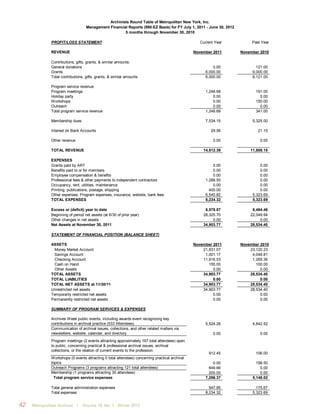
Treasurer’s Report 42
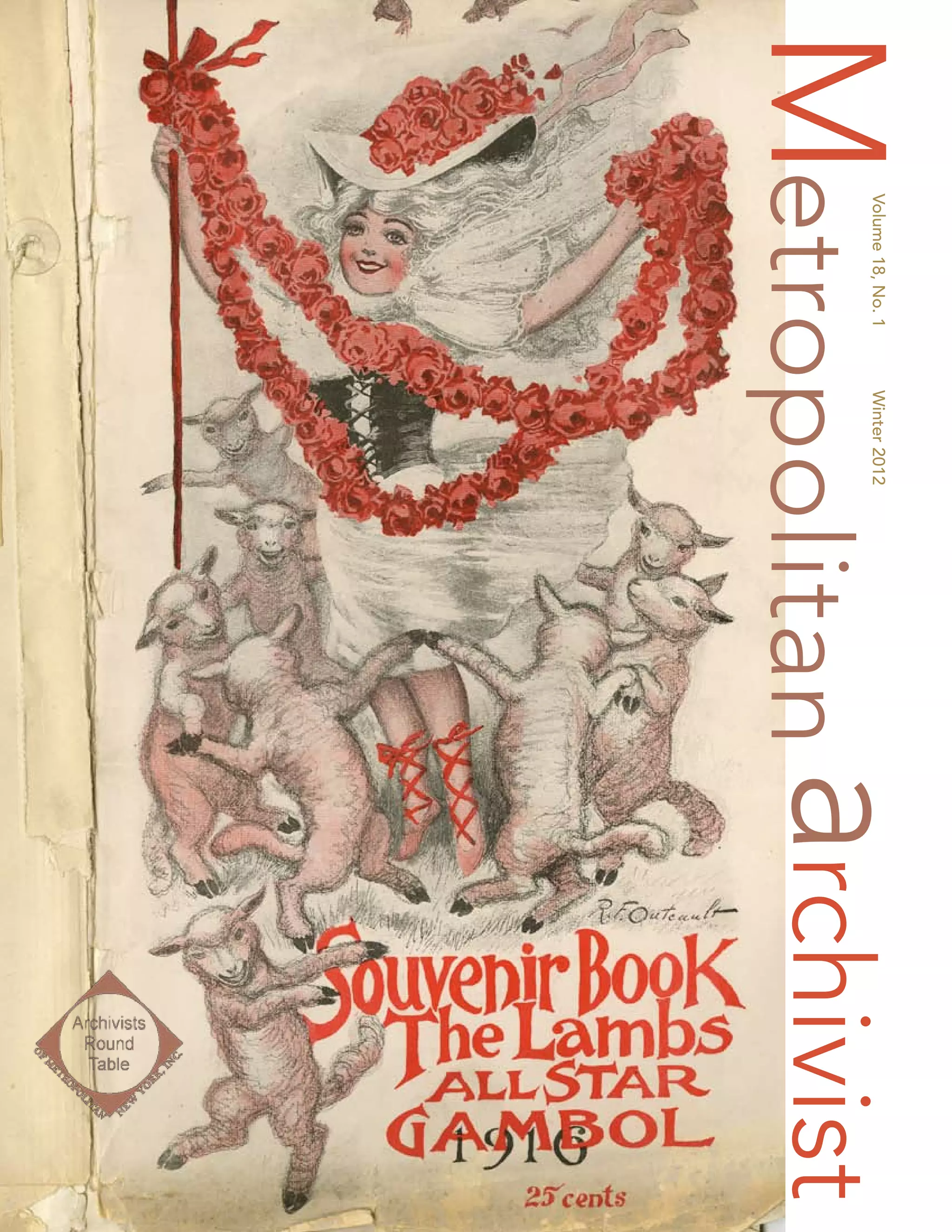
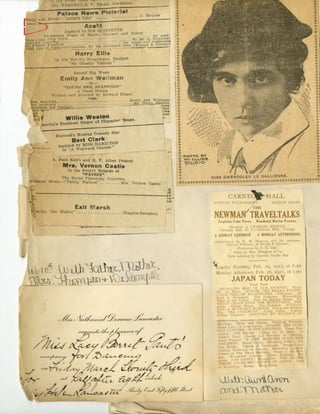
Front and Back Cover: A souvenir program from the Lambs Club All Star Gambol, All the World’s a Stage, 1916, from an
annotated scrapbook belonging to Agnes Miller, Henry Miller’s daughter. Image courtesy of the Henry and Gilbert Miller
Collection, Roundabout Theatre Company Archives.
4 Metropolitan Archivist | Volume 18, No. 1 Winter 2012
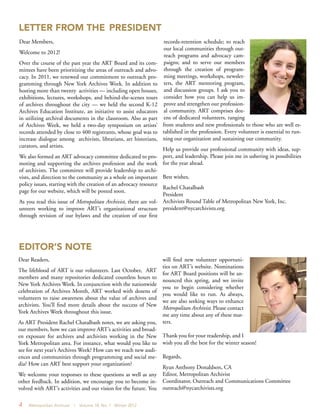
LETTER FROM THE PRESIDENT
EDITOR’S NOTE
Dear Members,
Welcome to 2012!
Over the course of the past year the ART Board and its com-
mittees have been prioritizing the areas of outreach and advo-
cacy. In 2011, we renewed our commitment to outreach pro-
gramming through New York Archives Week. In addition to
hosting more than twenty activities — including open houses,
exhibitions, lectures, workshops, and behind-the-scenes tours
of archives throughout the city — we held the second K-12
Archives Education Institute, an initiative to assist educators
in utilizing archival documents in the classroom. Also as part
of Archives Week, we held a two-day symposium on artists’
records attended by close to 400 registrants, whose goal was to
increase dialogue among archivists, librarians, art historians,
curators, and artists.
We also formed an ART advocacy committee dedicated to pro-
moting and supporting the archives profession and the work
of archivists. The committee will provide leadership to archi-
vists, and direction to the community as a whole on important
policy issues, starting with the creation of an advocacy resource
page for our website, which will be posted soon.
As you read this issue of Metropolitan Archivist, there are vol-
unteers working to improve ART’s organizational structure
through revision of our bylaws and the creation of our first
records-retention schedule; to reach
our local communities through out-
reach programs and advocacy cam-
paigns; and to serve our members
through the creation of program-
ming meetings, workshops, newslet-
ters, the ART mentoring program,
and discussion groups. I ask you to
consider how you can help us im-
prove and strengthen our profession-
al community. ART comprises doz-
ens of dedicated volunteers, ranging
from students and new professionals to those who are well es-
tablished in the profession. Every volunteer is essential to run-
ning our organization and sustaining our community.
Help us provide our professional community with ideas, sup-
port, and leadership. Please join me in ushering in possibilities
for the year ahead.
Best wishes,
Rachel Chatalbash
President
Archivists Round Table of Metropolitan New York, Inc.
president@nycarchivists.org
Dear Readers,
The lifeblood of ART is our volunteers. Last October, ART
members and many repositories dedicated countless hours to
New York Archives Week. In conjunction with the nationwide
celebration of Archives Month, ART worked with dozens of
volunteers to raise awareness about the value of archives and
archivists. You’ll find more details about the success of New
York Archives Week throughout this issue.
As ART President Rachel Chatalbash notes, we are asking you,
our members, how we can improve ART’s activities and broad-
en exposure for archives and archivists working in the New
York Metropolitan area. For instance, what would you like to
see for next year’s Archives Week? How can we reach new audi-
ences and communities through programming and social me-
dia? How can ART best support your organization?
We welcome your responses to these questions as well as any
other feedback. In addition, we encourage you to become in-
volved with ART’s activities and our vision for the future. You
will find new volunteer opportuni-
ties on ART’s website. Nominations
for ART Board positions will be an-
nounced this spring, and we invite
you to begin considering whether
you would like to run. As always,
we are also seeking ways to enhance
Metropolitan Archivist. Please contact
me any time about any of these mat-
ters.
Thank you for your readership, and I
wish you all the best for the winter season!
Regards,
Ryan Anthony Donaldson, CA
Editor, Metropolitan Archivist
Coordinator, Outreach and Communications Committee
outreach@nycarchivists.org
Volume 18, No. 1 Winter 2012 | Metropolitan Archivist 5
DISCUSSION GROUPS
On Tuesday, June 28, 2011, a group of archivists gathered at the Kellen Design Ar-
chives at The New School to discuss the role of oral histories in and out of the ar-
chives.
Questions included: Does your repository have an oral history program, or are you
thinking about starting one? Do you work with another department in your institu-
tion that conducts oral histories?
Or, do you have a cache of old inter-
views on audiocassette that you’re trying
to decide what to do with?
The following issues were addressed:
• Deciding to shoot video, or
only to record audio
• Role of the archivist in creat-
ing oral history
• Selecting/buying/leasing
equipment
• Choosing subjects
• Coordinating with other
departments
• Pre- and post-interview
communication with interview
subjects
• Transcription
• Online access to audio and
transcripts
• Digitizing recordings
• Rights issues
• Use in exhibitions
ART DISCUSSION GROUP #8: Oral Histories and the Archives
by Editorial Staff
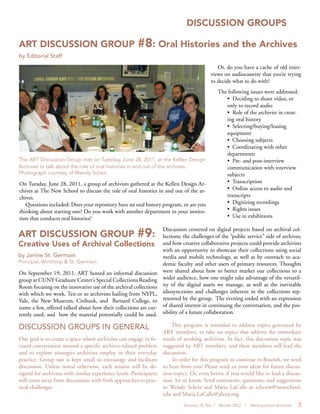
The ART Discussion Group met on Tuesday, June 28, 2011, at the Kellen Design
Archives to talk about the role of oral histories in and out of the archives.
Photograph courtesy of Wendy Scheir.
ART DISCUSSION GROUP #9:
Creative Uses of Archival Collections
by Janine St. Germain
Principal, Winthrop & St. Germain
On September 19, 2011, ART hosted an informal discussion
group at CUNY Graduate Center’s Special Collections Reading
Room focusing on the innovative use of the archival collections
with which we work. Ten or so archivists hailing from NYPL,
Yale, the New Museum, Citibank, and Barnard College, to
name a few, offered talked about how their collections are cur-
rently used, and how the material potentially could be used.
DISCUSSION GROUPS IN GENERAL
Our goal is to create a space where archivists can engage in fo-
cused conversation around a specific archives-related problem
and to explore strategies archivists employ in their everyday
practice. Group size is kept small to encourage and facilitate
discussion. Unless noted otherwise, each session will be de-
signed for archivists with similar experience levels. Participants
will come away from discussions with fresh approaches to prac-
tical challenges.
Discussion centered on digital projects based on archival col-
lections; the challenges of the “public service” side of archives;
and how creative collaborative projects could provide archivists
with an opportunity to showcase their collections using social
media and mobile technology, as well as by outreach to aca-
demic faculty and other users of primary resources. Thoughts
were shared about how to better market our collections to a
wider audience, how one might take advantage of the versatil-
ity of the digital assets we manage, as well as the inevitable
idiosyncrasies and challenges inherent in the collections rep-
resented by the group. The evening ended with an expression
of shared interest in continuing the conversation, and the pos-
sibility of a future collaboration.
This program is intended to address topics generated by
ART members, to take on topics that address the immediate
needs of working archivists. In fact, this discussion topic was
suggested by ART members, and these members will lead the
discussion.
In order for this program to continue to flourish, we need
to hear from you! Please send us your ideas for future discus-
sion topics. Or, even better, if you would like to lead a discus-
sion, let us know. Send comments, questions, and suggestions
to Wendy Scheir and Maria LaCalle at scheirw@newschool.
edu and Maria.LaCalle@jdcny.org.
6 Metropolitan Archivist | Volume 18, No. 1 Winter 2012
Volume 18, No. 1 Winter 2012 | Metropolitan Archivist 7
THE COOPER UNION
100th ANNIVERSARY
PHOTOGRAPHSby Julie Castelluzzo
Electronic Services Librarian and Digital Projects Coordinator
The Cooper Union Library
Carol Salomon
Archives Librarian and Acting Director
The Cooper Union Library
• The content would be of inter-
est to researchers both inside and
outside the institution, including
historians, alumni, and develop-
ment personnel
• The photographs would provide
a touchstone for Cooper Union’s
150th Anniversary Celebration,
which would take place in 2009.
Personnel
Without funds for additional staff, we
decided that existing library personnel
would take on the project as a team, even
though the staffing level at the time could
be best described as adequate. The learn-
ing curve would be steep, and it meant
trying to squeeze more work out of the
day. However, the benefits of experience
gained as well as the promotion and vis-
ibility for the Cooper Archives and the
Library in general outweighed the costs.
CarolSalomonandJulieCastelluzzo,the
archives librarian and electronic services
librarian, respectively, attended a MET-
RO workshop on the basics of CON-
TENTdm, along with Mitsuko Brooks,
part-time archives assistant. They formed
the core of the team. Julie became project
coordinator, learned the basics of Dub-
lin Core, put together the initial record
schema and Continued on page 36
On April 20, 2011, The Cooper Union Library announced the first searchable digital
collection from the Cooper Archives: The Cooper Union 100th Anniversary Photo-
graphs. The collection consists of 198 scanned photographic prints depicting events
surrounding the 100th anniversary, in the 1950s, of the founding of The Cooper
Union for the Advancement of Science and Art. The centennial began with a three-
day convocation in 1956 and culminated in the 100th Anniversary Convocation on
November 2, 1959. Many notable individuals addressed the guests and participated
in panel discussions held at The Cooper Union and at various locations in Manhat-
tan. Speakers included the architect R. Buckminster Fuller, former President of the
United States Herbert Hoover, Supreme Court Justice Felix Frankfurter, and writer
and urbanist Lewis Mumford.
Undertaking a First Digitization Project and Finding the Means
The Cooper librarians initially discussed a potential digital project in March 2009.
Ideas for projects from the archives had been brewing for years but had not taken off,
mainly due to budgetary constraints. Having been unsuccessful with grant applica-
tions, we lacked hardware and software for an appropriate development platform and
personnel with the necessary skills, namely familiarity with the standards and best
practices involved in creating an archival digital collection and ability to maintain a
server.
Two major obstacles disappeared with the addition of a hosted instance of the
CONTENTdm digital collection management software through OCLC, at no ad-
ditional cost beyond the existing FirstSearch Base Package subscription. It eliminated
the need for a server in house, and provided the right software for the task.
Next came the choice of a collection to digitize. The 100th Anniversary Photo-
graphs were chosen because:
• They had not been cataloged at the item level
• The collection was a manageable size
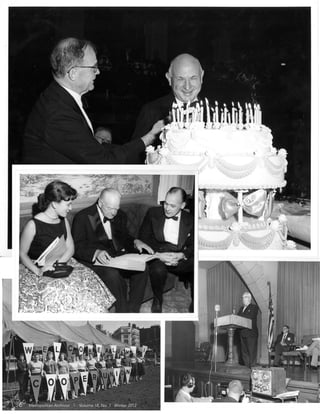
Previous Page, top: Cooper Union Board Chairman Irving S. Olds and President Edwin S. Burdell about to cut the 100th-
anniversary cake, Waldorf-Astoria Hotel, November 2, 1959. Center: Herbert Hoover, former President of the United States,
and Honorary Chairman of the Cooper Union Centennial Committee, holding his translation of Agricola’s De re metallica,
October 9, 1956. The volume is now part of the Cooper Union Library’s collection. Bottom right: Richard Buckminster Fuller
addressing the General Session of the 1956 Convocation on the topic “The Union of Science and Art,” October 6, 1956, in
the Great Hall of The Cooper Union. Bottom left: Cooper Art School students holding banners welcoming alumni to the
Alumni Association tent, erected on the former Bible House site, for the alumni gathering luncheon, October 6, 1956.
All photographs courtesy of The Cooper Union
8 Metropolitan Archivist | Volume 18, No. 1 Winter 2012
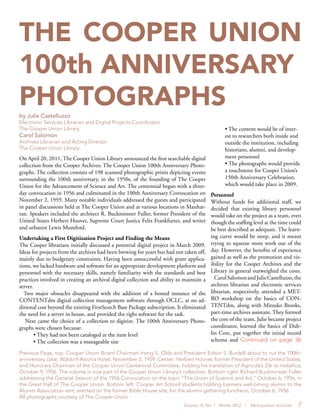
Restored panel salvaged from the Henry Miller’s Theatre.
Photograph by Ryan Donaldson.
Roundabout Theatre’s
Stephen Sondheim Theatre:
Discovering Its Pastby Tiffany Nixon
Archivist, Roundabout Theatre
Company
The Roundabout Theatre Company’s
connection to Henry Miller’sTheatre (re-
named the Stephen Sondheim Theatre in
2010) dates to the late 1990s. The venue
was then operating as a nightclub, and
we leased it for a production of Cabaret.
The dark seediness provided the perfect
venue for Roundabout’s gritty revival,
which ran there for nine months. Fol-
lowing a construction accident nearby,
the production was forced to relocate to
another nightclub — the notorious Stu-
dio 54.
When Henry Miller’s Theatre reopened
in 2009 following major renovations
it made headlines as Broadway’s first
LEED-certified theater; less heralded was
the care that had been taken to preserve
not only the historic neo-Georgian fa-
çade, but also the box office lobby and
interior artifacts, which are now dis-
played throughout the theater. Doors,
wall panels, and plaster friezes provide
a remarkable and historic look at the
motifs and color schemes of the original
1918 building.
Recovering a Piece of History
This story, however, is not about the
fresh new theater but instead, about the
decaying former theater and one man’s
attempt to salvage a tiny piece of its for-
mer glory. In July 2010, the house staff
at Henry Miller’s Theatre contacted me:
a man had left a piece of artwork, with
his phone number and a note explaining
that the piece was original to the Henry
Miller’s Theatre. I raced there and found
a piece of canvas, 11 by 24 inches, de-
picting two reclining figures in a black cameo surrounded by a floral motif in greens
and reds, surmounted by a lovely woman’s face. The canvas showed missing and
cracked paint, but overall the colors and condition were remarkably intact. The note
stated that the piece was one of the last surviving interior-design elements from the
mezzanine loge of the original Henry Miller’s Theatre. It had been in private hands
for thirty years, and the owner was now returning it.
As I admired this piece of nearly 100-year-old theater history I was transported
to 1922: watching Miss Billie Burke recite her lines to Alfred Lunt in The Intimate
Strangers. Oh, the stories this panel could tell! After gathering my senses, I covered
the panel, placed it on a piece of cardboard, and carefully walked it through tourist-
clogged Times Square, back to the Roundabout Archives.
The Henry Miller’s Theatre is owned by The Durst Organization, but because the
theater’s records — including some contracts dating to the 1920s and ‘30s discovered
during the renovation — fell outside of Durst’s collecting policy, they were gifted to
the Roundabout Archives where they now reside, forging a connection between the
two organizations. I contacted The Durst Organization’s archivist, who immediately
came to view the artifact. We decided it was best to relocate it to his collection for
preservation. Then I contacted the man who had left it for us.
The Man Behind the Panel
Dan Olderman, an actor dabbling in theater construction in the late 1970s, had
Volume 18, No. 1 Winter 2012 | Metropolitan Archivist 9
stopped by the Henry Miller’s Theatre to oversee its demolition/renovation into a
disco. As an actor and a theater-history enthusiast it pained him to see original de-
tails destroyed, so he had the painted panel removed, including the entire section of
wall behind it. He carried that chunk of wall back to his apartment on the subway.
(Envision that in the 1970s!) He had arrived too late to save all eight of the painted
mezzanine panels, but he did save this one.
As Mr. Olderman tells it, upon examining the piece, he detected a painting beneath
the surface grime. He chipped away at the posterior plasterwork, and consulted a
museum conservator who instructed him in cleaning techniques. Eventually he un-
covered an original painted motif used throughout the Henry Miller’s Theatre (and
now found in the historic artifacts on display in the renovated Stephen Sondheim
Theatre). Mr. Olderman had the panel framed and took it with him when he left
New York. He took good care of the panel, and says that the woman above the cameo
elevations, photographs, and more).They
help us understand our history, and shed
light on New York’s relationship to the-
ater and theater houses: how they have
been historically used (and misused), re-
purposed, and reconstructed.
This recently acquired panel, in its
original state with its vivid colors and
lovely artistry, emphasizes the beauty and
craftsmanship of early twentieth-century
theater design. Working together, our
two archives benefited from this discov-
ery: The Durst Organization Archives
became his muse. When he heard about the restoration of Henry Miller’s Theatre
back to a legitimate venue, he decided, after three decades of stewardship over a small
but lovely piece of local theater history, to return it to the theater.
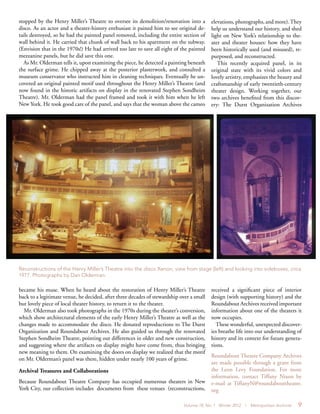
Mr. Olderman also took photographs in the 1970s during the theater’s conversion,
which show architectural elements of the early Henry Miller’s Theatre as well as the
changes made to accommodate the disco. He donated reproductions to The Durst
Organization and Roundabout Archives. He also guided us through the renovated
Stephen Sondheim Theatre, pointing out differences in older and new construction,
and suggesting where the artifacts on display might have come from, thus bringing
new meaning to them. On examining the doors on display we realized that the motif
on Mr. Olderman’s panel was there, hidden under nearly 100 years of grime.
Archival Treasures and Collaborations
Because Roundabout Theatre Company has occupied numerous theaters in New
York City, our collection includes documents from these venues (reconstructions,
received a significant piece of interior
design (with supporting history) and the
Roundabout Archives received important
information about one of the theaters it
now occupies.
These wonderful, unexpected discover-
ies breathe life into our understanding of
history and its context for future genera-
tions.
Roundabout Theatre Company Archives
are made possible through a grant from
the Leon Levy Foundation. For more
information, contact Tiffany Nixon by
e-mail at TiffanyN@roundabouttheatre.
org
Reconstructions of the Henry Miller’s Theatre into the disco Xenon, view from stage (left) and looking into sideboxes, circa
1977. Photographs by Dan Olderman.
10 Metropolitan Archivist | Volume 18, No. 1 Winter 2012
The Edward Steichen Archive is now
available to researchers in the archives
at The Museum of Modern Art. The
Steichen archive was assembled from
1968 to 1980 in the museum’s Depart-
ment of Photography, which Steichen
(1879–1973) headed from 1947 to 1962.
Designed as a study resource on Steichen’s
life and output as painter, designer, pho-
tographer, museum professional, and
film-maker, the archive includes origi-
nal correspondence, photographs and
sketches, still and moving images, sound
recordings, tear-sheets, and other materi-
als. The archive’s finding aid is searchable
online from any Internet-enabled device
(http://www.moma.org/learn/resources/
archives/EAD/steichenf); the physical
materials can be consulted, by appoint-
ment at MoMA’s Queens Archives Read-
ing Room ( http://www.moma.org/learn/
resources/archives/archives_contact).
According to René d’Harnoncourt
who served as MoMA’s director from
1949 to 1967: “The function of the ar-
chive will be to collect, catalog and su-
pervise the use of research materials that
will amplify and clarify the meaning of
Steichen’s contribution to the art of pho-
tography, and to modern art generally…”
He noted that it was designed to comple-
ment Steichen’s work in various media
in the museum context, “where it could
be studied in proximity to the museum’s
rich collection of works by Steichen and
by many of the other artists with whom
he has been most closely associated.”
The archive was created by Grace M.
Mayer. She began her career in the Department of Photography as assistant to the
director in 1959 and became curator of photography in 1962. She retired in 1968,
returning to serve as curator of the Edward Steichen Archive until the mid-1980s.
As well as seeking, amassing, and organizing materials by, about, and related to
Steichen from individuals, institutions, and published sources, she created detailed
card catalogues of various groups of these materials, now housed in the Grace M.
Mayer Papers, also at MoMA.
The Edward Steichen Archive consists of deliberately selected primary and second-
ary materials (a so-called artificial collection) about Steichen’s personal and family
life; his work in painting, design, photography, museum Continued on page 36
EDWARD STEICHEN
ARCHIVE NOW AVAILABLE
at The Museum of
Modern ART
by Celia Hartmann
Project Assistant Archivist, Edward
Steichen Archive, The Museum of
Modern Art
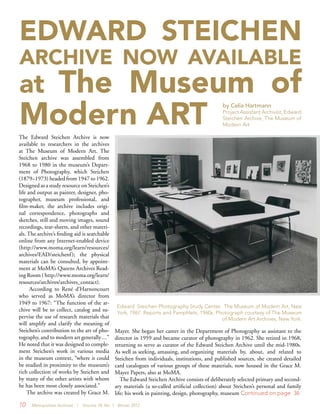
Edward Steichen Photography Study Center. The Museum of Modern Art, New
York, 1967. Reports and Pamphlets, 1960s. Photograph courtesy of The Museum
of Modern Art Archives, New York.
Volume 18, No. 1 Winter 2012 | Metropolitan Archivist 11
METRO Digitization
Grant at the
Center for
Jewish History
by Susan Woodland
Senior Archivist
American Jewish Historical Society
The Hadassah Archives, on deposit with the American Jewish Historical Society at
the Center for Jewish History, announces its completion of a 2010 Collaborative
Digitization Grant from the Metropolitan New York Library Council (METRO).
Thanks to the METRO grant, Hadassah has now digitized fifty audio reels from its
collection, as well as the first twenty years of the Hadassah Newsletter (1914–1933).
The Hadassah grant, which totaled nearly $11,000, was written in collaboration
with the Digital Lab at the Center for Jewish History, where the digitization was done.
The grant permitted the digitization of the audio tapes and optical character recogni-
tion digitization of the newsletter. Additional funds were used to enter the files into
the center’s catalog, where they are now accessible alongside other Hadassah material
and findable in a general search of all of the Center’s digital collections: http://digital.
cjh.org/R/81XK85MRHRILUAVFK34IB39YV4GET9596AGKNAI4F6C25U2X
RS-04640?func=collections&collection_
id=1411.
Sound Recordings
Prior to digitization, the only informa-
tion we had about the audio reels came
from minimal labeling on the packages
or from random documentation included
with the reels. Working from the names,
dates, and events mentioned in the label-
ing, we selected recordings from the en-
tire collection of more than 100 reels for
potential interest to a wide and general
audience, importance in the context of
related materials within the collection,
and, to simplify copyright research, prob-
able ownership by Hadassah. The results
of the project were deeply rewarding, as
the content of the digitized tapes proved
to be rich and varied.
Here are a few of the highlights:
Senator Edward M. Kennedy visiting
Hadassah Hospital, Jerusalem, Sep-
tember 14, 1971
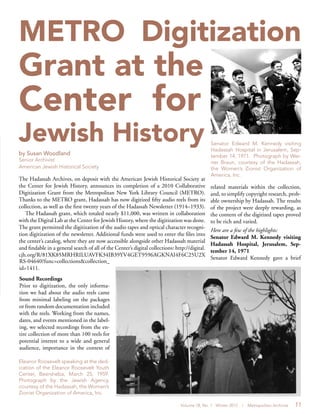
Senator Edward Kennedy gave a brief
Senator Edward M. Kennedy visiting
Hadassah Hospital in Jerusalem, Sep-
tember 14, 1971. Photograph by Wer-
ner Braun, courtesy of the Hadassah,
the Women’s Zionist Organization of
America, Inc.
Eleanor Roosevelt speaking at the ded-
ication of the Eleanor Roosevelt Youth
Center, Beersheba, March 25, 1959.
Photograph by the Jewish Agency,
courtesy of the Hadassah, the Women’s
Zionist Organization of America, Inc.
12 Metropolitan Archivist | Volume 18, No. 1 Winter 2012
interview in Jerusalem after visiting the
Hadassah Medical Center on a fact-
finding mission with the United States
Senate Health Sub-Committee, which
he chaired. Listening to him speak of his
hopes that their findings would be help-
ful in solving the health care crisis in the
United States, one realizes how long the
United States (and, until his death, Sena-
tor Kennedy) had struggled with provid-
ing affordable healthcare coverage.
Listen to the sound recording here:
h t t p : / / d i g i t a l . c j h . o r g : 8 0 / R / -
?func=dbin-jump-full&object_
id=1358925&silo_library=GEN01
Eleanor Roosevelt receiving the First
Henrietta Szold Award at the Waldorf
Astoria (addresses by Rose Halprin
and Eleanor Roosevelt), February 10,
1949
It is a rare treat to hear, on one of Ha-
dassah’s earliest surviving recordings,
Eleanor Roosevelt speaking about her
work with Youth Aliyah, a youth rescue
program that Hadassah began funding
in 1933: “I was in Paris and couldn’t go
to Israel; I had the good fortune of hav-
ing Mr. [Henry] Morgenthau invite my
grandson to go. And he came back with a deep impression of what it meant to see
a young nation being born, to see the enthusiasm of young people, but also deeply
impressed at what that young nation could do for refugees, particularly for children.
And a little bit ashamed that we couldn’t do the same thing in this country. Neverthe-
less I think probably that unselfishness which seems to be able to take other people
and share with them in the most extraordinary way will probably bring great reward
in the future to the young nation of Israel.”
Listen to the sound recording here:
http://digital.cjh.org:80/R/-?func=dbin-jump-full&object_
id=1357370&silo_library=GEN01
Madeline Lewin-Epstein, interviewed in Jerusalem by Moshe (Marlin) Levin,
March 21, 1961
This is one of three surviving recordings of interviews Continued on page 38
Madeline Lewin-Epstein with her fa-
ther-in-law, Eliyahu W. Lewin-Epstein,
and her new husband, Samuel Lewin-
Epstein, soon after arrival in Palestine,
circa 1918, courtesy of the Hadassah,
the Women’s Zionist Organization of
America, Inc.
Hadassah Bulletin No. 1, September 10, 1914. Photograph courtesy of Hadassah,
the Women’s Zionist Organization of America, Inc.
Volume 18, No. 1 Winter 2012 | Metropolitan Archivist 13
Brooklyn Historical Society (BHS) recently launched an ambitious project whose
goal is to create new models for undergraduate instruction in archives. Students and
Faculty in the Archives (SAFA) is a museum-university collaboration that will teach
first-year undergraduates to use primary sources, and will support faculty integra-
tion of archival material into course assignments. The project will establish effective
practices for managing a robust instruction program with limited resources. Most
important, it hopes to demonstrate the benefits of archival instruction.
Project Structure and Design
SAFA is funded by a three-year, $749,997 grant from the U. S. Department of Edu-
cation’s Fund for the Improvement of Postsecondary Education (FIPSE). The project
is led by a full-time, grant-funded team comprising an archivist (the author of this
article) and a historian. Since Spring 2011, we have worked closely with eighteen
faculty members from three partner schools: New York City College of Technology
(City Tech); Brooklyn Campus, Long Island University; and St. Francis College, each
chosen for their proximity to BHS and for their commitment to minority, nontradi-
tional, and first-generation students.
Participating faculty will teach at least one SAFA course per academic year for the
duration of the project (Fall 2011to Fall 2013). Each course will visit BHS at least
once and will produce a website with support provided by SAFA’s contracted educa-
tional technologist. All faculty members receive a stipend.
We want to demonstrate that primary-source research can be useful across a wide
range of courses. In our first semester alone, we welcomed more than 400 students
from fifteen courses in English, history, American studies, religious studies, art his-
tory, photography, and architectural technology. Students, who ranged from honors
students to remedial level, made a total of forty visits to BHS.
By 2013, external evaluators will assess SAFA’s ability to build a collaborative net-
work; design activities; provide faculty development; enhance student archival lit-
eracy skills; and improve student engagement, retention, and academic success. In
our first semester we have already gained insight into the logistics and pedagogy of
undergraduate instruction.
Document Selection
We want SAFA to focus on document analysis, not on searching or finding materials.
This is partly because our collections are not easily discoverable (they soon will be,
thanks to a Hidden Collections grant from the Council on Library and Information
Resources [CLIR]). Most important, we believe first-year students need to hone their
document-analysis skills before learning to pose research questions or to find and
select sources. Therefore we ask professors to pre-select documents for each visit,
considering physical limitations, difficulty, and relevance. Not surprisingly, the most
successful visits gave students ample time with fewer documents.
Preparation for Class Visits
All visits were scheduled before the semester began. We ask faculty to submit online
Brooklyn Historical
Society Launches Project
to Teach Undergrads to Use Archives
by Robin Katz
Outreach and Public Services Archivist
Brooklyn Historical Society
Top: The Othmer Library at Brooklyn
Historical Society. Photograph courtesy
of Brooklyn Historical Society. Center:
Participating faculty at the SAFA Sum-
mer Institute, June 2011. Bottom: The
reading room at Brooklyn Historical
Society is ready for a SAFA class visit.
Photographs by Robin Katz.
call slips (a Google form, which popu-
lates a spreadsheet used by our project’s
invaluable stack assistant) three weeks
before a visit. We pull items, temporarily
re-house and arrange materials, and cre-
ate individual citations. We like to receive
student instructions and agendas a week
before. As we refine and document our
procedures, we want to make visit prepa-
ration more seamless for professors, while
establishing consequences for missed
deadlines. Continued on page 37
14 Metropolitan Archivist | Volume 18, No. 1 Winter 2012
History Coming Home
by John Beekman
Assistant Manager, New Jersey Room
Jersey City Free Public Library
On October 20, 2011, Carl Childs, director of local records for
the Library of Virginia, and his colleague Vince Brooks traveled
to the New Jersey Room of the Jersey City Free Public Library
to take possession of a volume of colonial records that had been
stolen by a Union soldier during the Civil War. Theft and out-
right destruction of records were so common in northern Vir-
ginia through the several conflicts fought there that historians
and genealogists have termed the area “the burned counties.”
Childs noted at the event marking the volume’s return that
“the return of this volume helps to fill a gap in the history of
Stafford County and its inhabitants.” Identifying this volume,
coming to the realization of what it really was, and being a part
of the process of returning it to its proper home in Virginia has
been a humbling, gratifying experience.
An Act of War
In early 1863 Capt. William Treadwell was training African-
American troops in the Washington, D.C. area, after having
served as an aide-de-camp to General Abner Doubleday at An-
tietam. On March 30, 1863, when he was in Stafford County,
about 50 miles down the Potomac, he removed a volume of
records from the county courthouse as a souvenir, and shipped
it home to Boston. It consisted of court orders — summaries
of cases appearing before the local magistrates — from 1749
to 1755, transcribed “in a fair and legible hand” in 1791. As a
record of wills contested and other property disputes and per-
sonal matters, it provides an invaluable glimpse into the daily
lives of the colonists.
Lost in Jersey City
Notations in the book record that Treadwell presented it to
Charles B. Duff, when and where we do not know. It end-
ed up in the possession of William Brinkerhoff, member of a
prominent family of Bergen, the Dutch village that was the first
chartered municipality in New Jersey, which was absorbed into
Jersey City in 1873. A Civil War veteran himself, Brinkerhoff
was a state senator, lawyer, and banker. He was a charter mem-
ber of the Historical Society of Hudson County, and after his
death in 1931, at age 83, his heirs donated the historical items
he had collected to the Society. Continued on page 38
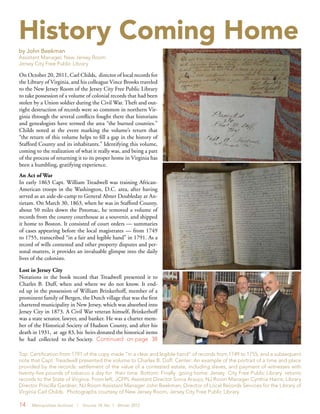
Top: Certification from 1791 of the copy made “in a clear and legible hand” of records from 1749 to 1755, and a subsequent
note that Capt. Treadwell presented the volume to Charles B. Duff. Center: An example of the portrait of a time and place
provided by the records: settlement of the value of a contested estate, including slaves, and payment of witnesses with
twenty-five pounds of tobacco a day for their time. Bottom: Finally going home: Jersey City Free Public Library returns
records to the State of Virginia. From left, JCFPL Assistant Director Sonia Araujo; NJ Room Manager Cynthia Harris; Library
Director Priscilla Gardner; NJ Room Assistant Manager John Beekman; Director of Local Records Services for the Library of
Virginia Carl Childs. Photographs courtesy of New Jersey Room, Jersey City Free Public Library.
Volume 18, No. 1 Winter 2012 | Metropolitan Archivist 15
FROM
FEVER
TO
FOLDER:
Session
Presentations
from
the
“To the
Source”
Symposium
Editor’s Note
On Thursday, March 31, 2011, the
School of Communication and Infor-
mation at Rutgers, the State University
of New Jersey, marked the tenth anni-
versary of its Student Organization for
Unique and Rare Collections Everywhere
(SOURCE) with a one-day symposium
exploring the theory and practice gener-
ated around the concept of SOURCE.
“Across a series of events,” the program
noted, “we will reflect on practices of
collecting, politics and publics of the
archive, critical thought initiated from
and disciplinary discourses framing the
primary source, as well as the material-
ity and form of the source, be it letter,
daguerreotype or digital object.” The
discussion aimed to transcend boundar-
ies, by bringing together academics and
practitioners from a wide range of cultur-
al institutions and attracting an audience
from equally varied backgrounds.
The afternoon session was entitled
“From Fever to Folder: Applying Critical
Theory and Activism in the Archives.”
Panelists were Jenna Freedman, research
and zine librarian, Barnard College; Lau-
ra Helton, History Department, New
York University; Grace Lile, director of
Operations and Archives, WITNESS;
and Jonathan Lill, project archivist for
the Records of P.S. 1, the Museum of
Modern Art Archives. Rachel C. Miller,
Center for Jewish History, was the panel’s
moderator and respondent.
We are pleased to reprint presentations
by Freedman, Lile, and Lill, here.
For Miller’s summary of the day’s event
in a previous issue of Metropolitan Ar-
chivist, see http://www.nycarchivists.org/
Resources/Documents/2011_2.pdf.
Laura Helton, whose paper is not re-
produced here, spoke on “The Archive
as Subject — and Not Just Source — of
Critical History.” For the past eight years,
Laura Helton has simultaneously worked
as an archivist of social movements and
studied those archives as critical sites of
engagement around the problems and
politics of history. She brings to both en-
deavors an interest in critical theory and
interdisciplinary approaches to archival
studies. Her discussion focused on the
intersection of archival practice, the field
of history, and “the archive” as an increas-
ingly popular concept within a variety
of humanities disciplines. The practical,
ethical, methodological, and metaphori-
cal meanings of archives change shape in
each of these contexts. Her presentation
explored whether there is a way to speak
multiple archival languages at once.
Introduction
The concept of “activist archives” or the
“activist archivist,” widely attributed to
Howard Zinn’s seminal SAA address of
1970, has since taken root as part of a
larger discourse of postmodern archiving.
What does the concept mean within the
framework of professional archival prac-
tice and, in particular, for an organization
such as WITNESS, which has advocacy
at the heart of its mission?
The use of the word “activism” in the
context of archives is a bit provocative.
A value-laden term with political con-
notations, it can be positive or negative
depending on who you are and how it is
used. It can connote an agenda, or sug-
gest the promotion of a singular narrative
at the expense of a more complex truth.
Archives are fundamentally concerned
with evidence, truth, control, and objec-
tivity. My intention is to explore some
of the meanings suggested by “activism”
and “activist” within the framework of a
postmodernist approach to archives, to
describe how some of these meanings
come into play in relation to our work
at the WITNESS Media Archive, and to
share a few personal reflections on their
implications for professional identity.
My Background
I graduated from Library School twenty-
three years ago. My late-1980s MLIS pro-
gram was oriented in large part toward
work in public and corporate libraries.
Although I knew I wanted to work with
moving images, there were virtually no
courses devoted to what were often called
“non-book” materials. For most of my
career, I have worked as the first archivist
in organizations whose missions focused
elsewhere, specifically at CNN in New
Activist Archivists,
Archivist Activists:
Identity, Anxiety,
and Politics in the
Archives
by Grace Lile
Director of Operations and Archives
WITNESS
16 Metropolitan Archivist | Volume 18, No. 1 Winter 2012
York and now at WITNESS. Finding
myself outside of what I perceive to be
the archival mainstream of academic,
cultural, or research-oriented institu-
tions, I have often felt a bit on the edges
of the profession.
My work as an archivist in these orga-
nizations has, thus, involved establishing
structures, building databases, imple-
menting standards and schemas, and cre-
ating and writing policies and procedures
for selection, appraisal, description, ac-
cess, preservation — in short, impos-
ing order and functionality where it was
lacking.
I started at WITNESS in 2003. WIT-
NESS is a human rights organization
that trains and partners with grassroots
human rights groups to facilitate the use
of video in their campaigns. This work
takes myriad forms, but in the classic sce-
nario WITNESS trains a locally based
group to use video for an existing human
rights campaign, then collaborates with
them on the production, editing, and
distribution of a video or videos with
very specific advocacy objectives. We co-
own and archive their source footage and
the videos they produce. These partners
have come from over seventy countries
in virtually every region of the world,
and they have led campaigns on topics
ranging from educational discrimination
against Roma children in Bulgaria, to
rape as a weapon of war in Sierra Leone,
to elder abuse in the United States, to
displacement and torture in Burma.
Over the past eight years my colleagues
and I have built the archives from a mini-
mally organized and described collection
of videotapes into an organized, man-
aged, cataloged, curated, and accessible
collection. Our activities have included
creating and developing a database, from
which evolved a full-fledged digital asset
management system; establishing end-
to-end workflows; implementing web
access; and creating procedures and poli-
cies. The archives is fully integrated with
our production and post-production
functions, working seamlessly with video
trainers, editors, media managers, and
producers, and closely with our program
staff. This scenario is fairly atypical in
production environments, where pro-
duction and archives, if archives exist at
all, are typically segregated.
What We Are
We are also fairly unique in being a hu-
man rights advocacy nongovernmental
organization (NGO) with such a fully
developed archives and with both an
internal and external user community.
In my early days here, the focus was on
the potential of the archives as a revenue
source, via the licensing of footage to
news media, filmmakers, and so on, and
we’ve done that: licensing is actually our
primary means of providing external ac-
cess. But we have deliberately shifted our
purpose to one that is mission driven, in-
tegral to human rights advocacy, and not
merely functional, on the one hand, or
a passive resource awaiting distant future
researchers, on the other.
Definitions of Archival Activism
What is archival activism? Perhaps the
first answer is, an intentional commit-
ment to what Verne Harris has deemed
the “call of justice”:
The dimension of power in ar-
chives is made plain in the ex-
treme circumstances of oppres-
sion, and in the heady processes
of rapid transition to democracy,
as shown … for South Africa.
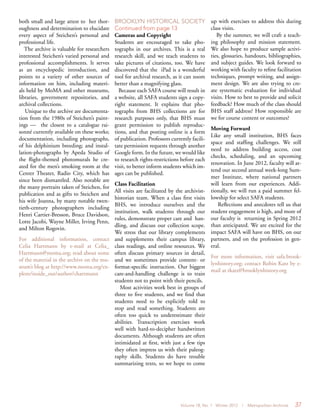
However, even in the relatively
calm backwaters of established
democracies, we ignore the di-
mension of power at our peril.
Archivists, wherever they work
and however they are positioned,
are subject to the call of and for
justice. For the archive can never
be a quiet retreat for professionals
and scholars and craftspersons.
It is a crucible of human experi-
ence, a battleground for mean-
ing and significance, a babel of
stories, a place and a space of
complex and ever-shifting pow-
er-plays. Here one cannot keep
one’s hands clean. Any attempt
to be impartial, to stand above
the power-plays, constitutes a
choice, whether conscious or not,
to replicate if not to reinforce
prevailing relations of power. In
contrast, archivists who hear the
calling of justice, who understand
and work with the archival record
as an enchanted sliver, will always
be troubling the prevailing rela-
tions of power.
Harris touches on one of the critical
concepts in the postmodern discourse:
the distinction between objectivity and
neutrality, the acknowledgment that
neutrality is an illusion at best, a cop-out
at worst, that every decision we make (or
do not) in selection, appraisal, descrip-
tion, and access is informed by organi-
zational, societal, and personal contexts.
The media archives’ mission asserts that
we “collect, document, preserve and pro-
vide access to audiovisual human rights
media in the support of advocacy, pros-
ecution of justice, truthtelling, and the
historical record.”  That does not mean
that we serve only one point of view,
falsify, obscure, suppress, or misrepre-
sent. We apply rigorous standards of
accuracy and truthfulness, and as much
comprehensiveness and transparency as
possible. It does mean that we may be
quite selective in providing access based
on intended use or purpose, and that we
privilege some uses or users over others.
For some archives that would not be an
ethical choice, but for us it aligns with
our mission.
At the same time, the archives’ view of
access is broader than any current cam-
paign or advocacy goal of WITNESS or
our partners, because we believe deeply
in the importance of the collection as his-
torical documentation. Activists, driven
by the urgencies of a current campaign,
sometimes have difficulty grasping the
archival imperative. There is sometimes
a subtle tension within the organization,
a suspicion of archival activities that have
no evident relationship to current work.
Archivists by nature project themselves
into the future. In our minds, our most
important users may not yet be born:
they may be the children of displaced
Karen villagers in Burma, who need and
are entitled to know their history; or the
families of the disappeared in Chechnya,
still awaiting the legal mechanism to
which criminal evidence can be present-
ed. We do not yet know how that access
might happen, but we want to make sure
that it can.
Volume 18, No. 1 Winter 2012 | Metropolitan Archivist 17
Not Just Documenting the
Well-Documented
When gadfly historian Howard Zinn
spoke to the Society of American Archi-
vists in 1970, he excoriated archivists gen-
erally for, in Gerald Ham’s later phrase,
“continuing to document the well-docu-
mented.” Almost by definition, our col-
lection embodies what Zinn, Ham, Ian
Johnston, and many others since, have
advocated: that archives must actively
and assertively document and represent
the poor and powerless, the marginalized
and underrepresented, that majority of
the world’s people who lack ties to eco-
nomic, social, and political power. By its
very existence the archives does this. We
ensure the persistence of footage shot by
grassroots activists, and the videos they
co-produced. These videos reflect their
knowledge, perspectives, and advocacy
goals, rather than those of WITNESS or
other external media makers.
On the other hand, we recognize that
every act of archiving is a form of media-
tion. Our catalog is in English, although
we have some records and portions of
records in other languages. It does not
approach the breadth of the source ma-
terial, in which more than seventy-five
languages are represented. We select, de-
scribe, and present according to our own
assumptions about quality, significance,
usefulness to our current work, and so
on. We do make conscious choices to
reflect a subject’s perspective rather than
a standard. One example is our use of
the word Burma rather than Myanmar,
which is no more or less than a politi-
cal statement; another example is that
we use the word Feminicide (versus the
more prevalent Femicide) to reflect our
partner’s preference. We sometimes con-
fer with partners about subsequent foot-
age use, even when we are full co-owners;
we try as much as possible to consider
and provide context for sensitivities not
readily apparent. For example, footage of
forensic anthropology missions at Guate-
malan massacre sites depicts a very objec-
tive, scientific process of documentation
for legal purposes. But it also shows the
gravesites of murder victims, their fami-
lies often present, perhaps off-camera, for
whom it has Continued on page 39
The Intersection of Art
Museums, Archives, and
Critical Theory
by Jonathan Lill
Processing Archivist for the Archives of
P.S. 1
The Museum of Modern Art
As a processing archivist, I do not feel
the effect of critical theory in my every-
day tasks and activities. Nor do I see it as
having a role of any significance in the
quotidian functioning of the archives as
a whole. Yet, critical theory has been a
force in art-making for more than forty
years, and it continues to shape the ac-
tivities of curators and museums. Using
the example of materials recently on view
at MoMA, I want to highlight some ac-
tivities of artists and museums that I see
as both relating directly to critical theory
and, directly or indirectly, involving the
museum Archives.
When I wrote this paper, the second-
floor galleries surrounding the atrium
were showing a selection of works from
the permanent collection focusing on the
1970s, 1980s, and later. The installation
was mainly concerned with alternative
currents in the art world: things that are
not primarily painting and sculpture.
Among these pieces was a work by Fluxus
artist George Maciunas. The work, enti-
tled One Year (from 1973-1974), is sim-
ply a selection of the food containers he
purchased and ate from over the course
of a year. Thus the viewer sees only a neat
stack of soup cans, boxes from frozen
vegetables, and other cartons. The work
is nothing more than the record of Maci-
unas’s diet.
Maciunas’s food containers not only
undermine Walter Benjamin’s aura of art
by virtue of their identity as utterly ba-
nal mass-produced consumer goods, but
also, as a collection of objects compiled
by the artist, mock the historical produc-
tion and collection of artwork that muse-
ums traditionally contained. The idea of
making a work of art simply by collect-
ing things was at this time a new idea,
one that I think is strongly connected to
structuralist ideas of the grammar and
rhetoric of organizational systems, and
how relationships and meaning can be
created between objects when they are
placed in a system. Furthermore, this
idea of self-archiving, of individuated
collection-building, has more recently
been seen at MoMA in the work of Chi-
nese artist Song Dong, who, with his
mother’s cooperation, installed the entire
contents of her home, from China, in the
museum’s atrium. He thereby displayed,
in some sense, an archives of a life.
The museum confronts within itself
contending ideas of order and narrative.
The institutional archives is thus chal-
lenged to defend our own ideas of order.
This is a healthy dialogue to have; it helps
the archives reaffirm its processes and
provides opportunities for communica-
tion about our methods and our mission.
Only in bad dreams do I feel threatened
by this challenge: at P.S.1 we were told
that the administrators were delighted to
allow an artist to use, in an installation,
old records of the school that had pre-
viously occupied the building. I do not
know where those materials went and
am uncomfortable with the idea of the
archives as artist’s plaything.
Around the corner from the Maciunas
work was a room devoted to political and
protest work from the 1980s. In one cor-
ner was an array of posters, charts, graphs,
and informational materials prepared by
the Guerrilla Girls around 1987. The
Guerrilla Girls were a group of promi-
nent women artists who anonymously
staged protests and other activities that
critiqued museums, art critics, and gal-
leries for the systematic exclusion and
marginalization of women artists from
their respective spaces. While the Guer-
rilla Girls’ activities are tied to a specific
moment in time, they are also related to
earlier works of protest, street theater,
and other performance works conducted
by artists and staged outside and in op-
position to the gallery and museum set-
ting.
As a whole those activities produced no
permanent works of art. Rather, we are
frequently left only with printed materi-
als, such as the informational charts and
graphs the Guerrilla Girls produced, or
ephemera, such as their posters and hand-
18 Metropolitan Archivist | Volume 18, No. 1 Winter 2012
SLIDE 1
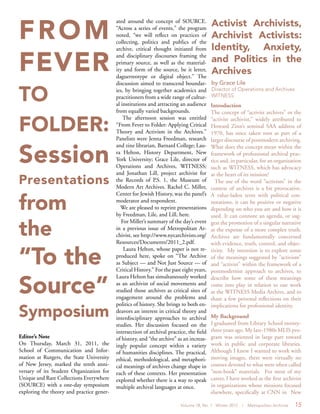
I presented this “perzine-tation” at the “To the Source Sympo-
sium” at Rutgers, naming it after “personal zines” or “perzines.”
I did so to signal that my offering was going to be far less schol-
arly than the presentations of my co-panelists (Laura Helton,
Grace Lile, and Jonathan Lill) and our extremely erudite mod-
erator, Rachel C. Miller, who also curated the panel.
The Zines Are in Charge: A Radical
Reference Librarian in the Archives
by Jenna Freedman
Zine Librarian
Barnard College Library
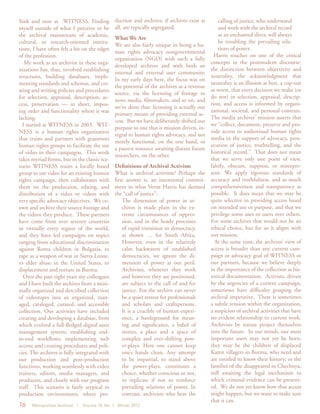
SLIDE 2
Readers should know that I am not an archivist. I could better
be described as an accidental special collections librarian, hav-
ing pitched the zine collection to the (then) library dean, Carol
bills. In other words, what remains is something approaching
an archival record. Not all of these types of materials make it to
the archives. Materials may end up in vertical files, pamphlet
collections, or elsewhere.
As the artist has taken up activities not specifically tied to
the creation of enduring objects, the evidence of the art ac-
tivity passes out of the museum’s curatorial departments into
the hands of archives and other Continued on page 40
Falcione, and having learned a few things about archival and
special collections practices, after making many mistakes along
the way. While I am an academic librarian who has written or
contributed to peer-reviewed publications, my focus tends to
be on practice, which perhaps reflects my activism. These days
I see myself as somewhere between activism and scholarship. I
am not as actively engaged as I once was in political demonstra-
tions and campaigns, and I am not writing about them much
either, not even on my blog. What I am doing, and probably
why I was asked to participate in this event, is collecting, pre-
serving, and providing access to the creative, emotional, and
intellectual output of young women activists, in the form of
zines.
It is not just my political orientation, however, that informs
my work with zines; it is my librarian orientation: reference.
Archivists and librarians must constantly balance the seesaw
that places access at one end and preservation at the other. As
a reference librarian (or, doormat), whenever there is a choice
to make, I tend to privilege access over preservation. That’s no
better or worse than what a trained or born archivist does, it’s
just important to note.
You may be annoyed by the first person, casual tone of this
presentation/essay. In part, the style is meant to mimic that of
a personal zine, hence the “perzine-tation” subtitle. The other
part is to signal that the lines in my life as a librarian, an activ-
ist, and just me are extremely blurry. Many librarians identify
strongly with their jobs, and I am no exception. I do a lot of
Barnard work from home, and occasionally I do work for Radi-
cal Reference (a group of librarians who serve the information
needs of activists and independent journalists) from Barnard. I
feel like I am always “on” as a zine librarian, a member of Radi-
cal Reference, or as a librarian in general.
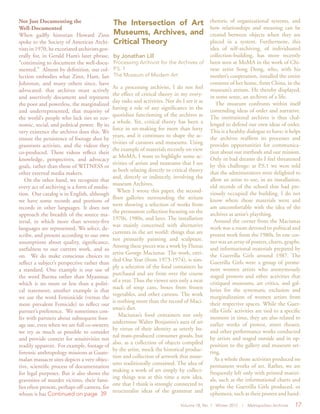
SLIDE 3
The Barnard Library Zine Collection policy is as follows:
Barnard’s zines are written by women (cis- and transgender)
with an emphasis on zines by women of color. We collect zines
on feminism and femme identity by people of all genders. The
zines are personal and political publications on activism, anar-
chism, body image, third wave feminism, gender, parenting,
Volume 18, No. 1 Winter 2012 | Metropolitan Archivist 19
queer community, riot grrrl, sexual assault, trans experience,
and other topics.
The policy has changed twice in the seven-year history of the
zine collection, both with substantial input from the commu-
nity. As a zine librarian, in addition to privileging access over
preservation, I favor anarcho-punk-influenced zine community
mores, rather than the tenets of librarianship, when the two are
in conflict.
So that you know where I am coming from, let me quote
from Dylan Clark’s article “The Raw and the Rotten: Punk
Cuisine” (Ethnology 43 [2004], 1: 19), about how punk ideals
affect food choices, to explain how I understand that anarcho-
punk influence:
Being punk is a way of critiquing privileges and challenging
social hierarchies. Contemporary punks are generally inspired
by anarchism, which they understand to be a way of life in
favor of egalitarianism and environmentalism and against sex-
ism, racism, and corporate domination.
Examples of honoring zinesters’ wants and needs over librari-
anship’s include removing someone’s name from the catalog
record, even if it is explicitly stated in the zine; always asking
for permission to use zine cover and interior images and quo-
tations, even when they would be considered fair use with a
mainstream publication; and asking people whose gender ex-
pressions have changed since they published their zine wheth-
er they feel comfortable having their work in a collection of
women’s zines.
The more recent of the two collection changes was meant to
be more explicit about our inclusion of zines by transgender
and transsexual women, as well as cisgendered (meaning hav-
ing your gender match your sex) women. I started by present-
ing the old statement and a new version and soliciting feed-
back on our LiveJournal blog (http://barnardzines.livejournal.
com/79446.html).
Some back-and-forth on and off the website led us to our
current statement. Community contributions were both sur-
prising and helpful. We learned that in going out of our way to
include trans women, we were actually reinforcing a difference.
We might have done better to leave the statement as it was,
at least regarding women (cis- and trans-). Getting e-schooled
by the trans community was sometimes painful, but it was
educational and worth the effort, and I hope it will yield trust
dividends down the line. I do find that nearly everything I do
purely out of a sense of duty to the zine community ends up in
the plus column for the library: donations, publicity, and good
will, even if that is not at all what drives me.
Being driven almost always leads to extra work. In the case
of the Barnard Library Zine Collection, it sometimes means
doing twice as much. I catalog the zines in the catalog Bar-
nard shares with Columbia University, CLIO, and thereby in
WorldCat. However, because the Anglo American Cataloging
Rules, not to mention Library of Congress Subject Headings
(LCSH), do not always serve zines (or any library holdings) as
well as they could, I enter more details about each zine in a pre-
cataloging database available only on the password-protected
Barnard library network. The privacy is a good thing: it allows
me to include writers’ real names and other information that is
important for me, my colleagues, and successors to know, but
that does not belong in public view.
My biggest LCSH complaints right now? The lack of an ac-
cess point for people who identify as queer, rather than gay,
lesbian, or bisexual, and people who prefer to be described as
survivors rather than victims, e.g., rape survivors. The umbrella
term available for queer is “sexual minorities,” which is not es-
pecially popular with those whom it is meant to describe.
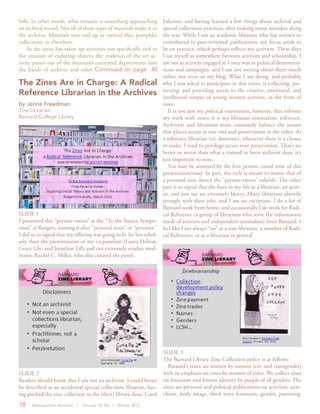
SLIDE 4
Other Library of Congress Subject Headings I wish the Subject
Authority Cooperative Program (SACO) would reconsider:
• Fan magazines: http://lowereastsidelibrarian.info/
lcsh/2009/week35/fanzines
This really makes my blood boil. It happened over two
years ago, and I am still outraged. The Library of Con-
gress, in all its wisdom (ha!) merged Fanzines and Fan
magazines (they are nothing alike) under the heading of
Fan magazines (which is by far the less popular genre).
• Butch and Femme: http://lowereastsidelibrarian.info/
butchandfemme
I’ve been agitating for ages on my blog and via the suggest
terminology form (http://id.loc.gov/authorities/subjects/
sh2009007614.html ) to establish headings for Butch and
for Femme identities.
• Sizeism (http://lowereastsidelibrarian.info/fatacceptan-
ceplease)
This is another heading I’ve been agitating for, on the
grounds that people of size do not necessarily identify or
want to be identified as overweight or obese, that these
descriptors are inappropriate, inaccurate, and pejorative.
• Privilege
LC recently rejected White Privilege as a subject heading.
This is a descriptor that I would love to apply to zines,
along with Male or Gender Privilege, Class Privilege, and
so forth. From the SACO list White privilege:
White privilege is a Continued on page 41
20 Metropolitan Archivist | Volume 18, No. 1 Winter 2012
This issue’s interview is with Jason Kucs-
ma, the new executive director of the
Metropolitan New York Library Council
(METRO). Jason’s appointment was an-
nounced at the METRO Annual Meet-
ing on October 17, 2011. In November,
I sent him some questions by e-mail and
he kindly responded. Our correspon-
dence, slightly edited, appears in full,
below.
Where did you grow up?
I was born and raised on the east side
suburbs of Cleveland, Ohio. After grad-
uating from high school, I moved to
northwestern Ohio where I spent most
of the next thirteen years.
Can you tell us about your educational
background?
I went to Bowling Green State University
[BGSU] for my undergraduate degree (in
communication) and first master’s degree
in American Culture Studies. I wrote
my thesis on zines (independent/under-
ground press) and the role they play in
raising consciousness around race, class,
and gender issues for people from com-
munities of privilege. As someone from
an upper-middle-class family, where I
wasn’t really exposed to those issues, it
was an opportunity for me to work out
some ideas I had about progressive poli-
tics.
How did you first become interested in li-
braries and cultural heritage?
While I was working on my master’s at
BGSU, I had the opportunity to work
with great librarians at both the Brown
Popular Culture Library and the Music
and Sound Recording Archives. At the
time, I was teaching undergraduates,
working on my thesis, organizing an an-
nual conference for independent media
makers (still going strong in Detroit: Al-
lied Media Conference), and working on
launching a nationally distributed pro-
gressive politics, culture, and arts maga-
zine. Still, I knew from my time working
in those libraries that I’d like to return to
that environment one day. Fast forward
seven years or so, and my girlfriend at the
time (now my wife) and I started talking
about going back to school for our MLS
degrees. We moved to Tucson and started
the program at the University of Arizo-
na’s School of Information Resources and
Library Science around the same time I
was working with my partners to shut-
ter our magazine’s doors after publishing
thirty-eight issues over seven years.
In your career, you’ve previously focused on
publishing, including your work as founder
of Clamor Magazine. Did your previous
experience in publishing inform your later
work with libraries?
Absolutely! I got involved in indepen-
dent media because it was a way to am-
plify underrepresented voices or issues
in a mainstream media format. I see my
work as a librarian or information profes-
sional along the same lines — a socially
INTERVIEW WITH THE ARCHIVIST
Connecting & Cementing
Communities in the
Information Ecosystem:
An Interview with Jason Kucsma
by Ryan A. Donaldson
Editor
Metropolitan Archivist
Top: Jason Kucsma addresses the au-
dience at the METRO Annual Meet-
ing at the Fashion Institute of Tech-
nology’s Katie Murphy Amphitheatre,
October 17, 2011. Available online:
http://www.flickr.com/photos/metro-
nyc/6261145485/in/photostream. Pho-
tograph courtesy of Metropolitan New
York Library Council.
Bottom: Digitization in the Real World.
Edited by Kwong Bor Ng and Jason
Kucsma. Image courtesy of Metropoli-
tan New York Library Council.
Volume 18, No. 1 Winter 2012 | Metropolitan Archivist 21
responsible occupation for someone in-
terested in upholding one of the most
important pillars of democracy: access to
information. I see a direct connection be-
tween my former life in publishing and
the work I’m doing now — especially
with regards to creating opportunities for
community-building around key issues
facing librarians and archivists.
How did you become involved with co-ed-
iting Digitization in the Real World? What
was your experience of working on it?
We had been working closely with Pro-
fessor K. B. Ng (QueensCollegeGSLIS)
to deliver hands-on technology and
digital-services classes at METRO. He
came to us with the idea of publishing
case studies from recipients of METRO’s
digitization grants, and asked if I wanted
to edit it with him. In subsequent con-
versations, we realized that there was a
lack of stories from the long-tail of digi-
tization projects: mainly the experiences
of small- and medium-sized digitization
projects going on in countless libraries,
archives, museums, and cultural-heritage
institutions throughout the country. So
we expanded the scope of the project and
received hundreds of chapter proposals.
We also decided to self-publish, so we
had more control over the pricing and
distribution of the book. In doing so,
we were able to spend the better part of
a year posting one chapter/case study a
week on our site (http://bit.ly/ditrwblog)
for anyone to download for free. The
book has been out a couple years now,
but I still think there are valuable lessons
in those case studies.
Based on your experience with digitization,
how do you see it fitting in with the strate-
gic plans of libraries and archives?
There’s this misconception that we’re
pretty close to reaching the point where
everything will be available for free on-
line. Anyone who works in libraries and
archives knows that we’re still a long way
from that, and supporting that long-tail
of digitization is more critical than ever.
The richness of collections — in New
York City alone — that are only avail-
able by visiting the holding libraries and
archives is amazing. At the same time,
funding for these sorts of digitization
projects is still hard to come by; maybe
because funding agencies also assume
we’ve captured everything worth captur-
ing by now. We’ve still got a lot of work
to do, and I’m hoping we can support
that work even more than we already
have at METRO over the last five-plus
years of providing digitization grants to
our members.
During your tenure as METRO’s Emerg-
ing Technologies Manager, what were your
greatest challenges in dealing with member
organizations and their adoption of new
technologies?
One of the biggest challenges is provid-
ing useful services to an extremely di-
verse membership. We have over 250
institutional members, from some of
the world’s most prominent research li-
braries to some of the smallest mission-
driven libraries. It makes it difficult, as a
small organization ourselves, to program
services and resources for such a varied
community, but it’s a challenge I’ve really
enjoyed over the last four years.
You have played a leading role in creating
METRO’s new website, which offers oppor-
tunities for member institutions to connect
with METRO online. Can you describe the
creation of the new website and expanding
upon interactive opportunities? Were there
benchmarks that you looked to?
Like many smaller organizations, our
website had served an important purpose
for years, but it had also outgrown its plat-
form, and technology tools and resources
had advanced so much since the older
site was launched. We were tasked with
bringing a number of distributed services
(online registration, job listings, blogs,
calendars, and our member-management
system) under one roof. We spent about
six months working with East Coast
Catalyst (http://www.eastcoastcatalyst.
com/) to articulate a digital strategy for
the organization. Once we had that in-
ternal understanding in hand, we were
able to talk with various platform devel-
opers to find the right fit for METRO.
We ultimately decided to work with a
company in Houston called Schipul, be-
cause they had extensive experience cre-
ating a member-management system and
website platform called Tendenci. The
entire development and migration pro-
cess probably took less than six months,
which I think is pretty remarkable, given
the amount of content we had put into
the existing site in the previous six to ten
years. Still, it’s worth noting that web
development and user-experience im-
provements are ongoing. Our new site
has been live for only one year, and we’re
already upgrading our system and doing
some additional usability testing to im-
prove users’ experiences.
While at METRO, you have managed
METRO’s Digitization Grant Program.
What elements do you believe comprise a
successful application and lead to a flour-
ishing project?
It’s interesting, because we’ve seen the ap-
plications improve considerably over the
last five years. When the program start-
ed, our members were still learning their
way around metadata schemas, digital
conversion standards, and workflows, so
grant reviewers were particularly focused
on making sure the proposals adhered to
accepted best practices. Now we’re seeing
very polished applications that display a
high level of comfort and familiarity with
the digital collection- building process. It
allows us to focus on supporting collec-
tions that we think are going to be the
most useful to the communities they are
built to serve.
I’m consistently pleased with the qual-
ity work that all of our grantees are doing
with these projects. A truly great digitiza-
tion project is one that builds community
investment in the collection and takes on
a life of its own after it is created. A re-
cent grant funded collaboration between
Queens College and Queens Public Li-
brary, called the QueensMemoryProject
(http://queensmemory.org/), is a good
example. They focused on oral histories
from Flushing and have been digitizing
archival resources related to those oral his-
INTERVIEW WITH THE ARCHIVIST
22 Metropolitan Archivist | Volume 18, No. 1 Winter 2012
Background and Context
Every field has its hot topics. These days, the development of common core stan-
dards in mathematics and English/language arts is one of the hottest in education
reform. This development, more than 25 years in the making, deserves its own story.
(Interested readers can follow the excellent coverage in Education Week, www.edweek.
org.) Thanks to a partnership between ART, the National Archives and Records
Administration (NARA), and the Association of Teachers of Social Studies/United
Federation of Teachers, archivists have entered this arena.
And just in time. The matter of how school districts will organize teacher profes-
sional development to implement the standards and the related assessments now be-
ing developed is red hot, as is the daunting task of preparing high quality curriculum
guides and materials teachers will need when the standards are phased in across the
country.
Led by ART’s Outreach Committee, the partners held this year’s K–12 Archives
REACHING OUT
doing during flush times.
In October, you were named the executive
director of METRO. First off, congratula-
tions! As executive director, what are your
institutional priorities?
Thank you! The organization had a long
and thorough search to replace my pre-
decessor, Dottie Hiebing. The response
to the news of my appointment has
been overwhelmingly positive, and I’m
really looking forward to the future of
METRO.
In the almost four years I’ve been here,
I’ve learned a lot about what an important
role METRO and other organizations
like ART play in anticipating and meet-
ing the needs of our member commu-
nity. METRO and the other eight New
York 3Rs councils were created to pro-
mote collaboration and realize efficien-
cies for our members that were difficult
for them to do individually. I can’t speak
to specific projects or initiatives we’re
working on at this time, but I’m work-
ing with METRO members and staff
to identify ways we can strengthen the
community and provide new opportu-
nities for collaboration, shared learning,
and growth for our entire community —
while also growing our membership base.
One of my primary goals for METRO
in the coming years — and this is some-
thing we addressed at our annual meet-
ing — is to further cement our members’
statuses as essential components of this
larger information creation-curation-
consumption ecosystem. Our members
bring incredible expertise and rich col-
lections of resources to a larger environ-
ment of digital information creation and
consumption, and I’m looking forward
to building strong and direct connec-
tions between our traditional library and
archive community and the communi-
ties of knowledge-management profes-
sionals, entrepreneurs, journalists, artists,
and the like who share similar challenges
and opportunities. We can learn as much
from these other communities as they
can learn from us.
Where do you envision METRO in five
years?
That’s a hard question to answer. Given
the head-spinning pace at which technol-
ogy is changing how we — as individu-
als and institutions — create, curate, and
consume information, it feels impossible
to predict where we’ll be in five years.
Suffice to say, that I would like METRO
to further establish itself as the connec-
tor between some of the world’s leading
institutions in information management,
discovery, and access.
The Metropolitan Archivist is always in
search of interview leads. If you have
suggestions for future interviews, please
contact our Interviews Editor Ellen
Mehling.
INTERVIEW WITH THE ARCHIVIST
tories to create something that the com-
munity and community leaders are truly
invested in. They also worked with Story
Corps— the very popular oral history
program — for their project launch, and
extended their reach through that part-
nership. So what began as a pilot project
has now grown into a digital collection
program. That is the ultimate goal.
What advice can you offer libraries and ar-
chives that want to engage in advocacy for
their institutions?
Advocacy is something we need to be
doing every day, but I think we need a
better term for it. We’re all doing very
important work within our own insti-
tutions, and I think outside recognition
and appreciation for that work can be an
organic byproduct of having strong rela-
tionships with the communities we serve.
One must be proactive in building con-
nections with other organizations doing
similar work — and even relationships
withnot-so-usualsuspects.Reactiveadvo-
cacy has its place — especially when we’re
consistently faced with funding shortfalls
— but it can feel a little demoralizing to
always be fighting for existence. Instead,
I think it’s critical to have a strong out-
reach strategy that underscores that our
work in the community is irreplaceable
and essential. Building alliances between
institutions and individuals gives us a
network we can leverage during difficult
times and an amplifier for the work we’re
Second Annual
K-12 Archives
Education
Institute
by Barbara Gombach
ART Member
Volume 18, No. 1 Winter 2012 | Metropolitan Archivist 23
REACHING OUT
Education Institute (AEI) on Saturday, October 15, 2011, at the National Archives
and Records Administration at New York City. The institute brought together thirty-
five local teachers and archivists with the ultimate objective of producing curriculum
on immigration and migration based on the common core standards, using selected
primary documents from archival repositories in the metropolitan New York area.
The Program
Following introductions and acknowledgments by Janet Bunde and Ryan Antho-
ny Donaldson on behalf of the institute’s sponsors, the day began with a panel of
archivists moderated by NARA’s Christopher Zarr. He led a wide-ranging discus-
sion of questions including the qualities of a “teachable” archival document, how
the common core standards will change the ways teachers and archive educators use
archival documents, and new possibilities for how archivists can work with K–12
students. Pamela Cruz, Director, Girl Scouts of the USA National Historic Preserva-
tion Center; Richard Geldmacher, a social studies teacher at PS 68 in the Bronx; Beth
Kuhlman, Adjunct Lecturer of Education at Queens College and a history teacher at
Queens Metropolitan High School in Forest Hills; Ellen Noonan, Adjunct Professor
of Public History at NYU and affiliated with the American Social History Project at
the Graduate Center, City University of New York; and Andy Steinitz, M.S. candi-
date in Pratt’s Library and Information Science program and Assistant Registrar at
the Institute, all contributed their diverse perspectives during the panel discussion.
Following a stimulating full-group discussion, Christopher Zarr led a tour of the Na-
tional Archives. The group examined and discussed a number of fascinating docu-
ments related to immigration and migration to and through New York City that
Chris and his colleagues had selected from the archives’ collections.
After lunch five individuals introduced participants to their archives or to their own
use of archival materials in the classroom by sharing sample documents that might
be appropriate for elementary, middle school, and/or high school students. Michael
Andrec of the Ukrainian Historical and Educational Center of New Jersey opened a
window on that collection through documents illustrating the refugee experience of
Ukrainians following World War II. Marian Riordan of Friends Academy brought a
letter from 1930 containing first-hand impressions of Sutter’s Mill and its surround-
ings in California at that time. Leslie Shope of the Brooklyn Public Library shared a
sample article profiling the Italian communities of South Brooklyn from the digital
database of the Brooklyn Daily Eagle newspaper. Gary Keblish of the Tenzer Center,
which works with students to earn their G.E.D., shared a publication of student
writing on the theme of migration and immigration. Debra Edmunds, who teaches
elementary school social studies in Brooklyn, shared the manifest of passengers from
her grandmother’s 1922 emigration to
the U.S. from Grenada.
Participants then met in small groups,
brainstorming possible uses of the mate-
rials the archivists had discussed as well as
sample documents some of the teachers
had brought to share.
Twenty-four participants shared writ-
ten assessments of the day’s program. All
said that the institute had met their ex-
pectations. One participant summed up
the very positive feedback reflected in the
evaluations this way: “A workshop for
educators that I can honestly say was a
wonderful way to spend a Saturday!”
Next Steps
With grant support from MetLife, ART’s
Outreach Committee will collaborate
with Marisa Gitto, AEI Curriculum Co-
ordinator, to prepare lesson plans using
the primary documents shared during
the institute. Interested to know how
it turns out? Want to share your opin-
ions about how ART can continue to be
involved in this historic development in
education in the U.S.? Please join ART
and the AEI participants at the National
Archives at New York City at 7 p.m. on
January 19, 2012, to preview the curricu-
lum and get to know those who partici-
pated. The event is free and open to the
public, though RSVP in advance is re-
quired on the ART website. Photos from
the institute are on ART’s Flickr page,
and – soon to come – a full report on the
2011 institute.
Left: Photograph of Immigrants Buying Railroad Tickets on Ellis Island.
Image courtesy National Archives. Center: Leslie Shope presents archi-
val documents from the collections of the Brooklyn Public Library. Pho-
tograph by Johanna O’Toole. Right: Chris Zarr leads the group on a tour
of the National Archives at New York City. Photograph by Bonnie Marie
Sauer, courtesy of the National Archives at New York City.
24 Metropolitan Archivist | Volume 18, No. 1 Winter 2012
STUDENT SECTION
As we approach the second decade of the
twenty-first century, the mission at the
heart of most libraries, archives, and mu-
seums is knowledge creation, innovation,
and accessibility. An archivist must un-
derstand that knowledge is not the arti-
fact, the item, or the book, but rather the
people it serves and the conversations it
facilitates. The resounding theme, which
is also a warning to be up-to-date with
the latest technological tools, seems to be
“forewarned is forearmed.”
Many have listened, but few have taken
action. Most repositories are scrambling
to catch up to the new standards now
common for doing business and educat-
ing people in this era of accessibility. For
example, the New York Public Library
is celebrating its hundredth anniversary
with a free exhibit featuring many of its
prized books and artifacts. The show
contains everything from Sumerian cu-
neiform tablets, to elephant-folio illus-
trations of John James Audubon’s Birds of
America, to selections from the library’s
740,000-item Digital Gallery. Who
knew the NYPL had such a huge collec-
tion of stuff all tucked away in boxes be-
low 42nd Street?
Paul LeClerc, the past president of the
NYPL, was a visionary. He understood
that the future of libraries and archives
will center on their special collections,
and he recognized the importance of
making these materials accessible to the
public via digital technology and educa-
tional programs. In announcing his re-
tirement in 2011, LeClerc said his basic
approach boiled down to a simple for-
mula: “Find out what people want and
give it to them.” LeClerc combined this
philosophy with educational programs
and a robust digitization agenda that
facilitated learning and started conversa-
tions with library users.
Most corporations and institutions un-
derstand that the new model for business
and education includes people as co-cre-
ators. The affordability and miniaturiza-
tion of technology has made it possible to
access information in new and innovative
ways. Wikipedia, Facebook, YouTube,
and Twitter are among the many free,
open-source platforms millions of people
use daily to find and create information.
Libraries and archives are obsessed with
the tools of the trade. The mission of
knowledge creation, providing global lit-
eracy, freedom of speech, and facilitating
education is still thriving and should be
paramount.
In the past, the special library and ar-
chives fields focused on system building.
Doing the legwork, accessioning, and
organizing materials are very important
tasks.Before Google, archives and libraries
were among the few businesses concerned
with developing knowledge organization,
cataloging and fine-tuning the multi-
faceted search. Today it is vital to explore
how to connect the dots and establishrela-
tionships in the organic way that compa-
nies have pioneered via social networking
and linked data crowd sourcing.
Jackie Dooley, a member of the re-
search team that designed EAD, is an
evangelist for the digital movement who
preaches that “the world has changed.”
In her article “Ten Commandments for
Special Collections: Librarians in the
Digital Age,” she writes that there is not
a specific day that marks the beginning of
the digital era, but several, such as the de-
velopment of ENIAC in the 1940s, the
introduction of the personal computer in
the 1980s, and the public advent of the
World Wide Web in 1991.
What replaced craft, beauty, and indi-
viduality? Affordability. Mass dissemina-
tion. Speed. Accessibility. Intelligibility.
Innovation. Efficiency. As human beings
have increasingly sought democratiza-
tion of information and knowledge, ev-
ery step along the book’s technological
continuum has served these needs. In the
digital age, we have moved from physical
artifacts to intangible content for the first
time: an enormous leap, and one that
sometimes makes us question whether
we are still doing the work that we set out
to do in our younger days (Dooley).
In Dooley’s ninth commandment, she
urges the profession to “revere the inno-
vative ideas of the young.” She refers to
the “digital natives” moniker coined by
Karen Calhoun to describe people born
into the digital world and who are oblivi-
ous to the systems created in the past.
This part of society “has no need to adapt
or learn new skills; their world is digital.”
In her third commandment, she sounded
the battle call: “Digitize with abandon.”
For a newcomer to the field, this article
serves to underscore the archivist’s trans-
formation from passive custodian to ac-
tive mediator, helping to facilitate soci-
ety’s collective memory in a way that goes
far beyond historical research.
I especially enjoy Thomas Jefferson’s
observation that “a library in confusion
loses much of its utility.” It is impor-
tant to remind the profession about the
importance of their new partner in this
changing world: the patron, the student,
the professor, the user. Many scholars
and archivists seem optimistic about the
intentions of this generation and its use
of collected memory for the greater good.
So am I.
An MLIS Student’s Perspective
on Archives and Special Collections
by Ann McGettigan
Resources
Cohen, Patricia. “Library Leader in Era of Change to Step Down.” The New York Times, 19 November 2009. http://www.nytimes.com/2009/11/19/		
books/19library.html (accessed 15 September 2011.)
Dooley, Jackie. “Ten Commandments for Special Collections Librarians in the Digital Age.” A Journal of Rare Books, Manuscripts, and Cultural Heritage 	 	
10 (2009), 1.
Volume 18, No. 1 Winter 2012 | Metropolitan Archivist 25
BOOK REVIEWS
Waldo Gifford Leland and
the Origins of the American
Archives Profession
by Dr. Peter J. Wosh
Society of American Archivists,
2011. 398 pp.
Review by Thomas G. Lannon
Assistant Curator, Manuscripts and
Archives
New York Public Library
Waldo Gifford Leland and the Origins of
the American Archives Profession, edited
by Dr. Peter J. Wosh, Director of the Ar-
chives Program at New York University,
follows the pattern set forth in previous
volumes of SAA’s Archival Classics Se-
ries. The reader is introduced to Waldo
Gifford Leland (1879–1966) through a
careful selection of essays, recollections,
and remarks, both published and un-
published in his lifetime. To help readers
understand the historic significance of
of this father of archival theory and his
service to the archival profession, Wosh
includes a lengthy biographical study
emphasizing Leland’s training and pro-
fessional networks.
Wosh and Dr. Richard Cox teamed up
at the Annual Conference in Chicago
last August to to discuss Leland, Lester J.
Cappon (1900–1981), and Solon J. Buck
(1884–1962) in a panel entitled “Found-
ing Brothers: Leland, Buck, and Cappon
and the Formation of the Archives Pro-
fession” as part of the celebration of the
75th anniversary of the Society of Amer-
ican Archivists. While the discipline of
archival studies today is concerned with
born-digital material and processing
backlogs, these two archivist-historians
forced practitioners to look back and re-
member the past as prologue.
Leland’s biography takes readers to
an age in which the Apollonian traits of
Anglo-American civilization were still
but faint echoes in the marble halls of
its academy and government. He was a
member of the prestigious Cosmos Club
in Washington D.C. for fifty-six years.
Son of a grammar school instructor in
Newton, Massachusetts, young Waldo
Gifford was raised by his older half-sister
Minerva. The Leland family valued Prot-
estant ideals of education and indepen-
dent thought. Leland recalled later in life
that he had been brought up to “regard
teaching as one of the sacred vocations,
along with the ministry and medicine.”
He enrolled in Brown University when
it was a Baptist institution that taught
manners and respectability, rather than
the research institution it would later be-
come. He then spent a year at Harvard to
take an A.M. in history. More interested
in the emerging field of social science,
Leland was advised to pursue history
by his advisor, the progressive historian,
John Franklin Jameson (1859–1937).
Jameson’s influence on Leland cannot be
overstated.The elder historian guided Le-
land’s undergraduate and graduate work
and helped the young man find employ-
ment in the fledgling Carnegie Institu-
tion. Leland’s work there culminated in
his first significant achievement, Guide
to the Archives of the Government of the
United States in Washington, published
in 1904. A second revised edition was
published in 1907. Leland’s Guide was
not superseded until 1940 when Publica-
tion No. 14, Guide to the Material in the
National Archives was published by The
National Archives.
Leland has been called an archivist-by-
association. From 1908 to 1919 he was
secretary of the American Historical As-
sociation where he helped form the first
conference of archivists in conjunction
with the twenty-fifth annual meeting of
that group. His “Programme forThe Na-
tional Archives” was published in 1912,
decades before the creation of the federal
repository. He remained in the profes-
sional service of the Carnegie Institution
until 1927, and served as the Institu-
tion’s principal representative in France,
first from 1907 to 1914 and again from
1922 to 1927. Leland’s interests broad-
ened beyond archival matters after the
First World War. He urged several pro-
fessional associations to come together to
form the American Council of Learned
Societies; he became president in 1926
and served in that capacity for two de-
cades. In Europe, Leland attended im-
portant international conferences such as
the First International Conference of Ar-
chivists and Librarians. He authored two
volumes on the archives of the Ministry
of Foreign Affairs in 1932 and 1943.
His European experience also placed him
in the forefront of the contest to adopt
the principle of provenance as the basis
of arrangement and classification of ar-
chives in the United States. Theodore
Schellenberg, whose influential work was
published a generation later, compiled
Leland’s early writings to create “Staff
Information Paper Number Twenty”
for the National Archives in 1955. All
of Leland’s associations are chronicled
by Wosh, who presents them alongside
original research utilizing sources such as
the Waldo Gifford Leland papers held at
the Library of Congress. The volume is
useful as a reference guide, as much as it
is a blow-by-blow account of the devel-
opment of archival science.
So why should archivists today look
to the past and read about a so-called
“founding brother” of their profession?
Wosh attempts to answer this question
in his epilogue when he compares Leland
to Waldo from the ‘Where’s Waldo?’ car-
toons: “He’s always been there visible.
26 Metropolitan Archivist | Volume 18, No. 1 Winter 2012
BOOK REVIEWS
He’s just been hard to find, ” Wosh writes.
But this timidity undercuts the value of
representing Leland’s life and work to a
new audience in 2011. Leland and the
social scientists of his generation were
drawn to archives to aid the endeavor of
uncovering historical truth. This dedica-
tion to truth of the records contained in
repositories linked archivists and histori-
ans in a common bond and allowed for
great collaborative undertakings in the
early twentieth century By becoming
familiar with the efforts of individuals
like Leland and Cappon, today’s archivist
may be better suited to stand alongside
archival researchers and share a common
goal of accepting some truth in the re-
cords they help maintain.
A Different Kind of Web:
New Connections Between
Archives and Our Users
Edited by Kate Theimer
Foreword by David S. Ferriero
Society of American Archivists,
2011. 369 pp.
ISBN 1-931666-39-3.
$69.95/$49.95 (SAA Members)
Review by Michael D. Montalbano
Processing/Institutional Archivist
Center for Jewish History
The continuing development of infor-
mation technology offers an abundance
of possibilities for the improvement of
archival outreach and management. The
use of these new tools as a means to im-
proving archival access is the subject of A
Different Kind of Web: New Connections
between Archives and Our Users, edited by
SAA Council member and ArchivesNext
creator Kate Theimer.

A Different Kind of Web provides a one-
stop shop for those interested in the use
of social media and the web to engage us-
ers and archival management. The book
has been organized around thirteen case
studies, which describe the approaches,
results, and lessons learned in the course
of using social media to enhance the ar-
chival experience through the creation of
user-participated content. The case stud-
ies are grouped by theme, and analytical
essays heading up each section examine
the themes and provide insights into the
implications of the studies. Joy Palmer
and Jane Stevenson’s essay, “Something
Worth Sitting Still For? Some Implica-
tions of Web 2.0 for Outreach,” intro-
duces the first set of case studies and ana-
lyzes how Web 2.0 tools can be used to
further outreach and provide venues of
collaboration among users and archivists.
The second section opens with an essay
by Elizabeth Yakel, “Balancing Archival
Authority with Encouraging Authentic
Voices to Engage with Records,” which
explores how social media has allowed
users to provide further description of
archival material and what this means for
archival authority. James Gerencser ana-
lyzes case-study examples of how Web
2.0 applications can be used to improve
archival management in his essay, “New
Tools Equal New Opportunities: Using
Social Media to Achieve Archival Man-
agement Goals.” The final section re-
flects on how Web 2.0 tools are changing
user interactions with archival material.
In “Old Divisions, New Opportunities:
Historians and Other Users Working
with and in Archives,” Robert Townsend
uses the relationship of the historian and
the archivist to provide context for the
other essays.
Theimer’s volume also includes two
admonitory essays regarding the appli-
cation of Web 2.0 tools: Terry Baxter’s
“Going to See the Elephant: Archives,
Diversity, and the Social Web,” points
out that there will always be users who,
for a myriad of reasons, are unable to
participate, and that archivists cannot
entrust their mission of outreach and ad-
vocacy to technology. In “Archives 101 in
a 2.0 World: The Continuing Need for
Parallel Systems,” Randall Jimerson also
reminds us that embracing these tools is
a means to improving archives services,
but it should never be mistaken for them.
The volume concludes with Theimer’s
own assessment of how the development
of social media and participatory use has
changed the profession. 

Like the term Web 2.0, Archives 2.0
is useful jargon for understanding that
things have changed. New technologies
have created new opportunities to fur-
ther the profession’s mission, by broad-
ening access to archival material and fa-
cilitating participation from previously
unheard voices, who bring their own
contributions to the historical record.
A Different Kind of Web is a valuable re-
source for those considering implement-
ing Web 2.0 projects and reflecting on
the broader implications of technology
in the archives.
Call for Book Reviewers
Metropolitan Archivist is seeking book
reviewers for upcoming issues. Reviews
should be 400–500 words in length
and should offer a critique of the work
and provide readers with information to
judge whether the title is something they
would wish to purchase. Review copies of
recently published works are available, or
reviewers may select their own titles. We
welcome contributions that revisit a fa-
vorite classic or those that review the lat-
est publications in the field. If you would
like to be added to our roster of review-
ers, or if you have a title you are interest-
ed in reviewing for our next issue, please
contact Lindsey Wyckoff, lwyckoff@
bankstreet.edu, Book Reviews Editor.
Volume 18, No. 1 Winter 2012 | Metropolitan Archivist 27
CITING COLLECTIONS
We want to hear about new publications
that cite the archival collections of New
York metropolitan area archives. If your
institution’s collections are cited, please
send the publication details (author,
title, publisher, and a copy of the cover
image) and information on the featured
collections to: Ryan A. Donaldson, ART
Editor, outreach@nyarchivists.org. The
deadline for the next issue is May 15,
2012.
Archival Anxiety and the Vocational Call-
ing
Richard J. Cox. Duluth, MN: Litwin
Books LLC, 2011.
Archival Anxiety, Dr. Cox’s 16th book on
archives, addresses archival education in
the course of discussing the future of the
profession. This book will be the topic
for an upcoming ART discussion group
this spring. The group will read the book
in advance then discuss together. Please
check ART’s website in January 2012 for
more information, or contact Maria La-
Calle, Marial.LaCalle@jdcny.org.
Holdouts! The Buildings That Got in the
Way
Andrew Alpern and Seymour Durst. Jaf-
fery, NH: David R. Godine, 2011.
Holdouts! chronicles the history of New
York City buildings whose owners re-
fused to sell to developers (with often
absurd results). The book cites the image
collections of the Museum of the City of
New York, the Durst Organization, and
the New-York Historical Society, among
others. This volume is a revised edition
of a work first published in 1984, with
a new foreword by Vishaan Chakrabarti,
Marc Holliday Associate Professor of
Real Estate Development at Columbia
University. Co-author Andrew Alpern
will speak at the Mid-Manhattan Library
on January 17, 2012, 6:30-8:30 p.m.
I, Digital: Personal Collections in the Digi-
tal Era
Edited by Christopher Lee. Chicago: So-
ciety of American Archivists, 2011.
Ten authors explore issues, challenges,
and opportunities in the management of
personal digital collections, focusing pri-
marily on the born-digital materials that
individuals generate and keep. The con-
tributions represent the range of think-
ing about how cultural institutions can
grapple with new forms of documenta-
tion, and about how individuals manage
Recently Published Titles Citing Collections
from the Manuscripts & Archives Division of
the New York Public Library
The Gospel of Beauty in the Progressive Era: Reforming
American Verse and Values
Lisa Szefel. New York: Palgrave MacMillan, 2011
Cites the James Oppenheim papers.
Conscience: Two Soldiers, Two Pacifists, One Family — A
Test of Will and Faith in World War I
Louisa Thomas. New York: Penguin Press, 2011
Cites the Norman Thomas papers.
The Forgotten Founding Father: Noah Webster’s Obsession
and the Creation of an American Culture
Joshua Kendall. New York: Putnam Books, 2011
Cites the Noah Webster papers.
Civic Discipline: Geography in America, 1860-1890
Karen M. Morin. London: Ashgate, 2011
Cites the Charles P. Daly papers.
The Powell Papers: A Confidence Man Amok Among the
Anglo-American Literati
Hershel Parker. Chicago: Northwestern University Press, 2011
Cites the Gansevoort-Lansing papers and the Duyckinck Fam-
ily papers.
Diana Vreeland: The Eye Has to Travel
Lisa Immordino Vreeland. New York: Abrams, 2011
Cites the Diana Vreeland papers.
Witness to an Extreme Century
Robert Jay Lifton. New York: The Free Press, 2011
Cites the Robert Jay Lifton papers.
The Convert: A Tale of Exile and Extremism
Deborah Baker. Minneapolis: Graywolf Press, 2011.
Cites the Maryam Jameelah papers.
Elizabeth Bishop and the New Yorker: The Complete Cor-
respondence
Joelle Bielle. New York: Farrar, Straus and Giroux, 2011
Cites The New Yorker records.
— or can better manage — the digital
information that is part of contemporary
life. Metropolitan Archivist is seeking a
reviewer for this book. If you are inter-
ested, please contact Lindsey Wyckoff,
ART Book Reviews Editor, lwyckoff@
bankstreet.edu.
Jacqueline Kennedy: Historic Conversa-
tions on Life with John F. Kennedy
Caroline Kennedy and Michael Beschloss.
New York: Hyperion Books, 2011.
This annotated book includes an eight-
CD set of the original interviews from
January 1964.
Other Recently Published Titles
28 Metropolitan Archivist | Volume 18, No. 1 Winter 2012
The ARChive of
Contemporary Music
(ARC) Announces the
Launch of Brazilian
World Music Day
Bob George
Director
ARChive of Contemporary Music
ART NEWS
In collaboration with Columbia Uni-
versity Libraries and with the support of
founding partners Gracenote and the In-
ternet Archive, ARC will lead an online
effort to celebrate Brazilian music and
catalogue tens of thousands of recordings
from around the world on a single day:
September 7, 2012, Brazil’s National
Day.
In 2011, ARC launched the first
“World Music Day,” celebrating Islamic
music and culture (www.muslimworld-
musicday.com). More than three million
people worldwide accessed this website
on its first day, and it still gets over 2,000
visitors daily.The Archivists RoundTable
of Metropolitan New York awarded the
project its prestigious “Innovative Use of
Archives Award.”
Building on this success, ARC will cre-
ate the first Brazilian World Music Day
(BWMD). BWMD will create a website
to present, promote, and explore the rich
cultural heritage of Brazilian music of the
past, present, and future. We will invite
real-time global grassroots participation
by artists, fans, and scholars. BWMD
will offer videos, histories, seminars, con-
certs, lectures, sound files, sheet music,
album cover art galleries, essays, blogs, photos, and links, all to highlight the impor-
tance and beauty of Brazilian music, as well as to educate a global audience about its
many genres and facets. With Google Maps, ARC will create an interactive map that
will pinpoint and link genres and artists by region.
A major component of BWMD will be the database describing ARC’s Brazilian
Music Collection and Brazilian recordings held by archives and libraries around the
world. With more than 5,000 recordings, ARC already holds the largest collection of
Brazilian music outside of Brazil. Our goal is to grow this collection of 78s, LPs, and
CDs, in partnership with a cultural institution in Brazil. Information on all known
Brazilian recordings worldwide will be posted on the website in a freely available
online database for reference and research.
The project director for Brazilian World Music Day is New York-based producer
Béco Dranoff, who is known for his work with Bebel Gilberto, The Red Hot Orga-
nization (Red Hot + Rio projects), and the documentary Beyond Ipanema: Brazilian
Waves in Global Music.
The ARC invites organizations and individuals interested in supporting and partici-
pating in the project to contact us at info@arcmusic.org or to call 212-226-6967.
Obrigado!
Mount Sinai Medical Center
Archives Opens Papers of
Surgeon Albert S. Lyons
Nicholas Webb
Assistant Archivist
Mount Sinai Medical Center
The Mount Sinai Medical Center Archives has opened the papers of Dr. Albert S.
Lyons (1912–2006), a collection that will be of interest to scholars in many areas of
medical history. A gastric surgeon, Dr. Lyons established the Intestinal Rehabilitation
Clinic at the Mount Sinai Hospital and was clinical professor of Surgery at Mount Si-
nai School of Medicine. He chaired the Medical Society of the State of New York’s Ad
Hoc Committee to Study Professional Medical Liability Insurance. An early advocate
of patient self-help, he was instrumental in organizing a support group for ostomy
patients at Mount Sinai, the first such group of its kind. He also helped establish
the United Ostomy Association (UOA), a national umbrella organization, which
he served for many years as medical advisor. In addition to his medical career, Dr.
Lyons was also a historian of medicine, who wrote on medical history’s relationship
to medical education. In 1978 he published the lavishly illustrated volume Medicine:
An Illustrated History (New York: Harry N. Abrams).
Lyons’s papers contain 13 linear feet of material, including correspondence, proj-
ect files, and the records of various organizations. Approximately half the collection
consists of records related to ostomy groups and ostomy care, including the admin-
istrative records of the UOA and several regional ostomy clubs. A file of periodi-
cals issued by groups throughout the country includes near-complete runs of several
newsletters, as well as materials relating to international ostomy groups, publications
by vendors of ostomy-related products, and an assortment of other literature on os-
tomy self-help. A finding aid is available at http://library.mssm.edu/services/archives/
archives_collections/.
Volume 18, No. 1 Winter 2012 | Metropolitan Archivist 29
ART NEWS
Association of
Moving Image
Archivists Student
Chapter Organized
at New York University
Kathryn Gronsbell
Vice President
Association of Moving Image
Archivists Student Chapter
New York University
A Student Chapter of the Association of
Moving Image Archivists has been orga-
nized at New York University. AMIA @
NYU, based in the Moving Image Ar-
chiving and Preservation program at the
Tisch School of the Arts, joins with pro-
fessionals, scholars, students, and other
enthusiasts who seek to address the most
urgent issues of conservation, preserva-
tion, and access in the field. The AMIA
Student Chapter at NYU strives to pro-
mote a public awareness of the need for
action in our field, by organizing year-
round events, symposia, screenings, and
other engaging programs. We believe the
catalysts for progress are education and
action: the student chapter will offer on-
going educational panels and programs
to provide training and guidance to stu-
dents, professionals, and the public. The
AMIA Student Chapter at NYU encour-
ages dialogue with other fields to enrich
our understanding of the moving image
and its unique challenges.
If you were unable to attend our Archives
Week roundtable discussion, “Advocat-
ing the A/V Archive,” we hope that you
will still join us for upcoming workshops
and panels. Information about AMIA @
NYU, events, news, and resources can
be found at www.AMIAstudentsNYC.
com. If you are interested in becoming a
liaison or contributing to an educational
panel, please e-mail the student chapter
at NYU.AMIA@gmail.com
American Field Service ambulance drivers deliver patients from the Monte Cassi-
no battlefront to a camouflaged Polish dressing station behind British Eighth
Army lines, April 1944. Photograph by George Holton, courtesy of the Archives
of the American Field Service and AFS Intercultural Programs.
Finding Aids for American Field Service World
War I and II Collections Now Available Online
Nicole Milano
Head Archivist
Archives of the American Field Service and AFS Intercultural Programs
The Archives of the American Field Service and AFS Intercultural Programs (AFS
Archives) announces that for the first time finding aids for fifty-six collections dating
from the two world wars are now searchable online on the AFS’s website, www.afs.
org/afs-history-and-archives.
Online access to the collections was made possible through a grant from the Na-
tional Historical Publications and Records Commission. This grant allowed AFS to
survey 175 cubic feet of archival material; arrange, describe, and preserve the collec-
tions at a basic level; and create a website where researchers can easily browse subject
terms, creators, record groups, and the fifty-six new finding aids. The finding aids are
now also catalogued in regional and national databases.
The AFS Archives contains documents, photographs, works of art, recordings,
and artifacts related to the history and development of the organization that is now
known as AFS Intercultural Programs, Inc. AFS began as a voluntary ambulance and
camion corps serving with the French Army during the First World War. The ambu-
lance service was reactivated during World War II, when American volunteers drove
ambulances in France, North Africa, the Middle East, Italy, Germany, India, and
Burma, and carried over 700,000 casualties by the end of the war. Today, AFS is an
international exchange organization for students and young adults, which organizes
and supports intercultural learning experiences in more than eighty countries.
For more information, contact Nicole Milano at nicole.milano@afs.org or Carlos
Porro at carlos.porro@afs.org.
30 Metropolitan Archivist | Volume 18, No. 1 Winter 2012
ART NEWS
Records of Iconic Times Square
Sign Designer Now Available at
New York Public Library
Kit Messick
Manuscripts Specialist, Manuscripts and Archives Division
New York Public Library
The Manuscripts and Archives Division of the New York Public Library has recently
opened to researchers the records of the Artkraft Strauss Sign Corporation. Artkraft
Strauss created many of the giant advertising “spectaculars” that have formed the
backdrop for Times Square since the early twentieth century, including the “smok-
ing” Camel cigarette billboard, the Bond clothing store illuminated display, and the
half-scale British Airways Concorde jet. For decades the company also produced the
annual New Year’s Eve ball drop.
Founded in 1897 by Benjamin Strauss and a Russian immigrant named Jacob
Starr, Artkraft Strauss began as a small sign-painting operation, but by the 1920s it
had grown to be the principal builder of theater marquees on Broadway. With its
1929 purchase of the Artkraft Company of Lima, Ohio, the firm became the exclu-
sive North American franchise for neon and went on to become the premiere Times
Square sign maker. Artkraft Strauss would remain at the forefront of advertising tech-
nology into the twenty-first century.
The Public Library acquired the records from Artkraft Strauss’s current president
— the granddaughter of company co-founder Jacob Starr — in 2007 after the com-
pany closed its West Side factory. Over 175 linear feet in total, the collection docu-
ments more than seventy years of the company’s business. The records include job
files, blueprints, original drawings, technical specifications, and an extensive photo-
graph and video library documenting the work of this preeminent sign manufacturer
in New York City and beyond.
For more information, contact the Manuscripts and Archives Division at mssref@
nypl.org.
Original drawing of Ben-Hur marquee, Lowe’s State Theatre, ca. 1959. Image
courtesy of Artkraft Strauss records, New York Public Library.
AudioVisual Preservation
Solutions
Joshua Ranger
Senior Consulatant
AudioVisual Preservation Solutions
(AVPS) contributed to a number of re-
cently published studies, which have
focused on developing improved prac-
tices for the reformatting and preserva-
tion of media objects. In October, the
Association of Recorded Sound Collec-
tions Technical Committee released its
AVPS-coordinated “Study of Embedded
Metadata Support in Audio Recording
Software.” In July, AVPS’s founder and
president Chris Lacinak published an ar-
ticle on “Embedded Metadata in WAVE
Files: A Look inside Tools and Issues” in
the International Association of Sound
and Audiovisual Archives Journal. These
two studies examined means of testing
the integrity of audio digitized from ana-
log sources and the persistence of meta-
data across systems, revealing a number
of issues that need attention within the
archival community. Both projects tie
into AVPS’s work with the Federal Agen-
cies Digitization Guidelines Initiative to
develop audio digitization standards and
analytical tools, such as the BWF MetaE-
dit software. In September, Indiana Uni-
versity released its report “Meeting the
Challenge of Media Preservation: Strate-
gies and Solutions,” on which AVPS was
a contributing consultant. The report
outlines the university’s planned ap-
proach to a massive and groundbreak-
ing campus-wide digitization
project as part of its Media
Preservation Initiative.
AVPS continues to offer
training sessions through the
International Centre for the
Study of the Preservation and
Restoration of Cultural Prop-
erty’s Sound and Image Collections Conservation Program; New York University’s
Audiovisual Preservation Exchange in Ghana; and as a service provider through the
Metropolitan New York Library Council’s (METRO) Documentary Heritage Pro-
gram. In addition, the firm is now an approved Federal Library and Information
Network vendor for training and preservation services.
Volume 18, No. 1 Winter 2012 | Metropolitan Archivist 31
ART NEWS
Brooklyn’s Sebago Canoe
Club Archives Deposited
at Mystic Seaport
Charles Lee Egleston
Archivist
Sebago Canoe Club
In October 2011, the Sebago Canoe
Club deposited its core archives in the G.
W. Blunt White Library at Mystic Sea-
port in Mystic, Connecticut. Mystic Sea-
port holds perhaps the most significant
nautical archives in the United States.
Its collections include the records of the
American Canoe Association, of which
the Sebago Club, located in Canarsie,
Brooklyn, and at Lake Sebago in Harri-
man State Park, is a member.
Consisting of “commodore files” (es-
sential governance materials), photo-
graphs, and a nearly complete run of the
club’s newsletter, The Blade, the club’s ar-
chives documents Sebago’s water-sports
activities in the New York City metro-
politan area from 1933 to the present
day. Members of the club have persisted
in canoeing, kayaking, rowing, and sail-
ing in spite of the endemic pollution that
has characterized the city’s waters since
the end of the nineteenth century. The
archives also includes original documents
from Marilyn Vogel, a leading activist in
the struggle by the Sierra Club, the Se-
bago Canoe Club, and others, to force
the city to comply with the Clean Water
Act of 1972.
New York Public Library’s Manuscripts and
Archives Division Announces that New York
Foundation Records are Open for Research
Laura Morris
Manuscripts Specialist, Manuscripts and Archives Division
New York Public Library
The New York Foundation — a philanthropic foundation established in New York
City in 1909 for the purpose of providing financial support toward “altruistic pur-
poses, charitable, benevolent, educational, or otherwise” — recently donated the re-
cords of its first century of grant-making activity to the Manuscripts and Archives
Division of the New York Public Library. These records have been processed and are
now open for research; a finding aid is available at http://www.nypl.org/sites/default/
files/archivalcollections/pdf/mss18363.pdf.
Since its inception, the New York Foundation has awarded grants to charitable and
non-profit organizations in numerous fields, including public health, workers’ rights,
literacy, child welfare, AIDS research and treatment, women’s suffrage, racial equity,
legal aid, the alleviation of poverty, civil rights, immigrants’ rights, and education re-
form. Although some earlier grants supported programs in other areas of the country,
the bulk of the foundation’s grants since 1975 have been awarded to organizations
in New York City, with a focus on grassroots community organizations. The records
not only document the individual organizations, communities, and programs which
benefitted from foundation grants, but also provide insight into the social, cultural,
educational, political, and medical issues which New Yorkers and others faced in the
course of the twentieth century. The collection provides a window onto an expan-
sive range of neighborhoods, ethnicities, and under-documented groups, and in
many instances reveals the effects of broader events on local communities and
Freedom Quilting Bee quilters before the construction of their new sewing cen-
ter, circa 1965. Photograph courtesy of New York Foundation records, New York
Public Library, Manuscripts and Archives Division.
grassroots organizations.
Blog posts highlighting specific files in
the collection may be found at:
http://www.nypl.org/blog/2011/10/11/
freedom-quilting-bee-cooperative
http://www.nypl.org/blog/2011/10/18/
franz-boas-project-26
http://www.nypl.org/blog/2011/10/25/
emergency-committee-aid-displaced-for-
eign-physicians-and-medical-scientists
Please contact us at mssref@nypl.org
with any questions.
32 Metropolitan Archivist | Volume 18, No. 1 Winter 2012
ART NEWS
Carnegie Hall Archives Receives National Film
Preservation Foundation Grant
Rob Hudson
Associate Archivist
Carnegie Hall
The Carnegie Hall Archives recently received a National Film Preservation Founda-
tion grant to preserve one of four “Carnegie Hall Concerts” films, a series produced
in 1953 by Academy Award winning documentary filmmaker Robert Snyder that
features some of the greatest musicians of the time performing at Carnegie Hall.
This collection of rarely seen 35 mm black and white film contains some of the only
moving-image material of artists performing in Carnegie Hall prior to 1960, when
the building was saved from demolition and the not-for-profit Carnegie Hall Corpo-
ration was founded.
The first film selected for preservation features harpsichordist Ralph Kirkpatrick
(1911–1984) performing four sonatas by Domenico Scarlatti. Kirkpatrick, also re-
nowned for his interpretations of Bach, published his monumental study of Scarlatti
the same year these films were produced. The other artists in the series include pianist
Claudio Arrau, violinist Michael Rabin, and mezzo-soprano Jennie Tourel. Colorlab,
of Rockville, Maryland, is completing the preservation and reformatting work.
Kenneth Schlesinger
Designs Library-Archives
Plan for South Africa’s
Steve Biko Centre
Kenneth Schlesinger
Chief Librarian
Lehman College
In early 2011, Lehman College Chief
Librarian Kenneth Schlesinger travelled
to South Africa as a Fulbright Senior
Specialist to complete a research project
for the Steve Biko Centre in the East-
ern Cape (http://www.lehman.edu/
lehmantoday/2011_03/t_schlesinger.
html). The Steve Biko Foundation is
constructing a cultural heritage center,
which will comprise a museum, audito-
rium, conference center, community gar-
den, Internet cafe, and multimedia lab.
Professor Schlesinger’s task was to devel-
op a three-year strategic plan for a library
and archives as an integral component of
the Centre.
Steve Biko (1946–1977), a South Af-
rican student leader and liberation activ-
ist, was brutally murdered by the police
while held in detention. The Centre as-
pires to celebrate his legacy and commit-
ment to community empowerment by
creating an interactive resource for Gins-
berg Township and visitors.
Professor Schlesinger toured local
public libraries and met with adminis-
trators and educators to identify specific
literacy and learning needs. His plan for
the library incorporates access to Internet
technologies, research databases, books
related to African civilization and the
liberation movement, as well as a chil-
dren’s room. The archives, in contrast, is
a specialized collection of primary source
documents about the life, accomplish-
ments, and political philosophy of Steve
Biko. The Biko family has donated pho-
tographs and personal papers, and several
archives have pledged to make available
copies of pertinent documents.
Slated to open in September 2012,
the Biko Centre has been designated a
UNESCO World Heritage site.
The Seamen’s Church Institute Joins Queens
College Archives and Special Collections
Jonathan Thayer
Associate Archivist
Seamen’s Church Institute
At the beginning of the nineteenth century, in the absence of international regula-
tions, merchant mariners frequently experienced mistreatment, ranging from unfair
Archives Week a Success at Schomburg Center
Miranda Mims
Manuscripts, Archives, and Rare Book Division
Schomburg Center for Research in Black Culture
On October 16, 2011 ART’s Archives Week culminated at the New York Public
Library with a special open house at the Manuscripts, Archives, and Rare Books Di-
vision of the Schomburg Center for Research in Black Culture. Waves of historians,
genealogists, library students, and people from the community came through our
doors eager to tour the collections and attend workshops on preserving family records
and keepsakes. Among our guests were participants in a Harlem walking tour, as well
as a reporter from DNAinfo.com.
The materials displayed touched on an array of subjects such as slavery and aboli-
tion; Africa and the Caribbean; the Civil Rights, Black Power, and Black Arts move-
ments; hip-hop; and religion. Popular items included Marcus Garvey’s Universal
Negro Improvement Association membership cards from the 1920s and the anti-
apartheid posters collected by Dennis Brutus, a South African activist, educator, jour-
nalist, and poet best known for his campaign to have apartheid South Africa banned
from the Olympic Games. Another notable piece was an Ethiopian scroll, written in
the ancient language of Ge’ez, which nobleman Wolde Selassie had commissioned in
the 1800s as a healing prayer against demons and the “evil eye.”
Following on the success of this event, we hope to include materials from all the
divisions of the Schomburg Center in next year’s Archives Week.
Volume 18, No. 1 Winter 2012 | Metropolitan Archivist 33
Theatre Library Association
Celebrates 2011 Award Winners
Ryan A. Donaldson
Editor
Metropolitan Archivist
The Theatre Library Association (TLA) feted six award winners at its annual TLA
Awards Ceremony, held on November 4, 2011, at the Dorothy and Lewis B. Cull-
man Center at the New York Public Library for the Performing Arts. The TLA Book
Awards recognize exceptional scholarship in published form that has utilized the re-
sources of academic, research, and public libraries for works published during the
previous calendar year. Winners are announced annually in June, and are honored in
a ceremony following the Annual Business Meeting.
This year’s award winners were:
George Freedley Memorial Award recognizing this year’s outstanding book in the
area of live performance:
Contested Will: Who Wrote Shakespeare? by James Shapiro, Simon & Schuster, 2010.
Special Jury Prize:
Finishing the Hat: Collected Lyrics (1954-1981) with Attendant Comments, Principles,
Heresies, Grudges, Whines and Anecdotes, by Stephen Sondheim, Knopf, 2010.
Richard Wall Memorial Award recognizing this year’s outstanding book in the area
of film or broadcasting:
Empire of Dreams: The Epic Life of Cecil B. DeMille, by Scott Eyman, Simon & Schus-
ter, 2010.
Special Jury Prize:
Charlie Chan: The Untold Story of the Honorable Detective and His Rendezvous with
American History, by Yunte Huang, W.W. Norton & Company, 2010.
Brooks McNamara Performing Arts Librarian Scholarship:
Abigail Garnett, Palmer School of Li-
brary and Information Science, Long Is-
land University.
The Theatre Library Association’s Award
for Distinguished Service in Performing
Arts Librarianship:
Susan Brady, Archivist at the Beinecke
Rare Book and Manuscript Library, Yale
University
Book Awards Co-Chairs Cynthia Tobar
(City University of New York, Graduate
Center) and Flordalisa Lopez (Skadden,
Arps, Slate, Meagher & Flom, LLP) or-
ganized the event on behalf of TLA and
in concert with other TLA members and
the TLA board. The Freedley Jurors in-
cluded: Charlotte Cubbage (Northwest-
ern University), Robert Melton (Univer-
sity of California, San Diego), and Don
B. Wilmeth (Brown University). Wall
Jurors included: John Calhoun (NYPL
for the Performing Arts), Madeline Matz
(Library of Congress), and Stephen Tro-
piano (Ithaca College). The Archivists
Round Table congratulates all the au-
thors, publishers, and awards winners,
including our colleague and fellow archi-
vist, Susan Brady.
ART NEWS
Top: Abigail Garnett (left) with her
scholarship award, presented by Nancy
Friedland, at the 2011 Theatre Library
Association Awards Ceremony. Bot-
tom: Nena Couch (left) presents the
distinguished service award to archivist
Susan Brady at the 2011 Theatre Library
Association Awards Ceremony. Photo-
graphs courtesy of Angela E. Weaver.
wages to abuse on board ship. If not for the Seamen’s Church Institute (SCI), which
helped to pass important legislation for seafarers’ rights, the international shipping
boom might have entirely trampled its human factor. It is fitting, therefore, that SCI,
as one of the nation’s leading promoters of the rights of merchant mariners, has signed
an agreement to house its archives with a leading repository for human-rights archival
collections, the Queens College Department of Special Collections and Archives
(http://www.qc.cuny.edu/Academics/Degrees/DAH/library/SpecialCollections/Pag-
es/default.aspx).
SCI’s archives document 178 years of the institute’s work providing pastoral and
professional assistance to seafarers in the Port of New York. The collection details the
development of maritime workers’ rights from the nineteenth century to the water-
front labor and political tensions of the 1930s and 1950s. At its heart, the collection
represents the voices and perspectives of the working seafarer in New York.
SCI continues to process the institute’s records, a collection consisting of more than
200 linear feet of paper documents, photographs, artifacts, and publications collect-
ed over SCI’s history. Highlight items include nineteenth-century journals from the
chaplains of SCI’s three floating chapels, letters from longtime SCI board member
Franklin D. Roosevelt, and a photograph collection dating back to the late 1800s.
View finding aids and a Digital Collection containing more than 12,000 items from
SCI’s archives at www.seamenschurch.org/archives.
34 Metropolitan Archivist | Volume 18, No. 1 Winter 2012
PROGRAMMING COMMITTEE REPORT
On September 28, 2011, ART joined the curatorial and collections staff of the In-
trepid Sea, Air and Space Museum at Pier 86 in Manhattan for a tour of the mu-
seum’s new collections storage space. The Intrepid Museum collects archival materials
and artifacts that pertain to Intrepid’s service history, and the museum staff use the
collections to illuminate the “humanity behind the hardware” — the stories of the
50,000 men who served aboard the ship over her three-decade Navy career.
Collections Manager Rachel Herman, Coordinator for the Collections/Exhibition
Department Norma Jean Garriton, and Curator of History Jessica Williams each led
a group, sharing items from the archives and exploring how these materials are used
to bring to life the experiences of the ship’s sailors, aviators, and marines. ART is
grateful to the Intrepid for co-sponsoring this event and allowing open access to the
entire museum during and after our event for a capacity crowd. The Programming
Committee would like to thank Manhattan Borough Historian Michael Miscione
for referring us to the Intrepid, and Jessica Williams for being our onsite liaison with
the wonderful team at the Intrepid. For more information about the Intrepid visit
intrepidmuseum.org
From October 9–15, 2011, the Archivists Round Table of Metropolitan New York
(ART), along with hundreds of organizations in the archives community across New
York State, celebrated the twenty-third Annual New York Archives Week. Archives
Week events included lectures, repository tours, and workshops, all free and open to
the public. These special events are designed to celebrate the importance of historical
records, and to familiarize interested organizations and the public with a wealth of
fascinating archival materials illuminating centuries of New York City history and
culture.
Among the events this year was a two-day symposium, “Artists’ Records in the
Archives,” held at the New York Public Library and the Fashion Institute of Technol-
ogy. The symposium, geared to the perspective of the information professional, ad-
dressed the relationships between artists’ records, their artwork, and the creators; the
significance of artists’ records in archives for scholars and curators; and how archivists
and special-collections librarians manage artists’ records in their repositories. ART is
working with panel participants to publish the proceedings.
In addition, ART, in partnership with the National Archives at New York City
and the United Federation of Teachers/Associated Teachers of Social Studies, hosted
the second annual K-12 Archives Education Institute (AEI). This program brought
together thirty-five local K-12 teachers, educators, and archivists to discuss strategies
for teaching the topic of immigration and migration using primary-source materials.
You can read more about the AEI in this issue’s “Reaching Out” section.
New York Archives Week’s premier event is the ART Awards Ceremony, the only
awards program in the metropolitan New York area that honors the work of archivists
and those who support archival programs. ART was pleased to receive the Mayor’s
Proclamation recognizing New York Archives Week, presented by New York City De-
Intrepid’s Curator of History Jessica Wil-
liams (second from left) discusses how
archival materials are used by museum
staff to reveal the “humanity behind the
hardware.” Photograph courtesy of Pa-
mela Cruz.
SEPTEMBER PROGRAM:
The Intrepid Sea, Air and Space Musem
by Pamela Cruz
ART Vice President
OCTOBER PROGRAM:
ART Celebrates 2011 New York Archives Week
partment of Records Deputy Commis-
sioner Eileen Flannelly to ART President
Rachel Chatalbash. In his proclamation,
Mayor Bloomberg noted: “Archivists
understand that history is not fixed or
static — this generation of students and
historians and the next will continue to
conduct original research and find new
ways of interpreting our past.”
At the ceremony, ART conferred the
following awards:
• Councilwoman Gale A. Brewer for
Outstanding Support of Archives
• Muslim World Music Day for In-
novative Use of Archives
• Barbara Haws for Archival
Achievement
• Aquinas Honor Society of the
Immaculate Conception School for
Educational Use of Archives
The program for the awards ceremony
is available at: http://www.nycarchivists.
org/Resources/Documents/2011_ART_
Awards_Ceremony_Journal.pdf
Volume 18, No. 1 Winter 2012 | Metropolitan Archivist 35
PROGRAMMING COMMITTEE REPORT
Other Archives Week events includ-
ing: tours of ART-member repositories
included the archives at the Museum
of the City of New York, the Girl Scout
National Historic Preservation Center,
and the New York Transit Museum; a
workshop on preserving family papers at
the National Archives at New York City;
a textile preservation workshop at the
Oyster Bay Historical Society; and open
house presentations at the Schomburg
Center for Research in Black Culture, and
Franklin Furnace Archive, Inc. See all the
events with ART’s 2011 Archives Week
Calendar- http://www.nycarchivists.org/
Resources/Documents/2011Calendar.
pdf.
ART would like to thank all our mem-
ber volunteers and participating organi-
zations for making this year a great suc-
cess! We also thank the hundreds of New
York City residents who attended and
NOVEMBER PROGRAM:
The Tamiment Library and Robert F. Wagner Labor Archives
by Pamela Cruz
ART Vice President
participated in the events.
On November 30, 2011, ART co-sponsored a Programming Committee event
with The Tamiment Library and Robert F. Wagner Labor Archives at New York Uni-
versity, one of the oldest special collections in the United States devoted to the history
of leftist politics, labor, and social protest movements. Tamiment’s holdings include
oral histories, film, more than 75,000 monographs, 20,000 linear feet of archives and
manuscripts, 15,000 periodical titles, an 850,000-item pamphlet and ephemera col-
lection, and a million photographs.
In 2006, the Communist Party of the United States (CPUSA) donated its archives
and holdings from their library of the Reference Center for Marxist Studies to the
Tamiment Library in order to make its history accessible to students, scholars, and
activists. For ART’s November meeting, Tamiment Library project staff responsible
for processing and cataloguing these materials shared exciting anecdotes and interest-
ing assets, discussed the collection’s history, and talked about the challenges encoun-
tered during processing.
The event’s hosts and speakers were all members of the Tamiment staff: Michael
Nash, Ph.D., director; Chela Scott Weber, associate head for archival collections; Hil-
lel Arnold, project archivist for the photo morgue of the Daily Worker; Jillian Cuel-
lar, processing archivist for the Communist Party, U.S.A. records; and Daniel Eshom,
Daniel Eshom, cataloging librarian of the
Reference Center for Marxist Studies collec-
tion, shared a presentation of assets from
the collection. Photograph by Pamela Cruz
Above: The 2011 ART honorees (from left to right) Brian G. Andersson, retired com-
missioner, NYC Department of Records; Councilwoman Gale Brewer; New York
Philharmonic Archivist-Historian Barbara Haws; Bob George, director, ARChive of
Contemporary Music; Anne Madi, past president, Aquinas Honor Society; and Carl
Ballenas, moderator, Aquinas Honor Society. Photograph by Michael Lorenzini
Top Left: 1990 New York Archives Week
“Voices From The Beyond” poster that
was displayed on the New York City
subway. ART began New York Archives
Week in 1988. Image courtesy of Mari-
lyn H. Pettit
cataloging librarian for the library of the
Reference Center for Marxist Studies
materials.
To learn more about The Tamiment
Library and Robert F. Wagner Labor
36 Metropolitan Archivist | Volume 18, No. 1 Winter 2012
Another challenging task was putting
together a group of beta testers for the
site and keeping in touch with them to
obtain feedback.
A few valuable lessons learned:
• Time spent on planning at the
beginning will save staff time later.
In particular, it is important to
have the record schema and con-
trolled vocabulary in place before
any data entry is done, in order
to reduce editing and corrections
later on.
• If you build it, they will come.
Once you produce an attractive
and easy-to-use searchable digital
collection, be prepared for your
target audience to have high ex-
pectations that you will produce
more!
We are very pleased to have produced
this historic digital image collection,
and are about to embark on the second
digital collection from the Cooper Ar-
chives. It will be the early annual reports
of The Cooper Union, from 1860–1884
— those reports published during and
immediately following the lifetime of
the institution’s founder, Peter Cooper.
These documents provide valuable in-
sights into his intentions and hopes, and
constitute a significant portion of the
documentation of the early history of
the institution. As Cooper Union’s new
president Jamshed Bharucha views Coo-
per’s writings and the institution’s early
history guideposts for steering Cooper
Union into the future while retaining the
founder’s vision, there is no better time
than the present to undertake this next
digitization project.
For more information, contact Julie Cas-
telluzzo by e-mail at juliec@cooper.edu
or Carol Salomon at salomo@cooper.
edu.
COOPER UNION Continued from
page 7 documentation, and determined
how to upload metadata and images.
Carol collaborated on the schema, cre-
ated controlled vocabulary for key fields,
oversaw quality control, and made the
final calls on image selection and editing
of descriptive fields. Mitsuko scanned the
photographs, analyzing any descriptive
text or captions that existed to provide
the initial data entry. In addition, Thom-
as Micchelli, visual resources librarian,
advised on image rights management
and customization of the visual design of
the site. Rayad Khan, systems adminis-
tration technician, handled installation
and upgrades of the client software, set
up shared folders on a local server, and
monitored storage space limitations on
the host server. In all, the team consisted
of five existing personnel — four full-
time and one part-time.
Challenges Encountered and Lessons
Learned
Most challenges were related to the lack
of personnel dedicated exclusively to this
project. It’s no wonder that it took two
years to complete! There were also some
technical difficulties because we were us-
ing the most recent version of the client
software for CONTENTdm. Most users
had not yet upgraded to the latest ver-
sion, making us de facto beta testers,
sometimes being the first to report bugs
and problems to OCLC’s technical sup-
port. This caused some slowdowns until
a workaround could be found. In ad-
dition, not having direct control of the
server caused one particular problem at
the very end: an unexpected upgrade
to the server software resulted in major
changes to the end-user interface. We
scrambled to fix some crucial features,
such as default search and display fields
and facets for narrowing search results.
STEICHEN ARCHIVE Continued
from page 10 administration, exhi-
bition organization, horticulture, and
film; his contact with and promotion of
modern artists in the United States; his
awards and citations; and documentation
of all these activities in print and on tele-
vision, radio, and film. It includes origi-
nal and photocopied correspondence and
notes; photographic prints and negatives,
glass and film slides, and moving images;
clippings, tear-sheets, catalogues, and
engravers’proofs; audio tapes, recordings,
and cassettes; awards, citations, medals,
and plaques; as well as published books
and posters.
The archive is overwhelmingly mate-
rial about Steichen, rather than materials
created by him. Curator Grace M. Mayer
researched tirelessly, following leads,
maintaining extensive correspondence,
and documenting new discoveries as well
as errors and inconsistencies in the previ-
ous written record by and about Steichen,
while collecting information and physi-
cal objects for the archive. She privileged
scope and completeness over the acquisi-
tion of original material, as evidenced by
the collection’s plethora of photocopies,
news clippings, and typed excerpts from
previously published material, as well as
her own notes and cross-references. The
range of her correspondents — including
artists, collectors, critics, curators, Ste-
ichen family members, as well as some
of their current and ex- spouses and lov-
ers — and her detailed notes on events
Volume 18, No. 1 Winter 2012 | Metropolitan Archivist 37
both small and large attest to her thor-
oughness and determination to elucidate
every aspect of Steichen’s personal and
professional life.
The archive is valuable for researchers
interested Steichen’s varied personal and
professional accomplishments. It serves
as an encyclopedic introduction, and
points to a variety of other sources of
information on him, including materi-
als held by MoMA and other museums,
libraries, government repositories, and
archival collections.
Unique to the archive are documenta-
tion from the 1980s of Steichen’s paint-
ings — the closest to a catalogue rai-
sonné currently available on these works;
documentation, including photographs,
of his delphinium breeding; and instal-
lation-photographs by Apeda Studio of
the flight-themed photomurals he cre-
ated for the men’s smoking room at the
Center Theater, Radio City, which has
since been dismantled. Also notable are
the many portraits taken of Steichen, for
publication and as gifts to Steichen and
his wife Joanna, by many notable twen-
tieth-century photographers including
Henri Cartier-Bresson, Bruce Davidson,
Lotte Jacobi, Wayne Miller, Irving Penn,
and Milton Rogovin.
For additional information, contact
Celia Hartmann by e-mail at Celia_
Hartmann@moma.org; read about some
of the material in the archive on the mu-
seum’s blog at http://www.moma.org/ex-
plore/inside_out/author/chartmann
BROOKLYN HISTORICAL SOCIETY
Continued from page 13
Cameras and Copyright
Students are encouraged to take pho-
tographs in our archives. This is a real
research skill, and we teach students to
take pictures of citations, too. We have
discovered that the iPad is a wonderful
tool for archival research, as it can zoom
better than a magnifying glass.
Because each SAFA course will result in
a website, all SAFA students sign a copy-
right statement. It explains that pho-
tographs from BHS collections are for
research purposes only, that BHS must
grant permission to publish reproduc-
tions, and that posting online is a form
of publication. Professors currently facili-
tate permission requests through another
Google form. In the future, we would like
to research rights-restrictions before each
visit, to better inform students which im-
ages can be published.
Class Facilitation
All visits are facilitated by the archivist-
historian team. When a class first visits
BHS, we introduce ourselves and the
institution, walk students through our
rules, demonstrate proper care and han-
dling, and discuss our collection scope.
We stress that our library complements
and supplements their campus library,
class readings, and online resources. We
often discuss primary sources in detail,
and we sometimes provide content- or
format-specific instruction. Our biggest
care-and-handling challenge is to train
students not to point with their pencils.
Most activities work best in groups of
three to five students, and we find that
students need to be explicitly told to
stop and read something. Students are
often too quick to underestimate their
abilities. Transcription exercises work
well with hard-to-decipher handwritten
documents. Although students are often
intimidated at first, with just a few tips
they often impress us with their paleog-
raphy skills. Students do have trouble
summarizing texts, so we hope to come
up with exercises to address this during
class visits.
By the summer, we will craft a teach-
ing philosophy and mission statement.
We also hope to produce sample activi-
ties, glossaries, handouts, bibliographies,
and subject guides. We look forward to
working with faculty to refine facilitation
techniques, prompt writing, and assign-
ment design. We are also trying to cre-
ate systematic evaluation for individual
visits. How to best to provide and solicit
feedback? How much of the class should
BHS staff address? How responsible are
we for course content or outcomes?
Moving Forward
Like any small institution, BHS faces
space and staffing challenges. We still
need to address building access, coat
checks, scheduling, and an upcoming
renovation. In June 2012, faculty will at-
tend our second annual week-long Sum-
mer Institute, where national partners
will learn from our experiences. Addi-
tionally, we will run a paid summer fel-
lowship for select SAFA students.
Reflections and anecdotes tell us that
student engagement is high, and more of
our faculty is returning in Spring 2012
than anticipated. We are excited for the
impact SAFA will have on BHS, on our
partners, and on the profession in gen-
eral.
For more information, visit safa.brook-
lynhistory.org; contact Robin Katz by e-
mail at rkatz@brooklynhistory.org
38 Metropolitan Archivist | Volume 18, No. 1 Winter 2012
CENTER FOR JEWISH HISTORY
Continuted from page 12 the early
years of Hadassah. It provides a vivid de-
scription of the American Zionist Medi-
cal Unit (AZMU), funded in part by
Hadassah, as it travelled, in 1918, across
the Atlantic from New York, through
Europe, to Alexandria and Palestine.
Madeline, a nurse in the unit, met her
husband on board ship. They remained
in Jerusalem and were instrumental in
building the AZMU into what is known
today as the Hadassah Medical Organiza-
tion. In her interview, she provides great
detail on the daily life of the nurses in the
unit in 1918–1919, the sites they visited
on first arriving in Palestine, and the dif-
ficult life of a medical professional in the
early years there.
Listen to the sound recording here:
h t t p : / / d i g i t a l . c j h . o r g : 8 0 / R / -
?func=dbin-jump-full&object_
id=1358275&silo_library=GEN01
To browse all the sound record-
ings, visit: http://digital.cjh.org/
R/21XQP6Y37N1JBP8BYMPLM
36X7BH1E8C3AFEX5T5DRTQ1
8DYFAM-04395?func=collections-
result&collection_id=1853
Hadassah Newsletters
With the first issue in 1914, the news-
letters became an important vehicle for
transmitting news about the organiza-
tion and individual chapters, as well as
general interest news on Palestine and
the American Jewish community. Today,
most of the information contained in the
first twenty years of these newsletters ex-
ists nowhere else.They are a treasure trove
of detail on Hadassah’s early chapters, on
how funds were raised, and on the medi-
cal projects Hadassah supported in Pal-
estine. Fully transcribed with searchable
text, the newsletters are a valuable and
easily utilized resource.
The newsletters are also delightful to
browse at random or by date (http://
digital.cjh.org/R/21XQP6Y37N1JBP8B
YMPLM36X7BH1E8C3AFEX5T5DR
TQ18DYFAM-04359?func=collections-
result&collection_id=1832).Learnabout
trachoma, or early medical care in Tibe-
rias, or fundraising news from the chap-
ters. Hadassah underwent tremendous
growth in the 1920s and 1930s, and the
newsletters reflect how the organization
developed, expanded, and became so
successful.
For information about the project, con-
tact Susan Woodland by e-mail at
swoodland@ajhs.org.
HISTORY COMING HOME Con-
tinued from page 14 A letter from
Brinkerhoff’s secretary implores Society
President Louis Sherwood to “get this
bulky volume out of the office.” Howev-
er, it seems that little more attention was
paid to the volume thereafter. The next
year a major collection of documents di-
rectly relevant to Hudson County history
was donated by the widow of John Heck,
taking up the Society’s limited processing
capacity.
Seventy Years in Storage
The Historical Society went out of ex-
istence in the late 1950s. Its collections
housed in the Jersey City Free Public
Library became part of the local history
department, the New Jersey Room, when
it was established in 1964. As an active
public library collection, at an institu-
tion facing the financial and social chal-
lenges of a deindustrializing city during
the late twentieth century, all materials
were merged into the main collection of
books and vertical files, with more eso-
teric and less relevant material placed in
storage. Some solid work on preservation
was undertaken by Joan Doherty Lovero
in the 1980s, at which point the Stafford
County volume was boxed up and la-
beled simply “Civil War.”
When Cynthia Harris became manager
of the New Jersey Room in 2001, she
began applying more rigorous archival
practice to the special collections depart-
ment, and I was hired in 2006 to assist.
It is both daunting and a joy to explore
materials that have been held in storage,
trying to get them organized and acces-
sible. Among the principal goals has been
to understand and survey the Historical
Society collections, beginning with the
addition to the New Jersey Digital High-
way (http://www.njdigitalhighway.org/)
of many items related to the Dutch pe-
riod.
Volume 18, No. 1 Winter 2012 | Metropolitan Archivist 39
Sesquicentennial Realization
With the sesquicentennial of the Civil
War’s beginning in 2011, I took a look
at our holdings related to that great and
terrible conflict. Anniversaries can be
valuable because they give us a chance to
direct our attention to places we may pre-
viously have passed over too easily. This
was the case for us, as I realized that we
had a unique volume of Grand Army of
the Republic service narratives from the
Jersey City chapter, as well as other in-
teresting local items. There was also that
dusty, banged up volume. Once I read its
provenance notations, I was awed at just
how much “in the presence of history”
I was, and at the opportunity to right a
wrong after nearly 150 years.
Once I had researched and contacted
the appropriate repository for the volume,
Carl Childs and I realized, in a tidy iro-
ny, that we had both been at a MARAC
session on replevin. We are pleased and
relieved that this case did not involve
litigation; indeed the Library of Virginia
has been very gracious in this process.
We hope that our two institutions’ en-
counter with history may be an occasion
for thought. Cynthia Harris puts it well:
“For the Library of Virginia to receive
back a unique, irreplaceable eighteenth-
century ledger almost 150 years after it
was stolen and after all expectation of its
return had long ago died, is nothing short
of miraculous. Perhaps other archivists
will be inspired … to take a closer look
at items that don’t really fit the scope of
their collection and find more suitable
homes or even the rightful homes for any
such items.”
Formoreinformation,contactJohnBeek-
man by e-mail at jbeekman@jclibrary.
org, or by phone at (201) 547-4503.
ACTIVIST ARCHIVISTS Continued
from page 17 a profoundly sacred
dimension. Even the most seemingly
straightforward facts and decisions may
have cultural or political implications.
A hallmark of the postmodern para-
digm is that traditional boundaries
between archives and creator have in-
creasingly dissolved. At WITNESS the
archives plays an integral role in the
training and documentation processes.
More than many other forms, audiovisu-
al documentation relies tremendously on
context and description for sense, mean-
ing, significance, and evidentiary value.
We work with partners by creating and
providing training materials, forms, and
instructional tools for audiovisual docu-
mentation, metadata capture, and other
best practices, and also by endeavoring to
instill a consciousness about the value of
archiving. Thus the archives is an active
and essential partner in the documen-
tation/production process and, in fact,
shapes it. The partner must likewise be
viewed as a critical collaborator in the
archiving endeavor (hence “archivist ac-
tivist”).
The video in our collection tells thou-
sands of stories from many parts of the
world: stories of torture and displace-
ment, genocide and discrimination, war
and poverty and terror. But also very
importantly, it tells stories of activism,
agency, empowerment, and heroic ef-
forts for social justice. Activists and hu-
man rights defenders are often the least
likely to perceive value in these stories:
they tend to be self-effacingly focused on
the never-ending work at hand. They are
much like archivists in this regard; and,
like archives and archivists, the work itself
demands consideration and study. Con-
text is inextricable from content: what
was the purpose, the point of view of the
creator? Were there security risks during
shooting, what kind of camera was used,
why was one person interviewed rather
than another? Are we sure they are cred-
ible? What is missing, what was left un-
said? It is very difficult to obtain and re-
cord answers to most such questions, but
the record is enriched immeasurably by
knowing the why and the how, and not
just the who, what, where, and when.
Activism Within Our Organizations
Finally, there is this notion of activism for
archives within our own organizations. I
did not learn to be an activist archivist
at WITNESS. I learned my activism at
CNN, when I had to devise ways to pro-
vide access in an instantaneous 24-hour
news cycle, and had to create both the
processes and a culture of archiving in an
environment that was relentlessly pres-
ent-minded and, quite frankly, resistant
to it. Being much younger, it shocked
me to learn that the purpose and value of
archives was not self-evident to everyone,
and that even the utilitarian or business-
case benefits were not always understood.
Advocacy was therefore essential to my
job as an archivist, as I defined and un-
derstood it. This has been true to some
degree ever since. And I believe it to be
true of most of us, whether our battles
are internal, external, or both.
I believe there are significant implica-
tions for professional identity. Increas-
ingly, archivists conceptualize our work
in terms of “meaning” (Mark Greene),
“belief” (Verne Harris), “power” (Derrida
et al.), and, yes, “activism,” concepts that
are subjective, amorphous, and open-
ended. As someone who has spent my
career imposing order and process, striv-
ing to promote professional standards,
and advocating within organizations for
a greater commitment to a truthful and
persistent documentary record, to enter
this realm is anxiety provoking indeed.
If we adopt a collaborative approach,
invite participation and feedback by us-
ers, question standards, or acknowledge
bias, do we cede or undermine our own
authority? When I invoke the word “ac-
tivism,” do I risk having my objectivity,
expertise, and judgment called into ques-
tion by non-archivists and other archi-
vists alike? Perhaps.
I have been aware of some interesting
online conversations of late, about wheth-
er the word “archive” should be used as a
verb and about the connotations of the
term “citizen archivist,” all of which to
me express a deep anxiety about how we
define ourselves and convey that identity
40 Metropolitan Archivist | Volume 18, No. 1 Winter 2012
to others. I understand these anxieties,
and to some extent I share them. When
the boundaries between records-creators
and archivists become fuzzy, when every
website has an “archive” and anyone can
be a citizen “archivist,” when there is a
poverty of existing language to differenti-
ate between the trained professional and
the impassioned amateur, how do we
assert our value and identity as profes-
sionals, especially as our work becomes,
in fact, more complex, specialized, and
difficult?
I do not have the answers, but my feel-
ing is that this increased mutual inter-
est and engagement is ultimately a good
thing. If we become too mired in debates
over language and definitions, we lose
sight of the larger meaning of what we,
as archivists, do. When we engage users
and subjects, and invite non-archivists
into the archival process, we not only
enrich the documentary record but also
enter a realm in which archives really do
matter to everyone. In the end, that’s
what archival activism is really about.
Verne Harris, “Power, Memory and
Archives in South Africa,” Archival
Science 2(2002): 63–86. Later pub-
lished as “Secrecy, Archives and the
Public Interest,” Midwestern Archivist
2 (1977), 2:14-27. F.
Gerald Ham, “The Archival Edge,”
American Archivist 38 (January 1975):
5-13.
Mark Greene, “The Power of Meaning:
The Archival Mission in the Post-
modern Age,” American Archivist 65
(Spring-Summer 2002): 42-55;
Verne Harris, “A World Whose Calling
Can Only Be Justice,” in Archives and
Justice: A South African Perspective
(SAA, 2007), p. 256.
INTERSECTION OF ART Continued
from page 18 repository structures.
This expansion empowers the archives
and broadens and enriches the types of
experiences and narratives presented
within the museum setting.
The rise of performance art, and the
museum’s desire to include it and other
art activities of the last decades that
leave few traces behind, means that the
amount of documentary and archival
materials present in the museum galleries
is on the rise. Staging Action: Performance
in Photography since 1960, another re-
cent exhibition, consists entirely of such
documentation. As some of the artists
who created these performances attain
greater prominence, greater importance
is placed on the documentary evidence
of their work. Those documents begin to
be the site of some tension between the
museum and the archives. The issue is
not whether a manuscript, score, or per-
formance script constitutes an artwork,
but to what extent such documents are
enmeshed in a contextual relation within
a larger body of records. In other words,
can single items, such as a photograph or
a music score, actually tell you about the
artwork, when removed from that larger
collection of documents? The problem
has many layers, since artists have strong
individual opinions about their records,
and different documents have stronger
or weaker claims to being integral parts
of a larger corpus of records. Because of
these complexities, the issue can only be
resolved from instance to instance de-
pending on local circumstance.
Fueled by critical theory, artists over the
last four decades have engaged in activi-
ties and art production that intended to
negate the museum’s previous insistence
that art be stable, concrete, enduring,
and unitary. As artists have challenged
museums’ authority and legitimacy, ar-
chives have been confronted with artist-
made systems and collections meant to
occupy the same territory as the actual
archives. As museums strive to present or
re-present transitory art production, the
archives rises in importance as the holder
of documentation of those activities. As
such documentation increases in impor-
tance as the only surviving trace of sig-
nificant works of art, the exact identity of
those documents, their provenance and
residence, fuels an important continu-
ing discussion between the archives and
the museum. Finally, with the archives as
safe-keeper of the record of all museum
activities, any effort to examine, inter-
rogate, or reinterpret the museum’s ac-
tivities, and the narratives of history and
culture it has constructed or abetted, will
require active use of the museum archives
and should require, as well, the active and
enthusiastic participation of museum ar-
chivists.
For more information, contact Jonathan
Lill by email at jonathan_lill@moma.
org.
Volume 18, No. 1 Winter 2012 | Metropolitan Archivist 41
ZINES Continued from page 19
particular way of viewing racism; instead of look-
ing at the disadvantages that people of color experi-
ence, the scholarship examines the privileges white
people have.The concept is covered by several exist-
ing headings, such as Racism; Race discrimination;
[class of persons or ethnic group] — Social condi-
tions; [place] — Race relations; [ethnic group] —
Race identity; etc. The meeting feels that the ex-
isting subject headings are sufficient. The proposal
was not approved.
They are so wrong!!!
Luckily I am occasionally successful at getting new headings
established, usually with the help of a for-real cataloger like
Sandy Berman, Jocelyn Saidenburg, or Adam Schiff.
SLIDE 5
I often think what I do is not particularly radical. The materials
I work with do have political content, and their creators may
seem strange to people outside their subculture. But really, I am
just trying to treat their work respectfully and make it available
to researchers and leisure readers. That’s not so weird for an
academic archivist or special collections librarian, is it?
Oh, wait a minute — leisure readers? Maybe that is a little
weird. Based on advice dispensed from genuine archivist James
Danky, I began the collection by trying to acquire two copies of
every zine, the first for the climate-controlled, acid-free archives
and the second for the stacks. The stacks’ zines were always
browsable, but in 2007 they began circulating, including via
Interlibrary Loan. I let anyone into the library to use the stacks
zines and I will page archives zines on demand, without requir-
ing credentials or a justification. There are no white gloves and
no inspecting of bags. People can make photocopies and scans
and take pictures of the zines. (Remember when I said where I
stand on the access versus preservation seesaw?)
Another thing that I do not think is radical, but others might,
is a commitment to bringing alternative voices and opinions
into the library, thereby giving them greater legitimacy. If we
did not have zines at Barnard, we would also not have repre-
SLIDE 6
This was the end of my talk, which I delivered at Rutgers at top
speed, with great enthusiasm, but perhaps less structure than a
better archivist would have mustered. I apologize for bringing
a taste of the chaos that is my presentation style to the page.
That’s what happens when you let a radical into the archives.
She spices things up, but not necessarily in the ways that one
would have envisioned.
sented the thoughts and opinions of teenage girls and young
women, including women with limited education, views unac-
ceptable or unsellable to corporate publishers, and lots of other
girls and women sharing stories you’d never see unmediated
and unabashed on a library shelf.
These voices are so important to me and so underrepresented
that I felt that it was important do item-level cataloging for
them and to be sure they were included in WorldCat, as well
as in our local catalog, CLIO. I create original catalog records
for the majority of our zines, putting in a lot of my own time
to do so.
Zine cataloging has become my activist project. I am given
one day a week to catalog zines from home, and I generally
spend ten to fifteen hours on zine cataloging in my “off” time,
rather than the seven hours I’m paid to do it. I skip meetings
and protests to catalog zines. I have let my other primary activ-
ist project (Radical Reference) go to some extent in favor of
zine cataloging. I’m not bragging or complaining — I’m ex-
plaining my presence on a panel about activism and archives.
I’m really quite thrilled to have the chance to contribute, in my
own way, to the girl revolution.
42 Metropolitan Archivist | Volume 18, No. 1 Winter 2012
PROFIT/LOSS STATEMENT Current Year Past Year
REVENUE November 2011 November 2010
Contributions, gifts, grants, & similar amounts:
General donations 0.00 121.00
Grants 6,000.00 6,000.00
Total contributions, gifts, grants, & similar amounts 6,000.00 6,121.00
Program service revenue:
Program meetings 1,248.68 191.00
Holiday party 0.00 0.00
Workshops 0.00 150.00
Outreach 0.00 0.00
Total program service revenue 1,248.68 341.00
Membership dues 7,534.15 5,325.00
Interest on Bank Accounts 29.56 21.15
Other revenue 0.00 0.00
TOTAL REVENUE 14,812.39 11,808.15
EXPENSES
Grants paid by ART 0.00 0.00
Benefits paid to or for members 0.00 0.00
Employee compensation & benefits 0.00 0.00
Professional fees & other payments to independent contractors 1,288.50 0.00
Occupancy, rent, utilities, maintenance 0.00 0.00
Printing, publications, postage, shipping 400.00 0.00
Other expenses: Program expenses, insurance, website, bank fees 6,545.82 5,323.69
TOTAL EXPENSES 8,234.32 5,323.69
Excess or (deficit) year to date 6,578.07 6,484.46
Beginning of period net assets (at 6/30 of prior year) 28,325.70 22,049.94
Other changes in net assets 0.00 0.00
Net Assets at November 30, 2011 34,903.77 28,534.40
STATEMENT OF FINANCIAL POSITION (BALANCE SHEET)
ASSETS November 2011 November 2010
Money Market Account 21,831.07 23,120.23
Savings Account 1,001.17 4,048.81
Checking Account 11,916.53 1,265.36
Cash on Hand 155.00 100.00
Other Assets 0.00 0.00
TOTAL ASSETS 34,903.77 28,534.40
TOTAL LIABILITIES 0.00 0.00
TOTAL NET ASSETS at 11/30/11 34,903.77 28,534.40
Unrestricted net assets 34,903.77 28,534.40
Temporarily restricted net assets 0.00 0.00
Permanently restricted net assets 0.00 0.00
SUMMARY OF PROGRAM SERVICES & EXPENSES
Archives Week public events, including awards event recognizing key
contributions in archival practice (533 Attendees) 5,524.26 4,842.52
Communication of archival issues, collections, and other related matters via
newsletters, website, calendar, and directory 0.00 0.00
Program meetings (2 events attracting approximately 167 total attendees) open
to public, concerning practical & professional archival issues, archival
collections, or the relation of current events to the profession.
912.45 106.00
Workshops (0 events attracting 0 total attendees) concerning practical archival
topics 0.00 199.50
Outreach Programs (3 programs attracting 121 total attendees) 649.66 0.00
Membership (1 programs attracting 30 attendees) 200.00 0.00
Total program service expenses 7,286.37 5,148.02
Total general administration expenses 947.95 175.67
Total expenses 8,234.32 5,323.69
Archivists Round Table of Metropolitan New York, Inc.
Management Financial Reports (990-EZ Basis) for FY July 1, 2011 - June 30, 2012
5 months through November 30, 2010
Archivists Round Table of Metropolitan New York
P.O. Box 151
New York, NY 10274-0154
* Your donation is tax-deductible to the extent allowed by law. Donors receive no goods or services in return for their
donation. A copy of ART’s latest annual report may be obtained, upon request, from the organization or from the New York
State Attorney General’s Charities Bureau, Attn: FOIL Officer, 120 Broadway, New York, New York 10271.
Membership Form 2011-2012
Membership year runs from July 1, 2011 to June 30, 2012
PLEASE TYPE OR PRINT CLEARLY
Name:
Position or Title:
Institution:
Institution Address:
City: State: Zip Code:
Home Address:
City: State: Zip Code:
Business Telephone: Home Telephone:
*To receive meeting announcements and other information you MUST provide a valid email address*
Preferred Email Address:
Are you a new member? Yes No Are you a student? Yes No
My directory
listing should
be:
Home Institution None
My mailing
address
should be:
Home Institution
Monthly Meetings
and/or Holiday Event
Awards Ceremony
Board Nominations
Committee
Newsletter Education/Workshops
Mentoring (being a
mentor)
I am
interested in
volunteering
with:
Membership
Communications &
Outreach
Donating space for
meetings & programs
Advocacy
To complete membership: Send the completed form with a check for $25 plus any additional tax-
deductible donation* you would like to make to the address indicated below. Make checks payable to the
Archivists Round Table of Metropolitan New York, Inc. (ART). Note: Membership is FREE for students.
ART Membership
P.O Box 151
New York, NY 10274-0154
Metropolitan-Archivist-Vol-18-No-1

Metropolitan-Archivist-Vol-18-No-1

  • 2.
    BOARD OF DIRECTORS RachelChatalbash President Pamela Cruz Vice President Mitchell Brodsky Treasurer Catherine Carson Ricciardi Secretary Elizabeth Pope Coordinator, Education Committee Ryan Anthony Donaldson Coordinator, Communications & Outreach Committee Heather Ball Coordinator, Membership & Nominating Committee Editor-in-Chief Ryan Anthony Donaldson Managing Editors Mary Ann Quinn Madeline Rogers Features Editor Celia Hartmann Interview Editor Ellen Mehling Book Review Editor Lindsey Wyckoff ART News Editor Will Andersen Student Section Editor Jesi Bender Layout Design Shirin Khaki New Members Lindsay Anderberg Peter Bahra John Beekman Anna Bekker Whitney Berman Soraya Ciego Alan Delozier Kara Flanigon Allison Grande Marilyn Hayden Rachel Jirka Evie Joselow Robin M. Katz Michael Lorenzini Ashley Maraffino Ivy Marvel Lisa Mix Karen Morse Elizabeth D. Pessala Nancy Picchi Daniel Saftler Marisa Shaari Robert Singleton Rihoko Ueno Desiree Yael Vester Brooke Watkins David Wiltsey Phyllis Wrynn Rufus de Rham Laurie Duke Kathryn Gronsbell Kelly Haydon Kristin MacDonough Hanan Ohayon Pratt Institute, School of Information and Library Sciences Laurie Alvandian Emily Atwater Caridad Bojorquez Amalia Butler Alyssa Carver Paula Chan Allison Cloyd Kenyetta Dean Laura Elsner Carolina Garcia Leigh Hurwitz Joyce Joseph Boni Joi Koelliker Miriam Lakes Caroline LeFevre Alyson Leggio Elizabeth Lizan Selene Mays Christina Meninger Robert Moeller Aurelia Moser Gretchen Nadasky Charlotte Nicholson WELCOME The following individuals have joined the Archivists Round Table of Metropolitan New York since June 2011 The mission of Metropolitan Archivist is to serve members of the Archivists RoundTable of Metropolitan New York (ART) by: • Informing them of ART activities through reports of monthly meetings and committee activities • Relating important announcements about individual members and member repositories • Reporting important news related to the New York metropolitan area archival profession • Providing a forum to discuss archival issues Metropolitan Archivist (ISSN 1546-3125) is issued semi-annually to the members of ART. Comments, questions, or submissions for features should be directed to the editor at outreach@nycarchivists.org. Deadlines for submissions are April 30 and November 15. Similar inquiries and submissions for reviews should be directed to outreach@nycarchivists.org. Preferred length of submissions is 800–1000 words for feature articles and 400–500 words for reviews. Metropolitan Archivist and ART assume no responsibility for statements made by contributors. New Student Members Long Island University, Palmer School of Library and Information Science Lauren Dzura Michael Floyd Abigail Garnett Cherry Montejo Devon Nevola Daniel Sokolowski New York University Cassandra Brewer Katie Ehrlich Kate Feighery Hester Goodwin Rachel Greer Paul Kershaw Alison Lotto Elizabeth Lovero Shira Peltzman Maggie Schreiner New York University, Moving Image Archiving and Preservation Seth Anderson Christopher Banuelos Clare O’Dowd Brenda Park Aimai Reporter Alison Rhonemus Veronica Rodriguez Roxanne Shirazi Teresa Silva Kai Smith Lauren Spiro Queens College Lisa Bocchimuzzo Lisa Cavanagh Adam Foldes Shayna Marchese Deborah Tint Daniel Batchelder Douglas Cantelmo Julie Dawson Valerie Coates Leslie Harker Lisa Iannucci Annie Killelea Ed Kirtz Marie Lascu Jonathan Lawler Christine McCluskey Miranda Mims Endo Motoki R. Brenessa Rovere Rena Tobey Cristina Vignone We extend a special thank you to the following members for their support as Sponsorship Members: Celia Hartmann Brenda Parnes Ricki Moskowitz Heather Strelecki Sustaining Members: Gaetano F. Bello Marilyn H. Pettit Barbara Haws
  • 3.
    Volume 18, No.1 Winter 2012 | Metropolitan Archivist 3 TABLE OF CONTENTS Letter from the President / Editor’s Note 4 5 Discussion Groups The Cooper Union 100th Anniversary Photographs by Julie Castelluzzo & Carol Salomon 6 Roundabout Theatre’s Stephen Sondheim Theatre: Discovering Its Past by Tiffany Nixon 8 Edward Steichen Archive Now Available at the Museum of Modern Art by Celia Hartmann 10 11 METRO Digitization Grant at the Center for Jewish History by Susan Woodland 13 Brooklyn Historical Society Launches Project to Teach Undergrads to Use Archives by Robin Katz History Coming Home by John Beekman 14 15 FROM FEVER TO FOLDER: Session Presentations from the “To the Source” Symposium by Grace Lile, Jonathan Lill, and Jenna Freedman INTERVIEW WITH THE ARCHIVIST: Connecting & Cementing Communities in the Information Ecosystem: An Interview with Jason Kucsma 20 REACHING OUT: Second Annual K-12 Archives Education Institute by Barbara Gombach 22 STUDENT SECTION: An MLIS Student’s Perspective on Archives & Special Collections by Ann McGettigan 24 25 BOOK REVIEWS 27 CITING COLLECTIONS ART News 28 Programming Committee Report 34 Treasurer’s Report 42 Front and Back Cover: A souvenir program from the Lambs Club All Star Gambol, All the World’s a Stage, 1916, from an annotated scrapbook belonging to Agnes Miller, Henry Miller’s daughter. Image courtesy of the Henry and Gilbert Miller Collection, Roundabout Theatre Company Archives.
  • 4.
    4 Metropolitan Archivist| Volume 18, No. 1 Winter 2012 LETTER FROM THE PRESIDENT EDITOR’S NOTE Dear Members, Welcome to 2012! Over the course of the past year the ART Board and its com- mittees have been prioritizing the areas of outreach and advo- cacy. In 2011, we renewed our commitment to outreach pro- gramming through New York Archives Week. In addition to hosting more than twenty activities — including open houses, exhibitions, lectures, workshops, and behind-the-scenes tours of archives throughout the city — we held the second K-12 Archives Education Institute, an initiative to assist educators in utilizing archival documents in the classroom. Also as part of Archives Week, we held a two-day symposium on artists’ records attended by close to 400 registrants, whose goal was to increase dialogue among archivists, librarians, art historians, curators, and artists. We also formed an ART advocacy committee dedicated to pro- moting and supporting the archives profession and the work of archivists. The committee will provide leadership to archi- vists, and direction to the community as a whole on important policy issues, starting with the creation of an advocacy resource page for our website, which will be posted soon. As you read this issue of Metropolitan Archivist, there are vol- unteers working to improve ART’s organizational structure through revision of our bylaws and the creation of our first records-retention schedule; to reach our local communities through out- reach programs and advocacy cam- paigns; and to serve our members through the creation of program- ming meetings, workshops, newslet- ters, the ART mentoring program, and discussion groups. I ask you to consider how you can help us im- prove and strengthen our profession- al community. ART comprises doz- ens of dedicated volunteers, ranging from students and new professionals to those who are well es- tablished in the profession. Every volunteer is essential to run- ning our organization and sustaining our community. Help us provide our professional community with ideas, sup- port, and leadership. Please join me in ushering in possibilities for the year ahead. Best wishes, Rachel Chatalbash President Archivists Round Table of Metropolitan New York, Inc. president@nycarchivists.org Dear Readers, The lifeblood of ART is our volunteers. Last October, ART members and many repositories dedicated countless hours to New York Archives Week. In conjunction with the nationwide celebration of Archives Month, ART worked with dozens of volunteers to raise awareness about the value of archives and archivists. You’ll find more details about the success of New York Archives Week throughout this issue. As ART President Rachel Chatalbash notes, we are asking you, our members, how we can improve ART’s activities and broad- en exposure for archives and archivists working in the New York Metropolitan area. For instance, what would you like to see for next year’s Archives Week? How can we reach new audi- ences and communities through programming and social me- dia? How can ART best support your organization? We welcome your responses to these questions as well as any other feedback. In addition, we encourage you to become in- volved with ART’s activities and our vision for the future. You will find new volunteer opportuni- ties on ART’s website. Nominations for ART Board positions will be an- nounced this spring, and we invite you to begin considering whether you would like to run. As always, we are also seeking ways to enhance Metropolitan Archivist. Please contact me any time about any of these mat- ters. Thank you for your readership, and I wish you all the best for the winter season! Regards, Ryan Anthony Donaldson, CA Editor, Metropolitan Archivist Coordinator, Outreach and Communications Committee outreach@nycarchivists.org
  • 5.
    Volume 18, No.1 Winter 2012 | Metropolitan Archivist 5 DISCUSSION GROUPS On Tuesday, June 28, 2011, a group of archivists gathered at the Kellen Design Ar- chives at The New School to discuss the role of oral histories in and out of the ar- chives. Questions included: Does your repository have an oral history program, or are you thinking about starting one? Do you work with another department in your institu- tion that conducts oral histories? Or, do you have a cache of old inter- views on audiocassette that you’re trying to decide what to do with? The following issues were addressed: • Deciding to shoot video, or only to record audio • Role of the archivist in creat- ing oral history • Selecting/buying/leasing equipment • Choosing subjects • Coordinating with other departments • Pre- and post-interview communication with interview subjects • Transcription • Online access to audio and transcripts • Digitizing recordings • Rights issues • Use in exhibitions ART DISCUSSION GROUP #8: Oral Histories and the Archives by Editorial Staff The ART Discussion Group met on Tuesday, June 28, 2011, at the Kellen Design Archives to talk about the role of oral histories in and out of the archives. Photograph courtesy of Wendy Scheir. ART DISCUSSION GROUP #9: Creative Uses of Archival Collections by Janine St. Germain Principal, Winthrop & St. Germain On September 19, 2011, ART hosted an informal discussion group at CUNY Graduate Center’s Special Collections Reading Room focusing on the innovative use of the archival collections with which we work. Ten or so archivists hailing from NYPL, Yale, the New Museum, Citibank, and Barnard College, to name a few, offered talked about how their collections are cur- rently used, and how the material potentially could be used. DISCUSSION GROUPS IN GENERAL Our goal is to create a space where archivists can engage in fo- cused conversation around a specific archives-related problem and to explore strategies archivists employ in their everyday practice. Group size is kept small to encourage and facilitate discussion. Unless noted otherwise, each session will be de- signed for archivists with similar experience levels. Participants will come away from discussions with fresh approaches to prac- tical challenges. Discussion centered on digital projects based on archival col- lections; the challenges of the “public service” side of archives; and how creative collaborative projects could provide archivists with an opportunity to showcase their collections using social media and mobile technology, as well as by outreach to aca- demic faculty and other users of primary resources. Thoughts were shared about how to better market our collections to a wider audience, how one might take advantage of the versatil- ity of the digital assets we manage, as well as the inevitable idiosyncrasies and challenges inherent in the collections rep- resented by the group. The evening ended with an expression of shared interest in continuing the conversation, and the pos- sibility of a future collaboration. This program is intended to address topics generated by ART members, to take on topics that address the immediate needs of working archivists. In fact, this discussion topic was suggested by ART members, and these members will lead the discussion. In order for this program to continue to flourish, we need to hear from you! Please send us your ideas for future discus- sion topics. Or, even better, if you would like to lead a discus- sion, let us know. Send comments, questions, and suggestions to Wendy Scheir and Maria LaCalle at scheirw@newschool. edu and Maria.LaCalle@jdcny.org.
  • 6.
    6 Metropolitan Archivist| Volume 18, No. 1 Winter 2012
  • 7.
    Volume 18, No.1 Winter 2012 | Metropolitan Archivist 7 THE COOPER UNION 100th ANNIVERSARY PHOTOGRAPHSby Julie Castelluzzo Electronic Services Librarian and Digital Projects Coordinator The Cooper Union Library Carol Salomon Archives Librarian and Acting Director The Cooper Union Library • The content would be of inter- est to researchers both inside and outside the institution, including historians, alumni, and develop- ment personnel • The photographs would provide a touchstone for Cooper Union’s 150th Anniversary Celebration, which would take place in 2009. Personnel Without funds for additional staff, we decided that existing library personnel would take on the project as a team, even though the staffing level at the time could be best described as adequate. The learn- ing curve would be steep, and it meant trying to squeeze more work out of the day. However, the benefits of experience gained as well as the promotion and vis- ibility for the Cooper Archives and the Library in general outweighed the costs. CarolSalomonandJulieCastelluzzo,the archives librarian and electronic services librarian, respectively, attended a MET- RO workshop on the basics of CON- TENTdm, along with Mitsuko Brooks, part-time archives assistant. They formed the core of the team. Julie became project coordinator, learned the basics of Dub- lin Core, put together the initial record schema and Continued on page 36 On April 20, 2011, The Cooper Union Library announced the first searchable digital collection from the Cooper Archives: The Cooper Union 100th Anniversary Photo- graphs. The collection consists of 198 scanned photographic prints depicting events surrounding the 100th anniversary, in the 1950s, of the founding of The Cooper Union for the Advancement of Science and Art. The centennial began with a three- day convocation in 1956 and culminated in the 100th Anniversary Convocation on November 2, 1959. Many notable individuals addressed the guests and participated in panel discussions held at The Cooper Union and at various locations in Manhat- tan. Speakers included the architect R. Buckminster Fuller, former President of the United States Herbert Hoover, Supreme Court Justice Felix Frankfurter, and writer and urbanist Lewis Mumford. Undertaking a First Digitization Project and Finding the Means The Cooper librarians initially discussed a potential digital project in March 2009. Ideas for projects from the archives had been brewing for years but had not taken off, mainly due to budgetary constraints. Having been unsuccessful with grant applica- tions, we lacked hardware and software for an appropriate development platform and personnel with the necessary skills, namely familiarity with the standards and best practices involved in creating an archival digital collection and ability to maintain a server. Two major obstacles disappeared with the addition of a hosted instance of the CONTENTdm digital collection management software through OCLC, at no ad- ditional cost beyond the existing FirstSearch Base Package subscription. It eliminated the need for a server in house, and provided the right software for the task. Next came the choice of a collection to digitize. The 100th Anniversary Photo- graphs were chosen because: • They had not been cataloged at the item level • The collection was a manageable size Previous Page, top: Cooper Union Board Chairman Irving S. Olds and President Edwin S. Burdell about to cut the 100th- anniversary cake, Waldorf-Astoria Hotel, November 2, 1959. Center: Herbert Hoover, former President of the United States, and Honorary Chairman of the Cooper Union Centennial Committee, holding his translation of Agricola’s De re metallica, October 9, 1956. The volume is now part of the Cooper Union Library’s collection. Bottom right: Richard Buckminster Fuller addressing the General Session of the 1956 Convocation on the topic “The Union of Science and Art,” October 6, 1956, in the Great Hall of The Cooper Union. Bottom left: Cooper Art School students holding banners welcoming alumni to the Alumni Association tent, erected on the former Bible House site, for the alumni gathering luncheon, October 6, 1956. All photographs courtesy of The Cooper Union
  • 8.
    8 Metropolitan Archivist| Volume 18, No. 1 Winter 2012 Restored panel salvaged from the Henry Miller’s Theatre. Photograph by Ryan Donaldson. Roundabout Theatre’s Stephen Sondheim Theatre: Discovering Its Pastby Tiffany Nixon Archivist, Roundabout Theatre Company The Roundabout Theatre Company’s connection to Henry Miller’sTheatre (re- named the Stephen Sondheim Theatre in 2010) dates to the late 1990s. The venue was then operating as a nightclub, and we leased it for a production of Cabaret. The dark seediness provided the perfect venue for Roundabout’s gritty revival, which ran there for nine months. Fol- lowing a construction accident nearby, the production was forced to relocate to another nightclub — the notorious Stu- dio 54. When Henry Miller’s Theatre reopened in 2009 following major renovations it made headlines as Broadway’s first LEED-certified theater; less heralded was the care that had been taken to preserve not only the historic neo-Georgian fa- çade, but also the box office lobby and interior artifacts, which are now dis- played throughout the theater. Doors, wall panels, and plaster friezes provide a remarkable and historic look at the motifs and color schemes of the original 1918 building. Recovering a Piece of History This story, however, is not about the fresh new theater but instead, about the decaying former theater and one man’s attempt to salvage a tiny piece of its for- mer glory. In July 2010, the house staff at Henry Miller’s Theatre contacted me: a man had left a piece of artwork, with his phone number and a note explaining that the piece was original to the Henry Miller’s Theatre. I raced there and found a piece of canvas, 11 by 24 inches, de- picting two reclining figures in a black cameo surrounded by a floral motif in greens and reds, surmounted by a lovely woman’s face. The canvas showed missing and cracked paint, but overall the colors and condition were remarkably intact. The note stated that the piece was one of the last surviving interior-design elements from the mezzanine loge of the original Henry Miller’s Theatre. It had been in private hands for thirty years, and the owner was now returning it. As I admired this piece of nearly 100-year-old theater history I was transported to 1922: watching Miss Billie Burke recite her lines to Alfred Lunt in The Intimate Strangers. Oh, the stories this panel could tell! After gathering my senses, I covered the panel, placed it on a piece of cardboard, and carefully walked it through tourist- clogged Times Square, back to the Roundabout Archives. The Henry Miller’s Theatre is owned by The Durst Organization, but because the theater’s records — including some contracts dating to the 1920s and ‘30s discovered during the renovation — fell outside of Durst’s collecting policy, they were gifted to the Roundabout Archives where they now reside, forging a connection between the two organizations. I contacted The Durst Organization’s archivist, who immediately came to view the artifact. We decided it was best to relocate it to his collection for preservation. Then I contacted the man who had left it for us. The Man Behind the Panel Dan Olderman, an actor dabbling in theater construction in the late 1970s, had
  • 9.
    Volume 18, No.1 Winter 2012 | Metropolitan Archivist 9 stopped by the Henry Miller’s Theatre to oversee its demolition/renovation into a disco. As an actor and a theater-history enthusiast it pained him to see original de- tails destroyed, so he had the painted panel removed, including the entire section of wall behind it. He carried that chunk of wall back to his apartment on the subway. (Envision that in the 1970s!) He had arrived too late to save all eight of the painted mezzanine panels, but he did save this one. As Mr. Olderman tells it, upon examining the piece, he detected a painting beneath the surface grime. He chipped away at the posterior plasterwork, and consulted a museum conservator who instructed him in cleaning techniques. Eventually he un- covered an original painted motif used throughout the Henry Miller’s Theatre (and now found in the historic artifacts on display in the renovated Stephen Sondheim Theatre). Mr. Olderman had the panel framed and took it with him when he left New York. He took good care of the panel, and says that the woman above the cameo elevations, photographs, and more).They help us understand our history, and shed light on New York’s relationship to the- ater and theater houses: how they have been historically used (and misused), re- purposed, and reconstructed. This recently acquired panel, in its original state with its vivid colors and lovely artistry, emphasizes the beauty and craftsmanship of early twentieth-century theater design. Working together, our two archives benefited from this discov- ery: The Durst Organization Archives became his muse. When he heard about the restoration of Henry Miller’s Theatre back to a legitimate venue, he decided, after three decades of stewardship over a small but lovely piece of local theater history, to return it to the theater. Mr. Olderman also took photographs in the 1970s during the theater’s conversion, which show architectural elements of the early Henry Miller’s Theatre as well as the changes made to accommodate the disco. He donated reproductions to The Durst Organization and Roundabout Archives. He also guided us through the renovated Stephen Sondheim Theatre, pointing out differences in older and new construction, and suggesting where the artifacts on display might have come from, thus bringing new meaning to them. On examining the doors on display we realized that the motif on Mr. Olderman’s panel was there, hidden under nearly 100 years of grime. Archival Treasures and Collaborations Because Roundabout Theatre Company has occupied numerous theaters in New York City, our collection includes documents from these venues (reconstructions, received a significant piece of interior design (with supporting history) and the Roundabout Archives received important information about one of the theaters it now occupies. These wonderful, unexpected discover- ies breathe life into our understanding of history and its context for future genera- tions. Roundabout Theatre Company Archives are made possible through a grant from the Leon Levy Foundation. For more information, contact Tiffany Nixon by e-mail at TiffanyN@roundabouttheatre. org Reconstructions of the Henry Miller’s Theatre into the disco Xenon, view from stage (left) and looking into sideboxes, circa 1977. Photographs by Dan Olderman.
  • 10.
    10 Metropolitan Archivist| Volume 18, No. 1 Winter 2012 The Edward Steichen Archive is now available to researchers in the archives at The Museum of Modern Art. The Steichen archive was assembled from 1968 to 1980 in the museum’s Depart- ment of Photography, which Steichen (1879–1973) headed from 1947 to 1962. Designed as a study resource on Steichen’s life and output as painter, designer, pho- tographer, museum professional, and film-maker, the archive includes origi- nal correspondence, photographs and sketches, still and moving images, sound recordings, tear-sheets, and other materi- als. The archive’s finding aid is searchable online from any Internet-enabled device (http://www.moma.org/learn/resources/ archives/EAD/steichenf); the physical materials can be consulted, by appoint- ment at MoMA’s Queens Archives Read- ing Room ( http://www.moma.org/learn/ resources/archives/archives_contact). According to René d’Harnoncourt who served as MoMA’s director from 1949 to 1967: “The function of the ar- chive will be to collect, catalog and su- pervise the use of research materials that will amplify and clarify the meaning of Steichen’s contribution to the art of pho- tography, and to modern art generally…” He noted that it was designed to comple- ment Steichen’s work in various media in the museum context, “where it could be studied in proximity to the museum’s rich collection of works by Steichen and by many of the other artists with whom he has been most closely associated.” The archive was created by Grace M. Mayer. She began her career in the Department of Photography as assistant to the director in 1959 and became curator of photography in 1962. She retired in 1968, returning to serve as curator of the Edward Steichen Archive until the mid-1980s. As well as seeking, amassing, and organizing materials by, about, and related to Steichen from individuals, institutions, and published sources, she created detailed card catalogues of various groups of these materials, now housed in the Grace M. Mayer Papers, also at MoMA. The Edward Steichen Archive consists of deliberately selected primary and second- ary materials (a so-called artificial collection) about Steichen’s personal and family life; his work in painting, design, photography, museum Continued on page 36 EDWARD STEICHEN ARCHIVE NOW AVAILABLE at The Museum of Modern ART by Celia Hartmann Project Assistant Archivist, Edward Steichen Archive, The Museum of Modern Art Edward Steichen Photography Study Center. The Museum of Modern Art, New York, 1967. Reports and Pamphlets, 1960s. Photograph courtesy of The Museum of Modern Art Archives, New York.
  • 11.
    Volume 18, No.1 Winter 2012 | Metropolitan Archivist 11 METRO Digitization Grant at the Center for Jewish History by Susan Woodland Senior Archivist American Jewish Historical Society The Hadassah Archives, on deposit with the American Jewish Historical Society at the Center for Jewish History, announces its completion of a 2010 Collaborative Digitization Grant from the Metropolitan New York Library Council (METRO). Thanks to the METRO grant, Hadassah has now digitized fifty audio reels from its collection, as well as the first twenty years of the Hadassah Newsletter (1914–1933). The Hadassah grant, which totaled nearly $11,000, was written in collaboration with the Digital Lab at the Center for Jewish History, where the digitization was done. The grant permitted the digitization of the audio tapes and optical character recogni- tion digitization of the newsletter. Additional funds were used to enter the files into the center’s catalog, where they are now accessible alongside other Hadassah material and findable in a general search of all of the Center’s digital collections: http://digital. cjh.org/R/81XK85MRHRILUAVFK34IB39YV4GET9596AGKNAI4F6C25U2X RS-04640?func=collections&collection_ id=1411. Sound Recordings Prior to digitization, the only informa- tion we had about the audio reels came from minimal labeling on the packages or from random documentation included with the reels. Working from the names, dates, and events mentioned in the label- ing, we selected recordings from the en- tire collection of more than 100 reels for potential interest to a wide and general audience, importance in the context of related materials within the collection, and, to simplify copyright research, prob- able ownership by Hadassah. The results of the project were deeply rewarding, as the content of the digitized tapes proved to be rich and varied. Here are a few of the highlights: Senator Edward M. Kennedy visiting Hadassah Hospital, Jerusalem, Sep- tember 14, 1971 Senator Edward Kennedy gave a brief Senator Edward M. Kennedy visiting Hadassah Hospital in Jerusalem, Sep- tember 14, 1971. Photograph by Wer- ner Braun, courtesy of the Hadassah, the Women’s Zionist Organization of America, Inc. Eleanor Roosevelt speaking at the ded- ication of the Eleanor Roosevelt Youth Center, Beersheba, March 25, 1959. Photograph by the Jewish Agency, courtesy of the Hadassah, the Women’s Zionist Organization of America, Inc.
  • 12.
    12 Metropolitan Archivist| Volume 18, No. 1 Winter 2012 interview in Jerusalem after visiting the Hadassah Medical Center on a fact- finding mission with the United States Senate Health Sub-Committee, which he chaired. Listening to him speak of his hopes that their findings would be help- ful in solving the health care crisis in the United States, one realizes how long the United States (and, until his death, Sena- tor Kennedy) had struggled with provid- ing affordable healthcare coverage. Listen to the sound recording here: h t t p : / / d i g i t a l . c j h . o r g : 8 0 / R / - ?func=dbin-jump-full&object_ id=1358925&silo_library=GEN01 Eleanor Roosevelt receiving the First Henrietta Szold Award at the Waldorf Astoria (addresses by Rose Halprin and Eleanor Roosevelt), February 10, 1949 It is a rare treat to hear, on one of Ha- dassah’s earliest surviving recordings, Eleanor Roosevelt speaking about her work with Youth Aliyah, a youth rescue program that Hadassah began funding in 1933: “I was in Paris and couldn’t go to Israel; I had the good fortune of hav- ing Mr. [Henry] Morgenthau invite my grandson to go. And he came back with a deep impression of what it meant to see a young nation being born, to see the enthusiasm of young people, but also deeply impressed at what that young nation could do for refugees, particularly for children. And a little bit ashamed that we couldn’t do the same thing in this country. Neverthe- less I think probably that unselfishness which seems to be able to take other people and share with them in the most extraordinary way will probably bring great reward in the future to the young nation of Israel.” Listen to the sound recording here: http://digital.cjh.org:80/R/-?func=dbin-jump-full&object_ id=1357370&silo_library=GEN01 Madeline Lewin-Epstein, interviewed in Jerusalem by Moshe (Marlin) Levin, March 21, 1961 This is one of three surviving recordings of interviews Continued on page 38 Madeline Lewin-Epstein with her fa- ther-in-law, Eliyahu W. Lewin-Epstein, and her new husband, Samuel Lewin- Epstein, soon after arrival in Palestine, circa 1918, courtesy of the Hadassah, the Women’s Zionist Organization of America, Inc. Hadassah Bulletin No. 1, September 10, 1914. Photograph courtesy of Hadassah, the Women’s Zionist Organization of America, Inc.
  • 13.
    Volume 18, No.1 Winter 2012 | Metropolitan Archivist 13 Brooklyn Historical Society (BHS) recently launched an ambitious project whose goal is to create new models for undergraduate instruction in archives. Students and Faculty in the Archives (SAFA) is a museum-university collaboration that will teach first-year undergraduates to use primary sources, and will support faculty integra- tion of archival material into course assignments. The project will establish effective practices for managing a robust instruction program with limited resources. Most important, it hopes to demonstrate the benefits of archival instruction. Project Structure and Design SAFA is funded by a three-year, $749,997 grant from the U. S. Department of Edu- cation’s Fund for the Improvement of Postsecondary Education (FIPSE). The project is led by a full-time, grant-funded team comprising an archivist (the author of this article) and a historian. Since Spring 2011, we have worked closely with eighteen faculty members from three partner schools: New York City College of Technology (City Tech); Brooklyn Campus, Long Island University; and St. Francis College, each chosen for their proximity to BHS and for their commitment to minority, nontradi- tional, and first-generation students. Participating faculty will teach at least one SAFA course per academic year for the duration of the project (Fall 2011to Fall 2013). Each course will visit BHS at least once and will produce a website with support provided by SAFA’s contracted educa- tional technologist. All faculty members receive a stipend. We want to demonstrate that primary-source research can be useful across a wide range of courses. In our first semester alone, we welcomed more than 400 students from fifteen courses in English, history, American studies, religious studies, art his- tory, photography, and architectural technology. Students, who ranged from honors students to remedial level, made a total of forty visits to BHS. By 2013, external evaluators will assess SAFA’s ability to build a collaborative net- work; design activities; provide faculty development; enhance student archival lit- eracy skills; and improve student engagement, retention, and academic success. In our first semester we have already gained insight into the logistics and pedagogy of undergraduate instruction. Document Selection We want SAFA to focus on document analysis, not on searching or finding materials. This is partly because our collections are not easily discoverable (they soon will be, thanks to a Hidden Collections grant from the Council on Library and Information Resources [CLIR]). Most important, we believe first-year students need to hone their document-analysis skills before learning to pose research questions or to find and select sources. Therefore we ask professors to pre-select documents for each visit, considering physical limitations, difficulty, and relevance. Not surprisingly, the most successful visits gave students ample time with fewer documents. Preparation for Class Visits All visits were scheduled before the semester began. We ask faculty to submit online Brooklyn Historical Society Launches Project to Teach Undergrads to Use Archives by Robin Katz Outreach and Public Services Archivist Brooklyn Historical Society Top: The Othmer Library at Brooklyn Historical Society. Photograph courtesy of Brooklyn Historical Society. Center: Participating faculty at the SAFA Sum- mer Institute, June 2011. Bottom: The reading room at Brooklyn Historical Society is ready for a SAFA class visit. Photographs by Robin Katz. call slips (a Google form, which popu- lates a spreadsheet used by our project’s invaluable stack assistant) three weeks before a visit. We pull items, temporarily re-house and arrange materials, and cre- ate individual citations. We like to receive student instructions and agendas a week before. As we refine and document our procedures, we want to make visit prepa- ration more seamless for professors, while establishing consequences for missed deadlines. Continued on page 37
  • 14.
    14 Metropolitan Archivist| Volume 18, No. 1 Winter 2012 History Coming Home by John Beekman Assistant Manager, New Jersey Room Jersey City Free Public Library On October 20, 2011, Carl Childs, director of local records for the Library of Virginia, and his colleague Vince Brooks traveled to the New Jersey Room of the Jersey City Free Public Library to take possession of a volume of colonial records that had been stolen by a Union soldier during the Civil War. Theft and out- right destruction of records were so common in northern Vir- ginia through the several conflicts fought there that historians and genealogists have termed the area “the burned counties.” Childs noted at the event marking the volume’s return that “the return of this volume helps to fill a gap in the history of Stafford County and its inhabitants.” Identifying this volume, coming to the realization of what it really was, and being a part of the process of returning it to its proper home in Virginia has been a humbling, gratifying experience. An Act of War In early 1863 Capt. William Treadwell was training African- American troops in the Washington, D.C. area, after having served as an aide-de-camp to General Abner Doubleday at An- tietam. On March 30, 1863, when he was in Stafford County, about 50 miles down the Potomac, he removed a volume of records from the county courthouse as a souvenir, and shipped it home to Boston. It consisted of court orders — summaries of cases appearing before the local magistrates — from 1749 to 1755, transcribed “in a fair and legible hand” in 1791. As a record of wills contested and other property disputes and per- sonal matters, it provides an invaluable glimpse into the daily lives of the colonists. Lost in Jersey City Notations in the book record that Treadwell presented it to Charles B. Duff, when and where we do not know. It end- ed up in the possession of William Brinkerhoff, member of a prominent family of Bergen, the Dutch village that was the first chartered municipality in New Jersey, which was absorbed into Jersey City in 1873. A Civil War veteran himself, Brinkerhoff was a state senator, lawyer, and banker. He was a charter mem- ber of the Historical Society of Hudson County, and after his death in 1931, at age 83, his heirs donated the historical items he had collected to the Society. Continued on page 38 Top: Certification from 1791 of the copy made “in a clear and legible hand” of records from 1749 to 1755, and a subsequent note that Capt. Treadwell presented the volume to Charles B. Duff. Center: An example of the portrait of a time and place provided by the records: settlement of the value of a contested estate, including slaves, and payment of witnesses with twenty-five pounds of tobacco a day for their time. Bottom: Finally going home: Jersey City Free Public Library returns records to the State of Virginia. From left, JCFPL Assistant Director Sonia Araujo; NJ Room Manager Cynthia Harris; Library Director Priscilla Gardner; NJ Room Assistant Manager John Beekman; Director of Local Records Services for the Library of Virginia Carl Childs. Photographs courtesy of New Jersey Room, Jersey City Free Public Library.
  • 15.
    Volume 18, No.1 Winter 2012 | Metropolitan Archivist 15 FROM FEVER TO FOLDER: Session Presentations from the “To the Source” Symposium Editor’s Note On Thursday, March 31, 2011, the School of Communication and Infor- mation at Rutgers, the State University of New Jersey, marked the tenth anni- versary of its Student Organization for Unique and Rare Collections Everywhere (SOURCE) with a one-day symposium exploring the theory and practice gener- ated around the concept of SOURCE. “Across a series of events,” the program noted, “we will reflect on practices of collecting, politics and publics of the archive, critical thought initiated from and disciplinary discourses framing the primary source, as well as the material- ity and form of the source, be it letter, daguerreotype or digital object.” The discussion aimed to transcend boundar- ies, by bringing together academics and practitioners from a wide range of cultur- al institutions and attracting an audience from equally varied backgrounds. The afternoon session was entitled “From Fever to Folder: Applying Critical Theory and Activism in the Archives.” Panelists were Jenna Freedman, research and zine librarian, Barnard College; Lau- ra Helton, History Department, New York University; Grace Lile, director of Operations and Archives, WITNESS; and Jonathan Lill, project archivist for the Records of P.S. 1, the Museum of Modern Art Archives. Rachel C. Miller, Center for Jewish History, was the panel’s moderator and respondent. We are pleased to reprint presentations by Freedman, Lile, and Lill, here. For Miller’s summary of the day’s event in a previous issue of Metropolitan Ar- chivist, see http://www.nycarchivists.org/ Resources/Documents/2011_2.pdf. Laura Helton, whose paper is not re- produced here, spoke on “The Archive as Subject — and Not Just Source — of Critical History.” For the past eight years, Laura Helton has simultaneously worked as an archivist of social movements and studied those archives as critical sites of engagement around the problems and politics of history. She brings to both en- deavors an interest in critical theory and interdisciplinary approaches to archival studies. Her discussion focused on the intersection of archival practice, the field of history, and “the archive” as an increas- ingly popular concept within a variety of humanities disciplines. The practical, ethical, methodological, and metaphori- cal meanings of archives change shape in each of these contexts. Her presentation explored whether there is a way to speak multiple archival languages at once. Introduction The concept of “activist archives” or the “activist archivist,” widely attributed to Howard Zinn’s seminal SAA address of 1970, has since taken root as part of a larger discourse of postmodern archiving. What does the concept mean within the framework of professional archival prac- tice and, in particular, for an organization such as WITNESS, which has advocacy at the heart of its mission? The use of the word “activism” in the context of archives is a bit provocative. A value-laden term with political con- notations, it can be positive or negative depending on who you are and how it is used. It can connote an agenda, or sug- gest the promotion of a singular narrative at the expense of a more complex truth. Archives are fundamentally concerned with evidence, truth, control, and objec- tivity. My intention is to explore some of the meanings suggested by “activism” and “activist” within the framework of a postmodernist approach to archives, to describe how some of these meanings come into play in relation to our work at the WITNESS Media Archive, and to share a few personal reflections on their implications for professional identity. My Background I graduated from Library School twenty- three years ago. My late-1980s MLIS pro- gram was oriented in large part toward work in public and corporate libraries. Although I knew I wanted to work with moving images, there were virtually no courses devoted to what were often called “non-book” materials. For most of my career, I have worked as the first archivist in organizations whose missions focused elsewhere, specifically at CNN in New Activist Archivists, Archivist Activists: Identity, Anxiety, and Politics in the Archives by Grace Lile Director of Operations and Archives WITNESS
  • 16.
    16 Metropolitan Archivist| Volume 18, No. 1 Winter 2012 York and now at WITNESS. Finding myself outside of what I perceive to be the archival mainstream of academic, cultural, or research-oriented institu- tions, I have often felt a bit on the edges of the profession. My work as an archivist in these orga- nizations has, thus, involved establishing structures, building databases, imple- menting standards and schemas, and cre- ating and writing policies and procedures for selection, appraisal, description, ac- cess, preservation — in short, impos- ing order and functionality where it was lacking. I started at WITNESS in 2003. WIT- NESS is a human rights organization that trains and partners with grassroots human rights groups to facilitate the use of video in their campaigns. This work takes myriad forms, but in the classic sce- nario WITNESS trains a locally based group to use video for an existing human rights campaign, then collaborates with them on the production, editing, and distribution of a video or videos with very specific advocacy objectives. We co- own and archive their source footage and the videos they produce. These partners have come from over seventy countries in virtually every region of the world, and they have led campaigns on topics ranging from educational discrimination against Roma children in Bulgaria, to rape as a weapon of war in Sierra Leone, to elder abuse in the United States, to displacement and torture in Burma. Over the past eight years my colleagues and I have built the archives from a mini- mally organized and described collection of videotapes into an organized, man- aged, cataloged, curated, and accessible collection. Our activities have included creating and developing a database, from which evolved a full-fledged digital asset management system; establishing end- to-end workflows; implementing web access; and creating procedures and poli- cies. The archives is fully integrated with our production and post-production functions, working seamlessly with video trainers, editors, media managers, and producers, and closely with our program staff. This scenario is fairly atypical in production environments, where pro- duction and archives, if archives exist at all, are typically segregated. What We Are We are also fairly unique in being a hu- man rights advocacy nongovernmental organization (NGO) with such a fully developed archives and with both an internal and external user community. In my early days here, the focus was on the potential of the archives as a revenue source, via the licensing of footage to news media, filmmakers, and so on, and we’ve done that: licensing is actually our primary means of providing external ac- cess. But we have deliberately shifted our purpose to one that is mission driven, in- tegral to human rights advocacy, and not merely functional, on the one hand, or a passive resource awaiting distant future researchers, on the other. Definitions of Archival Activism What is archival activism? Perhaps the first answer is, an intentional commit- ment to what Verne Harris has deemed the “call of justice”: The dimension of power in ar- chives is made plain in the ex- treme circumstances of oppres- sion, and in the heady processes of rapid transition to democracy, as shown … for South Africa. However, even in the relatively calm backwaters of established democracies, we ignore the di- mension of power at our peril. Archivists, wherever they work and however they are positioned, are subject to the call of and for justice. For the archive can never be a quiet retreat for professionals and scholars and craftspersons. It is a crucible of human experi- ence, a battleground for mean- ing and significance, a babel of stories, a place and a space of complex and ever-shifting pow- er-plays. Here one cannot keep one’s hands clean. Any attempt to be impartial, to stand above the power-plays, constitutes a choice, whether conscious or not, to replicate if not to reinforce prevailing relations of power. In contrast, archivists who hear the calling of justice, who understand and work with the archival record as an enchanted sliver, will always be troubling the prevailing rela- tions of power. Harris touches on one of the critical concepts in the postmodern discourse: the distinction between objectivity and neutrality, the acknowledgment that neutrality is an illusion at best, a cop-out at worst, that every decision we make (or do not) in selection, appraisal, descrip- tion, and access is informed by organi- zational, societal, and personal contexts. The media archives’ mission asserts that we “collect, document, preserve and pro- vide access to audiovisual human rights media in the support of advocacy, pros- ecution of justice, truthtelling, and the historical record.”  That does not mean that we serve only one point of view, falsify, obscure, suppress, or misrepre- sent. We apply rigorous standards of accuracy and truthfulness, and as much comprehensiveness and transparency as possible. It does mean that we may be quite selective in providing access based on intended use or purpose, and that we privilege some uses or users over others. For some archives that would not be an ethical choice, but for us it aligns with our mission. At the same time, the archives’ view of access is broader than any current cam- paign or advocacy goal of WITNESS or our partners, because we believe deeply in the importance of the collection as his- torical documentation. Activists, driven by the urgencies of a current campaign, sometimes have difficulty grasping the archival imperative. There is sometimes a subtle tension within the organization, a suspicion of archival activities that have no evident relationship to current work. Archivists by nature project themselves into the future. In our minds, our most important users may not yet be born: they may be the children of displaced Karen villagers in Burma, who need and are entitled to know their history; or the families of the disappeared in Chechnya, still awaiting the legal mechanism to which criminal evidence can be present- ed. We do not yet know how that access might happen, but we want to make sure that it can.
  • 17.
    Volume 18, No.1 Winter 2012 | Metropolitan Archivist 17 Not Just Documenting the Well-Documented When gadfly historian Howard Zinn spoke to the Society of American Archi- vists in 1970, he excoriated archivists gen- erally for, in Gerald Ham’s later phrase, “continuing to document the well-docu- mented.” Almost by definition, our col- lection embodies what Zinn, Ham, Ian Johnston, and many others since, have advocated: that archives must actively and assertively document and represent the poor and powerless, the marginalized and underrepresented, that majority of the world’s people who lack ties to eco- nomic, social, and political power. By its very existence the archives does this. We ensure the persistence of footage shot by grassroots activists, and the videos they co-produced. These videos reflect their knowledge, perspectives, and advocacy goals, rather than those of WITNESS or other external media makers. On the other hand, we recognize that every act of archiving is a form of media- tion. Our catalog is in English, although we have some records and portions of records in other languages. It does not approach the breadth of the source ma- terial, in which more than seventy-five languages are represented. We select, de- scribe, and present according to our own assumptions about quality, significance, usefulness to our current work, and so on. We do make conscious choices to reflect a subject’s perspective rather than a standard. One example is our use of the word Burma rather than Myanmar, which is no more or less than a politi- cal statement; another example is that we use the word Feminicide (versus the more prevalent Femicide) to reflect our partner’s preference. We sometimes con- fer with partners about subsequent foot- age use, even when we are full co-owners; we try as much as possible to consider and provide context for sensitivities not readily apparent. For example, footage of forensic anthropology missions at Guate- malan massacre sites depicts a very objec- tive, scientific process of documentation for legal purposes. But it also shows the gravesites of murder victims, their fami- lies often present, perhaps off-camera, for whom it has Continued on page 39 The Intersection of Art Museums, Archives, and Critical Theory by Jonathan Lill Processing Archivist for the Archives of P.S. 1 The Museum of Modern Art As a processing archivist, I do not feel the effect of critical theory in my every- day tasks and activities. Nor do I see it as having a role of any significance in the quotidian functioning of the archives as a whole. Yet, critical theory has been a force in art-making for more than forty years, and it continues to shape the ac- tivities of curators and museums. Using the example of materials recently on view at MoMA, I want to highlight some ac- tivities of artists and museums that I see as both relating directly to critical theory and, directly or indirectly, involving the museum Archives. When I wrote this paper, the second- floor galleries surrounding the atrium were showing a selection of works from the permanent collection focusing on the 1970s, 1980s, and later. The installation was mainly concerned with alternative currents in the art world: things that are not primarily painting and sculpture. Among these pieces was a work by Fluxus artist George Maciunas. The work, enti- tled One Year (from 1973-1974), is sim- ply a selection of the food containers he purchased and ate from over the course of a year. Thus the viewer sees only a neat stack of soup cans, boxes from frozen vegetables, and other cartons. The work is nothing more than the record of Maci- unas’s diet. Maciunas’s food containers not only undermine Walter Benjamin’s aura of art by virtue of their identity as utterly ba- nal mass-produced consumer goods, but also, as a collection of objects compiled by the artist, mock the historical produc- tion and collection of artwork that muse- ums traditionally contained. The idea of making a work of art simply by collect- ing things was at this time a new idea, one that I think is strongly connected to structuralist ideas of the grammar and rhetoric of organizational systems, and how relationships and meaning can be created between objects when they are placed in a system. Furthermore, this idea of self-archiving, of individuated collection-building, has more recently been seen at MoMA in the work of Chi- nese artist Song Dong, who, with his mother’s cooperation, installed the entire contents of her home, from China, in the museum’s atrium. He thereby displayed, in some sense, an archives of a life. The museum confronts within itself contending ideas of order and narrative. The institutional archives is thus chal- lenged to defend our own ideas of order. This is a healthy dialogue to have; it helps the archives reaffirm its processes and provides opportunities for communica- tion about our methods and our mission. Only in bad dreams do I feel threatened by this challenge: at P.S.1 we were told that the administrators were delighted to allow an artist to use, in an installation, old records of the school that had pre- viously occupied the building. I do not know where those materials went and am uncomfortable with the idea of the archives as artist’s plaything. Around the corner from the Maciunas work was a room devoted to political and protest work from the 1980s. In one cor- ner was an array of posters, charts, graphs, and informational materials prepared by the Guerrilla Girls around 1987. The Guerrilla Girls were a group of promi- nent women artists who anonymously staged protests and other activities that critiqued museums, art critics, and gal- leries for the systematic exclusion and marginalization of women artists from their respective spaces. While the Guer- rilla Girls’ activities are tied to a specific moment in time, they are also related to earlier works of protest, street theater, and other performance works conducted by artists and staged outside and in op- position to the gallery and museum set- ting. As a whole those activities produced no permanent works of art. Rather, we are frequently left only with printed materi- als, such as the informational charts and graphs the Guerrilla Girls produced, or ephemera, such as their posters and hand-
  • 18.
    18 Metropolitan Archivist| Volume 18, No. 1 Winter 2012 SLIDE 1 I presented this “perzine-tation” at the “To the Source Sympo- sium” at Rutgers, naming it after “personal zines” or “perzines.” I did so to signal that my offering was going to be far less schol- arly than the presentations of my co-panelists (Laura Helton, Grace Lile, and Jonathan Lill) and our extremely erudite mod- erator, Rachel C. Miller, who also curated the panel. The Zines Are in Charge: A Radical Reference Librarian in the Archives by Jenna Freedman Zine Librarian Barnard College Library SLIDE 2 Readers should know that I am not an archivist. I could better be described as an accidental special collections librarian, hav- ing pitched the zine collection to the (then) library dean, Carol bills. In other words, what remains is something approaching an archival record. Not all of these types of materials make it to the archives. Materials may end up in vertical files, pamphlet collections, or elsewhere. As the artist has taken up activities not specifically tied to the creation of enduring objects, the evidence of the art ac- tivity passes out of the museum’s curatorial departments into the hands of archives and other Continued on page 40 Falcione, and having learned a few things about archival and special collections practices, after making many mistakes along the way. While I am an academic librarian who has written or contributed to peer-reviewed publications, my focus tends to be on practice, which perhaps reflects my activism. These days I see myself as somewhere between activism and scholarship. I am not as actively engaged as I once was in political demonstra- tions and campaigns, and I am not writing about them much either, not even on my blog. What I am doing, and probably why I was asked to participate in this event, is collecting, pre- serving, and providing access to the creative, emotional, and intellectual output of young women activists, in the form of zines. It is not just my political orientation, however, that informs my work with zines; it is my librarian orientation: reference. Archivists and librarians must constantly balance the seesaw that places access at one end and preservation at the other. As a reference librarian (or, doormat), whenever there is a choice to make, I tend to privilege access over preservation. That’s no better or worse than what a trained or born archivist does, it’s just important to note. You may be annoyed by the first person, casual tone of this presentation/essay. In part, the style is meant to mimic that of a personal zine, hence the “perzine-tation” subtitle. The other part is to signal that the lines in my life as a librarian, an activ- ist, and just me are extremely blurry. Many librarians identify strongly with their jobs, and I am no exception. I do a lot of Barnard work from home, and occasionally I do work for Radi- cal Reference (a group of librarians who serve the information needs of activists and independent journalists) from Barnard. I feel like I am always “on” as a zine librarian, a member of Radi- cal Reference, or as a librarian in general. SLIDE 3 The Barnard Library Zine Collection policy is as follows: Barnard’s zines are written by women (cis- and transgender) with an emphasis on zines by women of color. We collect zines on feminism and femme identity by people of all genders. The zines are personal and political publications on activism, anar- chism, body image, third wave feminism, gender, parenting,
  • 19.
    Volume 18, No.1 Winter 2012 | Metropolitan Archivist 19 queer community, riot grrrl, sexual assault, trans experience, and other topics. The policy has changed twice in the seven-year history of the zine collection, both with substantial input from the commu- nity. As a zine librarian, in addition to privileging access over preservation, I favor anarcho-punk-influenced zine community mores, rather than the tenets of librarianship, when the two are in conflict. So that you know where I am coming from, let me quote from Dylan Clark’s article “The Raw and the Rotten: Punk Cuisine” (Ethnology 43 [2004], 1: 19), about how punk ideals affect food choices, to explain how I understand that anarcho- punk influence: Being punk is a way of critiquing privileges and challenging social hierarchies. Contemporary punks are generally inspired by anarchism, which they understand to be a way of life in favor of egalitarianism and environmentalism and against sex- ism, racism, and corporate domination. Examples of honoring zinesters’ wants and needs over librari- anship’s include removing someone’s name from the catalog record, even if it is explicitly stated in the zine; always asking for permission to use zine cover and interior images and quo- tations, even when they would be considered fair use with a mainstream publication; and asking people whose gender ex- pressions have changed since they published their zine wheth- er they feel comfortable having their work in a collection of women’s zines. The more recent of the two collection changes was meant to be more explicit about our inclusion of zines by transgender and transsexual women, as well as cisgendered (meaning hav- ing your gender match your sex) women. I started by present- ing the old statement and a new version and soliciting feed- back on our LiveJournal blog (http://barnardzines.livejournal. com/79446.html). Some back-and-forth on and off the website led us to our current statement. Community contributions were both sur- prising and helpful. We learned that in going out of our way to include trans women, we were actually reinforcing a difference. We might have done better to leave the statement as it was, at least regarding women (cis- and trans-). Getting e-schooled by the trans community was sometimes painful, but it was educational and worth the effort, and I hope it will yield trust dividends down the line. I do find that nearly everything I do purely out of a sense of duty to the zine community ends up in the plus column for the library: donations, publicity, and good will, even if that is not at all what drives me. Being driven almost always leads to extra work. In the case of the Barnard Library Zine Collection, it sometimes means doing twice as much. I catalog the zines in the catalog Bar- nard shares with Columbia University, CLIO, and thereby in WorldCat. However, because the Anglo American Cataloging Rules, not to mention Library of Congress Subject Headings (LCSH), do not always serve zines (or any library holdings) as well as they could, I enter more details about each zine in a pre- cataloging database available only on the password-protected Barnard library network. The privacy is a good thing: it allows me to include writers’ real names and other information that is important for me, my colleagues, and successors to know, but that does not belong in public view. My biggest LCSH complaints right now? The lack of an ac- cess point for people who identify as queer, rather than gay, lesbian, or bisexual, and people who prefer to be described as survivors rather than victims, e.g., rape survivors. The umbrella term available for queer is “sexual minorities,” which is not es- pecially popular with those whom it is meant to describe. SLIDE 4 Other Library of Congress Subject Headings I wish the Subject Authority Cooperative Program (SACO) would reconsider: • Fan magazines: http://lowereastsidelibrarian.info/ lcsh/2009/week35/fanzines This really makes my blood boil. It happened over two years ago, and I am still outraged. The Library of Con- gress, in all its wisdom (ha!) merged Fanzines and Fan magazines (they are nothing alike) under the heading of Fan magazines (which is by far the less popular genre). • Butch and Femme: http://lowereastsidelibrarian.info/ butchandfemme I’ve been agitating for ages on my blog and via the suggest terminology form (http://id.loc.gov/authorities/subjects/ sh2009007614.html ) to establish headings for Butch and for Femme identities. • Sizeism (http://lowereastsidelibrarian.info/fatacceptan- ceplease) This is another heading I’ve been agitating for, on the grounds that people of size do not necessarily identify or want to be identified as overweight or obese, that these descriptors are inappropriate, inaccurate, and pejorative. • Privilege LC recently rejected White Privilege as a subject heading. This is a descriptor that I would love to apply to zines, along with Male or Gender Privilege, Class Privilege, and so forth. From the SACO list White privilege: White privilege is a Continued on page 41
  • 20.
    20 Metropolitan Archivist| Volume 18, No. 1 Winter 2012 This issue’s interview is with Jason Kucs- ma, the new executive director of the Metropolitan New York Library Council (METRO). Jason’s appointment was an- nounced at the METRO Annual Meet- ing on October 17, 2011. In November, I sent him some questions by e-mail and he kindly responded. Our correspon- dence, slightly edited, appears in full, below. Where did you grow up? I was born and raised on the east side suburbs of Cleveland, Ohio. After grad- uating from high school, I moved to northwestern Ohio where I spent most of the next thirteen years. Can you tell us about your educational background? I went to Bowling Green State University [BGSU] for my undergraduate degree (in communication) and first master’s degree in American Culture Studies. I wrote my thesis on zines (independent/under- ground press) and the role they play in raising consciousness around race, class, and gender issues for people from com- munities of privilege. As someone from an upper-middle-class family, where I wasn’t really exposed to those issues, it was an opportunity for me to work out some ideas I had about progressive poli- tics. How did you first become interested in li- braries and cultural heritage? While I was working on my master’s at BGSU, I had the opportunity to work with great librarians at both the Brown Popular Culture Library and the Music and Sound Recording Archives. At the time, I was teaching undergraduates, working on my thesis, organizing an an- nual conference for independent media makers (still going strong in Detroit: Al- lied Media Conference), and working on launching a nationally distributed pro- gressive politics, culture, and arts maga- zine. Still, I knew from my time working in those libraries that I’d like to return to that environment one day. Fast forward seven years or so, and my girlfriend at the time (now my wife) and I started talking about going back to school for our MLS degrees. We moved to Tucson and started the program at the University of Arizo- na’s School of Information Resources and Library Science around the same time I was working with my partners to shut- ter our magazine’s doors after publishing thirty-eight issues over seven years. In your career, you’ve previously focused on publishing, including your work as founder of Clamor Magazine. Did your previous experience in publishing inform your later work with libraries? Absolutely! I got involved in indepen- dent media because it was a way to am- plify underrepresented voices or issues in a mainstream media format. I see my work as a librarian or information profes- sional along the same lines — a socially INTERVIEW WITH THE ARCHIVIST Connecting & Cementing Communities in the Information Ecosystem: An Interview with Jason Kucsma by Ryan A. Donaldson Editor Metropolitan Archivist Top: Jason Kucsma addresses the au- dience at the METRO Annual Meet- ing at the Fashion Institute of Tech- nology’s Katie Murphy Amphitheatre, October 17, 2011. Available online: http://www.flickr.com/photos/metro- nyc/6261145485/in/photostream. Pho- tograph courtesy of Metropolitan New York Library Council. Bottom: Digitization in the Real World. Edited by Kwong Bor Ng and Jason Kucsma. Image courtesy of Metropoli- tan New York Library Council.
  • 21.
    Volume 18, No.1 Winter 2012 | Metropolitan Archivist 21 responsible occupation for someone in- terested in upholding one of the most important pillars of democracy: access to information. I see a direct connection be- tween my former life in publishing and the work I’m doing now — especially with regards to creating opportunities for community-building around key issues facing librarians and archivists. How did you become involved with co-ed- iting Digitization in the Real World? What was your experience of working on it? We had been working closely with Pro- fessor K. B. Ng (QueensCollegeGSLIS) to deliver hands-on technology and digital-services classes at METRO. He came to us with the idea of publishing case studies from recipients of METRO’s digitization grants, and asked if I wanted to edit it with him. In subsequent con- versations, we realized that there was a lack of stories from the long-tail of digi- tization projects: mainly the experiences of small- and medium-sized digitization projects going on in countless libraries, archives, museums, and cultural-heritage institutions throughout the country. So we expanded the scope of the project and received hundreds of chapter proposals. We also decided to self-publish, so we had more control over the pricing and distribution of the book. In doing so, we were able to spend the better part of a year posting one chapter/case study a week on our site (http://bit.ly/ditrwblog) for anyone to download for free. The book has been out a couple years now, but I still think there are valuable lessons in those case studies. Based on your experience with digitization, how do you see it fitting in with the strate- gic plans of libraries and archives? There’s this misconception that we’re pretty close to reaching the point where everything will be available for free on- line. Anyone who works in libraries and archives knows that we’re still a long way from that, and supporting that long-tail of digitization is more critical than ever. The richness of collections — in New York City alone — that are only avail- able by visiting the holding libraries and archives is amazing. At the same time, funding for these sorts of digitization projects is still hard to come by; maybe because funding agencies also assume we’ve captured everything worth captur- ing by now. We’ve still got a lot of work to do, and I’m hoping we can support that work even more than we already have at METRO over the last five-plus years of providing digitization grants to our members. During your tenure as METRO’s Emerg- ing Technologies Manager, what were your greatest challenges in dealing with member organizations and their adoption of new technologies? One of the biggest challenges is provid- ing useful services to an extremely di- verse membership. We have over 250 institutional members, from some of the world’s most prominent research li- braries to some of the smallest mission- driven libraries. It makes it difficult, as a small organization ourselves, to program services and resources for such a varied community, but it’s a challenge I’ve really enjoyed over the last four years. You have played a leading role in creating METRO’s new website, which offers oppor- tunities for member institutions to connect with METRO online. Can you describe the creation of the new website and expanding upon interactive opportunities? Were there benchmarks that you looked to? Like many smaller organizations, our website had served an important purpose for years, but it had also outgrown its plat- form, and technology tools and resources had advanced so much since the older site was launched. We were tasked with bringing a number of distributed services (online registration, job listings, blogs, calendars, and our member-management system) under one roof. We spent about six months working with East Coast Catalyst (http://www.eastcoastcatalyst. com/) to articulate a digital strategy for the organization. Once we had that in- ternal understanding in hand, we were able to talk with various platform devel- opers to find the right fit for METRO. We ultimately decided to work with a company in Houston called Schipul, be- cause they had extensive experience cre- ating a member-management system and website platform called Tendenci. The entire development and migration pro- cess probably took less than six months, which I think is pretty remarkable, given the amount of content we had put into the existing site in the previous six to ten years. Still, it’s worth noting that web development and user-experience im- provements are ongoing. Our new site has been live for only one year, and we’re already upgrading our system and doing some additional usability testing to im- prove users’ experiences. While at METRO, you have managed METRO’s Digitization Grant Program. What elements do you believe comprise a successful application and lead to a flour- ishing project? It’s interesting, because we’ve seen the ap- plications improve considerably over the last five years. When the program start- ed, our members were still learning their way around metadata schemas, digital conversion standards, and workflows, so grant reviewers were particularly focused on making sure the proposals adhered to accepted best practices. Now we’re seeing very polished applications that display a high level of comfort and familiarity with the digital collection- building process. It allows us to focus on supporting collec- tions that we think are going to be the most useful to the communities they are built to serve. I’m consistently pleased with the qual- ity work that all of our grantees are doing with these projects. A truly great digitiza- tion project is one that builds community investment in the collection and takes on a life of its own after it is created. A re- cent grant funded collaboration between Queens College and Queens Public Li- brary, called the QueensMemoryProject (http://queensmemory.org/), is a good example. They focused on oral histories from Flushing and have been digitizing archival resources related to those oral his- INTERVIEW WITH THE ARCHIVIST
  • 22.
    22 Metropolitan Archivist| Volume 18, No. 1 Winter 2012 Background and Context Every field has its hot topics. These days, the development of common core stan- dards in mathematics and English/language arts is one of the hottest in education reform. This development, more than 25 years in the making, deserves its own story. (Interested readers can follow the excellent coverage in Education Week, www.edweek. org.) Thanks to a partnership between ART, the National Archives and Records Administration (NARA), and the Association of Teachers of Social Studies/United Federation of Teachers, archivists have entered this arena. And just in time. The matter of how school districts will organize teacher profes- sional development to implement the standards and the related assessments now be- ing developed is red hot, as is the daunting task of preparing high quality curriculum guides and materials teachers will need when the standards are phased in across the country. Led by ART’s Outreach Committee, the partners held this year’s K–12 Archives REACHING OUT doing during flush times. In October, you were named the executive director of METRO. First off, congratula- tions! As executive director, what are your institutional priorities? Thank you! The organization had a long and thorough search to replace my pre- decessor, Dottie Hiebing. The response to the news of my appointment has been overwhelmingly positive, and I’m really looking forward to the future of METRO. In the almost four years I’ve been here, I’ve learned a lot about what an important role METRO and other organizations like ART play in anticipating and meet- ing the needs of our member commu- nity. METRO and the other eight New York 3Rs councils were created to pro- mote collaboration and realize efficien- cies for our members that were difficult for them to do individually. I can’t speak to specific projects or initiatives we’re working on at this time, but I’m work- ing with METRO members and staff to identify ways we can strengthen the community and provide new opportu- nities for collaboration, shared learning, and growth for our entire community — while also growing our membership base. One of my primary goals for METRO in the coming years — and this is some- thing we addressed at our annual meet- ing — is to further cement our members’ statuses as essential components of this larger information creation-curation- consumption ecosystem. Our members bring incredible expertise and rich col- lections of resources to a larger environ- ment of digital information creation and consumption, and I’m looking forward to building strong and direct connec- tions between our traditional library and archive community and the communi- ties of knowledge-management profes- sionals, entrepreneurs, journalists, artists, and the like who share similar challenges and opportunities. We can learn as much from these other communities as they can learn from us. Where do you envision METRO in five years? That’s a hard question to answer. Given the head-spinning pace at which technol- ogy is changing how we — as individu- als and institutions — create, curate, and consume information, it feels impossible to predict where we’ll be in five years. Suffice to say, that I would like METRO to further establish itself as the connec- tor between some of the world’s leading institutions in information management, discovery, and access. The Metropolitan Archivist is always in search of interview leads. If you have suggestions for future interviews, please contact our Interviews Editor Ellen Mehling. INTERVIEW WITH THE ARCHIVIST tories to create something that the com- munity and community leaders are truly invested in. They also worked with Story Corps— the very popular oral history program — for their project launch, and extended their reach through that part- nership. So what began as a pilot project has now grown into a digital collection program. That is the ultimate goal. What advice can you offer libraries and ar- chives that want to engage in advocacy for their institutions? Advocacy is something we need to be doing every day, but I think we need a better term for it. We’re all doing very important work within our own insti- tutions, and I think outside recognition and appreciation for that work can be an organic byproduct of having strong rela- tionships with the communities we serve. One must be proactive in building con- nections with other organizations doing similar work — and even relationships withnot-so-usualsuspects.Reactiveadvo- cacy has its place — especially when we’re consistently faced with funding shortfalls — but it can feel a little demoralizing to always be fighting for existence. Instead, I think it’s critical to have a strong out- reach strategy that underscores that our work in the community is irreplaceable and essential. Building alliances between institutions and individuals gives us a network we can leverage during difficult times and an amplifier for the work we’re Second Annual K-12 Archives Education Institute by Barbara Gombach ART Member
  • 23.
    Volume 18, No.1 Winter 2012 | Metropolitan Archivist 23 REACHING OUT Education Institute (AEI) on Saturday, October 15, 2011, at the National Archives and Records Administration at New York City. The institute brought together thirty- five local teachers and archivists with the ultimate objective of producing curriculum on immigration and migration based on the common core standards, using selected primary documents from archival repositories in the metropolitan New York area. The Program Following introductions and acknowledgments by Janet Bunde and Ryan Antho- ny Donaldson on behalf of the institute’s sponsors, the day began with a panel of archivists moderated by NARA’s Christopher Zarr. He led a wide-ranging discus- sion of questions including the qualities of a “teachable” archival document, how the common core standards will change the ways teachers and archive educators use archival documents, and new possibilities for how archivists can work with K–12 students. Pamela Cruz, Director, Girl Scouts of the USA National Historic Preserva- tion Center; Richard Geldmacher, a social studies teacher at PS 68 in the Bronx; Beth Kuhlman, Adjunct Lecturer of Education at Queens College and a history teacher at Queens Metropolitan High School in Forest Hills; Ellen Noonan, Adjunct Professor of Public History at NYU and affiliated with the American Social History Project at the Graduate Center, City University of New York; and Andy Steinitz, M.S. candi- date in Pratt’s Library and Information Science program and Assistant Registrar at the Institute, all contributed their diverse perspectives during the panel discussion. Following a stimulating full-group discussion, Christopher Zarr led a tour of the Na- tional Archives. The group examined and discussed a number of fascinating docu- ments related to immigration and migration to and through New York City that Chris and his colleagues had selected from the archives’ collections. After lunch five individuals introduced participants to their archives or to their own use of archival materials in the classroom by sharing sample documents that might be appropriate for elementary, middle school, and/or high school students. Michael Andrec of the Ukrainian Historical and Educational Center of New Jersey opened a window on that collection through documents illustrating the refugee experience of Ukrainians following World War II. Marian Riordan of Friends Academy brought a letter from 1930 containing first-hand impressions of Sutter’s Mill and its surround- ings in California at that time. Leslie Shope of the Brooklyn Public Library shared a sample article profiling the Italian communities of South Brooklyn from the digital database of the Brooklyn Daily Eagle newspaper. Gary Keblish of the Tenzer Center, which works with students to earn their G.E.D., shared a publication of student writing on the theme of migration and immigration. Debra Edmunds, who teaches elementary school social studies in Brooklyn, shared the manifest of passengers from her grandmother’s 1922 emigration to the U.S. from Grenada. Participants then met in small groups, brainstorming possible uses of the mate- rials the archivists had discussed as well as sample documents some of the teachers had brought to share. Twenty-four participants shared writ- ten assessments of the day’s program. All said that the institute had met their ex- pectations. One participant summed up the very positive feedback reflected in the evaluations this way: “A workshop for educators that I can honestly say was a wonderful way to spend a Saturday!” Next Steps With grant support from MetLife, ART’s Outreach Committee will collaborate with Marisa Gitto, AEI Curriculum Co- ordinator, to prepare lesson plans using the primary documents shared during the institute. Interested to know how it turns out? Want to share your opin- ions about how ART can continue to be involved in this historic development in education in the U.S.? Please join ART and the AEI participants at the National Archives at New York City at 7 p.m. on January 19, 2012, to preview the curricu- lum and get to know those who partici- pated. The event is free and open to the public, though RSVP in advance is re- quired on the ART website. Photos from the institute are on ART’s Flickr page, and – soon to come – a full report on the 2011 institute. Left: Photograph of Immigrants Buying Railroad Tickets on Ellis Island. Image courtesy National Archives. Center: Leslie Shope presents archi- val documents from the collections of the Brooklyn Public Library. Pho- tograph by Johanna O’Toole. Right: Chris Zarr leads the group on a tour of the National Archives at New York City. Photograph by Bonnie Marie Sauer, courtesy of the National Archives at New York City.
  • 24.
    24 Metropolitan Archivist| Volume 18, No. 1 Winter 2012 STUDENT SECTION As we approach the second decade of the twenty-first century, the mission at the heart of most libraries, archives, and mu- seums is knowledge creation, innovation, and accessibility. An archivist must un- derstand that knowledge is not the arti- fact, the item, or the book, but rather the people it serves and the conversations it facilitates. The resounding theme, which is also a warning to be up-to-date with the latest technological tools, seems to be “forewarned is forearmed.” Many have listened, but few have taken action. Most repositories are scrambling to catch up to the new standards now common for doing business and educat- ing people in this era of accessibility. For example, the New York Public Library is celebrating its hundredth anniversary with a free exhibit featuring many of its prized books and artifacts. The show contains everything from Sumerian cu- neiform tablets, to elephant-folio illus- trations of John James Audubon’s Birds of America, to selections from the library’s 740,000-item Digital Gallery. Who knew the NYPL had such a huge collec- tion of stuff all tucked away in boxes be- low 42nd Street? Paul LeClerc, the past president of the NYPL, was a visionary. He understood that the future of libraries and archives will center on their special collections, and he recognized the importance of making these materials accessible to the public via digital technology and educa- tional programs. In announcing his re- tirement in 2011, LeClerc said his basic approach boiled down to a simple for- mula: “Find out what people want and give it to them.” LeClerc combined this philosophy with educational programs and a robust digitization agenda that facilitated learning and started conversa- tions with library users. Most corporations and institutions un- derstand that the new model for business and education includes people as co-cre- ators. The affordability and miniaturiza- tion of technology has made it possible to access information in new and innovative ways. Wikipedia, Facebook, YouTube, and Twitter are among the many free, open-source platforms millions of people use daily to find and create information. Libraries and archives are obsessed with the tools of the trade. The mission of knowledge creation, providing global lit- eracy, freedom of speech, and facilitating education is still thriving and should be paramount. In the past, the special library and ar- chives fields focused on system building. Doing the legwork, accessioning, and organizing materials are very important tasks.Before Google, archives and libraries were among the few businesses concerned with developing knowledge organization, cataloging and fine-tuning the multi- faceted search. Today it is vital to explore how to connect the dots and establishrela- tionships in the organic way that compa- nies have pioneered via social networking and linked data crowd sourcing. Jackie Dooley, a member of the re- search team that designed EAD, is an evangelist for the digital movement who preaches that “the world has changed.” In her article “Ten Commandments for Special Collections: Librarians in the Digital Age,” she writes that there is not a specific day that marks the beginning of the digital era, but several, such as the de- velopment of ENIAC in the 1940s, the introduction of the personal computer in the 1980s, and the public advent of the World Wide Web in 1991. What replaced craft, beauty, and indi- viduality? Affordability. Mass dissemina- tion. Speed. Accessibility. Intelligibility. Innovation. Efficiency. As human beings have increasingly sought democratiza- tion of information and knowledge, ev- ery step along the book’s technological continuum has served these needs. In the digital age, we have moved from physical artifacts to intangible content for the first time: an enormous leap, and one that sometimes makes us question whether we are still doing the work that we set out to do in our younger days (Dooley). In Dooley’s ninth commandment, she urges the profession to “revere the inno- vative ideas of the young.” She refers to the “digital natives” moniker coined by Karen Calhoun to describe people born into the digital world and who are oblivi- ous to the systems created in the past. This part of society “has no need to adapt or learn new skills; their world is digital.” In her third commandment, she sounded the battle call: “Digitize with abandon.” For a newcomer to the field, this article serves to underscore the archivist’s trans- formation from passive custodian to ac- tive mediator, helping to facilitate soci- ety’s collective memory in a way that goes far beyond historical research. I especially enjoy Thomas Jefferson’s observation that “a library in confusion loses much of its utility.” It is impor- tant to remind the profession about the importance of their new partner in this changing world: the patron, the student, the professor, the user. Many scholars and archivists seem optimistic about the intentions of this generation and its use of collected memory for the greater good. So am I. An MLIS Student’s Perspective on Archives and Special Collections by Ann McGettigan Resources Cohen, Patricia. “Library Leader in Era of Change to Step Down.” The New York Times, 19 November 2009. http://www.nytimes.com/2009/11/19/ books/19library.html (accessed 15 September 2011.) Dooley, Jackie. “Ten Commandments for Special Collections Librarians in the Digital Age.” A Journal of Rare Books, Manuscripts, and Cultural Heritage 10 (2009), 1.
  • 25.
    Volume 18, No.1 Winter 2012 | Metropolitan Archivist 25 BOOK REVIEWS Waldo Gifford Leland and the Origins of the American Archives Profession by Dr. Peter J. Wosh Society of American Archivists, 2011. 398 pp. Review by Thomas G. Lannon Assistant Curator, Manuscripts and Archives New York Public Library Waldo Gifford Leland and the Origins of the American Archives Profession, edited by Dr. Peter J. Wosh, Director of the Ar- chives Program at New York University, follows the pattern set forth in previous volumes of SAA’s Archival Classics Se- ries. The reader is introduced to Waldo Gifford Leland (1879–1966) through a careful selection of essays, recollections, and remarks, both published and un- published in his lifetime. To help readers understand the historic significance of of this father of archival theory and his service to the archival profession, Wosh includes a lengthy biographical study emphasizing Leland’s training and pro- fessional networks. Wosh and Dr. Richard Cox teamed up at the Annual Conference in Chicago last August to to discuss Leland, Lester J. Cappon (1900–1981), and Solon J. Buck (1884–1962) in a panel entitled “Found- ing Brothers: Leland, Buck, and Cappon and the Formation of the Archives Pro- fession” as part of the celebration of the 75th anniversary of the Society of Amer- ican Archivists. While the discipline of archival studies today is concerned with born-digital material and processing backlogs, these two archivist-historians forced practitioners to look back and re- member the past as prologue. Leland’s biography takes readers to an age in which the Apollonian traits of Anglo-American civilization were still but faint echoes in the marble halls of its academy and government. He was a member of the prestigious Cosmos Club in Washington D.C. for fifty-six years. Son of a grammar school instructor in Newton, Massachusetts, young Waldo Gifford was raised by his older half-sister Minerva. The Leland family valued Prot- estant ideals of education and indepen- dent thought. Leland recalled later in life that he had been brought up to “regard teaching as one of the sacred vocations, along with the ministry and medicine.” He enrolled in Brown University when it was a Baptist institution that taught manners and respectability, rather than the research institution it would later be- come. He then spent a year at Harvard to take an A.M. in history. More interested in the emerging field of social science, Leland was advised to pursue history by his advisor, the progressive historian, John Franklin Jameson (1859–1937). Jameson’s influence on Leland cannot be overstated.The elder historian guided Le- land’s undergraduate and graduate work and helped the young man find employ- ment in the fledgling Carnegie Institu- tion. Leland’s work there culminated in his first significant achievement, Guide to the Archives of the Government of the United States in Washington, published in 1904. A second revised edition was published in 1907. Leland’s Guide was not superseded until 1940 when Publica- tion No. 14, Guide to the Material in the National Archives was published by The National Archives. Leland has been called an archivist-by- association. From 1908 to 1919 he was secretary of the American Historical As- sociation where he helped form the first conference of archivists in conjunction with the twenty-fifth annual meeting of that group. His “Programme forThe Na- tional Archives” was published in 1912, decades before the creation of the federal repository. He remained in the profes- sional service of the Carnegie Institution until 1927, and served as the Institu- tion’s principal representative in France, first from 1907 to 1914 and again from 1922 to 1927. Leland’s interests broad- ened beyond archival matters after the First World War. He urged several pro- fessional associations to come together to form the American Council of Learned Societies; he became president in 1926 and served in that capacity for two de- cades. In Europe, Leland attended im- portant international conferences such as the First International Conference of Ar- chivists and Librarians. He authored two volumes on the archives of the Ministry of Foreign Affairs in 1932 and 1943. His European experience also placed him in the forefront of the contest to adopt the principle of provenance as the basis of arrangement and classification of ar- chives in the United States. Theodore Schellenberg, whose influential work was published a generation later, compiled Leland’s early writings to create “Staff Information Paper Number Twenty” for the National Archives in 1955. All of Leland’s associations are chronicled by Wosh, who presents them alongside original research utilizing sources such as the Waldo Gifford Leland papers held at the Library of Congress. The volume is useful as a reference guide, as much as it is a blow-by-blow account of the devel- opment of archival science. So why should archivists today look to the past and read about a so-called “founding brother” of their profession? Wosh attempts to answer this question in his epilogue when he compares Leland to Waldo from the ‘Where’s Waldo?’ car- toons: “He’s always been there visible.
  • 26.
    26 Metropolitan Archivist| Volume 18, No. 1 Winter 2012 BOOK REVIEWS He’s just been hard to find, ” Wosh writes. But this timidity undercuts the value of representing Leland’s life and work to a new audience in 2011. Leland and the social scientists of his generation were drawn to archives to aid the endeavor of uncovering historical truth. This dedica- tion to truth of the records contained in repositories linked archivists and histori- ans in a common bond and allowed for great collaborative undertakings in the early twentieth century By becoming familiar with the efforts of individuals like Leland and Cappon, today’s archivist may be better suited to stand alongside archival researchers and share a common goal of accepting some truth in the re- cords they help maintain. A Different Kind of Web: New Connections Between Archives and Our Users Edited by Kate Theimer Foreword by David S. Ferriero Society of American Archivists, 2011. 369 pp. ISBN 1-931666-39-3. $69.95/$49.95 (SAA Members) Review by Michael D. Montalbano Processing/Institutional Archivist Center for Jewish History The continuing development of infor- mation technology offers an abundance of possibilities for the improvement of archival outreach and management. The use of these new tools as a means to im- proving archival access is the subject of A Different Kind of Web: New Connections between Archives and Our Users, edited by SAA Council member and ArchivesNext creator Kate Theimer.
 A Different Kind of Web provides a one- stop shop for those interested in the use of social media and the web to engage us- ers and archival management. The book has been organized around thirteen case studies, which describe the approaches, results, and lessons learned in the course of using social media to enhance the ar- chival experience through the creation of user-participated content. The case stud- ies are grouped by theme, and analytical essays heading up each section examine the themes and provide insights into the implications of the studies. Joy Palmer and Jane Stevenson’s essay, “Something Worth Sitting Still For? Some Implica- tions of Web 2.0 for Outreach,” intro- duces the first set of case studies and ana- lyzes how Web 2.0 tools can be used to further outreach and provide venues of collaboration among users and archivists. The second section opens with an essay by Elizabeth Yakel, “Balancing Archival Authority with Encouraging Authentic Voices to Engage with Records,” which explores how social media has allowed users to provide further description of archival material and what this means for archival authority. James Gerencser ana- lyzes case-study examples of how Web 2.0 applications can be used to improve archival management in his essay, “New Tools Equal New Opportunities: Using Social Media to Achieve Archival Man- agement Goals.” The final section re- flects on how Web 2.0 tools are changing user interactions with archival material. In “Old Divisions, New Opportunities: Historians and Other Users Working with and in Archives,” Robert Townsend uses the relationship of the historian and the archivist to provide context for the other essays. Theimer’s volume also includes two admonitory essays regarding the appli- cation of Web 2.0 tools: Terry Baxter’s “Going to See the Elephant: Archives, Diversity, and the Social Web,” points out that there will always be users who, for a myriad of reasons, are unable to participate, and that archivists cannot entrust their mission of outreach and ad- vocacy to technology. In “Archives 101 in a 2.0 World: The Continuing Need for Parallel Systems,” Randall Jimerson also reminds us that embracing these tools is a means to improving archives services, but it should never be mistaken for them. The volume concludes with Theimer’s own assessment of how the development of social media and participatory use has changed the profession. 
 Like the term Web 2.0, Archives 2.0 is useful jargon for understanding that things have changed. New technologies have created new opportunities to fur- ther the profession’s mission, by broad- ening access to archival material and fa- cilitating participation from previously unheard voices, who bring their own contributions to the historical record. A Different Kind of Web is a valuable re- source for those considering implement- ing Web 2.0 projects and reflecting on the broader implications of technology in the archives. Call for Book Reviewers Metropolitan Archivist is seeking book reviewers for upcoming issues. Reviews should be 400–500 words in length and should offer a critique of the work and provide readers with information to judge whether the title is something they would wish to purchase. Review copies of recently published works are available, or reviewers may select their own titles. We welcome contributions that revisit a fa- vorite classic or those that review the lat- est publications in the field. If you would like to be added to our roster of review- ers, or if you have a title you are interest- ed in reviewing for our next issue, please contact Lindsey Wyckoff, lwyckoff@ bankstreet.edu, Book Reviews Editor.
  • 27.
    Volume 18, No.1 Winter 2012 | Metropolitan Archivist 27 CITING COLLECTIONS We want to hear about new publications that cite the archival collections of New York metropolitan area archives. If your institution’s collections are cited, please send the publication details (author, title, publisher, and a copy of the cover image) and information on the featured collections to: Ryan A. Donaldson, ART Editor, outreach@nyarchivists.org. The deadline for the next issue is May 15, 2012. Archival Anxiety and the Vocational Call- ing Richard J. Cox. Duluth, MN: Litwin Books LLC, 2011. Archival Anxiety, Dr. Cox’s 16th book on archives, addresses archival education in the course of discussing the future of the profession. This book will be the topic for an upcoming ART discussion group this spring. The group will read the book in advance then discuss together. Please check ART’s website in January 2012 for more information, or contact Maria La- Calle, Marial.LaCalle@jdcny.org. Holdouts! The Buildings That Got in the Way Andrew Alpern and Seymour Durst. Jaf- fery, NH: David R. Godine, 2011. Holdouts! chronicles the history of New York City buildings whose owners re- fused to sell to developers (with often absurd results). The book cites the image collections of the Museum of the City of New York, the Durst Organization, and the New-York Historical Society, among others. This volume is a revised edition of a work first published in 1984, with a new foreword by Vishaan Chakrabarti, Marc Holliday Associate Professor of Real Estate Development at Columbia University. Co-author Andrew Alpern will speak at the Mid-Manhattan Library on January 17, 2012, 6:30-8:30 p.m. I, Digital: Personal Collections in the Digi- tal Era Edited by Christopher Lee. Chicago: So- ciety of American Archivists, 2011. Ten authors explore issues, challenges, and opportunities in the management of personal digital collections, focusing pri- marily on the born-digital materials that individuals generate and keep. The con- tributions represent the range of think- ing about how cultural institutions can grapple with new forms of documenta- tion, and about how individuals manage Recently Published Titles Citing Collections from the Manuscripts & Archives Division of the New York Public Library The Gospel of Beauty in the Progressive Era: Reforming American Verse and Values Lisa Szefel. New York: Palgrave MacMillan, 2011 Cites the James Oppenheim papers. Conscience: Two Soldiers, Two Pacifists, One Family — A Test of Will and Faith in World War I Louisa Thomas. New York: Penguin Press, 2011 Cites the Norman Thomas papers. The Forgotten Founding Father: Noah Webster’s Obsession and the Creation of an American Culture Joshua Kendall. New York: Putnam Books, 2011 Cites the Noah Webster papers. Civic Discipline: Geography in America, 1860-1890 Karen M. Morin. London: Ashgate, 2011 Cites the Charles P. Daly papers. The Powell Papers: A Confidence Man Amok Among the Anglo-American Literati Hershel Parker. Chicago: Northwestern University Press, 2011 Cites the Gansevoort-Lansing papers and the Duyckinck Fam- ily papers. Diana Vreeland: The Eye Has to Travel Lisa Immordino Vreeland. New York: Abrams, 2011 Cites the Diana Vreeland papers. Witness to an Extreme Century Robert Jay Lifton. New York: The Free Press, 2011 Cites the Robert Jay Lifton papers. The Convert: A Tale of Exile and Extremism Deborah Baker. Minneapolis: Graywolf Press, 2011. Cites the Maryam Jameelah papers. Elizabeth Bishop and the New Yorker: The Complete Cor- respondence Joelle Bielle. New York: Farrar, Straus and Giroux, 2011 Cites The New Yorker records. — or can better manage — the digital information that is part of contemporary life. Metropolitan Archivist is seeking a reviewer for this book. If you are inter- ested, please contact Lindsey Wyckoff, ART Book Reviews Editor, lwyckoff@ bankstreet.edu. Jacqueline Kennedy: Historic Conversa- tions on Life with John F. Kennedy Caroline Kennedy and Michael Beschloss. New York: Hyperion Books, 2011. This annotated book includes an eight- CD set of the original interviews from January 1964. Other Recently Published Titles
  • 28.
    28 Metropolitan Archivist| Volume 18, No. 1 Winter 2012 The ARChive of Contemporary Music (ARC) Announces the Launch of Brazilian World Music Day Bob George Director ARChive of Contemporary Music ART NEWS In collaboration with Columbia Uni- versity Libraries and with the support of founding partners Gracenote and the In- ternet Archive, ARC will lead an online effort to celebrate Brazilian music and catalogue tens of thousands of recordings from around the world on a single day: September 7, 2012, Brazil’s National Day. In 2011, ARC launched the first “World Music Day,” celebrating Islamic music and culture (www.muslimworld- musicday.com). More than three million people worldwide accessed this website on its first day, and it still gets over 2,000 visitors daily.The Archivists RoundTable of Metropolitan New York awarded the project its prestigious “Innovative Use of Archives Award.” Building on this success, ARC will cre- ate the first Brazilian World Music Day (BWMD). BWMD will create a website to present, promote, and explore the rich cultural heritage of Brazilian music of the past, present, and future. We will invite real-time global grassroots participation by artists, fans, and scholars. BWMD will offer videos, histories, seminars, con- certs, lectures, sound files, sheet music, album cover art galleries, essays, blogs, photos, and links, all to highlight the impor- tance and beauty of Brazilian music, as well as to educate a global audience about its many genres and facets. With Google Maps, ARC will create an interactive map that will pinpoint and link genres and artists by region. A major component of BWMD will be the database describing ARC’s Brazilian Music Collection and Brazilian recordings held by archives and libraries around the world. With more than 5,000 recordings, ARC already holds the largest collection of Brazilian music outside of Brazil. Our goal is to grow this collection of 78s, LPs, and CDs, in partnership with a cultural institution in Brazil. Information on all known Brazilian recordings worldwide will be posted on the website in a freely available online database for reference and research. The project director for Brazilian World Music Day is New York-based producer Béco Dranoff, who is known for his work with Bebel Gilberto, The Red Hot Orga- nization (Red Hot + Rio projects), and the documentary Beyond Ipanema: Brazilian Waves in Global Music. The ARC invites organizations and individuals interested in supporting and partici- pating in the project to contact us at info@arcmusic.org or to call 212-226-6967. Obrigado! Mount Sinai Medical Center Archives Opens Papers of Surgeon Albert S. Lyons Nicholas Webb Assistant Archivist Mount Sinai Medical Center The Mount Sinai Medical Center Archives has opened the papers of Dr. Albert S. Lyons (1912–2006), a collection that will be of interest to scholars in many areas of medical history. A gastric surgeon, Dr. Lyons established the Intestinal Rehabilitation Clinic at the Mount Sinai Hospital and was clinical professor of Surgery at Mount Si- nai School of Medicine. He chaired the Medical Society of the State of New York’s Ad Hoc Committee to Study Professional Medical Liability Insurance. An early advocate of patient self-help, he was instrumental in organizing a support group for ostomy patients at Mount Sinai, the first such group of its kind. He also helped establish the United Ostomy Association (UOA), a national umbrella organization, which he served for many years as medical advisor. In addition to his medical career, Dr. Lyons was also a historian of medicine, who wrote on medical history’s relationship to medical education. In 1978 he published the lavishly illustrated volume Medicine: An Illustrated History (New York: Harry N. Abrams). Lyons’s papers contain 13 linear feet of material, including correspondence, proj- ect files, and the records of various organizations. Approximately half the collection consists of records related to ostomy groups and ostomy care, including the admin- istrative records of the UOA and several regional ostomy clubs. A file of periodi- cals issued by groups throughout the country includes near-complete runs of several newsletters, as well as materials relating to international ostomy groups, publications by vendors of ostomy-related products, and an assortment of other literature on os- tomy self-help. A finding aid is available at http://library.mssm.edu/services/archives/ archives_collections/.
  • 29.
    Volume 18, No.1 Winter 2012 | Metropolitan Archivist 29 ART NEWS Association of Moving Image Archivists Student Chapter Organized at New York University Kathryn Gronsbell Vice President Association of Moving Image Archivists Student Chapter New York University A Student Chapter of the Association of Moving Image Archivists has been orga- nized at New York University. AMIA @ NYU, based in the Moving Image Ar- chiving and Preservation program at the Tisch School of the Arts, joins with pro- fessionals, scholars, students, and other enthusiasts who seek to address the most urgent issues of conservation, preserva- tion, and access in the field. The AMIA Student Chapter at NYU strives to pro- mote a public awareness of the need for action in our field, by organizing year- round events, symposia, screenings, and other engaging programs. We believe the catalysts for progress are education and action: the student chapter will offer on- going educational panels and programs to provide training and guidance to stu- dents, professionals, and the public. The AMIA Student Chapter at NYU encour- ages dialogue with other fields to enrich our understanding of the moving image and its unique challenges. If you were unable to attend our Archives Week roundtable discussion, “Advocat- ing the A/V Archive,” we hope that you will still join us for upcoming workshops and panels. Information about AMIA @ NYU, events, news, and resources can be found at www.AMIAstudentsNYC. com. If you are interested in becoming a liaison or contributing to an educational panel, please e-mail the student chapter at NYU.AMIA@gmail.com American Field Service ambulance drivers deliver patients from the Monte Cassi- no battlefront to a camouflaged Polish dressing station behind British Eighth Army lines, April 1944. Photograph by George Holton, courtesy of the Archives of the American Field Service and AFS Intercultural Programs. Finding Aids for American Field Service World War I and II Collections Now Available Online Nicole Milano Head Archivist Archives of the American Field Service and AFS Intercultural Programs The Archives of the American Field Service and AFS Intercultural Programs (AFS Archives) announces that for the first time finding aids for fifty-six collections dating from the two world wars are now searchable online on the AFS’s website, www.afs. org/afs-history-and-archives. Online access to the collections was made possible through a grant from the Na- tional Historical Publications and Records Commission. This grant allowed AFS to survey 175 cubic feet of archival material; arrange, describe, and preserve the collec- tions at a basic level; and create a website where researchers can easily browse subject terms, creators, record groups, and the fifty-six new finding aids. The finding aids are now also catalogued in regional and national databases. The AFS Archives contains documents, photographs, works of art, recordings, and artifacts related to the history and development of the organization that is now known as AFS Intercultural Programs, Inc. AFS began as a voluntary ambulance and camion corps serving with the French Army during the First World War. The ambu- lance service was reactivated during World War II, when American volunteers drove ambulances in France, North Africa, the Middle East, Italy, Germany, India, and Burma, and carried over 700,000 casualties by the end of the war. Today, AFS is an international exchange organization for students and young adults, which organizes and supports intercultural learning experiences in more than eighty countries. For more information, contact Nicole Milano at nicole.milano@afs.org or Carlos Porro at carlos.porro@afs.org.
  • 30.
    30 Metropolitan Archivist| Volume 18, No. 1 Winter 2012 ART NEWS Records of Iconic Times Square Sign Designer Now Available at New York Public Library Kit Messick Manuscripts Specialist, Manuscripts and Archives Division New York Public Library The Manuscripts and Archives Division of the New York Public Library has recently opened to researchers the records of the Artkraft Strauss Sign Corporation. Artkraft Strauss created many of the giant advertising “spectaculars” that have formed the backdrop for Times Square since the early twentieth century, including the “smok- ing” Camel cigarette billboard, the Bond clothing store illuminated display, and the half-scale British Airways Concorde jet. For decades the company also produced the annual New Year’s Eve ball drop. Founded in 1897 by Benjamin Strauss and a Russian immigrant named Jacob Starr, Artkraft Strauss began as a small sign-painting operation, but by the 1920s it had grown to be the principal builder of theater marquees on Broadway. With its 1929 purchase of the Artkraft Company of Lima, Ohio, the firm became the exclu- sive North American franchise for neon and went on to become the premiere Times Square sign maker. Artkraft Strauss would remain at the forefront of advertising tech- nology into the twenty-first century. The Public Library acquired the records from Artkraft Strauss’s current president — the granddaughter of company co-founder Jacob Starr — in 2007 after the com- pany closed its West Side factory. Over 175 linear feet in total, the collection docu- ments more than seventy years of the company’s business. The records include job files, blueprints, original drawings, technical specifications, and an extensive photo- graph and video library documenting the work of this preeminent sign manufacturer in New York City and beyond. For more information, contact the Manuscripts and Archives Division at mssref@ nypl.org. Original drawing of Ben-Hur marquee, Lowe’s State Theatre, ca. 1959. Image courtesy of Artkraft Strauss records, New York Public Library. AudioVisual Preservation Solutions Joshua Ranger Senior Consulatant AudioVisual Preservation Solutions AudioVisual Preservation Solutions (AVPS) contributed to a number of re- cently published studies, which have focused on developing improved prac- tices for the reformatting and preserva- tion of media objects. In October, the Association of Recorded Sound Collec- tions Technical Committee released its AVPS-coordinated “Study of Embedded Metadata Support in Audio Recording Software.” In July, AVPS’s founder and president Chris Lacinak published an ar- ticle on “Embedded Metadata in WAVE Files: A Look inside Tools and Issues” in the International Association of Sound and Audiovisual Archives Journal. These two studies examined means of testing the integrity of audio digitized from ana- log sources and the persistence of meta- data across systems, revealing a number of issues that need attention within the archival community. Both projects tie into AVPS’s work with the Federal Agen- cies Digitization Guidelines Initiative to develop audio digitization standards and analytical tools, such as the BWF MetaE- dit software. In September, Indiana Uni- versity released its report “Meeting the Challenge of Media Preservation: Strate- gies and Solutions,” on which AVPS was a contributing consultant. The report outlines the university’s planned ap- proach to a massive and groundbreak- ing campus-wide digitization project as part of its Media Preservation Initiative. AVPS continues to offer training sessions through the International Centre for the Study of the Preservation and Restoration of Cultural Prop- erty’s Sound and Image Collections Conservation Program; New York University’s Audiovisual Preservation Exchange in Ghana; and as a service provider through the Metropolitan New York Library Council’s (METRO) Documentary Heritage Pro- gram. In addition, the firm is now an approved Federal Library and Information Network vendor for training and preservation services.
  • 31.
    Volume 18, No.1 Winter 2012 | Metropolitan Archivist 31 ART NEWS Brooklyn’s Sebago Canoe Club Archives Deposited at Mystic Seaport Charles Lee Egleston Archivist Sebago Canoe Club In October 2011, the Sebago Canoe Club deposited its core archives in the G. W. Blunt White Library at Mystic Sea- port in Mystic, Connecticut. Mystic Sea- port holds perhaps the most significant nautical archives in the United States. Its collections include the records of the American Canoe Association, of which the Sebago Club, located in Canarsie, Brooklyn, and at Lake Sebago in Harri- man State Park, is a member. Consisting of “commodore files” (es- sential governance materials), photo- graphs, and a nearly complete run of the club’s newsletter, The Blade, the club’s ar- chives documents Sebago’s water-sports activities in the New York City metro- politan area from 1933 to the present day. Members of the club have persisted in canoeing, kayaking, rowing, and sail- ing in spite of the endemic pollution that has characterized the city’s waters since the end of the nineteenth century. The archives also includes original documents from Marilyn Vogel, a leading activist in the struggle by the Sierra Club, the Se- bago Canoe Club, and others, to force the city to comply with the Clean Water Act of 1972. New York Public Library’s Manuscripts and Archives Division Announces that New York Foundation Records are Open for Research Laura Morris Manuscripts Specialist, Manuscripts and Archives Division New York Public Library The New York Foundation — a philanthropic foundation established in New York City in 1909 for the purpose of providing financial support toward “altruistic pur- poses, charitable, benevolent, educational, or otherwise” — recently donated the re- cords of its first century of grant-making activity to the Manuscripts and Archives Division of the New York Public Library. These records have been processed and are now open for research; a finding aid is available at http://www.nypl.org/sites/default/ files/archivalcollections/pdf/mss18363.pdf. Since its inception, the New York Foundation has awarded grants to charitable and non-profit organizations in numerous fields, including public health, workers’ rights, literacy, child welfare, AIDS research and treatment, women’s suffrage, racial equity, legal aid, the alleviation of poverty, civil rights, immigrants’ rights, and education re- form. Although some earlier grants supported programs in other areas of the country, the bulk of the foundation’s grants since 1975 have been awarded to organizations in New York City, with a focus on grassroots community organizations. The records not only document the individual organizations, communities, and programs which benefitted from foundation grants, but also provide insight into the social, cultural, educational, political, and medical issues which New Yorkers and others faced in the course of the twentieth century. The collection provides a window onto an expan- sive range of neighborhoods, ethnicities, and under-documented groups, and in many instances reveals the effects of broader events on local communities and Freedom Quilting Bee quilters before the construction of their new sewing cen- ter, circa 1965. Photograph courtesy of New York Foundation records, New York Public Library, Manuscripts and Archives Division. grassroots organizations. Blog posts highlighting specific files in the collection may be found at: http://www.nypl.org/blog/2011/10/11/ freedom-quilting-bee-cooperative http://www.nypl.org/blog/2011/10/18/ franz-boas-project-26 http://www.nypl.org/blog/2011/10/25/ emergency-committee-aid-displaced-for- eign-physicians-and-medical-scientists Please contact us at mssref@nypl.org with any questions.
  • 32.
    32 Metropolitan Archivist| Volume 18, No. 1 Winter 2012 ART NEWS Carnegie Hall Archives Receives National Film Preservation Foundation Grant Rob Hudson Associate Archivist Carnegie Hall The Carnegie Hall Archives recently received a National Film Preservation Founda- tion grant to preserve one of four “Carnegie Hall Concerts” films, a series produced in 1953 by Academy Award winning documentary filmmaker Robert Snyder that features some of the greatest musicians of the time performing at Carnegie Hall. This collection of rarely seen 35 mm black and white film contains some of the only moving-image material of artists performing in Carnegie Hall prior to 1960, when the building was saved from demolition and the not-for-profit Carnegie Hall Corpo- ration was founded. The first film selected for preservation features harpsichordist Ralph Kirkpatrick (1911–1984) performing four sonatas by Domenico Scarlatti. Kirkpatrick, also re- nowned for his interpretations of Bach, published his monumental study of Scarlatti the same year these films were produced. The other artists in the series include pianist Claudio Arrau, violinist Michael Rabin, and mezzo-soprano Jennie Tourel. Colorlab, of Rockville, Maryland, is completing the preservation and reformatting work. Kenneth Schlesinger Designs Library-Archives Plan for South Africa’s Steve Biko Centre Kenneth Schlesinger Chief Librarian Lehman College In early 2011, Lehman College Chief Librarian Kenneth Schlesinger travelled to South Africa as a Fulbright Senior Specialist to complete a research project for the Steve Biko Centre in the East- ern Cape (http://www.lehman.edu/ lehmantoday/2011_03/t_schlesinger. html). The Steve Biko Foundation is constructing a cultural heritage center, which will comprise a museum, audito- rium, conference center, community gar- den, Internet cafe, and multimedia lab. Professor Schlesinger’s task was to devel- op a three-year strategic plan for a library and archives as an integral component of the Centre. Steve Biko (1946–1977), a South Af- rican student leader and liberation activ- ist, was brutally murdered by the police while held in detention. The Centre as- pires to celebrate his legacy and commit- ment to community empowerment by creating an interactive resource for Gins- berg Township and visitors. Professor Schlesinger toured local public libraries and met with adminis- trators and educators to identify specific literacy and learning needs. His plan for the library incorporates access to Internet technologies, research databases, books related to African civilization and the liberation movement, as well as a chil- dren’s room. The archives, in contrast, is a specialized collection of primary source documents about the life, accomplish- ments, and political philosophy of Steve Biko. The Biko family has donated pho- tographs and personal papers, and several archives have pledged to make available copies of pertinent documents. Slated to open in September 2012, the Biko Centre has been designated a UNESCO World Heritage site. The Seamen’s Church Institute Joins Queens College Archives and Special Collections Jonathan Thayer Associate Archivist Seamen’s Church Institute At the beginning of the nineteenth century, in the absence of international regula- tions, merchant mariners frequently experienced mistreatment, ranging from unfair Archives Week a Success at Schomburg Center Miranda Mims Manuscripts, Archives, and Rare Book Division Schomburg Center for Research in Black Culture On October 16, 2011 ART’s Archives Week culminated at the New York Public Library with a special open house at the Manuscripts, Archives, and Rare Books Di- vision of the Schomburg Center for Research in Black Culture. Waves of historians, genealogists, library students, and people from the community came through our doors eager to tour the collections and attend workshops on preserving family records and keepsakes. Among our guests were participants in a Harlem walking tour, as well as a reporter from DNAinfo.com. The materials displayed touched on an array of subjects such as slavery and aboli- tion; Africa and the Caribbean; the Civil Rights, Black Power, and Black Arts move- ments; hip-hop; and religion. Popular items included Marcus Garvey’s Universal Negro Improvement Association membership cards from the 1920s and the anti- apartheid posters collected by Dennis Brutus, a South African activist, educator, jour- nalist, and poet best known for his campaign to have apartheid South Africa banned from the Olympic Games. Another notable piece was an Ethiopian scroll, written in the ancient language of Ge’ez, which nobleman Wolde Selassie had commissioned in the 1800s as a healing prayer against demons and the “evil eye.” Following on the success of this event, we hope to include materials from all the divisions of the Schomburg Center in next year’s Archives Week.
  • 33.
    Volume 18, No.1 Winter 2012 | Metropolitan Archivist 33 Theatre Library Association Celebrates 2011 Award Winners Ryan A. Donaldson Editor Metropolitan Archivist The Theatre Library Association (TLA) feted six award winners at its annual TLA Awards Ceremony, held on November 4, 2011, at the Dorothy and Lewis B. Cull- man Center at the New York Public Library for the Performing Arts. The TLA Book Awards recognize exceptional scholarship in published form that has utilized the re- sources of academic, research, and public libraries for works published during the previous calendar year. Winners are announced annually in June, and are honored in a ceremony following the Annual Business Meeting. This year’s award winners were: George Freedley Memorial Award recognizing this year’s outstanding book in the area of live performance: Contested Will: Who Wrote Shakespeare? by James Shapiro, Simon & Schuster, 2010. Special Jury Prize: Finishing the Hat: Collected Lyrics (1954-1981) with Attendant Comments, Principles, Heresies, Grudges, Whines and Anecdotes, by Stephen Sondheim, Knopf, 2010. Richard Wall Memorial Award recognizing this year’s outstanding book in the area of film or broadcasting: Empire of Dreams: The Epic Life of Cecil B. DeMille, by Scott Eyman, Simon & Schus- ter, 2010. Special Jury Prize: Charlie Chan: The Untold Story of the Honorable Detective and His Rendezvous with American History, by Yunte Huang, W.W. Norton & Company, 2010. Brooks McNamara Performing Arts Librarian Scholarship: Abigail Garnett, Palmer School of Li- brary and Information Science, Long Is- land University. The Theatre Library Association’s Award for Distinguished Service in Performing Arts Librarianship: Susan Brady, Archivist at the Beinecke Rare Book and Manuscript Library, Yale University Book Awards Co-Chairs Cynthia Tobar (City University of New York, Graduate Center) and Flordalisa Lopez (Skadden, Arps, Slate, Meagher & Flom, LLP) or- ganized the event on behalf of TLA and in concert with other TLA members and the TLA board. The Freedley Jurors in- cluded: Charlotte Cubbage (Northwest- ern University), Robert Melton (Univer- sity of California, San Diego), and Don B. Wilmeth (Brown University). Wall Jurors included: John Calhoun (NYPL for the Performing Arts), Madeline Matz (Library of Congress), and Stephen Tro- piano (Ithaca College). The Archivists Round Table congratulates all the au- thors, publishers, and awards winners, including our colleague and fellow archi- vist, Susan Brady. ART NEWS Top: Abigail Garnett (left) with her scholarship award, presented by Nancy Friedland, at the 2011 Theatre Library Association Awards Ceremony. Bot- tom: Nena Couch (left) presents the distinguished service award to archivist Susan Brady at the 2011 Theatre Library Association Awards Ceremony. Photo- graphs courtesy of Angela E. Weaver. wages to abuse on board ship. If not for the Seamen’s Church Institute (SCI), which helped to pass important legislation for seafarers’ rights, the international shipping boom might have entirely trampled its human factor. It is fitting, therefore, that SCI, as one of the nation’s leading promoters of the rights of merchant mariners, has signed an agreement to house its archives with a leading repository for human-rights archival collections, the Queens College Department of Special Collections and Archives (http://www.qc.cuny.edu/Academics/Degrees/DAH/library/SpecialCollections/Pag- es/default.aspx). SCI’s archives document 178 years of the institute’s work providing pastoral and professional assistance to seafarers in the Port of New York. The collection details the development of maritime workers’ rights from the nineteenth century to the water- front labor and political tensions of the 1930s and 1950s. At its heart, the collection represents the voices and perspectives of the working seafarer in New York. SCI continues to process the institute’s records, a collection consisting of more than 200 linear feet of paper documents, photographs, artifacts, and publications collect- ed over SCI’s history. Highlight items include nineteenth-century journals from the chaplains of SCI’s three floating chapels, letters from longtime SCI board member Franklin D. Roosevelt, and a photograph collection dating back to the late 1800s. View finding aids and a Digital Collection containing more than 12,000 items from SCI’s archives at www.seamenschurch.org/archives.
  • 34.
    34 Metropolitan Archivist| Volume 18, No. 1 Winter 2012 PROGRAMMING COMMITTEE REPORT On September 28, 2011, ART joined the curatorial and collections staff of the In- trepid Sea, Air and Space Museum at Pier 86 in Manhattan for a tour of the mu- seum’s new collections storage space. The Intrepid Museum collects archival materials and artifacts that pertain to Intrepid’s service history, and the museum staff use the collections to illuminate the “humanity behind the hardware” — the stories of the 50,000 men who served aboard the ship over her three-decade Navy career. Collections Manager Rachel Herman, Coordinator for the Collections/Exhibition Department Norma Jean Garriton, and Curator of History Jessica Williams each led a group, sharing items from the archives and exploring how these materials are used to bring to life the experiences of the ship’s sailors, aviators, and marines. ART is grateful to the Intrepid for co-sponsoring this event and allowing open access to the entire museum during and after our event for a capacity crowd. The Programming Committee would like to thank Manhattan Borough Historian Michael Miscione for referring us to the Intrepid, and Jessica Williams for being our onsite liaison with the wonderful team at the Intrepid. For more information about the Intrepid visit intrepidmuseum.org From October 9–15, 2011, the Archivists Round Table of Metropolitan New York (ART), along with hundreds of organizations in the archives community across New York State, celebrated the twenty-third Annual New York Archives Week. Archives Week events included lectures, repository tours, and workshops, all free and open to the public. These special events are designed to celebrate the importance of historical records, and to familiarize interested organizations and the public with a wealth of fascinating archival materials illuminating centuries of New York City history and culture. Among the events this year was a two-day symposium, “Artists’ Records in the Archives,” held at the New York Public Library and the Fashion Institute of Technol- ogy. The symposium, geared to the perspective of the information professional, ad- dressed the relationships between artists’ records, their artwork, and the creators; the significance of artists’ records in archives for scholars and curators; and how archivists and special-collections librarians manage artists’ records in their repositories. ART is working with panel participants to publish the proceedings. In addition, ART, in partnership with the National Archives at New York City and the United Federation of Teachers/Associated Teachers of Social Studies, hosted the second annual K-12 Archives Education Institute (AEI). This program brought together thirty-five local K-12 teachers, educators, and archivists to discuss strategies for teaching the topic of immigration and migration using primary-source materials. You can read more about the AEI in this issue’s “Reaching Out” section. New York Archives Week’s premier event is the ART Awards Ceremony, the only awards program in the metropolitan New York area that honors the work of archivists and those who support archival programs. ART was pleased to receive the Mayor’s Proclamation recognizing New York Archives Week, presented by New York City De- Intrepid’s Curator of History Jessica Wil- liams (second from left) discusses how archival materials are used by museum staff to reveal the “humanity behind the hardware.” Photograph courtesy of Pa- mela Cruz. SEPTEMBER PROGRAM: The Intrepid Sea, Air and Space Musem by Pamela Cruz ART Vice President OCTOBER PROGRAM: ART Celebrates 2011 New York Archives Week partment of Records Deputy Commis- sioner Eileen Flannelly to ART President Rachel Chatalbash. In his proclamation, Mayor Bloomberg noted: “Archivists understand that history is not fixed or static — this generation of students and historians and the next will continue to conduct original research and find new ways of interpreting our past.” At the ceremony, ART conferred the following awards: • Councilwoman Gale A. Brewer for Outstanding Support of Archives • Muslim World Music Day for In- novative Use of Archives • Barbara Haws for Archival Achievement • Aquinas Honor Society of the Immaculate Conception School for Educational Use of Archives The program for the awards ceremony is available at: http://www.nycarchivists. org/Resources/Documents/2011_ART_ Awards_Ceremony_Journal.pdf
  • 35.
    Volume 18, No.1 Winter 2012 | Metropolitan Archivist 35 PROGRAMMING COMMITTEE REPORT Other Archives Week events includ- ing: tours of ART-member repositories included the archives at the Museum of the City of New York, the Girl Scout National Historic Preservation Center, and the New York Transit Museum; a workshop on preserving family papers at the National Archives at New York City; a textile preservation workshop at the Oyster Bay Historical Society; and open house presentations at the Schomburg Center for Research in Black Culture, and Franklin Furnace Archive, Inc. See all the events with ART’s 2011 Archives Week Calendar- http://www.nycarchivists.org/ Resources/Documents/2011Calendar. pdf. ART would like to thank all our mem- ber volunteers and participating organi- zations for making this year a great suc- cess! We also thank the hundreds of New York City residents who attended and NOVEMBER PROGRAM: The Tamiment Library and Robert F. Wagner Labor Archives by Pamela Cruz ART Vice President participated in the events. On November 30, 2011, ART co-sponsored a Programming Committee event with The Tamiment Library and Robert F. Wagner Labor Archives at New York Uni- versity, one of the oldest special collections in the United States devoted to the history of leftist politics, labor, and social protest movements. Tamiment’s holdings include oral histories, film, more than 75,000 monographs, 20,000 linear feet of archives and manuscripts, 15,000 periodical titles, an 850,000-item pamphlet and ephemera col- lection, and a million photographs. In 2006, the Communist Party of the United States (CPUSA) donated its archives and holdings from their library of the Reference Center for Marxist Studies to the Tamiment Library in order to make its history accessible to students, scholars, and activists. For ART’s November meeting, Tamiment Library project staff responsible for processing and cataloguing these materials shared exciting anecdotes and interest- ing assets, discussed the collection’s history, and talked about the challenges encoun- tered during processing. The event’s hosts and speakers were all members of the Tamiment staff: Michael Nash, Ph.D., director; Chela Scott Weber, associate head for archival collections; Hil- lel Arnold, project archivist for the photo morgue of the Daily Worker; Jillian Cuel- lar, processing archivist for the Communist Party, U.S.A. records; and Daniel Eshom, Daniel Eshom, cataloging librarian of the Reference Center for Marxist Studies collec- tion, shared a presentation of assets from the collection. Photograph by Pamela Cruz Above: The 2011 ART honorees (from left to right) Brian G. Andersson, retired com- missioner, NYC Department of Records; Councilwoman Gale Brewer; New York Philharmonic Archivist-Historian Barbara Haws; Bob George, director, ARChive of Contemporary Music; Anne Madi, past president, Aquinas Honor Society; and Carl Ballenas, moderator, Aquinas Honor Society. Photograph by Michael Lorenzini Top Left: 1990 New York Archives Week “Voices From The Beyond” poster that was displayed on the New York City subway. ART began New York Archives Week in 1988. Image courtesy of Mari- lyn H. Pettit cataloging librarian for the library of the Reference Center for Marxist Studies materials. To learn more about The Tamiment Library and Robert F. Wagner Labor
  • 36.
    36 Metropolitan Archivist| Volume 18, No. 1 Winter 2012 Another challenging task was putting together a group of beta testers for the site and keeping in touch with them to obtain feedback. A few valuable lessons learned: • Time spent on planning at the beginning will save staff time later. In particular, it is important to have the record schema and con- trolled vocabulary in place before any data entry is done, in order to reduce editing and corrections later on. • If you build it, they will come. Once you produce an attractive and easy-to-use searchable digital collection, be prepared for your target audience to have high ex- pectations that you will produce more! We are very pleased to have produced this historic digital image collection, and are about to embark on the second digital collection from the Cooper Ar- chives. It will be the early annual reports of The Cooper Union, from 1860–1884 — those reports published during and immediately following the lifetime of the institution’s founder, Peter Cooper. These documents provide valuable in- sights into his intentions and hopes, and constitute a significant portion of the documentation of the early history of the institution. As Cooper Union’s new president Jamshed Bharucha views Coo- per’s writings and the institution’s early history guideposts for steering Cooper Union into the future while retaining the founder’s vision, there is no better time than the present to undertake this next digitization project. For more information, contact Julie Cas- telluzzo by e-mail at juliec@cooper.edu or Carol Salomon at salomo@cooper. edu. COOPER UNION Continued from page 7 documentation, and determined how to upload metadata and images. Carol collaborated on the schema, cre- ated controlled vocabulary for key fields, oversaw quality control, and made the final calls on image selection and editing of descriptive fields. Mitsuko scanned the photographs, analyzing any descriptive text or captions that existed to provide the initial data entry. In addition, Thom- as Micchelli, visual resources librarian, advised on image rights management and customization of the visual design of the site. Rayad Khan, systems adminis- tration technician, handled installation and upgrades of the client software, set up shared folders on a local server, and monitored storage space limitations on the host server. In all, the team consisted of five existing personnel — four full- time and one part-time. Challenges Encountered and Lessons Learned Most challenges were related to the lack of personnel dedicated exclusively to this project. It’s no wonder that it took two years to complete! There were also some technical difficulties because we were us- ing the most recent version of the client software for CONTENTdm. Most users had not yet upgraded to the latest ver- sion, making us de facto beta testers, sometimes being the first to report bugs and problems to OCLC’s technical sup- port. This caused some slowdowns until a workaround could be found. In ad- dition, not having direct control of the server caused one particular problem at the very end: an unexpected upgrade to the server software resulted in major changes to the end-user interface. We scrambled to fix some crucial features, such as default search and display fields and facets for narrowing search results. STEICHEN ARCHIVE Continued from page 10 administration, exhi- bition organization, horticulture, and film; his contact with and promotion of modern artists in the United States; his awards and citations; and documentation of all these activities in print and on tele- vision, radio, and film. It includes origi- nal and photocopied correspondence and notes; photographic prints and negatives, glass and film slides, and moving images; clippings, tear-sheets, catalogues, and engravers’proofs; audio tapes, recordings, and cassettes; awards, citations, medals, and plaques; as well as published books and posters. The archive is overwhelmingly mate- rial about Steichen, rather than materials created by him. Curator Grace M. Mayer researched tirelessly, following leads, maintaining extensive correspondence, and documenting new discoveries as well as errors and inconsistencies in the previ- ous written record by and about Steichen, while collecting information and physi- cal objects for the archive. She privileged scope and completeness over the acquisi- tion of original material, as evidenced by the collection’s plethora of photocopies, news clippings, and typed excerpts from previously published material, as well as her own notes and cross-references. The range of her correspondents — including artists, collectors, critics, curators, Ste- ichen family members, as well as some of their current and ex- spouses and lov- ers — and her detailed notes on events
  • 37.
    Volume 18, No.1 Winter 2012 | Metropolitan Archivist 37 both small and large attest to her thor- oughness and determination to elucidate every aspect of Steichen’s personal and professional life. The archive is valuable for researchers interested Steichen’s varied personal and professional accomplishments. It serves as an encyclopedic introduction, and points to a variety of other sources of information on him, including materi- als held by MoMA and other museums, libraries, government repositories, and archival collections. Unique to the archive are documenta- tion from the 1980s of Steichen’s paint- ings — the closest to a catalogue rai- sonné currently available on these works; documentation, including photographs, of his delphinium breeding; and instal- lation-photographs by Apeda Studio of the flight-themed photomurals he cre- ated for the men’s smoking room at the Center Theater, Radio City, which has since been dismantled. Also notable are the many portraits taken of Steichen, for publication and as gifts to Steichen and his wife Joanna, by many notable twen- tieth-century photographers including Henri Cartier-Bresson, Bruce Davidson, Lotte Jacobi, Wayne Miller, Irving Penn, and Milton Rogovin. For additional information, contact Celia Hartmann by e-mail at Celia_ Hartmann@moma.org; read about some of the material in the archive on the mu- seum’s blog at http://www.moma.org/ex- plore/inside_out/author/chartmann BROOKLYN HISTORICAL SOCIETY Continued from page 13 Cameras and Copyright Students are encouraged to take pho- tographs in our archives. This is a real research skill, and we teach students to take pictures of citations, too. We have discovered that the iPad is a wonderful tool for archival research, as it can zoom better than a magnifying glass. Because each SAFA course will result in a website, all SAFA students sign a copy- right statement. It explains that pho- tographs from BHS collections are for research purposes only, that BHS must grant permission to publish reproduc- tions, and that posting online is a form of publication. Professors currently facili- tate permission requests through another Google form. In the future, we would like to research rights-restrictions before each visit, to better inform students which im- ages can be published. Class Facilitation All visits are facilitated by the archivist- historian team. When a class first visits BHS, we introduce ourselves and the institution, walk students through our rules, demonstrate proper care and han- dling, and discuss our collection scope. We stress that our library complements and supplements their campus library, class readings, and online resources. We often discuss primary sources in detail, and we sometimes provide content- or format-specific instruction. Our biggest care-and-handling challenge is to train students not to point with their pencils. Most activities work best in groups of three to five students, and we find that students need to be explicitly told to stop and read something. Students are often too quick to underestimate their abilities. Transcription exercises work well with hard-to-decipher handwritten documents. Although students are often intimidated at first, with just a few tips they often impress us with their paleog- raphy skills. Students do have trouble summarizing texts, so we hope to come up with exercises to address this during class visits. By the summer, we will craft a teach- ing philosophy and mission statement. We also hope to produce sample activi- ties, glossaries, handouts, bibliographies, and subject guides. We look forward to working with faculty to refine facilitation techniques, prompt writing, and assign- ment design. We are also trying to cre- ate systematic evaluation for individual visits. How to best to provide and solicit feedback? How much of the class should BHS staff address? How responsible are we for course content or outcomes? Moving Forward Like any small institution, BHS faces space and staffing challenges. We still need to address building access, coat checks, scheduling, and an upcoming renovation. In June 2012, faculty will at- tend our second annual week-long Sum- mer Institute, where national partners will learn from our experiences. Addi- tionally, we will run a paid summer fel- lowship for select SAFA students. Reflections and anecdotes tell us that student engagement is high, and more of our faculty is returning in Spring 2012 than anticipated. We are excited for the impact SAFA will have on BHS, on our partners, and on the profession in gen- eral. For more information, visit safa.brook- lynhistory.org; contact Robin Katz by e- mail at rkatz@brooklynhistory.org
  • 38.
    38 Metropolitan Archivist| Volume 18, No. 1 Winter 2012 CENTER FOR JEWISH HISTORY Continuted from page 12 the early years of Hadassah. It provides a vivid de- scription of the American Zionist Medi- cal Unit (AZMU), funded in part by Hadassah, as it travelled, in 1918, across the Atlantic from New York, through Europe, to Alexandria and Palestine. Madeline, a nurse in the unit, met her husband on board ship. They remained in Jerusalem and were instrumental in building the AZMU into what is known today as the Hadassah Medical Organiza- tion. In her interview, she provides great detail on the daily life of the nurses in the unit in 1918–1919, the sites they visited on first arriving in Palestine, and the dif- ficult life of a medical professional in the early years there. Listen to the sound recording here: h t t p : / / d i g i t a l . c j h . o r g : 8 0 / R / - ?func=dbin-jump-full&object_ id=1358275&silo_library=GEN01 To browse all the sound record- ings, visit: http://digital.cjh.org/ R/21XQP6Y37N1JBP8BYMPLM 36X7BH1E8C3AFEX5T5DRTQ1 8DYFAM-04395?func=collections- result&collection_id=1853 Hadassah Newsletters With the first issue in 1914, the news- letters became an important vehicle for transmitting news about the organiza- tion and individual chapters, as well as general interest news on Palestine and the American Jewish community. Today, most of the information contained in the first twenty years of these newsletters ex- ists nowhere else.They are a treasure trove of detail on Hadassah’s early chapters, on how funds were raised, and on the medi- cal projects Hadassah supported in Pal- estine. Fully transcribed with searchable text, the newsletters are a valuable and easily utilized resource. The newsletters are also delightful to browse at random or by date (http:// digital.cjh.org/R/21XQP6Y37N1JBP8B YMPLM36X7BH1E8C3AFEX5T5DR TQ18DYFAM-04359?func=collections- result&collection_id=1832).Learnabout trachoma, or early medical care in Tibe- rias, or fundraising news from the chap- ters. Hadassah underwent tremendous growth in the 1920s and 1930s, and the newsletters reflect how the organization developed, expanded, and became so successful. For information about the project, con- tact Susan Woodland by e-mail at swoodland@ajhs.org. HISTORY COMING HOME Con- tinued from page 14 A letter from Brinkerhoff’s secretary implores Society President Louis Sherwood to “get this bulky volume out of the office.” Howev- er, it seems that little more attention was paid to the volume thereafter. The next year a major collection of documents di- rectly relevant to Hudson County history was donated by the widow of John Heck, taking up the Society’s limited processing capacity. Seventy Years in Storage The Historical Society went out of ex- istence in the late 1950s. Its collections housed in the Jersey City Free Public Library became part of the local history department, the New Jersey Room, when it was established in 1964. As an active public library collection, at an institu- tion facing the financial and social chal- lenges of a deindustrializing city during the late twentieth century, all materials were merged into the main collection of books and vertical files, with more eso- teric and less relevant material placed in storage. Some solid work on preservation was undertaken by Joan Doherty Lovero in the 1980s, at which point the Stafford County volume was boxed up and la- beled simply “Civil War.” When Cynthia Harris became manager of the New Jersey Room in 2001, she began applying more rigorous archival practice to the special collections depart- ment, and I was hired in 2006 to assist. It is both daunting and a joy to explore materials that have been held in storage, trying to get them organized and acces- sible. Among the principal goals has been to understand and survey the Historical Society collections, beginning with the addition to the New Jersey Digital High- way (http://www.njdigitalhighway.org/) of many items related to the Dutch pe- riod.
  • 39.
    Volume 18, No.1 Winter 2012 | Metropolitan Archivist 39 Sesquicentennial Realization With the sesquicentennial of the Civil War’s beginning in 2011, I took a look at our holdings related to that great and terrible conflict. Anniversaries can be valuable because they give us a chance to direct our attention to places we may pre- viously have passed over too easily. This was the case for us, as I realized that we had a unique volume of Grand Army of the Republic service narratives from the Jersey City chapter, as well as other in- teresting local items. There was also that dusty, banged up volume. Once I read its provenance notations, I was awed at just how much “in the presence of history” I was, and at the opportunity to right a wrong after nearly 150 years. Once I had researched and contacted the appropriate repository for the volume, Carl Childs and I realized, in a tidy iro- ny, that we had both been at a MARAC session on replevin. We are pleased and relieved that this case did not involve litigation; indeed the Library of Virginia has been very gracious in this process. We hope that our two institutions’ en- counter with history may be an occasion for thought. Cynthia Harris puts it well: “For the Library of Virginia to receive back a unique, irreplaceable eighteenth- century ledger almost 150 years after it was stolen and after all expectation of its return had long ago died, is nothing short of miraculous. Perhaps other archivists will be inspired … to take a closer look at items that don’t really fit the scope of their collection and find more suitable homes or even the rightful homes for any such items.” Formoreinformation,contactJohnBeek- man by e-mail at jbeekman@jclibrary. org, or by phone at (201) 547-4503. ACTIVIST ARCHIVISTS Continued from page 17 a profoundly sacred dimension. Even the most seemingly straightforward facts and decisions may have cultural or political implications. A hallmark of the postmodern para- digm is that traditional boundaries between archives and creator have in- creasingly dissolved. At WITNESS the archives plays an integral role in the training and documentation processes. More than many other forms, audiovisu- al documentation relies tremendously on context and description for sense, mean- ing, significance, and evidentiary value. We work with partners by creating and providing training materials, forms, and instructional tools for audiovisual docu- mentation, metadata capture, and other best practices, and also by endeavoring to instill a consciousness about the value of archiving. Thus the archives is an active and essential partner in the documen- tation/production process and, in fact, shapes it. The partner must likewise be viewed as a critical collaborator in the archiving endeavor (hence “archivist ac- tivist”). The video in our collection tells thou- sands of stories from many parts of the world: stories of torture and displace- ment, genocide and discrimination, war and poverty and terror. But also very importantly, it tells stories of activism, agency, empowerment, and heroic ef- forts for social justice. Activists and hu- man rights defenders are often the least likely to perceive value in these stories: they tend to be self-effacingly focused on the never-ending work at hand. They are much like archivists in this regard; and, like archives and archivists, the work itself demands consideration and study. Con- text is inextricable from content: what was the purpose, the point of view of the creator? Were there security risks during shooting, what kind of camera was used, why was one person interviewed rather than another? Are we sure they are cred- ible? What is missing, what was left un- said? It is very difficult to obtain and re- cord answers to most such questions, but the record is enriched immeasurably by knowing the why and the how, and not just the who, what, where, and when. Activism Within Our Organizations Finally, there is this notion of activism for archives within our own organizations. I did not learn to be an activist archivist at WITNESS. I learned my activism at CNN, when I had to devise ways to pro- vide access in an instantaneous 24-hour news cycle, and had to create both the processes and a culture of archiving in an environment that was relentlessly pres- ent-minded and, quite frankly, resistant to it. Being much younger, it shocked me to learn that the purpose and value of archives was not self-evident to everyone, and that even the utilitarian or business- case benefits were not always understood. Advocacy was therefore essential to my job as an archivist, as I defined and un- derstood it. This has been true to some degree ever since. And I believe it to be true of most of us, whether our battles are internal, external, or both. I believe there are significant implica- tions for professional identity. Increas- ingly, archivists conceptualize our work in terms of “meaning” (Mark Greene), “belief” (Verne Harris), “power” (Derrida et al.), and, yes, “activism,” concepts that are subjective, amorphous, and open- ended. As someone who has spent my career imposing order and process, striv- ing to promote professional standards, and advocating within organizations for a greater commitment to a truthful and persistent documentary record, to enter this realm is anxiety provoking indeed. If we adopt a collaborative approach, invite participation and feedback by us- ers, question standards, or acknowledge bias, do we cede or undermine our own authority? When I invoke the word “ac- tivism,” do I risk having my objectivity, expertise, and judgment called into ques- tion by non-archivists and other archi- vists alike? Perhaps. I have been aware of some interesting online conversations of late, about wheth- er the word “archive” should be used as a verb and about the connotations of the term “citizen archivist,” all of which to me express a deep anxiety about how we define ourselves and convey that identity
  • 40.
    40 Metropolitan Archivist| Volume 18, No. 1 Winter 2012 to others. I understand these anxieties, and to some extent I share them. When the boundaries between records-creators and archivists become fuzzy, when every website has an “archive” and anyone can be a citizen “archivist,” when there is a poverty of existing language to differenti- ate between the trained professional and the impassioned amateur, how do we assert our value and identity as profes- sionals, especially as our work becomes, in fact, more complex, specialized, and difficult? I do not have the answers, but my feel- ing is that this increased mutual inter- est and engagement is ultimately a good thing. If we become too mired in debates over language and definitions, we lose sight of the larger meaning of what we, as archivists, do. When we engage users and subjects, and invite non-archivists into the archival process, we not only enrich the documentary record but also enter a realm in which archives really do matter to everyone. In the end, that’s what archival activism is really about. Verne Harris, “Power, Memory and Archives in South Africa,” Archival Science 2(2002): 63–86. Later pub- lished as “Secrecy, Archives and the Public Interest,” Midwestern Archivist 2 (1977), 2:14-27. F. Gerald Ham, “The Archival Edge,” American Archivist 38 (January 1975): 5-13. Mark Greene, “The Power of Meaning: The Archival Mission in the Post- modern Age,” American Archivist 65 (Spring-Summer 2002): 42-55; Verne Harris, “A World Whose Calling Can Only Be Justice,” in Archives and Justice: A South African Perspective (SAA, 2007), p. 256. INTERSECTION OF ART Continued from page 18 repository structures. This expansion empowers the archives and broadens and enriches the types of experiences and narratives presented within the museum setting. The rise of performance art, and the museum’s desire to include it and other art activities of the last decades that leave few traces behind, means that the amount of documentary and archival materials present in the museum galleries is on the rise. Staging Action: Performance in Photography since 1960, another re- cent exhibition, consists entirely of such documentation. As some of the artists who created these performances attain greater prominence, greater importance is placed on the documentary evidence of their work. Those documents begin to be the site of some tension between the museum and the archives. The issue is not whether a manuscript, score, or per- formance script constitutes an artwork, but to what extent such documents are enmeshed in a contextual relation within a larger body of records. In other words, can single items, such as a photograph or a music score, actually tell you about the artwork, when removed from that larger collection of documents? The problem has many layers, since artists have strong individual opinions about their records, and different documents have stronger or weaker claims to being integral parts of a larger corpus of records. Because of these complexities, the issue can only be resolved from instance to instance de- pending on local circumstance. Fueled by critical theory, artists over the last four decades have engaged in activi- ties and art production that intended to negate the museum’s previous insistence that art be stable, concrete, enduring, and unitary. As artists have challenged museums’ authority and legitimacy, ar- chives have been confronted with artist- made systems and collections meant to occupy the same territory as the actual archives. As museums strive to present or re-present transitory art production, the archives rises in importance as the holder of documentation of those activities. As such documentation increases in impor- tance as the only surviving trace of sig- nificant works of art, the exact identity of those documents, their provenance and residence, fuels an important continu- ing discussion between the archives and the museum. Finally, with the archives as safe-keeper of the record of all museum activities, any effort to examine, inter- rogate, or reinterpret the museum’s ac- tivities, and the narratives of history and culture it has constructed or abetted, will require active use of the museum archives and should require, as well, the active and enthusiastic participation of museum ar- chivists. For more information, contact Jonathan Lill by email at jonathan_lill@moma. org.
  • 41.
    Volume 18, No.1 Winter 2012 | Metropolitan Archivist 41 ZINES Continued from page 19 particular way of viewing racism; instead of look- ing at the disadvantages that people of color experi- ence, the scholarship examines the privileges white people have.The concept is covered by several exist- ing headings, such as Racism; Race discrimination; [class of persons or ethnic group] — Social condi- tions; [place] — Race relations; [ethnic group] — Race identity; etc. The meeting feels that the ex- isting subject headings are sufficient. The proposal was not approved. They are so wrong!!! Luckily I am occasionally successful at getting new headings established, usually with the help of a for-real cataloger like Sandy Berman, Jocelyn Saidenburg, or Adam Schiff. SLIDE 5 I often think what I do is not particularly radical. The materials I work with do have political content, and their creators may seem strange to people outside their subculture. But really, I am just trying to treat their work respectfully and make it available to researchers and leisure readers. That’s not so weird for an academic archivist or special collections librarian, is it? Oh, wait a minute — leisure readers? Maybe that is a little weird. Based on advice dispensed from genuine archivist James Danky, I began the collection by trying to acquire two copies of every zine, the first for the climate-controlled, acid-free archives and the second for the stacks. The stacks’ zines were always browsable, but in 2007 they began circulating, including via Interlibrary Loan. I let anyone into the library to use the stacks zines and I will page archives zines on demand, without requir- ing credentials or a justification. There are no white gloves and no inspecting of bags. People can make photocopies and scans and take pictures of the zines. (Remember when I said where I stand on the access versus preservation seesaw?) Another thing that I do not think is radical, but others might, is a commitment to bringing alternative voices and opinions into the library, thereby giving them greater legitimacy. If we did not have zines at Barnard, we would also not have repre- SLIDE 6 This was the end of my talk, which I delivered at Rutgers at top speed, with great enthusiasm, but perhaps less structure than a better archivist would have mustered. I apologize for bringing a taste of the chaos that is my presentation style to the page. That’s what happens when you let a radical into the archives. She spices things up, but not necessarily in the ways that one would have envisioned. sented the thoughts and opinions of teenage girls and young women, including women with limited education, views unac- ceptable or unsellable to corporate publishers, and lots of other girls and women sharing stories you’d never see unmediated and unabashed on a library shelf. These voices are so important to me and so underrepresented that I felt that it was important do item-level cataloging for them and to be sure they were included in WorldCat, as well as in our local catalog, CLIO. I create original catalog records for the majority of our zines, putting in a lot of my own time to do so. Zine cataloging has become my activist project. I am given one day a week to catalog zines from home, and I generally spend ten to fifteen hours on zine cataloging in my “off” time, rather than the seven hours I’m paid to do it. I skip meetings and protests to catalog zines. I have let my other primary activ- ist project (Radical Reference) go to some extent in favor of zine cataloging. I’m not bragging or complaining — I’m ex- plaining my presence on a panel about activism and archives. I’m really quite thrilled to have the chance to contribute, in my own way, to the girl revolution.
  • 42.
    42 Metropolitan Archivist| Volume 18, No. 1 Winter 2012 PROFIT/LOSS STATEMENT Current Year Past Year REVENUE November 2011 November 2010 Contributions, gifts, grants, & similar amounts: General donations 0.00 121.00 Grants 6,000.00 6,000.00 Total contributions, gifts, grants, & similar amounts 6,000.00 6,121.00 Program service revenue: Program meetings 1,248.68 191.00 Holiday party 0.00 0.00 Workshops 0.00 150.00 Outreach 0.00 0.00 Total program service revenue 1,248.68 341.00 Membership dues 7,534.15 5,325.00 Interest on Bank Accounts 29.56 21.15 Other revenue 0.00 0.00 TOTAL REVENUE 14,812.39 11,808.15 EXPENSES Grants paid by ART 0.00 0.00 Benefits paid to or for members 0.00 0.00 Employee compensation & benefits 0.00 0.00 Professional fees & other payments to independent contractors 1,288.50 0.00 Occupancy, rent, utilities, maintenance 0.00 0.00 Printing, publications, postage, shipping 400.00 0.00 Other expenses: Program expenses, insurance, website, bank fees 6,545.82 5,323.69 TOTAL EXPENSES 8,234.32 5,323.69 Excess or (deficit) year to date 6,578.07 6,484.46 Beginning of period net assets (at 6/30 of prior year) 28,325.70 22,049.94 Other changes in net assets 0.00 0.00 Net Assets at November 30, 2011 34,903.77 28,534.40 STATEMENT OF FINANCIAL POSITION (BALANCE SHEET) ASSETS November 2011 November 2010 Money Market Account 21,831.07 23,120.23 Savings Account 1,001.17 4,048.81 Checking Account 11,916.53 1,265.36 Cash on Hand 155.00 100.00 Other Assets 0.00 0.00 TOTAL ASSETS 34,903.77 28,534.40 TOTAL LIABILITIES 0.00 0.00 TOTAL NET ASSETS at 11/30/11 34,903.77 28,534.40 Unrestricted net assets 34,903.77 28,534.40 Temporarily restricted net assets 0.00 0.00 Permanently restricted net assets 0.00 0.00 SUMMARY OF PROGRAM SERVICES & EXPENSES Archives Week public events, including awards event recognizing key contributions in archival practice (533 Attendees) 5,524.26 4,842.52 Communication of archival issues, collections, and other related matters via newsletters, website, calendar, and directory 0.00 0.00 Program meetings (2 events attracting approximately 167 total attendees) open to public, concerning practical & professional archival issues, archival collections, or the relation of current events to the profession. 912.45 106.00 Workshops (0 events attracting 0 total attendees) concerning practical archival topics 0.00 199.50 Outreach Programs (3 programs attracting 121 total attendees) 649.66 0.00 Membership (1 programs attracting 30 attendees) 200.00 0.00 Total program service expenses 7,286.37 5,148.02 Total general administration expenses 947.95 175.67 Total expenses 8,234.32 5,323.69 Archivists Round Table of Metropolitan New York, Inc. Management Financial Reports (990-EZ Basis) for FY July 1, 2011 - June 30, 2012 5 months through November 30, 2010
  • 43.
    Archivists Round Tableof Metropolitan New York P.O. Box 151 New York, NY 10274-0154 * Your donation is tax-deductible to the extent allowed by law. Donors receive no goods or services in return for their donation. A copy of ART’s latest annual report may be obtained, upon request, from the organization or from the New York State Attorney General’s Charities Bureau, Attn: FOIL Officer, 120 Broadway, New York, New York 10271. Membership Form 2011-2012 Membership year runs from July 1, 2011 to June 30, 2012 PLEASE TYPE OR PRINT CLEARLY Name: Position or Title: Institution: Institution Address: City: State: Zip Code: Home Address: City: State: Zip Code: Business Telephone: Home Telephone: *To receive meeting announcements and other information you MUST provide a valid email address* Preferred Email Address: Are you a new member? Yes No Are you a student? Yes No My directory listing should be: Home Institution None My mailing address should be: Home Institution Monthly Meetings and/or Holiday Event Awards Ceremony Board Nominations Committee Newsletter Education/Workshops Mentoring (being a mentor) I am interested in volunteering with: Membership Communications & Outreach Donating space for meetings & programs Advocacy To complete membership: Send the completed form with a check for $25 plus any additional tax- deductible donation* you would like to make to the address indicated below. Make checks payable to the Archivists Round Table of Metropolitan New York, Inc. (ART). Note: Membership is FREE for students. ART Membership P.O Box 151 New York, NY 10274-0154