Cite as
Cysewski P, Przybyłek M, Jeliński T. Predicting sulfanilamide
solubility in the binary mixtures using a reference
solvent approach [published online as ahead of print
on February 2, 2024]. PolimMed. 2024.
doi:10.17219/pim/178284
DOI
10.17219/pim/178284
Copyright
Copyright by Author(s)
This is an article distributed under the terms of the
Creative Commons Attribution 3.0 Unported (CC BY 3.0)
(https://creativecommons.org/licenses/by/3.0/)
Address for correspondence
Piotr Cysewski
E-mail: piotr.cysewski@cm.umk.pl
Funding sources
None declared
Conflict of interest
None declared
Received on November 19, 2023
Reviewed on December 19, 2023
Accepted on January 5, 2024
Published online on February 2, 2024
Abstract
Background. Solubility is a fundamental physicochemical property of active pharmaceutical ingredients.
The optimization of a dissolution medium aims not only to increase solubility and other aspects are to be
included such as environmental impact, toxicity degree, availability, and costs. Obtaining comprehensive
solubilitycharacteristicsofchemicalcompoundsisanon-trivialanddemandingprocess.Therefore,support
from theoretical approaches is of practical importance.
Objectives.Thisstudyaimstoexaminetheaccuracyofthereferencesolubilityapproachinthecaseofsulfa-
nilamidedissolutioninavarietyofbinarysolvents.Thispharmaceuticallyactivesubstancehasbeenextensively
studied,andasubstantialamountofsolubilitydataisavailable.Unfortunately,usingthissetofdatadirectly
fortheoreticalmodelingisimpededbynoticeableinconsistenciesinthepublishedsolubilitydata.Hence,this
aspect is addressed by data curation using theoretical and experimental confirmations.
Materials and methods. In the experimental part of our study, the popular shake-flask method com-
bined with ultraviolet (UV) spectrophotometric measurements was applied for solubility determination.
Thecomputationalphaseutilizedtheconductor-likescreeningmodelforrealsolvents(COSMO-RS)approach.
Results. The analysis of the results of solubility calculations for sulfonamide in binary solvents revealed
abnormally high error values for acetone-ethyl acetate mixtures, which were further confirmed with ex-
perimentalmeasurements.Additionalconfirmationwasobtainedbyextendingthesolubilitymeasurements
to a series of homologous acetate esters.
Conclusions.Ourstudyaddressesthecrucialissueofcoherenceofsolubilitydatausedformanytheoretical
inquiries, including parameter fitting of semi-empirical models, in-depth thermodynamic interpretations
and application of machine learning protocols. The effectiveness of the proposed methodology for data-
set curation was demonstrated for sulfanilamide solubility in binary mixtures. This approach enabled not
only the formulation of a consistent dataset of sulfanilamide solubility binary solvent mixtures, but also its
implementationasaqualitativetoolguidingrationalesolventselectionforexperimentalsolubilityscreening.
Key words: in silico, solubility, sulfanilamide, binary solvents, COSMO-RS
Original papers
Predicting sulfanilamide solubility in the binary
mixtures using a reference solvent approach
Przewidywanie rozpuszczalności sulfanilamidu
w mieszaninach dwuskładnikowych z wykorzystaniem
metodyki rozpuszczalnika referencyjnego
Piotr CysewskiA–F
, Maciej PrzybyłekB–F
, Tomasz JelińskiB–F
Department of Physical Chemistry, Faculty of Pharmacy, Ludwik Rydgier Collegium Medicum in Bydgoszcz, Nicolaus Copernicus University in Toruń, Poland
A – research concept and design; B – collection and/or assembly of data; C – data analysis and interpretation;
D – writing the article; E – critical revision of the article; F – final approval of the article
Polymers in Medicine, ISSN 0370-0747 (print), ISSN 2451-2699 (online)  PolimMed. 2024
P. Cysewski, M. Przybyłek, T. Jeliński. Reference solvent method for sulfanilamide
2
Background
Sulfonamides are a highly important class of active phar-
maceutical ingredients (APIs). This group of antimicrobial
substances has a broad spectrum of applications, including
the treatment of various bacterial and fungal infections
and diabetes therapy.1,2
Sulfanilamide (SA; C6H8N2O2S;
CAS:63-74-1, DrugBank: DB00259) is a precursor of sul-
fonamides used as topical anti-infectives.3
Furthermore,
besides its conventional applications, SA has been em-
ployed in the synthesis of functional polymers with poten-
tial biomedical and pharmaceutical significance.4–6
The solubility of a particular API is a fundamental phys-
icochemical property routinely determined at the early
stages of drug development. Moreover, the optimization
of the dissolution media is often required to fulfill the cri-
terion of solubilization effectiveness and additional re-
quirements such as ecological issues, toxicity, availability,
and costs. However, due to the enormously large solvent
space, the practical realization of this step poses seri-
ous challenges. Hence, multiple theoretical approaches
have been developed for the estimation of the properties
of saturated solutions. Among the many available meth-
ods, the conductor-like screening model for real solvents
(COSMO-RS)7,8
is one of the most ambitious theoretical
approaches, aiming to determine the comprehensive char-
acteristics of liquids exclusively from molecular structure.
This particular approach harnesses the first principle
of quantum chemistry computations augmented with sta-
tistical thermodynamics. This 2-step procedure results
in full temperature-dependent thermodynamics for bulk
systems, even with complex compositions. A unique fea-
ture is its theoretical framework that explicitly includes
the structural and energetic diversity of the liquid sys-
tems by allowing the molecular representation by the set
of the most probable conformers. There is considerable
evidence of the successful application of this method
to a wide range of chemical problems. Some reported ex-
amples include solubility modeling of rutin in natural deep
eutectic solvents (NADES),9
halogenated hydrocarbons
in ionic liquids10
or cellulose in ionic liquids.11
Notably,
according to a recent report by Klajmon,12
the COSMO-RS
model is generally significantly more accurate for modeling
the solubility of various pharmaceuticals in conventional
solvents compared to the popular perturbed-chain statisti-
cal associating fluid theory (PC-SAFT) method.
Importantly, COSMO-RS is a theory of bulk liquids,
and the characteristics of the solid-liquid equilibria (SLE)
require taking into account the Gibbs free energy val-
ues of fusion of the solute (ΔGfus). This thermodynamic
property considers the transfer of the compound from
the crystalline state into an unordered liquid and is typi-
cally determined experimentally using differential scan-
ning calorimetry (DSC) measurements, including melting
temperature (Tm), heat of fusion (ΔHfus), and heat capacity
changeuponmelting.Althoughmanysolidshavebeenfully
Streszczenie
Wprowadzenie.Rozpuszczalnośćjestjednąznajbardziejfundamentalnychcharakterystykfizykochemicznychsubstancjiaktywnychfarmaceutycznie.Optymali-
zacjamediumrozpuszczalnikowegojestzłożonymproblememobejmującymnietylkowyznaczeniesamejrozpuszczalnościalerównieżtakieaspektyjakwpływna
środowisko, toksyczność, dostępność i koszt zakupu oraz utylizacji rozpuszczalników. Ponieważ uzyskanie kompleksowej charakterystyki rozpuszczalności nie jest
trywialna, a często wiąże się z kosztownym i czasochłonnym procesem, badania teoretyczne stanowią istotne wsparcie.
Celpracy.Celempracyjestilościowaocenaefektywnościobliczaniarozpuszczalnościwmieszaninachdwuskładnikowychwoparciuometodologięreferencyjnego
rozpuszczalnika. Z uwagi na duże zainteresowanie tym związkiem dostępna jest znaczna ilość danych doświadczalnych umożliwiających szczegółową analizę
teoretyczną.Niestety,wykorzystanietegozestawubezpośredniodomodelowaniateoretycznegojestutrudnioneprzezzaobserwowaneniespójności.Tenproblem
został szczegółowo przeanalizowanych w oparciu o rozważania teoretyczną oraz przeprowadzone eksperymenty.
Materiałimetody.Częśćdoświadczalnabadańobejmowałarównowagowypomiarrozpuszczalnościzwykorzystaniemmetodyspektrofotometrycznejwzakresie
UV. Badania teoretyczne zostały zrealizowane z wykorzystaniem modelu COSMO-RS.
Wyniki.Analizawynikówprzeprowadzonychobliczeńrozpuszczalnościsulfonamiduwbinarnychrozpuszczalnikachujawniłaanomalniewysokiewartościbłędówdla
przypadkumieszaninaceton-octanetylu,cozostałozweryfikowanepoprzeznowepomiaryeksperymentalne.Dodatkowegopotwierdzeniadostarczyłorozszerzenie
pomiarówrozpuszczalnościoseriehomologicznychestrówoctanowych.Ponowneobliczenierozpuszczalnościwoparciuometodykęrozpuszczalnikareferencyjnego
doprowadziło do znaczącej mniejszej rozbieżności pomiędzy obliczonymi oraz zmierzonymi wartościami ułamków molowych.
Wnioski.Niniejszyraportporuszakluczowąkwestięzapewnieniaspójnościdanychrozpuszczalności,któreczęstokroćsąwykorzystywanerozważaniachteoretycz-
nych,takichjakinterpretacjarozpuszczalnościwoparciuomodeleempiryczneczypółempiryczneoraztermodynamicznejcharakterystyceprocesówrozpuszczania.
Zastosowaniemetodykiobliczaniarozpuszczalnościwmieszaninachdwuskładnikowychnapodstawiedanychdlaczystychrozpuszczalnikówpozwoliłonietylkona
identyfikację niespójności danych ale również na potencjalne badania przesiewowe.
Słowa kluczowe: in silico, rozpuszczalność, sulfonamid, COSMO-RS
Polim Med. 2024 3
characterized in these respects,13,14
such thermodynamic
data are not available for numerous active pharmaceutical
ingredients. The reasons for this are related to the thermal
instabilities and decomposition below the melting point.
Additionally, the complex polymorphic behavior, which
is often observed for many solids, requires further deter-
mination of thermodynamic equilibria between the differ-
ent polymorphs. Occasionally,15
the polymorph dissolved
under the experimental conditions of solubility measure-
ments differs from the crystal form stable at the melting
point. Also, sulfanilamide is considered a problematic
solid. In the Cambridge Structural Database (CSD), sul-
fanilamide solid structure is deposited in 4 sets of records
documenting distinct polymorphic forms, namely α (Pbca),
β (P21/c), γ (P 21/c), and δ (Pbca). It has been reported16,17
that both α and β forms during the heating process un-
dergo a transition to the γ form, which is the only existing
form under melting conditions. The 4th
form is metastable
and does not melt. The β-polymorph is the most stable one
under ambient conditions and is usually commercially
available.18
This complicates the theoretical computations
of solubility since the experimental fusion data are un-
available. Moreover, proper characteristics of the fusion
require the determination of the temperature-related heat
capacities of the solid and liquid states, which often exceed
the melting conditions. Therefore, the melting and fusion
terms are often distinguishable. The former is used to de-
pict the solid-liquid phase transition at the melting state,
while the latter is reserved for solid transfer into a sub-
cooled liquid state at any other temperature. Furthermore,
the possibility of solvate formation should be considered.
Fortunately, for sulfanilamide, no solvent inclusion occurs
after crystallization.16,19
The reported DSC thermograms19
provide a consistent picture where the thermograms’
shapes are preserved irrespective of the recrystallization
from many solvents. This is evident by the observed small
endothermic peak corresponding to the polymorphic tran-
sition and the large endothermic peak associated with
the melting of the γ form.
The above information suggests that solubility com-
putation is not a straightforward and trivial task, even
in conjunction with the first-principle approach. Hence,
many simplifications have been proposed by some authors,
but criticized by others.20
However, the lack of consensus
regarding the appropriate way of including fusion thermo-
dynamics in solubility predictions should not be a prohib-
iting factor. Indeed, in the COSMOtherm program (Das-
sault Systèmes, Biovia, San Diego, USA), which practically
implements the COSMO-RS theory, it is possible to com-
pute solid solubility by indirectly defining necessary fusion
data. This is achieved by providing experimental data for
a given solute in a given solvent or mixture at a given tem-
perature as input data for computing solubility in differ-
ent media. This approach refers to the reference solubility
method. Furthermore, using the value of ΔGfus determined
in such a manner reproduces the solubility of the solutes
given as the reference. Hence, this method is very flex-
ible, providing the reference solubility at conditions differ-
ent from those of the solubility predictions. Particularly,
it is possible to generate several reference solubility values
or a variety of temperatures. The former option is uti-
lized in our study by providing the 2 reference solubility
data, which were experimentally determined for neat sol-
vents for computing the solubility in the binary mixture
at the given temperature. This reference solvent procedure
was previously used with varying effectiveness, depending
on the system under consideration.21
In general, the proper
selection of a reference solvent can provide a reasonable
solubility estimate. Such a solvent is commonly referred
to as a consonance solvent.15,21
It is interesting to note that
this approach is not utilized for the practical prediction
of solubility in solvent mixtures.
Herein, we analyzed the accuracy of the aforementioned
approach for sulfanilamide dissolved in a variety of binary
solvent mixtures. This particular solute was extensively
studied, and the available solubility data were large enough
for theoretical analysis.
Materials and methods
Analytical grade sulfanilamide (≥98%, SA, CAS: 63-74-
1), ethyl acetate (99.5%, CAS: 141-78-6), n-propyl acetate
(≥99.5%, CAS: 109-60-4), n-butyl acetate (99.7%, CAS: 123-
86-4), and methanol (≥99.8%, CAS: 67-56-1) were obtained
from Sigma-Aldrich (Saint Louis, USA) and used as re-
ceived. Nitrogen (99.999%) for DSC analyses was supplied
by Linde (Warsaw, Poland).
Solubility measurements
In this study, the shake-flask solubility determination
procedure was applied. It is worth noting that the pro-
tocol has been previously employed for various organic
compounds and validated in literature data.19,22–27
To de-
termine the concentration of the saturated solutions of sul-
fanilamide in the considered set of solvents, the samples
containing undissolved excess of active substances were
incubated with mixing (60 rpm) at 25°C. The mixtures
were prepared by dissolving sulfanilamide in a solvent
in glass tubes (10 mL). Then, the test tubes were placed
in an incubator (Orbital Shaker ES-20/60; Biosan, Riga,
Latvia). After allowing the undissolved precipitate to settle
for 1 h at 25°C, the mixture and the sediment were sepa-
rated by filtration using a syringe equipped with a 0.22 μm
PTFE filter. Spectrophotometric measurements were taken
using 0.1 mL of the filtered solution, which was imme-
diately diluted with 2 mL of methanol. Rapid dilution
of the samples was essential to avoid crystallization during
subsequent analytical procedures for concentration deter-
mination. For the same reason, i.e., to avoid crystallization,
the equipment employed at the filtration and dilution steps
P. Cysewski, M. Przybyłek, T. Jeliński. Reference solvent method for sulfanilamide
4
(syringes, filters, test tubes for filtrates, and pipette tips)
was preheated at 25°C before use. For density determina-
tion, 1 mL of the filtrate was immediately transferred using
an automatic pipette (Eppendorf Reference 2; Eppendorf,
Hamburg, Germany) with a preheated tip to the tared
10 mL glass flask and weighted using an analytical balance
(RADWAG AS 110 R2.PLUS; Radwag, Radom, Poland).
The quantification of SA in filtrates was ascertained
using a spectrophotometric method (λmax = 262 nm). To es-
tablish the calibration curve, the absorbance values were
determined for a series of dilutions of the stock sulfanil-
amide solution (1.78×10⁻⁵
–6.68×0–5
M). All spectropho-
tometric measurements were performed using the A360
UV-VIS device (AOE Instruments, Shanghai, China).
Thermal analysis
After the shake-flask procedure, SA solid residues were
air-dried and subjected to DSC analysis using a DSC 6000
PerkinElmer calorimeter (PerkinElmer, Waltham, USA).
Heating rate was set to 5 K/min, while the nitrogen flow
was 20 mL/min. The samples were measured in standard
aluminum pans. The heat flow and temperature calibra-
tion were performed using zinc and indium standards sup-
plied by the DSC device manufacturer.
Solubility dataset
An extensive literature review revealed sulfanilamide
solubility of 18 different binary mixtures, including water-
propylene glycol,28
1,4-dioxane-water,29
water-methanol,30
acetone-ethanol,31
acetone-methanol,31
acetone-toluene,31
methanol-toluene,32
ethanol-toluene,32
methanol-chloro-
form,32
ethanol-chloroform,32
methanol-ethanol,32
1,4-di-
oxane-water,19
ethanol-water,19
dimethyl sulfoxide
(DMSO)-water,19
dimethyl­
formamide (DMF)-water,19
acetonitrile-water,19
and 4-formylmorpholine-water.19
This collection included 13 solvents used for binary mix-
tures’ preparation in broad ranges of compositions and
temperatures. The total number of datapoints was equal
to n = 1171.
COSMO-RS computations
The COSMO-RS quantum chemistry approach7,8
was
used for solubility predictions, as implemented in the COS-
MOtherm software.33
A standard procedure for conformer
generation was adopted, using the COSMOconf program
(Dassault Systèmes, Biovia, San Diego, USA)34
at the high-
est parametrization level available (BP_TZVPD_FINE_21.
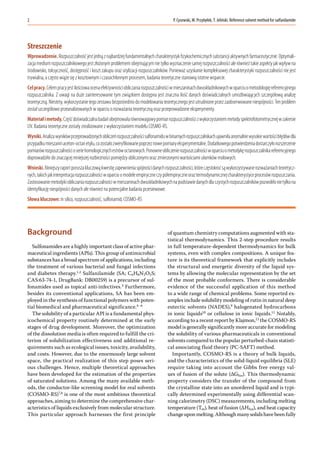
ctd). The most stable conformer is shown in Fig. 1.
The solubility computations relied on a thermody-
namic equation defining the general solid-liquid equilibria
in the following form (Equation 1):
–
–
(
∫
)
ln(yi • x1
id
) =
ΔHfus
R
ΔCp,fus
T
ΔCp,fus dT + dT
1
Tm
T
Tm
T
Tm
1
T
1
RT ∫
1
R
(1)
where the left side defines the solute activity ai = yi • x1
id
at saturated conditions, Tm stands for melting temperature,
ΔHfus represents heat of fusion, ΔCp,fus denotes heat capac-
ity change upon melting, and R is the gas constant. The fu-
sion data indispensable for direct solubility computations
in the COSMOtherm were taken as the average of available
values,13
namely heat of fusion ΔHfus = 23.40 ±0.38 kJ/mol
(average of reported 23.28 kJ/mol,35
23.30 kJ/mol,35,36
24.02 kJ/mol,37
23.0 kJ/mol,38
and 23.42 kJ/mol32
) and
melting point Tm = 437.3 ±1.84 K (mean value of reported
435.35,35
435.4 K,35,36
439.3K,37
438.7 K,38
and 437.7 K32
).
The application of this equation for any solid solute is often
simplified by assuming the temperature independence
of ΔCp,fus. There are 2 common alternatives, which suffer
Fig. 1. A graphical representation of the structure and charge density distribution of the most stable conformer of sulfanilamide
Polim Med. 2024 5
from different inaccuracies depending on the studied
system. The crudest simplification ignores heat capacity
by setting ΔCp,fus = 0, which is often quite acceptable and
was denoted as COSMO-RS in our study. Alternatively,
one can assume ΔCp,fus ≈ Sfus = ΔHfus/Tm referred to below
as CSOMO-RS(2). It is worth mentioning that these fu-
sion data were used for computing the solubility in binary
mixtures only for comparisons with reference solubility
computations. The latter did not require fusion thermo-
dynamics, since they were computed using the COSMOth-
erm program from the provided reference solubility data.
The solubility values were computed by completely solving
the SLE problem, utilizing a sequence of the following op-
tions in the input file “SLESOL solub screening”. For every
reference solvent computation, actual values of neat solvent
solubility were declared using the “ref_sol_x_log10” option
along with the binary mixture composition, “x_ref_sol”,
and temperature, “T_ref_sol”, keywords.
Results and discussion
The solubility of sulfanilamide in binary solvent mix-
tures was computed using the reference solvent ap-
proach. The experimental mole fractions of the saturated
solutions were collected from the literature for systems
listed in the methodology section. The computed values
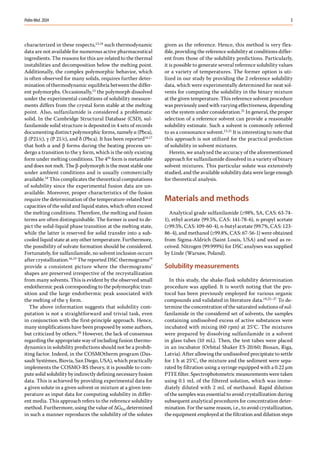
of SA solubility for the whole dataset are shown in Fig. 2,
which comprises of 4 sets of results. The 1st
set consisted
of the prediction of SA solubility in binary mixtures
derived directly from solving SLE within the COSMO-
RS framework, and was displayed as the distribution
of gray crosses. It was visible that this method provided
a very raw estimate of the experimental solubility data.
However, reports have stated that COSMO-RS performs
poorly in solubility prediction for various systems,22,39
al-
though there are cases where the computed values are
in good agreement with the experimental ones.24
This
was not the case for SA dissolved in the binary solvent
mixtures, and we did not rely on such values for screen-
ing purposes, due to the back-computed values suffering
from serious inaccuracies. The value of the mean absolute
percentage error (MAPE) of mole fractions was as high
as 1,310% (or 100% of the mean absolute logarithmic error),
and cases arose that predicted value deviates by 3 orders
of magnitude with respect to the measured ones. This was
found for SA dissolution in chloroform, DMSO, DMF, and
4-formylmorpholine. Fortunately, the reference solvent
procedure significantly increased the accuracy of the over-
all performance, since MAPE was reduced to about 40%.
Although this was not a qualitative prediction, it offered
rational estimates directing solvent selection for further
experiments, if screening was needed. This was a very
practical result, since only about 10% of the systems were
studied experimentally within the whole solubility space
formed by all possible combinations of the 13 neat sol-
vents involved in the collected dataset of SA. Additionally,
by performing measurements of SA in new neat solvents,
the procedure enabled the estimation of solubility in vir-
tually any combinations forming new binary mixtures.
Apart from the above determinations, additional in-
teresting aspects emerged after performing reference
solvent computations. Unexpected and anomalous be-
havior of acetone-ethyl acetate binary systems can be
observed.31
This occasionally occurs where the reported
solubilities were incongruent23
and should be used with
reserve. Herein, the highly inaccurate values of SA solu-
bility in the mentioned binary mixture computed using
Fig. 2. Distribution
of the computed values
of sulfanilamide solubility
in 18 binary mixtures confronted
with experimentally determined
ones. The circles represent
the results of reference solubility
computations and are denoted
in the legend as the RefSol series.
The distribution obtained for
the whole dataset (open black
circles) is overlapped with data
described by Kodide et al.31
(gray circles) and measurements
from the present study work
(red circles). Additionally, results
of the solubility computed
using the COSMO-RS approach
are provided, assuming ∆Cp = 0
(gray crosses, COSMO-RS(1)) and
∆Cp = ∆Hfus/Tm (blue plusses,
COSMO-RS(2)). In both cases,
the following fusion data are
used: ∆Hfus = 23.40 kJ/mol and
Tm = 437.3 K
P. Cysewski, M. Przybyłek, T. Jeliński. Reference solvent method for sulfanilamide
6
the reference solvent approach are highlighted in Fig. 2
as gray circles distribution. Reports suggest a similarity
in the solubility of SA in toluene and ethyl acetate.31
How-
ever, due to the differences in the polarity of both solvents,
the opposite is expected. Notably, Asadi et al.40
showed
relatively high deviations for SA solubility in the acetone-
ethyl acetate system if interpreted using different solubility
equations. Hence, extremely inaccurate predictions using
reference solvent approaches for this system should not be
attributed to theoretical issues. To resolve this problem
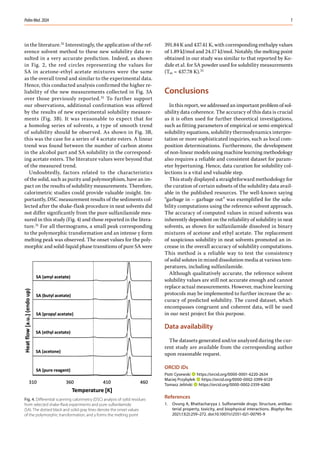
and univocally address the observed discrepancy, 2 series
of new measurements were performed. In the 1st
trial,
the solubility of SA was measured in 9 compositions of ac-
etone and ethyl acetate at room temperature. To further
confirm the solubility trend, the solubility of SA was de-
termined in a series of ester homologs. The results of these
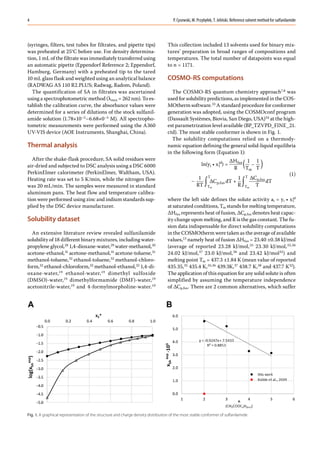
2 series of experiments are provided in Fig. 3. The obtained
data highlighted the problem of the reported SA solubil-
ity in acetone-ethyl acetate binary mixtures and provided
a comprehensive and convincing resolution.
First, the left panel confirms the serious discrep-
ancy between our measurements and those reported
Fig. 3. Results of solubility
determination (T = 298.15K)
of sulfanilamide (SA) in (a)
acetone (2) – ethyl acetate
(3) as a function of acetone
composition in solute-free
solutions and (b) homology
series of acetate esters, where
n denotes carbon atoms
of the alcohol part (2 for ethyl
acetate, 3 for n-propyl acetate,
4 for n-butyl acetate, and 5 for
n-amyl acetate)
Polim Med. 2024 7
in the literature.31
Interestingly, the application of the ref-
erence solvent method to these new solubility data re-
sulted in a very accurate prediction. Indeed, as shown
in Fig. 2, the red circles representing the values for
SA in acetone-ethyl acetate mixtures were the same
as the overall trend and similar to the experimental data.
Hence, this conducted analysis confirmed the higher re-
liability of the new measurements collected in Fig. 3A
over those previously reported.31
To further support
our observations, additional confirmation was offered
by the results of new experimental solubility measure-
ments (Fig. 3B). It was reasonable to expect that for
a homolog series of solvents, a type of smooth trend
of solubility should be observed. As shown in Fig. 3B,
this was the case for a series of 4 acetate esters. A linear
trend was found between the number of carbon atoms
in the alcohol part and SA solubility in the correspond-
ing acetate esters. The literature values were beyond that
of the measured trend.
Undoubtedly, factors related to the characteristics
of the solid, such as purity and polymorphism, have an im-
pact on the results of solubility measurements. Therefore,
calorimetric studies could provide valuable insight. Im-
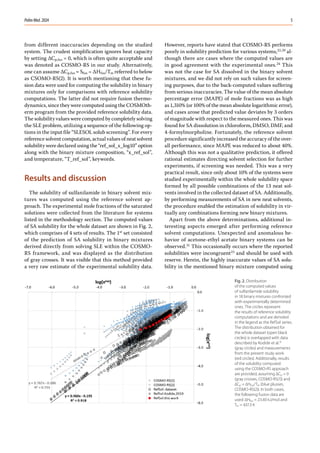
portantly, DSC measurement results of the sediments col-
lected after the shake-flask procedure in neat solvents did
not differ significantly from the pure sulfanilamide mea-
sured in this study (Fig. 4) and those reported in the litera-
ture.31
For all thermograms, a small peak corresponding
to the polymorphic transformation and an intense γ form
melting peak was observed. The onset values for the poly-
morphic and solid-liquid phase transitions of pure SA were
391.84 K and 437.41 K, with corresponding enthalpy values
of 1.89 kJ/mol and 24.17 kJ/mol. Notably, the melting point
obtained in our study was similar to that reported by Ko-
dide et al. for SA powder used for solubility measurements
(Tm = 437.78 K).31
Conclusions
In this report, we addressed an important problem of sol-
ubility data coherence. The accuracy of this data is crucial
as it is often used for further theoretical investigations,
such as fitting parameters of empirical or semi-empirical
solubility equations, solubility thermodynamics interpre-
tation or more sophisticated inquiries, such as local com-
position determinations. Furthermore, the development
of non-linear models using machine learning methodology
also requires a reliable and consistent dataset for param-
eter hypertuning. Hence, data curation for solubility col-
lections is a vital and valuable step.
This study displayed a straightforward methodology for
the curation of certain subsets of the solubility data avail-
able in the published resources. The well-known saying
“garbage in – garbage out” was exemplified for the solu-
bility computations using the reference solvent approach.
The accuracy of computed values in mixed solvents was
inherently dependent on the reliability of solubility in neat
solvents, as shown for sulfanilamide dissolved in binary
mixtures of acetone and ethyl acetate. The replacement
of suspicious solubility in neat solvents promoted an in-
crease in the overall accuracy of solubility computations.
This method is a reliable way to test the consistency
of solid solutes in mixed dissolution media at various tem-
peratures, including sulfanilamide.
Although qualitatively accurate, the reference solvent
solubility values are still not accurate enough and cannot
replace actual measurements. However, machine learning
protocols may be implemented to further increase the ac-
curacy of predicted solubility. The cured dataset, which
encompasses congruent and coherent data, will be used
in our next project for this purpose.
Data availability
The datasets generated and/or analyzed during the cur-
rent study are available from the corresponding author
upon reasonable request.
ORCID iDs
Piotr Cysewski  https://orcid.org/0000-0001-6220-2634
Maciej Przybyłek  https://orcid.org/0000-0002-3399-6129
Tomasz Jeliński  https://orcid.org/0000-0002-2359-6260
References
1. Ovung A, Bhattacharyya J. Sulfonamide drugs: Structure, antibac-
terial property, toxicity, and biophysical interactions. Biophys Rev.
2021;13(2):259–272. doi:10.1007/s12551-021-00795-9
Fig. 4. Differential scanning calorimetry (DSC) analysis of solid residues
from selected shake-flask experiments and pure sulfanilamide
(SA). The dotted black and solid gray lines denote the onset values
of the polymorphic transformation, and γ forms the melting point
P. Cysewski, M. Przybyłek, T. Jeliński. Reference solvent method for sulfanilamide
8
2. Hegazy WAH, Rajab AAH, Abu Lila AS, Abbas HA. Anti-diabetics and
antimicrobials: Harmony of mutual interplay. World J Diabetes. 2021;
12(11):1832–1855. doi:10.4239/wjd.v12.i11.1832
3. Drugbank Online. Sulfanilamide. Drugbank Online; 2023. https://
go.drugbank.com/drugs/DB00259. Accessed November 15, 2023.
4. Odnoroh M, Marty JD, Bourdon V, Coutelier O, Destarac M. Primary
sulfonamide-functional polymers with controlled chain architec-
tures by RAFT polymerisation. Polym Chem. 2023;14(33):3821–3826.
doi:10.1039/D3PY00629H
5. Erol I. Synthesis and characterization of novel sulfonamide function-
alized maleimide polymers: Conventional kinetic analysis, antimicro-
bial activity and dielectric properties. JMolStruct. 2022;1255:132362.
doi:10.1016/j.molstruc.2022.132362
6. Reddy CU, Amalraj A, Reddy BSR, Arun A. Polymeric drug based on
sulfanilamide: Synthesis, antimicrobial and drug releasing studies.
J Pharm Pharmacol. 2010;59(9):1207–1213. doi:10.1211/jpp.59.9.0004
7. Eckert F, Klamt A. Fast solvent screening via quantum chemistry:
COSMO‐RS approach. AIChE J. 2002;48(2):369–385. doi:10.1002/aic.
690480220
8. Klamt A, Schüürmann G. COSMO: A new approach to dielectric
screening in solvents with explicit expressions for the screening
energy and its gradient. J Chem Soc Perkin Trans 2. 1993;5:799–805.
doi:10.1039/P29930000799
9. Popović BM, Uka D, Alioui O, Ždero Pavlović R, Benguerba Y. Experi-
mental and COSMO-RS theoretical exploration of rutin formulations
in natural deep eutectic solvents: Solubility, stability, antioxidant
activity, and bioaccessibility. JMolLiq. 2022;359:119266. doi:10.1016/j.
molliq.2022.119266
10. AlSaleemSS,ZahidWM,AlNashefIM,Hadj-KaliMK.Solubilityofhalo-
genated hydrocarbons in hydrophobic ionic liquids: Experimen-
tal study and COSMO-RS prediction. J Chem Eng Data. 2015;60(10):
2926–2936. doi:10.1021/acs.jced.5b00310
11. KahlenJ,MasuchK,LeonhardK.Modellingcellulosesolubilitiesinionic
liquids using COSMO-RS. Green Chem. 2010;12(12):2172. doi:10.1039
/c0gc00200c
12. Klajmon M. Purely predicting the pharmaceutical solubility: What
to expect from PC-SAFT and COSMO-RS? Mol Pharm. 2022;19(11):
4212–4232. doi:10.1021/acs.molpharmaceut.2c00573
13. Acree W, Chickos JS. Phase transition enthalpy measurements
oforganicandorganometalliccompounds:Sublimation,vaporization
andfusionenthalpiesfrom1880to2015.Part1:C1−C10.JPhysChemRef.
2016;45(3):033101. doi:10.1063/1.4948363
14. Acree W, Chickos JS. Phase transition enthalpy measurements of
organic and organometallic compounds and ionic liquids: Sublima-
tion, vaporization, and fusion enthalpies from 1880 to 2015. Part 2:
C11–C192. J Phys Chem Ref. 2017;46(1):013104. doi:10.1063/1.4970519
15. Cysewski P, Przybyłek M, Jeliński T. Intermolecular interactions
asameasureofdapsonesolubilityinneatsolventsandbinarysolvent
mixtures.Materials(Basel).2023;16(18):6336.doi:10.3390/ma16186336
16. Toscani S, Thorén S, Agafonov V, Céolin R, Dugué J. Thermodynamic
study of sulfanilamide polymorphism: (I) Monotropy of the α-variety.
Pharm Res. 1995;12(10):1453–1456. doi:10.1023/A:1016271017802
17. Trontelj Z, Lužnik J, Pirnat J, Jazbinšek V, Lavrič Z, Srčič S. Polymor-
phism in sulfanilamide: 14N nuclear quadrupole resonance study.
J Pharm Sci. 2019;108(9):2865–2870. doi:10.1016/j.xphs.2019.05.015
18. Toscani S, Dzyabchenko A, Agafonov V, Dugué J, Céolin R. Polymor-
phism of sulfanilamide: (II) Stability hierarchy of α-, β- and γ- forms
from energy calculations by the atom–atom potential method and
from the construction of the p,T phase diagram. Pharm Res. 1996;
13(1):151–154. doi:10.1023/A:1016058123659
19. Jeliński T, Bugalska N, Koszucka K, Przybyłek M, Cysewski P. Solubility
of sulfanilamide in binary solvents containing water: Measurements
and prediction using Buchowski–Ksiazczak solubility model. J Mol
Liq. 2020;319:114342. doi:10.1016/j.molliq.2020.114342
20. AbbottS.Solubility:PrinciplesandPractice.Ipswich,UK:StevenAbbott
TCNF Ltd; 2017. https://www.stevenabbott.co.uk/_downloads/Solu-
bility%20Science%20Principles%20and%20Practice.pdf. Accessed
December 1, 2023.
21. Cysewski P. Application of the consonance solvent concept for accu-
ratepredictionofBuckminstersolubilityin180netsolventsusingCOS-
MO-RSapproach.Symmetry.2019;11(6):828.doi:10.3390/sym11060828
22. Cysewski P, Jeliński T, Cymerman P, Przybyłek M. Solvent screening
for solubility enhancement of theophylline in neat, binary and ter-
nary NADES solvents: New measurements and ensemble machine
learning. Int J Mol Sci. 2021;22(14):7347. doi:10.3390/ijms22147347
23. Cysewski P, Jeliński T, Przybyłek M. Application of COSMO-RS-DARE
as a tool for testing consistency of solubility data: Case of cou-
marin in neat alcohols. Molecules. 2022;27(16):5274. doi:10.3390/
molecules27165274
24. Przybyłek M, Miernicka A, Nowak M, Cysewski P. New screening pro-
tocol for effective green solvents selection of benzamide, salicyl-
amide and ethenzamide. Molecules. 2022;27(10):3323. doi:10.3390/
molecules27103323
25. Cysewski P, Przybyłek M, Rozalski R. Experimental and theoretical
screening for green solvents improving sulfamethizole solubility.
Materials (Basel). 2021;14(20):5915. doi:10.3390/ma14205915
26. Cysewski P, Przybyłek M, Kowalska A, Tymorek N. Thermodynam-
ics and intermolecular interactions of nicotinamide in neat and
binary solutions: Experimental measurements and COSMO-RS con-
centration dependent reactions investigations. Int J Mol Sci. 2021;
22(14):7365. doi:10.3390/ijms22147365
27. Przybyłek M, Kowalska A, Tymorek N, Dziaman T, Cysewski P. Ther-
modynamic characteristics of phenacetin in solid state and satu-
rated solutions in several neat and binary solvents. Molecules. 2021;
26(13):4078. doi:10.3390/molecules26134078
28. Delgado DR, Romdhani A, Martínez F. Thermodynamics of sulfanil-
amidesolubilityinpropyleneglycol+watermixtures.LatAmJPharm.
2011;30(10):2024. http://www.latamjpharm.org/resumenes/30/10/
LAJOP_30_10_1_23.pdf. Accessed November 15, 2023.
29. Delgado DR, Peña Fernández MÁ, Martínez F. Preferential solvation
of some sulfonamides in 1,4-dioxane + water co-solvent mixtures
at 298.15 K according to the inverse Kirkwood–Buff integrals meth-
od. Rev la Acad Colomb ciencias exactas, físicas y Nat. 2014;38(146):
104–114. https://raccefyn.co/index.php/raccefyn/article/view/44.
Accessed November 15, 2023.
30. CárdenasZJ,JiménezDM,AlmanzaOA,JouybanA,MartínezF,AcreeWE.
Solubility and preferential solvation of sulfanilamide, sulfame-
thizole and sulfapyridine in methanol+water mixtures at 298.15 K.
JSolutionChem.2016;45(10):1479–1503.doi:10.1007/s10953-016-0513-7
31. Kodide K, Asadi P, Thati J. Solubility and thermodynamic modeling
of sulfanilamide in 12 mono solvents and 4 binary solvent mixtures
from 278.15 to 318.15 K. J Chem Eng Data. 2019;64(12):5196–5209.
doi:10.1021/acs.jced.9b00411
32. Asadi P, Kodide K, Kota M, Thati J. Determination and correlation
of solubility and solution thermodynamics of 4-aminobenzenesul-
fonamide in five binary solvent mixtures from 278.15 to 318.15 K.
J Mol Liq. 2020;303:112670. doi:10.1016/j.molliq.2020.112670
33. Dassault Systèmes. COSMOtherm. Dassault Systèmes, Biovia, San
Diego, USA; 2022. https://www.3ds.com/products/biovia/cosmo-
rs/cosmotherm. Accessed November 15, 2023.
34. DassaultSystèmes.COSMOconf.DassaultSystèmes,Biovia,SanDiego,
USA;2022.https://www.3ds.com/products/biovia.AccessedNovem-
ber 15, 2023.
35. Martínez F, Gómez A. Thermodynamic study of the solubility of some
sulfonamides in octanol, water, and the mutually saturated solvents.
J Solution Chem. 2001;30(10):909–923. doi:10.1023/A:1012723731104
36. Martinez F, Gomez A. Estimation of the solubility of sulfonamides
in aqueous media from partition coefficients and entropies of fusion.
PhysChemLiq.2002;40(4):411–420.doi:10.1080/0031910021000017735
37. Ciocazanu I, Meltzer V. Etude thermodynamique de certains médi-
caments. J Ther Anal. 1996;47(6):1755–1758. doi:10.1007/BF01980921
38. Ohm A, Lippold BC. Surface tension of solid drugs and its correla-
tion with solubility. Int J Pharm Technol Prod Manuf. 1985;6(4):1–6.
39. Cysewski P. Prediction of ethenzamide solubility in organic solvents
byexplicitinclusionsofintermolecularinteractionswithintheframe-
work of COSMO-RS-DARE. J Mol Liq. 2019;290:111163. doi:10.1016/j.
molliq.2019.111163
40. Asadi P, Kodide K, Thati J, Busi MR. Predicting sulfanilamide solu-
bility in mixed solvents: A comparative analysis of computational
models. Fluid Phase Equilibria. 2024;577:113966. doi:10.1016/j.fluid.
2023.113966

Predicting sulfanilamide solubility in the binary mixtures using a reference solvent approach

  • 1.
    Cite as Cysewski P,Przybyłek M, Jeliński T. Predicting sulfanilamide solubility in the binary mixtures using a reference solvent approach [published online as ahead of print on February 2, 2024]. PolimMed. 2024. doi:10.17219/pim/178284 DOI 10.17219/pim/178284 Copyright Copyright by Author(s) This is an article distributed under the terms of the Creative Commons Attribution 3.0 Unported (CC BY 3.0) (https://creativecommons.org/licenses/by/3.0/) Address for correspondence Piotr Cysewski E-mail: piotr.cysewski@cm.umk.pl Funding sources None declared Conflict of interest None declared Received on November 19, 2023 Reviewed on December 19, 2023 Accepted on January 5, 2024 Published online on February 2, 2024 Abstract Background. Solubility is a fundamental physicochemical property of active pharmaceutical ingredients. The optimization of a dissolution medium aims not only to increase solubility and other aspects are to be included such as environmental impact, toxicity degree, availability, and costs. Obtaining comprehensive solubilitycharacteristicsofchemicalcompoundsisanon-trivialanddemandingprocess.Therefore,support from theoretical approaches is of practical importance. Objectives.Thisstudyaimstoexaminetheaccuracyofthereferencesolubilityapproachinthecaseofsulfa- nilamidedissolutioninavarietyofbinarysolvents.Thispharmaceuticallyactivesubstancehasbeenextensively studied,andasubstantialamountofsolubilitydataisavailable.Unfortunately,usingthissetofdatadirectly fortheoreticalmodelingisimpededbynoticeableinconsistenciesinthepublishedsolubilitydata.Hence,this aspect is addressed by data curation using theoretical and experimental confirmations. Materials and methods. In the experimental part of our study, the popular shake-flask method com- bined with ultraviolet (UV) spectrophotometric measurements was applied for solubility determination. Thecomputationalphaseutilizedtheconductor-likescreeningmodelforrealsolvents(COSMO-RS)approach. Results. The analysis of the results of solubility calculations for sulfonamide in binary solvents revealed abnormally high error values for acetone-ethyl acetate mixtures, which were further confirmed with ex- perimentalmeasurements.Additionalconfirmationwasobtainedbyextendingthesolubilitymeasurements to a series of homologous acetate esters. Conclusions.Ourstudyaddressesthecrucialissueofcoherenceofsolubilitydatausedformanytheoretical inquiries, including parameter fitting of semi-empirical models, in-depth thermodynamic interpretations and application of machine learning protocols. The effectiveness of the proposed methodology for data- set curation was demonstrated for sulfanilamide solubility in binary mixtures. This approach enabled not only the formulation of a consistent dataset of sulfanilamide solubility binary solvent mixtures, but also its implementationasaqualitativetoolguidingrationalesolventselectionforexperimentalsolubilityscreening. Key words: in silico, solubility, sulfanilamide, binary solvents, COSMO-RS Original papers Predicting sulfanilamide solubility in the binary mixtures using a reference solvent approach Przewidywanie rozpuszczalności sulfanilamidu w mieszaninach dwuskładnikowych z wykorzystaniem metodyki rozpuszczalnika referencyjnego Piotr CysewskiA–F , Maciej PrzybyłekB–F , Tomasz JelińskiB–F Department of Physical Chemistry, Faculty of Pharmacy, Ludwik Rydgier Collegium Medicum in Bydgoszcz, Nicolaus Copernicus University in Toruń, Poland A – research concept and design; B – collection and/or assembly of data; C – data analysis and interpretation; D – writing the article; E – critical revision of the article; F – final approval of the article Polymers in Medicine, ISSN 0370-0747 (print), ISSN 2451-2699 (online) PolimMed. 2024
  • 2.
    P. Cysewski, M.Przybyłek, T. Jeliński. Reference solvent method for sulfanilamide 2 Background Sulfonamides are a highly important class of active phar- maceutical ingredients (APIs). This group of antimicrobial substances has a broad spectrum of applications, including the treatment of various bacterial and fungal infections and diabetes therapy.1,2 Sulfanilamide (SA; C6H8N2O2S; CAS:63-74-1, DrugBank: DB00259) is a precursor of sul- fonamides used as topical anti-infectives.3 Furthermore, besides its conventional applications, SA has been em- ployed in the synthesis of functional polymers with poten- tial biomedical and pharmaceutical significance.4–6 The solubility of a particular API is a fundamental phys- icochemical property routinely determined at the early stages of drug development. Moreover, the optimization of the dissolution media is often required to fulfill the cri- terion of solubilization effectiveness and additional re- quirements such as ecological issues, toxicity, availability, and costs. However, due to the enormously large solvent space, the practical realization of this step poses seri- ous challenges. Hence, multiple theoretical approaches have been developed for the estimation of the properties of saturated solutions. Among the many available meth- ods, the conductor-like screening model for real solvents (COSMO-RS)7,8 is one of the most ambitious theoretical approaches, aiming to determine the comprehensive char- acteristics of liquids exclusively from molecular structure. This particular approach harnesses the first principle of quantum chemistry computations augmented with sta- tistical thermodynamics. This 2-step procedure results in full temperature-dependent thermodynamics for bulk systems, even with complex compositions. A unique fea- ture is its theoretical framework that explicitly includes the structural and energetic diversity of the liquid sys- tems by allowing the molecular representation by the set of the most probable conformers. There is considerable evidence of the successful application of this method to a wide range of chemical problems. Some reported ex- amples include solubility modeling of rutin in natural deep eutectic solvents (NADES),9 halogenated hydrocarbons in ionic liquids10 or cellulose in ionic liquids.11 Notably, according to a recent report by Klajmon,12 the COSMO-RS model is generally significantly more accurate for modeling the solubility of various pharmaceuticals in conventional solvents compared to the popular perturbed-chain statisti- cal associating fluid theory (PC-SAFT) method. Importantly, COSMO-RS is a theory of bulk liquids, and the characteristics of the solid-liquid equilibria (SLE) require taking into account the Gibbs free energy val- ues of fusion of the solute (ΔGfus). This thermodynamic property considers the transfer of the compound from the crystalline state into an unordered liquid and is typi- cally determined experimentally using differential scan- ning calorimetry (DSC) measurements, including melting temperature (Tm), heat of fusion (ΔHfus), and heat capacity changeuponmelting.Althoughmanysolidshavebeenfully Streszczenie Wprowadzenie.Rozpuszczalnośćjestjednąznajbardziejfundamentalnychcharakterystykfizykochemicznychsubstancjiaktywnychfarmaceutycznie.Optymali- zacjamediumrozpuszczalnikowegojestzłożonymproblememobejmującymnietylkowyznaczeniesamejrozpuszczalnościalerównieżtakieaspektyjakwpływna środowisko, toksyczność, dostępność i koszt zakupu oraz utylizacji rozpuszczalników. Ponieważ uzyskanie kompleksowej charakterystyki rozpuszczalności nie jest trywialna, a często wiąże się z kosztownym i czasochłonnym procesem, badania teoretyczne stanowią istotne wsparcie. Celpracy.Celempracyjestilościowaocenaefektywnościobliczaniarozpuszczalnościwmieszaninachdwuskładnikowychwoparciuometodologięreferencyjnego rozpuszczalnika. Z uwagi na duże zainteresowanie tym związkiem dostępna jest znaczna ilość danych doświadczalnych umożliwiających szczegółową analizę teoretyczną.Niestety,wykorzystanietegozestawubezpośredniodomodelowaniateoretycznegojestutrudnioneprzezzaobserwowaneniespójności.Tenproblem został szczegółowo przeanalizowanych w oparciu o rozważania teoretyczną oraz przeprowadzone eksperymenty. Materiałimetody.Częśćdoświadczalnabadańobejmowałarównowagowypomiarrozpuszczalnościzwykorzystaniemmetodyspektrofotometrycznejwzakresie UV. Badania teoretyczne zostały zrealizowane z wykorzystaniem modelu COSMO-RS. Wyniki.Analizawynikówprzeprowadzonychobliczeńrozpuszczalnościsulfonamiduwbinarnychrozpuszczalnikachujawniłaanomalniewysokiewartościbłędówdla przypadkumieszaninaceton-octanetylu,cozostałozweryfikowanepoprzeznowepomiaryeksperymentalne.Dodatkowegopotwierdzeniadostarczyłorozszerzenie pomiarówrozpuszczalnościoseriehomologicznychestrówoctanowych.Ponowneobliczenierozpuszczalnościwoparciuometodykęrozpuszczalnikareferencyjnego doprowadziło do znaczącej mniejszej rozbieżności pomiędzy obliczonymi oraz zmierzonymi wartościami ułamków molowych. Wnioski.Niniejszyraportporuszakluczowąkwestięzapewnieniaspójnościdanychrozpuszczalności,któreczęstokroćsąwykorzystywanerozważaniachteoretycz- nych,takichjakinterpretacjarozpuszczalnościwoparciuomodeleempiryczneczypółempiryczneoraztermodynamicznejcharakterystyceprocesówrozpuszczania. Zastosowaniemetodykiobliczaniarozpuszczalnościwmieszaninachdwuskładnikowychnapodstawiedanychdlaczystychrozpuszczalnikówpozwoliłonietylkona identyfikację niespójności danych ale również na potencjalne badania przesiewowe. Słowa kluczowe: in silico, rozpuszczalność, sulfonamid, COSMO-RS
  • 3.
    Polim Med. 20243 characterized in these respects,13,14 such thermodynamic data are not available for numerous active pharmaceutical ingredients. The reasons for this are related to the thermal instabilities and decomposition below the melting point. Additionally, the complex polymorphic behavior, which is often observed for many solids, requires further deter- mination of thermodynamic equilibria between the differ- ent polymorphs. Occasionally,15 the polymorph dissolved under the experimental conditions of solubility measure- ments differs from the crystal form stable at the melting point. Also, sulfanilamide is considered a problematic solid. In the Cambridge Structural Database (CSD), sul- fanilamide solid structure is deposited in 4 sets of records documenting distinct polymorphic forms, namely α (Pbca), β (P21/c), γ (P 21/c), and δ (Pbca). It has been reported16,17 that both α and β forms during the heating process un- dergo a transition to the γ form, which is the only existing form under melting conditions. The 4th form is metastable and does not melt. The β-polymorph is the most stable one under ambient conditions and is usually commercially available.18 This complicates the theoretical computations of solubility since the experimental fusion data are un- available. Moreover, proper characteristics of the fusion require the determination of the temperature-related heat capacities of the solid and liquid states, which often exceed the melting conditions. Therefore, the melting and fusion terms are often distinguishable. The former is used to de- pict the solid-liquid phase transition at the melting state, while the latter is reserved for solid transfer into a sub- cooled liquid state at any other temperature. Furthermore, the possibility of solvate formation should be considered. Fortunately, for sulfanilamide, no solvent inclusion occurs after crystallization.16,19 The reported DSC thermograms19 provide a consistent picture where the thermograms’ shapes are preserved irrespective of the recrystallization from many solvents. This is evident by the observed small endothermic peak corresponding to the polymorphic tran- sition and the large endothermic peak associated with the melting of the γ form. The above information suggests that solubility com- putation is not a straightforward and trivial task, even in conjunction with the first-principle approach. Hence, many simplifications have been proposed by some authors, but criticized by others.20 However, the lack of consensus regarding the appropriate way of including fusion thermo- dynamics in solubility predictions should not be a prohib- iting factor. Indeed, in the COSMOtherm program (Das- sault Systèmes, Biovia, San Diego, USA), which practically implements the COSMO-RS theory, it is possible to com- pute solid solubility by indirectly defining necessary fusion data. This is achieved by providing experimental data for a given solute in a given solvent or mixture at a given tem- perature as input data for computing solubility in differ- ent media. This approach refers to the reference solubility method. Furthermore, using the value of ΔGfus determined in such a manner reproduces the solubility of the solutes given as the reference. Hence, this method is very flex- ible, providing the reference solubility at conditions differ- ent from those of the solubility predictions. Particularly, it is possible to generate several reference solubility values or a variety of temperatures. The former option is uti- lized in our study by providing the 2 reference solubility data, which were experimentally determined for neat sol- vents for computing the solubility in the binary mixture at the given temperature. This reference solvent procedure was previously used with varying effectiveness, depending on the system under consideration.21 In general, the proper selection of a reference solvent can provide a reasonable solubility estimate. Such a solvent is commonly referred to as a consonance solvent.15,21 It is interesting to note that this approach is not utilized for the practical prediction of solubility in solvent mixtures. Herein, we analyzed the accuracy of the aforementioned approach for sulfanilamide dissolved in a variety of binary solvent mixtures. This particular solute was extensively studied, and the available solubility data were large enough for theoretical analysis. Materials and methods Analytical grade sulfanilamide (≥98%, SA, CAS: 63-74- 1), ethyl acetate (99.5%, CAS: 141-78-6), n-propyl acetate (≥99.5%, CAS: 109-60-4), n-butyl acetate (99.7%, CAS: 123- 86-4), and methanol (≥99.8%, CAS: 67-56-1) were obtained from Sigma-Aldrich (Saint Louis, USA) and used as re- ceived. Nitrogen (99.999%) for DSC analyses was supplied by Linde (Warsaw, Poland). Solubility measurements In this study, the shake-flask solubility determination procedure was applied. It is worth noting that the pro- tocol has been previously employed for various organic compounds and validated in literature data.19,22–27 To de- termine the concentration of the saturated solutions of sul- fanilamide in the considered set of solvents, the samples containing undissolved excess of active substances were incubated with mixing (60 rpm) at 25°C. The mixtures were prepared by dissolving sulfanilamide in a solvent in glass tubes (10 mL). Then, the test tubes were placed in an incubator (Orbital Shaker ES-20/60; Biosan, Riga, Latvia). After allowing the undissolved precipitate to settle for 1 h at 25°C, the mixture and the sediment were sepa- rated by filtration using a syringe equipped with a 0.22 μm PTFE filter. Spectrophotometric measurements were taken using 0.1 mL of the filtered solution, which was imme- diately diluted with 2 mL of methanol. Rapid dilution of the samples was essential to avoid crystallization during subsequent analytical procedures for concentration deter- mination. For the same reason, i.e., to avoid crystallization, the equipment employed at the filtration and dilution steps
  • 4.
    P. Cysewski, M.Przybyłek, T. Jeliński. Reference solvent method for sulfanilamide 4 (syringes, filters, test tubes for filtrates, and pipette tips) was preheated at 25°C before use. For density determina- tion, 1 mL of the filtrate was immediately transferred using an automatic pipette (Eppendorf Reference 2; Eppendorf, Hamburg, Germany) with a preheated tip to the tared 10 mL glass flask and weighted using an analytical balance (RADWAG AS 110 R2.PLUS; Radwag, Radom, Poland). The quantification of SA in filtrates was ascertained using a spectrophotometric method (λmax = 262 nm). To es- tablish the calibration curve, the absorbance values were determined for a series of dilutions of the stock sulfanil- amide solution (1.78×10⁻⁵ –6.68×0–5 M). All spectropho- tometric measurements were performed using the A360 UV-VIS device (AOE Instruments, Shanghai, China). Thermal analysis After the shake-flask procedure, SA solid residues were air-dried and subjected to DSC analysis using a DSC 6000 PerkinElmer calorimeter (PerkinElmer, Waltham, USA). Heating rate was set to 5 K/min, while the nitrogen flow was 20 mL/min. The samples were measured in standard aluminum pans. The heat flow and temperature calibra- tion were performed using zinc and indium standards sup- plied by the DSC device manufacturer. Solubility dataset An extensive literature review revealed sulfanilamide solubility of 18 different binary mixtures, including water- propylene glycol,28 1,4-dioxane-water,29 water-methanol,30 acetone-ethanol,31 acetone-methanol,31 acetone-toluene,31 methanol-toluene,32 ethanol-toluene,32 methanol-chloro- form,32 ethanol-chloroform,32 methanol-ethanol,32 1,4-di- oxane-water,19 ethanol-water,19 dimethyl sulfoxide (DMSO)-water,19 dimethyl­ formamide (DMF)-water,19 acetonitrile-water,19 and 4-formylmorpholine-water.19 This collection included 13 solvents used for binary mix- tures’ preparation in broad ranges of compositions and temperatures. The total number of datapoints was equal to n = 1171. COSMO-RS computations The COSMO-RS quantum chemistry approach7,8 was used for solubility predictions, as implemented in the COS- MOtherm software.33 A standard procedure for conformer generation was adopted, using the COSMOconf program (Dassault Systèmes, Biovia, San Diego, USA)34 at the high- est parametrization level available (BP_TZVPD_FINE_21. ctd). The most stable conformer is shown in Fig. 1. The solubility computations relied on a thermody- namic equation defining the general solid-liquid equilibria in the following form (Equation 1): – – ( ∫ ) ln(yi • x1 id ) = ΔHfus R ΔCp,fus T ΔCp,fus dT + dT 1 Tm T Tm T Tm 1 T 1 RT ∫ 1 R (1) where the left side defines the solute activity ai = yi • x1 id at saturated conditions, Tm stands for melting temperature, ΔHfus represents heat of fusion, ΔCp,fus denotes heat capac- ity change upon melting, and R is the gas constant. The fu- sion data indispensable for direct solubility computations in the COSMOtherm were taken as the average of available values,13 namely heat of fusion ΔHfus = 23.40 ±0.38 kJ/mol (average of reported 23.28 kJ/mol,35 23.30 kJ/mol,35,36 24.02 kJ/mol,37 23.0 kJ/mol,38 and 23.42 kJ/mol32 ) and melting point Tm = 437.3 ±1.84 K (mean value of reported 435.35,35 435.4 K,35,36 439.3K,37 438.7 K,38 and 437.7 K32 ). The application of this equation for any solid solute is often simplified by assuming the temperature independence of ΔCp,fus. There are 2 common alternatives, which suffer Fig. 1. A graphical representation of the structure and charge density distribution of the most stable conformer of sulfanilamide
  • 5.
    Polim Med. 20245 from different inaccuracies depending on the studied system. The crudest simplification ignores heat capacity by setting ΔCp,fus = 0, which is often quite acceptable and was denoted as COSMO-RS in our study. Alternatively, one can assume ΔCp,fus ≈ Sfus = ΔHfus/Tm referred to below as CSOMO-RS(2). It is worth mentioning that these fu- sion data were used for computing the solubility in binary mixtures only for comparisons with reference solubility computations. The latter did not require fusion thermo- dynamics, since they were computed using the COSMOth- erm program from the provided reference solubility data. The solubility values were computed by completely solving the SLE problem, utilizing a sequence of the following op- tions in the input file “SLESOL solub screening”. For every reference solvent computation, actual values of neat solvent solubility were declared using the “ref_sol_x_log10” option along with the binary mixture composition, “x_ref_sol”, and temperature, “T_ref_sol”, keywords. Results and discussion The solubility of sulfanilamide in binary solvent mix- tures was computed using the reference solvent ap- proach. The experimental mole fractions of the saturated solutions were collected from the literature for systems listed in the methodology section. The computed values of SA solubility for the whole dataset are shown in Fig. 2, which comprises of 4 sets of results. The 1st set consisted of the prediction of SA solubility in binary mixtures derived directly from solving SLE within the COSMO- RS framework, and was displayed as the distribution of gray crosses. It was visible that this method provided a very raw estimate of the experimental solubility data. However, reports have stated that COSMO-RS performs poorly in solubility prediction for various systems,22,39 al- though there are cases where the computed values are in good agreement with the experimental ones.24 This was not the case for SA dissolved in the binary solvent mixtures, and we did not rely on such values for screen- ing purposes, due to the back-computed values suffering from serious inaccuracies. The value of the mean absolute percentage error (MAPE) of mole fractions was as high as 1,310% (or 100% of the mean absolute logarithmic error), and cases arose that predicted value deviates by 3 orders of magnitude with respect to the measured ones. This was found for SA dissolution in chloroform, DMSO, DMF, and 4-formylmorpholine. Fortunately, the reference solvent procedure significantly increased the accuracy of the over- all performance, since MAPE was reduced to about 40%. Although this was not a qualitative prediction, it offered rational estimates directing solvent selection for further experiments, if screening was needed. This was a very practical result, since only about 10% of the systems were studied experimentally within the whole solubility space formed by all possible combinations of the 13 neat sol- vents involved in the collected dataset of SA. Additionally, by performing measurements of SA in new neat solvents, the procedure enabled the estimation of solubility in vir- tually any combinations forming new binary mixtures. Apart from the above determinations, additional in- teresting aspects emerged after performing reference solvent computations. Unexpected and anomalous be- havior of acetone-ethyl acetate binary systems can be observed.31 This occasionally occurs where the reported solubilities were incongruent23 and should be used with reserve. Herein, the highly inaccurate values of SA solu- bility in the mentioned binary mixture computed using Fig. 2. Distribution of the computed values of sulfanilamide solubility in 18 binary mixtures confronted with experimentally determined ones. The circles represent the results of reference solubility computations and are denoted in the legend as the RefSol series. The distribution obtained for the whole dataset (open black circles) is overlapped with data described by Kodide et al.31 (gray circles) and measurements from the present study work (red circles). Additionally, results of the solubility computed using the COSMO-RS approach are provided, assuming ∆Cp = 0 (gray crosses, COSMO-RS(1)) and ∆Cp = ∆Hfus/Tm (blue plusses, COSMO-RS(2)). In both cases, the following fusion data are used: ∆Hfus = 23.40 kJ/mol and Tm = 437.3 K
  • 6.
    P. Cysewski, M.Przybyłek, T. Jeliński. Reference solvent method for sulfanilamide 6 the reference solvent approach are highlighted in Fig. 2 as gray circles distribution. Reports suggest a similarity in the solubility of SA in toluene and ethyl acetate.31 How- ever, due to the differences in the polarity of both solvents, the opposite is expected. Notably, Asadi et al.40 showed relatively high deviations for SA solubility in the acetone- ethyl acetate system if interpreted using different solubility equations. Hence, extremely inaccurate predictions using reference solvent approaches for this system should not be attributed to theoretical issues. To resolve this problem and univocally address the observed discrepancy, 2 series of new measurements were performed. In the 1st trial, the solubility of SA was measured in 9 compositions of ac- etone and ethyl acetate at room temperature. To further confirm the solubility trend, the solubility of SA was de- termined in a series of ester homologs. The results of these 2 series of experiments are provided in Fig. 3. The obtained data highlighted the problem of the reported SA solubil- ity in acetone-ethyl acetate binary mixtures and provided a comprehensive and convincing resolution. First, the left panel confirms the serious discrep- ancy between our measurements and those reported Fig. 3. Results of solubility determination (T = 298.15K) of sulfanilamide (SA) in (a) acetone (2) – ethyl acetate (3) as a function of acetone composition in solute-free solutions and (b) homology series of acetate esters, where n denotes carbon atoms of the alcohol part (2 for ethyl acetate, 3 for n-propyl acetate, 4 for n-butyl acetate, and 5 for n-amyl acetate)
  • 7.
    Polim Med. 20247 in the literature.31 Interestingly, the application of the ref- erence solvent method to these new solubility data re- sulted in a very accurate prediction. Indeed, as shown in Fig. 2, the red circles representing the values for SA in acetone-ethyl acetate mixtures were the same as the overall trend and similar to the experimental data. Hence, this conducted analysis confirmed the higher re- liability of the new measurements collected in Fig. 3A over those previously reported.31 To further support our observations, additional confirmation was offered by the results of new experimental solubility measure- ments (Fig. 3B). It was reasonable to expect that for a homolog series of solvents, a type of smooth trend of solubility should be observed. As shown in Fig. 3B, this was the case for a series of 4 acetate esters. A linear trend was found between the number of carbon atoms in the alcohol part and SA solubility in the correspond- ing acetate esters. The literature values were beyond that of the measured trend. Undoubtedly, factors related to the characteristics of the solid, such as purity and polymorphism, have an im- pact on the results of solubility measurements. Therefore, calorimetric studies could provide valuable insight. Im- portantly, DSC measurement results of the sediments col- lected after the shake-flask procedure in neat solvents did not differ significantly from the pure sulfanilamide mea- sured in this study (Fig. 4) and those reported in the litera- ture.31 For all thermograms, a small peak corresponding to the polymorphic transformation and an intense γ form melting peak was observed. The onset values for the poly- morphic and solid-liquid phase transitions of pure SA were 391.84 K and 437.41 K, with corresponding enthalpy values of 1.89 kJ/mol and 24.17 kJ/mol. Notably, the melting point obtained in our study was similar to that reported by Ko- dide et al. for SA powder used for solubility measurements (Tm = 437.78 K).31 Conclusions In this report, we addressed an important problem of sol- ubility data coherence. The accuracy of this data is crucial as it is often used for further theoretical investigations, such as fitting parameters of empirical or semi-empirical solubility equations, solubility thermodynamics interpre- tation or more sophisticated inquiries, such as local com- position determinations. Furthermore, the development of non-linear models using machine learning methodology also requires a reliable and consistent dataset for param- eter hypertuning. Hence, data curation for solubility col- lections is a vital and valuable step. This study displayed a straightforward methodology for the curation of certain subsets of the solubility data avail- able in the published resources. The well-known saying “garbage in – garbage out” was exemplified for the solu- bility computations using the reference solvent approach. The accuracy of computed values in mixed solvents was inherently dependent on the reliability of solubility in neat solvents, as shown for sulfanilamide dissolved in binary mixtures of acetone and ethyl acetate. The replacement of suspicious solubility in neat solvents promoted an in- crease in the overall accuracy of solubility computations. This method is a reliable way to test the consistency of solid solutes in mixed dissolution media at various tem- peratures, including sulfanilamide. Although qualitatively accurate, the reference solvent solubility values are still not accurate enough and cannot replace actual measurements. However, machine learning protocols may be implemented to further increase the ac- curacy of predicted solubility. The cured dataset, which encompasses congruent and coherent data, will be used in our next project for this purpose. Data availability The datasets generated and/or analyzed during the cur- rent study are available from the corresponding author upon reasonable request. ORCID iDs Piotr Cysewski  https://orcid.org/0000-0001-6220-2634 Maciej Przybyłek  https://orcid.org/0000-0002-3399-6129 Tomasz Jeliński  https://orcid.org/0000-0002-2359-6260 References 1. Ovung A, Bhattacharyya J. Sulfonamide drugs: Structure, antibac- terial property, toxicity, and biophysical interactions. Biophys Rev. 2021;13(2):259–272. doi:10.1007/s12551-021-00795-9 Fig. 4. Differential scanning calorimetry (DSC) analysis of solid residues from selected shake-flask experiments and pure sulfanilamide (SA). The dotted black and solid gray lines denote the onset values of the polymorphic transformation, and γ forms the melting point
  • 8.
    P. Cysewski, M.Przybyłek, T. Jeliński. Reference solvent method for sulfanilamide 8 2. Hegazy WAH, Rajab AAH, Abu Lila AS, Abbas HA. Anti-diabetics and antimicrobials: Harmony of mutual interplay. World J Diabetes. 2021; 12(11):1832–1855. doi:10.4239/wjd.v12.i11.1832 3. Drugbank Online. Sulfanilamide. Drugbank Online; 2023. https:// go.drugbank.com/drugs/DB00259. Accessed November 15, 2023. 4. Odnoroh M, Marty JD, Bourdon V, Coutelier O, Destarac M. Primary sulfonamide-functional polymers with controlled chain architec- tures by RAFT polymerisation. Polym Chem. 2023;14(33):3821–3826. doi:10.1039/D3PY00629H 5. Erol I. Synthesis and characterization of novel sulfonamide function- alized maleimide polymers: Conventional kinetic analysis, antimicro- bial activity and dielectric properties. JMolStruct. 2022;1255:132362. doi:10.1016/j.molstruc.2022.132362 6. Reddy CU, Amalraj A, Reddy BSR, Arun A. Polymeric drug based on sulfanilamide: Synthesis, antimicrobial and drug releasing studies. J Pharm Pharmacol. 2010;59(9):1207–1213. doi:10.1211/jpp.59.9.0004 7. Eckert F, Klamt A. Fast solvent screening via quantum chemistry: COSMO‐RS approach. AIChE J. 2002;48(2):369–385. doi:10.1002/aic. 690480220 8. Klamt A, Schüürmann G. COSMO: A new approach to dielectric screening in solvents with explicit expressions for the screening energy and its gradient. J Chem Soc Perkin Trans 2. 1993;5:799–805. doi:10.1039/P29930000799 9. Popović BM, Uka D, Alioui O, Ždero Pavlović R, Benguerba Y. Experi- mental and COSMO-RS theoretical exploration of rutin formulations in natural deep eutectic solvents: Solubility, stability, antioxidant activity, and bioaccessibility. JMolLiq. 2022;359:119266. doi:10.1016/j. molliq.2022.119266 10. AlSaleemSS,ZahidWM,AlNashefIM,Hadj-KaliMK.Solubilityofhalo- genated hydrocarbons in hydrophobic ionic liquids: Experimen- tal study and COSMO-RS prediction. J Chem Eng Data. 2015;60(10): 2926–2936. doi:10.1021/acs.jced.5b00310 11. KahlenJ,MasuchK,LeonhardK.Modellingcellulosesolubilitiesinionic liquids using COSMO-RS. Green Chem. 2010;12(12):2172. doi:10.1039 /c0gc00200c 12. Klajmon M. Purely predicting the pharmaceutical solubility: What to expect from PC-SAFT and COSMO-RS? Mol Pharm. 2022;19(11): 4212–4232. doi:10.1021/acs.molpharmaceut.2c00573 13. Acree W, Chickos JS. Phase transition enthalpy measurements oforganicandorganometalliccompounds:Sublimation,vaporization andfusionenthalpiesfrom1880to2015.Part1:C1−C10.JPhysChemRef. 2016;45(3):033101. doi:10.1063/1.4948363 14. Acree W, Chickos JS. Phase transition enthalpy measurements of organic and organometallic compounds and ionic liquids: Sublima- tion, vaporization, and fusion enthalpies from 1880 to 2015. Part 2: C11–C192. J Phys Chem Ref. 2017;46(1):013104. doi:10.1063/1.4970519 15. Cysewski P, Przybyłek M, Jeliński T. Intermolecular interactions asameasureofdapsonesolubilityinneatsolventsandbinarysolvent mixtures.Materials(Basel).2023;16(18):6336.doi:10.3390/ma16186336 16. Toscani S, Thorén S, Agafonov V, Céolin R, Dugué J. Thermodynamic study of sulfanilamide polymorphism: (I) Monotropy of the α-variety. Pharm Res. 1995;12(10):1453–1456. doi:10.1023/A:1016271017802 17. Trontelj Z, Lužnik J, Pirnat J, Jazbinšek V, Lavrič Z, Srčič S. Polymor- phism in sulfanilamide: 14N nuclear quadrupole resonance study. J Pharm Sci. 2019;108(9):2865–2870. doi:10.1016/j.xphs.2019.05.015 18. Toscani S, Dzyabchenko A, Agafonov V, Dugué J, Céolin R. Polymor- phism of sulfanilamide: (II) Stability hierarchy of α-, β- and γ- forms from energy calculations by the atom–atom potential method and from the construction of the p,T phase diagram. Pharm Res. 1996; 13(1):151–154. doi:10.1023/A:1016058123659 19. Jeliński T, Bugalska N, Koszucka K, Przybyłek M, Cysewski P. Solubility of sulfanilamide in binary solvents containing water: Measurements and prediction using Buchowski–Ksiazczak solubility model. J Mol Liq. 2020;319:114342. doi:10.1016/j.molliq.2020.114342 20. AbbottS.Solubility:PrinciplesandPractice.Ipswich,UK:StevenAbbott TCNF Ltd; 2017. https://www.stevenabbott.co.uk/_downloads/Solu- bility%20Science%20Principles%20and%20Practice.pdf. Accessed December 1, 2023. 21. Cysewski P. Application of the consonance solvent concept for accu- ratepredictionofBuckminstersolubilityin180netsolventsusingCOS- MO-RSapproach.Symmetry.2019;11(6):828.doi:10.3390/sym11060828 22. Cysewski P, Jeliński T, Cymerman P, Przybyłek M. Solvent screening for solubility enhancement of theophylline in neat, binary and ter- nary NADES solvents: New measurements and ensemble machine learning. Int J Mol Sci. 2021;22(14):7347. doi:10.3390/ijms22147347 23. Cysewski P, Jeliński T, Przybyłek M. Application of COSMO-RS-DARE as a tool for testing consistency of solubility data: Case of cou- marin in neat alcohols. Molecules. 2022;27(16):5274. doi:10.3390/ molecules27165274 24. Przybyłek M, Miernicka A, Nowak M, Cysewski P. New screening pro- tocol for effective green solvents selection of benzamide, salicyl- amide and ethenzamide. Molecules. 2022;27(10):3323. doi:10.3390/ molecules27103323 25. Cysewski P, Przybyłek M, Rozalski R. Experimental and theoretical screening for green solvents improving sulfamethizole solubility. Materials (Basel). 2021;14(20):5915. doi:10.3390/ma14205915 26. Cysewski P, Przybyłek M, Kowalska A, Tymorek N. Thermodynam- ics and intermolecular interactions of nicotinamide in neat and binary solutions: Experimental measurements and COSMO-RS con- centration dependent reactions investigations. Int J Mol Sci. 2021; 22(14):7365. doi:10.3390/ijms22147365 27. Przybyłek M, Kowalska A, Tymorek N, Dziaman T, Cysewski P. Ther- modynamic characteristics of phenacetin in solid state and satu- rated solutions in several neat and binary solvents. Molecules. 2021; 26(13):4078. doi:10.3390/molecules26134078 28. Delgado DR, Romdhani A, Martínez F. Thermodynamics of sulfanil- amidesolubilityinpropyleneglycol+watermixtures.LatAmJPharm. 2011;30(10):2024. http://www.latamjpharm.org/resumenes/30/10/ LAJOP_30_10_1_23.pdf. Accessed November 15, 2023. 29. Delgado DR, Peña Fernández MÁ, Martínez F. Preferential solvation of some sulfonamides in 1,4-dioxane + water co-solvent mixtures at 298.15 K according to the inverse Kirkwood–Buff integrals meth- od. Rev la Acad Colomb ciencias exactas, físicas y Nat. 2014;38(146): 104–114. https://raccefyn.co/index.php/raccefyn/article/view/44. Accessed November 15, 2023. 30. CárdenasZJ,JiménezDM,AlmanzaOA,JouybanA,MartínezF,AcreeWE. Solubility and preferential solvation of sulfanilamide, sulfame- thizole and sulfapyridine in methanol+water mixtures at 298.15 K. JSolutionChem.2016;45(10):1479–1503.doi:10.1007/s10953-016-0513-7 31. Kodide K, Asadi P, Thati J. Solubility and thermodynamic modeling of sulfanilamide in 12 mono solvents and 4 binary solvent mixtures from 278.15 to 318.15 K. J Chem Eng Data. 2019;64(12):5196–5209. doi:10.1021/acs.jced.9b00411 32. Asadi P, Kodide K, Kota M, Thati J. Determination and correlation of solubility and solution thermodynamics of 4-aminobenzenesul- fonamide in five binary solvent mixtures from 278.15 to 318.15 K. J Mol Liq. 2020;303:112670. doi:10.1016/j.molliq.2020.112670 33. Dassault Systèmes. COSMOtherm. Dassault Systèmes, Biovia, San Diego, USA; 2022. https://www.3ds.com/products/biovia/cosmo- rs/cosmotherm. Accessed November 15, 2023. 34. DassaultSystèmes.COSMOconf.DassaultSystèmes,Biovia,SanDiego, USA;2022.https://www.3ds.com/products/biovia.AccessedNovem- ber 15, 2023. 35. Martínez F, Gómez A. Thermodynamic study of the solubility of some sulfonamides in octanol, water, and the mutually saturated solvents. J Solution Chem. 2001;30(10):909–923. doi:10.1023/A:1012723731104 36. Martinez F, Gomez A. Estimation of the solubility of sulfonamides in aqueous media from partition coefficients and entropies of fusion. PhysChemLiq.2002;40(4):411–420.doi:10.1080/0031910021000017735 37. Ciocazanu I, Meltzer V. Etude thermodynamique de certains médi- caments. J Ther Anal. 1996;47(6):1755–1758. doi:10.1007/BF01980921 38. Ohm A, Lippold BC. Surface tension of solid drugs and its correla- tion with solubility. Int J Pharm Technol Prod Manuf. 1985;6(4):1–6. 39. Cysewski P. Prediction of ethenzamide solubility in organic solvents byexplicitinclusionsofintermolecularinteractionswithintheframe- work of COSMO-RS-DARE. J Mol Liq. 2019;290:111163. doi:10.1016/j. molliq.2019.111163 40. Asadi P, Kodide K, Thati J, Busi MR. Predicting sulfanilamide solu- bility in mixed solvents: A comparative analysis of computational models. Fluid Phase Equilibria. 2024;577:113966. doi:10.1016/j.fluid. 2023.113966