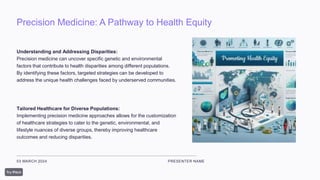
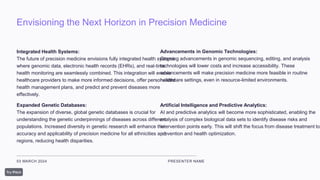
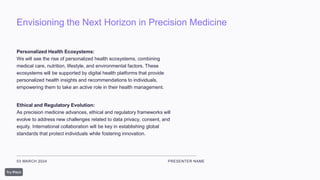
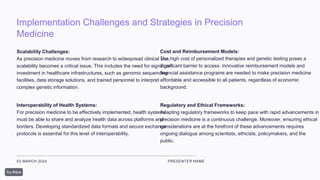
Precision medicine tailors healthcare to individual patients using genetic testing and personalized strategies, contrasting with traditional models that apply standardized treatments. Its potential lies in enhancing diagnosis accuracy, treatment efficacy, and preventive care, while addressing healthcare disparities and improving outcomes in chronic and infectious diseases. The successful implementation of precision medicine requires overcoming barriers such as high costs, technological limitations, ethical concerns, and ensuring equitable access across diverse populations.