Prayer in Schools William Allan Kritsonis, PhD
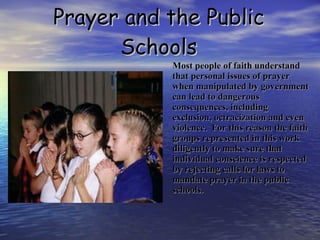
Prayer and the Public Schools Most people of faith understand that personal issues of prayer when manipulated by government can lead to dangerous consequences, including exclusion, octracization and even violence.  For this reason the faith groups represented in this work diligently to make sure that individual conscience is respected by rejecting calls for laws to mandate prayer in the public schools.
Recent Court Decisions about Prayer in Schools By the 1990s the courts began addressing prayer at school extracurricular  events  with less clarity. While some courts allowed student prayers from the podium at graduation exercises, a federal  appellate  court  in  Houston  ruled in 1999 that the recent controversy has revolved around prayer at school athletics events. Guidance was provided by the Supreme Court in  Santa Fe Independent School Dist. v. Doe  [2000] when it upheld a lower court ruling invalidating prayers conducted over the public address system prior to high school games at state school facilities before a school-gathered audience.
Continued from Slide 2 Those in favor of sponsored prayer in state schools publicly often say that "prayer" is forbidden in state schools.  [1]  Prayer is not and never has been forbidden. Regarding the  Free Exercise Clause of the First Amendment , the courts have consistently ruled that students' expressions of religious views through prayer or otherwise cannot be abridged unless they can be shown to cause substantial disruption in the school. Reinstatement of state-sponsored prayer has been attempted in different forms in a number of areas of the U.S. Some introduced a "moment of silence" or "moment of reflection" when a  student  may, if he or she wishes to, offer a silent prayer.
ACLU on Constitutional Amendment on School Prayer Or Moment of Silence (2002) Some, like former Secretary of Education William Bennett blame the 1962 decision, Engel v. Vitale, banning official prayer from public schools, for everything from low SAT scores to high teenage pregnancy rates. But many educators and other experts tell us that these problems flow from the enormous and increasing gulf in wealth and opportunity and education, between the richest and poorest people in our society. A one-minute prayer or moment of silence in school everyday will do nothing to change that.
Prayer at Graduation Ceremonies Recently, some high schools have banned prayer from graduation ceremonies. In May 2006, the ACLU  of Tennessee convinced Munford High School 's principal to ban official prayer at graduation. [2]  In response, students pulled out cards with the Lord's Prayer  written on them and began to read. Also, some have concluded that the school's ACLU club faculty adviser has lost her job over the incident. [3]
In Different Regions of the World United Kingdom In  England and Wales ,  the School Standards and Framework Act 1998  states that all pupils in  state schools  must take part in a daily act of collective worship, unless their parents request that they be excused from attending. [1]  The majority of these acts of collective worship are required to be "wholly or mainly of a broadly  Christian  character", with two exceptions: Religious schools, which should provide worship appropriate to the school's religion (although most religious schools in the UK are Christian.)  Schools where the  Local Education Authority 's Standing Advisory Council on Religious Education has determined that Christian worship would not be appropriate for part or all of the school.  Despite there being a statutory requirement for schools to hold a daily act of collective worship, many do not.  OFSTED 's 2002-03 annual report  [2] , for example, states that 80% of  secondary schools  are failing to provide daily worship for all pupils
The History of Prayer in Schools School Sponsored or Employee- Led Prayer.  More than40 years ago, the U.S. Supreme Court handed down two major school prayer decisions. The first,  Engel v. Vitale(1962),  involved a denominationally neutral prayer composed by the New York State Board of Regents: “Almighty God, we acknowledge our dependence upon Thee, and we beg Thy blessings upon us, our parents, our teachers, and our Country.” The second case,  School District of Abington v. Schempp (1963),  involved state laws requiring selection and reading of passages from the Bible and recitation of the Lord’s Prayer. The Court ruled against the state- endorsed prayers in both cases. Since the state had in effect made a law respecting an establishment of religion in these cases, the Court ruled that the Constitution was violated.
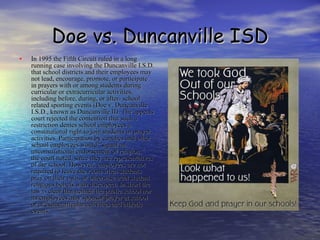
Doe vs. Duncanville ISD In 1995 the Fifth Circuit ruled in a long running case involving the Duncanville I.S.D. that school districts and their employees may not lead, encourage, promote, or participate in prayers with or among students during curricular or extracurricular activities, including before, during, or after- school related sporting events (Doe v. Duncanville I.S.D., known as Duncanville II). The appeals court rejected the contention that such a restriction denies school employees a constitutional right to join students in prayer activities. Participation by coaches and other school employees would “signal an unconstitutional endorsement of religion,” the court noted, since they are representatives of the school. However, employees are not required to leave the room when students pray on their own, or otherwise treat student religious beliefs with disrespect. In short the law is clear that neither the public school nor its employees may sponsor prayer at school or at extracurricular activities and athletic events.
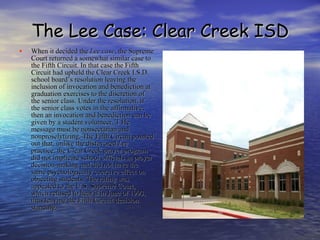
The Lee Case: Clear Creek ISD When it decided the  Lee case , the Supreme Court returned a somewhat similar case to the Fifth Circuit. In that case the Fifth Circuit had upheld the Clear Creek I.S.D. school board’s resolution leaving the inclusion of invocation and benediction at graduation exercises to the discretion of the senior class. Under the resolution, if the senior class votes in the affirmative, then an invocation and benediction can be given by a student volunteer. T He message must be nonsectarian and nonproselytizing. The Fifth Circuit pointed out that, unlike the disfavored  Lee  practice, the Clear Creek prayer program did not implicate school officials in prayer decision-making and did not have the same psychologically coercive effect on objecting students. The ruling was appealed to the U.S. Supreme Court, which refused to hear it in June of 1993, thus leaving the Fifth Circuit decision standing.
Overall Conclusion Both the federal courts and the Texas Education Code recognize that students can engage in personal prayer at school and at school-sponsored extracurricular and athletic events separate and apart from school involvement. In  Doe v. Duncanville I.S.D. I,  the trial court pointed out that “Students may voluntarily pray together, provided such prayer is not done with school participation.” The judge added, “Athletes may pray before or after the games, but again , the activity must not suggest that school officials are sponsoring or participating in the prayer in any manner.” The Fifth Circuit affirmed the decision. TEC 25.901 declares that a public school student has an “absolute right” to pray or meditate in school in a nondisruptive manner.
Credits “ Prayer in Schools” Course ADMIN: 5023/ Prairie View A&M University Professor: Dr. Petterway By: Lelia Jones Sources http://www.cleffpublishing.com/articles/jj122902.htm http://www.infidels.org/library/modern/church-state/prayer.html

Prayer In Schools

  • 1.
    Prayer in SchoolsWilliam Allan Kritsonis, PhD
  • 2.
    Prayer and thePublic Schools Most people of faith understand that personal issues of prayer when manipulated by government can lead to dangerous consequences, including exclusion, octracization and even violence. For this reason the faith groups represented in this work diligently to make sure that individual conscience is respected by rejecting calls for laws to mandate prayer in the public schools.
  • 3.
    Recent Court Decisionsabout Prayer in Schools By the 1990s the courts began addressing prayer at school extracurricular events with less clarity. While some courts allowed student prayers from the podium at graduation exercises, a federal appellate court in Houston ruled in 1999 that the recent controversy has revolved around prayer at school athletics events. Guidance was provided by the Supreme Court in Santa Fe Independent School Dist. v. Doe [2000] when it upheld a lower court ruling invalidating prayers conducted over the public address system prior to high school games at state school facilities before a school-gathered audience.
  • 4.
    Continued from Slide2 Those in favor of sponsored prayer in state schools publicly often say that "prayer" is forbidden in state schools. [1] Prayer is not and never has been forbidden. Regarding the Free Exercise Clause of the First Amendment , the courts have consistently ruled that students' expressions of religious views through prayer or otherwise cannot be abridged unless they can be shown to cause substantial disruption in the school. Reinstatement of state-sponsored prayer has been attempted in different forms in a number of areas of the U.S. Some introduced a "moment of silence" or "moment of reflection" when a student may, if he or she wishes to, offer a silent prayer.
  • 5.
    ACLU on ConstitutionalAmendment on School Prayer Or Moment of Silence (2002) Some, like former Secretary of Education William Bennett blame the 1962 decision, Engel v. Vitale, banning official prayer from public schools, for everything from low SAT scores to high teenage pregnancy rates. But many educators and other experts tell us that these problems flow from the enormous and increasing gulf in wealth and opportunity and education, between the richest and poorest people in our society. A one-minute prayer or moment of silence in school everyday will do nothing to change that.
  • 6.
    Prayer at GraduationCeremonies Recently, some high schools have banned prayer from graduation ceremonies. In May 2006, the ACLU of Tennessee convinced Munford High School 's principal to ban official prayer at graduation. [2] In response, students pulled out cards with the Lord's Prayer written on them and began to read. Also, some have concluded that the school's ACLU club faculty adviser has lost her job over the incident. [3]
  • 7.
    In Different Regionsof the World United Kingdom In England and Wales , the School Standards and Framework Act 1998 states that all pupils in state schools must take part in a daily act of collective worship, unless their parents request that they be excused from attending. [1] The majority of these acts of collective worship are required to be "wholly or mainly of a broadly Christian character", with two exceptions: Religious schools, which should provide worship appropriate to the school's religion (although most religious schools in the UK are Christian.) Schools where the Local Education Authority 's Standing Advisory Council on Religious Education has determined that Christian worship would not be appropriate for part or all of the school. Despite there being a statutory requirement for schools to hold a daily act of collective worship, many do not. OFSTED 's 2002-03 annual report [2] , for example, states that 80% of secondary schools are failing to provide daily worship for all pupils
  • 8.
    The History ofPrayer in Schools School Sponsored or Employee- Led Prayer. More than40 years ago, the U.S. Supreme Court handed down two major school prayer decisions. The first, Engel v. Vitale(1962), involved a denominationally neutral prayer composed by the New York State Board of Regents: “Almighty God, we acknowledge our dependence upon Thee, and we beg Thy blessings upon us, our parents, our teachers, and our Country.” The second case, School District of Abington v. Schempp (1963), involved state laws requiring selection and reading of passages from the Bible and recitation of the Lord’s Prayer. The Court ruled against the state- endorsed prayers in both cases. Since the state had in effect made a law respecting an establishment of religion in these cases, the Court ruled that the Constitution was violated.
  • 9.
    Doe vs. DuncanvilleISD In 1995 the Fifth Circuit ruled in a long running case involving the Duncanville I.S.D. that school districts and their employees may not lead, encourage, promote, or participate in prayers with or among students during curricular or extracurricular activities, including before, during, or after- school related sporting events (Doe v. Duncanville I.S.D., known as Duncanville II). The appeals court rejected the contention that such a restriction denies school employees a constitutional right to join students in prayer activities. Participation by coaches and other school employees would “signal an unconstitutional endorsement of religion,” the court noted, since they are representatives of the school. However, employees are not required to leave the room when students pray on their own, or otherwise treat student religious beliefs with disrespect. In short the law is clear that neither the public school nor its employees may sponsor prayer at school or at extracurricular activities and athletic events.
  • 10.
    The Lee Case:Clear Creek ISD When it decided the Lee case , the Supreme Court returned a somewhat similar case to the Fifth Circuit. In that case the Fifth Circuit had upheld the Clear Creek I.S.D. school board’s resolution leaving the inclusion of invocation and benediction at graduation exercises to the discretion of the senior class. Under the resolution, if the senior class votes in the affirmative, then an invocation and benediction can be given by a student volunteer. T He message must be nonsectarian and nonproselytizing. The Fifth Circuit pointed out that, unlike the disfavored Lee practice, the Clear Creek prayer program did not implicate school officials in prayer decision-making and did not have the same psychologically coercive effect on objecting students. The ruling was appealed to the U.S. Supreme Court, which refused to hear it in June of 1993, thus leaving the Fifth Circuit decision standing.
  • 11.
    Overall Conclusion Boththe federal courts and the Texas Education Code recognize that students can engage in personal prayer at school and at school-sponsored extracurricular and athletic events separate and apart from school involvement. In Doe v. Duncanville I.S.D. I, the trial court pointed out that “Students may voluntarily pray together, provided such prayer is not done with school participation.” The judge added, “Athletes may pray before or after the games, but again , the activity must not suggest that school officials are sponsoring or participating in the prayer in any manner.” The Fifth Circuit affirmed the decision. TEC 25.901 declares that a public school student has an “absolute right” to pray or meditate in school in a nondisruptive manner.
  • 12.
    Credits “ Prayerin Schools” Course ADMIN: 5023/ Prairie View A&M University Professor: Dr. Petterway By: Lelia Jones Sources http://www.cleffpublishing.com/articles/jj122902.htm http://www.infidels.org/library/modern/church-state/prayer.html