1 
K. S. SCHOOL OF BUSINESS MANAGEMENT 
YEAR: - 2013-2014 
JM FINANCIAL 
Derivatives 
Summer Internship Project
2 
PROJECT REPORT 
ON 
SUMMER TRAINING 
ON 
“J M FINANCIAL” 
(DERIVATIVES) 
4TH YEAR MBA 
ROLL NO. “4036” 
SUBMITTED TO:- 
K.S.SCHOOL OF BUSINESS MANAGEMENT 
GUJARAT UNIVERSITY 
AHMEDABAD-380009
3 
ACKNOWLEDGEMENT: 
Success can never be achieved through individual effort but through proper guidance and 
support. 
First of all I would like to thank Dr.SARLA ACHUTHAN and K.S.School of Business 
`Management for giving me such a wonderful opportunity to explore my potential and for 
increasing the practical knowledge of real corporate field. 
My sincere thanks to Mrs.Ingita Jain for giving me guidance on this summer project. 
I would like to take this opportunity to thank my project guide MR. ANKIT ARORA, THE 
DERIVATIVE EXPERT in JM FINANCIAL for his constant interest, involvement and 
support and faculty guides who helped me to complete this challenging task. 
I would like to extend my gratitude to Mr. PRANAV PARIKH, Mr. KAUSHAL SUTRIA THE 
FUNDAMENTAL ANALYST , Mr. BARGAV DAVE, THE TECHNICLE ANALYST ,Mr. 
SAMEER MEHTA, for giving me such an opportunity and making me learn things which 
added a great value to my knowledge. 
Besides, I thank all those invisible hands without whose contribution this project would 
not have been possible.
4 
PREFACE: 
“Learning only can’t suffice a person and make him walk on the path of success unless and 
until he is given practical knowledge.” 
Practical knowledge leads a man toward perfection. 
The work summer project work is most important for having practical knowledge of real 
corporate world. 
This project is made on the summer training. I have done summer training in broking firm 
“J M FINANCIAL.” 
This project report refers to the indepth concept of derivative options and their 
implications. It shows the overview of secondary market. 
This project is compilation of information collected from various sources such as internet, 
library, NCFM authority and company itself. 
This project work has given me an opportunity to enhance and develop my theoretical as 
well as practical knowledge. I have also learnt how to work in the real corporate life and 
how to manage the work life balance. It is also helpful in improving my communication 
skills and personal skills.
5 
TABLE OF CONTENTS 
CHAPTER – I 
JM FINANCIAL OVERVIEW--------------------------------------- [9] 
COMPANY PROFILE 
HISTORY 
BACKGROUND 
FUNCTIONS 
CHAPTER– II 
FINANCIAL SEGMENT OVERVIEW------------------- ----------------------------- [16] 
PRIMARY MARKET 
SECONDARY MARKET 
CHAPTER-III 
DERIVATIVE---------------------------- [19] 
ORIGINE OF DERIVATIVE 
EMERGENCE OF DERIVATIVE 
DEVELOPMENT OF DERIVATIVE IN INDIA 
MARKET PLAYERS OF DERIVATIVE 
COMPONENT OF DERIVATIVE
6 
CHAPTER-IV 
FORWARD CONTRACT-------------------------------------- [37] 
DEFINATION 
FEATURES 
USE & LIMITATIONS 
CHAPTER-V 
FUTURE CONTRACT-------------------------------------- [40] 
DEFINITION 
FEATURES 
MARGINE 
CHAPTER-VI 
OPTIONS CONTRACT ------------------------ [47] 
DEFINITION 
CALL OPTION 
PUT OPTION 
CHAPTER-VII 
MARKET TRENDS & OPTIONS STRATEGY OVERVIEW------------------------ [50] 
TYPES OF MARKET TREND 
OPTION STRATEGY ACCORDING TO MARKET TREND
7 
CHAPTER-VIII 
OPTIONS STRATEGY ---------------- ---------------------------- [57] 
CHAPTER-IX 
CONCLUSION------------------------------------------- [70] 
FINDINGS 
SUGGETIONS 
LIMITATIONS 
CONCLUTIONS 
CHAPTER-X 
BIBLIOGRAPHY-------------- ---------------------------- [74] 
WEBOGRAPHY 
ANNEXUTERS
8 
COMPANY OVERVIEW: 
COMPANY PROFILE 
JM Financial Limited, the flagship listed company of the Group, is led by the Chairman & 
Managing Director, Mr. Nimesh Kampani. The members of the Board meet periodically to 
discuss and review the performance of the Company. 
REGISTERED OFFICE 
141, Maker Chambers III 
Nariman Point 
Mumbai 400 021 
India 
Tel: 91 22 6630 3030 
COMPANY LOGO 
Dynamic Growth Triangle 
The red triangle represents movement, pace, agility and dynamism. It positions JM 
Financial as a distinct, powerful and adaptable financial force.
9 
The Colour Blue 
Blue is the colour of the sky and sea meaning abundance. It is associated with depth and 
stability. It represents knowledge, integrity and expertise. 
HISTORY 
The Company was incorporated as a private limited company on 30th January 1986 in the 
name of J M Share & Stock Brokers Pvt. Ltd. 
The Company has been promoted by JMFICS to engage directly or indirectly in the 
business of share and stock broking, finance broking, underwriting of securities including 
shares, debentures, etc. The present issued, Equity Share JMFICS and, therefore, by virtue 
of Section 4 of the Act, the Company is a subsidiary of JMFICS. 
On JMFICS becoming a deemed public limited company by virtue of the Companies 
(Amendment) Act, 1988 read with the Companies Act, 1956, on 15th June, 1988, the 
Company also became a deemed public limited company as of that date pursuant to the 
applicable provisions of the Companies Act, 1956. 
BACKGROUND 
JM Financial is an integrated financial services group, offering a wide range of services 
to a significant clientele that includes corporations, financial institutions, high net‐worth 
individuals and retail investors. 
The company has interests in investment banking, institutional equity sales, trading, 
research and broking, private and corporate wealth management, equity broking, 
portfolio management, asset management, Non‐Banking Finance Company activities, 
private equity and asset reconstruction. 
JM Financial Services Private Ltd is the dedicated financial services arm of the JM 
Financial Group . JM Financial are one of the largest brokerage firms in India, offering 
comprehensive investment advisory and investment management services to 
institutions, banks, corporate, ultra high net‐worth individuals and Family offices.
10 
With more than three decades of experience & expertise in managing wealth, the 
company offer clients guidance to grow, protect & transfer their wealth. 
An exclusive level of personal attention, research capabilities and in‐depth capital 
market expertise enables the company to design and execute customised investment 
solutions for our clients. Company provide comprehensive financial planning, research‐based 
investment consulting services and execution capabilities. 
OVERVEIW 
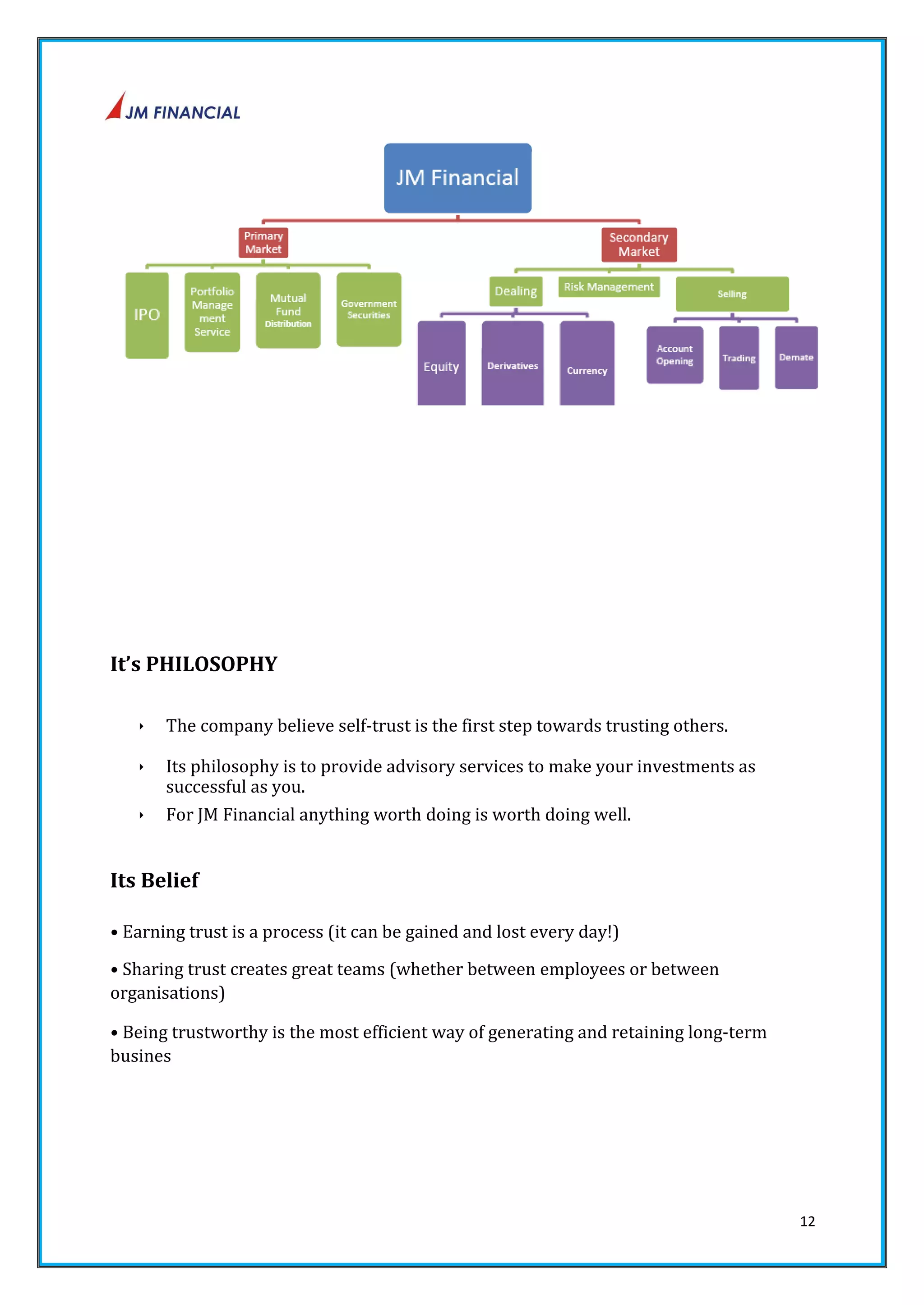
What Company Does 
‣ The Company is among the largest distributors of third party products (Mutual 
funds/IPO). 
‣ The company have a strong network of more than 25,000 IFAs spread across 
India. 
‣ The company facilitate client transactions with a diverse group of financial 
institutions, investment funds, governments and individuals, trading of and 
investing in fixed income and equity products and derivatives on these 
products. 
JM’s VISION 
To be the most trusted partner for every stakeholder in the financial world. 
Its VALUES
11 
The company have always sought to be a value‐driven organisation, where our values 
direct our growth and success.
12 
It’s PHILOSOPHY 
‣ The company believe self‐trust is the first step towards trusting others. 
‣ Its philosophy is to provide advisory services to make your investments as 
successful as you. 
‣ For JM Financial anything worth doing is worth doing well. 
Its Belief 
• Earning trust is a process (it can be gained and lost every day!) 
• Sharing trust creates great teams (whether between employees or between 
organisations) 
• Being trustworthy is the most efficient way of generating and retaining long‐term 
busines
13 
FINANCIAL MARKET 
OVERVIEW:
PRIMARY 
MARKET 
14 
FINANCIAL MARKET OVERVIEW : 
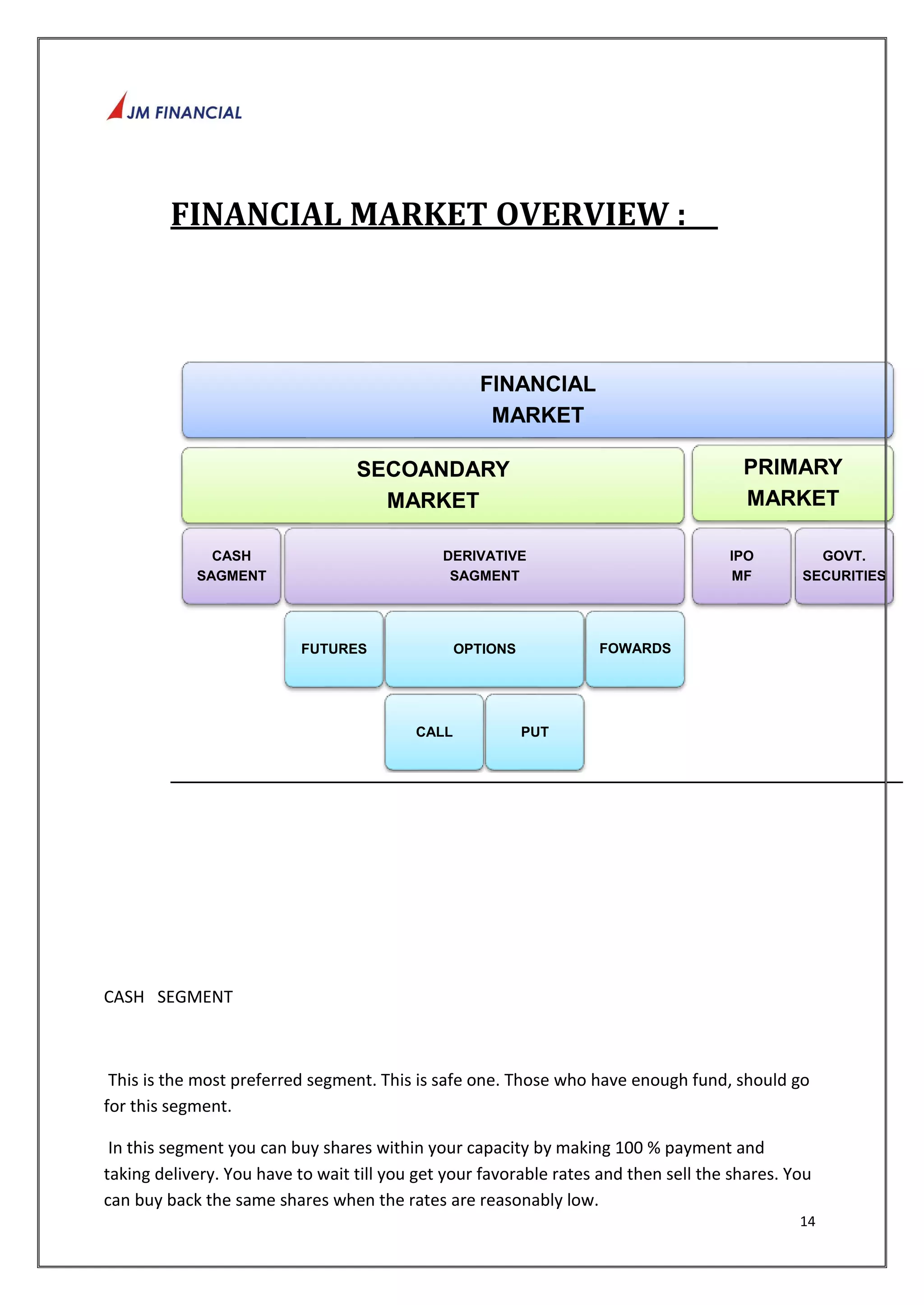
CASH 
SAGMENT 
CASH SEGMENT 
FINANCIAL 
MARKET 
SECOANDARY 
MARKET 
DERIVATIVE 
SAGMENT 
FUTURES OPTIONS 
CALL PUT 
FOWARDS 
IPO 
MF 
This is the most preferred segment. This is safe one. Those who have enough fund, should go 
for this segment. 
In this segment you can buy shares within your capacity by making 100 % payment and 
taking delivery. You have to wait till you get your favorable rates and then sell the shares. You 
can buy back the same shares when the rates are reasonably low. 
GOVT. 
SECURITIES
15 
Your ownership of position remains with you unless and until you have squared off. Such 
people are known as Investors. They don’t undergo frequent or day-to-day trading. It is 
observed that investors earn a good percentage of profit and that also without any tension. 
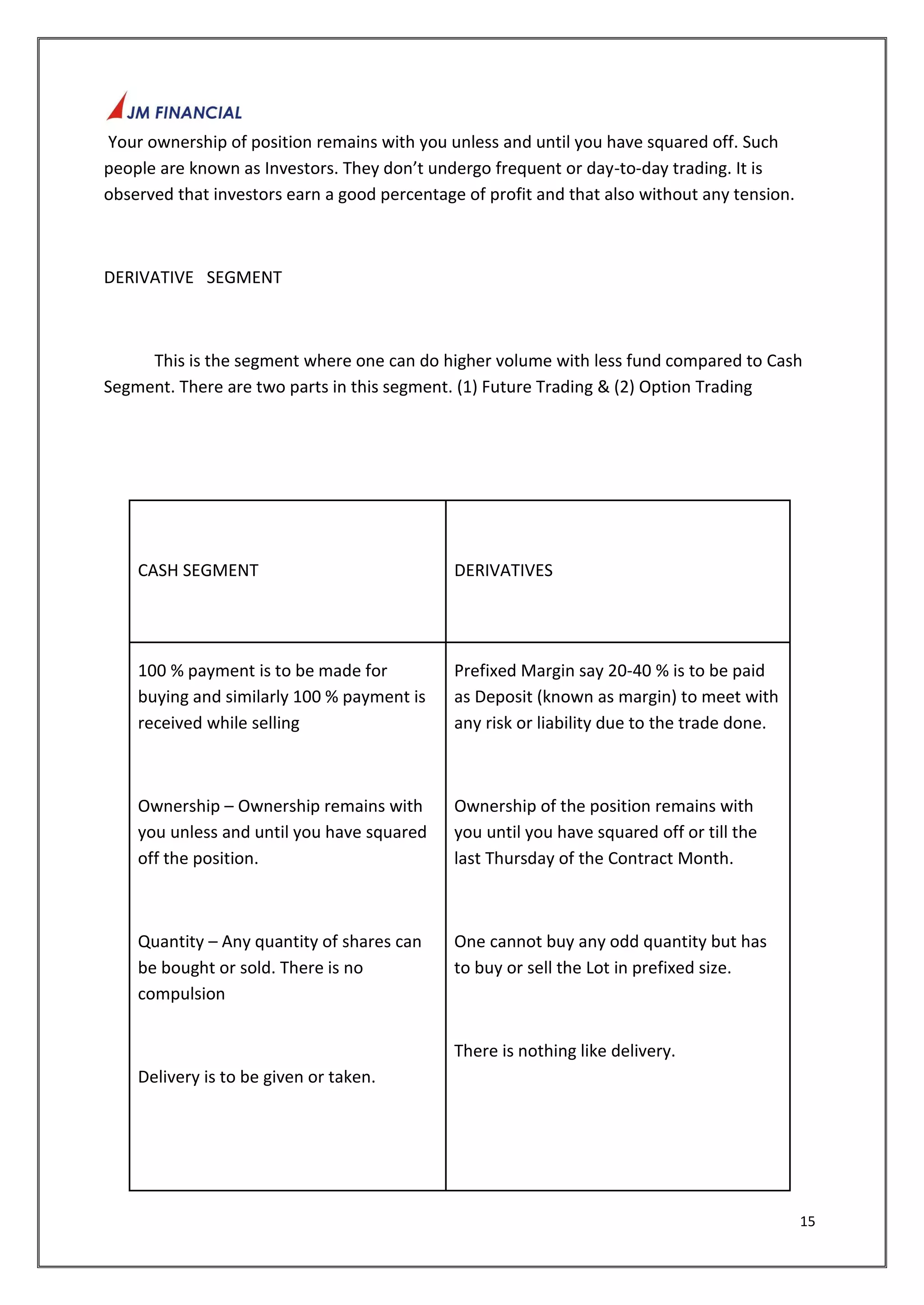
DERIVATIVE SEGMENT 
This is the segment where one can do higher volume with less fund compared to Cash 
Segment. There are two parts in this segment. (1) Future Trading & (2) Option Trading 
CASH SEGMENT 
DERIVATIVES 
100 % payment is to be made for 
buying and similarly 100 % payment is 
received while selling 
Ownership – Ownership remains with 
you unless and until you have squared 
off the position. 
Quantity – Any quantity of shares can 
be bought or sold. There is no 
compulsion 
Delivery is to be given or taken. 
Prefixed Margin say 20-40 % is to be paid 
as Deposit (known as margin) to meet with 
any risk or liability due to the trade done. 
Ownership of the position remains with 
you until you have squared off or till the 
last Thursday of the Contract Month. 
One cannot buy any odd quantity but has 
to buy or sell the Lot in prefixed size. 
There is nothing like delivery.
16 
DERIVATIVES 
OVERVIEW:
17 
DERIVATIVES 
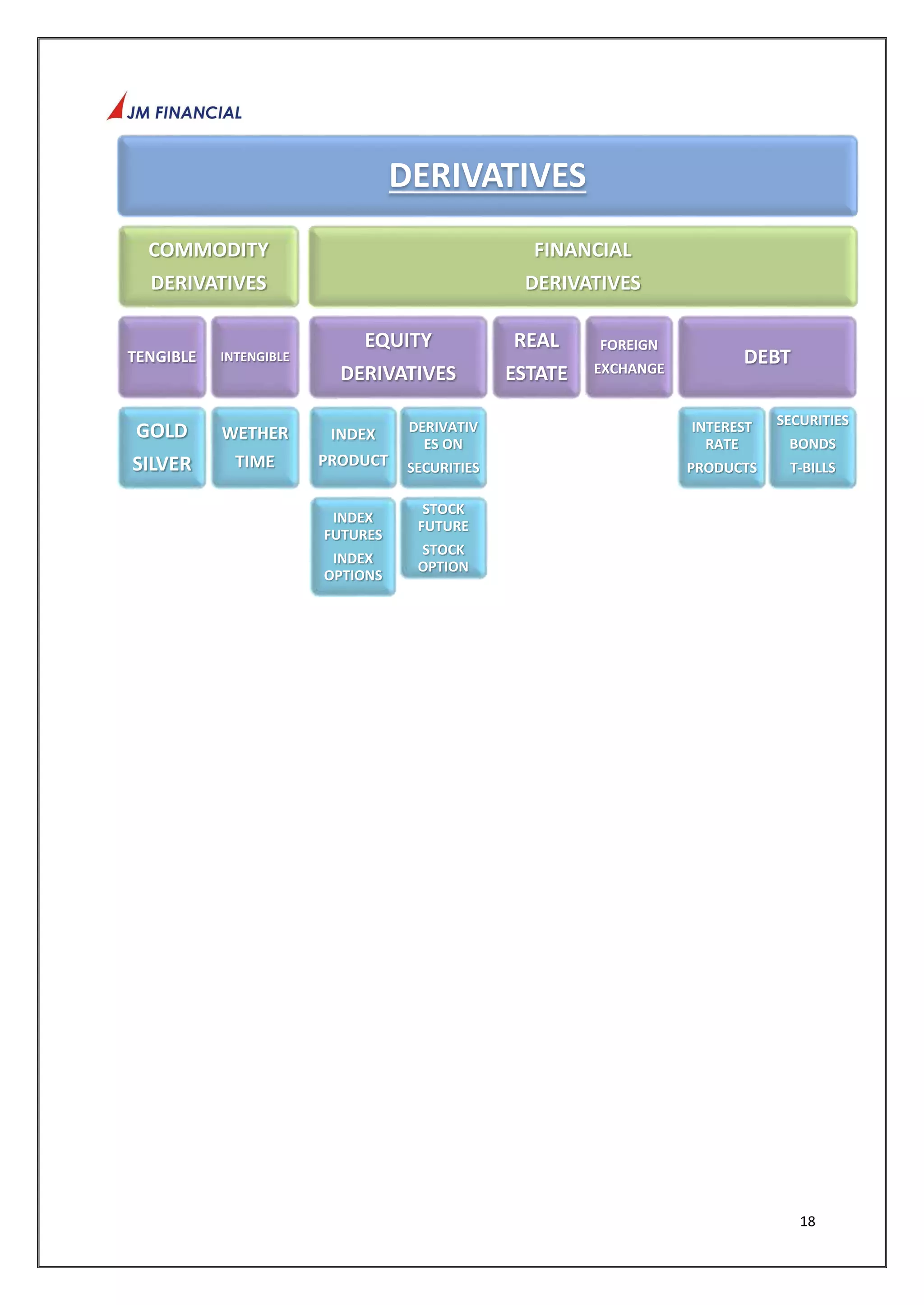
The term derivatives are used to refer to financial instruments which derive 
their value from some underlying assets. 
The underlying assets could be: 
 Interest Rate derivative 
 Foreign Exchange derivative 
 Credit derivative 
 Equity derivative 
 Commodity derivative 
Other examples of underlying exchangeables are: 
 Property (mortgage) derivatives 
 Economic derivatives that pay off according to economic reports[] as measured and 
reported by national statistical agencies 
 Freight derivatives 
 Inflation derivatives 
 Weather derivatives 
 Insurance derivatives 
 Emissions derivatives
18 
DERIVATIVES 
COMMODITY 
DERIVATIVES 
TENGIBLE 
GOLD 
SILVER 
INTENGIBLE 
WETHER 
TIME 
FINANCIAL 
DERIVATIVES 
EQUITY 
DERIVATIVES 
INDEX 
PRODUCT 
INDEX 
FUTURES 
INDEX 
OPTIONS 
DERIVATIV 
ES ON 
SECURITIES 
STOCK 
FUTURE 
STOCK 
OPTION 
REAL 
ESTATE 
FOREIGN 
EXCHANGE 
DEBT 
INTEREST 
RATE 
PRODUCTS 
SECURITIES 
BONDS 
T-BILLS
19 
EMERGENCE OF DERIVATIVES: 
Derivative products initially emerged as hedging devices against fluctuations in 
commodity prices and commodity-linked derivatives remained the sole form of such 
products for almost three hundred years. The financial derivatives came into spotlight 
in post-1970 period due to growing instability in the financial markets. However, 
since their emergence, these products have become very popular and by 1990s, they 
accounted for about two-thirds of total transactions in derivative products. 
The basic purpose of derivatives is to transfer the price risk (inherent in 
fluctuations of the asset prices) from one party to another. 
They facilitate the allocation of risk to those who are willing to take it. 
E.g.: On Nov 1, 2009 a rice farmer may wish to sell his harvest at the future date 
(say ‐ Jan 1, 2010) for a predetermined fixed price to eliminate the risk of change 
in prices by that date. Such a transaction is an example of a derivatives contract. 
The price of derivatives contract is driven by the spot price of rice which is the 
underlying. 
We will focus on EQUITY DERIVETIVES only.
20 
ORIGIN OF DERIVATIVES: 
The earliest evidence of derivatives can be traced back to ancient Greece. 
Derivatives were is existence in some or the other form since ancient time. The 
advent of modern day derivatives was attributed to protect farmers against 
decline in crop prices. 
The securities contract (regulation) act, 1956 defines “derivatives” to include: 
I. A security derived from a debt instrument, share loan whether secured or 
unsecured, security, risk instrument or contract for difference or any other form.
21 
Development of derivatives market in India: 
The first step towards introduction of derivatives trading in India was the promulgation 
of The Securities Laws (Amendment) Ordinance, 1995, which withdrew the prohibition 
on Options in securities. The market for derivatives, however, did not take off, as there 
was no regulatory framework to govern trading of derivatives. SEBI set up a 24– 
member Committee under the Chairmanship of Dr.L.C.Gupta on November 18, 1996 to 
develop appropriate regulatory framework for derivatives trading in India. The 
committee submitted its report on March 17, 1998 prescribing necessary pre– 
conditions for introduction of derivatives trading in India. The committee recommended 
that derivatives should be declared as ‘securities’ so that regulatory framework 
applicable to trading of ‘securities’ could also govern trading of securities. SEBI also set 
up a group in June 1998 under the Chairmanship of Prof.J.R.Varma, to recommend 
measures for risk containment in derivatives market in India. The report, which was 
submitted in October 1998, worked out the operational details of margining system, 
methodology for charging initial margins, broker net worth, deposit requirement 
and real–time monitoring requirements. 
The Securities Contract Regulation Act (SCRA) was amended in December 1999 to 
include derivatives within the ambit of ‘securities’ and the regulatory framework was 
developed for governing derivatives trading. The act also made it clear that derivative 
shall be legal and valid only if such contracts are traded on a recognized stock exchange, 
thus precluding OTC derivatives. The government also rescinded in March 2000, 
thethree– decade old notification, which prohibited forward trading in securities. 
Derivatives trading commenced in India in June 2000 after SEBI granted the final 
approval to this effect in May 2001. SEBI permitted the derivative segments of two stock 
exchanges, NSE and BSE, and their clearing house/corporation to commence trading 
and settlement in approved derivatives contracts. To begin with, SEBI approved trading 
in index futures contracts based on S&P CNX Nifty and BSE–30(Sensex) index. This was 
followed by approval for trading in options based on these two indexes and options on 
individual securities. 
The trading in BSE Sensex options commenced on June 4, 2001 and the trading in 
options on individual securities commenced in July 2001. Futures contracts on 
individual stocks were launched in November 2001. The derivatives trading on NSE 
commenced with S&P CNX Nifty Index futures on June 12, 2000. The trading in index 
options commenced on June 4, 2001 and trading in options on individual securities 
commenced on July 2, 2001. 
Single stock futures were launched on November 9, 2001. The index futures and options 
contract on NSE are based on S&P CNX. 
Trading and settlement in derivative contracts is done in accordance with the rules,
byelaws, and regulations of the respective exchanges and their 
clearing house/corporation duly approved by SEBI and notified in the official gazette. 
Foreign Institutional Investors (FIIs) are permitted to trade in all Exchange traded 
derivative products. 
The following are some observations based on the trading statistics provided in the NSE 
report on the futures and options (F&O): 
• Single‐stock futures continue to account for a sizable proportion of the F&O segment. 
It constituted 70 per cent of the total turnover during June 2002. A primary reason 
attributed to this phenomenon is that traders are comfortable with single‐stock futures 
22 
than equity options, as the former closely resembles the erstwhile badla system. 
• On relative terms, volumes in the index options segment continues to remain poor. 
This may be due to the low volatility of the spot index. Typically, options are considered 
more valuable when the volatility of the underlying (in this case, the index) is high. A 
related issue is that brokers do not earn high commissions by recommending index 
options to their clients, because low volatility leads to higher waiting time for round‐trips. 
• Put volumes in the index options and equity options segment have increased since 
January 2002. The call‐put volumes in index options have decreased from 2.86 in 
January 2002 to 1.32 in June. The fall in call‐put volumes ratio suggests that the traders 
are increasingly becoming pessimistic on the market. 
• Farther month futures contracts are still not actively traded. Trading in equity options 
on most stocks for even the next month was non‐existent. 
• Daily option price variations suggest that traders use the F&O segment as a less risky 
alternative (read substitute) to generate profits from the stock price movements. The 
fact that the option premiums tail intra‐day stock prices is evidence to this. Calls on 
Satyam fall, while puts rise when Satyam falls intra‐day. 
If calls and puts are not looked as just substitutes for spot trading, the intra‐day stock 
price variations should not have a one‐to‐one impact on the option premiums.
23 
TYPES OF TRADING: 
OTC and Exchange-traded 
In broad terms, there are two groups of derivative contracts, which are distinguished by 
the way they are traded in the market: 
 Over-the-counter 
(OTC) derivatives are contracts that are traded (and privately negotiated) directly 
between two parties, without going through an exchange or other intermediary. 
Products such as swaps, forward rate agreements, and exotic options are almost 
always traded in this way. The OTC derivative market is the largest market for 
derivatives, and is largely unregulated with respect to disclosure of information 
between the parties, since the OTC market is made up of banks and other highly 
sophisticated parties, such as hedge funds. Reporting of OTC amounts are difficult 
because trades can occur in private, without activity being visible on any exchange. 
According to the Bank for International Settlements, the total outstanding notional 
amount is US$684 trillion (as of June 2008).[6] Of this total notional amount, 67% are 
interest rate contracts, 8% are credit default swaps (CDS), 9% are foreign exchange 
contracts, 2% are commodity contracts, 1% are equity contracts, and 12% are other. 
Because OTC derivatives are not traded on an exchange, there is no central counter-party. 
Therefore, they are subject to counter-party risk, like an ordinary contract, since 
each counter-party relies on the other to perform. 
Exchange-traded derivative contracts 
(ETD) are those derivatives instruments that are traded via specialized derivatives 
exchanges or other exchanges. A derivatives exchange is a market where individuals 
trade standardized contracts that have been defined by the exchange.A derivatives 
exchange acts as an intermediary to all related transactions, and takes Initial margin 
from both sides of the trade to act as a guarantee.
24 
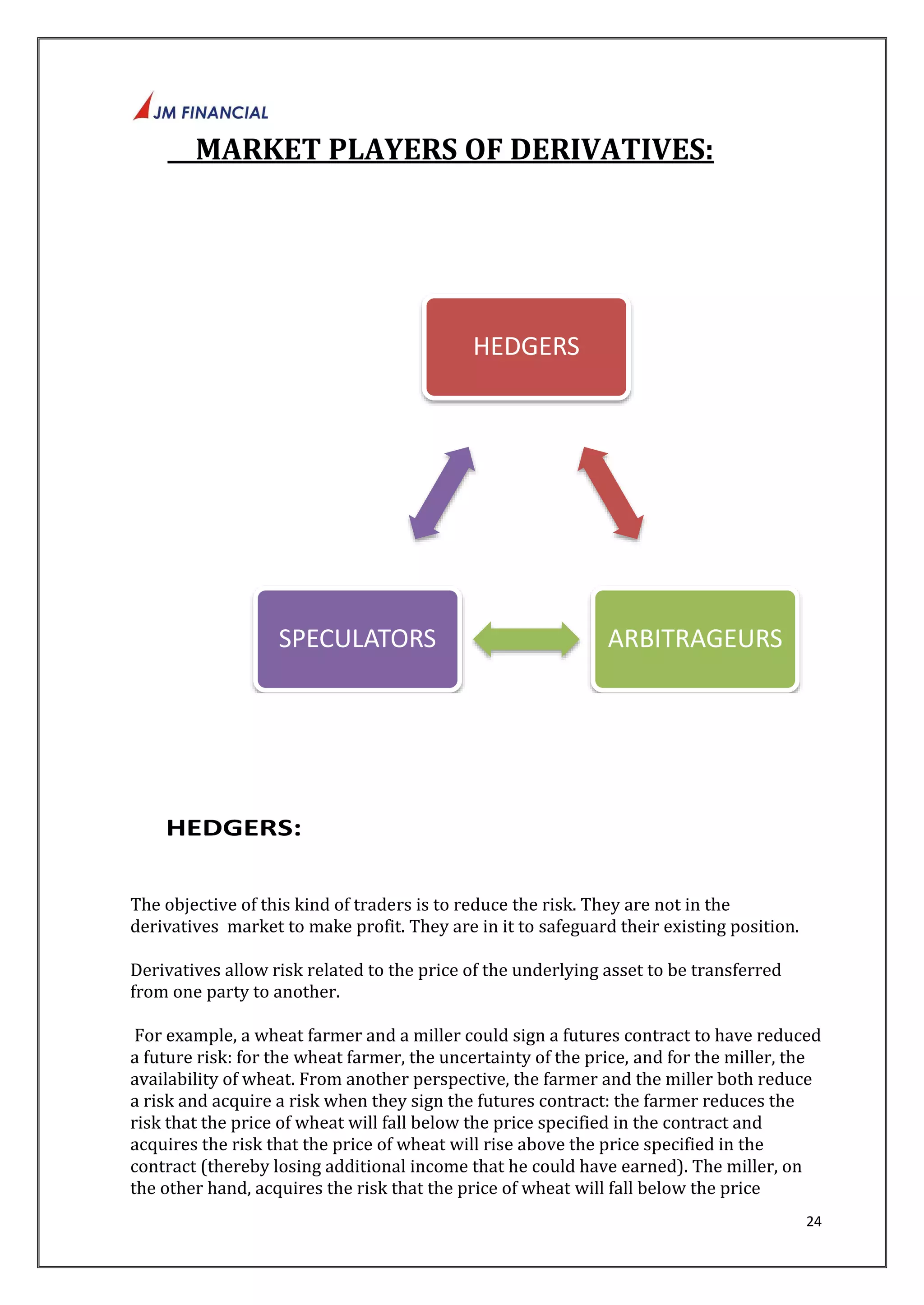
MARKET PLAYERS OF DERIVATIVES: 
SPECULATORS ARBITRAGEURS 
HEDGERS: 
HEDGERS 
The objective of this kind of traders is to reduce the risk. They are not in the 
derivatives market to make profit. They are in it to safeguard their existing position. 
Derivatives allow risk related to the price of the underlying asset to be transferred 
from one party to another. 
For example, a wheat farmer and a miller could sign a futures contract to have reduced 
a future risk: for the wheat farmer, the uncertainty of the price, and for the miller, the 
availability of wheat. From another perspective, the farmer and the miller both reduce 
a risk and acquire a risk when they sign the futures contract: the farmer reduces the 
risk that the price of wheat will fall below the price specified in the contract and 
acquires the risk that the price of wheat will rise above the price specified in the 
contract (thereby losing additional income that he could have earned). The miller, on 
the other hand, acquires the risk that the price of wheat will fall below the price
specified in the contract (thereby paying more in the future than he otherwise would 
have) and reduces the risk that the price of wheat will rise above the price specified in 
the contract. In this sense, one party is the insurer (risk taker) for one type of risk, and 
the counter-party is the insurer (risk taker) for another type of risk. 
25 
Apart from EQUITY MARKETS, Hedging is common in the foreign exchange markets 
where the fluctuations in the foreign exchange rate have to be taken care of in the 
foreign currency transactions. Derivatives can serve legitimate business purposes. 
For example, a corporation borrows a large sum of money at a specific interest 
rate.The rate of interest on the loan resets every six months. The corporation is 
concerned that the rate of interest may be much higher in six months. The corporation 
could buy a forward rate agreement (FRA), which is a contract to pay a fixed rate of 
interest six months after purchases on a notional amount of money. If the interest rate 
after six months is above the contract rate, the seller will pay the difference to the 
corporation, or FRA buyer. If the rate is lower, the corporation will pay the difference 
to the seller. The purchase of the FRA serves to reduce the uncertainty concerning the 
rate increase and stabilize earnings. 
SPECULATORS: 
Speculators are some what like a middle man. They are never interested in actual 
owing the commodity. They will just buy from one end and sell it to the other in 
anticipation of future price movements. They actually bet on the future movement in 
the price of an asset. 
They are the second major group of futures players. These participants include 
independent floor traders and investors. They handle trades for their personal clients 
or brokerage firms. 
Buying a futures contract in anticipation of price increases is known as ‘going long’. 
Selling a futures contract in anticipation of a price decrease is known as ‘going short’. 
Speculative participation in futures trading has increased with the availability of 
alternative methods of participation. 
Speculators have certain advantages over other investments they are as follows:
 If the trader’s judgment is good, he can make more money in the futures market 
faster because prices tend, on average, to change more quickly than real estate 
or stock prices. 
 Futures are highly leveraged investments. The trader puts up a small fraction of 
the value of the underlying contract as margin, yet he can ride on the full value 
of the contract as it moves up and down. The money he puts up is not a down 
payment on the underlying contract, but a performance bond. The actual value 
of the contract is only exchanged on those rare occasions when delivery takes 
place. 
26 
Arbitrators : 
Arbitrators are in the market for the risk free profit opportunity. 
Arbitrators are the person who take the advantage of a discrepancy between prices in 
two different markets. If he finds future prices of a stock edging out with the cash price, 
he will take offsetting positions in both the markets to lock in a profit. 
Misleading arbitrage opportunity: 
 When company declare dividend more than 10%. Investors think that there 
exist arbitrage opportunity, and take long position. But it is not actually like this. 
Because the future prices have already discounted in the market. 
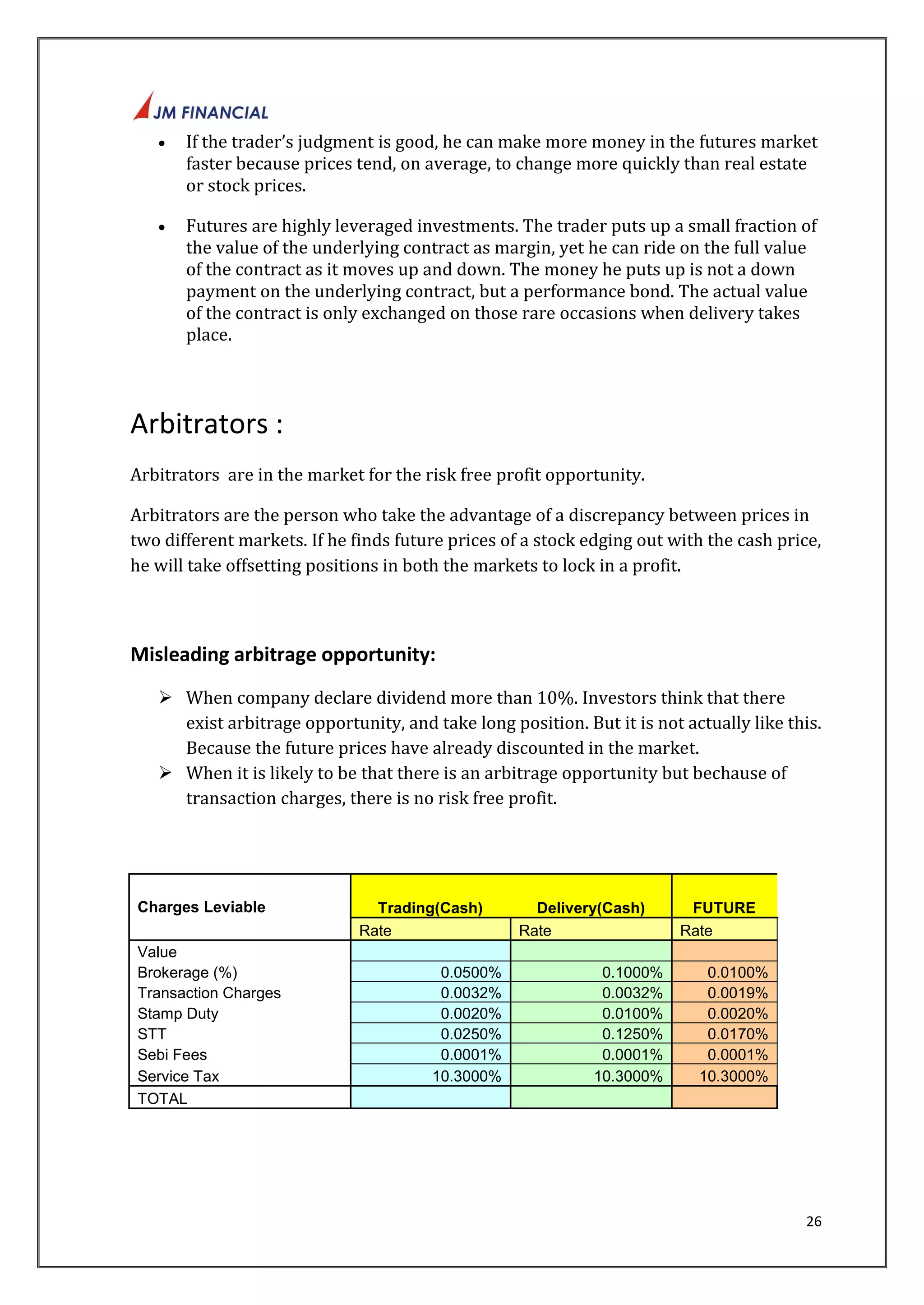
 When it is likely to be that there is an arbitrage opportunity but bechause of 
transaction charges, there is no risk free profit. 
Charges Leviable Trading(Cash) Delivery(Cash) FUTURE 
Rate Rate Rate 
Value 
Brokerage (%) 0.0500% 0.1000% 0.0100% 
Transaction Charges 0.0032% 0.0032% 0.0019% 
Stamp Duty 0.0020% 0.0100% 0.0020% 
STT 0.0250% 0.1250% 0.0170% 
Sebi Fees 0.0001% 0.0001% 0.0001% 
Service Tax 10.3000% 10.3000% 10.3000% 
TOTAL
27 
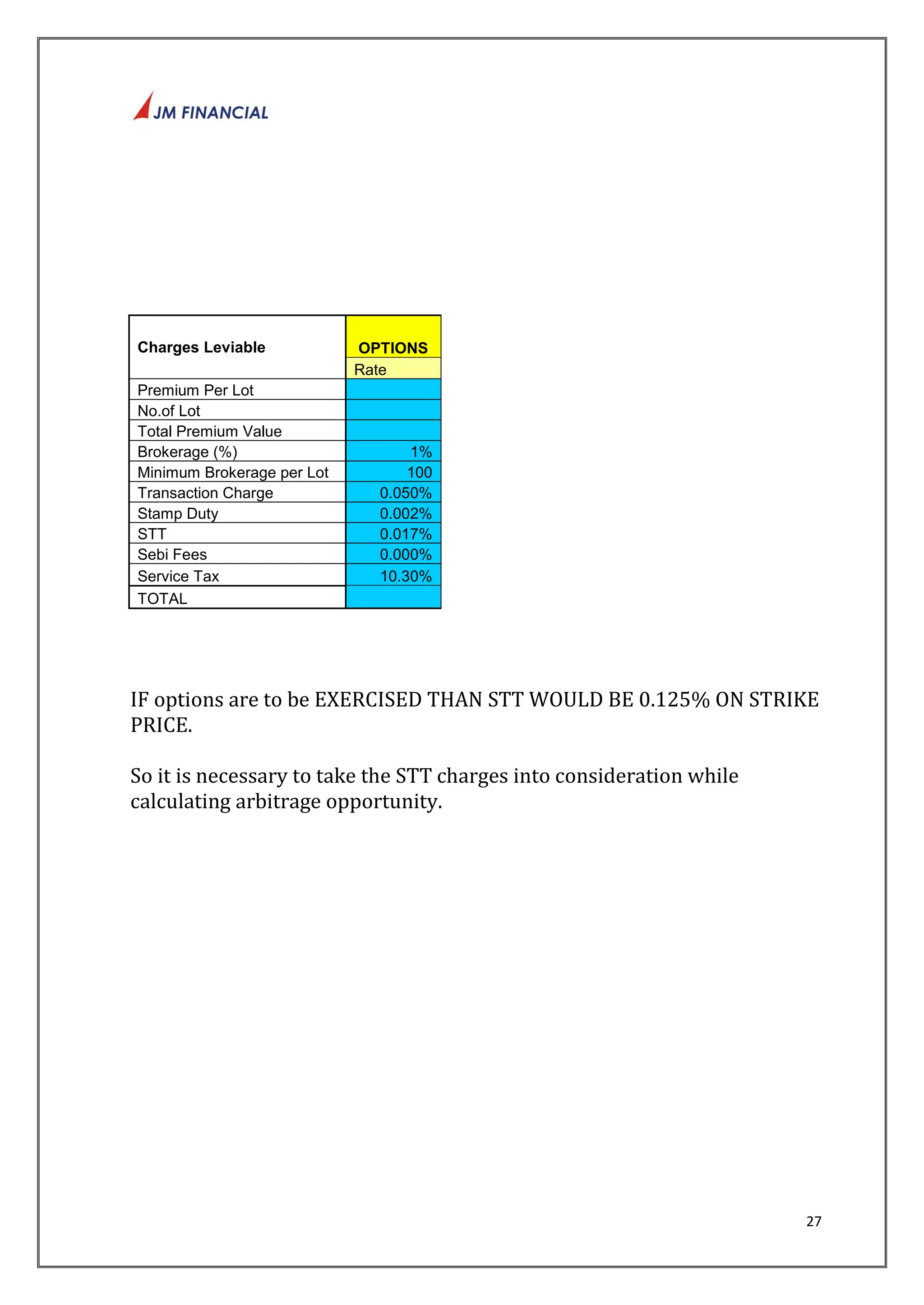
Charges Leviable OPTIONS 
Rate 
Premium Per Lot 
No.of Lot 
Total Premium Value 
Brokerage (%) 1% 
Minimum Brokerage per Lot 100 
Transaction Charge 0.050% 
Stamp Duty 0.002% 
STT 0.017% 
Sebi Fees 0.000% 
Service Tax 10.30% 
TOTAL 
IF options are to be EXERCISED THAN STT WOULD BE 0.125% ON STRIKE 
PRICE. 
So it is necessary to take the STT charges into consideration while 
calculating arbitrage opportunity.
28 
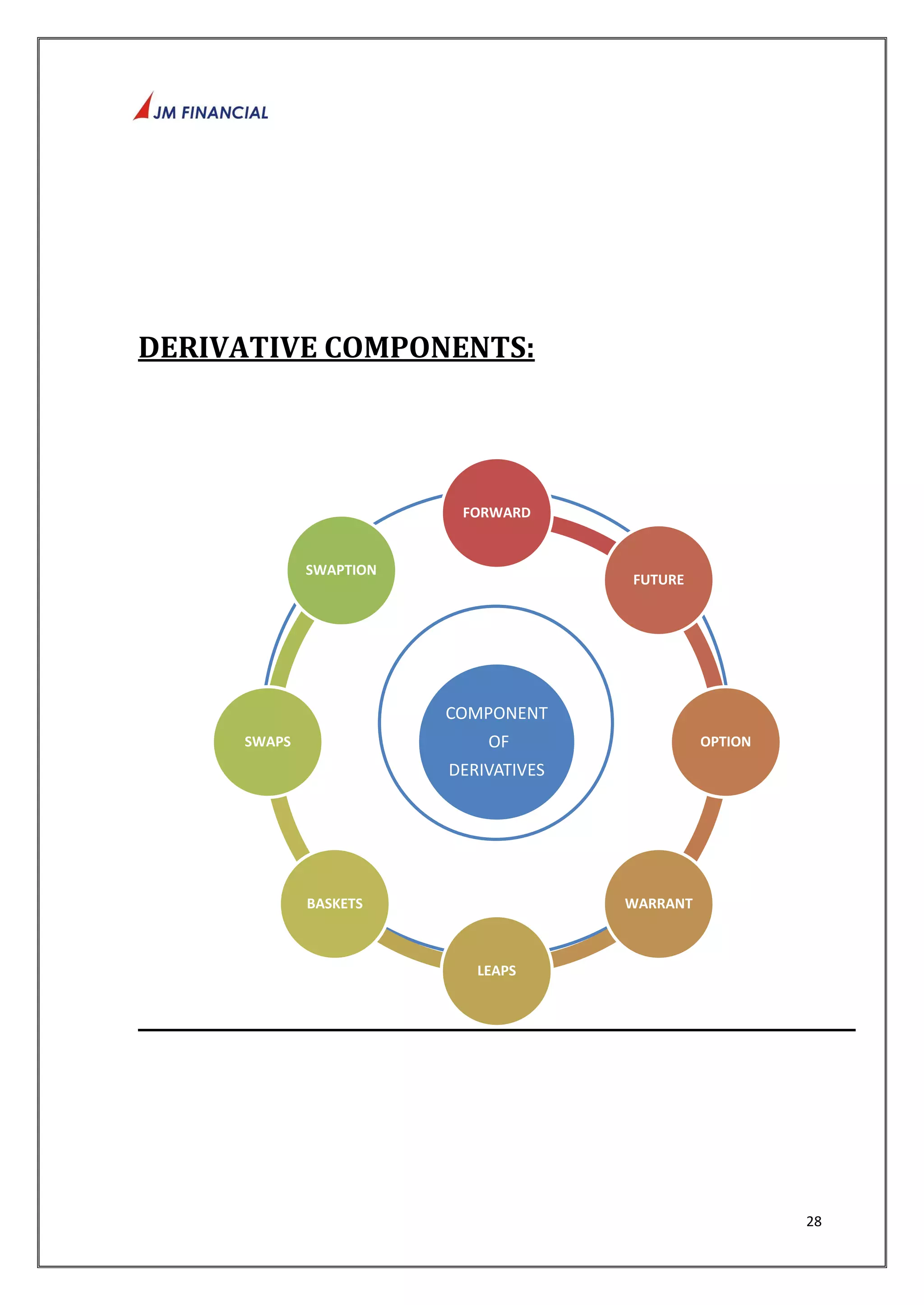
DERIVATIVE COMPONENTS: 
FORWARD 
COMPONENT 
OF 
DERIVATIVES 
FUTURE 
OPTION 
WARRANT 
LEAPS 
BASKETS 
SWAPS 
SWAPTION
29 
Derivative contracts have several variants. The most common variants are 
forwards, futures, options and swaps. 
(i) FORWARDS: 
A forward contract is a customized contract between 2 entities, were 
settlement takes place on a specific date in the future today pre‐agreed 
price. 
(ii) FUTURES: 
A future contract is an agreement between two parties to buy or sell an 
asset at a certain time in the future at a certain price. Futures contracts are 
special types of forward contracts in the sense that the former are 
standardized exchange traded contracts. 
(iii) OPTIONS: 
Options are two types‐ calls and puts. Calls give the buyer the right but 
not the obligation to buy a given quantity of the underlying asset, at a 
given price on or before a given future date. Puts give the buyer the right, 
but not the obligation to sell a given quantity asset at a given price on or 
before a given date. 
(iv) WARRANTS: 
Options generally have lives of up to one year; the majority of options 
traded on options exchanges having a maximum maturity of nine 
months. Longer dated options are called warrants and are generally 
traded over the counter. 
(v) LEAPS: 
The acronym LEAPS means Long Term Equity Anticipation Securities. 
These are options having a maturity of up to three years.
30 
(vi) BASKETS: 
Basket options are on portfolios of underlying assets. The underlying 
asset is usually a moving average of a basket of assets. Equity index 
options are a 
form of basket options. 
(vii) SWAPS: 
Swaps are private agreement between two parties to exchange cash 
flows in the future according to a prearranged formula. They can be 
regarded as portfolios of forward contracts. 
(viii) SWAPTIONS: 
Swaptions are options to buy or sell a swap that will become operative at the 
expiry of options. Thus a Swaptions is an option on a forward swap. Rather 
than have calls and puts the Swaptions market has receiver Swaptions and 
payer Swaptions. A receiver Swaptions is an option to receive fixed and pay 
floating. A payer Swaptions is an option to pay fixed and receives floating.
31 
FORWARD 
CONTRACTS
32 
FORWARD: 
It is a customized contract between two parties. 
Example: 
Imagine you are a farmer. You grow 1,000 dozens of mangoes every year. You want to 
sell these mangoes to a merchant but are not sure what the price will be when the season 
comes. You therefore agree with a merchant to sell all your mangoes for a fixed price for 
Rs 2lakhS. 
This is a forward contract where in you are the seller of mangoes forward and the 
merchant is the buyer. 
The price is agreed today in advance and The delivery will take place sometime in the 
future. 
The essential features of a forward contract 
The essential features of a forward contract are: 
 l Contract between two parties (without any exchange between them) 
 l Price decided today 
 l Quantity decided today (can be based on convenience of the parties) 
 l Quality decided today (can be based on convenience of the parties) 
 l Settlement will take place sometime in future (can be based on convenience of 
the parties) 
 l No margins are generally payable by any of the parties to the other 
Uses of forward 
Forwards have been used in the commodities market since centuries. Forwards are also 
widely used in the foreign exchange market.
33 
Limitations of forwards 
Forwards involve counter party risk. In the above example, if the merchant does not buy 
the mangoes for Rs 2lakhs when the season comes, what can you do? You can only file a 
case in the court, but that is a difficult process. Further, the price of Rs 2lakhs was 
negotiated between you and the merchant. If somebody else wants to buy these mangoes 
from you, there is no mechanism of knowing what the right price is. 
Thus, the two major limitations of forwards are: 
 l Counter party risk 
 l Price not being transparent 
 Counter party risk is also referred to as default risk or credit risk. 
How do Futures overcome these difficulties? 
An exchange (or its clearing corporation) becomes the legal counterparty in case of 
futures. Hence, if you buy any futures contract on an exchange, the exchange (or its 
clearing corporation) becomes the seller. 
If the other party (the real seller) does not deliver on the expiry date, you do not have to 
worry. The exchange (or its clearing corporation) will guarantee you the delivery. 
Further, prices of all Futures quoted on the exchange are known to all players. 
Transparency in prices is a big advantage over forwards.
34 
FUTURES 
CONTRACT
35 
FUTURES : 
Futures are similar to forwards in the sense that the price is decided today and the 
delivery will take place in future. But Futures are quoted on a stock exchange. Prices are 
available to all those who want to buy or sell because the trading takes place on a 
transparent computer system. 
Features of Futures 
The essential features of a Futures contract are: 
 Contract between two parties through an exchange 
 l Exchange is the legal counterparty to both parties 
 l Price decided today 
 l Quantity decided today (quantities have to be in standard denominations 
specified by the exchange) 
 l Quality decided today (quality should be as per the specifications decided by the 
exchange) 
 l Tick size (i.e. the minimum amount by which the price quoted can change) is 
decided by the exchange 
 l Delivery will take place sometime in future (expiry date is specified by the 
exchange) 
 l Margins are payable by both the parties to the exchange 
 l In some cases, the price limits (or circuit filters) can be decided by the exchange
36 
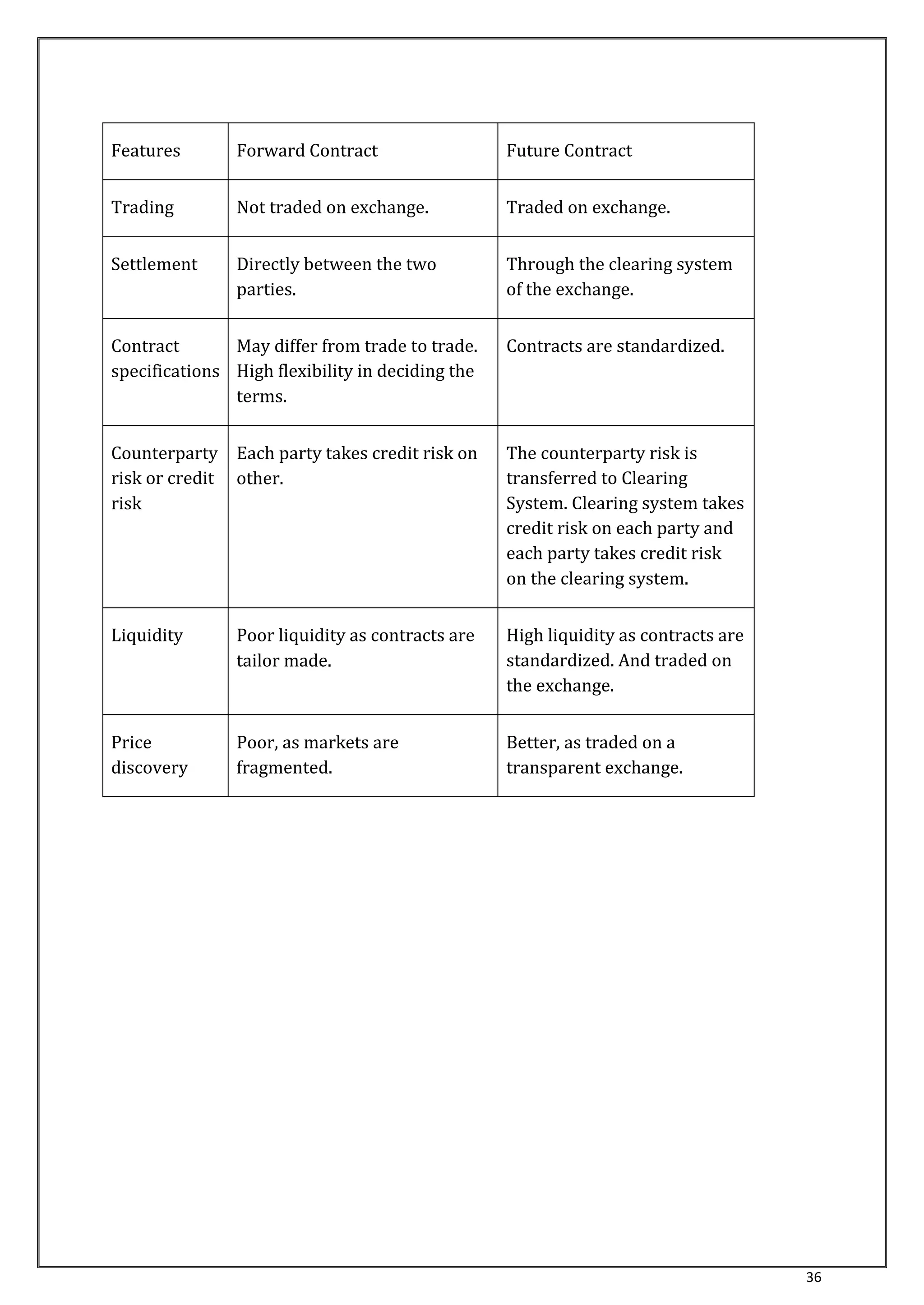
Features Forward Contract Future Contract 
Trading Not traded on exchange. Traded on exchange. 
Settlement Directly between the two 
parties. 
Through the clearing system 
of the exchange. 
Contract 
specifications 
May differ from trade to trade. 
High flexibility in deciding the 
terms. 
Contracts are standardized. 
Counterparty 
risk or credit 
risk 
Each party takes credit risk on 
other. 
The counterparty risk is 
transferred to Clearing 
System. Clearing system takes 
credit risk on each party and 
each party takes credit risk 
on the clearing system. 
Liquidity Poor liquidity as contracts are 
tailor made. 
High liquidity as contracts are 
standardized. And traded on 
the exchange. 
Price 
discovery 
Poor, as markets are 
fragmented. 
Better, as traded on a 
transparent exchange.
Future Trading is jut like Cash Segment Trading. In Future Trading you are not to pay 100 
% payment as you have to do in Cash Segment and there is nothing like delivery. 
37 
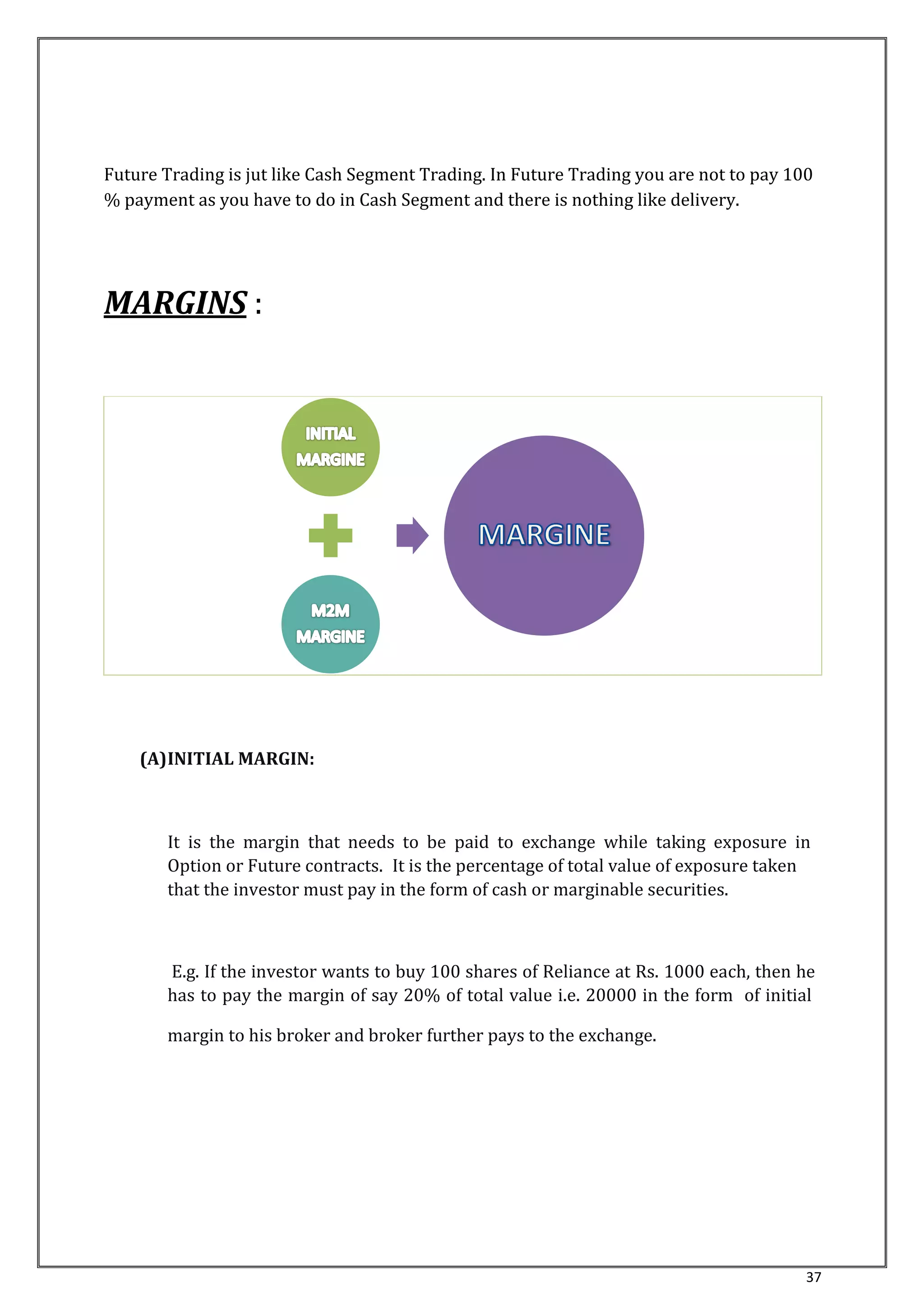
MARGINS : 
(A)INITIAL MARGIN: 
It is the margin that needs to be paid to exchange while taking exposure in 
Option or Future contracts. It is the percentage of total value of exposure taken 
that the investor must pay in the form of cash or marginable securities. 
E.g. If the investor wants to buy 100 shares of Reliance at Rs. 1000 each, then he 
has to pay the margin of say 20% of total value i.e. 20000 in the form of initial 
margin to his broker and broker further pays to the exchange.
38 
(B)MARK TO MARKET MARGIN: 
It is the margin that needs to be paid or received based on the daily movement of 
prices. So futures and options contracts are marked to daily market prices and 
based on exposure taken the investor’s account is debited or credited. If price 
movement goes against your expectation then the investor has to pay mark to 
market margin and if price run as per expectation then margin is credited in his 
account which he/she can withdraw. 
In Future contracts it has to be paid in the form of cash whereas in option 
contracts it can be paid in form of cash or marginable securities.
39 
OPTION
40 
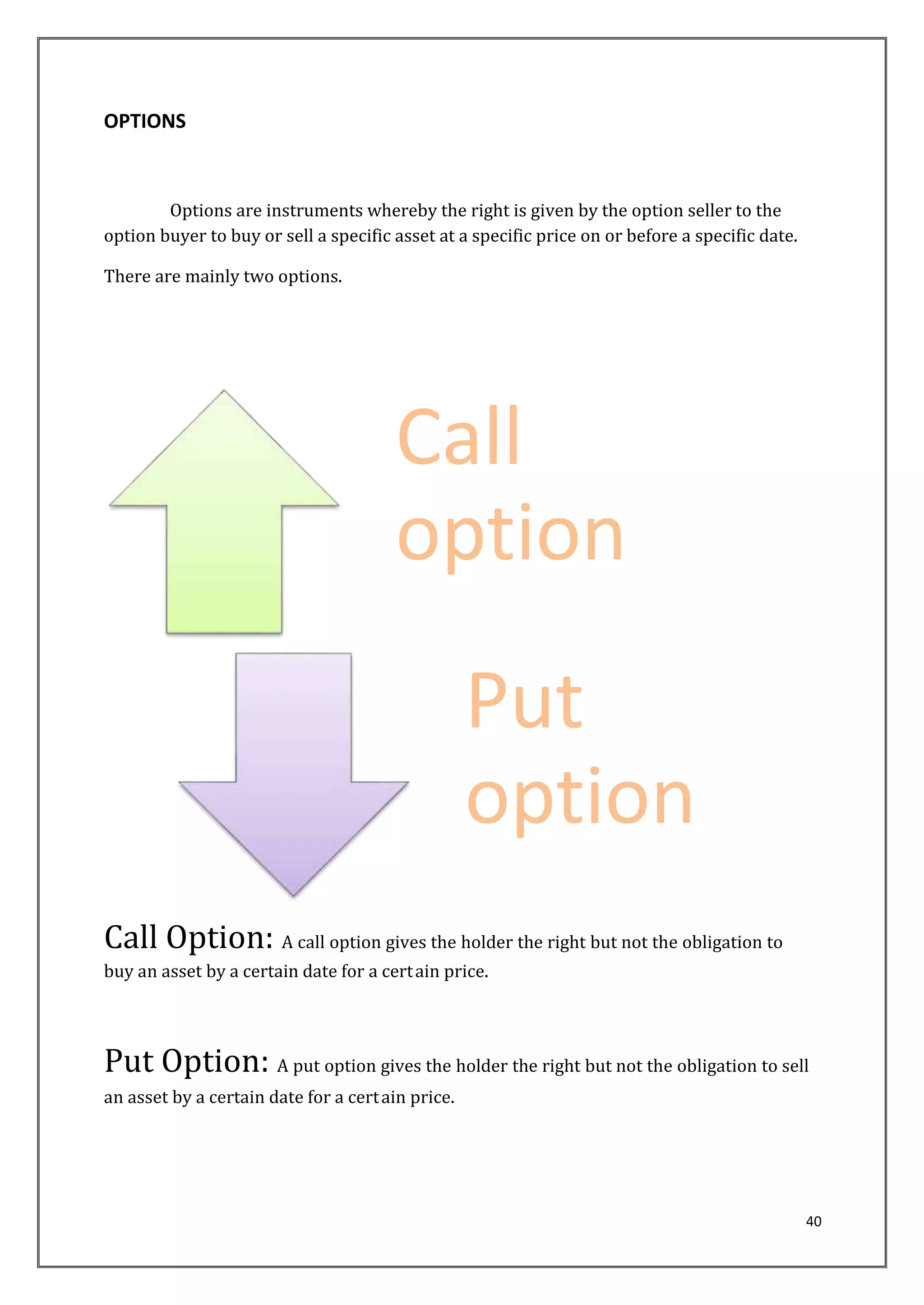
OPTIONS 
Options are instruments whereby the right is given by the option seller to the 
option buyer to buy or sell a specific asset at a specific price on or before a specific date. 
There are mainly two options. 
Call 
option 
Put 
option 
Call Option: A call option gives the holder the right but not the obligation to 
buy an asset by a certain date for a cert ain price. 
Put Option: A put option gives the holder the right but not the obligation to sell 
an asset by a certain date for a cert ain price.
41 
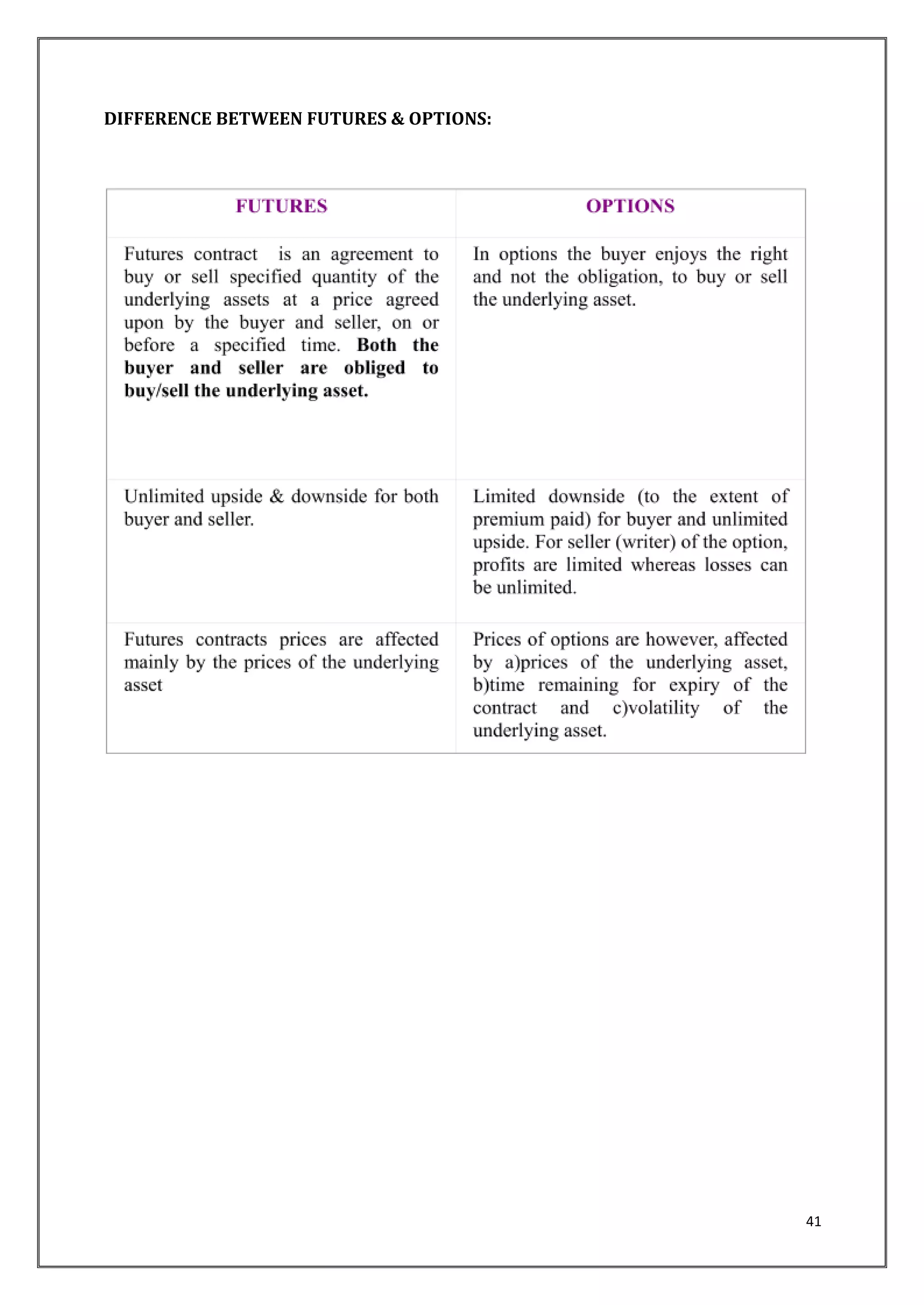
DIFFERENCE BETWEEN FUTURES & OPTIONS:
42 
Call & Put Option: 
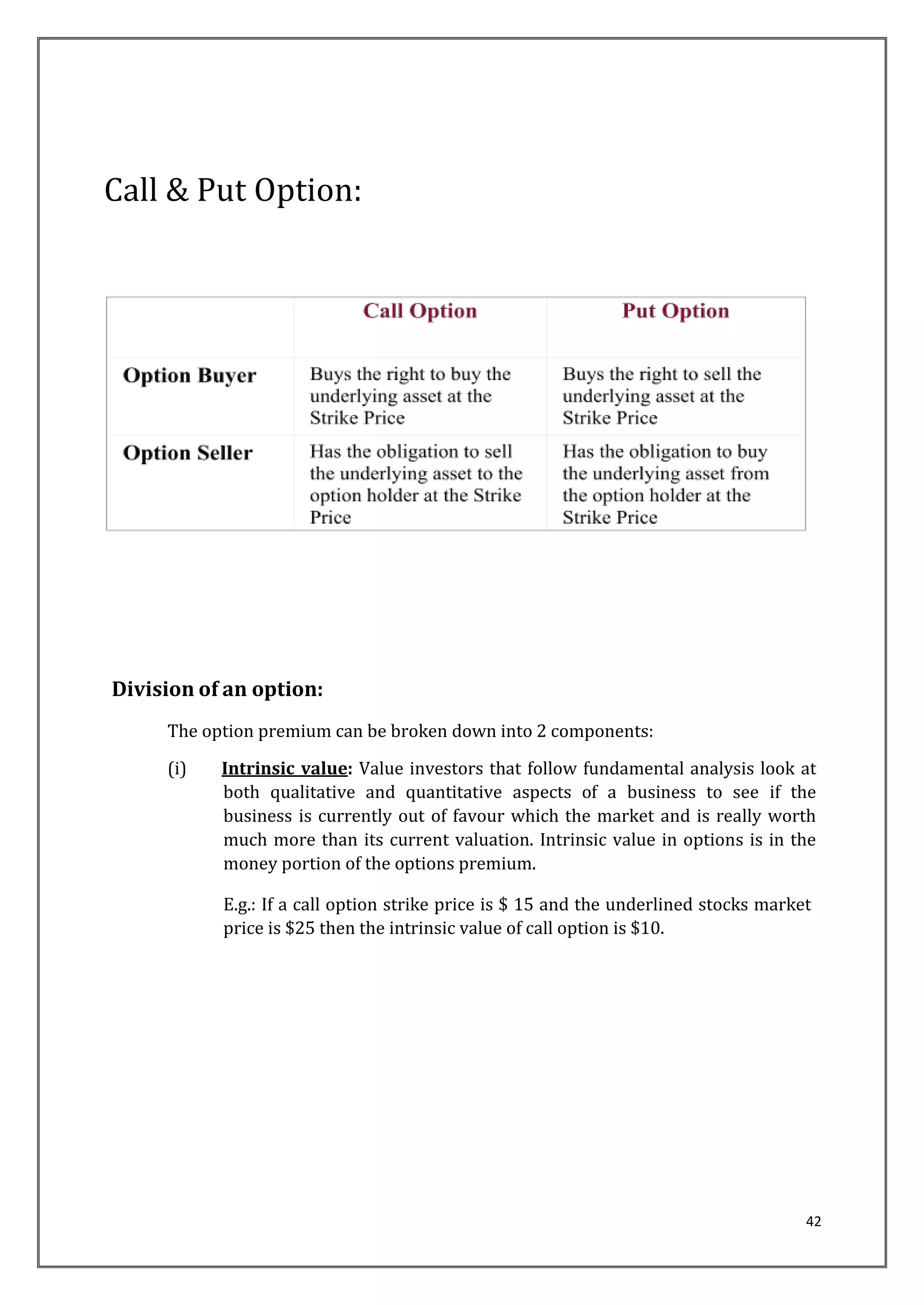
Division of an option: 
The option premium can be broken down into 2 components: 
(i) Intrinsic value: Value investors that follow fundamental analysis look at 
both qualitative and quantitative aspects of a business to see if the 
business is currently out of favour which the market and is really worth 
much more than its current valuation. Intrinsic value in options is in the 
money portion of the options premium. 
E.g.: If a call option strike price is $ 15 and the underlined stocks market 
price is $25 then the intrinsic value of call option is $10.
(ii) Time value: The time value of an option is the difference between its 
premium and its intrinsic value. Both calls and puts have time value. An 
option that is OTM or ATM has only time value. Usually the maximum 
time value exits when option is ATM. The longer the time to expiration, the 
greater is an options time value, or else equal. At expiration, an option should 
have more time value. 
43
44 
Market Trend & 
Option Strategies 
overview
45 
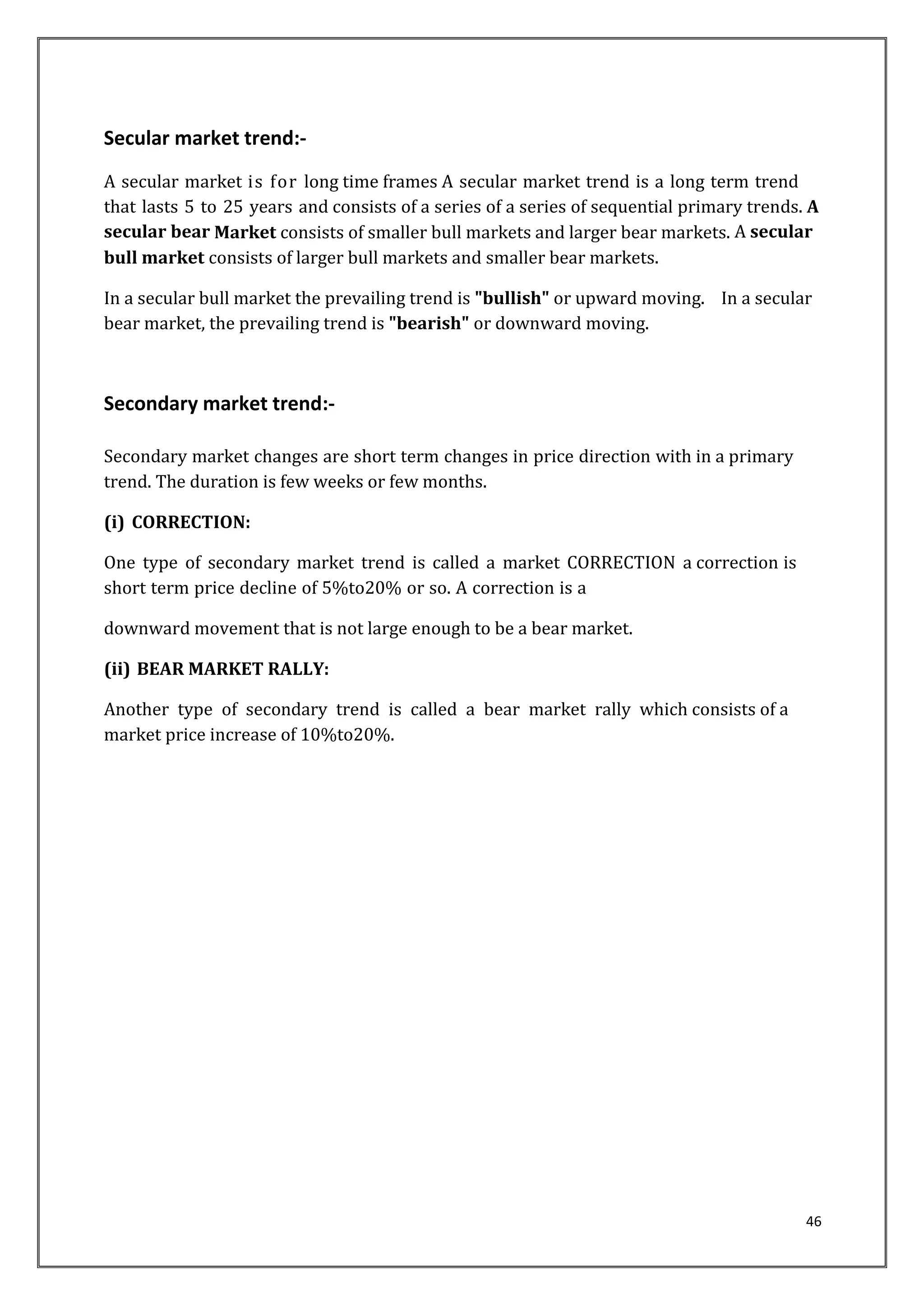
MARKET TRENDS:­A 
market trend is a putative tendency of a financial market to move in a 
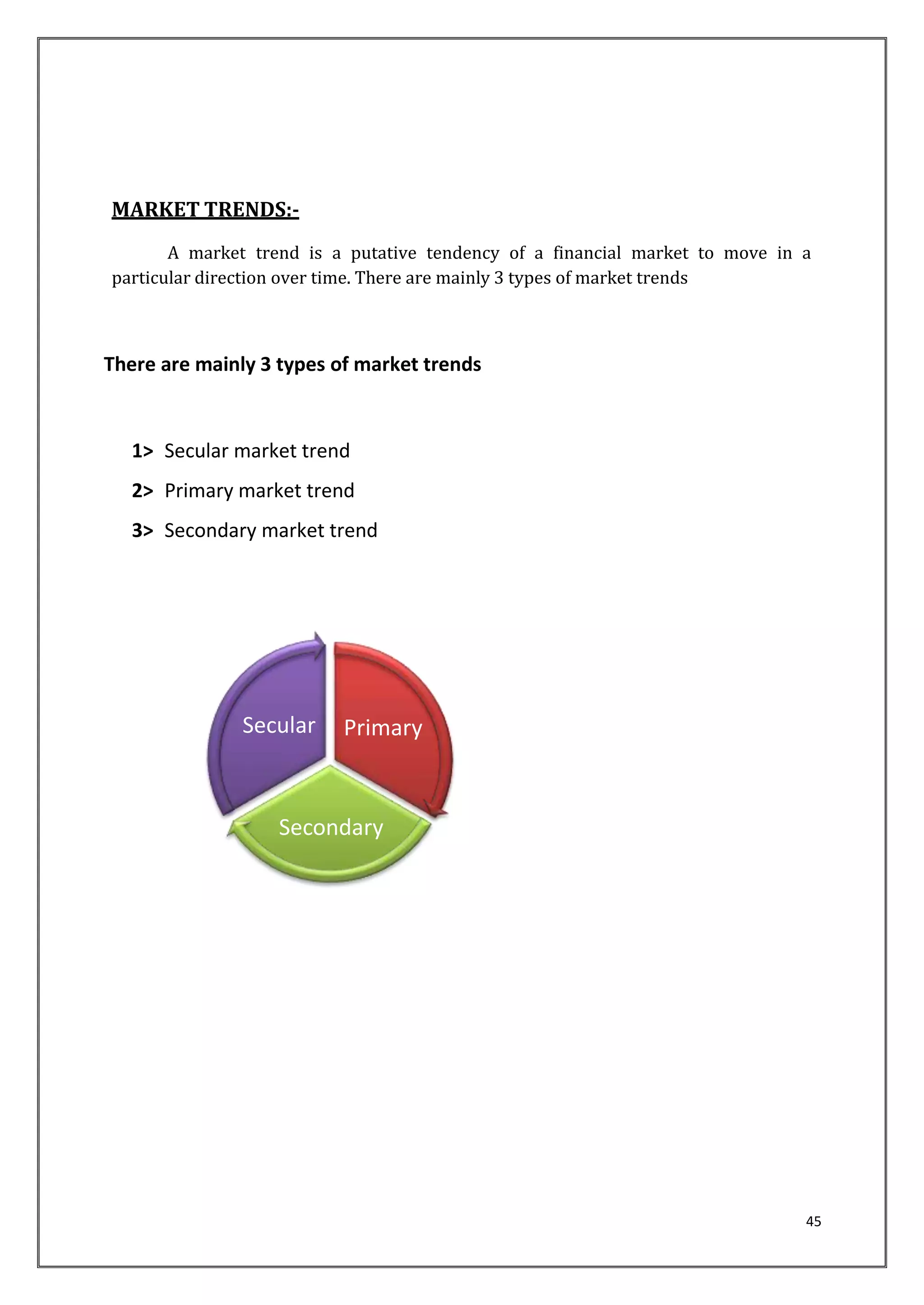
particular direction over time. There are mainly 3 types of market trends 
There are mainly 3 types of market trends 
1> Secular market trend 
2> Primary market trend 
3> Secondary market trend 
Primary 
Secular 
Secondary
46 
Secular market trend:- 
A secular market is for long time frames A secular market trend is a long term trend 
that lasts 5 to 25 years and consists of a series of a series of sequential primary trends. A 
secular bear Market consists of smaller bull markets and larger bear markets. A secular 
bull market consists of larger bull markets and smaller bear markets. 
In a secular bull market the prevailing trend is "bullish" or upward moving. In a secular 
bear market, the prevailing trend is "bearish" or downward moving. 
Secondary market trend:- 
Secondary market changes are short term changes in price direction with in a primary 
trend. The duration is few weeks or few months. 
(i) CORRECTION: 
One type of secondary market trend is called a market CORRECTION a correction is 
short term price decline of 5%to20% or so. A correction is a 
downward movement that is not large enough to be a bear market. 
(ii) BEAR MARKET RALLY: 
Another type of secondary trend is called a bear market rally which consists of a 
market price increase of 10%to20%.
47 
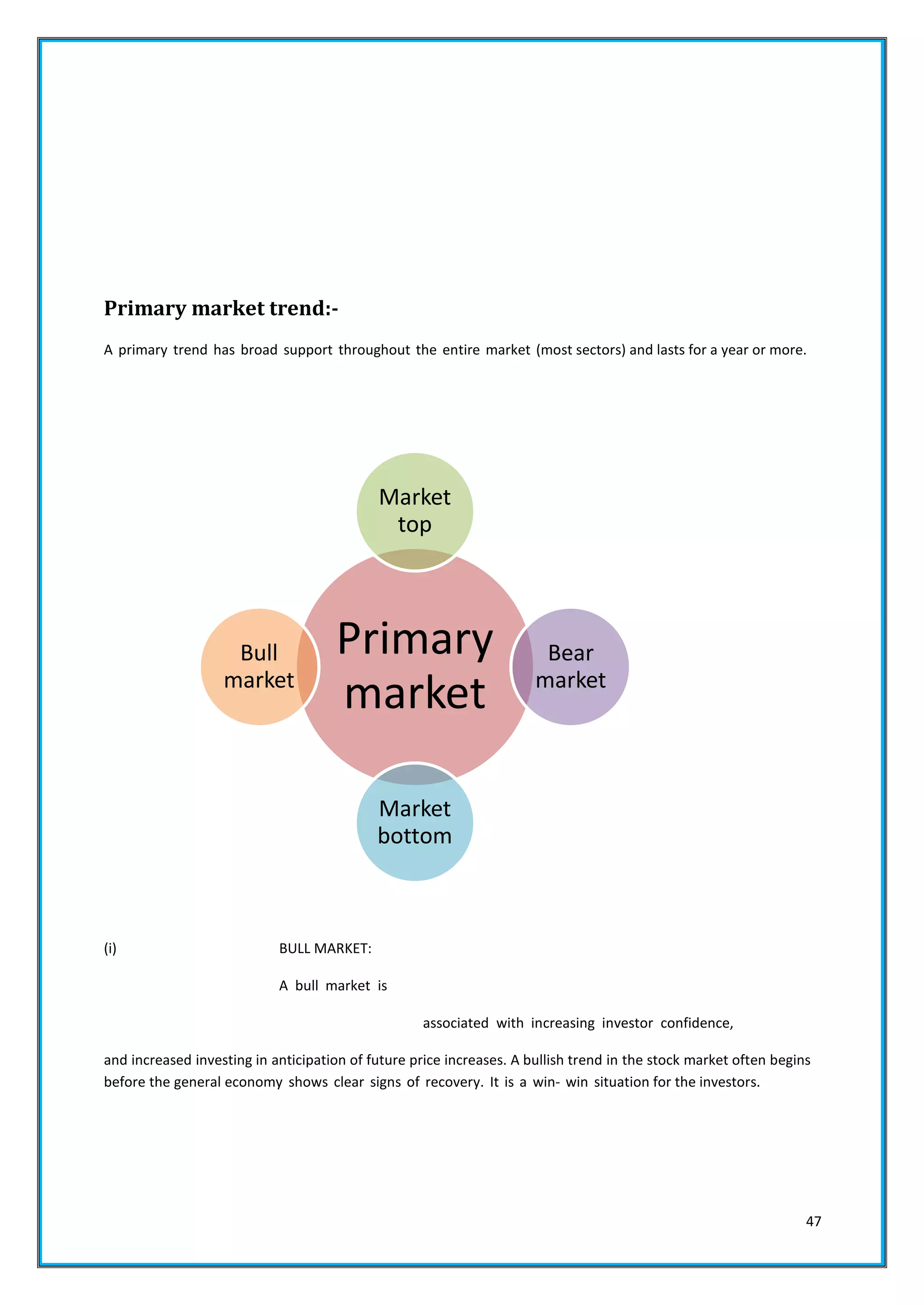
Primary market trend:- 
A primary trend has broad support throughout the entire market (most sectors) and lasts for a year or more. 
Market 
top 
Primary 
market 
Bull 
market 
(i) BULL MARKET: 
Market 
bottom 
A bull market is 
Bear 
market 
associated with increasing investor confidence, 
and increased investing in anticipation of future price increases. A bullish trend in the stock market often begins 
before the general economy shows clear signs of recovery. It is a win‐ win situation for the investors.
48 
(ii) BEAR MARKET: 
A bear market is a general decline in the stock market over a period of time. It is a transition from 
high investor optimism to 
widespread investor fear and pessimism. 
(iii) MARKET TOP: 
A market top (or market high) is usually not a dramatic event. The market has simply 
reached the highest point that it will, for some time (usually a few years). It is, by 
definition, retroactively defined as market participants are not aware of it as it 
happens. A decline 
then follows, usually gradually at first and later with more rapidity. 
(iv) MARKET BOTTOM: 
A market bottom is a trend reversal, the end of a market downtown, and 
precedes the beginning of an upward moving trend (bull market). 
It is very difficult to identify bottom while it is occurring. The 
upturn following decline is often short lived and prices may resume their decline. 
This would bring a loss for the investors who 
purchased stocks during “false” market bottom.
49 
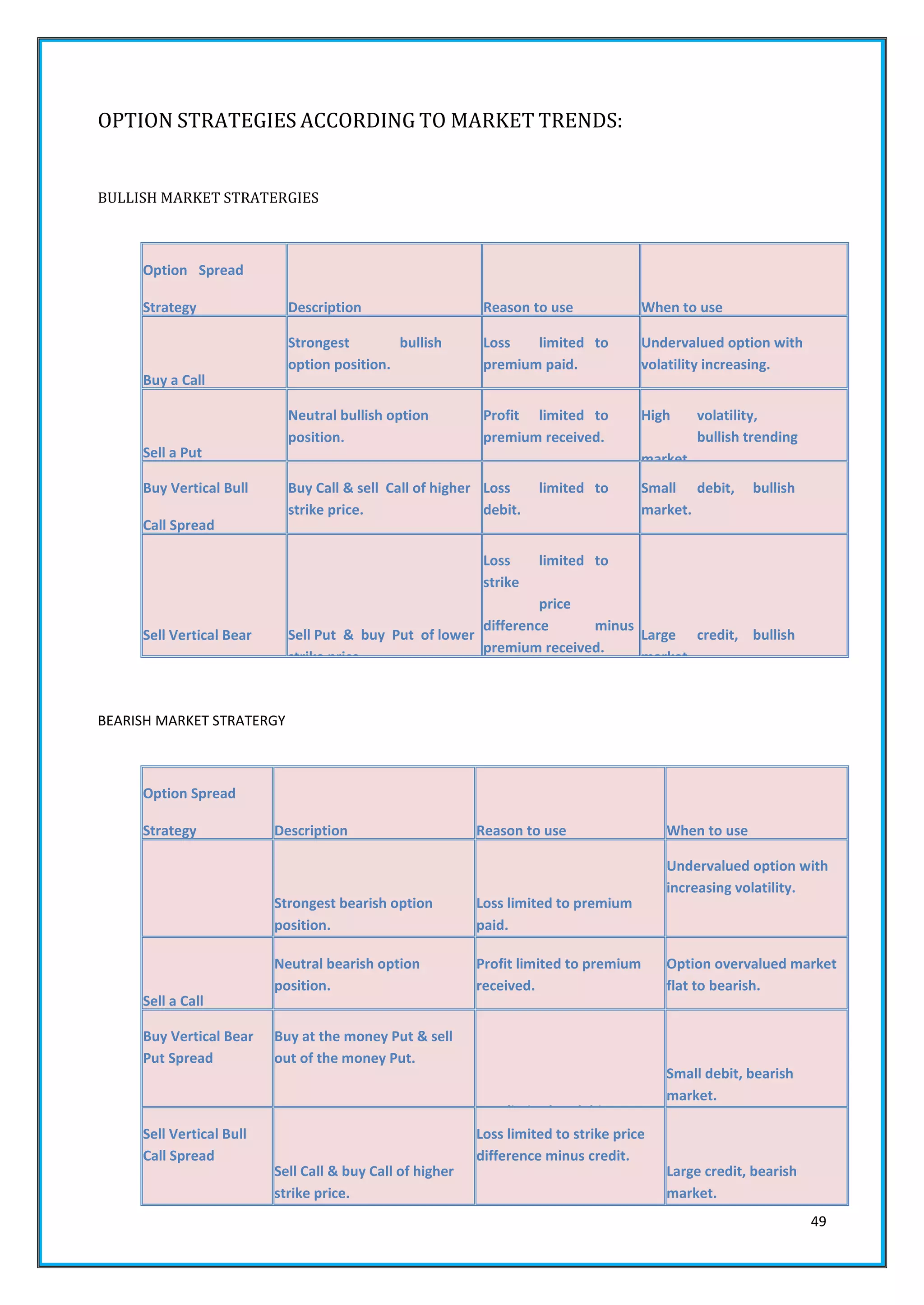
OPTION STRATEGIES ACCORDING TO MARKET TRENDS: 
BULLISH MARKET STRATERGIES 
Option Spread 
Strategy 
Description 
Reason to use 
When to use 
Buy a Call 
Strongest bullish 
option position. 
Loss limited to 
premium paid. 
Undervalued option with 
volatility increasing. 
Sell a Put 
Neutral bullish option 
position. 
Profit limited to 
premium received. 
High volatility, 
bullish trending 
market. 
Buy Vertical Bull 
Call Spread 
Buy Call & sell Call of higher 
strike price. 
Loss limited to 
debit. 
Small debit, bullish 
market. 
Sell Vertical Bear 
Put Spread 
Sell Put & buy Put of lower 
strike price. 
Loss limited to 
strike 
price 
difference minus 
premium received. 
Large credit, bullish 
market. 
BEARISH MARKET STRATERGY 
Option Spread 
Strategy 
Description 
Reason to use 
When to use 
Buy a Put 
Strongest bearish option 
position. 
Loss limited to premium 
paid. 
Undervalued option with 
increasing volatility. 
Sell a Call 
Neutral bearish option 
position. 
Profit limited to premium 
received. 
Option overvalued market 
flat to bearish. 
Buy Vertical Bear 
Put Spread 
Buy at the money Put & sell 
out of the money Put. 
Loss limited to debit. 
Small debit, bearish 
market. 
Sell Vertical Bull 
Call Spread 
Sell Call & buy Call of higher 
strike price. 
Loss limited to strike price 
difference minus credit. 
Large credit, bearish 
market.
50 
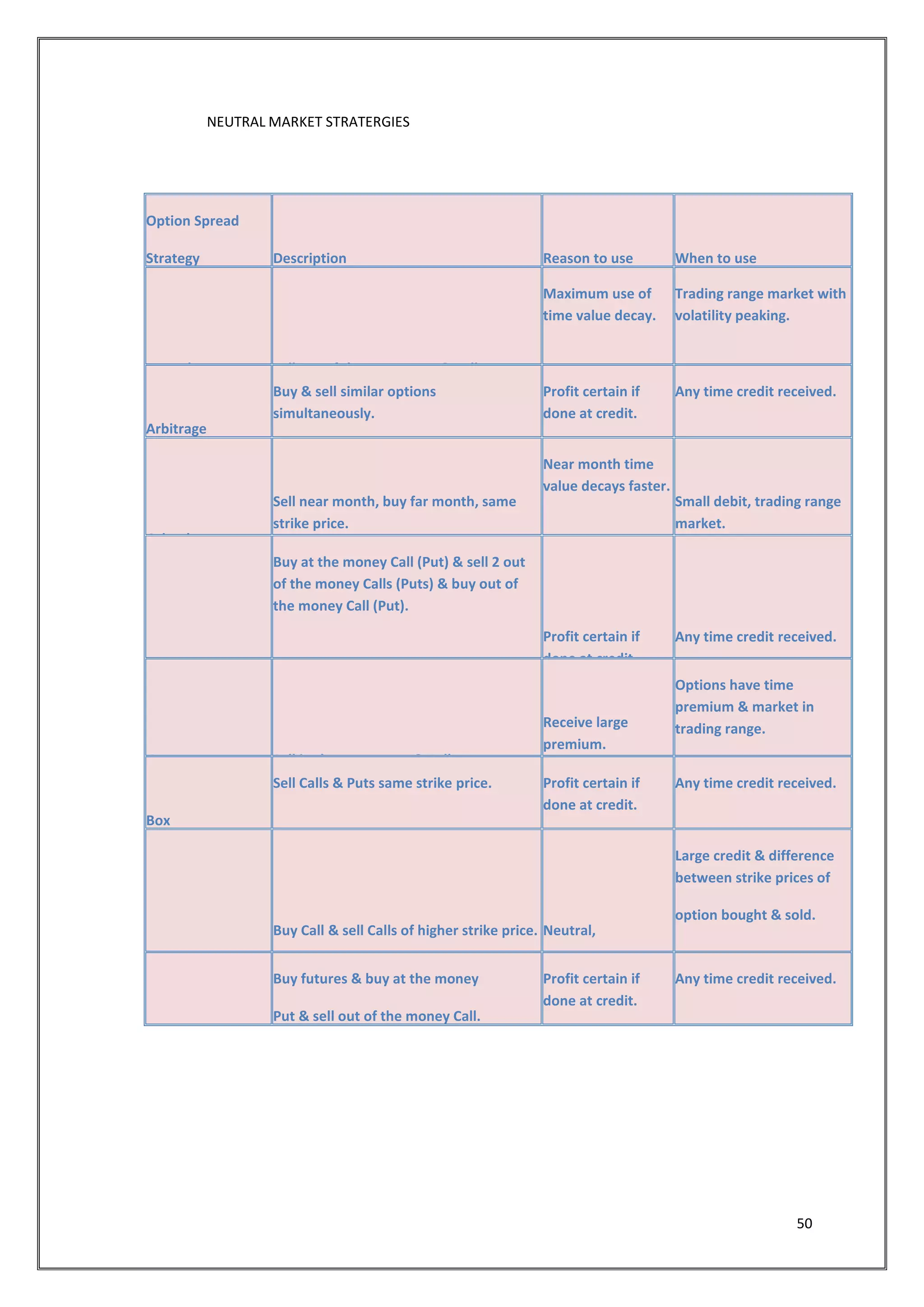
NEUTRAL MARKET STRATERGIES 
Option Spread 
Strategy 
Description 
Reason to use 
When to use 
Strangle 
Sell out of the money Put & Call. 
Maximum use of 
time value decay. 
Trading range market with 
volatility peaking. 
Arbitrage 
Buy & sell similar options 
simultaneously. 
Profit certain if 
done at credit. 
Any time credit received. 
Calendar 
Sell near month, buy far month, same 
strike price. 
Near month time 
value decays faster. 
Small debit, trading range 
market. 
Butterfly 
Buy at the money Call (Put) & sell 2 out 
of the money Calls (Puts) & buy out of 
the money Call (Put). 
Profit certain if 
done at credit. 
Any time credit received. 
Guts 
Sell in the money Put & Call. 
Receive large 
premium. 
Options have time 
premium & market in 
trading range. 
Box 
Sell Calls & Puts same strike price. Profit certain if 
done at credit. 
Any time credit received. 
Ratio Call 
Buy Call & sell Calls of higher strike price. 
Neutral, 
slightly bullish. 
Large credit & difference 
between strike prices of 
option bought & sold. 
Buy futures & buy at the money 
Put & sell out of the money Call. 
Profit certain if 
done at credit. 
Any time credit received.
51 
OPTION 
STATEGIES
PAYOFF 
5100 5150 5200 5250 5300 5350 5400 5450 5500 5550 5600 5650 5700 5750 5800 5850 5900 5950 6000 6050 6100 
52 
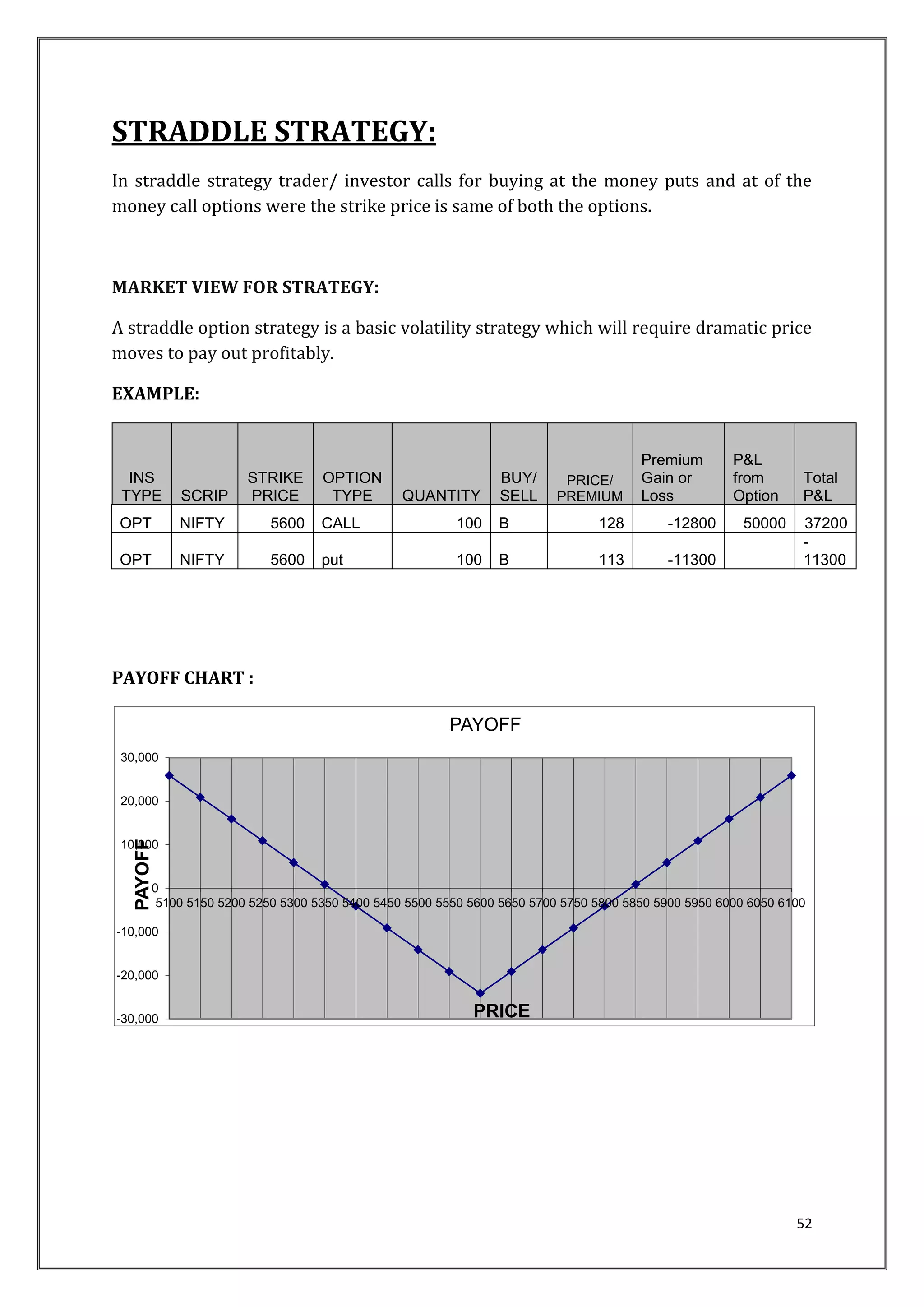
STRADDLE STRATEGY: 
In straddle strategy trader/ investor calls for buying at the money puts and at of the 
money call options were the strike price is same of both the options. 
MARKET VIEW FOR STRATEGY: 
A straddle option strategy is a basic volatility strategy which will require dramatic price 
moves to pay out profitably. 
EXAMPLE: 
INS 
TYPE SCRIP 
STRIKE 
PRICE 
OPTION 
TYPE QUANTITY 
BUY/ 
SELL 
PRICE/ 
PREMIUM 
Premium 
Gain or 
Loss 
P&L 
from 
Option 
Total 
P&L 
OPT NIFTY 5600 CALL 100 B 128 -12800 50000 37200 
OPT NIFTY 5600 put 100 B 113 -11300 
- 
11300 
PAYOFF CHART : 
30,000 
20,000 
PAYOFF 
10,000 
0 
-10,000 
-20,000 
-30,000 
PRICE
53 
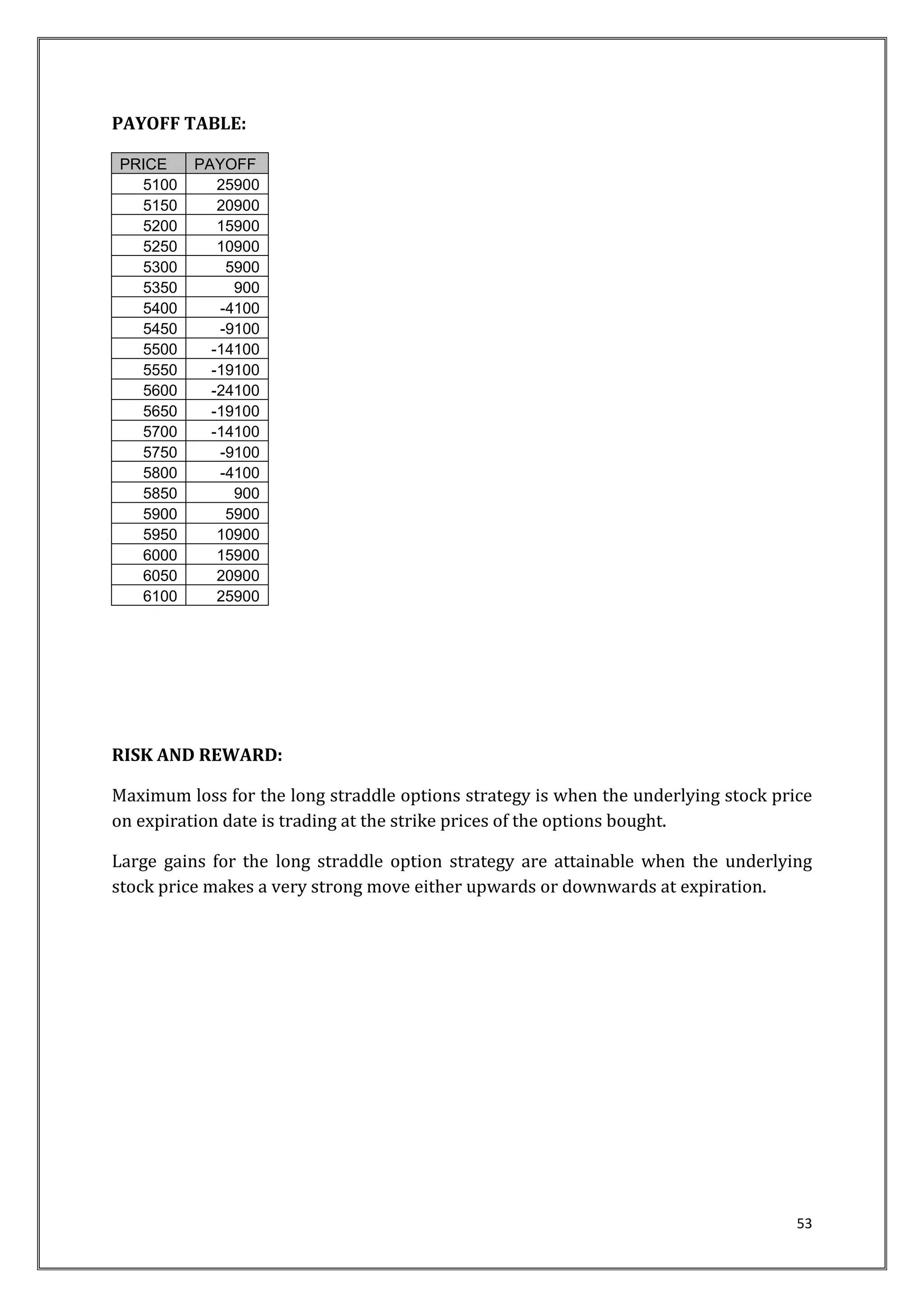
PAYOFF TABLE: 
PRICE PAYOFF 
5100 25900 
5150 20900 
5200 15900 
5250 10900 
5300 5900 
5350 900 
5400 -4100 
5450 -9100 
5500 -14100 
5550 -19100 
5600 -24100 
5650 -19100 
5700 -14100 
5750 -9100 
5800 -4100 
5850 900 
5900 5900 
5950 10900 
6000 15900 
6050 20900 
6100 25900 
RISK AND REWARD: 
Maximum loss for the long straddle options strategy is when the underlying stock price 
on expiration date is trading at the strike prices of the options bought. 
Large gains for the long straddle option strategy are attainable when the underlying 
stock price makes a very strong move either upwards or downwards at expiration.
PAYOFF 
PAYOFF 
5300 5325 5350 5375 5400 5425 5450 5475 5500 5525 5550 5575 5600 5625 5650 5675 5700 5725 5750 5775 5800 
54 
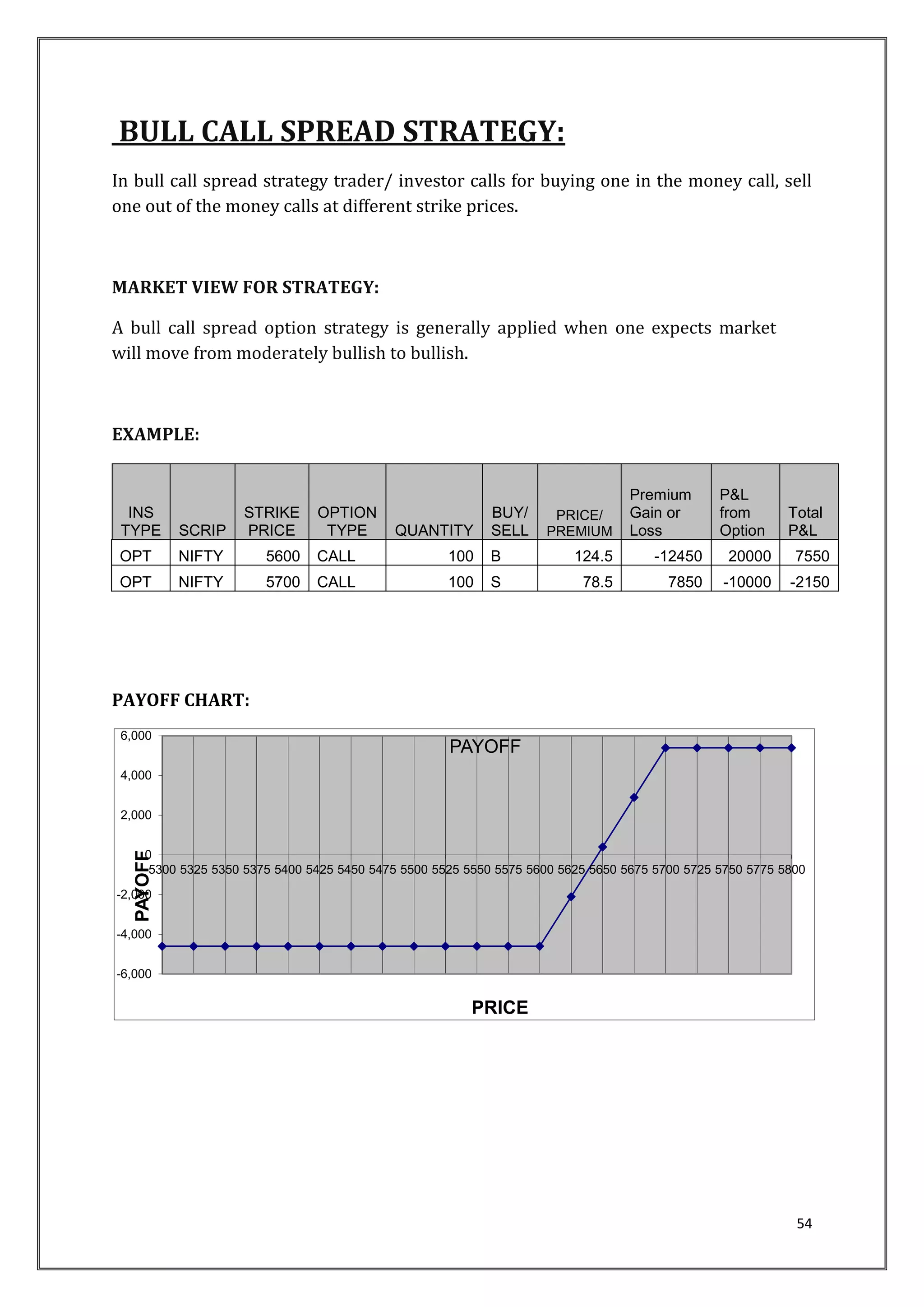
BULL CALL SPREAD STRATEGY: 
In bull call spread strategy trader/ investor calls for buying one in the money call, sell 
one out of the money calls at different strike prices. 
MARKET VIEW FOR STRATEGY: 
A bull call spread option strategy is generally applied when one expects market 
will move from moderately bullish to bullish. 
EXAMPLE: 
INS 
TYPE SCRIP 
STRIKE 
PRICE 
OPTION 
TYPE QUANTITY 
BUY/ 
SELL 
PRICE/ 
PREMIUM 
Premium 
Gain or 
Loss 
P&L 
from 
Option 
Total 
P&L 
OPT NIFTY 5600 CALL 100 B 124.5 -12450 20000 7550 
OPT NIFTY 5700 CALL 100 S 78.5 7850 -10000 -2150 
PAYOFF CHART: 
6,000 
4,000 
2,000 
0 
-2,000 
-4,000 
-6,000 
PRICE
55 
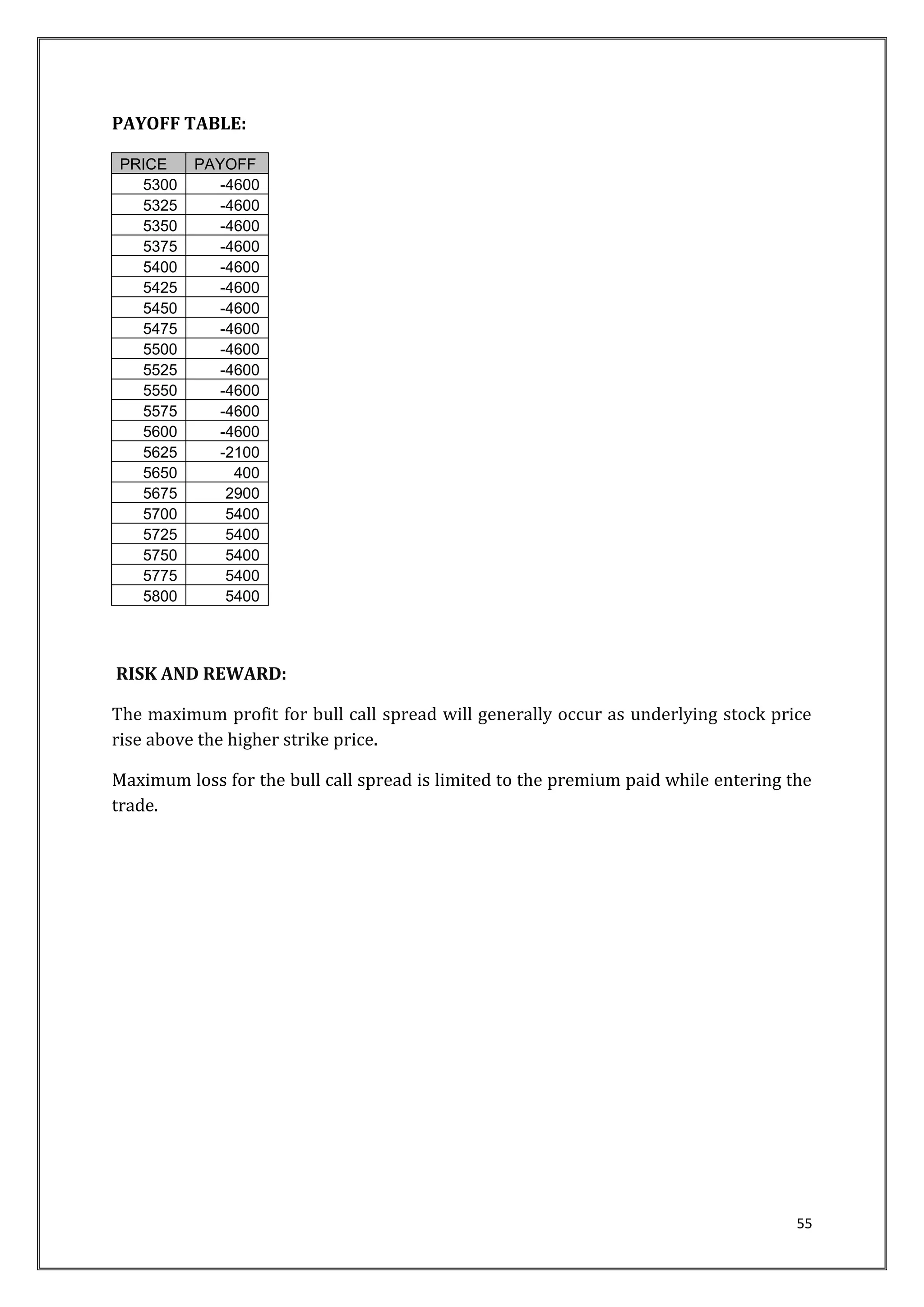
PAYOFF TABLE: 
PRICE PAYOFF 
5300 -4600 
5325 -4600 
5350 -4600 
5375 -4600 
5400 -4600 
5425 -4600 
5450 -4600 
5475 -4600 
5500 -4600 
5525 -4600 
5550 -4600 
5575 -4600 
5600 -4600 
5625 -2100 
5650 400 
5675 2900 
5700 5400 
5725 5400 
5750 5400 
5775 5400 
5800 5400 
RISK AND REWARD: 
The maximum profit for bull call spread will generally occur as underlying stock price 
rise above the higher strike price. 
Maximum loss for the bull call spread is limited to the premium paid while entering the 
trade.
PAYOFF 
PAYOFF 
5300 5325 5350 5375 5400 5425 5450 5475 5500 5525 5550 5575 5600 5625 5650 5675 5700 5725 5750 5775 5800 
56 
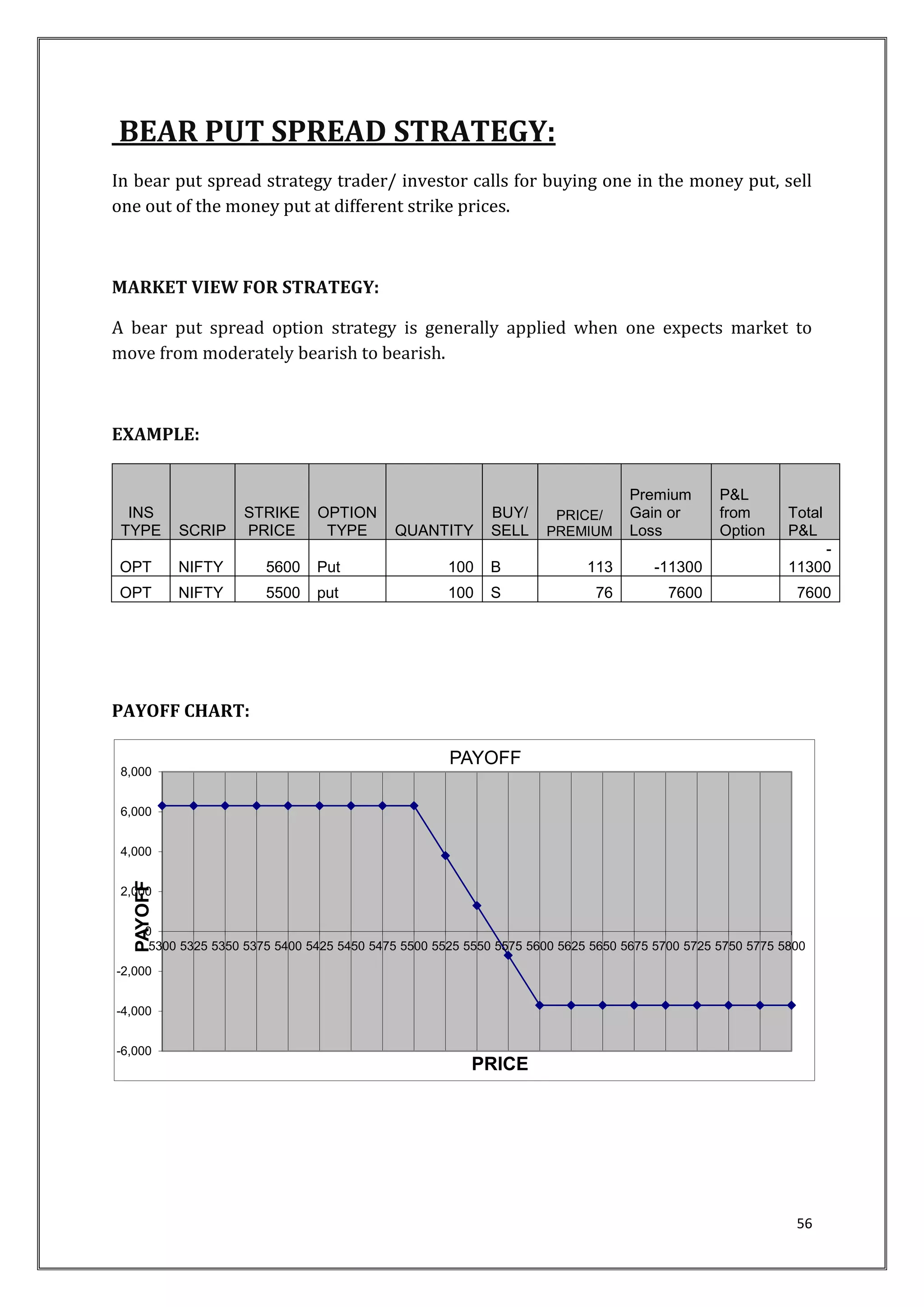
BEAR PUT SPREAD STRATEGY: 
In bear put spread strategy trader/ investor calls for buying one in the money put, sell 
one out of the money put at different strike prices. 
MARKET VIEW FOR STRATEGY: 
A bear put spread option strategy is generally applied when one expects market to 
move from moderately bearish to bearish. 
EXAMPLE: 
INS 
TYPE SCRIP 
STRIKE 
PRICE 
OPTION 
TYPE QUANTITY 
BUY/ 
SELL 
PRICE/ 
PREMIUM 
Premium 
Gain or 
Loss 
P&L 
from 
Option 
Total 
P&L 
OPT NIFTY 5600 Put 100 B 113 -11300 
- 
11300 
OPT NIFTY 5500 put 100 S 76 7600 
7600 
PAYOFF CHART: 
8,000 
6,000 
4,000 
2,000 
0 
-2,000 
-4,000 
-6,000 
PRICE
57 
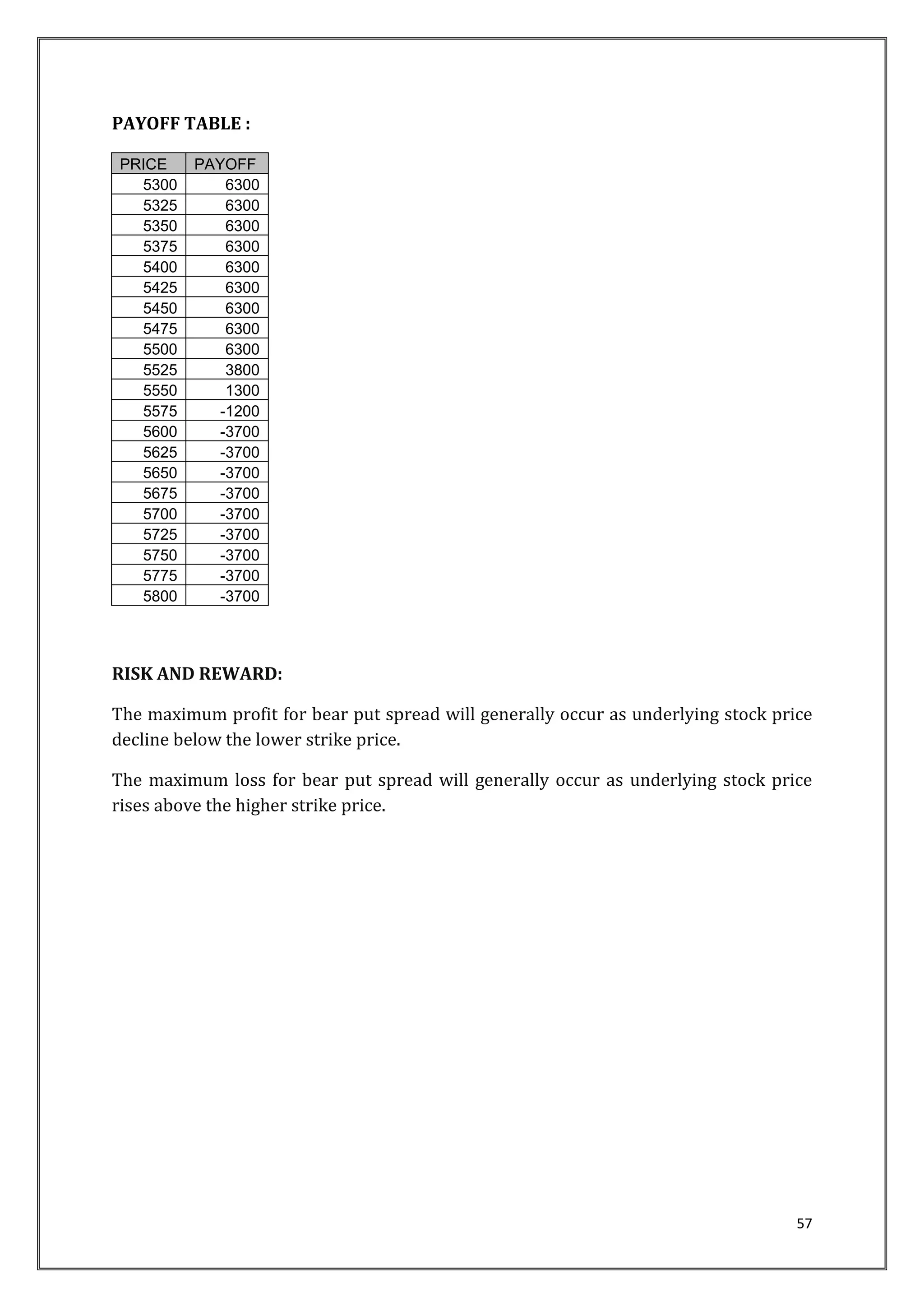
PAYOFF TABLE : 
PRICE PAYOFF 
5300 6300 
5325 6300 
5350 6300 
5375 6300 
5400 6300 
5425 6300 
5450 6300 
5475 6300 
5500 6300 
5525 3800 
5550 1300 
5575 -1200 
5600 -3700 
5625 -3700 
5650 -3700 
5675 -3700 
5700 -3700 
5725 -3700 
5750 -3700 
5775 -3700 
5800 -3700 
RISK AND REWARD: 
The maximum profit for bear put spread will generally occur as underlying stock price 
decline below the lower strike price. 
The maximum loss for bear put spread will generally occur as underlying stock price 
rises above the higher strike price.
PAYOFF 
PAYOFF 
5100 5150 5200 5250 5300 5350 5400 5450 5500 5550 5600 5650 5700 5750 5800 5850 5900 5950 6000 6050 6100 
58 
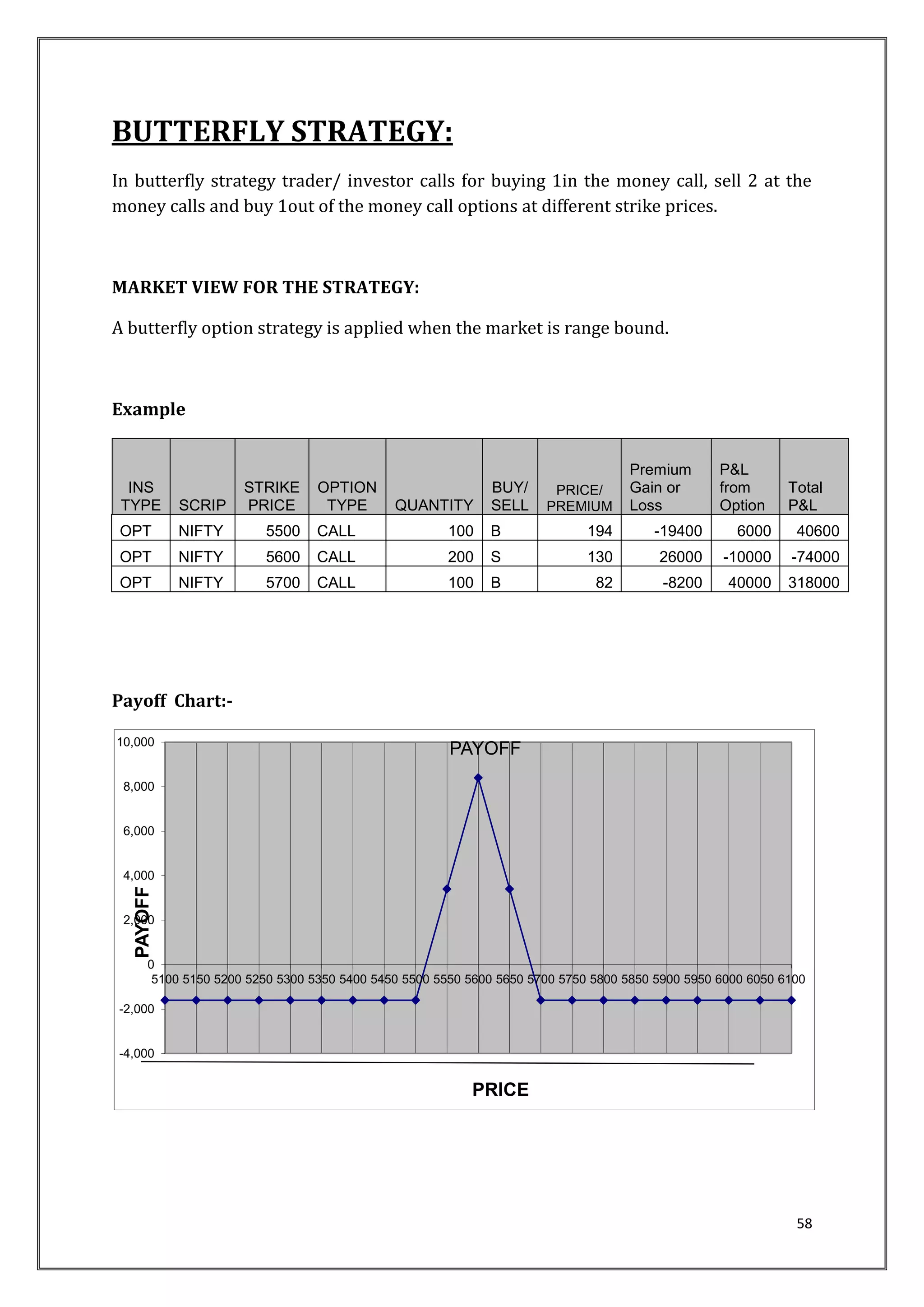
BUTTERFLY STRATEGY: 
In butterfly strategy trader/ investor calls for buying 1in the money call, sell 2 at the 
money calls and buy 1out of the money call options at different strike prices. 
MARKET VIEW FOR THE STRATEGY: 
A butterfly option strategy is applied when the market is range bound. 
Example 
INS 
TYPE SCRIP 
STRIKE 
PRICE 
OPTION 
TYPE QUANTITY 
BUY/ 
SELL 
PRICE/ 
PREMIUM 
Premium 
Gain or 
Loss 
P&L 
from 
Option 
Total 
P&L 
OPT NIFTY 5500 CALL 100 B 194 -19400 6000 40600 
OPT NIFTY 5600 CALL 200 S 130 26000 -10000 -74000 
OPT NIFTY 5700 CALL 100 B 82 -8200 40000 318000 
Payoff Chart:- 
10,000 
8,000 
6,000 
4,000 
2,000 
0 
-2,000 
-4,000 
PRICE
59 
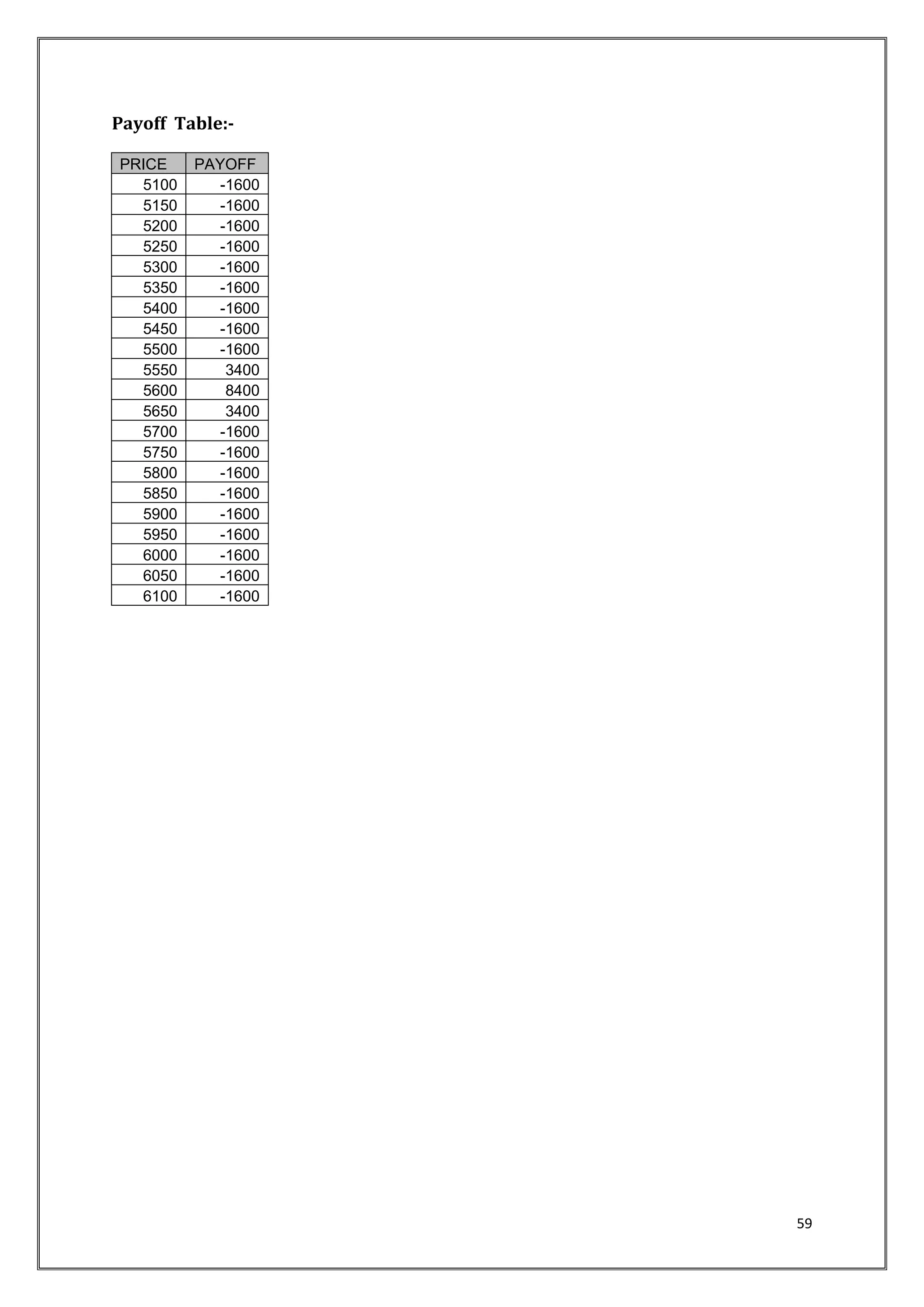
Payoff Table:- 
PRICE PAYOFF 
5100 -1600 
5150 -1600 
5200 -1600 
5250 -1600 
5300 -1600 
5350 -1600 
5400 -1600 
5450 -1600 
5500 -1600 
5550 3400 
5600 8400 
5650 3400 
5700 -1600 
5750 -1600 
5800 -1600 
5850 -1600 
5900 -1600 
5950 -1600 
6000 -1600 
6050 -1600 
6100 -1600
60 
Conclusion
61 
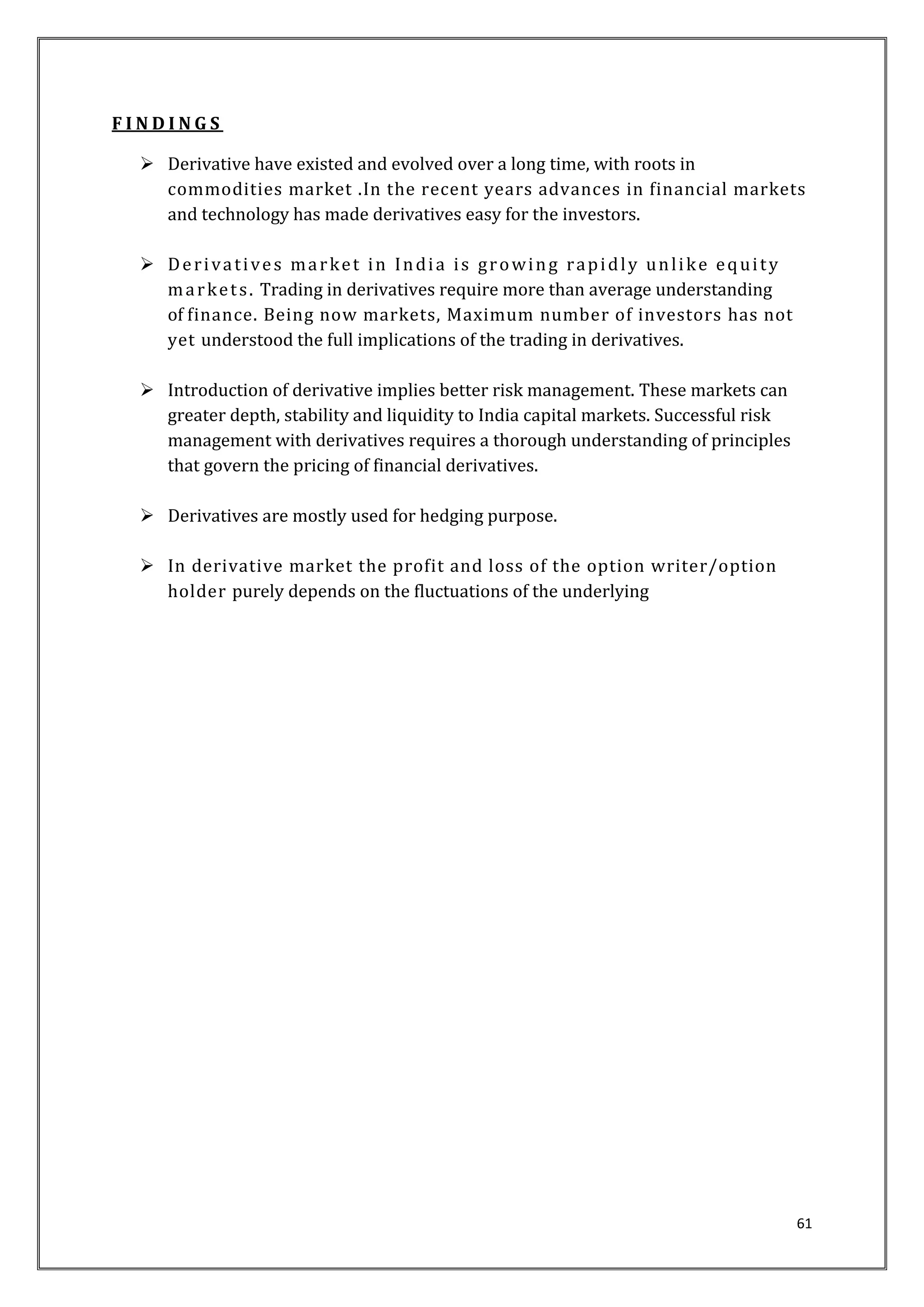
F I N D I N G S 
 Derivative have existed and evolved over a long time, with roots in 
commodities market .In the recent years advances in financial markets 
and technology has made derivatives easy for the investors. 
 De r i va t i ve s ma rket in Indi a i s growing rapidl y unl ike equi t y 
ma rket s . Trading in derivatives require more than average understanding 
of finance. Being now markets, Maximum number of investors has not 
yet understood the full implications of the trading in derivatives. 
 Introduction of derivative implies better risk management. These markets can 
greater depth, stability and liquidity to India capital markets. Successful risk 
management with derivatives requires a thorough understanding of principles 
that govern the pricing of financial derivatives. 
 Derivatives are mostly used for hedging purpose. 
 In derivative market the profit and loss of the option writer/option 
holder purely depends on the fluctuations of the underlying
62 
SUGGESTIONS 
 The inve s tor s can minimi ze r i sk by inve s t ing in de r i vat i ves . 
The us e of derivative equips the investor to face the risk, which is 
uncertain. Though the use of derivatives does not completely eliminate the 
risk, but it certainly lessens the risk. 
 It is advisable to the investor to invest in the derivatives market because of the 
greater amount of liquidity offered by the financial derivatives and the 
lower transaction costs associated with the trading of financial derivatives. 
 The derivative products give the investor an option or choice whether 
the exercise the contract or not . Option gives the choice to the investor 
toeither exercises his right or not. 
 If on expiry date the investor finds that the underlying asset in the 
option contract is traded at a less price in the stock market then, he 
has the full liberty to get out of the option contract and go ahead and 
buy the asset from the stock market. So in case of high uncertainty the 
investor can go for option. 
 However, these instruments act as a powerful instrument for 
knowledge t r ade r s to e xpose them to the prope r l y c al cul at ed 
and we l l under s tood risks in pursuit of reward i.e., profit 
 In orde r to inc r eas e the de r ivat i ves ma rket in India SEBI 
should r e vi s e some of thei r re gula t ion l ike cont ra c t s i z e, 
pa r t i c ipa t ion of Fi l l in th e de r i va t i ve ma rket . Cont ra c t s i z e 
should be minimi zed be caus e smal l investor cannot afford this much
63 
LIMITATIONS 
The following are the limitations of the study 
 The S c r i p c h o s e n f o r a n a l y s i s i s N i f t y ’ 5 0 a n d t h e 
c o n t r a c t t a k e n i n JULY 2011 is a one month contract ending in JULY. 
 The data collected is completely restricted to the NIFTY ’50 hence this analysis 
cannot be taken universally. 
CONCLUSION 
 Derivatives have existed and evolved over a long time, with roots in 
commodities market. In the recent years. Advances in financial 
markets and the technologies have made derivatives easy for the investors. 
 Derivatives market in Indian is growing unlike equity markets. 
Trading in derivatives require more than average unde rstanding of 
finance. Being new to markets maximum number of investors has not yet 
understood the full implications of the trading and derivatives. SEBI should take 
actions to create awareness in investors about the derivative market. 
 Introduction of derivatives implies better risk management. These markets c an 
g i ve g rea te r depth, s t abi l i t y and l iquidi t y to Indi an capi ta l 
ma rket s . Successful risk management with derivatives requires a thorough 
understanding of principles that govern the pricing of financial derivatives. 
 In orde r to inc r eas e the de r ivat i ves ma rket in India SEBI 
should r e vi s e some of their regulation like contract size, participation of FII 
in the derivative market, Contract size should be minimize because small 
investor cannot afford this much of huge premiums
64 
Bibliography
65 
BIBLOGRAPHY: 
Secondary data 
‐ NCFM’S Derivatives module 
 www.nseindia.com 
 www.bseindia.com 
 www.derivativeindia.com 
 www.indianderivatives.com 
‐ Reports and analysis of J M Financial
66 
GLOSSARY: 
Multiplier - It is a pre-determined value, used to arrive at the contract size. It is the 
price per index point. 
Tick Size - It is the minimum price difference between two quotes of similar nature. 
Contract Month - The month in which the contract will expire. 
Expiry Day - The last day on which the contract is available for trading. 
Open interest - Total outstanding long or short positions in the market at any specific 
point in time. As total long positions for market would be equal to total short positions, 
for calculation of open Interest, only one side of the contracts is counted. 
Volume - No. of contracts traded during a specific period of time. During a day, during a 
week or during a month. 
Long position- Outstanding/unsettled purchase position at any point of time. 
Short position - Outstanding/ unsettled sales position at any point of time. 
Open position - Outstanding/unsettled long or short position at any point of time. 
Cash settlement - Open position at the expiry of the contract is settled in cash. These 
contracts are designated as cash settled contracts. Index Futures fall in this category. 
Alternative Delivery Procedure (ADP) - Open position at the expiry of the contract is 
settled by two parties - one buyer and one seller, at the terms other than defined by the 
exchange. Worldwide a significant portion of the energy and energy related contracts 
(crude oil, heating and gasoline oil) are settled through Alternative Delivery Procedure. 
Option Seller - One who gives/writes the option. He has an obligation to perform, in 
case option buyer desires to exercise his option. 
Option Buyer - One who buys the option. He has the right to exercise the option but no 
obligation. 
Call Option - Option to buy. 
Put Option - Option to sell. 
American Option - An option which can be exercised anytime on or before the expiry 
date. 
European Option - An option which can be exercised only on expiry date.
67 
Strike Price/ Exercise Price - Price at which the option is to be exercised. 
Expiration Date - Date on which the option expires. 
Exercise Date - Date on which the option gets exercised by the option holder/buyer. 
Option Premium - The price paid by the option buyer to the option seller for granting 
the option. 
In the money options: 
An in the money option is an option that would lead to a positive cash flow to the holder 
if it were exercised immediately. A call option on the index is said to be in the money 
when the current index stands at a level higher than strike price (i.e. spot price > strike 
price). If the index is much higher than strike price the call is said to be deep in the 
money. In the case of put the put is in the money if the index is below than strike 
price. 
At the money options: 
At the money option is an option that would lead to zero cash flow if it were 
exercise immediately. An option on the index is at the money when the current index 
equals the strike price (i.e. spot price = strike price). 
Out of the money options: 
An out of the money is an option that would lead to negative cash flow if it were 
exercise immediately. A call option on the index is out of the money when the current 
index stands at a level which is less than strike price (i.e. spot price < strike price). If 
the index is much lower than strike price the call is said to be deep out of the money

Prashangi sip

  • 1.
    1 K. S.SCHOOL OF BUSINESS MANAGEMENT YEAR: - 2013-2014 JM FINANCIAL Derivatives Summer Internship Project
  • 2.
    2 PROJECT REPORT ON SUMMER TRAINING ON “J M FINANCIAL” (DERIVATIVES) 4TH YEAR MBA ROLL NO. “4036” SUBMITTED TO:- K.S.SCHOOL OF BUSINESS MANAGEMENT GUJARAT UNIVERSITY AHMEDABAD-380009
  • 3.
    3 ACKNOWLEDGEMENT: Successcan never be achieved through individual effort but through proper guidance and support. First of all I would like to thank Dr.SARLA ACHUTHAN and K.S.School of Business `Management for giving me such a wonderful opportunity to explore my potential and for increasing the practical knowledge of real corporate field. My sincere thanks to Mrs.Ingita Jain for giving me guidance on this summer project. I would like to take this opportunity to thank my project guide MR. ANKIT ARORA, THE DERIVATIVE EXPERT in JM FINANCIAL for his constant interest, involvement and support and faculty guides who helped me to complete this challenging task. I would like to extend my gratitude to Mr. PRANAV PARIKH, Mr. KAUSHAL SUTRIA THE FUNDAMENTAL ANALYST , Mr. BARGAV DAVE, THE TECHNICLE ANALYST ,Mr. SAMEER MEHTA, for giving me such an opportunity and making me learn things which added a great value to my knowledge. Besides, I thank all those invisible hands without whose contribution this project would not have been possible.
  • 4.
    4 PREFACE: “Learningonly can’t suffice a person and make him walk on the path of success unless and until he is given practical knowledge.” Practical knowledge leads a man toward perfection. The work summer project work is most important for having practical knowledge of real corporate world. This project is made on the summer training. I have done summer training in broking firm “J M FINANCIAL.” This project report refers to the indepth concept of derivative options and their implications. It shows the overview of secondary market. This project is compilation of information collected from various sources such as internet, library, NCFM authority and company itself. This project work has given me an opportunity to enhance and develop my theoretical as well as practical knowledge. I have also learnt how to work in the real corporate life and how to manage the work life balance. It is also helpful in improving my communication skills and personal skills.
  • 5.
    5 TABLE OFCONTENTS CHAPTER – I JM FINANCIAL OVERVIEW--------------------------------------- [9] COMPANY PROFILE HISTORY BACKGROUND FUNCTIONS CHAPTER– II FINANCIAL SEGMENT OVERVIEW------------------- ----------------------------- [16] PRIMARY MARKET SECONDARY MARKET CHAPTER-III DERIVATIVE---------------------------- [19] ORIGINE OF DERIVATIVE EMERGENCE OF DERIVATIVE DEVELOPMENT OF DERIVATIVE IN INDIA MARKET PLAYERS OF DERIVATIVE COMPONENT OF DERIVATIVE
  • 6.
    6 CHAPTER-IV FORWARDCONTRACT-------------------------------------- [37] DEFINATION FEATURES USE & LIMITATIONS CHAPTER-V FUTURE CONTRACT-------------------------------------- [40] DEFINITION FEATURES MARGINE CHAPTER-VI OPTIONS CONTRACT ------------------------ [47] DEFINITION CALL OPTION PUT OPTION CHAPTER-VII MARKET TRENDS & OPTIONS STRATEGY OVERVIEW------------------------ [50] TYPES OF MARKET TREND OPTION STRATEGY ACCORDING TO MARKET TREND
  • 7.
    7 CHAPTER-VIII OPTIONSSTRATEGY ---------------- ---------------------------- [57] CHAPTER-IX CONCLUSION------------------------------------------- [70] FINDINGS SUGGETIONS LIMITATIONS CONCLUTIONS CHAPTER-X BIBLIOGRAPHY-------------- ---------------------------- [74] WEBOGRAPHY ANNEXUTERS
  • 8.
    8 COMPANY OVERVIEW: COMPANY PROFILE JM Financial Limited, the flagship listed company of the Group, is led by the Chairman & Managing Director, Mr. Nimesh Kampani. The members of the Board meet periodically to discuss and review the performance of the Company. REGISTERED OFFICE 141, Maker Chambers III Nariman Point Mumbai 400 021 India Tel: 91 22 6630 3030 COMPANY LOGO Dynamic Growth Triangle The red triangle represents movement, pace, agility and dynamism. It positions JM Financial as a distinct, powerful and adaptable financial force.
  • 9.
    9 The ColourBlue Blue is the colour of the sky and sea meaning abundance. It is associated with depth and stability. It represents knowledge, integrity and expertise. HISTORY The Company was incorporated as a private limited company on 30th January 1986 in the name of J M Share & Stock Brokers Pvt. Ltd. The Company has been promoted by JMFICS to engage directly or indirectly in the business of share and stock broking, finance broking, underwriting of securities including shares, debentures, etc. The present issued, Equity Share JMFICS and, therefore, by virtue of Section 4 of the Act, the Company is a subsidiary of JMFICS. On JMFICS becoming a deemed public limited company by virtue of the Companies (Amendment) Act, 1988 read with the Companies Act, 1956, on 15th June, 1988, the Company also became a deemed public limited company as of that date pursuant to the applicable provisions of the Companies Act, 1956. BACKGROUND JM Financial is an integrated financial services group, offering a wide range of services to a significant clientele that includes corporations, financial institutions, high net‐worth individuals and retail investors. The company has interests in investment banking, institutional equity sales, trading, research and broking, private and corporate wealth management, equity broking, portfolio management, asset management, Non‐Banking Finance Company activities, private equity and asset reconstruction. JM Financial Services Private Ltd is the dedicated financial services arm of the JM Financial Group . JM Financial are one of the largest brokerage firms in India, offering comprehensive investment advisory and investment management services to institutions, banks, corporate, ultra high net‐worth individuals and Family offices.
  • 10.
    10 With morethan three decades of experience & expertise in managing wealth, the company offer clients guidance to grow, protect & transfer their wealth. An exclusive level of personal attention, research capabilities and in‐depth capital market expertise enables the company to design and execute customised investment solutions for our clients. Company provide comprehensive financial planning, research‐based investment consulting services and execution capabilities. OVERVEIW What Company Does ‣ The Company is among the largest distributors of third party products (Mutual funds/IPO). ‣ The company have a strong network of more than 25,000 IFAs spread across India. ‣ The company facilitate client transactions with a diverse group of financial institutions, investment funds, governments and individuals, trading of and investing in fixed income and equity products and derivatives on these products. JM’s VISION To be the most trusted partner for every stakeholder in the financial world. Its VALUES
  • 11.
    11 The companyhave always sought to be a value‐driven organisation, where our values direct our growth and success.
  • 12.
    12 It’s PHILOSOPHY ‣ The company believe self‐trust is the first step towards trusting others. ‣ Its philosophy is to provide advisory services to make your investments as successful as you. ‣ For JM Financial anything worth doing is worth doing well. Its Belief • Earning trust is a process (it can be gained and lost every day!) • Sharing trust creates great teams (whether between employees or between organisations) • Being trustworthy is the most efficient way of generating and retaining long‐term busines
  • 13.
  • 14.
    PRIMARY MARKET 14 FINANCIAL MARKET OVERVIEW : CASH SAGMENT CASH SEGMENT FINANCIAL MARKET SECOANDARY MARKET DERIVATIVE SAGMENT FUTURES OPTIONS CALL PUT FOWARDS IPO MF This is the most preferred segment. This is safe one. Those who have enough fund, should go for this segment. In this segment you can buy shares within your capacity by making 100 % payment and taking delivery. You have to wait till you get your favorable rates and then sell the shares. You can buy back the same shares when the rates are reasonably low. GOVT. SECURITIES
  • 15.
    15 Your ownershipof position remains with you unless and until you have squared off. Such people are known as Investors. They don’t undergo frequent or day-to-day trading. It is observed that investors earn a good percentage of profit and that also without any tension. DERIVATIVE SEGMENT This is the segment where one can do higher volume with less fund compared to Cash Segment. There are two parts in this segment. (1) Future Trading & (2) Option Trading CASH SEGMENT DERIVATIVES 100 % payment is to be made for buying and similarly 100 % payment is received while selling Ownership – Ownership remains with you unless and until you have squared off the position. Quantity – Any quantity of shares can be bought or sold. There is no compulsion Delivery is to be given or taken. Prefixed Margin say 20-40 % is to be paid as Deposit (known as margin) to meet with any risk or liability due to the trade done. Ownership of the position remains with you until you have squared off or till the last Thursday of the Contract Month. One cannot buy any odd quantity but has to buy or sell the Lot in prefixed size. There is nothing like delivery.
  • 16.
  • 17.
    17 DERIVATIVES Theterm derivatives are used to refer to financial instruments which derive their value from some underlying assets. The underlying assets could be:  Interest Rate derivative  Foreign Exchange derivative  Credit derivative  Equity derivative  Commodity derivative Other examples of underlying exchangeables are:  Property (mortgage) derivatives  Economic derivatives that pay off according to economic reports[] as measured and reported by national statistical agencies  Freight derivatives  Inflation derivatives  Weather derivatives  Insurance derivatives  Emissions derivatives
  • 18.
    18 DERIVATIVES COMMODITY DERIVATIVES TENGIBLE GOLD SILVER INTENGIBLE WETHER TIME FINANCIAL DERIVATIVES EQUITY DERIVATIVES INDEX PRODUCT INDEX FUTURES INDEX OPTIONS DERIVATIV ES ON SECURITIES STOCK FUTURE STOCK OPTION REAL ESTATE FOREIGN EXCHANGE DEBT INTEREST RATE PRODUCTS SECURITIES BONDS T-BILLS
  • 19.
    19 EMERGENCE OFDERIVATIVES: Derivative products initially emerged as hedging devices against fluctuations in commodity prices and commodity-linked derivatives remained the sole form of such products for almost three hundred years. The financial derivatives came into spotlight in post-1970 period due to growing instability in the financial markets. However, since their emergence, these products have become very popular and by 1990s, they accounted for about two-thirds of total transactions in derivative products. The basic purpose of derivatives is to transfer the price risk (inherent in fluctuations of the asset prices) from one party to another. They facilitate the allocation of risk to those who are willing to take it. E.g.: On Nov 1, 2009 a rice farmer may wish to sell his harvest at the future date (say ‐ Jan 1, 2010) for a predetermined fixed price to eliminate the risk of change in prices by that date. Such a transaction is an example of a derivatives contract. The price of derivatives contract is driven by the spot price of rice which is the underlying. We will focus on EQUITY DERIVETIVES only.
  • 20.
    20 ORIGIN OFDERIVATIVES: The earliest evidence of derivatives can be traced back to ancient Greece. Derivatives were is existence in some or the other form since ancient time. The advent of modern day derivatives was attributed to protect farmers against decline in crop prices. The securities contract (regulation) act, 1956 defines “derivatives” to include: I. A security derived from a debt instrument, share loan whether secured or unsecured, security, risk instrument or contract for difference or any other form.
  • 21.
    21 Development ofderivatives market in India: The first step towards introduction of derivatives trading in India was the promulgation of The Securities Laws (Amendment) Ordinance, 1995, which withdrew the prohibition on Options in securities. The market for derivatives, however, did not take off, as there was no regulatory framework to govern trading of derivatives. SEBI set up a 24– member Committee under the Chairmanship of Dr.L.C.Gupta on November 18, 1996 to develop appropriate regulatory framework for derivatives trading in India. The committee submitted its report on March 17, 1998 prescribing necessary pre– conditions for introduction of derivatives trading in India. The committee recommended that derivatives should be declared as ‘securities’ so that regulatory framework applicable to trading of ‘securities’ could also govern trading of securities. SEBI also set up a group in June 1998 under the Chairmanship of Prof.J.R.Varma, to recommend measures for risk containment in derivatives market in India. The report, which was submitted in October 1998, worked out the operational details of margining system, methodology for charging initial margins, broker net worth, deposit requirement and real–time monitoring requirements. The Securities Contract Regulation Act (SCRA) was amended in December 1999 to include derivatives within the ambit of ‘securities’ and the regulatory framework was developed for governing derivatives trading. The act also made it clear that derivative shall be legal and valid only if such contracts are traded on a recognized stock exchange, thus precluding OTC derivatives. The government also rescinded in March 2000, thethree– decade old notification, which prohibited forward trading in securities. Derivatives trading commenced in India in June 2000 after SEBI granted the final approval to this effect in May 2001. SEBI permitted the derivative segments of two stock exchanges, NSE and BSE, and their clearing house/corporation to commence trading and settlement in approved derivatives contracts. To begin with, SEBI approved trading in index futures contracts based on S&P CNX Nifty and BSE–30(Sensex) index. This was followed by approval for trading in options based on these two indexes and options on individual securities. The trading in BSE Sensex options commenced on June 4, 2001 and the trading in options on individual securities commenced in July 2001. Futures contracts on individual stocks were launched in November 2001. The derivatives trading on NSE commenced with S&P CNX Nifty Index futures on June 12, 2000. The trading in index options commenced on June 4, 2001 and trading in options on individual securities commenced on July 2, 2001. Single stock futures were launched on November 9, 2001. The index futures and options contract on NSE are based on S&P CNX. Trading and settlement in derivative contracts is done in accordance with the rules,
  • 22.
    byelaws, and regulationsof the respective exchanges and their clearing house/corporation duly approved by SEBI and notified in the official gazette. Foreign Institutional Investors (FIIs) are permitted to trade in all Exchange traded derivative products. The following are some observations based on the trading statistics provided in the NSE report on the futures and options (F&O): • Single‐stock futures continue to account for a sizable proportion of the F&O segment. It constituted 70 per cent of the total turnover during June 2002. A primary reason attributed to this phenomenon is that traders are comfortable with single‐stock futures 22 than equity options, as the former closely resembles the erstwhile badla system. • On relative terms, volumes in the index options segment continues to remain poor. This may be due to the low volatility of the spot index. Typically, options are considered more valuable when the volatility of the underlying (in this case, the index) is high. A related issue is that brokers do not earn high commissions by recommending index options to their clients, because low volatility leads to higher waiting time for round‐trips. • Put volumes in the index options and equity options segment have increased since January 2002. The call‐put volumes in index options have decreased from 2.86 in January 2002 to 1.32 in June. The fall in call‐put volumes ratio suggests that the traders are increasingly becoming pessimistic on the market. • Farther month futures contracts are still not actively traded. Trading in equity options on most stocks for even the next month was non‐existent. • Daily option price variations suggest that traders use the F&O segment as a less risky alternative (read substitute) to generate profits from the stock price movements. The fact that the option premiums tail intra‐day stock prices is evidence to this. Calls on Satyam fall, while puts rise when Satyam falls intra‐day. If calls and puts are not looked as just substitutes for spot trading, the intra‐day stock price variations should not have a one‐to‐one impact on the option premiums.
  • 23.
    23 TYPES OFTRADING: OTC and Exchange-traded In broad terms, there are two groups of derivative contracts, which are distinguished by the way they are traded in the market:  Over-the-counter (OTC) derivatives are contracts that are traded (and privately negotiated) directly between two parties, without going through an exchange or other intermediary. Products such as swaps, forward rate agreements, and exotic options are almost always traded in this way. The OTC derivative market is the largest market for derivatives, and is largely unregulated with respect to disclosure of information between the parties, since the OTC market is made up of banks and other highly sophisticated parties, such as hedge funds. Reporting of OTC amounts are difficult because trades can occur in private, without activity being visible on any exchange. According to the Bank for International Settlements, the total outstanding notional amount is US$684 trillion (as of June 2008).[6] Of this total notional amount, 67% are interest rate contracts, 8% are credit default swaps (CDS), 9% are foreign exchange contracts, 2% are commodity contracts, 1% are equity contracts, and 12% are other. Because OTC derivatives are not traded on an exchange, there is no central counter-party. Therefore, they are subject to counter-party risk, like an ordinary contract, since each counter-party relies on the other to perform. Exchange-traded derivative contracts (ETD) are those derivatives instruments that are traded via specialized derivatives exchanges or other exchanges. A derivatives exchange is a market where individuals trade standardized contracts that have been defined by the exchange.A derivatives exchange acts as an intermediary to all related transactions, and takes Initial margin from both sides of the trade to act as a guarantee.
  • 24.
    24 MARKET PLAYERSOF DERIVATIVES: SPECULATORS ARBITRAGEURS HEDGERS: HEDGERS The objective of this kind of traders is to reduce the risk. They are not in the derivatives market to make profit. They are in it to safeguard their existing position. Derivatives allow risk related to the price of the underlying asset to be transferred from one party to another. For example, a wheat farmer and a miller could sign a futures contract to have reduced a future risk: for the wheat farmer, the uncertainty of the price, and for the miller, the availability of wheat. From another perspective, the farmer and the miller both reduce a risk and acquire a risk when they sign the futures contract: the farmer reduces the risk that the price of wheat will fall below the price specified in the contract and acquires the risk that the price of wheat will rise above the price specified in the contract (thereby losing additional income that he could have earned). The miller, on the other hand, acquires the risk that the price of wheat will fall below the price
  • 25.
    specified in thecontract (thereby paying more in the future than he otherwise would have) and reduces the risk that the price of wheat will rise above the price specified in the contract. In this sense, one party is the insurer (risk taker) for one type of risk, and the counter-party is the insurer (risk taker) for another type of risk. 25 Apart from EQUITY MARKETS, Hedging is common in the foreign exchange markets where the fluctuations in the foreign exchange rate have to be taken care of in the foreign currency transactions. Derivatives can serve legitimate business purposes. For example, a corporation borrows a large sum of money at a specific interest rate.The rate of interest on the loan resets every six months. The corporation is concerned that the rate of interest may be much higher in six months. The corporation could buy a forward rate agreement (FRA), which is a contract to pay a fixed rate of interest six months after purchases on a notional amount of money. If the interest rate after six months is above the contract rate, the seller will pay the difference to the corporation, or FRA buyer. If the rate is lower, the corporation will pay the difference to the seller. The purchase of the FRA serves to reduce the uncertainty concerning the rate increase and stabilize earnings. SPECULATORS: Speculators are some what like a middle man. They are never interested in actual owing the commodity. They will just buy from one end and sell it to the other in anticipation of future price movements. They actually bet on the future movement in the price of an asset. They are the second major group of futures players. These participants include independent floor traders and investors. They handle trades for their personal clients or brokerage firms. Buying a futures contract in anticipation of price increases is known as ‘going long’. Selling a futures contract in anticipation of a price decrease is known as ‘going short’. Speculative participation in futures trading has increased with the availability of alternative methods of participation. Speculators have certain advantages over other investments they are as follows:
  • 26.
     If thetrader’s judgment is good, he can make more money in the futures market faster because prices tend, on average, to change more quickly than real estate or stock prices.  Futures are highly leveraged investments. The trader puts up a small fraction of the value of the underlying contract as margin, yet he can ride on the full value of the contract as it moves up and down. The money he puts up is not a down payment on the underlying contract, but a performance bond. The actual value of the contract is only exchanged on those rare occasions when delivery takes place. 26 Arbitrators : Arbitrators are in the market for the risk free profit opportunity. Arbitrators are the person who take the advantage of a discrepancy between prices in two different markets. If he finds future prices of a stock edging out with the cash price, he will take offsetting positions in both the markets to lock in a profit. Misleading arbitrage opportunity:  When company declare dividend more than 10%. Investors think that there exist arbitrage opportunity, and take long position. But it is not actually like this. Because the future prices have already discounted in the market.  When it is likely to be that there is an arbitrage opportunity but bechause of transaction charges, there is no risk free profit. Charges Leviable Trading(Cash) Delivery(Cash) FUTURE Rate Rate Rate Value Brokerage (%) 0.0500% 0.1000% 0.0100% Transaction Charges 0.0032% 0.0032% 0.0019% Stamp Duty 0.0020% 0.0100% 0.0020% STT 0.0250% 0.1250% 0.0170% Sebi Fees 0.0001% 0.0001% 0.0001% Service Tax 10.3000% 10.3000% 10.3000% TOTAL
  • 27.
    27 Charges LeviableOPTIONS Rate Premium Per Lot No.of Lot Total Premium Value Brokerage (%) 1% Minimum Brokerage per Lot 100 Transaction Charge 0.050% Stamp Duty 0.002% STT 0.017% Sebi Fees 0.000% Service Tax 10.30% TOTAL IF options are to be EXERCISED THAN STT WOULD BE 0.125% ON STRIKE PRICE. So it is necessary to take the STT charges into consideration while calculating arbitrage opportunity.
  • 28.
    28 DERIVATIVE COMPONENTS: FORWARD COMPONENT OF DERIVATIVES FUTURE OPTION WARRANT LEAPS BASKETS SWAPS SWAPTION
  • 29.
    29 Derivative contractshave several variants. The most common variants are forwards, futures, options and swaps. (i) FORWARDS: A forward contract is a customized contract between 2 entities, were settlement takes place on a specific date in the future today pre‐agreed price. (ii) FUTURES: A future contract is an agreement between two parties to buy or sell an asset at a certain time in the future at a certain price. Futures contracts are special types of forward contracts in the sense that the former are standardized exchange traded contracts. (iii) OPTIONS: Options are two types‐ calls and puts. Calls give the buyer the right but not the obligation to buy a given quantity of the underlying asset, at a given price on or before a given future date. Puts give the buyer the right, but not the obligation to sell a given quantity asset at a given price on or before a given date. (iv) WARRANTS: Options generally have lives of up to one year; the majority of options traded on options exchanges having a maximum maturity of nine months. Longer dated options are called warrants and are generally traded over the counter. (v) LEAPS: The acronym LEAPS means Long Term Equity Anticipation Securities. These are options having a maturity of up to three years.
  • 30.
    30 (vi) BASKETS: Basket options are on portfolios of underlying assets. The underlying asset is usually a moving average of a basket of assets. Equity index options are a form of basket options. (vii) SWAPS: Swaps are private agreement between two parties to exchange cash flows in the future according to a prearranged formula. They can be regarded as portfolios of forward contracts. (viii) SWAPTIONS: Swaptions are options to buy or sell a swap that will become operative at the expiry of options. Thus a Swaptions is an option on a forward swap. Rather than have calls and puts the Swaptions market has receiver Swaptions and payer Swaptions. A receiver Swaptions is an option to receive fixed and pay floating. A payer Swaptions is an option to pay fixed and receives floating.
  • 31.
  • 32.
    32 FORWARD: Itis a customized contract between two parties. Example: Imagine you are a farmer. You grow 1,000 dozens of mangoes every year. You want to sell these mangoes to a merchant but are not sure what the price will be when the season comes. You therefore agree with a merchant to sell all your mangoes for a fixed price for Rs 2lakhS. This is a forward contract where in you are the seller of mangoes forward and the merchant is the buyer. The price is agreed today in advance and The delivery will take place sometime in the future. The essential features of a forward contract The essential features of a forward contract are:  l Contract between two parties (without any exchange between them)  l Price decided today  l Quantity decided today (can be based on convenience of the parties)  l Quality decided today (can be based on convenience of the parties)  l Settlement will take place sometime in future (can be based on convenience of the parties)  l No margins are generally payable by any of the parties to the other Uses of forward Forwards have been used in the commodities market since centuries. Forwards are also widely used in the foreign exchange market.
  • 33.
    33 Limitations offorwards Forwards involve counter party risk. In the above example, if the merchant does not buy the mangoes for Rs 2lakhs when the season comes, what can you do? You can only file a case in the court, but that is a difficult process. Further, the price of Rs 2lakhs was negotiated between you and the merchant. If somebody else wants to buy these mangoes from you, there is no mechanism of knowing what the right price is. Thus, the two major limitations of forwards are:  l Counter party risk  l Price not being transparent  Counter party risk is also referred to as default risk or credit risk. How do Futures overcome these difficulties? An exchange (or its clearing corporation) becomes the legal counterparty in case of futures. Hence, if you buy any futures contract on an exchange, the exchange (or its clearing corporation) becomes the seller. If the other party (the real seller) does not deliver on the expiry date, you do not have to worry. The exchange (or its clearing corporation) will guarantee you the delivery. Further, prices of all Futures quoted on the exchange are known to all players. Transparency in prices is a big advantage over forwards.
  • 34.
  • 35.
    35 FUTURES : Futures are similar to forwards in the sense that the price is decided today and the delivery will take place in future. But Futures are quoted on a stock exchange. Prices are available to all those who want to buy or sell because the trading takes place on a transparent computer system. Features of Futures The essential features of a Futures contract are:  Contract between two parties through an exchange  l Exchange is the legal counterparty to both parties  l Price decided today  l Quantity decided today (quantities have to be in standard denominations specified by the exchange)  l Quality decided today (quality should be as per the specifications decided by the exchange)  l Tick size (i.e. the minimum amount by which the price quoted can change) is decided by the exchange  l Delivery will take place sometime in future (expiry date is specified by the exchange)  l Margins are payable by both the parties to the exchange  l In some cases, the price limits (or circuit filters) can be decided by the exchange
  • 36.
    36 Features ForwardContract Future Contract Trading Not traded on exchange. Traded on exchange. Settlement Directly between the two parties. Through the clearing system of the exchange. Contract specifications May differ from trade to trade. High flexibility in deciding the terms. Contracts are standardized. Counterparty risk or credit risk Each party takes credit risk on other. The counterparty risk is transferred to Clearing System. Clearing system takes credit risk on each party and each party takes credit risk on the clearing system. Liquidity Poor liquidity as contracts are tailor made. High liquidity as contracts are standardized. And traded on the exchange. Price discovery Poor, as markets are fragmented. Better, as traded on a transparent exchange.
  • 37.
    Future Trading isjut like Cash Segment Trading. In Future Trading you are not to pay 100 % payment as you have to do in Cash Segment and there is nothing like delivery. 37 MARGINS : (A)INITIAL MARGIN: It is the margin that needs to be paid to exchange while taking exposure in Option or Future contracts. It is the percentage of total value of exposure taken that the investor must pay in the form of cash or marginable securities. E.g. If the investor wants to buy 100 shares of Reliance at Rs. 1000 each, then he has to pay the margin of say 20% of total value i.e. 20000 in the form of initial margin to his broker and broker further pays to the exchange.
  • 38.
    38 (B)MARK TOMARKET MARGIN: It is the margin that needs to be paid or received based on the daily movement of prices. So futures and options contracts are marked to daily market prices and based on exposure taken the investor’s account is debited or credited. If price movement goes against your expectation then the investor has to pay mark to market margin and if price run as per expectation then margin is credited in his account which he/she can withdraw. In Future contracts it has to be paid in the form of cash whereas in option contracts it can be paid in form of cash or marginable securities.
  • 39.
  • 40.
    40 OPTIONS Optionsare instruments whereby the right is given by the option seller to the option buyer to buy or sell a specific asset at a specific price on or before a specific date. There are mainly two options. Call option Put option Call Option: A call option gives the holder the right but not the obligation to buy an asset by a certain date for a cert ain price. Put Option: A put option gives the holder the right but not the obligation to sell an asset by a certain date for a cert ain price.
  • 41.
    41 DIFFERENCE BETWEENFUTURES & OPTIONS:
  • 42.
    42 Call &Put Option: Division of an option: The option premium can be broken down into 2 components: (i) Intrinsic value: Value investors that follow fundamental analysis look at both qualitative and quantitative aspects of a business to see if the business is currently out of favour which the market and is really worth much more than its current valuation. Intrinsic value in options is in the money portion of the options premium. E.g.: If a call option strike price is $ 15 and the underlined stocks market price is $25 then the intrinsic value of call option is $10.
  • 43.
    (ii) Time value:The time value of an option is the difference between its premium and its intrinsic value. Both calls and puts have time value. An option that is OTM or ATM has only time value. Usually the maximum time value exits when option is ATM. The longer the time to expiration, the greater is an options time value, or else equal. At expiration, an option should have more time value. 43
  • 44.
    44 Market Trend& Option Strategies overview
  • 45.
    45 MARKET TRENDS:­A market trend is a putative tendency of a financial market to move in a particular direction over time. There are mainly 3 types of market trends There are mainly 3 types of market trends 1> Secular market trend 2> Primary market trend 3> Secondary market trend Primary Secular Secondary
  • 46.
    46 Secular markettrend:- A secular market is for long time frames A secular market trend is a long term trend that lasts 5 to 25 years and consists of a series of a series of sequential primary trends. A secular bear Market consists of smaller bull markets and larger bear markets. A secular bull market consists of larger bull markets and smaller bear markets. In a secular bull market the prevailing trend is "bullish" or upward moving. In a secular bear market, the prevailing trend is "bearish" or downward moving. Secondary market trend:- Secondary market changes are short term changes in price direction with in a primary trend. The duration is few weeks or few months. (i) CORRECTION: One type of secondary market trend is called a market CORRECTION a correction is short term price decline of 5%to20% or so. A correction is a downward movement that is not large enough to be a bear market. (ii) BEAR MARKET RALLY: Another type of secondary trend is called a bear market rally which consists of a market price increase of 10%to20%.
  • 47.
    47 Primary markettrend:- A primary trend has broad support throughout the entire market (most sectors) and lasts for a year or more. Market top Primary market Bull market (i) BULL MARKET: Market bottom A bull market is Bear market associated with increasing investor confidence, and increased investing in anticipation of future price increases. A bullish trend in the stock market often begins before the general economy shows clear signs of recovery. It is a win‐ win situation for the investors.
  • 48.
    48 (ii) BEARMARKET: A bear market is a general decline in the stock market over a period of time. It is a transition from high investor optimism to widespread investor fear and pessimism. (iii) MARKET TOP: A market top (or market high) is usually not a dramatic event. The market has simply reached the highest point that it will, for some time (usually a few years). It is, by definition, retroactively defined as market participants are not aware of it as it happens. A decline then follows, usually gradually at first and later with more rapidity. (iv) MARKET BOTTOM: A market bottom is a trend reversal, the end of a market downtown, and precedes the beginning of an upward moving trend (bull market). It is very difficult to identify bottom while it is occurring. The upturn following decline is often short lived and prices may resume their decline. This would bring a loss for the investors who purchased stocks during “false” market bottom.
  • 49.
    49 OPTION STRATEGIESACCORDING TO MARKET TRENDS: BULLISH MARKET STRATERGIES Option Spread Strategy Description Reason to use When to use Buy a Call Strongest bullish option position. Loss limited to premium paid. Undervalued option with volatility increasing. Sell a Put Neutral bullish option position. Profit limited to premium received. High volatility, bullish trending market. Buy Vertical Bull Call Spread Buy Call & sell Call of higher strike price. Loss limited to debit. Small debit, bullish market. Sell Vertical Bear Put Spread Sell Put & buy Put of lower strike price. Loss limited to strike price difference minus premium received. Large credit, bullish market. BEARISH MARKET STRATERGY Option Spread Strategy Description Reason to use When to use Buy a Put Strongest bearish option position. Loss limited to premium paid. Undervalued option with increasing volatility. Sell a Call Neutral bearish option position. Profit limited to premium received. Option overvalued market flat to bearish. Buy Vertical Bear Put Spread Buy at the money Put & sell out of the money Put. Loss limited to debit. Small debit, bearish market. Sell Vertical Bull Call Spread Sell Call & buy Call of higher strike price. Loss limited to strike price difference minus credit. Large credit, bearish market.
  • 50.
    50 NEUTRAL MARKETSTRATERGIES Option Spread Strategy Description Reason to use When to use Strangle Sell out of the money Put & Call. Maximum use of time value decay. Trading range market with volatility peaking. Arbitrage Buy & sell similar options simultaneously. Profit certain if done at credit. Any time credit received. Calendar Sell near month, buy far month, same strike price. Near month time value decays faster. Small debit, trading range market. Butterfly Buy at the money Call (Put) & sell 2 out of the money Calls (Puts) & buy out of the money Call (Put). Profit certain if done at credit. Any time credit received. Guts Sell in the money Put & Call. Receive large premium. Options have time premium & market in trading range. Box Sell Calls & Puts same strike price. Profit certain if done at credit. Any time credit received. Ratio Call Buy Call & sell Calls of higher strike price. Neutral, slightly bullish. Large credit & difference between strike prices of option bought & sold. Buy futures & buy at the money Put & sell out of the money Call. Profit certain if done at credit. Any time credit received.
  • 51.
  • 52.
    PAYOFF 5100 51505200 5250 5300 5350 5400 5450 5500 5550 5600 5650 5700 5750 5800 5850 5900 5950 6000 6050 6100 52 STRADDLE STRATEGY: In straddle strategy trader/ investor calls for buying at the money puts and at of the money call options were the strike price is same of both the options. MARKET VIEW FOR STRATEGY: A straddle option strategy is a basic volatility strategy which will require dramatic price moves to pay out profitably. EXAMPLE: INS TYPE SCRIP STRIKE PRICE OPTION TYPE QUANTITY BUY/ SELL PRICE/ PREMIUM Premium Gain or Loss P&L from Option Total P&L OPT NIFTY 5600 CALL 100 B 128 -12800 50000 37200 OPT NIFTY 5600 put 100 B 113 -11300 - 11300 PAYOFF CHART : 30,000 20,000 PAYOFF 10,000 0 -10,000 -20,000 -30,000 PRICE
  • 53.
    53 PAYOFF TABLE: PRICE PAYOFF 5100 25900 5150 20900 5200 15900 5250 10900 5300 5900 5350 900 5400 -4100 5450 -9100 5500 -14100 5550 -19100 5600 -24100 5650 -19100 5700 -14100 5750 -9100 5800 -4100 5850 900 5900 5900 5950 10900 6000 15900 6050 20900 6100 25900 RISK AND REWARD: Maximum loss for the long straddle options strategy is when the underlying stock price on expiration date is trading at the strike prices of the options bought. Large gains for the long straddle option strategy are attainable when the underlying stock price makes a very strong move either upwards or downwards at expiration.
  • 54.
    PAYOFF PAYOFF 53005325 5350 5375 5400 5425 5450 5475 5500 5525 5550 5575 5600 5625 5650 5675 5700 5725 5750 5775 5800 54 BULL CALL SPREAD STRATEGY: In bull call spread strategy trader/ investor calls for buying one in the money call, sell one out of the money calls at different strike prices. MARKET VIEW FOR STRATEGY: A bull call spread option strategy is generally applied when one expects market will move from moderately bullish to bullish. EXAMPLE: INS TYPE SCRIP STRIKE PRICE OPTION TYPE QUANTITY BUY/ SELL PRICE/ PREMIUM Premium Gain or Loss P&L from Option Total P&L OPT NIFTY 5600 CALL 100 B 124.5 -12450 20000 7550 OPT NIFTY 5700 CALL 100 S 78.5 7850 -10000 -2150 PAYOFF CHART: 6,000 4,000 2,000 0 -2,000 -4,000 -6,000 PRICE
  • 55.
    55 PAYOFF TABLE: PRICE PAYOFF 5300 -4600 5325 -4600 5350 -4600 5375 -4600 5400 -4600 5425 -4600 5450 -4600 5475 -4600 5500 -4600 5525 -4600 5550 -4600 5575 -4600 5600 -4600 5625 -2100 5650 400 5675 2900 5700 5400 5725 5400 5750 5400 5775 5400 5800 5400 RISK AND REWARD: The maximum profit for bull call spread will generally occur as underlying stock price rise above the higher strike price. Maximum loss for the bull call spread is limited to the premium paid while entering the trade.
  • 56.
    PAYOFF PAYOFF 53005325 5350 5375 5400 5425 5450 5475 5500 5525 5550 5575 5600 5625 5650 5675 5700 5725 5750 5775 5800 56 BEAR PUT SPREAD STRATEGY: In bear put spread strategy trader/ investor calls for buying one in the money put, sell one out of the money put at different strike prices. MARKET VIEW FOR STRATEGY: A bear put spread option strategy is generally applied when one expects market to move from moderately bearish to bearish. EXAMPLE: INS TYPE SCRIP STRIKE PRICE OPTION TYPE QUANTITY BUY/ SELL PRICE/ PREMIUM Premium Gain or Loss P&L from Option Total P&L OPT NIFTY 5600 Put 100 B 113 -11300 - 11300 OPT NIFTY 5500 put 100 S 76 7600 7600 PAYOFF CHART: 8,000 6,000 4,000 2,000 0 -2,000 -4,000 -6,000 PRICE
  • 57.
    57 PAYOFF TABLE: PRICE PAYOFF 5300 6300 5325 6300 5350 6300 5375 6300 5400 6300 5425 6300 5450 6300 5475 6300 5500 6300 5525 3800 5550 1300 5575 -1200 5600 -3700 5625 -3700 5650 -3700 5675 -3700 5700 -3700 5725 -3700 5750 -3700 5775 -3700 5800 -3700 RISK AND REWARD: The maximum profit for bear put spread will generally occur as underlying stock price decline below the lower strike price. The maximum loss for bear put spread will generally occur as underlying stock price rises above the higher strike price.
  • 58.
    PAYOFF PAYOFF 51005150 5200 5250 5300 5350 5400 5450 5500 5550 5600 5650 5700 5750 5800 5850 5900 5950 6000 6050 6100 58 BUTTERFLY STRATEGY: In butterfly strategy trader/ investor calls for buying 1in the money call, sell 2 at the money calls and buy 1out of the money call options at different strike prices. MARKET VIEW FOR THE STRATEGY: A butterfly option strategy is applied when the market is range bound. Example INS TYPE SCRIP STRIKE PRICE OPTION TYPE QUANTITY BUY/ SELL PRICE/ PREMIUM Premium Gain or Loss P&L from Option Total P&L OPT NIFTY 5500 CALL 100 B 194 -19400 6000 40600 OPT NIFTY 5600 CALL 200 S 130 26000 -10000 -74000 OPT NIFTY 5700 CALL 100 B 82 -8200 40000 318000 Payoff Chart:- 10,000 8,000 6,000 4,000 2,000 0 -2,000 -4,000 PRICE
  • 59.
    59 Payoff Table:- PRICE PAYOFF 5100 -1600 5150 -1600 5200 -1600 5250 -1600 5300 -1600 5350 -1600 5400 -1600 5450 -1600 5500 -1600 5550 3400 5600 8400 5650 3400 5700 -1600 5750 -1600 5800 -1600 5850 -1600 5900 -1600 5950 -1600 6000 -1600 6050 -1600 6100 -1600
  • 60.
  • 61.
    61 F IN D I N G S  Derivative have existed and evolved over a long time, with roots in commodities market .In the recent years advances in financial markets and technology has made derivatives easy for the investors.  De r i va t i ve s ma rket in Indi a i s growing rapidl y unl ike equi t y ma rket s . Trading in derivatives require more than average understanding of finance. Being now markets, Maximum number of investors has not yet understood the full implications of the trading in derivatives.  Introduction of derivative implies better risk management. These markets can greater depth, stability and liquidity to India capital markets. Successful risk management with derivatives requires a thorough understanding of principles that govern the pricing of financial derivatives.  Derivatives are mostly used for hedging purpose.  In derivative market the profit and loss of the option writer/option holder purely depends on the fluctuations of the underlying
  • 62.
    62 SUGGESTIONS The inve s tor s can minimi ze r i sk by inve s t ing in de r i vat i ves . The us e of derivative equips the investor to face the risk, which is uncertain. Though the use of derivatives does not completely eliminate the risk, but it certainly lessens the risk.  It is advisable to the investor to invest in the derivatives market because of the greater amount of liquidity offered by the financial derivatives and the lower transaction costs associated with the trading of financial derivatives.  The derivative products give the investor an option or choice whether the exercise the contract or not . Option gives the choice to the investor toeither exercises his right or not.  If on expiry date the investor finds that the underlying asset in the option contract is traded at a less price in the stock market then, he has the full liberty to get out of the option contract and go ahead and buy the asset from the stock market. So in case of high uncertainty the investor can go for option.  However, these instruments act as a powerful instrument for knowledge t r ade r s to e xpose them to the prope r l y c al cul at ed and we l l under s tood risks in pursuit of reward i.e., profit  In orde r to inc r eas e the de r ivat i ves ma rket in India SEBI should r e vi s e some of thei r re gula t ion l ike cont ra c t s i z e, pa r t i c ipa t ion of Fi l l in th e de r i va t i ve ma rket . Cont ra c t s i z e should be minimi zed be caus e smal l investor cannot afford this much
  • 63.
    63 LIMITATIONS Thefollowing are the limitations of the study  The S c r i p c h o s e n f o r a n a l y s i s i s N i f t y ’ 5 0 a n d t h e c o n t r a c t t a k e n i n JULY 2011 is a one month contract ending in JULY.  The data collected is completely restricted to the NIFTY ’50 hence this analysis cannot be taken universally. CONCLUSION  Derivatives have existed and evolved over a long time, with roots in commodities market. In the recent years. Advances in financial markets and the technologies have made derivatives easy for the investors.  Derivatives market in Indian is growing unlike equity markets. Trading in derivatives require more than average unde rstanding of finance. Being new to markets maximum number of investors has not yet understood the full implications of the trading and derivatives. SEBI should take actions to create awareness in investors about the derivative market.  Introduction of derivatives implies better risk management. These markets c an g i ve g rea te r depth, s t abi l i t y and l iquidi t y to Indi an capi ta l ma rket s . Successful risk management with derivatives requires a thorough understanding of principles that govern the pricing of financial derivatives.  In orde r to inc r eas e the de r ivat i ves ma rket in India SEBI should r e vi s e some of their regulation like contract size, participation of FII in the derivative market, Contract size should be minimize because small investor cannot afford this much of huge premiums
  • 64.
  • 65.
    65 BIBLOGRAPHY: Secondarydata ‐ NCFM’S Derivatives module  www.nseindia.com  www.bseindia.com  www.derivativeindia.com  www.indianderivatives.com ‐ Reports and analysis of J M Financial
  • 66.
    66 GLOSSARY: Multiplier- It is a pre-determined value, used to arrive at the contract size. It is the price per index point. Tick Size - It is the minimum price difference between two quotes of similar nature. Contract Month - The month in which the contract will expire. Expiry Day - The last day on which the contract is available for trading. Open interest - Total outstanding long or short positions in the market at any specific point in time. As total long positions for market would be equal to total short positions, for calculation of open Interest, only one side of the contracts is counted. Volume - No. of contracts traded during a specific period of time. During a day, during a week or during a month. Long position- Outstanding/unsettled purchase position at any point of time. Short position - Outstanding/ unsettled sales position at any point of time. Open position - Outstanding/unsettled long or short position at any point of time. Cash settlement - Open position at the expiry of the contract is settled in cash. These contracts are designated as cash settled contracts. Index Futures fall in this category. Alternative Delivery Procedure (ADP) - Open position at the expiry of the contract is settled by two parties - one buyer and one seller, at the terms other than defined by the exchange. Worldwide a significant portion of the energy and energy related contracts (crude oil, heating and gasoline oil) are settled through Alternative Delivery Procedure. Option Seller - One who gives/writes the option. He has an obligation to perform, in case option buyer desires to exercise his option. Option Buyer - One who buys the option. He has the right to exercise the option but no obligation. Call Option - Option to buy. Put Option - Option to sell. American Option - An option which can be exercised anytime on or before the expiry date. European Option - An option which can be exercised only on expiry date.
  • 67.
    67 Strike Price/Exercise Price - Price at which the option is to be exercised. Expiration Date - Date on which the option expires. Exercise Date - Date on which the option gets exercised by the option holder/buyer. Option Premium - The price paid by the option buyer to the option seller for granting the option. In the money options: An in the money option is an option that would lead to a positive cash flow to the holder if it were exercised immediately. A call option on the index is said to be in the money when the current index stands at a level higher than strike price (i.e. spot price > strike price). If the index is much higher than strike price the call is said to be deep in the money. In the case of put the put is in the money if the index is below than strike price. At the money options: At the money option is an option that would lead to zero cash flow if it were exercise immediately. An option on the index is at the money when the current index equals the strike price (i.e. spot price = strike price). Out of the money options: An out of the money is an option that would lead to negative cash flow if it were exercise immediately. A call option on the index is out of the money when the current index stands at a level which is less than strike price (i.e. spot price < strike price). If the index is much lower than strike price the call is said to be deep out of the money