Brainstorming for
Research Topics
What are the Main Parts of a Quantitative Research?
• I - INTRODUCTION (Background of the Study, Statement of the
Problem, Hypothesis, Scope and Delimitation, Research Framework,
Significance of the Study, Definition of Terms)
• II- REVIEW OF RELATED LITERATURE (Local Literature, Foreign
Literature)
• III – METHODOLOGY (Research Design, Research Respondents, Locale
of the Study. Research Instrument, Sampling Design, Statistical Treatment
of Data)
• IV – PRESENTATION AND INTERPRETATION OF DATA
• V – SUMMARY, CONCLUSION, & RECOMMENDATIONS
Learning Objectives
• 1. Discuss the different issues and ideas in their respective
fields;
• 2. Appreciate the importance of brainstorming to come up
with the best issue to cater to; and
• 3. Plan a research agenda in preparation for possible issues or
topics of a research study.
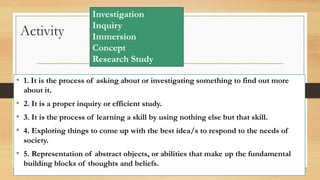
Activity
• 1. It is the process of asking about or investigating something to find out more
about it.
• 2. It is a proper inquiry or efficient study.
• 3. It is the process of learning a skill by using nothing else but that skill.
• 4. Exploring things to come up with the best idea/s to respond to the needs of
society.
• 5. Representation of abstract objects, or abilities that make up the fundamental
building blocks of thoughts and beliefs.
Investigation
Inquiry
Immersion
Concept
Research Study
Remember
• Research is an investigation or experimentation aimed at the
-discovery and interpretation of facts,
-revision of accepted theories or laws in the light of new facts, or
-practical application of such new or revised theories or laws.
• It is also a practice of collecting information about a particular
subject.
Inquiry
• An inquiry is a method that has the aim of
extending knowledge, undertaking doubt, or
solving a problem.
• A theory of inquiry is an interpretation of the
various types of inquiry and action of the ways
that each type of inquiry attains its aim.
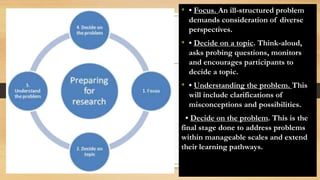
• • Focus. An ill-structured problem
demands consideration of diverse
perspectives.
• • Decide on a topic. Think-aloud,
asks probing questions, monitors
and encourages participants to
decide a topic.
• • Understanding the problem. This
will include clarifications of
misconceptions and possibilities.
• Decide on the problem. This is the
final stage done to address problems
within manageable scales and extend
their learning pathways.
Brainstorming
• Brainstorming is a way of inquiring ideas that will help
you to develop concepts and focusing techniques by
asking questions and knowing the interests of the persons
involved in the said issues.
• The potential ideas can be visualized for interpretations.
The following are the things that may be
considered before starting the research activity:
• 1. A problem that is most interesting to you
• 2. Existing problems in the class/school/campus which one may
want to solve
• 3. Existing needs of the community or society
• 4. Area of interest, specialization or event from related fields
• 5. Prevailing theories and philosophy
Criteria in Choosing a Research Topic:
• 1. It should be something new or different from what has already
been written about.
• 2. It must be original.
• 3. It should be significant to the field of study or discipline.
• 4. It must necessarily arouse intellectual curiosity.
• 5. It should be of researcher’s interest.
• 6. It should be a modest one for a beginner to be carried out within
a limited period of time.
• 7. It should be clear, not ambiguous.
• 8. It should be specific, not general.
• 9. It should consider the training and personal qualifications of
the researcher.
• 10.It should consider the availability of data involved in the study
and the methods and techniques to be employed in gathering
them.
• 11.It should consider the availability of effective instruments for
gathering the data and their treatment.
• 12.It should consider the financial capacity of the researcher to
support the project.
• 13.It should consider the time factor involved in the undertaking.1
Practical Research 2: Brainstorming for Research Topics

Practical Research 2: Brainstorming for Research Topics

  • 1.
  • 2.
    What are theMain Parts of a Quantitative Research? • I - INTRODUCTION (Background of the Study, Statement of the Problem, Hypothesis, Scope and Delimitation, Research Framework, Significance of the Study, Definition of Terms) • II- REVIEW OF RELATED LITERATURE (Local Literature, Foreign Literature) • III – METHODOLOGY (Research Design, Research Respondents, Locale of the Study. Research Instrument, Sampling Design, Statistical Treatment of Data) • IV – PRESENTATION AND INTERPRETATION OF DATA • V – SUMMARY, CONCLUSION, & RECOMMENDATIONS
  • 3.
    Learning Objectives • 1.Discuss the different issues and ideas in their respective fields; • 2. Appreciate the importance of brainstorming to come up with the best issue to cater to; and • 3. Plan a research agenda in preparation for possible issues or topics of a research study.
  • 4.
    Activity • 1. Itis the process of asking about or investigating something to find out more about it. • 2. It is a proper inquiry or efficient study. • 3. It is the process of learning a skill by using nothing else but that skill. • 4. Exploring things to come up with the best idea/s to respond to the needs of society. • 5. Representation of abstract objects, or abilities that make up the fundamental building blocks of thoughts and beliefs. Investigation Inquiry Immersion Concept Research Study
  • 6.
    Remember • Research isan investigation or experimentation aimed at the -discovery and interpretation of facts, -revision of accepted theories or laws in the light of new facts, or -practical application of such new or revised theories or laws. • It is also a practice of collecting information about a particular subject.
  • 7.
    Inquiry • An inquiryis a method that has the aim of extending knowledge, undertaking doubt, or solving a problem. • A theory of inquiry is an interpretation of the various types of inquiry and action of the ways that each type of inquiry attains its aim.
  • 8.
    • • Focus.An ill-structured problem demands consideration of diverse perspectives. • • Decide on a topic. Think-aloud, asks probing questions, monitors and encourages participants to decide a topic. • • Understanding the problem. This will include clarifications of misconceptions and possibilities. • Decide on the problem. This is the final stage done to address problems within manageable scales and extend their learning pathways.
  • 9.
    Brainstorming • Brainstorming isa way of inquiring ideas that will help you to develop concepts and focusing techniques by asking questions and knowing the interests of the persons involved in the said issues. • The potential ideas can be visualized for interpretations.
  • 10.
    The following arethe things that may be considered before starting the research activity: • 1. A problem that is most interesting to you • 2. Existing problems in the class/school/campus which one may want to solve • 3. Existing needs of the community or society • 4. Area of interest, specialization or event from related fields • 5. Prevailing theories and philosophy
  • 11.
    Criteria in Choosinga Research Topic: • 1. It should be something new or different from what has already been written about. • 2. It must be original. • 3. It should be significant to the field of study or discipline. • 4. It must necessarily arouse intellectual curiosity. • 5. It should be of researcher’s interest. • 6. It should be a modest one for a beginner to be carried out within a limited period of time.
  • 12.
    • 7. Itshould be clear, not ambiguous. • 8. It should be specific, not general. • 9. It should consider the training and personal qualifications of the researcher. • 10.It should consider the availability of data involved in the study and the methods and techniques to be employed in gathering them. • 11.It should consider the availability of effective instruments for gathering the data and their treatment. • 12.It should consider the financial capacity of the researcher to support the project. • 13.It should consider the time factor involved in the undertaking.1