PRACTICAL
RESEARCH 2
IDENTIFYING THE INQUIRY &
STATING THE PROBLEM
Unit 2
ICE BREAKER
 TOPICS THAT INTEREST ME!
 My chosen SHS track is: ___________________.
 The top three things that I excel doing are ________, _________,
and _________.
 The top five things that make me happy are ______, _______,
________, _______, and ________.
 The three things that I find interesting are _______, _______,
and _________.
STEPS IN DEVELOPING RESEARCH
TOPIC
1. Choose a broad topic
2. Do a preliminary research
3. Define the problem
4. Refine the question
CHOOSE A BROAD TOPIC
Choose an interesting topic- If you are not
interested, you will not be motivated
Select a significant topic- A topic that is worth
researching must be able to answer or solve
problems in the community.
Choose a topic relevant to your field
DO A PRELIMINARY RESEARCH
 Take time to read some more articles,
journals, and related research studies. Find
out how other researchers gathered data, what
research instruments were used, how the data
were analyzed, and what important findings
they shared.
DEFINE THE PROBLEM
After getting enough information, you may be
able to list some questions or problems that
you want to research. At this stage, you
should be able to narrow down broad topic
into feasible and manageable questions.
REFINE THE QUESTION
This steps lets you evaluate the questions
formulated. What specific questions should
you ask? How should you gather data
sufficient to answer the questions?
Guidelines in Choosing a Research Topic
Interest in the subject matter Availability of information
Guidelines in Choosing a Research Topic
 Timeliness and relevance
of the topic
 Limitations on the
subject
• Personal
Resources
RESEARCH TOPIC TO BE AVOIDED
1. Controversial Topic
2. Highly Technical Subjects
3. Hard-to-investigate subjects
4. Too broad
5. Too narrow
6. Vague
SOURCES OF RESEARCH TOPICS
1. Mass Media Communication
2. Books, Internet, government publications
3. Professional Periodicals
4. General Periodicals
5. Previous reading assignments
6. Work experience
VARIABLES
EXAMPLE:
 A research Title is the very first thing a reader comes
across when searching for scientific literature. It is concise
description of the content of the research study
containing the fewest possible words, yet adequate to
describe contents of the paper for a simple reason that
we do not want to mislead the readers. After
conceptualizing a most probable research topic, drafting
the title early in the research process helps keeping your
focus on the subject.
BASIC GUIDELINES IN WRITING A
RESEARCH TITLE
1. Use an accurate description of the subject and scope of the
study instead of using general terms.
2. Do not use abbreviations
3. Do not include words like “The study of,” “analysis of”, “an
investigation of,” or similar construction as these would only
lengthen the title.
4. Include the main dependent and independent variables.
5. Be mindful of the proper use of grammar and punctuation.
6. Capitalize all nouns, pronouns, verbs, adjectives, adverbs, as
well as the first letter of the first and last word.
Content of the title
1. It must be thought-provoking
2. It must answer the questions who, what, and where (in case of
correlational study)
3. It must seek solution to felt-need problem
4. It must be timely
5. It must be clear and specific.
6. It must excite the reader’s intellectual curiosity
7. It must not be wordy
8. It gives a very specific and accurate index of the study
Level of Preparedness of
Grade 10 Students
in Taking Research Subject
in Senior High School
Level of Preparedness of Grade 10 Students
in Taking Research Subject
in Senior High School
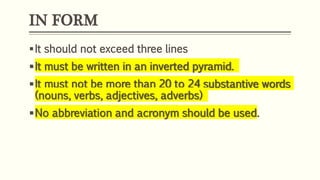
IN FORM
It should not exceed three lines
Level of Preparedness of Grade 10 Students
in Taking Research Subject
in Senior High School
Level of Preparedness of
Grade 10 Students in Taking
Research Subject in Senior High School
IN FORM
It should not exceed three lines
It must be written in an inverted pyramid.
It must not be more than 20 to 24 substantive words
(nouns, verbs, adjectives, adverbs)
No abbreviation and acronym should be used.
Level of Preparedness of Grade 10 Students
in Taking Research Subject
in Senior High School
Level of Preparedness of Grade
10 Students in Taking Research
Subject in Senior
High School
IN FORM
It should not exceed three lines
It must be written in an inverted pyramid.
It must not be more than 20 to 24 substantive words
(nouns, verbs, adjectives, adverbs)
No abbreviation and acronym should be used.
It must be arranged in thought phrase
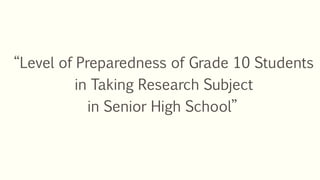
“Level of Preparedness of Grade 10 Students
in Taking Research Subject
in Senior High School”
IN FORM
It should not exceed three lines
It must be written in an inverted pyramid.
It must not be more than 20 to 24 substantive words
(nouns, verbs, adjectives, adverbs)
No abbreviation and acronym should be used.
It must be arranged in thought phrase
It must not be enclosed in quotation marks.
Level of Preparedness of Grade 10 Students
in Taking Research Subject
in Senior High School
IN FORM
 It should not exceed three lines
 It must be written in an inverted pyramid.
 It must not be more than 20 to 24 substantive words (nouns,
verbs, adjectives, adverbs)
 No abbreviation and acronym should be used.
 It must be arranged in thought phrase
 It must not be enclosed in quotation marks.
 No syllabication of words
 It must not indicate the time frame of the study

Prac-Reseacrh-2-Unit-2.pptx

  • 1.
  • 2.
    IDENTIFYING THE INQUIRY& STATING THE PROBLEM Unit 2
  • 3.
    ICE BREAKER  TOPICSTHAT INTEREST ME!  My chosen SHS track is: ___________________.  The top three things that I excel doing are ________, _________, and _________.  The top five things that make me happy are ______, _______, ________, _______, and ________.  The three things that I find interesting are _______, _______, and _________.
  • 4.
    STEPS IN DEVELOPINGRESEARCH TOPIC 1. Choose a broad topic 2. Do a preliminary research 3. Define the problem 4. Refine the question
  • 5.
    CHOOSE A BROADTOPIC Choose an interesting topic- If you are not interested, you will not be motivated Select a significant topic- A topic that is worth researching must be able to answer or solve problems in the community. Choose a topic relevant to your field
  • 6.
    DO A PRELIMINARYRESEARCH  Take time to read some more articles, journals, and related research studies. Find out how other researchers gathered data, what research instruments were used, how the data were analyzed, and what important findings they shared.
  • 7.
    DEFINE THE PROBLEM Aftergetting enough information, you may be able to list some questions or problems that you want to research. At this stage, you should be able to narrow down broad topic into feasible and manageable questions.
  • 8.
    REFINE THE QUESTION Thissteps lets you evaluate the questions formulated. What specific questions should you ask? How should you gather data sufficient to answer the questions?
  • 9.
    Guidelines in Choosinga Research Topic Interest in the subject matter Availability of information
  • 10.
    Guidelines in Choosinga Research Topic  Timeliness and relevance of the topic  Limitations on the subject • Personal Resources
  • 11.
    RESEARCH TOPIC TOBE AVOIDED 1. Controversial Topic 2. Highly Technical Subjects 3. Hard-to-investigate subjects 4. Too broad 5. Too narrow 6. Vague
  • 12.
    SOURCES OF RESEARCHTOPICS 1. Mass Media Communication 2. Books, Internet, government publications 3. Professional Periodicals 4. General Periodicals 5. Previous reading assignments 6. Work experience
  • 13.
  • 19.
  • 22.
     A researchTitle is the very first thing a reader comes across when searching for scientific literature. It is concise description of the content of the research study containing the fewest possible words, yet adequate to describe contents of the paper for a simple reason that we do not want to mislead the readers. After conceptualizing a most probable research topic, drafting the title early in the research process helps keeping your focus on the subject.
  • 23.
    BASIC GUIDELINES INWRITING A RESEARCH TITLE 1. Use an accurate description of the subject and scope of the study instead of using general terms. 2. Do not use abbreviations 3. Do not include words like “The study of,” “analysis of”, “an investigation of,” or similar construction as these would only lengthen the title. 4. Include the main dependent and independent variables. 5. Be mindful of the proper use of grammar and punctuation. 6. Capitalize all nouns, pronouns, verbs, adjectives, adverbs, as well as the first letter of the first and last word.
  • 24.
    Content of thetitle 1. It must be thought-provoking 2. It must answer the questions who, what, and where (in case of correlational study) 3. It must seek solution to felt-need problem 4. It must be timely 5. It must be clear and specific. 6. It must excite the reader’s intellectual curiosity 7. It must not be wordy 8. It gives a very specific and accurate index of the study
  • 25.
    Level of Preparednessof Grade 10 Students in Taking Research Subject in Senior High School Level of Preparedness of Grade 10 Students in Taking Research Subject in Senior High School
  • 26.
    IN FORM It shouldnot exceed three lines
  • 27.
    Level of Preparednessof Grade 10 Students in Taking Research Subject in Senior High School Level of Preparedness of Grade 10 Students in Taking Research Subject in Senior High School
  • 28.
    IN FORM It shouldnot exceed three lines It must be written in an inverted pyramid. It must not be more than 20 to 24 substantive words (nouns, verbs, adjectives, adverbs) No abbreviation and acronym should be used.
  • 29.
    Level of Preparednessof Grade 10 Students in Taking Research Subject in Senior High School Level of Preparedness of Grade 10 Students in Taking Research Subject in Senior High School
  • 30.
    IN FORM It shouldnot exceed three lines It must be written in an inverted pyramid. It must not be more than 20 to 24 substantive words (nouns, verbs, adjectives, adverbs) No abbreviation and acronym should be used. It must be arranged in thought phrase
  • 31.
    “Level of Preparednessof Grade 10 Students in Taking Research Subject in Senior High School”
  • 32.
    IN FORM It shouldnot exceed three lines It must be written in an inverted pyramid. It must not be more than 20 to 24 substantive words (nouns, verbs, adjectives, adverbs) No abbreviation and acronym should be used. It must be arranged in thought phrase It must not be enclosed in quotation marks.
  • 33.
    Level of Preparednessof Grade 10 Students in Taking Research Subject in Senior High School
  • 34.
    IN FORM  Itshould not exceed three lines  It must be written in an inverted pyramid.  It must not be more than 20 to 24 substantive words (nouns, verbs, adjectives, adverbs)  No abbreviation and acronym should be used.  It must be arranged in thought phrase  It must not be enclosed in quotation marks.  No syllabication of words  It must not indicate the time frame of the study

Editor's Notes

  • #2 NOTE: To change the image on this slide, select the picture and delete it. Then click the Pictures icon in the placeholder to insert your own image.
  • #17 Non- Experimental – Experimental. No Indep Variable & DV. Non Variable.
  • #18 Cause variable – the one responsible for the conditions that act on something else to bring about changes.
  • #19 Outcome Variable – It is a result or effect of the changes brought about by another variable. Independent variable. A variable that affects the dependent variable; variable that we research usually manipulate or control to see if we make changes to the dependent variable.