What is heritage
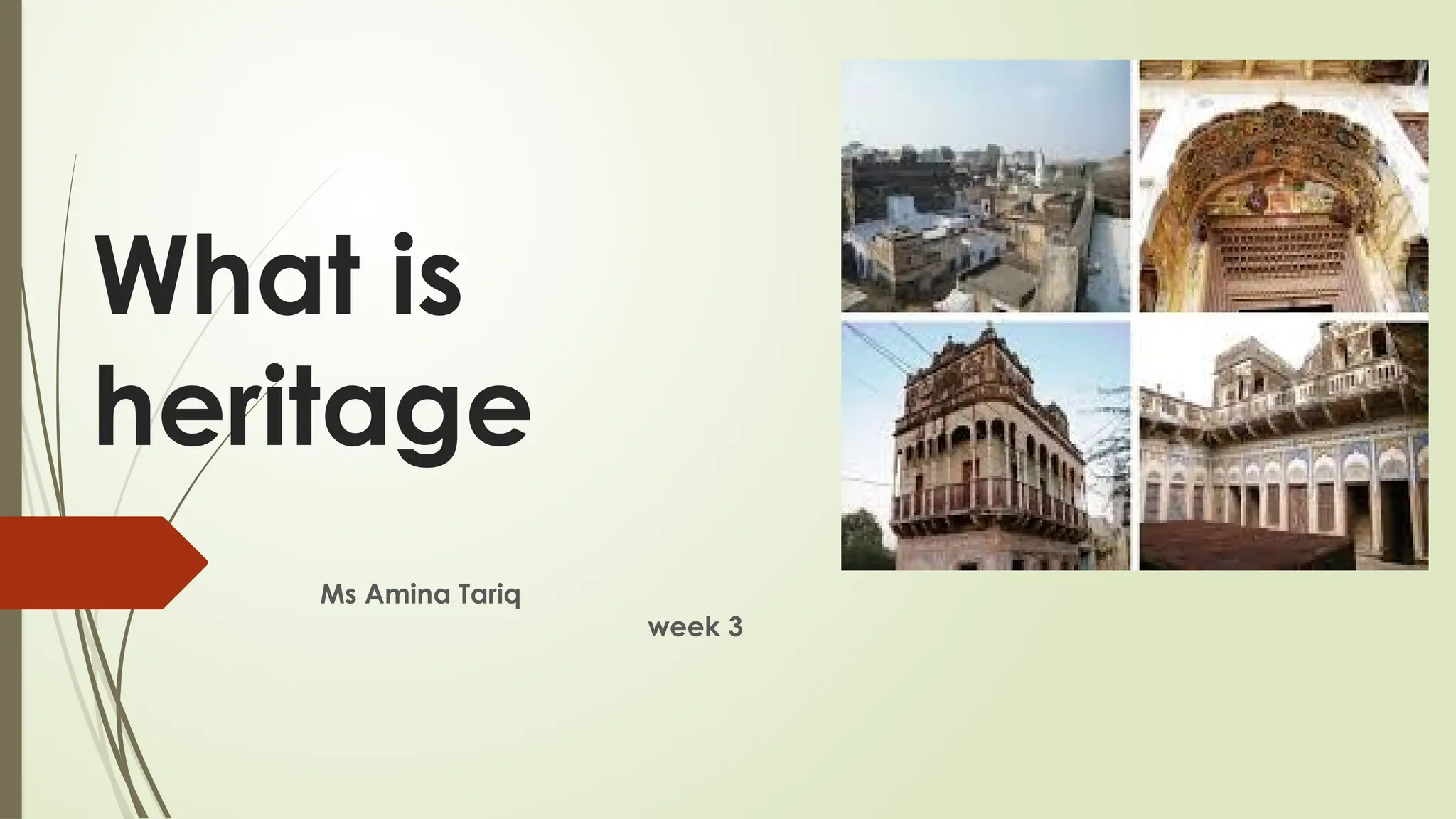
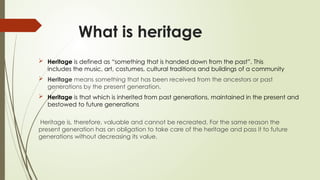
Heritage is defined as “something that is handed down from the past”. This
includes the music, art, costumes, cultural traditions and buildings of a community
Heritage means something that has been received from the ancestors or past
generations by the present generation.
Heritage is that which is inherited from past generations, maintained in the present and
bestowed to future generations
Heritage is, therefore, valuable and cannot be recreated. For the same reason the
present generation has an obligation to take care of the heritage and pass it to future
generations without decreasing its value.
4.
Natural heritage
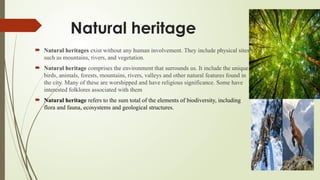
Naturalheritages exist without any human involvement. They include physical sites
such as mountains, rivers, and vegetation.
Natural heritage comprises the environment that surrounds us. It include the unique
birds, animals, forests, mountains, rivers, valleys and other natural features found in
the city. Many of these are worshipped and have religious significance. Some have
interested folklores associated with them
Natural heritage refers to the sum total of the elements of biodiversity, including
flora and fauna, ecosystems and geological structures.
5.
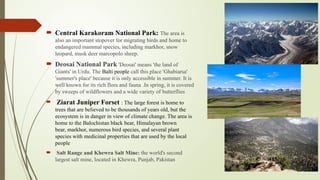
Central KarakoramNational Park: The area is
also an important stopover for migrating birds and home to
endangered mammal species, including markhor, snow
leopard, musk deer marcopolo sheep.
Deosai National Park 'Deosai' means 'the land of
Giants' in Urdu. The Balti people call this place 'Ghabiarsa'
'summer's place' because it is only accessible in summer. It is
well known for its rich flora and fauna .In spring, it is covered
by sweeps of wildflowers and a wide variety of butterflies
Ziarat Juniper Forset : The large forest is home to
trees that are believed to be thousands of years old, but the
ecosystem is in danger in view of climate change. The area is
home to the Balochistan black bear, Himalayan brown
bear, markhor, numerous bird species, and several plant
species with medicinal properties that are used by the local
people
Salt Range and Khewra Salt Mine: the world's second
largest salt mine, located in Khewra, Punjab, Pakistan
6.
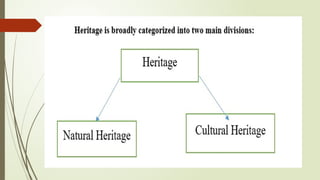
Cultural heritage
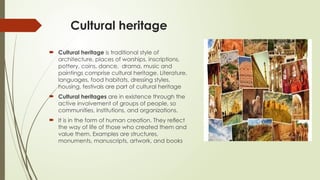
Culturalheritage is traditional style of
architecture, places of worships, inscriptions,
pottery, coins, dance, drama, music and
paintings comprise cultural heritage. Literature,
languages, food habitats, dressing styles,
housing, festivals are part of cultural heritage
Cultural heritages are in existence through the
active involvement of groups of people, so
communities, institutions, and organizations.
It is in the form of human creation. They reflect
the way of life of those who created them and
value them. Examples are structures,
monuments, manuscripts, artwork, and books
7.
Examples of culturalheritage
Cultural heritage sites (including archaeological sites, ruins, historic buildings)
Historic cities (urban landscapes and their constituent parts as well as ruined cities)
Cultural landscapes (including parks and gardens)
Natural sacred sites (places that people revere or hold important but that have no evidence of
human modification, for example sacred mountains)
Underwater cultural heritage (for example shipwrecks)
Museums (including cultural museums, art galleries and house museums)
Movable cultural heritage (objects as diverse as paintings, stone tools and cameras – this category
covers any form of object that is movable and that is outside of an archaeological context)
8.
Types of culturalheritage
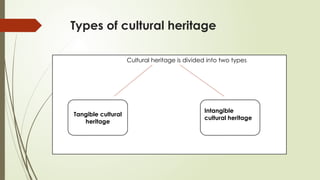
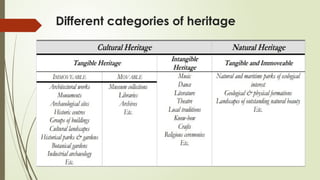
Cultural heritage is divided into two types
Tangible cultural
heritage
Intangible
cultural heritage
9.
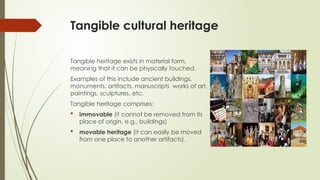
Tangible cultural heritage
Tangibleheritage exists in material form,
meaning that it can be physically touched.
Examples of this include ancient buildings,
monuments, artifacts, manuscripts works of art,
paintings, sculptures, etc.
Tangible heritage comprises:
immovable (it cannot be removed from its
place of origin, e.g., buildings)
movable heritage (it can easily be moved
from one place to another artifacts).
10.
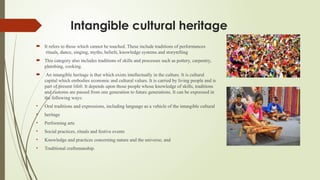
Intangible cultural heritage
It refers to those which cannot be touched. These include traditions of performances
rituals, dance, singing, myths, beliefs, knowledge systems and storytelling
This category also includes traditions of skills and processes such as pottery, carpentry,
plumbing, cooking.
An intangible heritage is that which exists intellectually in the culture. It is cultural
capital which embodies economic and cultural values. It is carried by living people and is
part of present life0. It depends upon those people whose knowledge of skills, traditions
and customs are passed from one generation to future generations. It can be expressed in
the following ways:
• Oral traditions and expressions, including language as a vehicle of the intangible cultural
• heritage
• Performing arts
• Social practices, rituals and festive events
• Knowledge and practices concerning nature and the universe; and
• Traditional craftsmanship.
Cultural heritage andtourism
Economic Benefits: Cultural heritage tourism can generate significant revenue for local
communities and national economies. This revenue can be used to fund conservation
efforts, support local businesses, and improve infrastructure.
Cultural Preservation: Tourism can provide an incentive for local communities to preserve
and protect their cultural heritage. By showcasing their cultural heritage, local
communities can demonstrate its value and importance, both to themselves and to
visitors.
Cultural Exchange: Tourism can facilitate cultural exchange between visitors and local
communities, promoting cross-cultural understanding and appreciation. This exchange
can help break down stereotypes and foster greater empathy and respect between
different cultures.
Promoting Cultural Awareness: Tourism can raise awareness about the importance of
cultural heritage and promote its conservation. By experiencing cultural heritage
firsthand, visitors can develop a deeper appreciation for its significance and importance.