WEL COME TO
PSYCHOLOGY
AND LIFE
SKILLS COURSE!!!
UNIT ONE
ESSENCE OF
PSYCHOLOGY
2
1.1. Definition of psychology
 Derived from two Greek words
1. Psyche- meaning “mind” or “soul/life/spirit”
2. Logos or Logy meaning “study/knowledge/discourse
Therefore, literally the term refers the study of mind” or
“soul/life/spirit”
 We humans are social animals.We are better in intelligence,
memory, habits, customs, values, than other animals, hence we
want to know about others & ourselves and we ask such questions
as:
 Who/what are human beings?
 What is our behavior, attitude, personality, etc.?
 Why we feel happy/sad?
 Why do we prosaically /antisocial?
A systematic body of knowledge has emerged to answer these and
other similar questions, i.e. psychology
Definition:-
 Psychology is defined as the scientific study of behavior and
mental processes
This definition consists of three key terms.
1. a scientific discipline (empirical science) - to study phenomenon, it
employs critical observation and experimentation based on
concrete data
2. studies about behavior – the overt characteristic - any
action/reaction that can be observed and recorded, e.g., talking,
walking, writing, kicking, etc
3. studies about mental processes – the covert characteristics - the
internal (mental), subjective experiences, that can not be observed
and recorded but inferred from the overt characteristics, e.g.,
sensation, perception, memory, emotion, thinking, attitude
Psychologists often conduct scientific research on animal
behavior which might sometimes be related to the behavior of
human beings
4
1.2. Goals of psychology
 Describing behavior – reporting the clear picture of the
existing behavior
 Explaining behavior - establish cause-effect relationship
 Predicting behavior – speculate what will happen in the
future
 Controlling behavior – improve a person’s life so as to
help him/her to enjoy quality life
 Modifying abnormal behavior - managing and changing
negative or anti-social aspects of behaviors and
maladjustment problems
5
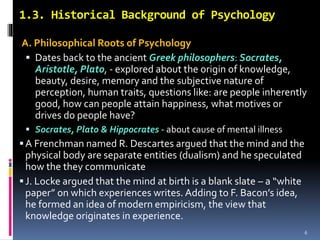
1.3. Historical Background of Psychology
A. Philosophical Roots of Psychology
 Dates back to the ancient Greek philosophers: Socrates,
Aristotle, Plato, - explored about the origin of knowledge,
beauty, desire, memory and the subjective nature of
perception, human traits, questions like: are people inherently
good, how can people attain happiness, what motives or
drives do people have?
 Socrates, Plato & Hippocrates - about cause of mental illness
A Frenchman named R. Descartes argued that the mind and the
physical body are separate entities (dualism) and he speculated
how the they communicate
J. Locke argued that the mind at birth is a blank slate – a “white
paper” on which experiences writes. Adding to F. Bacon’s idea,
he formed an idea of modern empiricism, the view that
knowledge originates in experience.
6
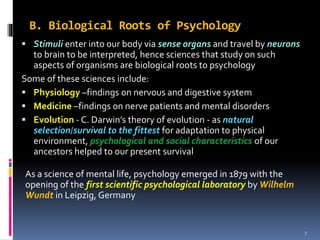
B. Biological Roots of Psychology
 Stimuli enter into our body via sense organs and travel by neurons
to brain to be interpreted, hence sciences that study on such
aspects of organisms are biological roots to psychology
Some of these sciences include:
 Physiology –findings on nervous and digestive system
 Medicine –findings on nerve patients and mental disorders
 Evolution - C. Darwin’s theory of evolution - as natural
selection/survival to the fittest for adaptation to physical
environment, psychological and social characteristics of our
ancestors helped to our present survival
As a science of mental life, psychology emerged in 1879 with the
opening of the first scientific psychological laboratory by Wilhelm
Wundt in Leipzig, Germany
7
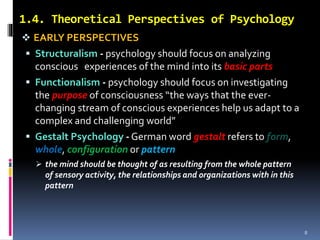
1.4. Theoretical Perspectives of Psychology
 EARLY PERSPECTIVES
 Structuralism - psychology should focus on analyzing
conscious experiences of the mind into its basic parts
 Functionalism - psychology should focus on investigating
the purpose of consciousness “the ways that the ever-
changing stream of conscious experiences help us adapt to a
complex and challenging world”
 Gestalt Psychology - German word gestalt refers to form,
whole, configuration or pattern
 the mind should be thought of as resulting from the whole pattern
of sensory activity, the relationships and organizations with in this
pattern
8
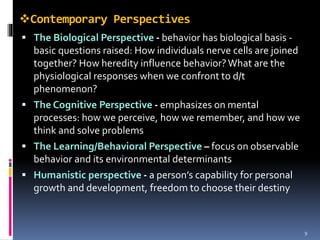
Contemporary Perspectives
 The Biological Perspective - behavior has biological basis -
basic questions raised: How individuals nerve cells are joined
together? How heredity influence behavior?What are the
physiological responses when we confront to d/t
phenomenon?
 The Cognitive Perspective - emphasizes on mental
processes: how we perceive, how we remember, and how we
think and solve problems
 The Learning/Behavioral Perspective – focus on observable
behavior and its environmental determinants
 Humanistic perspective - a person’s capability for personal
growth and development, freedom to choose their destiny
9
Perspectives (contd)
 The Psychodynamic Perspective -the hidden, often he
called the “unconscious”, part of a brain governs human
behavior; consisting dynamic forces (psychic energy) -
strong sexual and aggressive drives within an individual
 The Evolutionary Psychology Perspective– how
evolutionary process favors social and psychological
characteristics to increase organisms’ reproductive
success and the ability to pass their genes to the next
generation
 The Socio-cultural Perspective -culture, ethnicity, and
gender are essential to understand behavior, thought
and emotion
10
1.5. Branches of Psychology
 Abnormal psychology: diagnosis of mental
malfunctioning and maladjustment problems
 Counseling psychology: deals with personal
problems such as academic, social, emotional,
personality or vocational problems
 Clinical psychology: diagnosis and treatment of
psychological disorders and to promote
subjective well-being and personal development
 Developmental Psychology: studies about
changes in human behavior across the life span
11
Branches (Contd)
 Forensic psychology: deals with the application of
psychology on legal aspects of human behavior focusing on
deviance, delinquency and crime
 Personality Psychology: Concerned with differences in
behavior among individuals
 Social psychology: studies the effects of people have on one
another, factors affecting interpersonal attraction
 Industrial/organizational psychology: applies principles of
psychology on work place to employees’ potential -
selecting, evaluating and improving effectiveness,
management styles on worker motivation, job-satisfaction
12
1.6. Research methods in psychology
 Observational method: studying participants in
their natural setting as they go about their usual
activities. It takes 2 forms:
 Naturalistic observation
 Participant observation
 Case Study: in-depth study of a person (few
students) typically conducted to gain knowledge
about a certain psychological phenomenon
13
Research methods (Contd)
 Correlational method: focuses on the degree of
rssp b/n 2 or more mutually occurring variables.
 It shows the degree and direction of rssp b/n
variables by a correlation coefficient
Coefficient of correlation is a numerical value that
ranges from +1.00 (a perfect positive correlation) to -
1.00 (a perfect negative correlation)
 Survey method: collecting data about the
opinions, beliefs & attitudes of people towards an
event/issue, or personal experiences by using
interview and questionnaire
14
Research methods (Contd)
 Experimental method: an experimenter works with
two groups of subjects:
1) the experimental group which is exposed to the
experimental condition (independent variable), and
2) the control group which does not so that the expected
change (dependent variable) will be confirmed.
• The researcher also excludes variables that might affect the
outcome of the experiment (extraneous variables)
 dependent variable
 independent variable
 extraneous variable
15
Research Ethics in Psychology
(APA's ethical guide lines)
 Informed consent
 Deception
 Confidentiality
 Physical, social & psychological well being of participants
 Debriefing
16
1.7. Applications of
psychology
 Applied psychology is the application of
psychological principles to solve problems of
the human experience, including the
workplace, health, product design, law and
more.
July, 2005
E. W/G 17
THE END
THANK YOU VERY
MUCH
18

PPT-U1-Definition.pptx

  • 1.
    WEL COME TO PSYCHOLOGY ANDLIFE SKILLS COURSE!!!
  • 2.
  • 3.
    1.1. Definition ofpsychology  Derived from two Greek words 1. Psyche- meaning “mind” or “soul/life/spirit” 2. Logos or Logy meaning “study/knowledge/discourse Therefore, literally the term refers the study of mind” or “soul/life/spirit”  We humans are social animals.We are better in intelligence, memory, habits, customs, values, than other animals, hence we want to know about others & ourselves and we ask such questions as:  Who/what are human beings?  What is our behavior, attitude, personality, etc.?  Why we feel happy/sad?  Why do we prosaically /antisocial? A systematic body of knowledge has emerged to answer these and other similar questions, i.e. psychology
  • 4.
    Definition:-  Psychology isdefined as the scientific study of behavior and mental processes This definition consists of three key terms. 1. a scientific discipline (empirical science) - to study phenomenon, it employs critical observation and experimentation based on concrete data 2. studies about behavior – the overt characteristic - any action/reaction that can be observed and recorded, e.g., talking, walking, writing, kicking, etc 3. studies about mental processes – the covert characteristics - the internal (mental), subjective experiences, that can not be observed and recorded but inferred from the overt characteristics, e.g., sensation, perception, memory, emotion, thinking, attitude Psychologists often conduct scientific research on animal behavior which might sometimes be related to the behavior of human beings 4
  • 5.
    1.2. Goals ofpsychology  Describing behavior – reporting the clear picture of the existing behavior  Explaining behavior - establish cause-effect relationship  Predicting behavior – speculate what will happen in the future  Controlling behavior – improve a person’s life so as to help him/her to enjoy quality life  Modifying abnormal behavior - managing and changing negative or anti-social aspects of behaviors and maladjustment problems 5
  • 6.
    1.3. Historical Backgroundof Psychology A. Philosophical Roots of Psychology  Dates back to the ancient Greek philosophers: Socrates, Aristotle, Plato, - explored about the origin of knowledge, beauty, desire, memory and the subjective nature of perception, human traits, questions like: are people inherently good, how can people attain happiness, what motives or drives do people have?  Socrates, Plato & Hippocrates - about cause of mental illness A Frenchman named R. Descartes argued that the mind and the physical body are separate entities (dualism) and he speculated how the they communicate J. Locke argued that the mind at birth is a blank slate – a “white paper” on which experiences writes. Adding to F. Bacon’s idea, he formed an idea of modern empiricism, the view that knowledge originates in experience. 6
  • 7.
    B. Biological Rootsof Psychology  Stimuli enter into our body via sense organs and travel by neurons to brain to be interpreted, hence sciences that study on such aspects of organisms are biological roots to psychology Some of these sciences include:  Physiology –findings on nervous and digestive system  Medicine –findings on nerve patients and mental disorders  Evolution - C. Darwin’s theory of evolution - as natural selection/survival to the fittest for adaptation to physical environment, psychological and social characteristics of our ancestors helped to our present survival As a science of mental life, psychology emerged in 1879 with the opening of the first scientific psychological laboratory by Wilhelm Wundt in Leipzig, Germany 7
  • 8.
    1.4. Theoretical Perspectivesof Psychology  EARLY PERSPECTIVES  Structuralism - psychology should focus on analyzing conscious experiences of the mind into its basic parts  Functionalism - psychology should focus on investigating the purpose of consciousness “the ways that the ever- changing stream of conscious experiences help us adapt to a complex and challenging world”  Gestalt Psychology - German word gestalt refers to form, whole, configuration or pattern  the mind should be thought of as resulting from the whole pattern of sensory activity, the relationships and organizations with in this pattern 8
  • 9.
    Contemporary Perspectives  TheBiological Perspective - behavior has biological basis - basic questions raised: How individuals nerve cells are joined together? How heredity influence behavior?What are the physiological responses when we confront to d/t phenomenon?  The Cognitive Perspective - emphasizes on mental processes: how we perceive, how we remember, and how we think and solve problems  The Learning/Behavioral Perspective – focus on observable behavior and its environmental determinants  Humanistic perspective - a person’s capability for personal growth and development, freedom to choose their destiny 9
  • 10.
    Perspectives (contd)  ThePsychodynamic Perspective -the hidden, often he called the “unconscious”, part of a brain governs human behavior; consisting dynamic forces (psychic energy) - strong sexual and aggressive drives within an individual  The Evolutionary Psychology Perspective– how evolutionary process favors social and psychological characteristics to increase organisms’ reproductive success and the ability to pass their genes to the next generation  The Socio-cultural Perspective -culture, ethnicity, and gender are essential to understand behavior, thought and emotion 10
  • 11.
    1.5. Branches ofPsychology  Abnormal psychology: diagnosis of mental malfunctioning and maladjustment problems  Counseling psychology: deals with personal problems such as academic, social, emotional, personality or vocational problems  Clinical psychology: diagnosis and treatment of psychological disorders and to promote subjective well-being and personal development  Developmental Psychology: studies about changes in human behavior across the life span 11
  • 12.
    Branches (Contd)  Forensicpsychology: deals with the application of psychology on legal aspects of human behavior focusing on deviance, delinquency and crime  Personality Psychology: Concerned with differences in behavior among individuals  Social psychology: studies the effects of people have on one another, factors affecting interpersonal attraction  Industrial/organizational psychology: applies principles of psychology on work place to employees’ potential - selecting, evaluating and improving effectiveness, management styles on worker motivation, job-satisfaction 12
  • 13.
    1.6. Research methodsin psychology  Observational method: studying participants in their natural setting as they go about their usual activities. It takes 2 forms:  Naturalistic observation  Participant observation  Case Study: in-depth study of a person (few students) typically conducted to gain knowledge about a certain psychological phenomenon 13
  • 14.
    Research methods (Contd) Correlational method: focuses on the degree of rssp b/n 2 or more mutually occurring variables.  It shows the degree and direction of rssp b/n variables by a correlation coefficient Coefficient of correlation is a numerical value that ranges from +1.00 (a perfect positive correlation) to - 1.00 (a perfect negative correlation)  Survey method: collecting data about the opinions, beliefs & attitudes of people towards an event/issue, or personal experiences by using interview and questionnaire 14
  • 15.
    Research methods (Contd) Experimental method: an experimenter works with two groups of subjects: 1) the experimental group which is exposed to the experimental condition (independent variable), and 2) the control group which does not so that the expected change (dependent variable) will be confirmed. • The researcher also excludes variables that might affect the outcome of the experiment (extraneous variables)  dependent variable  independent variable  extraneous variable 15
  • 16.
    Research Ethics inPsychology (APA's ethical guide lines)  Informed consent  Deception  Confidentiality  Physical, social & psychological well being of participants  Debriefing 16
  • 17.
    1.7. Applications of psychology Applied psychology is the application of psychological principles to solve problems of the human experience, including the workplace, health, product design, law and more. July, 2005 E. W/G 17
  • 18.
    THE END THANK YOUVERY MUCH 18