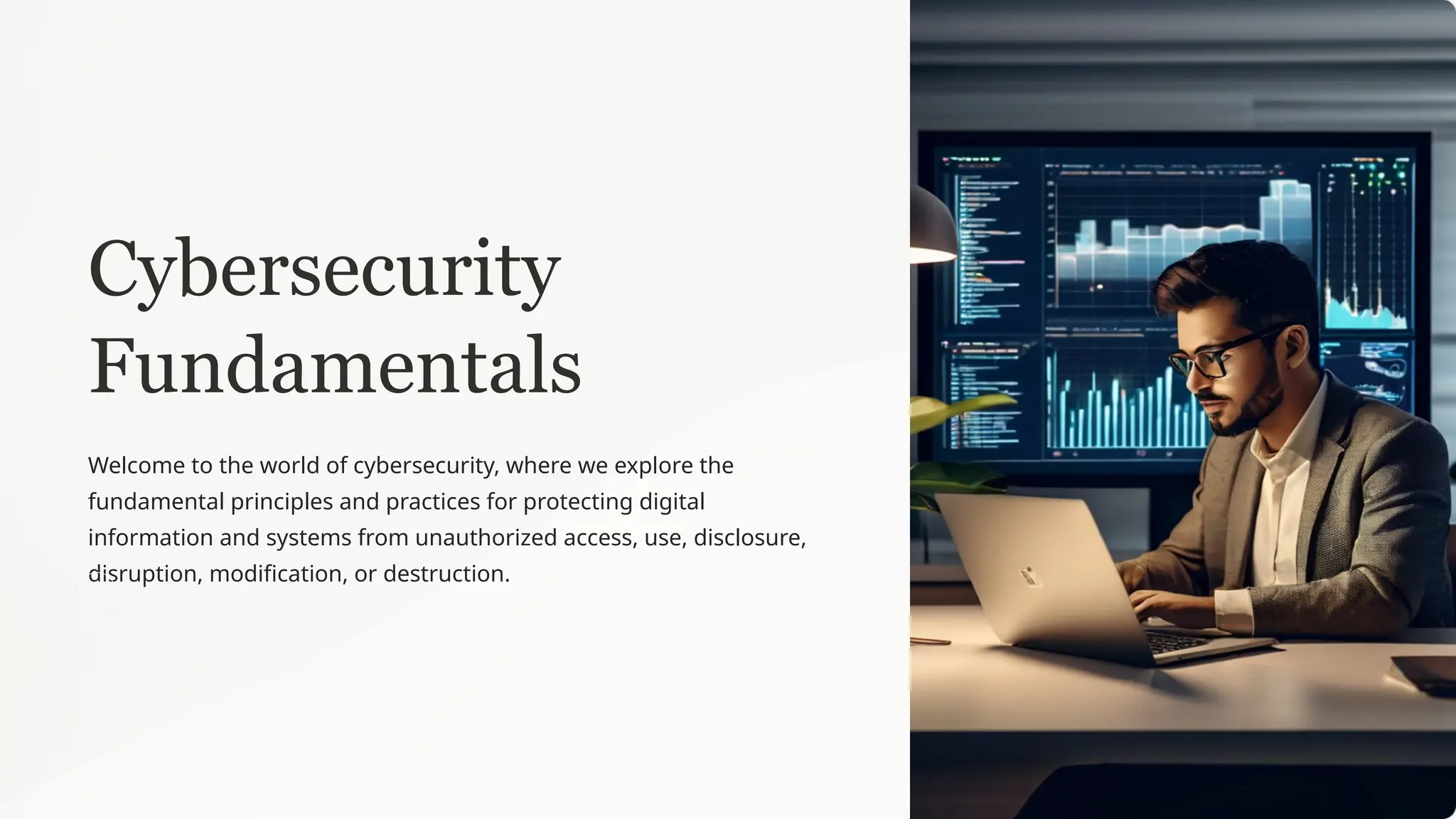
Cybersecurity
Fundamentals
Welcome to theworld of cybersecurity, where we explore the
fundamental principles and practices for protecting digital
information and systems from unauthorized access, use, disclosure,
disruption, modification, or destruction.
2.
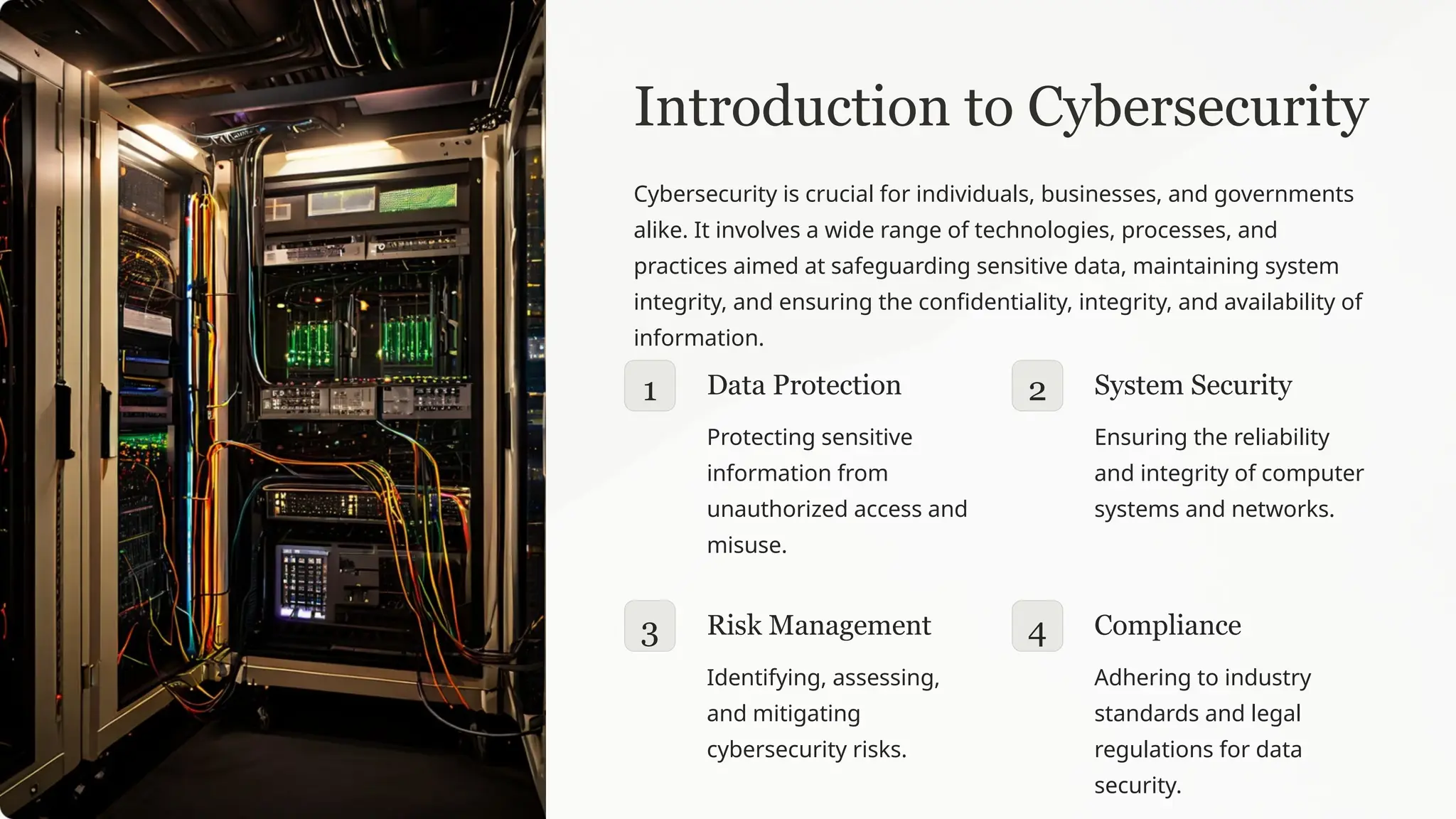
Introduction to Cybersecurity
Cybersecurityis crucial for individuals, businesses, and governments
alike. It involves a wide range of technologies, processes, and
practices aimed at safeguarding sensitive data, maintaining system
integrity, and ensuring the confidentiality, integrity, and availability of
information.
1 Data Protection
Protecting sensitive
information from
unauthorized access and
misuse.
2 System Security
Ensuring the reliability
and integrity of computer
systems and networks.
3 Risk Management
Identifying, assessing,
and mitigating
cybersecurity risks.
4 Compliance
Adhering to industry
standards and legal
regulations for data
security.
3.
Cybersecurity Threats andVulnerabilities
Cybersecurity threats are constantly evolving and becoming more sophisticated. Understanding common vulnerabilities
and attack vectors is crucial for building effective defenses.
Malware
Viruses, worms, Trojans, and
ransomware that can harm
systems and steal data.
Phishing
Deceptive emails or messages
designed to trick users into
revealing sensitive information.
Denial-of-Service Attacks
Overloading a system with traffic
to make it unavailable to legitimate
users.
4.
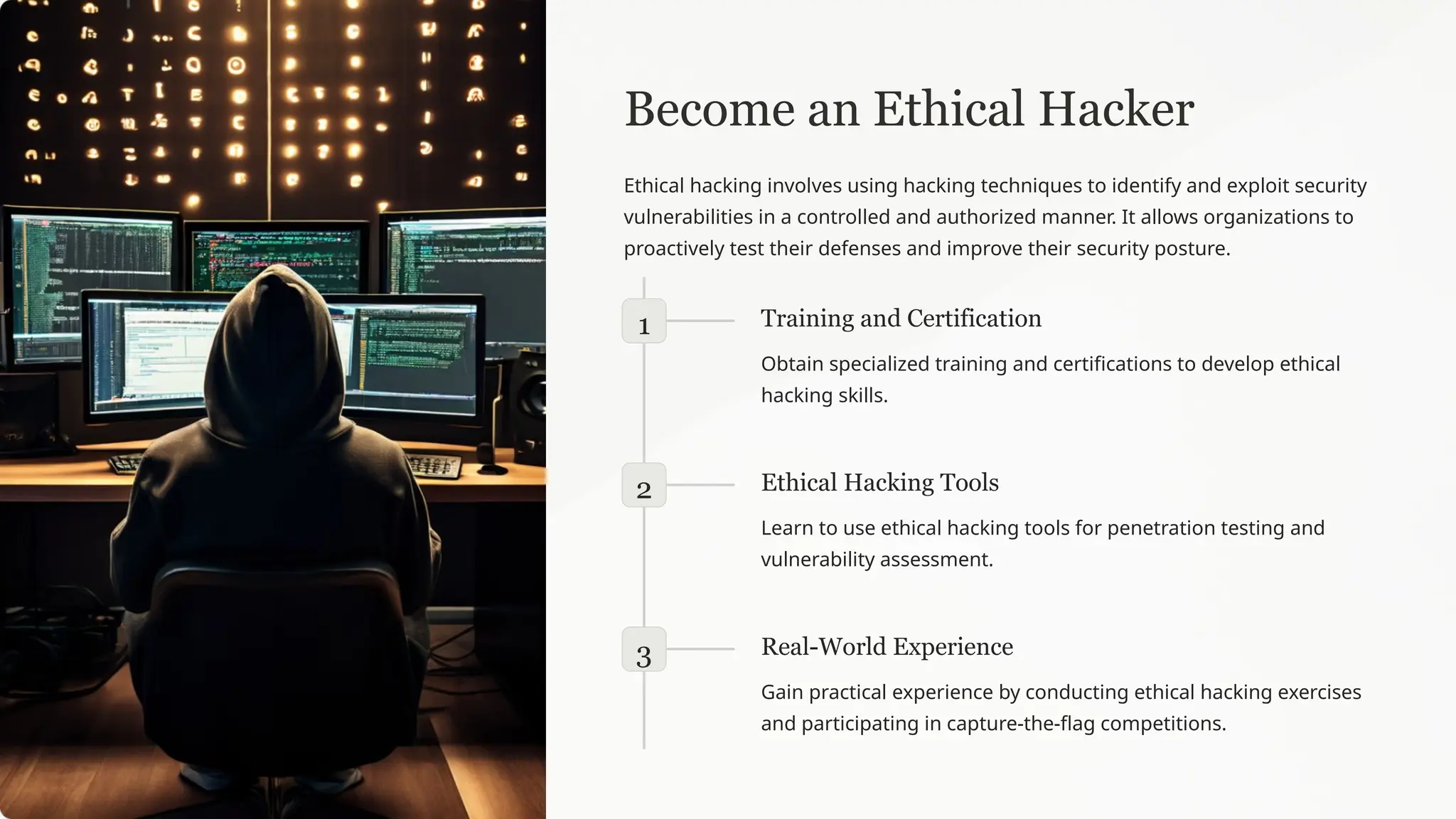
Become an EthicalHacker
Ethical hacking involves using hacking techniques to identify and exploit security
vulnerabilities in a controlled and authorized manner. It allows organizations to
proactively test their defenses and improve their security posture.
1 Training and Certification
Obtain specialized training and certifications to develop ethical
hacking skills.
2 Ethical Hacking Tools
Learn to use ethical hacking tools for penetration testing and
vulnerability assessment.
3 Real-World Experience
Gain practical experience by conducting ethical hacking exercises
and participating in capture-the-flag competitions.
5.
Ethical Hacking Methodology
Ethicalhackers follow a structured methodology to systematically assess and exploit security
vulnerabilities. This approach helps ensure a thorough and effective penetration test.
Information Gathering
Collecting information about the target system and its infrastructure.
Scanning and Enumeration
Identifying potential vulnerabilities and weaknesses in the target system.
Vulnerability Analysis
Analyzing identified vulnerabilities and determining their exploitable nature.
Exploitation
Attempting to exploit identified vulnerabilities to gain unauthorized access.
6.
Penetration Testing
Techniques
Penetration testinginvolves simulating real-world attacks to identify
and assess security vulnerabilities. It helps organizations understand
their security posture and prioritize remediation efforts.
Black Box Testing
Testers have no prior
knowledge of the target
system or its configuration.
Gray Box Testing
Testers have limited
knowledge of the target
system, such as user
credentials or internal
documentation.
White Box Testing
Testers have full access to the target system and its source code.
7.
Network Administration Skills
Networkadministration involves managing and maintaining computer networks. This
includes installing and configuring network devices, troubleshooting network issues,
and ensuring network security.
Networking Protocols Understanding network protocols
such as TCP/IP, DNS, and DHCP.
Network Devices Managing routers, switches, firewalls,
and other network hardware.
Network Security Implementing security measures to
protect the network from attacks.
Network Monitoring Monitoring network performance,
identifying bottlenecks, and resolving
issues.
8.
Network Fundamentals
Understanding networkfundamentals is essential for any
cybersecurity professional. This includes concepts such as network
topology, addressing, and routing.
Network Topology
The physical or logical
arrangement of network
devices.
Network Addressing
Assigning unique addresses to
network devices.
Network Routing
The process of forwarding data
packets between network
devices.
Network Switching
Connecting devices on a
network and managing data
flow.
9.
Network Security Protocols
Networksecurity protocols play a crucial role in protecting data and
systems. These protocols define how devices communicate securely
and enforce access control mechanisms.
1 SSL/TLS
Ensuring secure
communication between
web browsers and
servers.
2 IPSec
Providing secure
communication between
networks or devices.
3 VPN
Creating a secure
connection over a public
network.
4 Firewall
Blocking unauthorized
access to a network.
10.
Conclusion and Key
Takeaways
Cybersecurityis an ever-evolving field, and staying informed about
the latest threats and best practices is crucial. By understanding
cybersecurity fundamentals and ethical hacking techniques, you can
contribute to building a more secure digital world.