By Mulk Raj
Anand
© Salwan Public School, Mayur Vihar – 3, Delhi - 96
THE LOST CHILD
Lesson 1 : THE LOST CHILD
Objectives :
• To make the students familiar with Indian author
Mulk Raj Anand who wrote the famous The Coolie
and The Untouchable .
• To make students understand the importance of
parents in their lives.
• To introduce new vocabulary.
• To help students acquire Reading skills and develop
a good reading habit.
By MULK RAJ ANAND
© Salwan Public School, Mayur Vihar – 3, Delhi - 96
About the Author
MULKRAJ ANAND
© Salwan Public School, Mayur Vihar – 3, Delhi - 96
Mulk Raj Anand (12 December 1905 – 28 September 2004)
was an Indian writer in English, notable for his depiction
of the lives of the poorer castes in traditional Indian
society. One of the pioneers of Indo-Anglian fiction, he,
together with R. K. Narayan, Ahmad Ali and Raja Rao, was
one of the first India-based writers in English to gain an
International readership. Anand is admired for his novels
and short stories, which have acquired the status of
classics of modern Indian English literature; they are
noted for their perceptive insight into the lives of the
oppressed and for their analysis of impoverishment,
exploitation and misfortune. He became known for his
protest novel “Untouchable” (1935), followed by other
works on the Indian poor such as “Coolie” (1936) and
“Two Leaves and a Bud” (1937). He is also noted for being
among the first writers to incorporate Punjabi and
Hindustani idioms into English, and was a recipient of the
civilian honour of the Padma Bhushan.
VOCABULARY
Clad : dressed
The king was clad in rich robe embedded with jewels.
Brimming : to be full of
My heart was brimming over with happiness.
Lagged behind : to go slowly
I lagged behind my friend in the race.
Tyrant : cruel
Adolf Hitler was a tyrant.
Gaudy : too bright
I like to wear gaudy dresses in parties.
Shrieked : to give a sudden shout
The baby shrieked when it saw a snake on the bed.
© Salwan Public School, Mayur Vihar – 3, Delhi - 96
Major Characters of the
Story
 The Child – the hero : He is easily excited by many
things like toys, sweets, a garland and many more in
the fair. He is an obedient child as he could see the
refusal for his demands on his parents face. He is so
innocent and he is scared of his father. He knows
that his mother tries to please him more, though she
is not able to. He is afraid of his father, yet he is not
afraid of anything else in the presence of his father,
as he feels secure and protected. He is so mature that
he is able to shift his excitement from one thing to
other as he is aware that he will not get anything
whatever he wants for some reason or other. He does
not have any grudge for not getting what he wants.
He proves to be child of his age as he cries and sobs
when he has missed his parents.
© Salwan Public School, Mayur Vihar – 3, Delhi - 96
Major Characters of the
Story
• The Unknown Man : The unknown man was a
very kind and generous man. In the crowd, he
was the only one who came forward to help
the lost child. First he lifted up the lost child in
his arms. He asked the child about him and his
parents and got to know that he has lost his
parents. He tried each and every means to
console the lost and sobbing child. He offered
every exciting thing in the fair to the child
which earlier he wanted to buy. The unknown
man is the symbol of humanity who is ready
to help the lost child in all aspects.
© Salwan Public School, Mayur Vihar – 3, Delhi - 96
INTRODUCTION
The Lost Child is the story of a small child who
gets lost in a fair. He has gone with his parents
to the fair but loses them when he gets
engrossed in looking at a roundabout swing.
The story highlights the bond of love and
affection that the child shares with his parents.
Before losing them he had been demanding
different things like sweets, balloons, flowers,
swings, etc. Once he loses them, he is picked
up by a stranger. The stranger tries to quieten
the child by offering him all these things that he
had demanded from his parents but the child
does not want them any more. He wants his
parents first. © Salwan Public School, Mayur Vihar – 3, Delhi - 96
Summary of the
Lesson
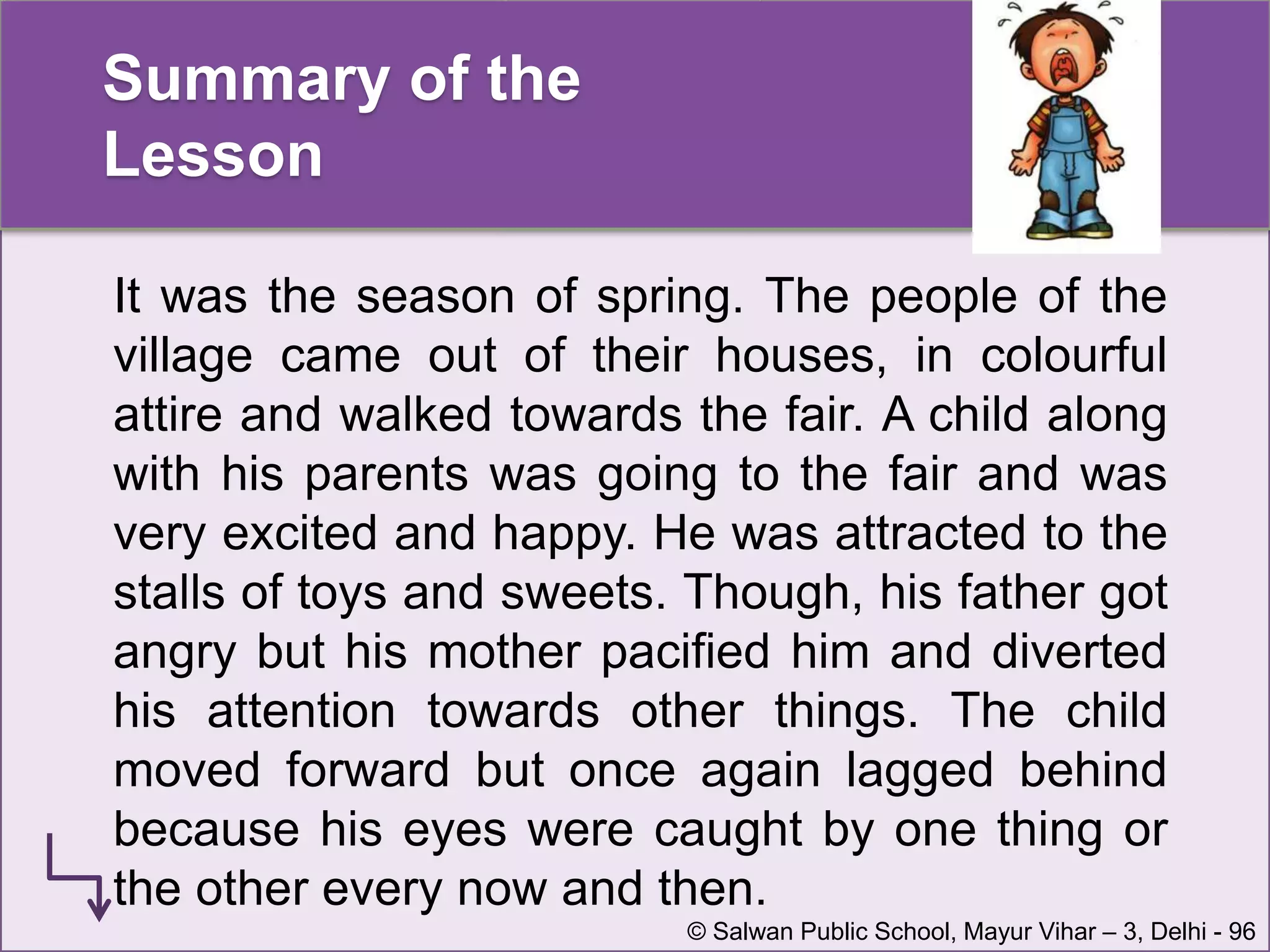
It was the season of spring. The people of the
village came out of their houses, in colourful
attire and walked towards the fair. A child along
with his parents was going to the fair and was
very excited and happy. He was attracted to the
stalls of toys and sweets. Though, his father got
angry but his mother pacified him and diverted
his attention towards other things. The child
moved forward but once again lagged behind
because his eyes were caught by one thing or
the other every now and then.
© Salwan Public School, Mayur Vihar – 3, Delhi - 96
Summary of the
Lesson
As they moved forward, the child wanted the
various things on the stalls. His mouth watered
seeing sweets decorated with gold and silver
leaves. He wanted his favourite burfi but
knowing that his parents would refuse on the
ground that he was greedy, he walked ahead.
Then he saw beautiful garlands of gulmohur but
didn’t ask for it, then he saw balloons but he
knew very well that his parents would deny due
to the fact that he was too old to play with
balloons, so he walked away.
© Salwan Public School, Mayur Vihar – 3, Delhi - 96
Summary of the
Lesson
Then he saw a snake charmer and a roundabout
swing. As he stopped to ask his parents for permission
to enjoy the swing, to his astonishment, there was no
reply. Neither his father nor his mother was there. Now
the child realized that he was lost. He ran here and
there but could not find them. The place was
overcrowded. He got terrified but suddenly a kind
hearted man took him up in his arms and consoled the
bitterly weeping child. He asked if he would like to have
a joyride but the child sobbed “I want my father, I want
my mother.” The man offered him sweets, balloons and
garland but the child kept sobbing “I want my father, I
want my mother.”
© Salwan Public School, Mayur Vihar – 3, Delhi - 96
Message of the Story
© Salwan Public School, Mayur Vihar – 3, Delhi - 96
The moral of the short story
'The Lost Child' by Mulk Raj
Anand is that every child
loves his/her parents
unconditionally. The parents
are the most beautiful and
the most significant people
in a child's life.
How to go about
1. Read the lesson well using the following methods:
Skimming is reading rapidly in order to get a general overview.
Scanning is reading rapidly to find specific facts.
Reading for detail is reading between the lines or reading to
derive a deeper meaning.
2. Underline the difficult words and use dictionary to find the
meanings and use key vocabulary given in the book as reference.
3. Do the questions ‘Thinking about text’ given after the lesson.
4. The purpose of PPT is to give you all a better understanding of the
lesson.
Conceptualised & created by Ms Chetna Verma, TGT English © Salwan Public School, Mayur Vihar – 3, Delhi - 96

PPT Class IX The Lost Child.pptx

  • 1.
    By Mulk Raj Anand ©Salwan Public School, Mayur Vihar – 3, Delhi - 96 THE LOST CHILD
  • 2.
    Lesson 1 :THE LOST CHILD Objectives : • To make the students familiar with Indian author Mulk Raj Anand who wrote the famous The Coolie and The Untouchable . • To make students understand the importance of parents in their lives. • To introduce new vocabulary. • To help students acquire Reading skills and develop a good reading habit. By MULK RAJ ANAND © Salwan Public School, Mayur Vihar – 3, Delhi - 96
  • 3.
    About the Author MULKRAJANAND © Salwan Public School, Mayur Vihar – 3, Delhi - 96 Mulk Raj Anand (12 December 1905 – 28 September 2004) was an Indian writer in English, notable for his depiction of the lives of the poorer castes in traditional Indian society. One of the pioneers of Indo-Anglian fiction, he, together with R. K. Narayan, Ahmad Ali and Raja Rao, was one of the first India-based writers in English to gain an International readership. Anand is admired for his novels and short stories, which have acquired the status of classics of modern Indian English literature; they are noted for their perceptive insight into the lives of the oppressed and for their analysis of impoverishment, exploitation and misfortune. He became known for his protest novel “Untouchable” (1935), followed by other works on the Indian poor such as “Coolie” (1936) and “Two Leaves and a Bud” (1937). He is also noted for being among the first writers to incorporate Punjabi and Hindustani idioms into English, and was a recipient of the civilian honour of the Padma Bhushan.
  • 4.
    VOCABULARY Clad : dressed Theking was clad in rich robe embedded with jewels. Brimming : to be full of My heart was brimming over with happiness. Lagged behind : to go slowly I lagged behind my friend in the race. Tyrant : cruel Adolf Hitler was a tyrant. Gaudy : too bright I like to wear gaudy dresses in parties. Shrieked : to give a sudden shout The baby shrieked when it saw a snake on the bed. © Salwan Public School, Mayur Vihar – 3, Delhi - 96
  • 5.
    Major Characters ofthe Story  The Child – the hero : He is easily excited by many things like toys, sweets, a garland and many more in the fair. He is an obedient child as he could see the refusal for his demands on his parents face. He is so innocent and he is scared of his father. He knows that his mother tries to please him more, though she is not able to. He is afraid of his father, yet he is not afraid of anything else in the presence of his father, as he feels secure and protected. He is so mature that he is able to shift his excitement from one thing to other as he is aware that he will not get anything whatever he wants for some reason or other. He does not have any grudge for not getting what he wants. He proves to be child of his age as he cries and sobs when he has missed his parents. © Salwan Public School, Mayur Vihar – 3, Delhi - 96
  • 6.
    Major Characters ofthe Story • The Unknown Man : The unknown man was a very kind and generous man. In the crowd, he was the only one who came forward to help the lost child. First he lifted up the lost child in his arms. He asked the child about him and his parents and got to know that he has lost his parents. He tried each and every means to console the lost and sobbing child. He offered every exciting thing in the fair to the child which earlier he wanted to buy. The unknown man is the symbol of humanity who is ready to help the lost child in all aspects. © Salwan Public School, Mayur Vihar – 3, Delhi - 96
  • 7.
    INTRODUCTION The Lost Childis the story of a small child who gets lost in a fair. He has gone with his parents to the fair but loses them when he gets engrossed in looking at a roundabout swing. The story highlights the bond of love and affection that the child shares with his parents. Before losing them he had been demanding different things like sweets, balloons, flowers, swings, etc. Once he loses them, he is picked up by a stranger. The stranger tries to quieten the child by offering him all these things that he had demanded from his parents but the child does not want them any more. He wants his parents first. © Salwan Public School, Mayur Vihar – 3, Delhi - 96
  • 8.
    Summary of the Lesson Itwas the season of spring. The people of the village came out of their houses, in colourful attire and walked towards the fair. A child along with his parents was going to the fair and was very excited and happy. He was attracted to the stalls of toys and sweets. Though, his father got angry but his mother pacified him and diverted his attention towards other things. The child moved forward but once again lagged behind because his eyes were caught by one thing or the other every now and then. © Salwan Public School, Mayur Vihar – 3, Delhi - 96
  • 9.
    Summary of the Lesson Asthey moved forward, the child wanted the various things on the stalls. His mouth watered seeing sweets decorated with gold and silver leaves. He wanted his favourite burfi but knowing that his parents would refuse on the ground that he was greedy, he walked ahead. Then he saw beautiful garlands of gulmohur but didn’t ask for it, then he saw balloons but he knew very well that his parents would deny due to the fact that he was too old to play with balloons, so he walked away. © Salwan Public School, Mayur Vihar – 3, Delhi - 96
  • 10.
    Summary of the Lesson Thenhe saw a snake charmer and a roundabout swing. As he stopped to ask his parents for permission to enjoy the swing, to his astonishment, there was no reply. Neither his father nor his mother was there. Now the child realized that he was lost. He ran here and there but could not find them. The place was overcrowded. He got terrified but suddenly a kind hearted man took him up in his arms and consoled the bitterly weeping child. He asked if he would like to have a joyride but the child sobbed “I want my father, I want my mother.” The man offered him sweets, balloons and garland but the child kept sobbing “I want my father, I want my mother.” © Salwan Public School, Mayur Vihar – 3, Delhi - 96
  • 11.
    Message of theStory © Salwan Public School, Mayur Vihar – 3, Delhi - 96 The moral of the short story 'The Lost Child' by Mulk Raj Anand is that every child loves his/her parents unconditionally. The parents are the most beautiful and the most significant people in a child's life.
  • 12.
    How to goabout 1. Read the lesson well using the following methods: Skimming is reading rapidly in order to get a general overview. Scanning is reading rapidly to find specific facts. Reading for detail is reading between the lines or reading to derive a deeper meaning. 2. Underline the difficult words and use dictionary to find the meanings and use key vocabulary given in the book as reference. 3. Do the questions ‘Thinking about text’ given after the lesson. 4. The purpose of PPT is to give you all a better understanding of the lesson. Conceptualised & created by Ms Chetna Verma, TGT English © Salwan Public School, Mayur Vihar – 3, Delhi - 96