P, Pi & PID controller
BY:-KARAN SATI
Introduction:-
The controller (an analogue/digital circuit, and software), is trying
to keep the controlled variable such as temperature, liquid level,
motor velocity, robot joint angle, at a certain value called the set
point (SP).
Controllers improve steady state accuracy by decreasing the steady
state errors.
Maximum overshoot of the system can be controlled using these
controllers
Some definitions :-
Peak time :-
The peak time is the time required for the response to reach the
first peak of the overshoot.
Overshoot :-
Overshoot is when a signal or function exceeds its target.
Steady state error:-
The difference between the desired final output and the actual
one" when the system reaches a steady state
Controllers:-
• A controller is one which compares controlled values with the
desired values and has a function to correct the deviation
produced.
• There are three basic types of contollers :
Propotional controller { P controller }
Derivative controller { D controller}
Integral controller { I controller }
P controller :-
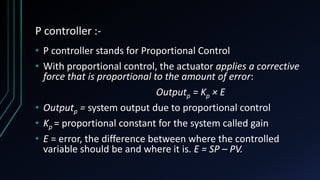
• P controller stands for Proportional Control
• With proportional control, the actuator applies a corrective
force that is proportional to the amount of error:
Outputp = Kp × E
• Outputp = system output due to proportional control
• Kp = proportional constant for the system called gain
• E = error, the difference between where the controlled
variable should be and where it is. E = SP – PV.
P controller :-
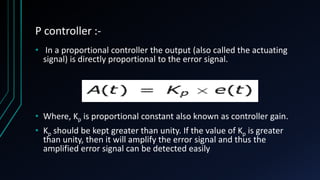
• In a proportional controller the output (also called the actuating
signal) is directly proportional to the error signal.
• Where, Kp is proportional constant also known as controller gain.
• Kp should be kept greater than unity. If the value of Kp is greater
than unity, then it will amplify the error signal and thus the
amplified error signal can be detected easily
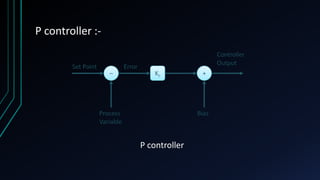
P controller :-
P controller
PI controller :-
• PI controller stands for propotional integral controller.
• P-I controller is mainly used to eliminate the steady state error
resulting from P controller.
• This controller is mostly used in areas where speed of the
system is not an issue.
• it is a combination of proportional and an integral controller the
output (also called the actuating signal) is equal to the summation
of proportional and integral of the error signal.
PI controller :-
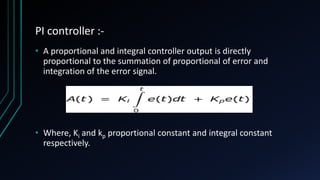
• A proportional and integral controller output is directly
proportional to the summation of proportional of error and
integration of the error signal.
• Where, Ki and kp proportional constant and integral constant
respectively.
PI controller :-
PI controller
PID controller :-
• PID stands for propotional integrated derivative.
• A proportional–integral–derivative controller (PID controller) is a
generic control loop feedback mechanism (controller) widely used
in industrial control systems.
• A PID controller attempts to correct the error between a
measured process variable and a desired setpoint by calculating
and then outputting a corrective action that can adjust the process
accordingly.
PID controller :-
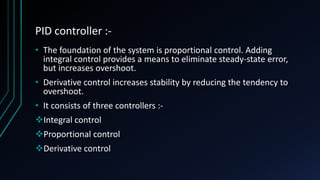
• The foundation of the system is proportional control. Adding
integral control provides a means to eliminate steady-state error,
but increases overshoot.
• Derivative control increases stability by reducing the tendency to
overshoot.
• It consists of three controllers :-
Integral control
Proportional control
Derivative control
PID controller :-
OutputPID = output from PID controller
KP = proportional control gain
KI = integral control gain
KD = derivative control gain
E = error (deviation from set point)
∑(E×Δt) = sum of all past errors (area under the error/time curve)
Δe / Δt = rate of change of error (slope of the error curve)
PID Controller :-
PID CONTROLLER
ppipdcontroller-190829154906.pdf

ppipdcontroller-190829154906.pdf

  • 1.
    P, Pi &PID controller BY:-KARAN SATI
  • 2.
    Introduction:- The controller (ananalogue/digital circuit, and software), is trying to keep the controlled variable such as temperature, liquid level, motor velocity, robot joint angle, at a certain value called the set point (SP). Controllers improve steady state accuracy by decreasing the steady state errors. Maximum overshoot of the system can be controlled using these controllers
  • 3.
    Some definitions :- Peaktime :- The peak time is the time required for the response to reach the first peak of the overshoot. Overshoot :- Overshoot is when a signal or function exceeds its target. Steady state error:- The difference between the desired final output and the actual one" when the system reaches a steady state
  • 4.
    Controllers:- • A controlleris one which compares controlled values with the desired values and has a function to correct the deviation produced. • There are three basic types of contollers : Propotional controller { P controller } Derivative controller { D controller} Integral controller { I controller }
  • 5.
    P controller :- •P controller stands for Proportional Control • With proportional control, the actuator applies a corrective force that is proportional to the amount of error: Outputp = Kp × E • Outputp = system output due to proportional control • Kp = proportional constant for the system called gain • E = error, the difference between where the controlled variable should be and where it is. E = SP – PV.
  • 6.
    P controller :- •In a proportional controller the output (also called the actuating signal) is directly proportional to the error signal. • Where, Kp is proportional constant also known as controller gain. • Kp should be kept greater than unity. If the value of Kp is greater than unity, then it will amplify the error signal and thus the amplified error signal can be detected easily
  • 7.
  • 8.
    PI controller :- •PI controller stands for propotional integral controller. • P-I controller is mainly used to eliminate the steady state error resulting from P controller. • This controller is mostly used in areas where speed of the system is not an issue. • it is a combination of proportional and an integral controller the output (also called the actuating signal) is equal to the summation of proportional and integral of the error signal.
  • 9.
    PI controller :- •A proportional and integral controller output is directly proportional to the summation of proportional of error and integration of the error signal. • Where, Ki and kp proportional constant and integral constant respectively.
  • 10.
  • 11.
    PID controller :- •PID stands for propotional integrated derivative. • A proportional–integral–derivative controller (PID controller) is a generic control loop feedback mechanism (controller) widely used in industrial control systems. • A PID controller attempts to correct the error between a measured process variable and a desired setpoint by calculating and then outputting a corrective action that can adjust the process accordingly.
  • 12.
    PID controller :- •The foundation of the system is proportional control. Adding integral control provides a means to eliminate steady-state error, but increases overshoot. • Derivative control increases stability by reducing the tendency to overshoot. • It consists of three controllers :- Integral control Proportional control Derivative control
  • 13.
    PID controller :- OutputPID= output from PID controller KP = proportional control gain KI = integral control gain KD = derivative control gain E = error (deviation from set point) ∑(E×Δt) = sum of all past errors (area under the error/time curve) Δe / Δt = rate of change of error (slope of the error curve)
  • 14.