Revisions to the Emergency
Department Rapid Detection and
Response Adult Observation Chart
(MR59A-ED) (RDR chart)
SA Health
Background to changes
> The MR-59A ward chart required review
to address the following:
• Issues / risk with current parameters (under
triggering and over-triggering escalation)
• Format / layout - sections used / not used,
some information not recorded /not referred to
• Requirement to add / emphasise new
information
> The changes to the parameters in the ED
RDR chart and escalation triggers were
needed to ensure consistency when
transferring patients from ED to ward
SA Health
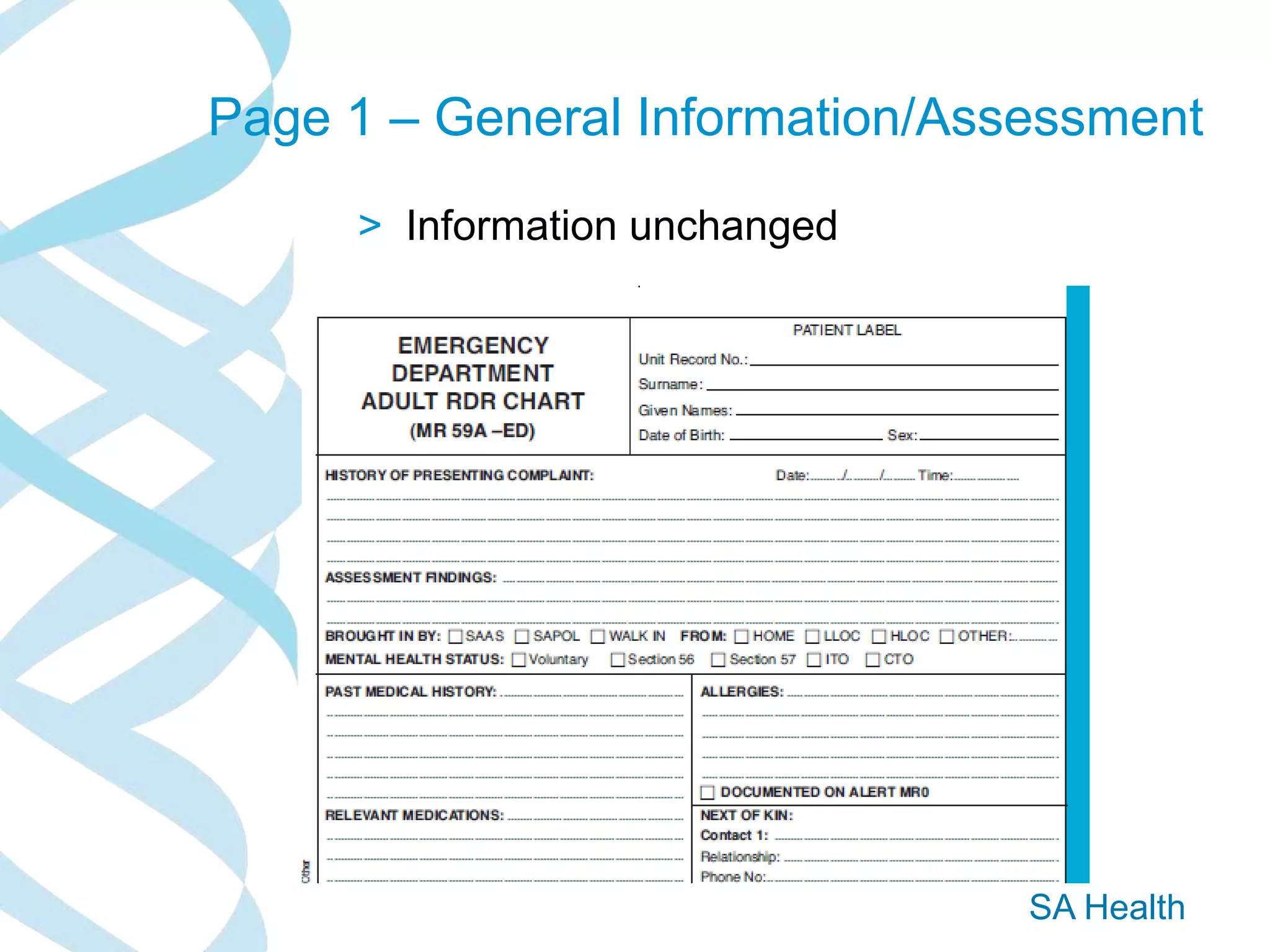
Page 1 – General Information/Assessment
> Information unchanged
SA Health
Observation Chart (page 2)
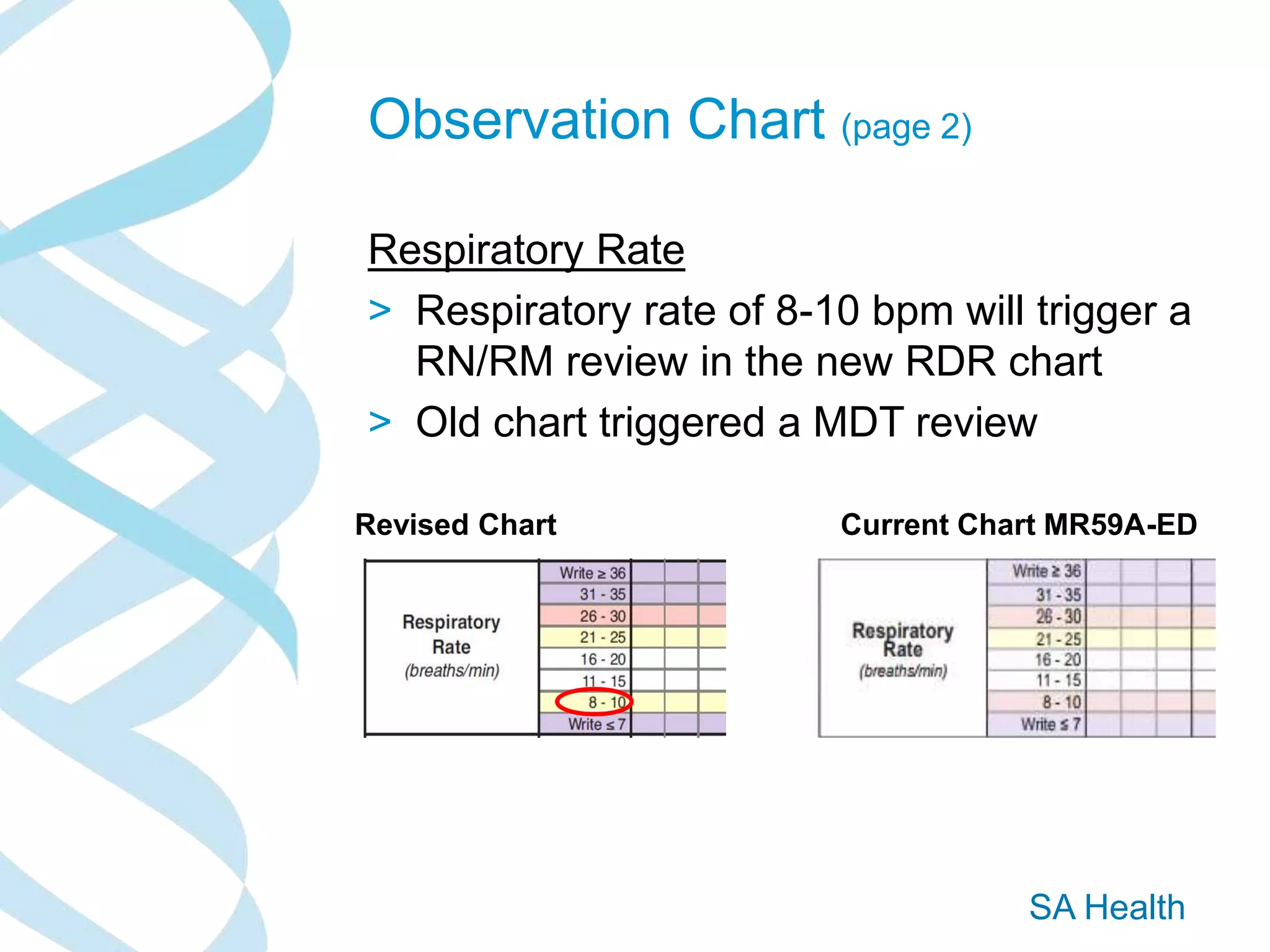
Respiratory Rate
> Respiratory rate of 8-10 bpm will trigger a
RN/RM review in the new RDR chart
> Old chart triggered a MDT review
Revised Chart Current Chart MR59A-ED
SA Health
Observation Chart (page 2)
O2 Saturation
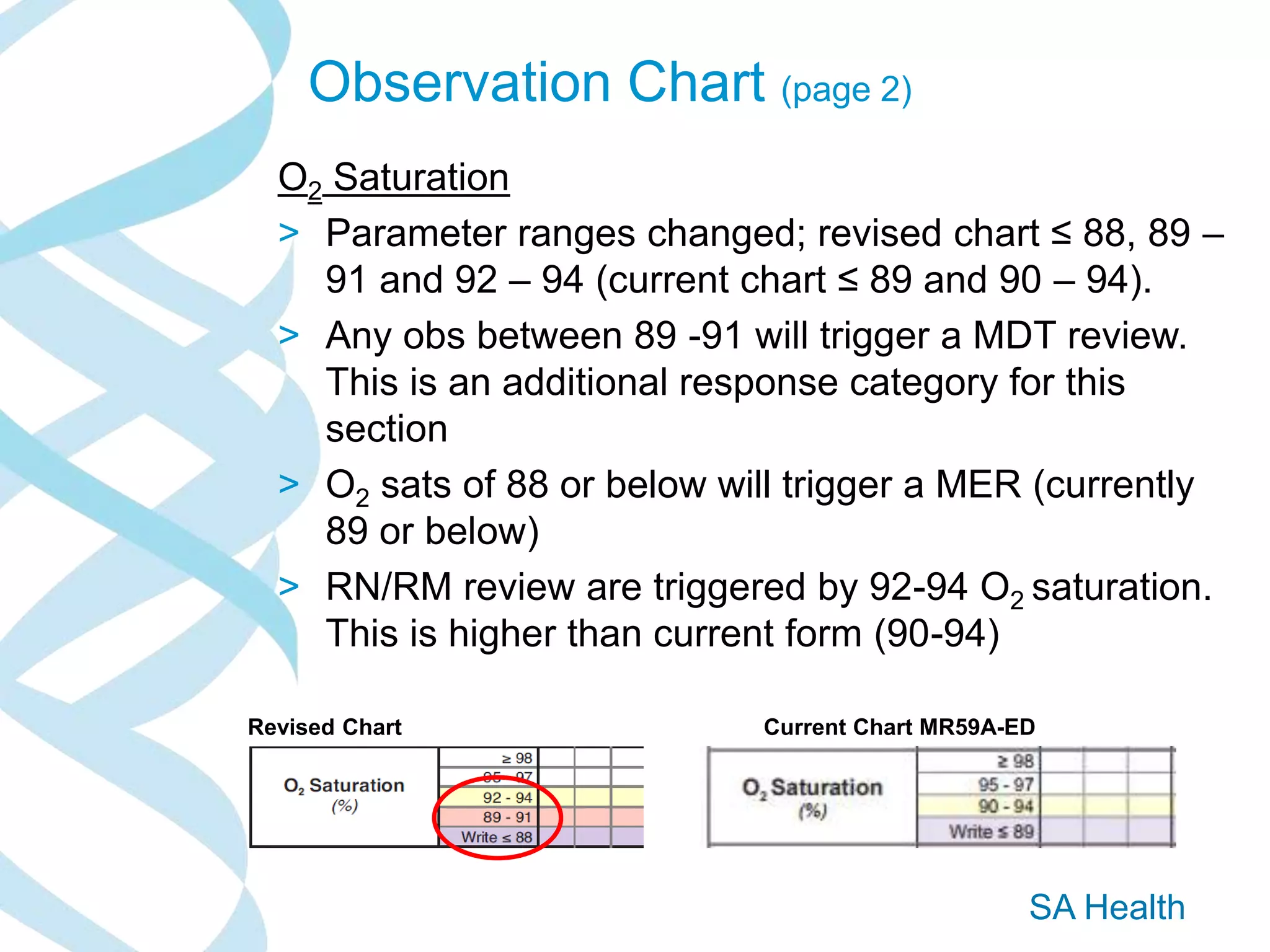
> Parameter ranges changed; revised chart ≤ 88, 89 –
91 and 92 – 94 (current chart ≤ 89 and 90 – 94).
> Any obs between 89 -91 will trigger a MDT review.
This is an additional response category for this
section
> O2 sats of 88 or below will trigger a MER (currently
89 or below)
> RN/RM review are triggered by 92-94 O2 saturation.
This is higher than current form (90-94)
Revised Chart Current Chart MR59A-ED
SA Health
Observation Chart (page 2)
O2 Flow Rate
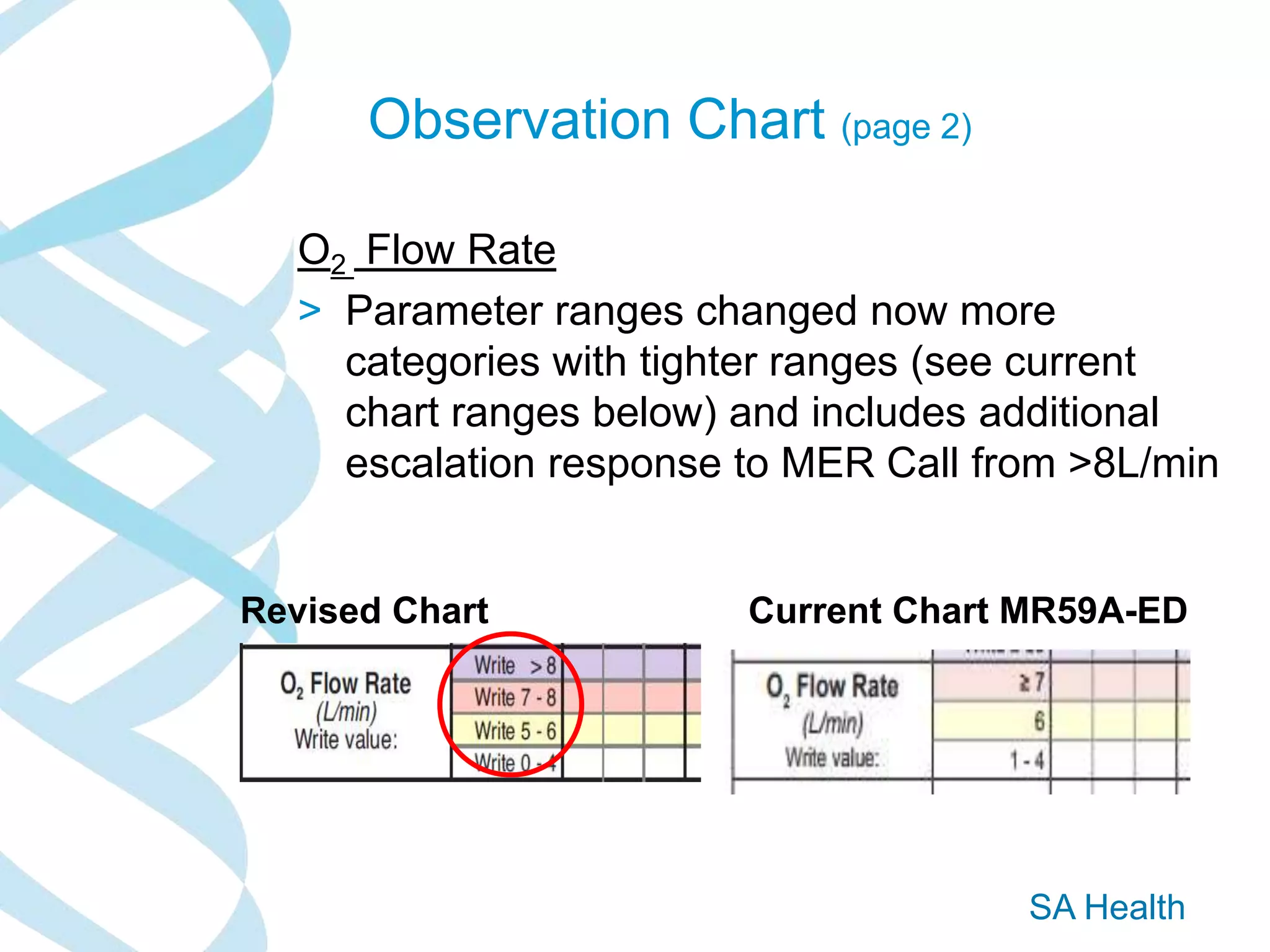
> Parameter ranges changed now more
categories with tighter ranges (see current
chart ranges below) and includes additional
escalation response to MER Call from >8L/min
Revised Chart Current Chart MR59A-ED
SA Health
Observation Chart (page 2)
Sedation Score
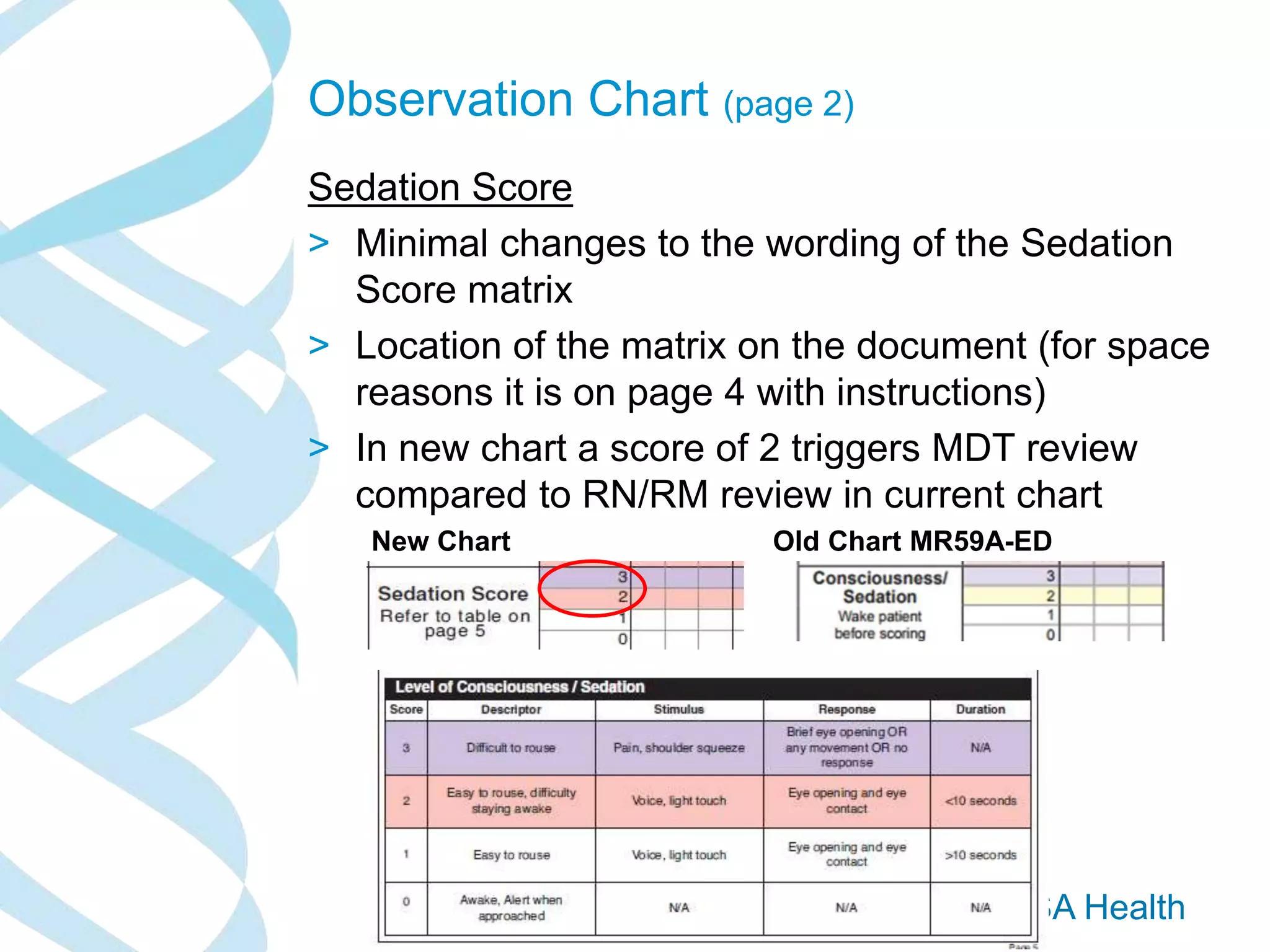
> Minimal changes to the wording of the Sedation
Score matrix
> Location of the matrix on the document (for space
reasons it is on page 4 with instructions)
> In new chart a score of 2 triggers MDT review
compared to RN/RM review in current chart
New Chart Old Chart MR59A-ED
SA Health
Observation Chart (page 2)
Pain Score
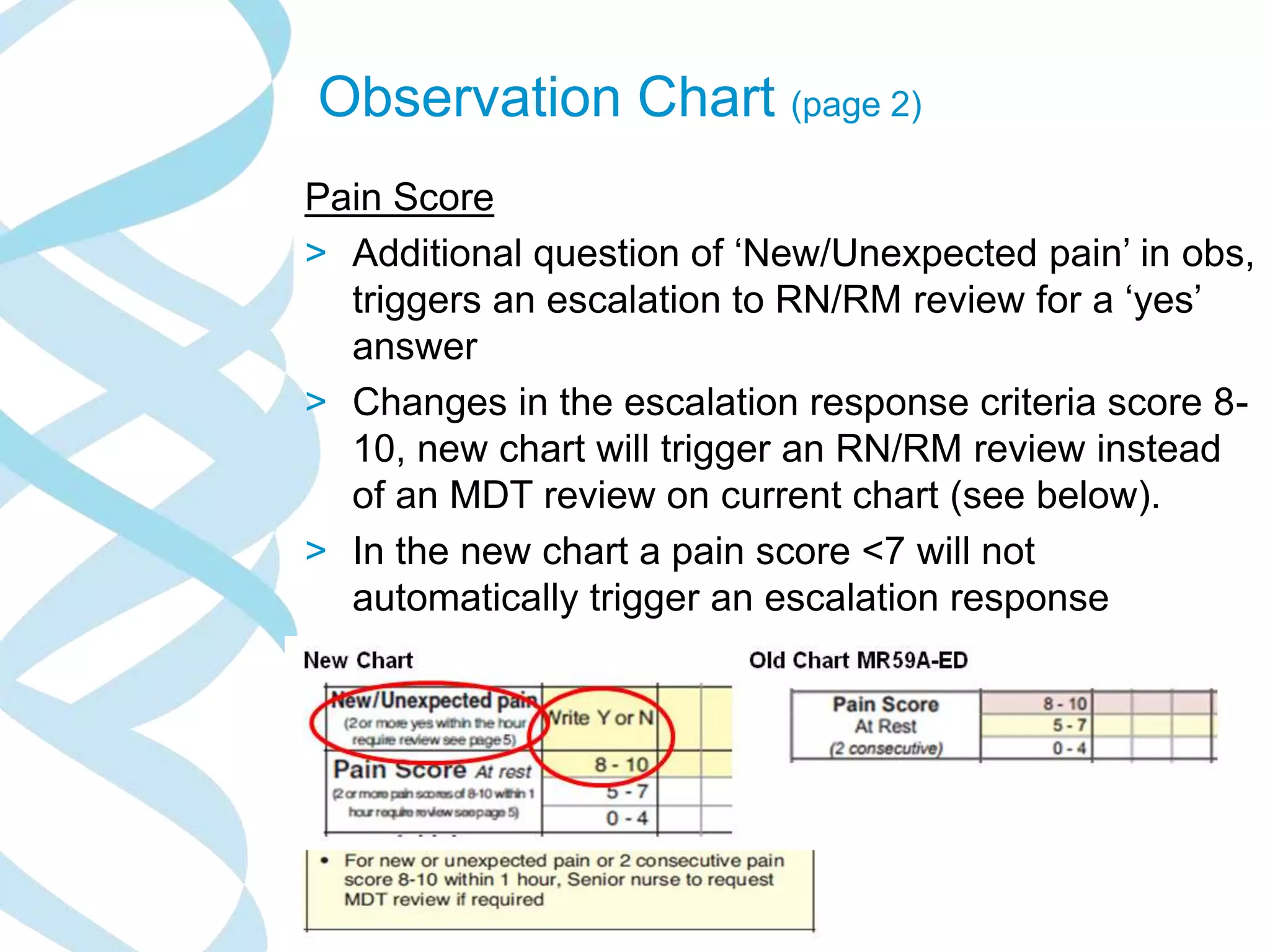
> Additional question of ‘New/Unexpected pain’ in obs,
triggers an escalation to RN/RM review for a ‘yes’
answer
> Changes in the escalation response criteria score 8-
10, new chart will trigger an RN/RM review instead
of an MDT review on current chart (see below).
> In the new chart a pain score <7 will not
automatically trigger an escalation response
SA Health
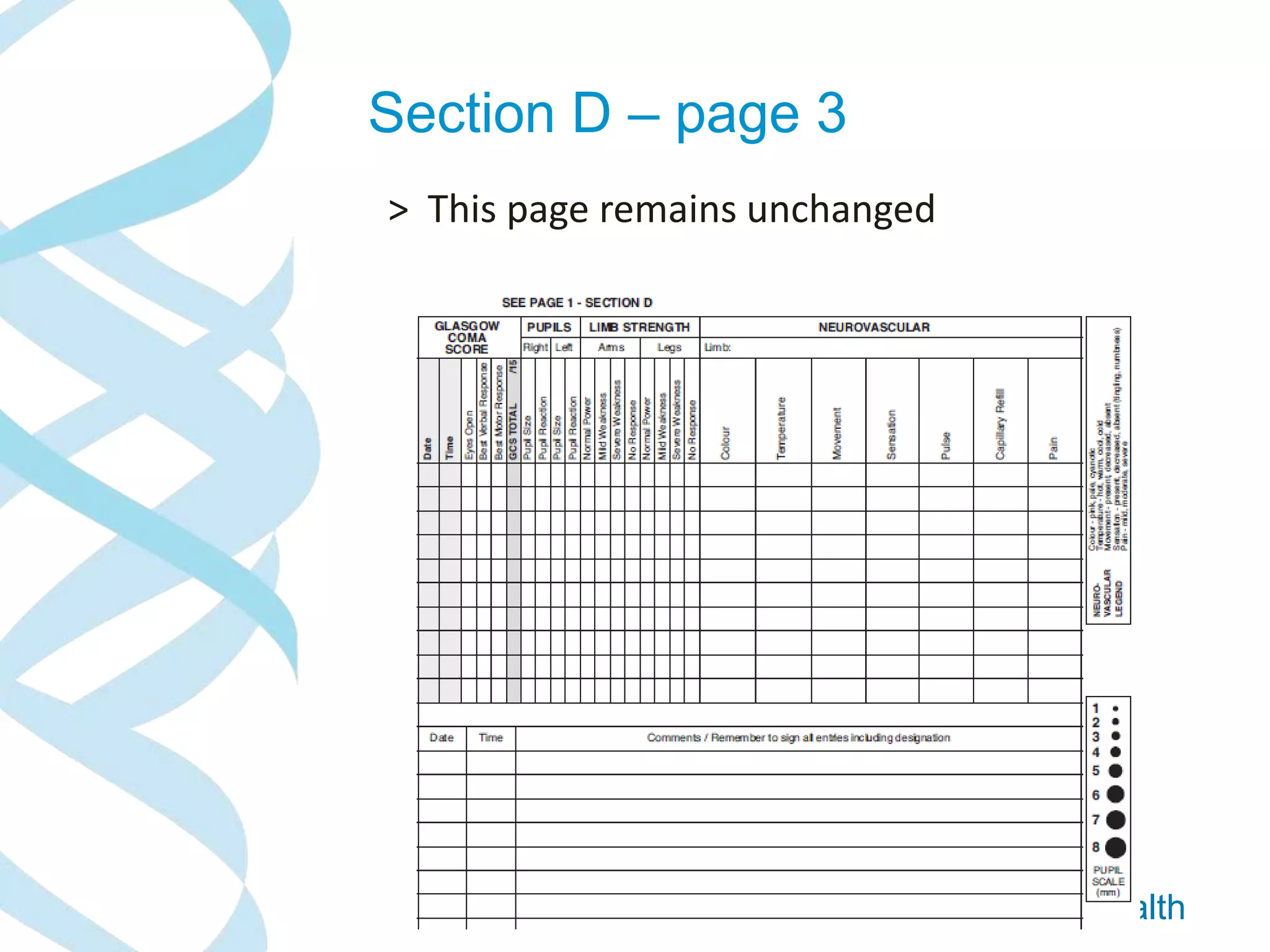
Section D – page 3
> This page remains unchanged
SA Health
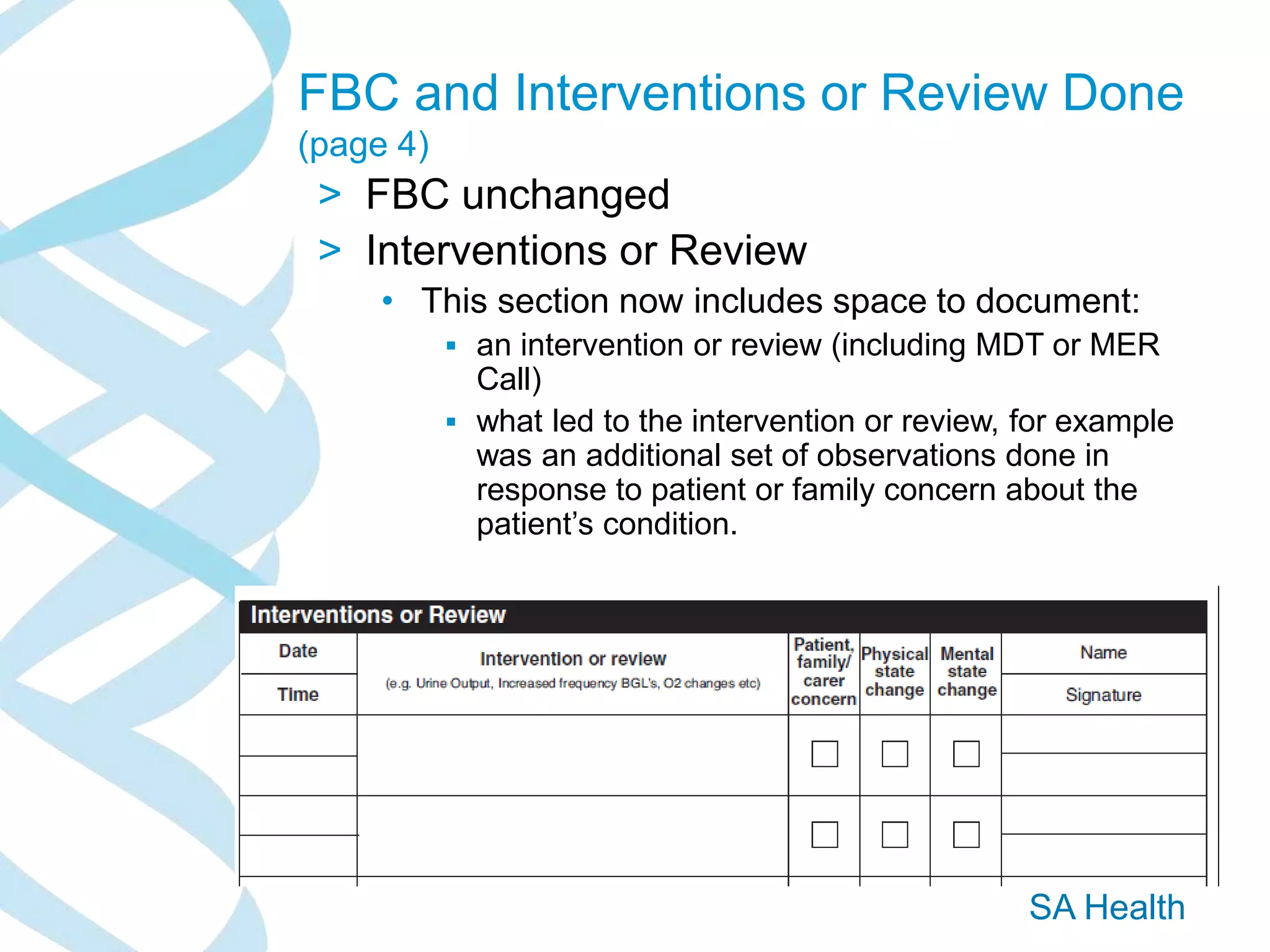
FBC and Interventions or Review Done
(page 4)
> FBC unchanged
> Interventions or Review
• This section now includes space to document:
 an intervention or review (including MDT or MER
Call)
 what led to the intervention or review, for example
was an additional set of observations done in
response to patient or family concern about the
patient’s condition.
SA Health
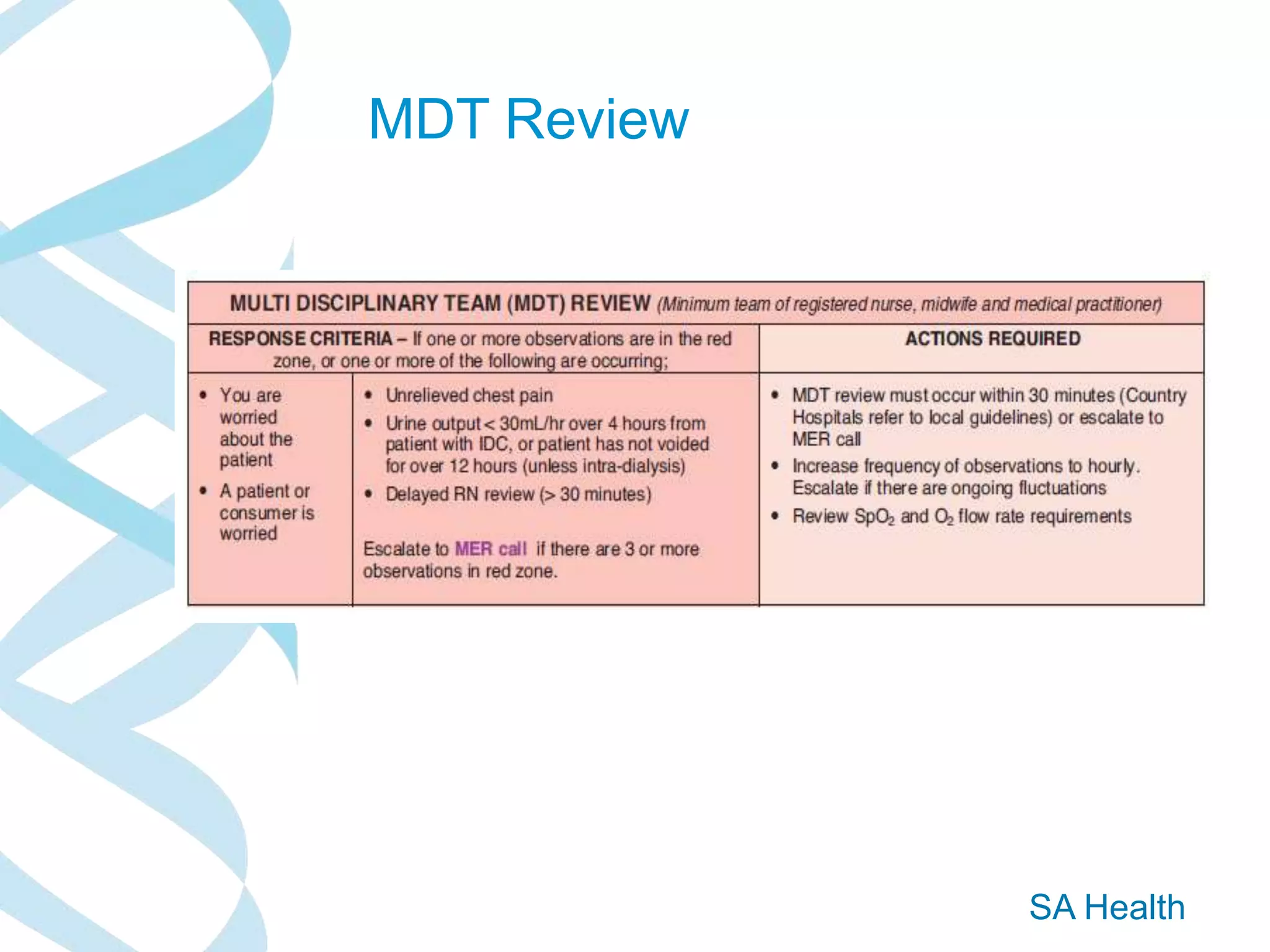
Response Criteria and Actions to Take
(page 5)
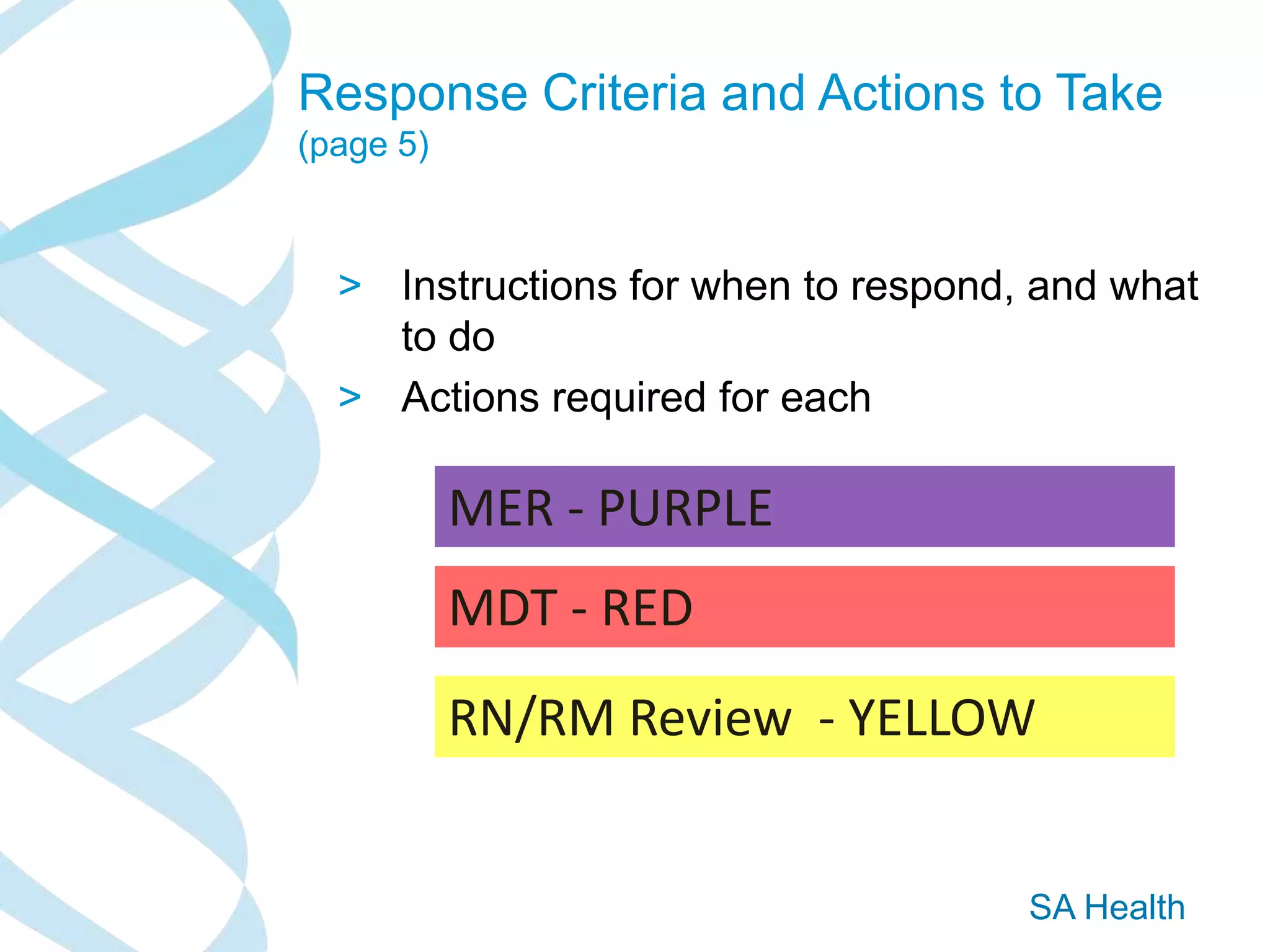
> Instructions for when to respond, and what
to do
> Actions required for each
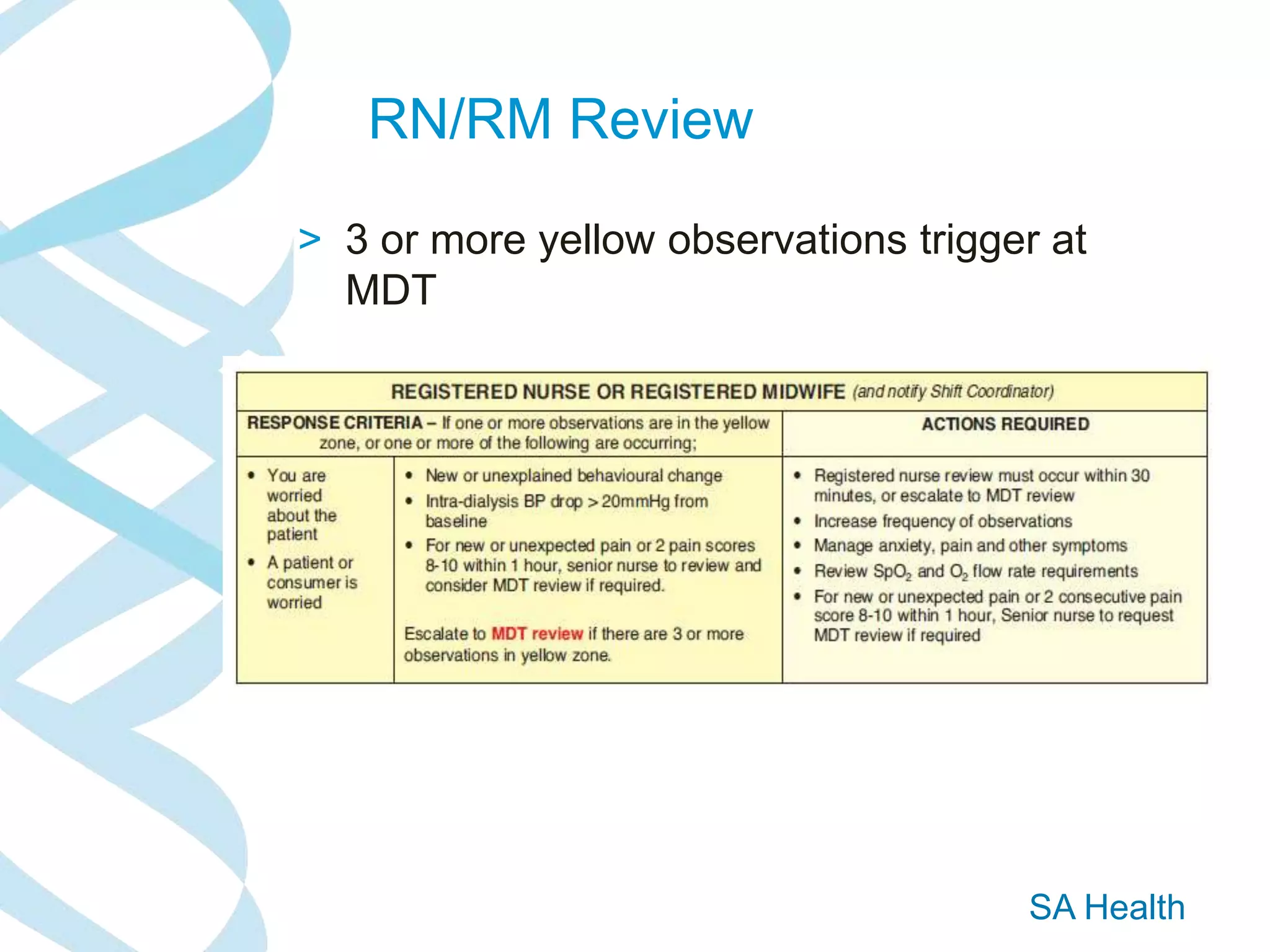
RN/RM Review - YELLOW
MDT - RED
MER - PURPLE
SA Health
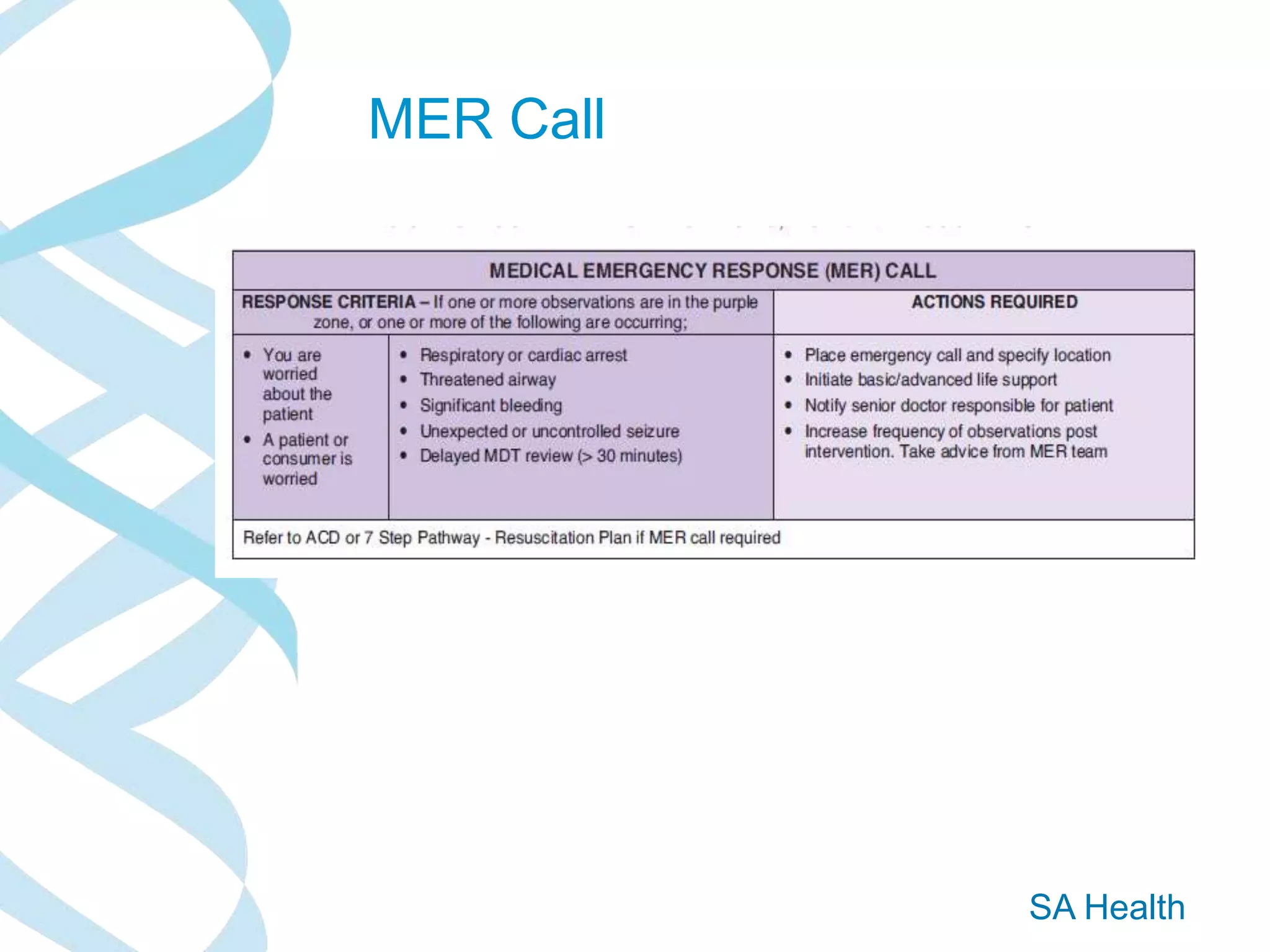
MER Call
SA Health
MDT Review
SA Health
RN/RM Review
> 3 or more yellow observations trigger at
MDT
SA Health
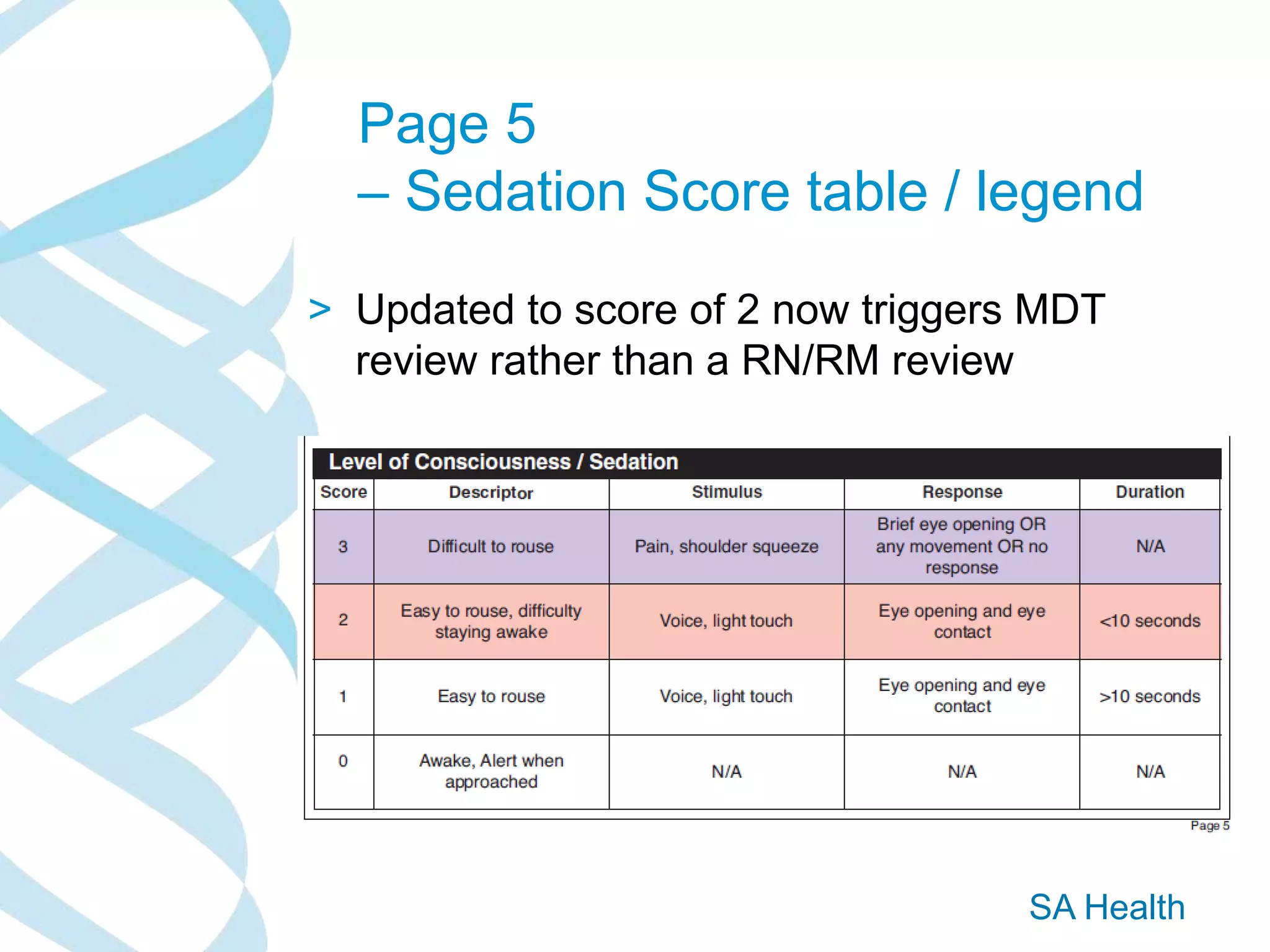
Page 5
– Sedation Score table / legend
> Updated to score of 2 now triggers MDT
review rather than a RN/RM review
SA Health
General Instructions (page 6)
> Instructions on how to complete the form
> Minor revisions to reflect the changes to
the form
SA Health
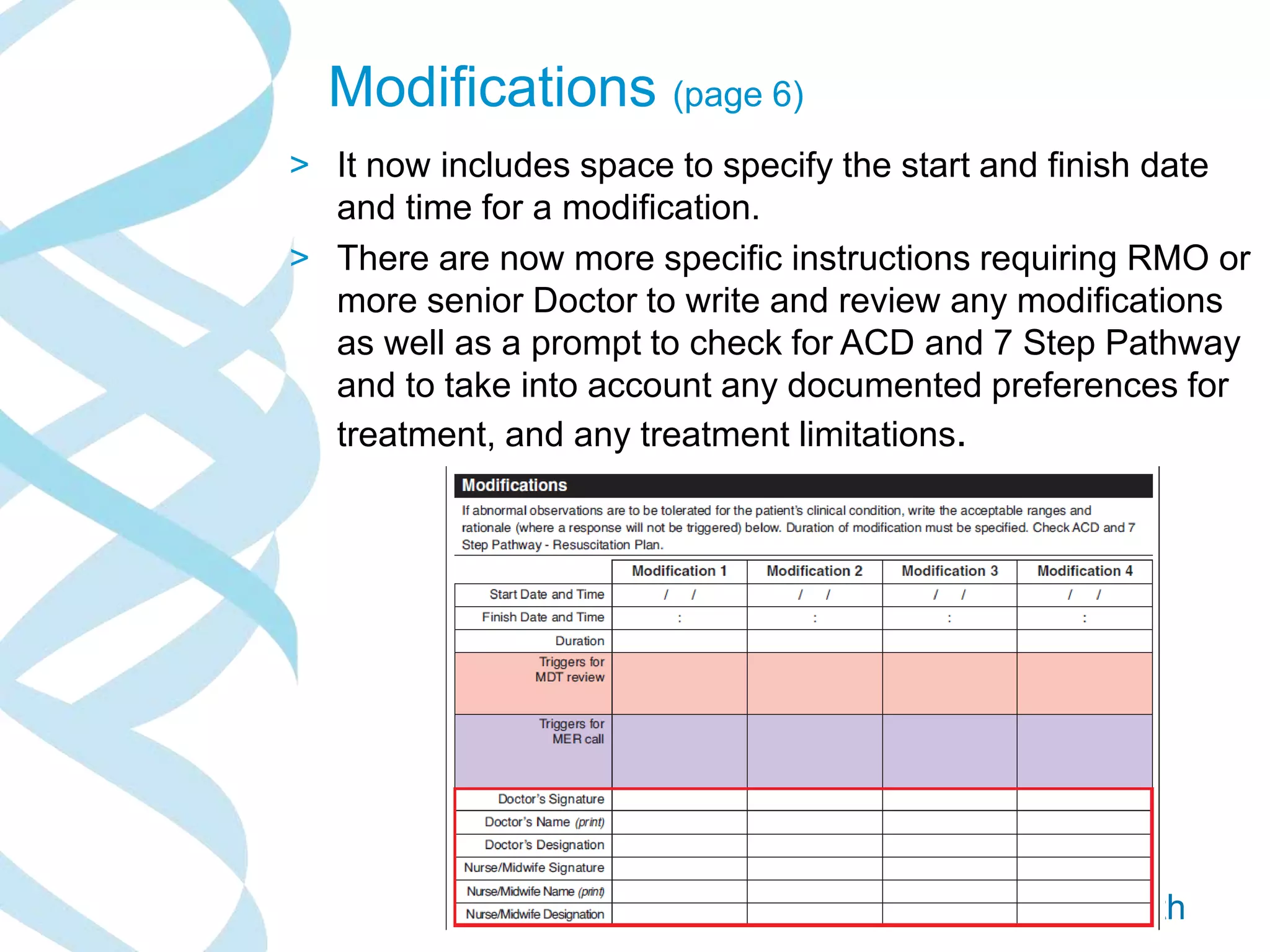
Modifications (page 6)
> It now includes space to specify the start and finish date
and time for a modification.
> There are now more specific instructions requiring RMO or
more senior Doctor to write and review any modifications
as well as a prompt to check for ACD and 7 Step Pathway
and to take into account any documented preferences for
treatment, and any treatment limitations.
SA Health
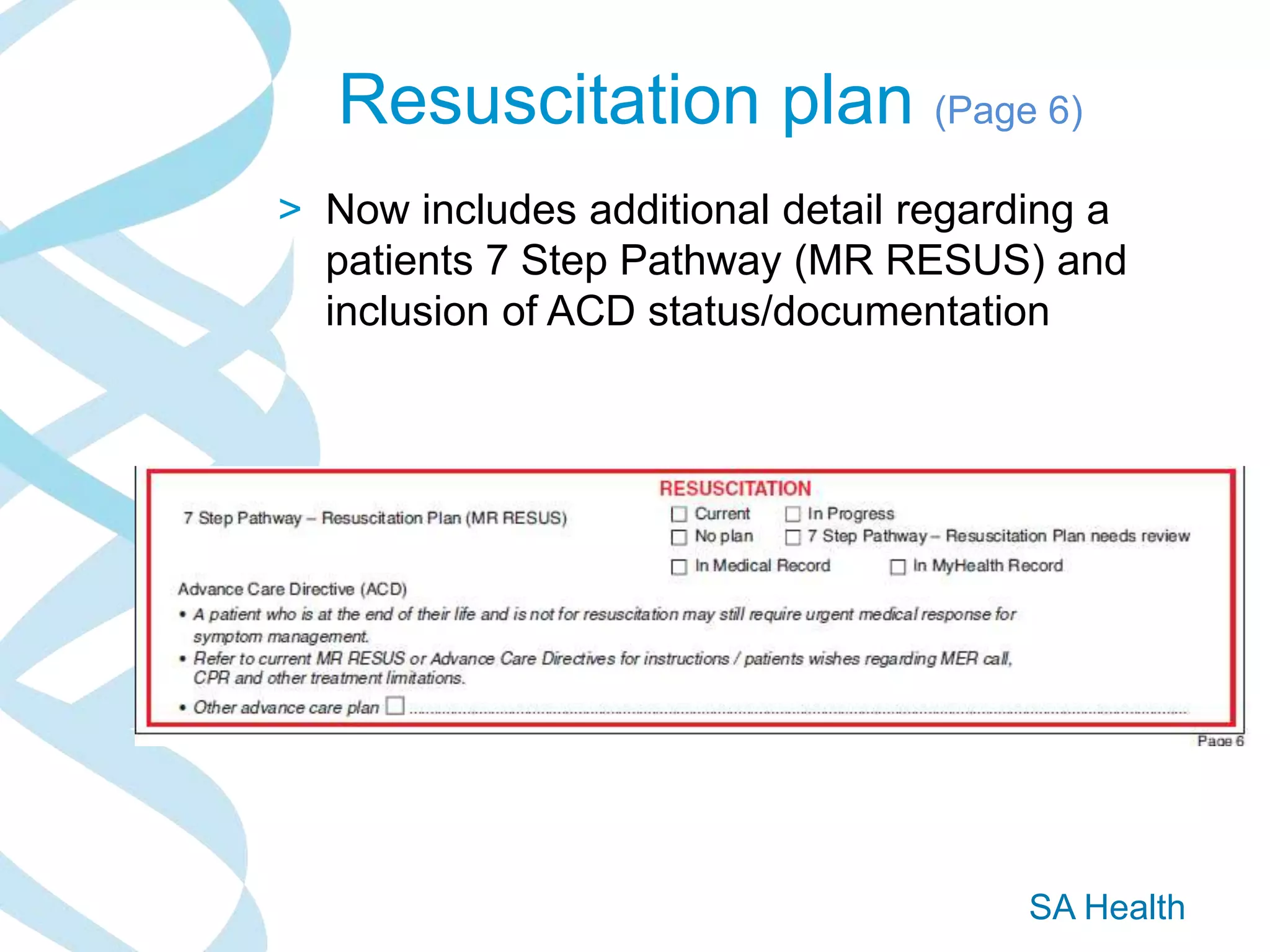
Resuscitation plan (Page 6)
> Now includes additional detail regarding a
patients 7 Step Pathway (MR RESUS) and
inclusion of ACD status/documentation
SA Health
Questions?

PowerPoint+Presentation+Revisions+to+the+Emergency+Department+RDR+Adult+Chart+(MR59A-ED)+2020_v2.ppt

  • 1.
    Revisions to theEmergency Department Rapid Detection and Response Adult Observation Chart (MR59A-ED) (RDR chart)
  • 2.
    SA Health Background tochanges > The MR-59A ward chart required review to address the following: • Issues / risk with current parameters (under triggering and over-triggering escalation) • Format / layout - sections used / not used, some information not recorded /not referred to • Requirement to add / emphasise new information > The changes to the parameters in the ED RDR chart and escalation triggers were needed to ensure consistency when transferring patients from ED to ward
  • 3.
    SA Health Page 1– General Information/Assessment > Information unchanged
  • 4.
    SA Health Observation Chart(page 2) Respiratory Rate > Respiratory rate of 8-10 bpm will trigger a RN/RM review in the new RDR chart > Old chart triggered a MDT review Revised Chart Current Chart MR59A-ED
  • 5.
    SA Health Observation Chart(page 2) O2 Saturation > Parameter ranges changed; revised chart ≤ 88, 89 – 91 and 92 – 94 (current chart ≤ 89 and 90 – 94). > Any obs between 89 -91 will trigger a MDT review. This is an additional response category for this section > O2 sats of 88 or below will trigger a MER (currently 89 or below) > RN/RM review are triggered by 92-94 O2 saturation. This is higher than current form (90-94) Revised Chart Current Chart MR59A-ED
  • 6.
    SA Health Observation Chart(page 2) O2 Flow Rate > Parameter ranges changed now more categories with tighter ranges (see current chart ranges below) and includes additional escalation response to MER Call from >8L/min Revised Chart Current Chart MR59A-ED
  • 7.
    SA Health Observation Chart(page 2) Sedation Score > Minimal changes to the wording of the Sedation Score matrix > Location of the matrix on the document (for space reasons it is on page 4 with instructions) > In new chart a score of 2 triggers MDT review compared to RN/RM review in current chart New Chart Old Chart MR59A-ED
  • 8.
    SA Health Observation Chart(page 2) Pain Score > Additional question of ‘New/Unexpected pain’ in obs, triggers an escalation to RN/RM review for a ‘yes’ answer > Changes in the escalation response criteria score 8- 10, new chart will trigger an RN/RM review instead of an MDT review on current chart (see below). > In the new chart a pain score <7 will not automatically trigger an escalation response
  • 9.
    SA Health Section D– page 3 > This page remains unchanged
  • 10.
    SA Health FBC andInterventions or Review Done (page 4) > FBC unchanged > Interventions or Review • This section now includes space to document:  an intervention or review (including MDT or MER Call)  what led to the intervention or review, for example was an additional set of observations done in response to patient or family concern about the patient’s condition.
  • 11.
    SA Health Response Criteriaand Actions to Take (page 5) > Instructions for when to respond, and what to do > Actions required for each RN/RM Review - YELLOW MDT - RED MER - PURPLE
  • 12.
  • 13.
  • 14.
    SA Health RN/RM Review >3 or more yellow observations trigger at MDT
  • 15.
    SA Health Page 5 –Sedation Score table / legend > Updated to score of 2 now triggers MDT review rather than a RN/RM review
  • 16.
    SA Health General Instructions(page 6) > Instructions on how to complete the form > Minor revisions to reflect the changes to the form
  • 17.
    SA Health Modifications (page6) > It now includes space to specify the start and finish date and time for a modification. > There are now more specific instructions requiring RMO or more senior Doctor to write and review any modifications as well as a prompt to check for ACD and 7 Step Pathway and to take into account any documented preferences for treatment, and any treatment limitations.
  • 18.
    SA Health Resuscitation plan(Page 6) > Now includes additional detail regarding a patients 7 Step Pathway (MR RESUS) and inclusion of ACD status/documentation
  • 19.

Editor's Notes

  • #5 If a patient has obs between 8-10 and a nurse review is triggered as per the new chart the RN must decide if this observation is acceptable for the patient or if they need to escalate to a medical review, the patient may require more frequent monitoring Also consider if the patient is on opioid medications as part of your assessment
  • #6 There is now an extra trigger category for obs of 89-91 which trigger a MDT review. This is providing a safety net between obs of >88 triggering a MER call and 92-94 triggering a RN review
  • #7 It is important to remember when assessing flow rate that you also consider in combination with O2 saturation and respiratory rate
  • #8 As with other observations ensure you interpret any observations in combination with other observations
  • #9 Pain score needs to be done when a patient is at rest and there is an additional question for NEW or UNEXPECTED pain, e.g. post surgery it would be expected that a patient would experience some pain If there is more than 2 pain scores >8-10 within 1 hr or >2 new or unexpected pain scores senior nurse to then request a MDT review (or internal departmental process such as critical response team review). If a patient has a high pain score you may need to reassess sooner As with other observations consider the patients other observations and if the patient is on medications such as opoids
  • #11 The sections includes space to document what led to the intervention or review, this is an important feature in the overall assessment of the patient as it may enable a more thorough assessment of what led up to the escalation, such as if there are behavioural or mental state concerns. Increased anxiety may be an important contributing factor to the patients observations or increased anxiety of the family that led to the additional observations or an intervention.
  • #18 This section is so the chart can be individualised to a patients needs. Clinicians can tailor the chart to suit a patients requirements such as patients who have lower respiratory rates this can be modified so they do not trigger unnecessary reviews. Clinicians need to specify start and finish times so that the modifications aren't open ended. ED’s who have internal process variations to a MDT such as a critical response team
  • #19 This section acts a prompt to check if a patient has a 7 step pathway or an ACD. Staff may need to consider checking a patient’s My Health Record if a patient has an ACD The chart does not have the space to include the detail of what is on the documents but rather to ensure that if an escalated response is called based on a patients' observations that the patients wishes for treatment are known and referred to if required. However clinicians must still ensure that for patients who are at the end of their life and have treatment limitations in place that they still receive urgent care as required e.g. pain relief for symptom management.