Antimicrobial Agents
MC3: Microbiology and Parasitology
University of Saint Anthony
College of Healthcare Education
OVERVIEW
Antimicrobials
OVERVIEW
Antibiotics
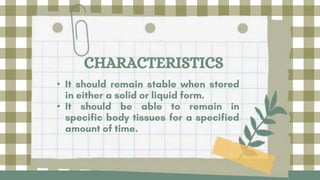
CHARACTERISTICS
•
•
•
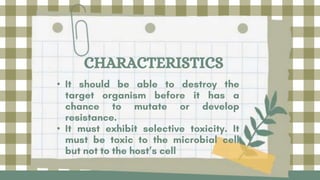
CHARACTERISTICS
•
•
CHARACTERISTICS
•
•
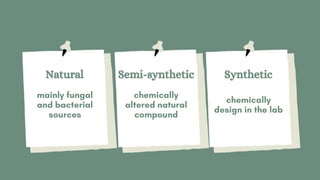
SOURCES OF ANTIBIOTICS
Natural Semi-synthetic Synthetic
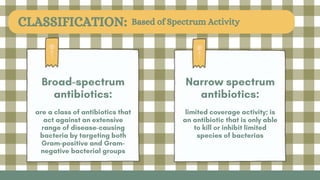
CLASSIFICATION: Based of Spectrum Activity
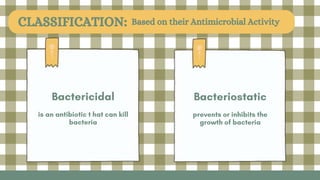
CLASSIFICATION: Based on their Antimicrobial Activity
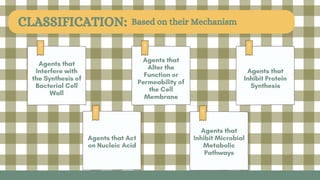
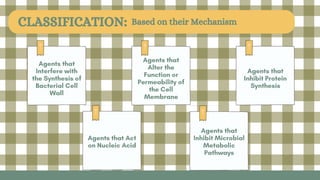
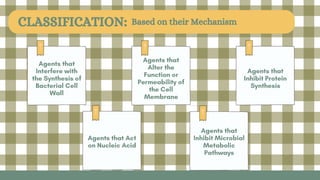
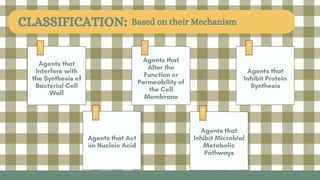
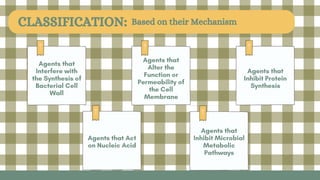
CLASSIFICATION: Based on their Mechanism
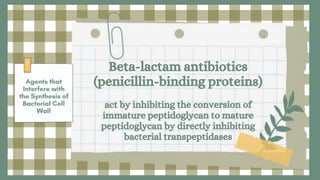
Beta-lactam antibiotics
(penicillin-binding proteins)
act by inhibiting the conversion of
immature peptidoglycan to mature
peptidoglycan by directly inhibiting
bacterial transpeptidases
Glycopeptides antibiotics
interfere with cell wall synthesis, which
are composed of glycosylated cyclic or
polycyclic non-ribosomal peptides
CLASSIFICATION: Based on their Mechanism
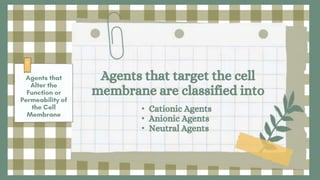
Agents that target the cell
membrane are classified into
• Cationic Agents
• Anionic Agents
• Neutral Agents
Polymyxins
After binding to lipopolysaccharide (LPS)
in the outer membrane of gram-negative
bacteria disrupt both the outer and inner
membranes
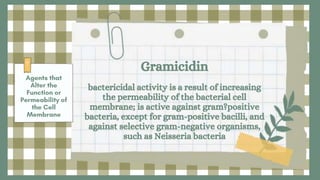
Gramicidin
bactericidal activity is a result of increasing
the permeability of the bacterial cell
membrane; is active against gram?positive
bacteria, except for gram-positive bacilli, and
against selective gram-negative organisms,
such as Neisseria bacteria
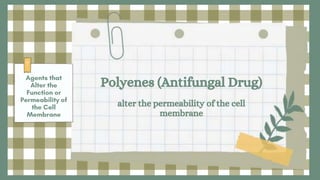
Polyenes (Antifungal Drug)
alter the permeability of the cell
membrane
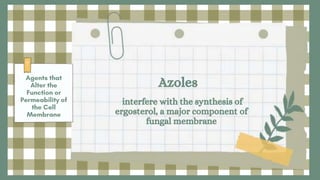
Azoles
interfere with the synthesis of
ergosterol, a major component of
fungal membrane
CLASSIFICATION: Based on their Mechanism
Inhibitors of the 30S ribosomal sub unit
interfere primarily with the initiation
process
Inhibitors of the 30S ribosomal sub unit
interfere primarily with the initiation
process
Aminoglycosides
⚬ cause formation of non?functional
complexes and misreading
Inhibitors of the 30S ribosomal sub unit
interfere primarily with the initiation
process
Spectinomycin
⚬ related to aminoglycosides that
binds to a protein in a 30S ribosomes
different from target of the
aminoglycosides
Inhibitors of the 30S ribosomal sub unit
interfere primarily with the initiation
process
Tetracycline
⚬ targets bacterial 30S ribosomal
subunit
Agents that bind to the 50S ribosomal sub-
unit are the inhibitors of elongation process
of protein synthesis
Agents that bind to the 50S ribosomal sub-
unit are the inhibitors of elongation process
of protein synthesis
Chloramphenicol
⚬ acts by binding a peptidyl
transferase enzyme thereby
inhibiting peptide bond formation
Agents that bind to the 50S ribosomal sub-
unit are the inhibitors of elongation process
of protein synthesis
Macrolides
⚬ act peptidyl transferase by
interfering with its reaction or
translocation
Agents that bind to the 50S ribosomal sub-
unit are the inhibitors of elongation process
of protein synthesis
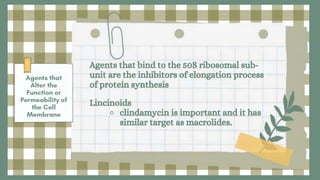
Lincinoids
⚬ clindamycin is important and it has
similar target as macrolides.
CLASSIFICATION: Based on their Mechanism
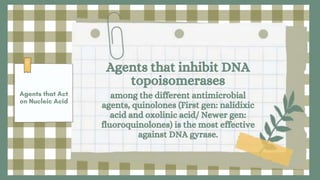
Agents that inhibit DNA
topoisomerases
among the different antimicrobial
agents, quinolones (First gen: nalidixic
acid and oxolinic acid/ Newer gen:
fluoroquinolones) is the most effective
against DNA gyrase.
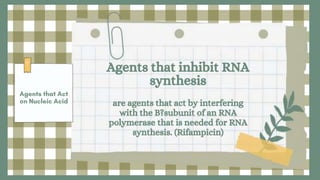
Agents that inhibit RNA
synthesis
are agents that act by interfering
with the B?subunit of an RNA
polymerase that is needed for RNA
synthesis. (Rifampicin)
CLASSIFICATION: Based on their Mechanism
Trimethoprim and sulfonamides
⚬ are antibiotics that interfere with
folic acid metabolism; act as
competitive inhibitors of
tetrahydrofolic acid
Sulfonamides
⚬ act specifically by inhibiting
formation of dihydrofolic acid
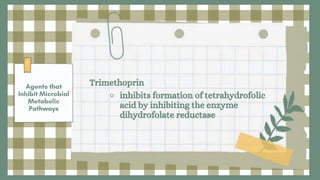
Trimethoprin
⚬ inhibits formation of tetrahydrofolic
acid by inhibiting the enzyme
dihydrofolate reductase
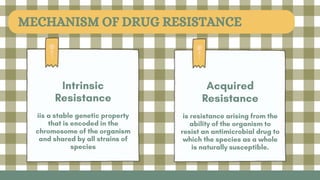
MECHANISM OF DRUG
RESISTANCE
MECHANISM OF DRUG RESISTANCE
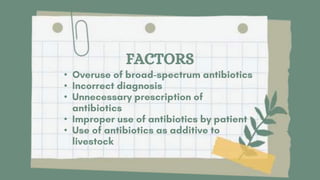
FACTORS
•
•
•
•
•
FACTORS
•
•
•
•
•
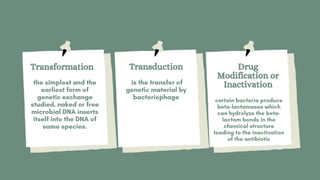
RESISTANCE ACQUIRED THROUGH GENETIC
EXCHANGE CAN OCCUR THREE WAYS
Transformation Transduction Drug
Modification or
Inactivation
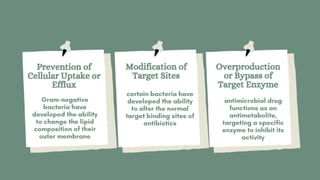
RESISTANCE ACQUIRED THROUGH GENETIC
EXCHANGE CAN OCCUR THREE WAYS
Prevention of
Cellular Uptake or
Efflux
Modification of
Target Sites
Overproduction
or Bypass of
Target Enzyme
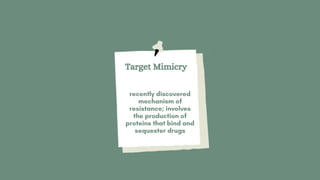
RESISTANCE ACQUIRED THROUGH GENETIC
EXCHANGE CAN OCCUR THREE WAYS
Target Mimicry

Powerpoint presentation on Antimicrobial Agents