Postpartum Hemorrhage
Supritha JP, 104
Case Scenario
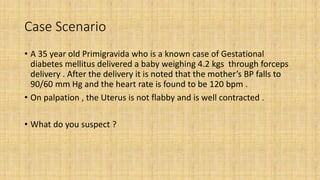
• A 35 year old Primigravida who is a known case of Gestational
diabetes mellitus delivered a baby weighing 4.2 kgs through forceps
delivery . After the delivery it is noted that the mother’s BP falls to
90/60 mm Hg and the heart rate is found to be 120 bpm .
• On palpation , the Uterus is not flabby and is well contracted .
• What do you suspect ?
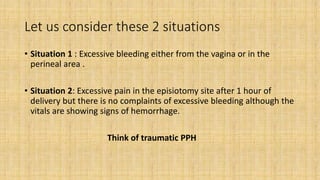
Let us consider these 2 situations
• Situation 1 : Excessive bleeding either from the vagina or in the
perineal area .
• Situation 2: Excessive pain in the episiotomy site after 1 hour of
delivery but there is no complaints of excessive bleeding although the
vitals are showing signs of hemorrhage.
Think of traumatic PPH
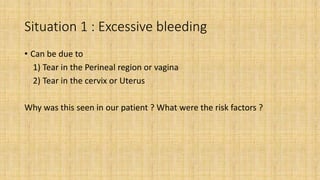
Situation 1 : Excessive bleeding
• Can be due to
1) Tear in the Perineal region or vagina
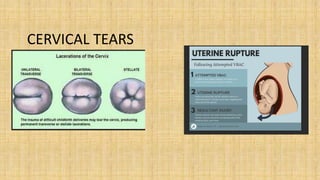
2) Tear in the cervix or Uterus
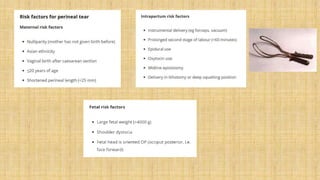
Why was this seen in our patient ? What were the risk factors ?
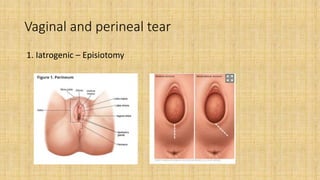
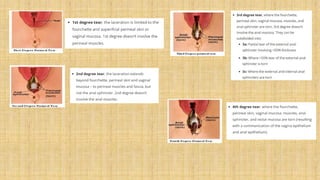
Vaginal and perineal tear
1. Iatrogenic – Episiotomy
CERVICAL TEARS
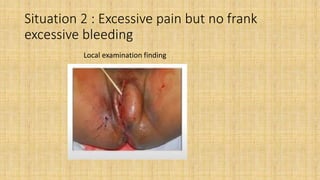
Situation 2 : Excessive pain but no frank
excessive bleeding
Local examination finding
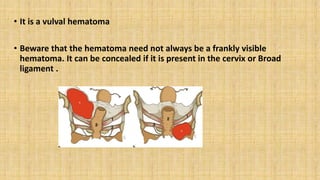
• It is a vulval hematoma
• Beware that the hematoma need not always be a frankly visible
hematoma. It can be concealed if it is present in the cervix or Broad
ligament .
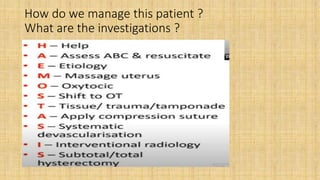
How do we manage this patient ?
What are the investigations ?
Managing the tear
• Perineal tear :
Repair done under 1% lignocaine or general anesthesia . Repair by
using interrupted vicryl sutures
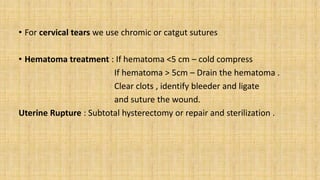
• For cervical tears we use chromic or catgut sutures
• Hematoma treatment : If hematoma <5 cm – cold compress
If hematoma > 5cm – Drain the hematoma .
Clear clots , identify bleeder and ligate
and suture the wound.
Uterine Rupture : Subtotal hysterectomy or repair and sterilization .
THANKYOU

Postpartum Hemorrhage.pptx

  • 1.
  • 2.
    Case Scenario • A35 year old Primigravida who is a known case of Gestational diabetes mellitus delivered a baby weighing 4.2 kgs through forceps delivery . After the delivery it is noted that the mother’s BP falls to 90/60 mm Hg and the heart rate is found to be 120 bpm . • On palpation , the Uterus is not flabby and is well contracted . • What do you suspect ?
  • 3.
    Let us considerthese 2 situations • Situation 1 : Excessive bleeding either from the vagina or in the perineal area . • Situation 2: Excessive pain in the episiotomy site after 1 hour of delivery but there is no complaints of excessive bleeding although the vitals are showing signs of hemorrhage. Think of traumatic PPH
  • 4.
    Situation 1 :Excessive bleeding • Can be due to 1) Tear in the Perineal region or vagina 2) Tear in the cervix or Uterus Why was this seen in our patient ? What were the risk factors ?
  • 6.
    Vaginal and perinealtear 1. Iatrogenic – Episiotomy
  • 8.
  • 9.
    Situation 2 :Excessive pain but no frank excessive bleeding Local examination finding
  • 10.
    • It isa vulval hematoma • Beware that the hematoma need not always be a frankly visible hematoma. It can be concealed if it is present in the cervix or Broad ligament .
  • 11.
    How do wemanage this patient ? What are the investigations ?
  • 12.
    Managing the tear •Perineal tear : Repair done under 1% lignocaine or general anesthesia . Repair by using interrupted vicryl sutures
  • 13.
    • For cervicaltears we use chromic or catgut sutures • Hematoma treatment : If hematoma <5 cm – cold compress If hematoma > 5cm – Drain the hematoma . Clear clots , identify bleeder and ligate and suture the wound. Uterine Rupture : Subtotal hysterectomy or repair and sterilization .
  • 14.