Performance of environ-safe ZiBOC, CCA and CCB Treated Imported Timbers in Cooling
Towers
Sadhna Tripathi, Shweta Bhatt and Pawan Poonia
Wood Preservation Discipline, Forest Products Division
Forest Research Institute Dehradun
tripathis@icfre.org
Performance of environ-safe ZiBOC, CCA and CCB Treated Imported Timbers in Cooling
Towers
Sadhna Tripathi, Shweta Bhatt and Pawan Poonia
Wood Preservation Discipline, Forest Products Division
Forest Research Institute Dehradun
tripathis@icfre.org
Abstract: Large-scale industries like oil refineries, chemical plants, power plants require cooling
towers as heat dissipating units. These are an important and inevitable part of any high energy
consuming and heat generating industry and capital investment in these towers is very high thus
it is essential that it should give about 12-15 years of service life. Wood has been found preferred
material for the construction of cooling towers as compared to cement concrete, asbestos etc .
However, due to the hygroscopic nature of wood, it has some undesirable properties such as poor
resistance against fungal and insect attack, and swelling and shrinkage caused by water adsorption
and desorption. Due to the limited availability of recommended indigenous species, the focus has
shifted to imported timbers from south east Asian countries. The study was conducted on Pinus
roxburghii, Pinus radiata and Pseudotsuga menziesii treated with CCA, CCB and ZiBOC by full
cell process and tested in prototype and industrial cooling tower at laboratory and field scale
respectively in veneers and stakes . The result revealed that natural durability of species was very
low which was substantially improved after preservative treatment. New environ-safe ZIBOC
was found at par with conventional CCA and CCB preservative . New methodology developed
for D.fir treatment which is refractory in nature and difficult to treat.
Abstract: Large-scale industries like oil refineries, chemical plants, power plants require cooling
towers as heat dissipating units. These are an important and inevitable part of any high energy
consuming and heat generating industry and capital investment in these towers is very high thus
it is essential that it should give about 12-15 years of service life. Wood has been found preferred
material for the construction of cooling towers as compared to cement concrete, asbestos etc .
However, due to the hygroscopic nature of wood, it has some undesirable properties such as poor
resistance against fungal and insect attack, and swelling and shrinkage caused by water adsorption
and desorption. Due to the limited availability of recommended indigenous species, the focus has
shifted to imported timbers from south east Asian countries. The study was conducted on Pinus
roxburghii, Pinus radiata and Pseudotsuga menziesii treated with CCA, CCB and ZiBOC by full
cell process and tested in prototype and industrial cooling tower at laboratory and field scale
respectively in veneers and stakes . The result revealed that natural durability of species was very
low which was substantially improved after preservative treatment. New environ-safe ZIBOC
was found at par with conventional CCA and CCB preservative . New methodology developed
for D.fir treatment which is refractory in nature and difficult to treat.
Materials and Methods:
Preservatives: CCA, CCB , ZiBOC
Concentration: 2, 4 and 6%
Treatment method: Full cell method (IS
401:2001)
Installation: Total 54 numbers of frames
consisting of veneers of 10x2.5x0.6 cm3
were
installed in Proto type cooling tower in F.R.I.
Dehradun, India
Inspection: Nine frames consisting of three
species, three preservative and three
concentrations along with control were
removed in each time interval and tested for
dry salt retention (DSR) & weight loss
percent. Frames were removed quarterly In
first year & half yearly in second year.
Conclusion & RecommendationsConclusion & Recommendations
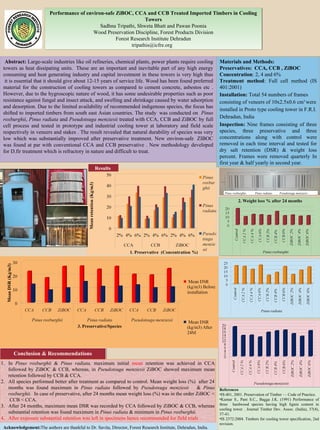
1. In Pinus roxburghii & Pinus radiata, maximum initial mean retention was achieved in CCA
followed by ZiBOC & CCB, whereas, in Pseudotsuga menziesii ZiBOC showed maximum mean
retention followed by CCB & CCA.
2. All species performed better after treatment as compared to control. Mean weight loss (%) after 24
months was found maximum in Pinus radiata followed by Pseudotsuga menziesii & Pinus
roxburghii. In case of preservative, after 24 months mean weight loss (%) was in the order ZiBOC <
CCB < CCA.
3. After 24 months, maximum mean DSR was recorded by CCA followed by ZiBOC & CCB, whereas
substantial retention was found maximum in Pinus radiata & minimum in Pinus roxburghii.
4. After exposure substantial retention was left in specimens hence recommended for field trials .
Acknowledgement:The authors are thankful to Dr. Savita, Director, Forest Research Institute, Dehradun, India.
References
•IS:401, 2001. Preservation of Timber — Code of Practice.
•Kumar S., Pant S.C., Bagga J.K. (1991) Performance of
three hardwood species having high lignin content in
cooling tower . Journal Timber Dev. Assoc. (India), 37(4),
37-41.
•IS 2372:2004. Timbers for cooling tower specification, 2nd
revision.
Prototype cooling tower assembly
Pinus roxburghii- Pinus radiata- Pseudotsuga menziesii -
Results

Poster cfc cooling tower

  • 1.
    Performance of environ-safeZiBOC, CCA and CCB Treated Imported Timbers in Cooling Towers Sadhna Tripathi, Shweta Bhatt and Pawan Poonia Wood Preservation Discipline, Forest Products Division Forest Research Institute Dehradun tripathis@icfre.org Performance of environ-safe ZiBOC, CCA and CCB Treated Imported Timbers in Cooling Towers Sadhna Tripathi, Shweta Bhatt and Pawan Poonia Wood Preservation Discipline, Forest Products Division Forest Research Institute Dehradun tripathis@icfre.org Abstract: Large-scale industries like oil refineries, chemical plants, power plants require cooling towers as heat dissipating units. These are an important and inevitable part of any high energy consuming and heat generating industry and capital investment in these towers is very high thus it is essential that it should give about 12-15 years of service life. Wood has been found preferred material for the construction of cooling towers as compared to cement concrete, asbestos etc . However, due to the hygroscopic nature of wood, it has some undesirable properties such as poor resistance against fungal and insect attack, and swelling and shrinkage caused by water adsorption and desorption. Due to the limited availability of recommended indigenous species, the focus has shifted to imported timbers from south east Asian countries. The study was conducted on Pinus roxburghii, Pinus radiata and Pseudotsuga menziesii treated with CCA, CCB and ZiBOC by full cell process and tested in prototype and industrial cooling tower at laboratory and field scale respectively in veneers and stakes . The result revealed that natural durability of species was very low which was substantially improved after preservative treatment. New environ-safe ZIBOC was found at par with conventional CCA and CCB preservative . New methodology developed for D.fir treatment which is refractory in nature and difficult to treat. Abstract: Large-scale industries like oil refineries, chemical plants, power plants require cooling towers as heat dissipating units. These are an important and inevitable part of any high energy consuming and heat generating industry and capital investment in these towers is very high thus it is essential that it should give about 12-15 years of service life. Wood has been found preferred material for the construction of cooling towers as compared to cement concrete, asbestos etc . However, due to the hygroscopic nature of wood, it has some undesirable properties such as poor resistance against fungal and insect attack, and swelling and shrinkage caused by water adsorption and desorption. Due to the limited availability of recommended indigenous species, the focus has shifted to imported timbers from south east Asian countries. The study was conducted on Pinus roxburghii, Pinus radiata and Pseudotsuga menziesii treated with CCA, CCB and ZiBOC by full cell process and tested in prototype and industrial cooling tower at laboratory and field scale respectively in veneers and stakes . The result revealed that natural durability of species was very low which was substantially improved after preservative treatment. New environ-safe ZIBOC was found at par with conventional CCA and CCB preservative . New methodology developed for D.fir treatment which is refractory in nature and difficult to treat. Materials and Methods: Preservatives: CCA, CCB , ZiBOC Concentration: 2, 4 and 6% Treatment method: Full cell method (IS 401:2001) Installation: Total 54 numbers of frames consisting of veneers of 10x2.5x0.6 cm3 were installed in Proto type cooling tower in F.R.I. Dehradun, India Inspection: Nine frames consisting of three species, three preservative and three concentrations along with control were removed in each time interval and tested for dry salt retention (DSR) & weight loss percent. Frames were removed quarterly In first year & half yearly in second year. Conclusion & RecommendationsConclusion & Recommendations 1. In Pinus roxburghii & Pinus radiata, maximum initial mean retention was achieved in CCA followed by ZiBOC & CCB, whereas, in Pseudotsuga menziesii ZiBOC showed maximum mean retention followed by CCB & CCA. 2. All species performed better after treatment as compared to control. Mean weight loss (%) after 24 months was found maximum in Pinus radiata followed by Pseudotsuga menziesii & Pinus roxburghii. In case of preservative, after 24 months mean weight loss (%) was in the order ZiBOC < CCB < CCA. 3. After 24 months, maximum mean DSR was recorded by CCA followed by ZiBOC & CCB, whereas substantial retention was found maximum in Pinus radiata & minimum in Pinus roxburghii. 4. After exposure substantial retention was left in specimens hence recommended for field trials . Acknowledgement:The authors are thankful to Dr. Savita, Director, Forest Research Institute, Dehradun, India. References •IS:401, 2001. Preservation of Timber — Code of Practice. •Kumar S., Pant S.C., Bagga J.K. (1991) Performance of three hardwood species having high lignin content in cooling tower . Journal Timber Dev. Assoc. (India), 37(4), 37-41. •IS 2372:2004. Timbers for cooling tower specification, 2nd revision. Prototype cooling tower assembly Pinus roxburghii- Pinus radiata- Pseudotsuga menziesii - Results